Once again, today is Worldwide NET Cancer Day, a day set aside to try to increase awareness of neuroendocrine (NET) cancers and to promote improved diagnostics, treatments, information, care and research. The focus of this year’s campaign is to highlight the challenges that patients and clinicians face around the early diagnosis of NETs.
A recent worldwide survey of NET patients showed that only 27% of them received a correct diagnosis the first time around. 44% of us, myself included, were misdiagnosed for several years before the correct source of our symptoms was discovered, often by accident. Globally, it has been taking 5 years on average from initial symptoms to diagnosis; 6 years here in North America which was also my experience.
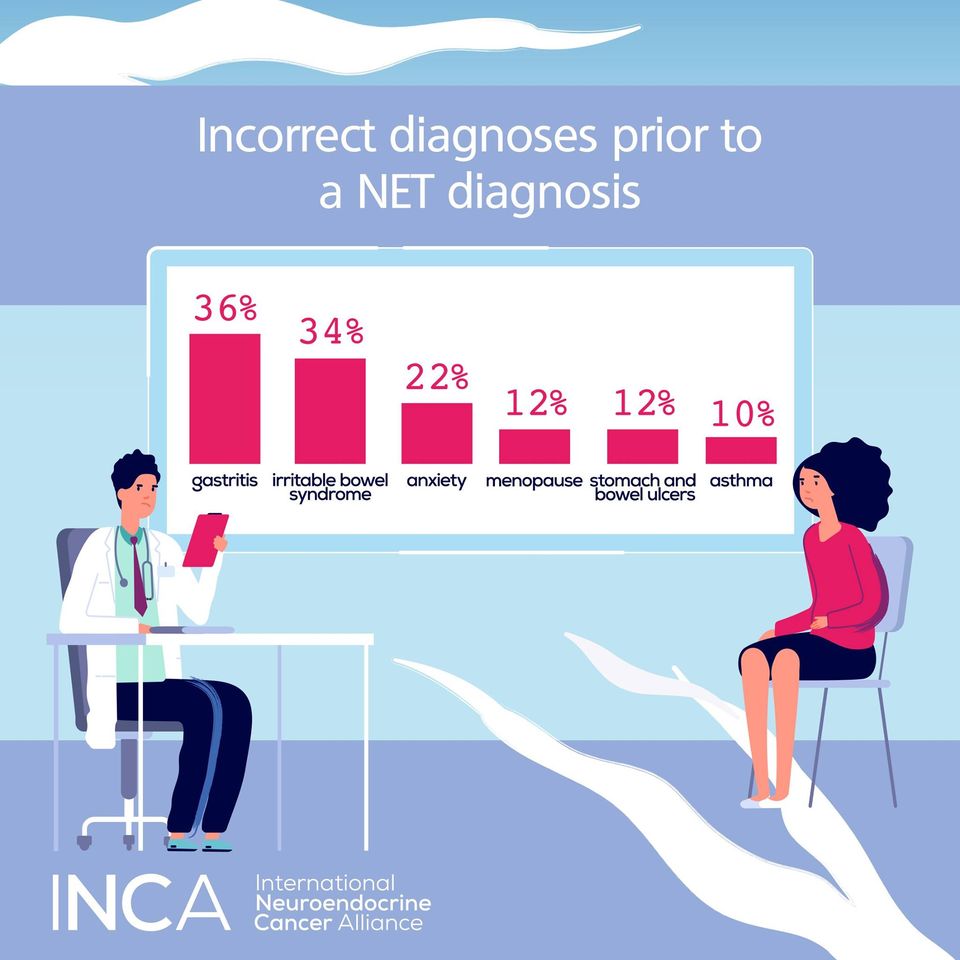
I’m part of the 36% who were initially diagnosed with gastritis, inflammation of the stomach lining. It was a GP who made that diagnosis based only on my symptom, a gnawing abdominal ache. I don’t fault him for that as NET cancer usually presents symptoms that mimic much more common ailments. Had we done a colonoscopy, however, the tiny tumour growing in my cecum would likely have been found before the cancer spread. It was several years later, when unusual spots on my liver showed up on a completely unrelated ultrasound, that suspicions were raised and I eventually learned that I had Stage 4 cancer! By that time, my symptoms had grown to include chronic diarrhea as well as occasional flushing and episodes of tachycardia (extremely rapid heart rate), all common characteristics of NET cancer.
There are 3 As that would significantly improve the outcome for many NET patients:
- Awareness of symptoms – We need health care professionals at every level to be aware of this complex disease and to be able to recognize its symptoms. My family physician had been practicing medicine for approximately 20 years when I was diagnosed, but I was his first NET patient and he knew very little about it. I’ll never forget the locum who argued with me that neuroendocrine tumours aren’t malignant (some aren’t) and that I didn’t actually have cancer at all!
- Availability of diagnostic tools – The most precise tool for detecting NET cancer is the Gallium 68 PET scan, but I have never had one. In fact, only 18% of the surveyed patients worldwide have. It isn’t available at many cancer treatment centres. For the past few years, there’s been talk of one coming to the Cross Cancer Institute where I receive all my care, but as far as I know it hasn’t happened yet.
- Access to NET specialists – In the survey mentioned above, 24% of the patients had not even heard of a NET cancer specialist and many others travel long distances to see one.
So, every year on November 10, and whenever I have the opportunity in between, I’ll do my bit to raise awareness, never giving up hope that eventually better diagnostics and treatments will be available to all NET patients and that ultimately a cure will be found!

 Following Augustine
You have enlightened many of us in the community about NETS since your diagnosis Elaine. Thank you for sharing your story. You never know how sharing this may help someone else.
I’d love to think that sharing my experience might help someone else receive an earlier diagnosis!