Celebrating wellness

In 2021, Alberta Blue Cross launched the Faces of Wellness program to celebrate Albertans who are champions of wellness in their communities whether by making positive lifestyle changes, promoting a health-related cause, making the most of life while living with a chronic condition, standing up for mental health, or being a role model for others. I was completely unaware of the program until early last fall when I saw a post about how to apply or nominate someone else for the 2024 award. The deadline to enter hadn’t passed yet, so I thought “why not?” It would be another opportunity to educate someone about neuroendocrine cancer even if it was only the contest judges.

The application process involved writing a detailed story outlining the individual’s wellness experience, how they embraced the courage to overcome, and examples of how they live a life of wellness and regularly encourage others to do the same. I wasn’t sure how I could accomplish all that in the limited space that was allowed, but after writing a longer version and then seriously editing it, this is what I came up with.

Eleven years ago, I was diagnosed with stage 4 neuroendocrine cancer (NET), a disease that even my family doctor had never heard of. For several years, I had been experiencing symptoms similar to those of several more common conditions and my slow-growing cancer was initially misdiagnosed as gastritis.

My cancer isn’t curable, but ongoing treatment keeps it from growing and spreading. Since my NET diagnosis, routine scans detected 2 unrelated cancers which were removed surgically. More recently, I was also diagnosed with type 2 diabetes.

In spite of all this, I am thriving! I’m not dying of cancer, I’m living with it. Wellness is about more than physical health. Spiritual, emotional, and social well-being are equally important. I have a strong faith and supportive family and friends who make the journey easier. A positive attitude won’t cure my cancer, but it certainly makes living with it easier.

Maintaining wellness involves actively practicing healthy habits. Eating well and being physically active are vital. I’m almost 72, but I exercise 5 days a week and love nothing more than paddling my kayak, going for a hike, or playing a round of golf.

From the beginning of my NET journey, it has been my mission to educate people in my community and elsewhere about the disease. I’m actively involved in patient advocacy as a member of the Advocacy Advisory Board to the Canadian Neuroendocrine Tumour Society. I’m involved in initiatives to try to make the patient experience better for all of us including those who have not yet been diagnosed. It’s not uncommon for people to experience symptoms for 5 to 7 years before receiving a correct diagnosis. That needs to change! Neuroendocrine cancer is the fastest growing class of cancer worldwide, but it’s not well-known in the medical world. That, too, needs to change! I’m passionate about making a difference by being a voice for change.

I sent off my submission and hardly gave it another thought until sometime in December when I received an email informing me that I had been chosen as a runner-up and would be receiving a $25 Atmosphere gift card in the mail once the Canadian postal strike came to an end. Apparently this is a face of wellness!

And so now, for those of you who have been following my wellness journey, an update. February was a month of tests, scans, and appointments. I was supposed to meet with my specialist on Wednesday to discuss the results of many of those tests including a CT scan that was done the week before. That appointment had to be postponed, however, because the scan results weren’t available yet and let me tell you, scanxiety (scan + anxiety) is real! I had already seen the results of the other tests online and most of them were good, but there was one that concerned me and made me wonder if the cancer was beginning to grow or spread again. Thankfully, the scan results finally showed up online at 10 o’clock last night! While I don’t understand all of the medical jargon and will have to wait for the specialist to interpret some of it, the final statement was clear, “No evidence of progressive disease from November.” In other words, nothing has changed since my last scan three months ago!

Over the past month, I’ve also learned that my A1C (3 month blood sugar level) continues to be stable (with medication), my blood pressure is excellent (also with medication), and my bone density has not deteriorated over the past two years. This is all very good news and, in spite of having cancer, I’m feeling pretty blessed to be a face of wellness!

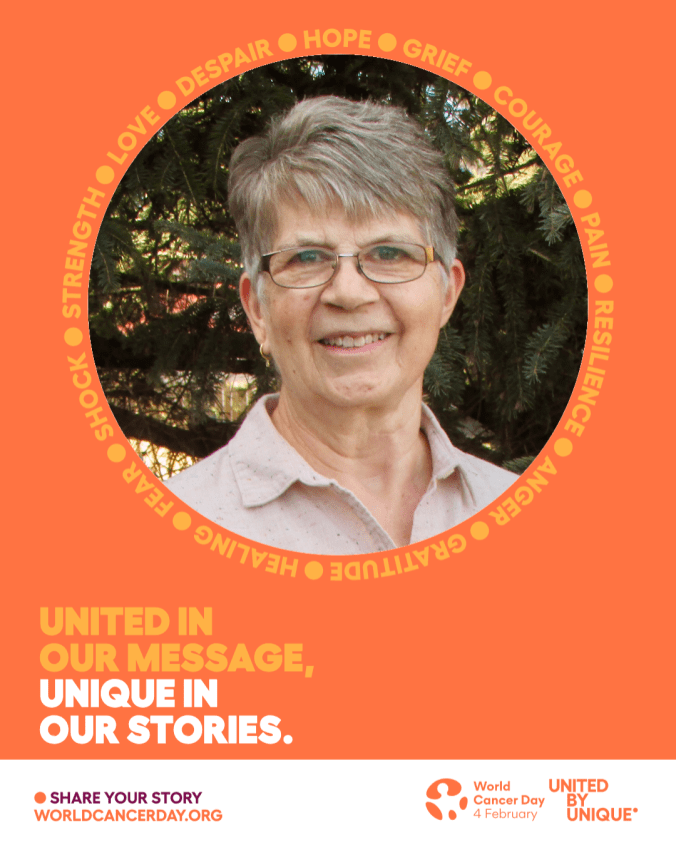
World Cancer Day 2025: United by Unique

February 4 is World Cancer Day. There are more than 200 different kinds of cancer and every patient’s experience is different. That’s why the new World Cancer Day theme, United by Unique, resonates so strongly with me. While each of our stories is unique, we are united in our message and in our desire to raise awareness and see progress made in fighting this dreadful disease. 

The emphasis of the 3-year United by Unique campaign that kicks off today will be people-centred care. Behind every diagnosis lies a unique human story. These are stories of grief, pain, healing, resilience, love and so much more. A people-centred approach to care that listens to patients’ stories and fully responds to each individual’s unique needs with compassion and empathy will lead to the best possible outcomes.  

People living with cancer don’t always feel heard, seen, or understood. They are often bewildered, feeling isolated and voiceless at a time when they’re also learning to navigate an unfamiliar and confusing health care system and dealing with the emotional highs and lows of cancer diagnosis, treatment, or recovery. That’s why the first year of this campaign will focus on telling our unique stories.

I feel very fortunate to receive my cancer care at the Cross Cancer Institute in Edmonton, Alberta, Canada, a facility where it is common practice to look beyond the patient to the person as a whole and to consider the impact of their cancer on all aspects of their life. When I go for appointments, I’m routinely handed a clipboard with a questionnaire that delves into not only the physical symptoms that I might be experiencing, but also the psychosocial ones. The CCI offers a wide range of supportive services that go far beyond the patient’s physical well-being. The health care team there includes professionals in psychology, social work, spiritual care, nursing, and psychiatry and available services include individual, couple, and family counselling; professionally-led support groups; and practical supports for financial and other basic needs. While the need for these supports has not been part of my unique story thus far, I’m glad to know that they’re available should I ever need them and I wish that that was true for patients everywhere.  

I have been invited to share my unique patient story at a Canadian Neuroendocrine Tumour Society (CNETS) conference in May. The big challenge is going to be condensing the approximately 20 years from initial symptoms to present day into a 10 minute talk that educates, encourages, and inspires those in attendance, especially those who are in the early days of their journey and who need to know that it’s possible to live long and live well in spite of their diagnosis. 

United in our goals, unique in our needs.

How to look put together every day

logo-by-samIt’s late in the day and I still haven’t written today’s Fashion Friday post, so this is going to be a quick one. We spent two days in the city this week attending medical appointments so that’s my excuse for not being better prepared. The good news is that the lab work and CT scans that I’ve had done over the past couple of weeks showed that my cancer is stable! That’s a word that I wasn’t sure I was ever going to hear again, so of course, I’m delighted. We’ll redo all the tests in three months time, but for now I can put that on the back burner and get on with other things.


We may not always feel as if we have it all together, but we can always look as though we do and how we look affects how we feel. Today I’m going to share 14 tips on how to look put together every single day regardless of age or occasion.

  1. Start by taking care of yourself. Regular exercise, a healthy diet, and adequate sleep go a long way toward looking and feeling your best.
  2. Get a good, low maintenance haircut.
  3. Good grooming is key. Develop a good skin care routine, make sure your hair is neat and clean, practice good dental hygiene, and don’t neglect nail care.
  4. Make sure your clothes are clean.
  5. Don’t wear wrinkled clothes (with the exception of linen which is supposed to be wrinkled). You might want to invest in a hand-held steamer for quick touch ups.
  6. Ensure that your clothing fits well.
  7. Invest in good basics. Shop within your means, but buy the best quality that you can afford.
  8. Use a fabric shaver to remove pilling from knitwear.
  9. Find the colour palette that works best for you.
  10. Make sure your footwear is clean and in good condition.
  11. Accessorize, but don’t overdo.
  12. Use makeup strategically. Again, don’t overdo.
  13. Practice good posture.
  14. And finally, wear a smile!

These tips might seem obvious, but you don’t have to look far to see women who ignore them, especially at this busy, sometimes frenzied time of year. Do you have any other tips to add to the list?

Another cancerversary!

Eleven years ago today I was told that I had stage 4 colon cancer. Thankfully, a biopsy proved that diagnosis inaccurate or I probably wouldn’t be here to tell you about it today. According to the Canadian Cancer Society, the 5-year survival rate for colon cancer that has spread from its original location to distant parts of the body is 11%.

What I do have is neuroendocrine cancer (NETS), a slow-growing cancer that originated in my colon, more specifically in the cecum which is part of the colon. By the time it was diagnosed, I had been experiencing vague symptoms for several years. In fact, I was told that I’d probably had it for 7 to 10 years. At diagnosis, it had already spread to lymph nodes and my liver. Accurate stats and information about survival rates aren’t as readily available for neuroendocrine cancer because it isn’t as well-known or well-documented as many of the more common varieties, but I don’t really need to know those numbers. I just need to know how I’m doing right now and I found that out last week.

In response to my oncologist’s, “How are you?” as he entered the examining room, I replied, “I’m good.” Glancing at the notes in his hand, he enthusiastically responded, “Yes, yes you are!”

I wasn’t as exuberant about the results of the previous week’s CT scan as he appeared to be. I had hoped to hear that March’s TheraSphere treatment had completely annihilated the largest tumour on my liver. In fact, it had only shrunk by about 20%. The doctor hastened to remind me that shrinkage is always a good thing. That, combined with the facts that I’m not experiencing any symptoms and that the scan also showed “no progression of disease” is actually very good news!

I’ll have another CT and more lab work done in November, but in the meantime I’ve got lots of living to do. In addition to the many ways that I’ve found to stay active and busy in retirement, I’ve also become more active in patient advocacy over the past year. As a member of the CNETS (Canadian Neuroendocrine Tumour Society) Advocacy Advisory Board, I’m working with other patients and caregivers from across the country to try to increase awareness of our disease, shorten the pathway to diagnosis, advocate for equal access to treatment for patients across the country, and promote research into newer and better treatments. I’m also involved in meetings with a group of patients and health professionals around the world as part of an initiative by Ipsen, the pharmaceutical company that produces the medication that I’m injected with every 28 days, to try to improve the patient experience.

That reminds me of another recent change. Hubby is now giving me that monthly injection which frees us up to take it with us when we travel instead of having to be at home to wait for the nurse’s visit. A cancer diagnosis is life changing for a partner or caregiver as well as for the patient, so this is really his cancerversary too. We aren’t doing anything special to celebrate, but we’re thankful for another year of relatively good health; another year of life!

Ribbon Symbol

Cancer metaphors and an update

Patients, caregivers, fundraisers, and even medical professionals use a variety of different metaphors to describe life with cancer.

From day one, I’ve referred to my cancer experience as a journey. As a seasoned traveller, when I was diagnosed I felt as if I was embarking on a trip into the unknown. It’s been a long and tumultuous trip, but the metaphor is one that still works for me. Some patients, however, are bothered by it believing that a journey should always be fun and something that you have control over.

An even more controversial metaphor is the one that refers to life with cancer as a battle. Although it’s very common, many people take exception to using the vocabulary of violence at a time when patients are at their most vulnerable. Within the language of winning and losing, there’s also the uncomfortable implication that those who’ve died of cancer are losers and that maybe if we just fight hard enough we can win. While I realize that there are limitations to any metaphor, I think that the battle metaphor can be empowering. I am in a fight for my life and cancer is the enemy.

Thankfully, no one fights cancer alone and that’s also where the battle metaphor works well. My closest ally is my husband who accompanies me to every appointment and is involved in every decision regarding my care. An army of skilled medical professionals with a vast array of formidable weaponry (chemical, biological, and nuclear) at their disposal direct my care and they are backed up by a battalion of prayer warriors around the world. Ultimately, the commander in chief, the only one who knows the final outcome, is the Lord Himself. As we sang in church yesterday,

So when I fight, I’ll fight on my kneesWith my hands lifted highOh God, the battle belongs to YouAnd every fear I lay at Your feetI’ll sing through the nightOh God, the battle belongs to You

360_f_141399140_3bi2tlzvts4ek3a81nu6askenc8pjsnd

While my life with cancer is both a journey and a battle, at times it’s also a roller coaster and that brings me to the latest news that I want to share with you. After several years of stability, things began to change about 18 months ago. The first sign that my cancer was becoming active again were some changes in lab results. Two markers that are of particular significance for neuroendocrine cancer (NETS) patients had been gradually climbing and were now flagged as being higher than the normal range. Suddenly, the roller coaster went over the top and I felt like I was falling! More frequent surveillance eventually showed significant growth to the largest tumour on my liver. That led to the Therasphere treatment that I had in March of this year. The roller coaster dropped again when a post treatment CT scan showed what appeared to be a new growth in my lower abdomen raising concerns that my cancer was spreading. In mid April I met with a new oncologist. After reviewing my case, he requested a Gallium scan (the most detailed scan for NETS) and another CT scan. Last week, I met with him again to discuss the results and the news was fantastic! First of all, the Therasphere treatment was successful in destroying the large tumour on my liver. Equally exciting was the news that what had looked like a new tumour in my abdomen was nothing more than a harmless diverticulum, a bulge in the lining of my colon! There are other tiny growths that we will need to continue to keep an eye on with regular surveillance, but those don’t appear to have changed significantly. Since my cancer is incurable, this news is about as good as it gets and I’m hoping for a smooth ride for some time to come!

So, what metaphors should you use when talking to or about a cancer patient? It is, of course, valid for a person to speak about their own illness in any way they choose and their loved ones ought to adopt the same language as a way of reflecting those experiences. Simply take your cues from the patient and you won’t go wrong.

Lyrics: Battle Belongs, Phil Wickham

A World Cancer Day update

World-Cancer-Day-2024-1-1

When I posted a World Cancer Day graphic on Facebook this morning and mentioned that I’m currently waiting for a treatment to destroy a tumour on my liver, the outpouring of support from people near and far was immediate and heartwarming. I was also asked recently whether this was related to my original cancer or something new. In response, I decided that today would be a good day to share an update on what’s been happening in my ongoing battle with cancer.

For those of you who may be new to the blog, I was diagnosed with neuroendocrine cancer (NETS) in 2013. The primary tumour was in my cecum (a pouch at the beginning of the large intestine that the appendix is connected to) and, as is very common with NETS, it had already spread to lymph nodes and my liver. A series of radioactive treatments (PRRT) resulted in some shrinkage and stability that lasted until about 17 months ago when we started to notice gradual changes in my regular lab results and scans. As neuroendocrine cancer is usually a slow-growing disease, we took a cautious approach. We started monitoring more often and eventually changed the medication that I receive by injection every 28 days. Unfortunately, that didn’t have the desired result.

The last time I wrote an update on the blog was back on November 10, NET Cancer Day. At that time, it was clear that the tumours that had been basically dormant for several years, or at least the largest one which is on my liver, were growing and producing an excess of hormones again. I was waiting for the tumour board at the Cross Cancer Institute to discuss my case and make their recommendations.

Shortly after that, I was referred to the Interventional Radiology department at the University Hospital and my NET specialist told me that I would undergo a radiofrequency ablation, a fairly non-invasive procedure that would destroy the cancer cells without damaging much of the surrounding tissue. I was all for that. Let’s zap that tumour, I thought! As it turns out, however, at 5 cm (2 inches) my tumour is too large for that procedure to be successful. Instead, I’ll be undergoing a transarterial radioembolization, also known as a TheraSphere treatment. (I love words, but as a cancer patient, I’ve learned a lot of big ones that I wish I’d never had to hear!)

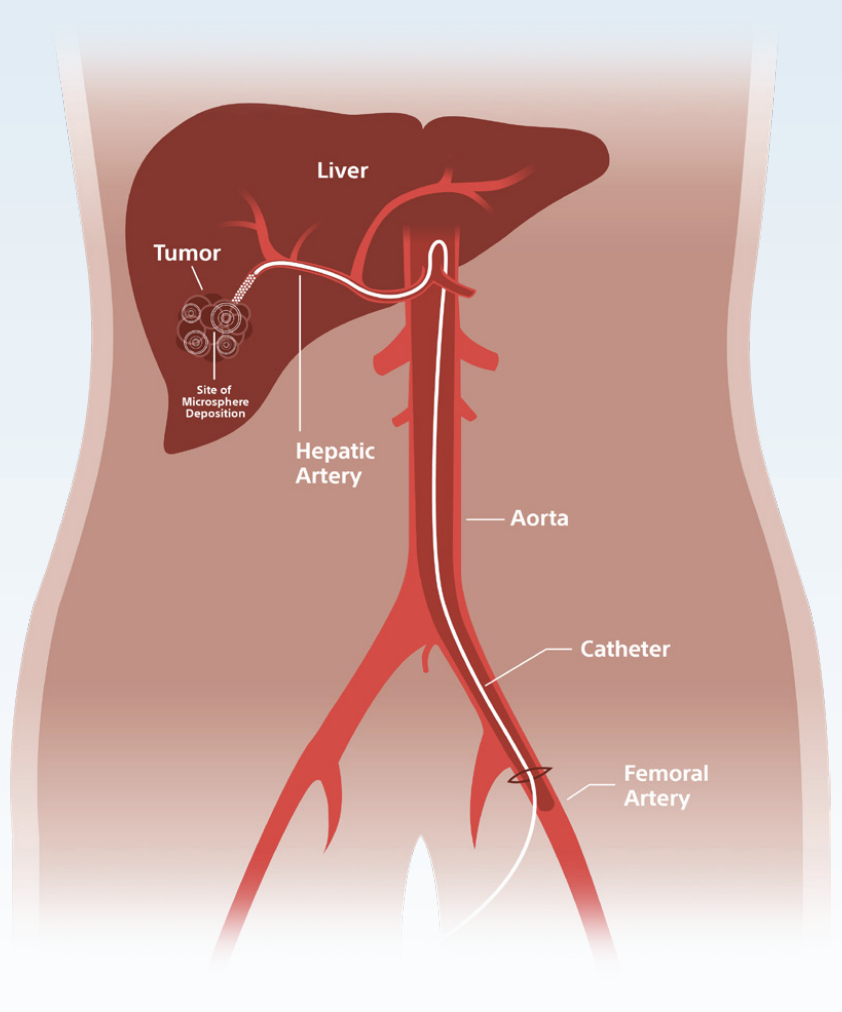
The treatment is a minimally invasive procedure that deposits millions of glass microspheres, each about one-third the width of a human hair, containing a radioactive isotope (Y-90) inside the blood vessels that supply a tumour. This blocks the blood supply to the cancer cells and delivers a high dose of radiation to the tumour. The treatment will destroy a significant portion of my liver, but thankfully, it has the amazing capacity to regenerate itself after damage.

Three weeks ago, I had a work-up which was basically a trial run. As will happen in the actual treatment, a catheter was inserted through the femoral artery in my groin and guided via x-ray to the hepatic artery supplying my liver. Mapping and measurements of the blood vessels feeding the tumour were done and then a contrast was injected and various images taken to ensure that the Y-90 would stay in my liver and not travel anywhere else in my body. During this entire time, which took several hours, and for four hours afterward, I had to lie on my back without raising my head or moving my right leg. It was a long and somewhat grueling day and after almost eleven hours, I was very happy to walk out of the hospital with no ill effects. I may not be quite as fortunate after the real deal. I’ve been told that common side effects include abdominal discomfort, nausea, and fatigue for a week or two afterward, but it will be worth it if it successfully destroys the tumour!

I was initially told that the treatment would take place two to five weeks after the work-up, but three weeks later, I haven’t been given a treatment date yet. Wheels often move very slowly in the medical world and waiting is something that patients have to get used to. It never seems to get any easier though!

To those of you who suggested in your very kind responses on Facebook this morning that you would be praying for me, I very much appreciate it. While I am enormously thankful to live in a part of the world where I have access to state of the art medical care at no personal expense, and I have a body of amazing doctors taking care of me, I know that God is ultimately my healer and it is He who holds my future. I continue to put my hope in Him!

Screenshot 2024-02-04 at 2.54.31 PM

Image: TheraSphere Patient Info – Boston Scientific

Sixteen years of blogging!

I published my very first blog post sixteen years ago today! It was also the shortest post I’ve ever written; a brief message announcing that hubby and I had just accepted positions teaching conversational English in Japan. The blog was meant to share that year-long adventure with friends, family and anyone else who might be interested. Never in my wildest dreams did I imagine that it would still be alive and well sixteen years later!

The title, Following Augustine, no longer fits the blog as well as it did in those early days, but since it’s what I’ve been known as in the blogosphere for more than a decade and a half, I hesitate to consider changing it. You can read about why I originally chose the title here.

Though I probably already had neuroendocrine cancer (NETS) when the blog was born, I didn’t know about it until several years later. When I finally received a correct diagnosis, blogging became a helpful way to process what was happening and to share the journey with friends and family. I also use the blog to raise awareness of NETS. I’m sure that this will continue to happen as I’ve recently become a member of a newly formed Advocacy Advisory Board that will report to the board of directors of the Canadian Neuroendocrine Tumour Society (CNETS).

When I started the blog, writing about fashion was the farthest thing from my mind. Several years ago, however, I starting following several fashion blogs and began to develop a greater interest in the topic. It was then that I decided to add the weekly Fashion Friday feature. At times, I find it a challenge to come up with a new fashion related topic every week, but it’s been a great way to connect with other women and to ensure that I post something at least once a week. Fashion Friday has a fairly small, but loyal following of interested readers, so I as long as I can continue to think of engaging content, I plan to keep the feature going.

As an avid reader, it was my passion for books that prompted me to add the latest feature to the blog, a monthly book review that first appeared at the beginning of February this year.

I refer to Following Augustine as a lifestyle, travel, and fashion blog, but in recent years, there hasn’t been as much travel content as I would have liked. First, the pandemic and then a number of other health issues, both mine and hubby’s, have limited our ability to spend as much time away from home as we would like, but our brand new ten year passports arrived in yesterday’s mail and we hope to be able to put them to good use in the future. If that happens, the blog will once again chronicle our wanderings.

Following Augustine will probably continue to undergo changes from time to time, but at this point, I don’t see it coming to an end anytime soon. Over the past sixteen years, I’ve published over 1400 posts and I expect that I’ll continue adding to that number until I’m no longer able!

3224919

NET Cancer Day 2023 and an update

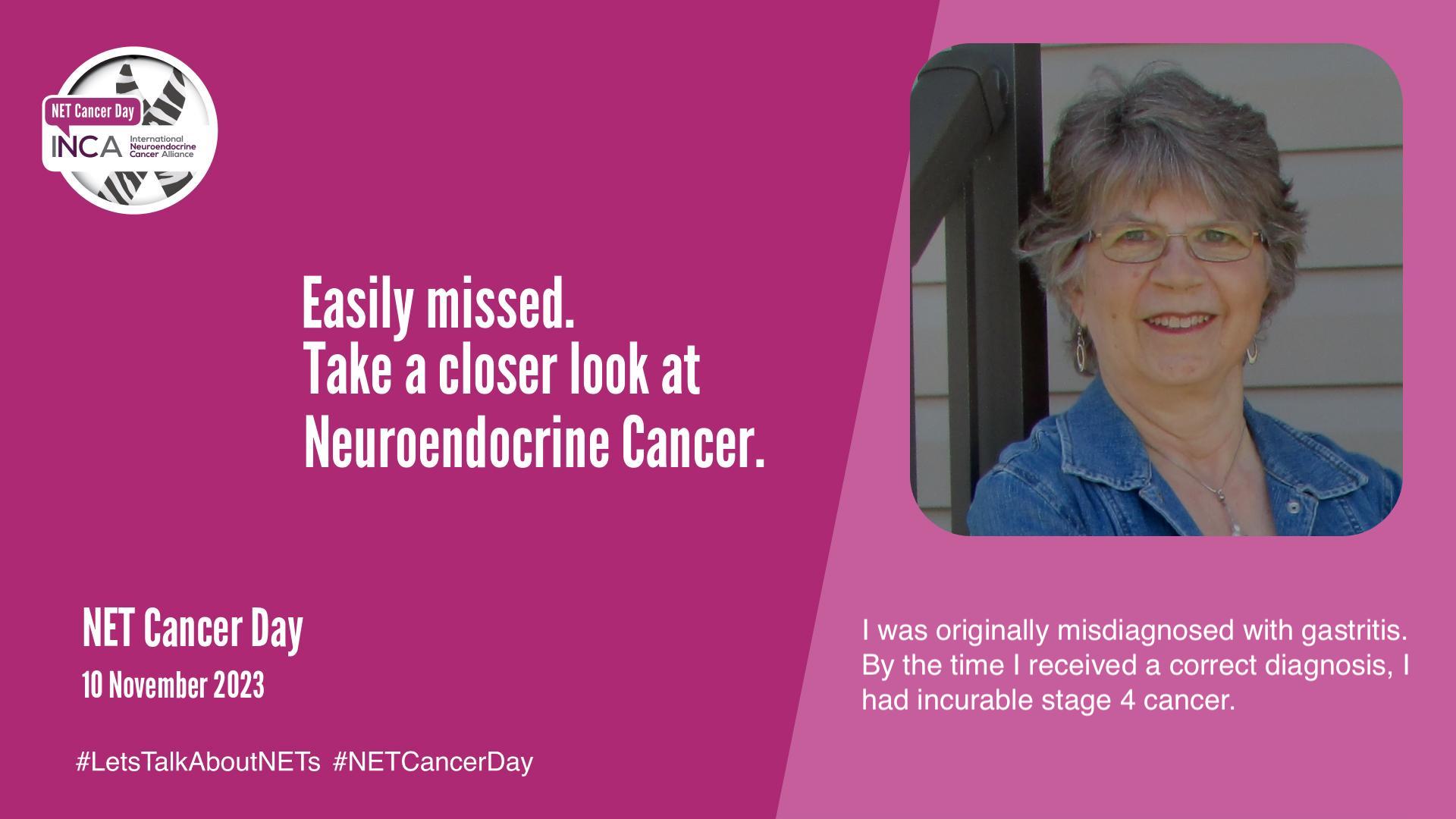
For those of us who have neuroendocrine cancer, every day is NET Cancer Day, but November 10 is the one day each year that is set aside to increase awareness of our disease and to promote improved diagnostics, treatments, care, and research. Unlike most cancers, neuroendocrine cancer (NETS) is often overlooked or misdiagnosed. Some patients, myself included, endure symptoms for 5 to 10 years before receiving an accurate diagnosis. All that time, the unseen disease is quietly growing and spreading which is why at least 50% of us, again myself included, have stage 4 cancer by the time we are diagnosed. At that point, it’s treatable, but not curable.

Why is this sneaky disease so easily missed? Why does it take so long to get a correct diagnosis? NETS starts in the cells of the neuroendocrine system which are found throughout the body. Neuroendocrine tumours can hide in many locations, but most commonly originate in the lungs, pancreas, gastrointestinal tract (specifically the large intestine, small intestine, or appendix), the adrenal glands or in rare cases, the brain, breast, or prostate. Without early detection, it spreads to other locations throughout the body including the lymph nodes, liver, peritoneal cavity, and bones.

Not only can the cancer be found in so many different parts of the body, but the symptoms vary and are often non-specific. They might include abdominal pain, diarrhea, nausea and vomiting, heightened anxiety, fatigue, weight loss, skin flushing, chest pain, coughing, wheezing, shortness of breath, and/or back pain. All of these are also symptoms of more common conditions, so it’s completely understandable that doctors don’t immediately consider a little-known cancer like NETS. Many have never encountered a case and know little or nothing about it. As a result, neuroendocrine cancer is often mistaken for other conditions including gastritis, IBS, generalized anxiety disorder, or even menopause. That’s why we need an annual NET Cancer Day and why we need to advocate for increased awareness amongst doctors and patients every day of the year.  

poster (3)

Last year, on NET Cancer Day, I was happy to be able to report that my disease was stable. Unfortunately, this year, that’s no longer the case. Over the past year, my tumours (or at least one of them), which had essentially been dormant for several years, have been waking up and producing excess hormones again. One of the lesions on my liver has also started to grow again. Thankfully, however, NETS is usually a slow-growing cancer and we still have a number of treatment options available. The neuroendocrine cancer team at the Cross Cancer Institute meets on Tuesdays (I absolutely love the fact that they take a team approach), so they’ll be discussing my case next week and deciding where we go from here.

In the meantime, other than an ongoing headache that is probably stress-related, I have no symptoms and I’m able to live a fairly normal life. Considering that fact that I’ve had stage 4 cancer for over ten years, I feel pretty blessed. I consider every day a gift and I continue to trust that I’m not dying of NETs, but living with it! 

There will be no Fashion Friday post today, but stay tuned for a new one next week. 

My 10 year cancerversary

Do you remember where you were and what you were doing exactly ten years ago today? I do. The day is etched in my memory in vivid detail. That was the day I was told that I had cancer in my colon and that it had already spread to my liver! There was no hope or expectation then that I’d be writing about that day ten years later!

It wasn’t until a couple of weeks later that we learned that what I actually had (and still have) is neuroendocrine cancer (NETS) which, though incurable, usually progresses slowly. That gave us a glimmer of hope, but on one of our earliest clinic visits, we read that the average life expectancy for a neuroendocrine cancer patient was five years following diagnosis. I now know that that information was probably already outdated. There are members of my online patient groups who have been living with this disease for 10, 15, even 20 years or more. Others, however, have not fared as well, so I’ve learned to consider every day a gift.

On a day like today, I could dwell on the fact that over the past ten years I’ve had two major surgeries, been exposed to an enormous amount of radiation, had dozens of tests and scans of various kinds, lived in 28 day increments between injections, had 128 of those “butt darts”, and on and on. Or, I could count my blessings; focusing instead on the things that I’ve been able to do and enjoy over the past ten years.

Since my initial diagnosis, we’ve seen our family grow by one daughter-in-law and four grandchildren! In spite of the worldwide pandemic that put a damper on travel for a time, we’ve holidayed in Nova Scotia, BC, and the Yukon, and traveled to Israel, Europe (Portugal, Italy, France, Belgium, and the Netherlands), and Mexico four times. We purchased a kayak and have spent many hours paddling quiet lakes and rivers. Over the past ten years, we’ve spent 240 nights in our trailer and I’ve played over 350 rounds of golf. We’ve tried new things like snowshoeing and joined a seniors’ bowling league. I’ve edited 1346 microloan descriptions for Kiva and joined a prison letter writing ministry. I’ve had the opportunity to teach two women to read and tutored an ESL student. And again, the list goes on!

Life is good! Yes, I have cancer. Yes, some of my tumours have grown a bit recently, but I still feel 100%. I don’t know what the future holds, but neither does anyone else. I have an army of people who pray for me and we know who holds my future. I’ll just focus on today!

So what am I doing to celebrate this momentous occasion? I suppose I could have planned something special, something big, but I’ve been so busy just living life that this one crept up on me! I have absolutely nothing planned, but that’s okay. I’m alive and living life to the fullest and that’s all that really matters!

Screenshot 2023-08-27 at 3.19.49 PM

Progression

As a neuroendocrine cancer (NETS) patient for the past ten years, stable became one of my favourite words. After each set of tests and scans, stable was the word that my doctors used to tell me that my cancer had not grown or spread. Unfortunately, when I saw my specialist on Friday, that was not what I heard. Instead, I heard the word progression.

In the cancer world, progression is the word that is used to describe growth or spread of the disease. It didn’t come as a shock to me. Over the past few months, we’ve been carefully watching test results that appeared to indicate that my tumours were likely becoming more active again. The news we heard on Friday was actually better than I feared. There has been a tiny bit of growth to a couple of tumours on my liver, but no spread anywhere else. That part is very good news!

Thankfully, I’m a cup half-full kind of person. I think I’d be a basket case by now if I wasn’t!

do-you-see-the-world-from-the-half-empty-or-half-full-perspective

So, what’s the good news in this? What happens next and what’s there to be optimistic or hopeful about?

After 126 monthly injections of a drug called Sandostatin, it would appear that it’s no longer doing its job and I’ll be switching to a different medication. Since Lanreotide is also given as an injection every 28 days there will be little change to the routine that we’ve become accustomed to over the years. There are, however, some real benefits to this medication.

Unlike Sandostatin which is know to suppress the production of the hormones that these tumours produce and thus reduce symptoms, Lanreotide is also known to actually delay their growth. Secondly, Novartis, the company that produces Sandostatin, cut out their in-home injection program over a year ago and I had to arrange for my family doctor to begin giving me my injections. Lanreotide is produced by Ipsen and I’ve been assured that once again, a nurse will begin visiting my home to administer my butt jabs. Not only is that more convenient for me, but it frees up my doctor’s time for other patients which is an important issue in a rural area where there’s a doctor shortage. Perhaps the most exciting part of all this for me, if there can be excitement in receiving news of progression, is the fact that hubby and/or I can be taught to administer the Lanreotide injections ourselves! Why is that exciting, you ask? Why would I want to poke myself if a visiting nurse could do it for me? For someone who loves to travel, as I do, the idea that I might be able to pack my medication and leave the country for more than 28 days at a time is actually quite exhilarating!

I’m already somewhat familiar with the new drug because many people in my online patient groups are on it and seem to tolerate it well. Hopefully I will too. I’ll have tests and scans again in late October to see if it’s having the desired effect. In the meantime, it’s summer in Alberta. There’s camping, hiking, and kayaking to be done and golf to play. In spite of the change from stable to progression, I still feel 100% and I’m determined to keep on living life to the fullest.