NET Cancer Day 2021

ncd-logo-new

Once again, today is Worldwide NET Cancer Day, a day set aside to increase awareness of neuroendocrine (NET) cancers and to promote improved diagnostics, treatments, information, care and research.

The theme of this year’s campaign is

Know the symptoms.

Push for diagnosis. 

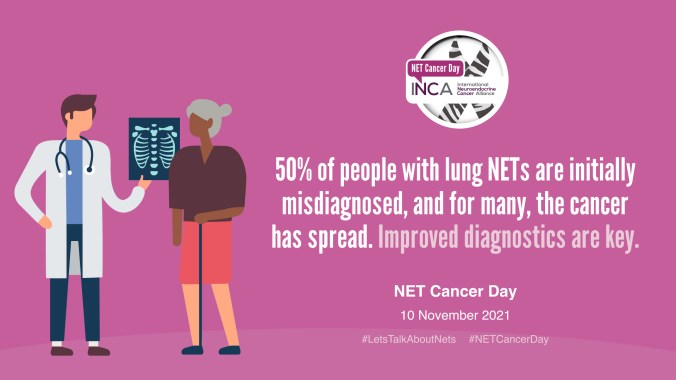
Less than 30% of neuroendocrine cancer patients receive a correct diagnosis the first time they reach out for help. In fact, it often takes five to ten years from onset of symptoms to correct diagnosis. During that time, of course, the cancer quietly spreads. Thankfully, compared to many other cancers, NETS is slow growing, but like many of my fellow patients, I was Stage 4 at diagnosis. This means that my cancer had already spread from its origin to distant parts of my body. At this point, 8 years after diagnosis, treatment has halted it’s progress and resulted in some shrinkage, but there is no cure.

Know the symptoms. 

23213264_715559725308228_7678779028864335896_o

Once considered rare, neuroendocrine cancer is actually the fastest growing class of cancers worldwide. Unfortunately, many health care professionals have never seen a case and know little or nothing about this complex disease. In order to achieve early, correct diagnosis for every patient, we need every primary care physician to know and recognize the symptoms. When they are presented with stomach pain, it makes sense for them to suspect gastritis (inflammation of the stomach lining), but we also need them to wonder if it could be neuroendocrine cancer. When the stomach pain is accompanied by severe diarrhea, irritable bowel syndrome is a definite possibility, but we also need the doctor to be aware that it could be NET cancer. When a woman complains of facial flushing, rather than simply assuming that it’s due to menopause, we need her doctor to ask himself if it could be NETS. Depending on the location of the primary tumour, other symptoms may include nausea and vomiting, rapid heartbeat, anxiety, skin rash, shortness of breath or wheezing, lack of appetite, unexplained weight loss and/or lack of energy.

Push for diagnosis. 

Message-5-16_9-Key-Messaging-Infographic

Diagnosing neuroendocrine cancer is complex. In addition to recognizing the symptoms, we need doctors to order the correct laboratory tests and scans. It’s also important for patients to push for correct diagnosis. One of the most important things I’ve learned since my diagnosis is how important it is to advocate for yourself. Know your body. Know what’s normal for you. Pay attention when something feels off. Take note of unusual symptoms and talk to your doctor as soon as possible. If you don’t get the answers you’re looking for, PUSH! Don’t give up. Years before I was finally diagnosed, I remember thinking “at least it’s not cancer” but I was wrong! If I’d pushed for answers then, perhaps it would have been caught much sooner and the outcome might have been very different!

Know the symptoms.

Push for diagnosis. 

When is an accessory not just an accessory?

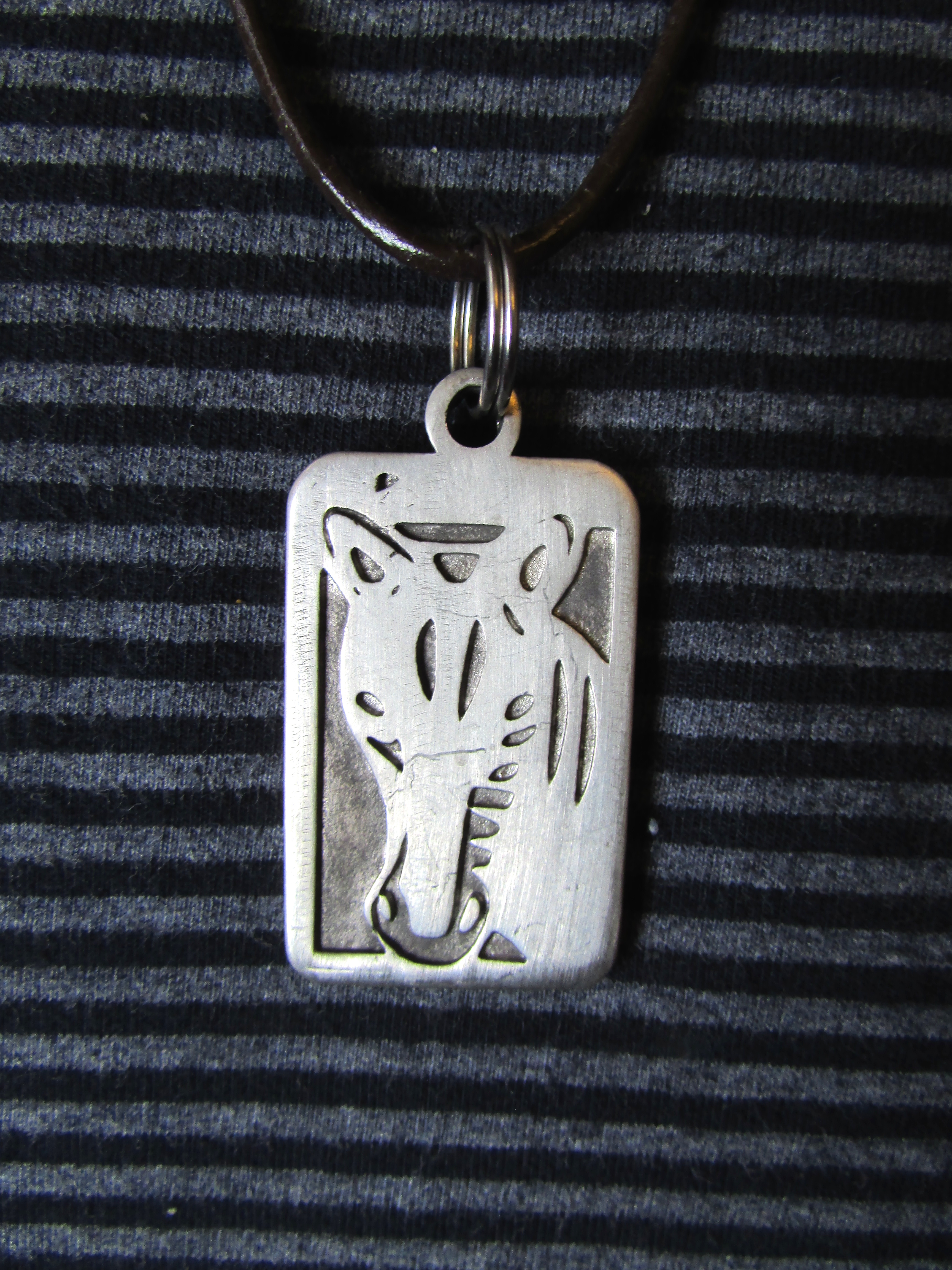
LogoAccessories are the finishing touches that can take an outfit from drab to dramatic. They also add versatility to your wardrobe enabling you to create many different looks with the same basic outfit. Accessories are also an opportunity to express your personal style, taste, and preferences, but sometimes they are even more than that. Sometimes an accessory has special meaning or significance to the person who wears it. That’s definitely the case with my new hand-crafted zebra pendant!

IMG_3007

As many of you are already aware, the zebra is a symbol of neuroendocrine cancer (NETS), the cancer that I’ve been living with for the past eight years. In medical school, doctors are taught “when you hear hoofbeats, think horses, not zebras”. NETS was previously considered rare and therefore, a zebra. However, with increasing awareness and quicker diagnosis, neuroendocrine cancers are proving not to be as rare as once thought. Another reason that the Canadian Neuroendocrine Tumour Society (CNETS) chose and continues to use the zebra as their mascot is the fact that every zebra has its own pattern of stripes. Just as each patient and their needs are unique, no two zebras are exactly alike.

Committed to improving the quality of life and the survival rate for NETS cancer patients across Canada, every year CNETS funds research initiatives that will have a direct and meaningful impact on their lives. As a little-known cancer, it falls upon patients to raise much of the money for this ongoing work.

Screen Shot 2021-09-15 at 2.45.32 PMAl Gillis is a neuroendocrine cancer patient who came up with a unique idea for both increasing awareness and raising funds; a beautiful one-of-a-kind pewter pendant/keyfob featuring the CNETS zebra logo. Made entirely of donated materials and using only volunteer labour, the first distribution sold out in less one day! I was fortunate to nab one of those. Now, a second batch is in stock and going fast. If you’re interested in purchasing one and supporting this important endeavour click here, but don’t hesitate too long or you’ll be waiting for Al and his crew to make more!

You might also be interested in watching this video in which Al demonstrates and explains how the pendants (which can also be used as keyfobs) are made. I found it quite fascinating.

Do you have any accessories that are especially meaningful to you? Please tell us about one or more of them in the comments section below. 


Blogging woes and cancer news

My beloved MacBook Air is getting old; old enough that I’m not able to update to a newer browser. Recently, whenever I opened WordPress to check my stats or work on a post, I received a message telling me that I was using an unsupported browser. Until earlier this week, however, I was able to click through to the appropriate page and work as usual. Then came the fateful day when all that I could open was a blank page with the WordPress logo in the centre!

As I usually do when something goes wrong in my blogging world, I fired off a cry for help to WordPress support and hoped for the best. They’ve never let me down yet, but while I wait to find out what they can or can’t do for me, I’m typing this on my husband’s computer. Not easy! Mine is a Mac, but his is not. The keyboard is a different size and my fingers don’t know what to do. Things jump around when I’m not expecting them to and then there’s the issue of all my photos being on my computer and not knowing how to transfer them to his. With practice, I’m sure these things will get easier, but this is, at best, a very temporary solution! I’m hoping that I don’t have to invest in a new computer right now as mine still does everything else I want it to do, but I have to be able to blog!   

Now, for the other news… 

In mid August, I went through a series of tests and scans, as I do every six months, to determine whether or not there were any changes to my cancers. When the results became available online, I was concerned about a spike in one marker that is particularly significant to neuroendocrine cancer (NETS). Not only had the level increased dramatically, but it was now slightly above the normal range. Knowing that I had to wait several weeks to see the doctor for an explanation, my response was similar to when WordPress quit working. I called for support. I sent out a cry for help to eight godly women asking each of them to pray, not only that my cancer had not grown or spread, but also that I wouldn’t be anxious as I waited for answers. Almost immediately, an unnatural peace descended on me and I was able to go on without undue stress or anxiety. 

“Do not be anxious about anything, but in everything, by prayer and petition, with thanksgiving, present your requests to God. And the peace of God, which transcends all understanding, will guard your hearts and your minds in Christ Jesus.”  Philippians 4:6-7

And now for the really good news… my cancer continues to be stable and the doctor has no concerns! Though the spike in that one marker looked concerning to me, she assured me that it would have to be much higher before it was anything to worry about. Praise the Lord!

Still walking, but not enough!

It’s been two months since I last posted an update on my summer walking challenge. On May 2 of this year, I challenged myself to walk and/or hike 300 km by our 45th wedding anniversary on October 2. Five months to walk 300 km. Easy peasy! Right?

I got off to a really good start reporting 87.07 km by June 2 and another 63.59 km in the month that followed. Two months into the challenge, I was already half way to my goal. In my third month, I walked another 68.83 km for a total of 219.49 km.

That’s when I slipped off the rails and I’m sad to say that in the past month I walked and/or hiked only 38.41 km! What happened? Well, I could make plenty of excuses. There was time spent with grandchildren. We did go hiking while they were with us, but other than that, I didn’t take time away from them to go for regular walks. We’ve had some rainy days. I do own an umbrella, but it’s easier to stay indoors on those days. And then there’s the fact that I hurt my back again. That one was a pretty good excuse for a few days, but even though it’s still not 100%, I could be going for short walks. In fact, they might even be good for me.

Most of all though, I’ve just been lazy! When it became obvious that I’d be able to reach my goal well ahead of schedule, I slacked off. Now it’s time to get off my butt, lace up those walking shoes, and finish the job! With only 42.1 km left to go and a full month until our anniversary, there’s plenty of time to get this done!

100 butt darts!

Every 28 days, without fail, a visiting nurse pulls up in front of our house and comes in to give me an injection of Sandostatin LAR. Today was the 100th of those butt darts!

185522421_4133815289994653_3767392803849794568_n

Sandostatin LAR is a long-acting treatment meant to reduce or eliminate the symptoms associated with neuroendocrine cancer (NETS) and for me it has been an absolute life changer! No longer do I live with the stomach pains and diarrhea that plagued me off and on for several years prior to diagnosis. Though the effect of Sandostatin on tumour size, rate of growth, and development of metastases has not yet been determined, it is thought that it might also be of benefit in those areas.

Sandostatin comes as a powder and a diluent solution that must be mixed and administered according to very precise instructions which is why I haven’t been taught to inject it myself. Once the diluent is added to the powder, it must be allowed to stand for a minimum of 2 minutes and not more than 5 to ensure that the powder is fully saturated. Then, after gently shaking the syringe for about 30 seconds to ensure that the powder is completely suspended, the nurse has to administer it without delay to avoid sedimentation. Even following these guidelines carefully and using a fairly large needle (19 gauge), it sometimes plugs. On those occasions, she has to quickly change the needle and try again. On a couple of occasions it has taken 4 jabs to get the medication into me! My 100 butt darts has actually involved about 130 pokes altogether.

In addition to the benefits that the drug offers, getting it into me and not wasting it is of vital importance because every one of those butt darts costs $2358.52 CAD! In other words, over the past almost 8 years, we have pumped more than $235,000 into my posterior! You could buy a nice house in our small town for that much.

This is where I’m really glad to be Canadian. I pick up the Sandostatin at my local pharmacy every 4 weeks and don’t pay a cent! The cost is fully covered by the government and that includes the cost of having the nurse come to my home. A Mobile Administration Program even enables me to have my injection administered by a trained nurse anywhere else in Canada. A simple phone call is all it takes to make the arrangements. I have to take the medication, which has to be refrigerated, with me but I’ve found that an insulated lunch bag and a mini freezer pack do the job as long as I can put it in a fridge overnight. So far, I’ve had butt darts administered at all 3 of my children’s homes. Arranging to have it done outside the country would be more complicated and isn’t something I’ve tried at this point.

So, is getting my monthly Sandostatin a pain in the butt? Not really. As a child, I was terrified of needles, but I lost that fear a long time ago. Only once in awhile does really hurt going in. Today was one of those occasions, but it went in on the first try, so I’m not complaining! The injection site often feels bruised for a couple of days and a lump often forms that gradually dissipates over the next few weeks, but these minor inconveniences are well worth it when I consider the benefits. So, 100 butt darts down and here’s hoping that I can have 100 more! Or 200. Or more!

A new challenge

I’ve been feeling very sluggish lately. I still do my morning exercise routine most days, but I quit weight lifting earlier than usual this spring when I foolishly tried lifting something I shouldn’t have and hurt my back. It’s okay now, so I really have no excuse except laziness and lack of incentive. Today I decided to do something about that!

Remembering back to last year when I walked 179.5 km as part of the Hoofing It Across Canada fundraiser for NET cancer research, I recalled how good all that walking felt and how much it helped to have a specific goal. That’s what I needed; a new challenge!

walking-for-weight-loss-tips-1588694143 (1)

October 2, our 45th wedding anniversary, is 5 months or exactly 154 days from now. I have decided to walk (or hike) 300 km between now and then. That’s an average of 1.95 km a day. (For my American readers, that’s a total of approximately 186 miles or 1.2 miles a day.) I know that I’m capable of walking further, but I also know that I won’t walk every single day and I want to set a goal that’s realistic and achievable. I’m telling you about it so that you’ll help keep me accountable. In fact, I’m wondering if anyone wants to join me? If my goal isn’t right for you, set one of your own and tell us about it in the comment section below.

Why walk?

Walking has many benefits including:

  • It’s accessible, easy, and free.
  • It reduces stress and decreases symptoms of depression and anxiety which, for many, have been escalated by the current pandemic.
  • It improves heart health and reduces the risk of cardiovascular disease.
  • It increases blood flow and therefore improves energy levels.
  • It improves blood pressure and cholesterol levels.
  • It reduces the risk of some cancers.
  • It boosts the immune system.
  • It helps prevent the onset of Type 2 diabetes.
  • It reduces the risk of osteoporosis.
  • It burns calories.
  • It promotes more restful sleep.
  • It improves flexibility and helps ease chronic pain and stiffness.
  • It improves brain function.
  • It’s even been linked to longer life expectancy!

My current walking challenge is not a fundraiser, but I will be participating in a 5 km walk for Multiple Sclerosis research on May 30 in support of a close friend who battles this disease. If you would like to add your support, you can find my fundraising page here.

Why wear flats?

LogoWell known Christian speaker, author, and Bible teacher extraordinaire, Beth Moore, recently cut ties with the Southern Baptist Convention saying that she no longer feels at home in the denomination that once saved her life. Moore, who has long endured criticism in conservative evangelical circles because of their belief that only men should be allowed to preach, felt that she could no longer identify with or be part of what she saw as a toxic mix of misogyny, nationalism, and partisan politics in the denomination. That, however, is a topic for another day.
On the topic of fashion, I was absolutely incensed when I read that within the Southern Baptist Convention, Beth Moore was expected to show deference to male leaders by wearing flats instead of heels when she served alongside a man who was shorter than she was! What? What century are we living in? How insecure must a man be to feel that his manhood is threatened by a woman who is taller than he is?

At 5’8″, I’m more than two inches taller than my husband. When we lived in Japan, where I towered over most of the women and many of the men, we were introduced to nomi no fufu, a phrase used to describe a couple like us. Nomi no fufu literally means ‘flea couple’ and is used because of the scientific fact that female fleas are bigger than males!

My husband couldn’t care less if I wear heels. He’s not even slightly intimidated by my height, nor should he be. Why, then, do I choose to wear flats most of the time? Why were they already my shoe of choice long before I met my “little flea”? I can answer that in one simple word!

Comfort!

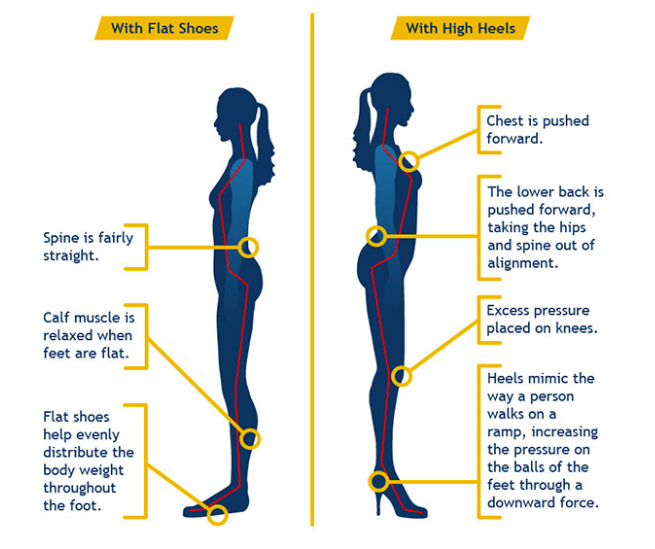
There are actually many good reasons to choose flats over heels. Studies have shown that by limiting the natural motion of the foot during walking, high heels can cause increased stress on the knees and may even contribute to osteoarthritis later in life. Similarly, if high heels are worn constantly, the spine’s ability to absorb shock can result in continued back pain. The vertebrae of the lower back may be compressed and back muscles over stressed. Wearing high heels too frequently can also cause the calf muscle to stiffen and the Achilles tendon to shorten which can actually make wearing flatter shoes uncomfortable. By putting a great deal of pressure on the ball of the foot and forcing the toes into a small toe box, high heels can cause or worsen many foot problems including corns, hammertoe, bunions, Morton’s neuroma and plantar fasciitis. This graphic from the Florida Hospital Medical Group Spine Health Institute helps explain. 

screen-shot-2018-12-05-at-9-15-41-pm

Does this mean that women should never wear high heels? Not at all! Worn in moderation, not everyday, they’re unlikely to cause any long-term physical health problems.

Now that spring seems to be here and the snow is almost entirely gone, I’m excited to be able to start wearing my sneakers and ballet flats again! That’s because they’re comfortable, not because I might intimidate some wussy man by standing next to him in heels!

My choice of shoes is most definitely not a religious or spiritual matter!

So much anger!

We’re living in a very angry world, or so it seems to me. Everywhere we look, whether in person or on social media, people seem to be protesting or venting their anger. First it was the shutdowns, then masks, and now the prospect of a vaccine that isn’t even available yet.

Calgary-COVID-protest-Nov-28-20204

Calgary, November 28, 2020 – Global

What is really behind all this anger? It’s clearly a response to what’s going on in the world around us, but why so much anger? Why are so many people lashing out at one another and at those in positions of authority? I think it’s much more than being asked to wear a little piece of fabric over their mouth and nose or the thought of having to have an injection.

There are many different emotions that might result in anger, but anxiety, sadness, fear, frustration, disappointment, and worry are some of the most common triggers and who amongst us hasn’t experienced some of those feelings in recent months? Add to that the fact that we feel like we’ve lost control of our lives. Things that we’ve always taken for granted, like spending time with family, have been taken away. For many, the things that they’ve trusted in, things that have given them a sense of security, have also been swept away. Some have lost jobs, others have had to close businesses. Some are still working, but feeling isolated at home. In addition to all of this, with the incredible amount of false information and fear mongering being spread by irresponsible “news” sources and keyboard warriors, it should be no surprise that undiscerning people are being sucked into the swirling maelstrom of fear and anger that surrounds us. The virus is everywhere. There isn’t even anywhere we can go to escape!

Unfortunately, anger is one of the most divisive and destructive forces on the planet. It’s a poison that spreads with astonishing speed; faster perhaps than Covid itself. It turns crowds into mobs, inflicts deep wounds, and crushes the human spirit. Plus, it does absolutely nothing to alleviate the crisis that we all find ourselves in.

Anger itself isn’t the problem; it’s what you do with it. First of all, let’s look at what NOT to do.

Don’t be a spreader! Don’t spread the virus, don’t spread misinformation, and don’t spread anger.

Don’t spread the virus. Whether or not you fully agree with the measures that have been recommended or mandated in your area, suck it up and cooperate. Wear the mask, stay 6 feet (2 metres) from other people, and whenever possible, stay home. We’re all in this together. The sooner we really start working together to limit its spread, the sooner we’ll have any hope of reclaiming some of the things that we’ve lost. 

Don’t spread false information. The internet is awash with misinformation, much of it deliberately intended to mislead and to stir up fear and anger. Don’t add to the noise! Check your facts before passing something on. Chances are that your neighbour down the street or your friend from high school doesn’t know as much about epidemiology as the experts do. The lack of respect and support for doctors, scientists, and other health professionals during this pandemic is nothing short of astonishing. There is plenty of evidence to show that masks do make a difference and no, they aren’t harmful to your health. There are very, very few people who have legitimate reasons for not being able to wear one and those people should be staying home because they clearly have other issues that put them at high risk. Yes, the vaccines have been fast tracked, but that doesn’t necessarily mean that they’re dangerous. They’ve been through the same rigorous testing as any other vaccines, but because of the urgency of the present situation, they weren’t allowed to bog down in bureaucratic red tape the way things usually do.  

Don’t spread your anger. Denying that you’re angry or keeping it bottled up inside isn’t healthy, but taking it out on an unsuspecting cashier who’s simply attempting to do her job in trying circumstances doesn’t make the situation better. Neither does waving a protest sign or ranting on social media. 

So what CAN we do with our anger? What SHOULD we do? 

  • Think before you speak, post or repost.
  • Find constructive ways to express your concerns clearly and directly to the right people without trying to hurt or control anyone. This might include asking questions in an attempt to seek out the truth and understand the reasons behind measures that are being recommended or mandated.
  • Take a break. That might mean taking a self-imposed time out from social media or getting outside for some fresh air and exercise.  
  • Practice relaxation. Listen to music, write in a journal, do a few yoga poses or some deep breathing exercises… whatever works for you.
  • Pray. Pray for wisdom, understanding, and grace. Pray for those in positions of authority who are daily faced with making incredibly difficult decisions. 
  • Do something positive for someone else. Instead of writing that Facebook rant, why not write a note of encouragement to someone? Instead of attending a protest rally, look for an opportunity to volunteer in your community. 
  • Know when to seek help. If your anger feels out of control, reach out to a mental health professional. 

I’m as eager as the next person to see this pandemic come to an end, but I’m equally anxious to see us pull together and rise above the overwhelming flood of anger that threatens to crush us all. 

Where do you find comfort?

If there was ever a time in most of our lives when we craved comfort, this is probably it. The combination of the upcoming holiday season + a worldwide pandemic is bound to be stressful. For many of us, the shorter, darker days of winter add to our feelings of disquiet. It’s a universal human trait to seek comfort when life becomes difficult, but where do we find that comfort? What do we turn to?

You’ve probably heard people refer to their “Quarantine 15”. In a poll of more than 1,000 WebMD readers, nearly half of the women and almost one-quarter of the men said that they had gained weight since March. This trend is no surprise. Food is one of the most common sources of comfort that people turn to in times of stress. There’s even a physiological reason for this. Chronic or ongoing stress causes the body to produce higher levels of the stress hormone, cortisol, which in turn triggers cravings for salty, sweet, or fried foods; foods that produce a burst of energy and pleasure.

Thankfully, this hasn’t been an issue for me. In fact, in times of distress I tend to lose my appetite. One of my main go tos for comfort is a cup of hot tea which is known to lower stress hormones. Since I drink my tea black, it has the added benefit of being calorie free.

tea-mugs-250x250

Soaking in a hot bath is another favourite source of comfort for me. There’s something about being surrounded by liquid warmth that soothes away anxiety and restores a sense of peace. Perhaps it’s reminiscent of returning to the womb! 

What are some other ways that you can comfort yourself, especially if you’re trying to avoid stress eating? Here are a few suggestions, but I’d love to hear your ideas in the comment section. 

  • Exercise. This one might be challenging if gyms and recreational facilities are closed in your area, but it goes hand in hand with the next suggestion. 
  • Spend time outdoors. 
  • Listen to music.
  • Do something creative… paint, sketch, knit, crochet, sew, embroider… the options are almost endless.
  • Keep a gratitude journal.
  • Practice mindfulness. Focus on whatever you’re doing at the moment. Notice the sights, sounds, and scents that surround you. 
  • Escape into fiction. Watch a movie or read a book. 
  • Work on a jigsaw, crossword, or sudoku puzzle.
  • Savour the routines in your life. If life seems chaotic, work on establishing some routines and focus on the comfort that you receive from that first cup of coffee in the morning, a regular devotional or prayer time, a few minutes of quiet reading or contemplation after work.  

We are living in tumultuous times and there seems to be no end in sight. We can’t see the big picture and have no idea how all this is going to work out for us individually or globally, but there is One who does know. Ultimately, true comfort is to be found in faith in God. Scripture is full of words of comfort. 

2 Corinthians 1-3-4

Who is the enemy?

One of the most valuable lessons I’ve learned about dealing with conflict in a relationship is the idea of standing shoulder to shoulder and attacking the problem together instead of face to face and attacking one another. If we all applied this principle to the fight against Covid-19, I think we’d have a much better chance of successfully containing the spread and minimizing the long term effects of this dreadful pandemic.

unnamed

The first step in fighting this battle together is identifying who or what is the enemy and perhaps even more important, who is NOT the enemy. The enemy is not the government, the public health authorities, or Bill Gates. The enemy is not 5G and it certainly isn’t your Facebook friend who thinks that Covid-19 is a hoax!

The enemy is a virus; a submicroscopic infectious agent that invades living cells and uses their chemical machinery to stay alive and to replicate itself. It doesn’t care whether or not we believe it’s real. It doesn’t care what our political views are, whether we’re young, old, or in-between, or if we’re good at math. It just needs an available host.

We can exhaust ourselves arguing about whether or not we should be wearing face masks and using hand sanitizer. We can wave protest signs and refuse to follow recommendations and requirements. We can spread rumours and accuse one another of all sorts of heinous things, but the virus doesn’t care! As long as we’re standing face to face and fighting with one another, it will simply continue its insidious attack. It will kill more of our elderly and vulnerable. Some of its victims will get off easy, but others will suffer long term physical and mental harm.

OR we can stop attacking one another and stand shoulder to shoulder against a common enemy. We can admit that we’re all in this together and that there are no quick fixes or easy answers. We can temporarily put aside our personal preferences and stop rebelling against every measure that is put in place to try to protect us.

header