Milestone!

I reached a medical milestone today!

Yesterday, I completed my initial round of four radioisotope treatments and this morning’s scans showed that my primary neuroendocrine tumour (located in my colon) is shrinking! The other four tumours appear not to have grown and there are no new ones. As a result, my cancer treatment will now go into a maintenance phase. I will continue to be treated with Lutetium-Octreotate, but instead of a treatment every nine to twelve weeks, I will now have one every six months!

While I was sitting on my hospital bed yesterday afternoon while the Lutetium was being administered via IV drip, I flipped open my new issue of Chatelaine magazine and was in for a surprise. When I read “Crashing the Cancer Club”, Jenny Charlesworth’s story of surviving cervical cancer, in the March 2015 issue, I immediately responded with a letter to the editor via email. I’d completely forgotten about that until I saw my letter in print yesterday! Here’s what it said:

Thank you for pointing out, in “Crashing the Cancer Club,” that every cancer story is different and that each of us who has cancer, or who has had it in the past, is a survivor in our own right. Since August 2013 (a misprint in the magazine says 2014), I have been diagnosed with two different cancers. One was removed by surgery followed by radiation; but the other is a rare, slow-growing cancer for which there is no cure. People have a hard time grasping the idea of a chronic cancer. The usual assumption is that patients either die of their disease or are cured, thereby becoming cancer survivors. I’ve learned to look at my situation differently. I may die of my cancer or I may die with it, but either way, I am a survivor.

It may sound silly, but I was encouraged by my own words. Written two months ago, they reminded me that though mine is an incurable disease and, barring a miracle of God, I will have it for the rest of my life, I am indeed a survivor!

Reaching today’s milestone was a great reminder of that!


Blogging is good for my health!

Seven years ago, when I started blogging, my husband and I were preparing to spend a year teaching English in Japan. Following Augustine was born to share that experience with friends and family back home in Canada. I’ve always enjoyed writing so it was no surprise to me that when the year came to an end, I’d fallen in love with blogging and I wasn’t ready to let it go.

Over the years that followed, my blog became an eclectic collection of posts on a wide variety of topics including faith, family, and travel with a bit of food, fashion, fitness and even history thrown in. In essence, it chronicled our life and interests as an active retired couple.

Then came cancer!

When my first cancer was diagnosed a year and a half ago, the blog became an avenue for sharing vital information about my health with concerned friends and family around the world. I soon learned that it had an added benefit. As I dealt with the diagnosis of a second unrelated cancer, surgery, radiation, multiple tests and scans, new treatments, a clinical trial, and the emotional ups and downs that accompanied them all, I found that writing about the journey helped me process what was going on. It seemed that blogging was good for my mental health.

Now I’ve discovered that there’s actually scientific evidence to support that! Studies have shown that expressive writing leads to physical and mental health benefits such as long-term improvement in mood, stress levels and depressive symptoms. People with asthma who write have been shown to have fewer attacks than those who don’t and cancer patients who write tend to have more optimistic perspectives and improved quality of life.

So what is it about writing that makes it so good for us?

Apparently, the act of expressive writing allows people to take a step back and evaluate their lives. It can help them find meaning in a stressful event, manage their emotions better, talk to other people about the situation more easily and reach out for support more willingly. Instead of brooding or obsessing over a diagnosis or a catastrophic event, they are able to focus on moving forward. By doing so, stress levels go down and health goes up.

Remarkably, researchers found that just 15 to 20 minutes of writing three to five times over the course of a four-month study was enough to make a difference. That was good news to me. Though I try to blog more often than that, I’ve never had any desire to post every day. I’ve seen too many daily bloggers burn brightly for a short period of time then flicker and burn out. I try to post at least once a week but I’ve even fallen short of that lately.

Cancer is only one of the topics that I continue to write about. Blogging will never be a cure but it’s nice to know that really is good for my health!

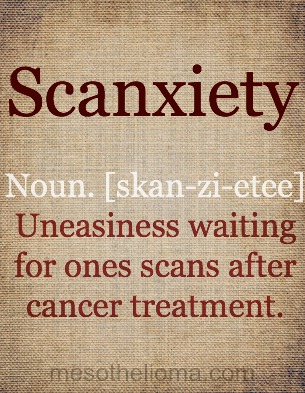
Scanxiety

Since being diagnosed with cancer almost 18 months ago, I’ve learned a lot of words that I, a self-professed word nerd, would rather not have had to know. Words like neuroendocrine tumour (I have five of them lurking inside of me) and carcinoid syndrome (a group of symptoms linked to the excess hormones released by the type of neuroendocrine tumour that I have). I could bore you with several others but the word that best describes my life the past few weeks is scanxiety.

Scanxiety

Scan + Anxiety = Scanxiety

Though my cancer is incurable, I go for a treatment about once every ten to twelve weeks that is designed to keep it from growing and spreading. I am injected with Lutetium-177, a radioactive therapy that adheres to specific receptor cells in my tumours and destroys them. The morning after each treatment, I have a full body scan that shows us exactly what has been happening with the disease since the previous treatment. Fortunately, I don’t have to wait long for the results. I meet with a doctor immediately afterward to view the pictures and talk about what they show.

For the most part, I’ve been at peace and have approached each treatment and scan without a lot of anxiety but this time was different. Since my last treatment in mid November, I’ve been experiencing intermittent stomach pains. They’re short-lived, lasting only a few minutes. It’s easy to second guess every ache or twinge and wonder if it’s related to the cancer but this was more than that. Stomach pain is one of the most common symptoms of carcinoid syndrome and one I’d experienced prior to diagnosis. I began to wonder if this was a sign that the cancer was growing or spreading.

Worry often begins as a little thing but it seems to feed on itself. Soon I was carrying a heavy burden of anxiety. It continued to grow until I was quite sure that I would hear bad news when I went for this week’s treatment and scan.

Then, on Tuesday night as I was brushing my teeth and preparing for bed, I heard the Lord say, “It’s going to be okay!” Oh, it wasn’t a booming voice thundering through the ceiling of our tiny ensuite bathroom. It wasn’t an audible voice at all but it might as well have been. I knew without a doubt that it was God speaking to my heart. He even said it several times. “It’s going to be okay!” I walked out of the bathroom feeling like the world had been lifted off my shoulders, crawled into bed and had a great sleep. Then, the next morning, I climbed out of bed, picked up the heavy load of anxiety and put it squarely back on my shoulders!

As we drove to Edmonton for my treatment and throughout the hours that followed, I tried to tell myself that everything was going to be okay, but I kept hearing the other voice, the one that said, “Are you sure it was God that you heard? It wasn’t God, it was only your own wishful thinking! You were right in the first place; the news is going to be bad!” Foolishly, I listened and my anxiety grew.

I was thankful for the visits that kept me sane that evening. First, an acquaintance from years gone by that I’ve recently reconnected with. We could have talked for hours! Then, my dear hubby who has walked every step of this cancer journey with me. I was also thankful that the treatment had made me tired enough to sleep.

The next morning, I prayed for the entire half hour or so that I was being scanned and then it was time to find out which voice I should have listened to. I walked into the consultation room where Dr. Sandy McEwan, head of the neuroendocrine tumour clinic at the Cross Cancer Institute, and Dr. Dean Ruether, leader of the provincial endocrine tumour program, sat waiting with smiles on their faces and I heard the words I’d been longing to hear, “Everything’s okay! There’s been no change.”

My cancer is stable! I can relax until mid April when we go through the whole thing again, hopefully without as much scanxiety! Oh, there are still the stomach pains to deal with but I’m even wondering if they will subside now that the burden of anxiety has been lifted. I’m going to be monitoring their frequency and intensity for the next few weeks to see if they’re actually lessening, as I think they may have been. If not, the solution might be as simple as increasing my monthly dose of Sandostatin which controls the carcinoid symptoms or as complicated as surgery to remove the primary tumour from my colon.

For now, I’m simply going to relax and give thanks to the One whose voice I should have listened to!

World Cancer Day 2015

World Cancer Day

When I first learned that today is World Cancer Day, a day in which the world comes together in unity in support of the global fight against cancer, I wasn’t sure how I felt about that. Do we really need an awareness day for everything? After all, isn’t everyone already aware of the devastation brought about by this dreadful family of diseases? Surely everybody has been touched by it in some manner. And what good does a day do anyway?

Cynical? Yes. Grouchy? Yup, that too! Perhaps my reaction has more to do with the fact that I’m resting on a heating pad because I wrenched my back yesterday than it does with whether or not we need a Cancer Day. It might also be related to the fact that I have a treatment next week followed by a scan that will tell us whether or not there has been any change in my own cancer. The days leading up to these scans are always a bit nerve wracking so I’d just as soon avoid the topic of cancer altogether today.

I’ve decided not to do that, however. The Lord has given me a voice (or in this case, a keyboard) and the least I can do is lend it to such a worthy cause. There’s really nothing that I can say about cancer that hasn’t already been said, but let’s begin with some alarming statistics:

  • Cancer is a leading cause of death worldwide and the leading cause among Canadians.
  • An estimated 191,300 Canadians were diagnosed with cancer in 2014 – 97,700 men and 93,600 women.
  • About 76,600 Canadians are estimated to have died of cancer in 2014 – 40,000 men and 36,600 women.
  • 45% of men and 41% of women will develop some form of cancer in their lifetime.
  • On average, 524 Canadians are diagnosed with cancer every day.
  • On average, 210 Canadians die of cancer every day.
  • About 30% of all cancer deaths are due to five leading behavioral and dietary risks: obesity, low fruit and vegetable intake, lack of physical activity, tobacco use, and alcohol use.
  • More than 60% of all new cases each year occur in Africa, Asia and Central and South America which account for 70% of the world’s cancer deaths.
  • Deaths from cancer worldwide are projected to continue rising, with an estimated 13.1 million deaths in 2030. I suspect that this is, in part, related to the fact that life expectancies are also rising.

Despite these gloomy numbers, cancer survival rates have doubled in the last 40 years. Awareness is making a difference!

The theme for World Cancer Day 2015 is “Not Beyond Us”. This year, the campaign is focusing on four key areas: choosing healthy lives, delivering early detection, achieving treatment for all, and maximizing quality of life. It takes a positive approach to the fight against cancer by highlighting new treatments and solutions that are within reach.

Today is World Cancer Day but the fight against cancer takes place every day. It takes place in research labs around the world but it also takes place all around you. It takes place in that home where a mother, father or child is fighting for life. It takes place in the hospitals and clinics where they receive treatment. It takes place in classrooms where good health habits are being taught and it takes place in communities, large and small, where fundraisers are held to benefit everything from individual patients to global research.

What will you do to make a difference in the fight against cancer? Will you make a donation, offer to drive an acquaintance to an appointment, or drop off a meal for the family when you know that Mom has had a treatment? Whatever you choose to do, you can make a difference!

Days of praise!

I have much to praise God for this week!

Under normal circumstances, I wouldn’t consider a visit to the dentist a big deal. There was a time, after a traumatic experience in a dentist’s chair when I was eleven or twelve, that going to the dentist was frightening but that’s in the distant past and hasn’t been an issue for a long time. No, the reason for Tuesday’s apprehension was different. For the past several months, I’ve been experiencing severe jaw pain when I eat. It appears to have been brought on by a combination of last spring and summer’s surgery and radiation treatments and accumulated stress. I’d been warned that radiation, in particular, would likely cause stiffening of the muscles in my jaw. When I started seeing a physiotherapist in early October, I could only open my mouth 26 mm (average is 50) and the pain when I ate was, at times, almost unbearable. Over the next few weeks of regular exercise, I regained quite a bit of flexibility and can now open my mouth about 35 mm. The pain has lessened but it hasn’t gone away. I was very concerned about whether or not I’d be able to keep my mouth open wide enough and long enough to have my teeth cleaned and checked and how much that would hurt. Unfortunately, however, I couldn’t postpone the appointment.

Until I had my parotid gland removed and my other saliva glands were compromised by radiation, I had no idea what an important role saliva plays in tooth protection. Now that my saliva production has been permanently reduced, I’m especially vulnerable to tooth decay and for at least the first year following radiation, in addition to brushing my teeth after every meal and giving myself daily fluoride treatments, I’ve been advised to see my dentist every four months. Tuesday’s was the first of these check-ups and I feared what the results might be.

As it turns out, I had nothing to worry about. Under the gentle care of my hygienist and dentist, the appointment went amazingly well. No pain and no cavities! As I said, I have much to be thankful for this week but that’s just the beginning!

The following morning, long before daylight, we set out on the two and a half hour drive to the city for my second Lutetium treatment at the Cross Cancer Institute. There were a few snowflakes in the air but the roads were clear and the drive uneventful; definitely another thing to be thankful for at this time of year in Alberta! I was admitted for an overnight stay and the treatment went ahead resulting in nothing more than a slightly queasy stomach that didn’t last very long.

After a reasonably decent sleep considering the fact that I was in a narrow hospital bed, I was up early on Thursday morning for my follow-up scan, the one that would tell us what’s been happening to my neuroendocrine tumours since September’s treatment. One of the things that I appreciate most about this process is that, unlike most medical procedures, I’m given the results immediately afterward. No anxious waiting for 2 or 3 weeks to hear back from the doctors.

And the news? That’s the biggest thing I have to be thankful for! There has been absolutely no change! The cancer has not grown or spread! It continues to be stable. I may have pain when I’m eating but in the overall scheme of things, that seems pretty insignificant. I have much to praise God for and I sincerely thank those of you who have been praying for me!

My next treatment will be on Feb. 11.

No laughing matter!

Every once in awhile, we need to be reminded how very lucky we are!

If you’ve been reading my blog for very long, you’ll probably recall that I’m an avid Kiva lender. Kiva is a non-profit organization that allows a person to lend as little as $25 to a specific low-income entrepreneur in one of 83 countries around the world. Though Kiva provides loans to both men and women, I choose to lend to women who are borrowing money to purchase specific items that they will use to generate income that will help them support their families and educate their children. As each of these women makes a monthly payment on her loan, my share of that payment is deposited in my Kiva account and I receive an email notifying me of my updated balance. I could withdraw the money at any time but instead, as soon as my balance reaches $25, I search the Kiva database and choose another woman to lend to. Today, I made my 30th loan!

Sokhem is a garment factory worker and mother of 5 who lives in a rural area of Cambodia. Together, she, her husband and their oldest child earn a combined income of approximately $13 a day. Sokhem requested a Kiva loan to purchase some cows and start a breeding program, but it was actually one of her long term goals that caught my eye and prompted me to help her today. She hopes eventually to be able to build a bathroom with a toilet in her home.

Can you begin to wrap your head around the idea of raising 5 children in a home without a toilet? I can’t.

Did you know that this Wednesday, November 19th is World Toilet Day, a day set aside to draw attention to the one-third of humanity who, like Sokhem, lack basic toilet and sanitation facilities? I didn’t either until I read this morning’s Edmonton Journal article just before checking my email and discovering that I had the necessary funds to make another Kiva loan.

World Toilet Day! It’s hard not to laugh, isn’t it? Sadly, when you read the statistics, it’s not a laughing matter.

  • One billion people – a sixth of the world’s population – defecate in the open because they simply have nowhere else to go.
  • In India alone, 600 million people – about half the country’s population – lack toilets in their homes.
  • 1.5 million children die annually from diarrhea that could be prevented by simply having clean toilet facilities.
  • People living in many towns and villages in Africa and elsewhere run the risk of being bitten by scorpions and venomous snakes every time they relieve themselves in fields and woods.
  • One billion people get their water from sources contaminated by human and animal feces.
Over the course of our travels, we’ve seen the best and the worst of the world’s toilets from “squatty potties” in many parts of Asia to high tech toilets with heated seats and built in bidets in higher end Japanese establishments, but wherever we’ve been, we’ve always been able to find a toilet to use. Here in Canada, where it’s not uncommon for a home to have 2 or 3 of them, we take so much for granted. On World Toilet Day, let’s not forget how very fortunate we are!


world-toilet-day-e1353430779651

School dreams and stress

For many years, in spite of the fact that I enjoyed my teaching career, I had what I called my “school dreams” in the days leading up to each new school year.  These were dreams in which everything went wrong.  All a teacher’s worst nightmares would visit me as the end of August approached! One of the things that I’ve really enjoyed about retirement has been the absence of these dreams; until recently that is.

Why in the world would I be having school dreams again more than seven years after retiring from the classroom? It happened again last night. This time, I was trying to teach a high school English lesson to a large class of students in a crowded area at the back of a busy hairdressing salon! Yes, my school dreams are like that; a curious mixture of realistic and just plain weird. Midway through the lesson, all but two of the students got up and went upstairs to some sort of student lounge. In spite of my pleading and threatening (definitely not effective teaching strategies), they refused to come down again. Over the years students leaving class and refusing to come back has been a fairly common theme in these dreams.

Teaching is a stressful occupation and during my career, though I anticipated the beginning of each new school year with excitement, I recognized that my strange dreams were a symptom of that stress.

Over the past 14 months, my life has been a series of one stressful event after another. I thought I was coping well but little by little, with each ensuing event, the stress built up until now it’s beginning to bubble over. According to the Holmes and Rahe Life Events Stress Test, which is supposed to give a rough estimate of how stress affects health, events including death of a close family member (Mom), major personal illness (cancer) and major change in health of a family member (Dad) have given me a 50-50 chance of succumbing to stress-related illness. I’m doing my best to combat that by continuing to eat well, exercise regularly and by ensuring that I get enough sleep but it’s absolutely amazing what’s stored away in the deep recesses of our brains. Apparently, mine still connects stress to teaching and  is reacting to my current stress level with school dreams! How weird is that!

Now the challenge is to find ways to reduce the build up of stress and manage it better in the future.

Any suggestions?


Coffee… poison in my cup

Coffee-addiction

I have no idea how many times I’ve quit drinking coffee! A better question might be, why in the world do I ever start again when I know how bad it is for me?

Coffee is known to have both positive and negative effects on health but for me, the negatives far outweigh the positives. Coffee simply isn’t my friend!

I fell off the wagon once again in August while we were on holiday. I started with just half a cup. After all, how much damage could half a cup do? The negative effects don’t show up immediately and that half cup tasted so good so that it soon became a daily habit. Before long, half a cup wasn’t enough in the morning and I started pouring myself a second one. Then my husband, who can drink copious amounts of the brew with no ill effects, started making a second pot in the afternoon. Another half cup was just what I needed to give myself a midday energy boost. Some days, I drank even more.

As usual, the side effects gradually snuck up on me and, as always, it took awhile for me to recognize what was happening. I have no idea why I didn’t immediately make the connection between the burning in my stomach and the poison in my cup, but I didn’t. Coffee is highly acidic and it can be very irritating to the gastrointestinal tract. Switching to decaf doesn’t really help. In fact, some research shows that decaf increases stomach acid even more than regular coffee.

I’ve always been extremely sensitive to caffeine. For most people it’s a mild stimulant, but for me it results in agitation and acute anxiety. Lately, my stress level has been going through the roof! After all that I’ve been through over the past 13 months, that’s hardly surprising and was easy to rationalize. Cancer, major surgery, radiation, death of a parent; all are very stressful but I’d been coping so well. Why did I suddenly feel like I’d hit a wall? I thought that my father’s stroke last month was the final straw and I have no doubt that it has contributed to my present state but I suspect that the coffee has also had a lot to do with it.

And so, once again, I have quit! Totally. Completely. Cold turkey. No more poison in my cup. I hope I have the good sense to make it permanent this time!

Enough already!

Just when I thought that life was going to settle down a little, my world was turned upside down again!

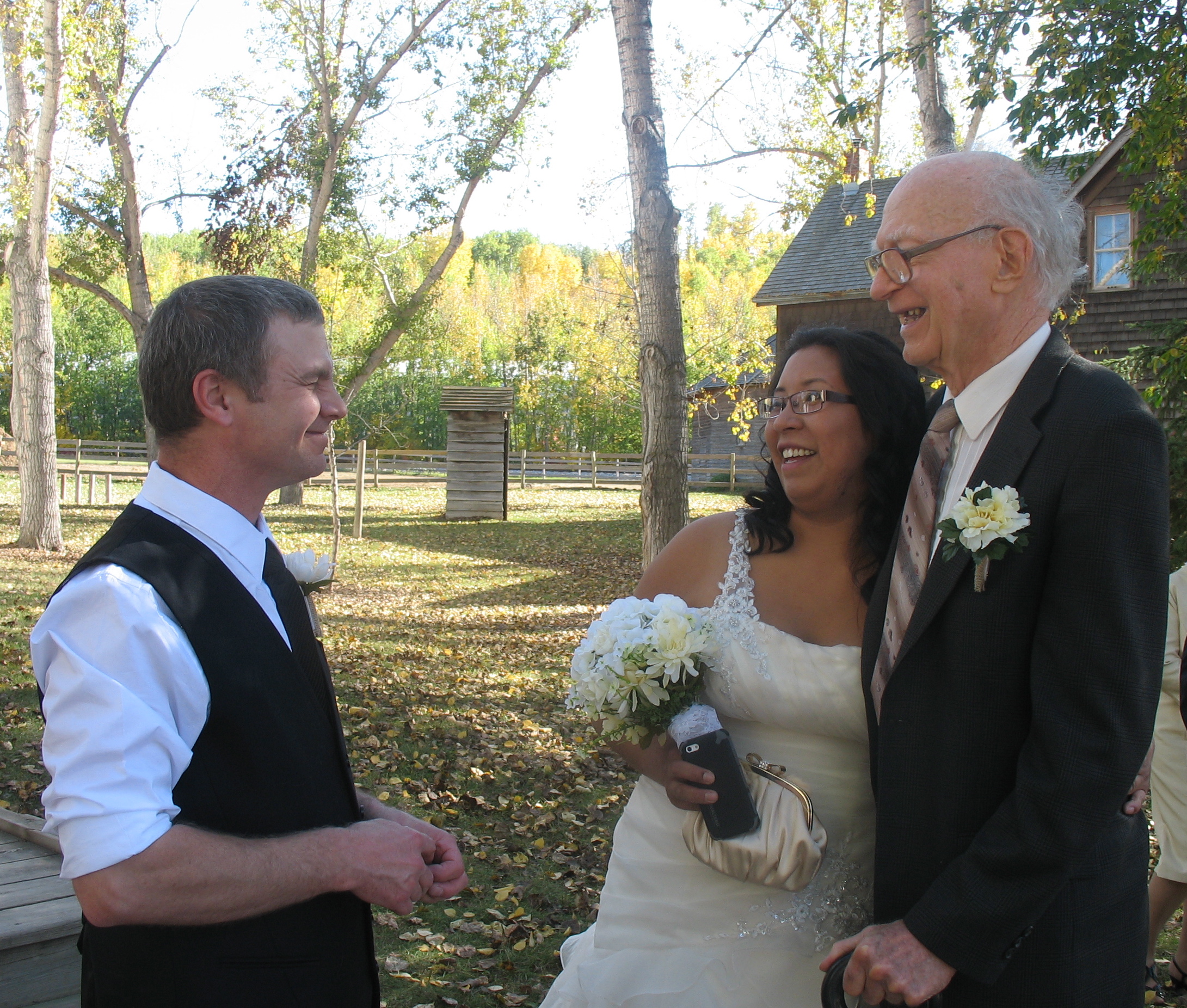
Last Thursday, my 91-year-old father flew to Alberta from his home in Vancouver. On Saturday, he walked his granddaughter down the aisle of Fort Edmonton‘s historic Anglican Church of St. Michael and the Angels. It was a unique and beautiful wedding and he was honoured to play such an important role.

IMG_4332_2IMG_4353_2

Less than 48 hours later, he was relaxing at my sister’s home in Vegreville when he suffered a cerebellar stroke!

Richard and I had just finished playing the third hole on our local golf course when the clubhouse manager drove out to tell us that our niece was trying to get hold of us about a medical emergency. We live just minutes away so in no time at all we were on our way to the Vegreville Hospital, arriving just in time for me to climb into an ambulance and accompany Dad as he was transferred to a larger hospital in Edmonton.

After laying in Emergency for another 48 hours waiting for a bed, he was finally transferred to the stroke ward yesterday. A cerebellar stroke affects the back of the brain which controls balance and coordination. Dad suffered no paralysis but he’s unable to stand without assistance because his sense of balance is completely off and he’s experiencing some weakness in his right hand. His speech is slurred, but mostly understandable, and he’s having some difficulty swallowing so he’s being given soft foods and thickened drinks. He is cognitively unimpaired and is in reasonably good spirits considering the circumstances.

I, on the other hand, feel like I’m reaching the end of my rope! In the past thirteen months, I’ve been diagnosed with two unrelated cancers. I’ve had seven hours of surgery and thirty radiation treatments for one of them and three radioisotope treatments for the other. I also lost my mother in June. Enough already!

In this morning’s devotions, I read about Gideon and I could definitely identify when he asked, “If the LORD is with us, why has all this happened to us?” (Judges 6:13)

Another devotional that I read this week was written by blogger, Cindy Keating of Red Carpet Life. It spoke of the pruning that God does in our lives to bring about greater fruitfulness.

I looked up and saw a sadly barren tree taped off in the middle of the orchard. It stuck out like a sore thumb with a noticeable sign hanging from it’s highest branch: “Pruning In Process.”

I instantly thought of the many painful times I have had to be pruned so the beauty of my fruit could shine for God’s glory rather than my own.

Is that what’s happening in my life? If so, I hope God has read this recommendation concerning pruning:

When deciding how much to prune a tree, as little as possible is often the best rule of thumb. All prunes place stress on a tree and increase its vulnerability…

As I said, I think enough’s enough already!

I know I’m not alone in asking why God is allowing these things to happen. The writers of the Psalms certainly asked similar questions. I particularly like the Psalms of Asaph who said things like “When I tried to understand all this, it was oppressive to me” (Psalm 73:16) and “do not forget the lives of your afflicted people forever.” (Psalm 74:19b)

I’ve often heard it said that God doesn’t allow us to go through more than we can handle but the Bible doesn’t actually say that and it definitely isn’t true. He allows more than we can handle so that we learn to lean on Him and, in spite of my whining today, that’s exactly what I will continue to do! I’ll put one foot in front of the other, hang onto the hem of His garment, and wait to see how He’ll get us over this latest hurdle.

We have no idea what the next little while will hold. Dad will likely remain in hospital for at least a week or two where he’ll have access to physio and occupational therapy. The neurologist anticipates that he’ll make a fairly good recovery but we have no way of knowing when he’ll be fit to travel again, whether or not one of us will need to accompany him, or whether he’ll need a higher level of care than he had before.

Please God, no more crises for awhile. Enough already!

Finally!

Yesterday I FINALLY had the cancer treatment that my doctors wanted to give me a year ago! Thankfully, mine is a slow-growing, chronic cancer or I doubt I’d be here to tell the tale.

When my neuroendocrine tumours (NETS) were diagnosed last September, the doctors at the Cross Cancer Institute in Edmonton would have preferred to start me on a radioisotope therapy, known as Lutetium-Octreotate, that they had been using very effectively since 2010. Unfortunately, shortly before that time, the government had cut off funding for that treatment citing a need for more evidence of its safety and effectiveness. That necessitated the setting up of a clinical trial, a very time-consuming process.

Unlike many NETS patients, my tumours were equally receptive to a second, similar treatment, so rather than waiting for Lutetium to become available again, I received injections of mIBG in November and January. It wasn’t long after that that my second cancer was diagnosed and treating it became a higher priority. My NETS was put on the back burner while I underwent surgery and radiation to rid me of the acinic cell carcinoma in my salivary gland. In fact, my neuroendocrine tumours weren’t looked at again until a CT scan was done in late July. Dealing with a second cancer was bad enough but not knowing what was going on with the first one was equally disconcerting.

While all of that was happening, the Lutetium-Octreotate clinical trial was finally approved and as of yesterday, I’m finally a participant. So, what does that mean? I don’t feel like a guinea pig because the treatment isn’t a brand new, untried one. Having heard the success stories from Dr. MacEwan, chair of the Oncology Department at the University of Alberta and head of the Nuclear Medicine Therapy/Neuroendocrine Tumour Clinic at the Cross Cancer Institute, a man who I trust completely, I have no doubt that it is both safe and effective. Simply put, participating in the clinical trial is the only way that I can access the treatment that Dr. MacEwan feels is the best one for me so it’s clearly a no brainer. I will remain in the study for up to seven years and will be followed up for another year after that. Data that’s gathered along the way will be retained for 25 years and will hopefully be used to improve patient care over the long term.

For me, there are several advantages to taking Lutetium instead of mIBG. From Dr. MacEwan’s point of view, the fact that it will probably be less harmful to my bone marrow was the deciding point, but I’m happiest about the difference in the precautions that I have to take after each treatment. They’ll still leave me radioactive but the effect of that radioactivity isn’t as far reaching. I didn’t have to stay shut away in the lead lined room after yesterday’s injection and Richard was allowed to visit me. Instead of being in virtual seclusion for two weeks afterward, now it will only be one week and the restrictions within that week are much less limiting. Following an mIBG treatment, I had to stay at least 10 feet away from Richard for all but 3 hours a day. For those 3 hours we were allowed to be just 3 feet apart! I still have to have my own bedroom and my own bathroom for the next week but we can be 3 feet apart at any time which definitely makes life easier. I’m also more free to mix with other people as long as I keep a bit of distance between us and I’m careful to stay away from pregnant women and children under the age of 12. Though there’s still the need for several blood tests between treatments, there will also be periods of several weeks when I’m not required to have any blood work done. I definitely see a winter holiday in our future!

I was told that I’d be very tired for the first week after each treatment but I really haven’t felt tired today at all. I suspect that that might have something to do with the exciting news that we received following this morning’s post treatment scans. They confirmed what July’s CT scan appeared to show. In the 7 months since my last mIBG treatment, my neuroendocrine tumours have remained absolutely stable. There are no new growths and the existing ones have not grown! In addition to that news, the scans also showed very clearly that the cancer in my face is completely gone. We were already quite sure of that but seeing it on the screen was absolutely wonderful!

Now I think I can FINALLY breathe a sigh of relief and begin to live a somewhat more normal life again. I still have cancer. In fact, without a miracle, I always will have, but I also have high hopes that the year ahead won’t be quite as crazy as the one we’ve just come through!