When no news is good news

It’s been quite awhile since I wrote anything about my health as there really hasn’t been anything new to report. That in itself is good news!

As many of you are aware, I was diagnosed with two completely separate and unrelated cancers in late 2013 and early 2014. Yesterday, I finally received the results of CT and PET scans and other tests done three weeks ago. The first good news was that there has been no significant change in my incurable neuroendocrine cancer (NETS) over the last year. I have only had two radioisotope (Lutetium) treatments during that time, one last October and one in April, but that has been enough to keep things stable. The tumours have not grown or spread.

Screen Shot 2016-08-09 at 4.34.33 PMSource

Neuroendocrine tumours (NETS) produce serotonin which is sometimes referred to as a happiness hormone because a deficit can to lead to depression. An excess, however, can result in carcinoid syndrome which, as in my case, results in symptoms that include abdominal cramping and diarrhea, skin flushing, and periods of rapid heart rate. It can also lead to heart disease and other complications. A 24 hour urine test is used to measure the amount of serotonin in the body. Though I don’t know what units are used to measure serotonin, at the time of diagnosis, the level in my body was 150. Now, it’s down to 40. Though still above average, it is considered borderline and indicates that my tumours, if not completely dormant, are barely functioning. Monthly injections of Sandostatin, meant to suppress this serotonin production, are obviously working and I have had none of the above listed symptoms for the past couple of years.

More good news was the fact that there is absolutely no sign of recurrence of my second cancer which was an acinic cell tumour in one of my saliva glands. It was removed surgically followed by six weeks of radiation treatments, thirty in all. I have now been free of that cancer for over two years!

The best news, however, is the fact that I feel 100% healthy! My energy level is normal and except for the monthly injections, which are given by a nurse who comes to the house, and a treatment requiring an overnight stay in hospital in Edmonton once every six months, I’m able to lead a completely normal life. We haven’t gone on any long hikes yet this summer, but I’m quite certain that I could.

If things continue to go this well over the next year, treatments will then be reduced to one every nine months. I have no idea what the long term outlook is, but then, who really does know what their future holds? I know who holds my future and that is good enough for me!

“I know the plans I have for you, declares the Lord, plans to prosper you and not to harm you, plans to give you hope and a future.”                                      Jeremiah 29:11

We’re winking again!

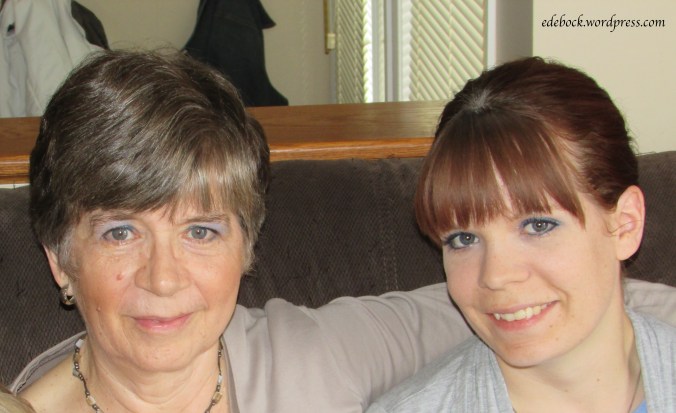
It’s hard to believe that it’s already been a year since my daughter and I put on our blue eyeshadow and participated in Wink Day 2015, but here it is again and as it turns out, I’m at her house again.

What is Wink Day, you ask? It’s a day set aside by the Canadian beauty industry, through it’s charitable foundation, Beauty Gives Back, in support of women going through the social and emotional challenges of the Cancer Blues. Women across Canada are  encouraged to post pictures and videos of themselves wearing blue eyeshadow (with the hashtag #winkday) as a way of raising awareness of the Cancer Blues. The Cancer Blues is a term, coined by Beauty Gives Back, to describe the emotional distress caused by cancer and its treatment, an often ignored consequence of the disease that can seriously affect a person’s ability to fight and thrive through the ordeal.

IMG_1898

My daughter looks great in blue eyeshadow, but me, not so much! “It ages you,” she told me as we applied our make-up and I think she’s right. For Wink Day, however, I’ll put vanity aside.

For over 20 years, Beauty Gives Back has supported tens of thousands of Canadian women through the Cancer Blues with programs such as Look Good Feel Better and FacingCancer.ca. Look Good Feel Better workshops are free of charge to all women with cancer and are designed to help them feel better about themselves and thus face their illness with greater confidence. Over 1800 volunteer cosmetic advisers and hair alternative specialists give generously of their time to bring the two hour seminars to cancer care centres across the country. I was so impressed with my own Look Good Feel Better experience that I’m now a spokesperson for the program helping promote the twice a year fundraising galas put on by Shopper’s Drug Mart, one of the program’s biggest sponsors.

Though I’ve been diagnosed with two completely unrelated cancers over the past three years, one of which is incurable, I must admit that I haven’t experienced the degree of mental distress that many victims of the Cancer Blues do. I attribute this to my faith, my wonderfully supportive family and friends, a great cancer care team and the fact that, so far, my treatment has been successful. My disease is stable and I’m able to live a reasonably normal life. I do, however, love those occasions when I’m someplace where no one knows that I’m the woman with cancer; moments when I can almost forget about it myself.

On days like Wink Day, however, I’m eager to do my part to raise awareness even if it means looking totally silly! It’s not too late to join the fun. Simply post a picture or a video  of yourself wearing blue eyeshadow on social media anytime before the end of June (with the hashtag #winkday) or visit winkday.ca to find out how else you can help.

IMG_1896


Beauty from the inside out

Screen Shot 2016-03-18 at 11.07.24 PM 3Long before I ever thought about trying my hand at fashion blogging, I wrote a series of posts about what makes a woman beautiful. You can find those posts here, here and here.

As I mentioned in the first of that series, the Bible speaks of “the unfading beauty of a gentle and quiet spirit” that “does not come from outward adornment.” (1 Peter 3:3-4) It also says “The LORD does not look at the things man looks at. Man looks at the outward appearance, but the LORD looks at the heart.” (1 Samuel 16:7)

If these things are true, and I sincerely believe that they are, why in the world am I blogging about fashion? Nowhere does scripture say that a godly woman shouldn’t concern herself with style, dress in fine clothes, wear elaborate jewelry or use make-up. It simply says that her true beauty shouldn’t depend on these things. It ought to come from within.

Some Christians emphatically declare that inner beauty is all that matters; that attention to outer beauty is sinful vanity. I disagree completely! True, a nasty, mean-spirited woman dressed in designer clothes and made up impeccably, is still mean and nasty. Unless something happens to transform her from the inside out, that ill-tempered spirit will soon become evident and we will see through her attractive appearance. Similarly, a beautiful spirit can be hidden beneath a frumpy or unkempt exterior, but sadly, it may not be noticed. It’s our outer appearance that often attracts people to us and makes our inner person readily available to them.

Clothing, hair and make-up can be an asset without becoming an obsession and, like it or not, the way we present ourselves sends messages to those who come in contact with us. Rightly or wrongly, we live in a culture where people do judge a book by its cover.

What does your appearance say about you? Does it tell the world that you care about yourself, that you matter, that you’re worth the time it takes to look after yourself? I think it should!

Clearly, we need balance in our lives. We need to do those things that nurture inner peace and beauty, but if we want them to shine through and be seen,  it behooves us to put a little effort into our outward appearance too. In addition, looking good is a great confidence booster!

Looking our best doesn’t mean being overdressed and it doesn’t have to cost a lot. Here’s a comfy, casual look that I might wear to the grocery store on a cool spring day.

IMG_1509

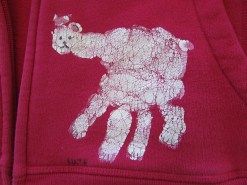
I’m wearing dark wash jeans from Old Navy, a Reitman’s t-shirt, cute sneakers and a very special bright pink hoodie that adds a pop of colour to my otherwise neutral outfit.

IMG_1507

The prints on the pockets are the hands of two of my young grandsons! They live over 1300 km from me, but when I wear this gift I feel just a wee bit closer to them.

IMG_1515 IMG_1516

And this is hidden on the inside… from my son and his wife.

IMG_1517

Don’t I have a creative daughter-in-law? She’s definitely one of the beautiful women in my life!

Blessings in the ordinary and mundane

What are some of the most ordinary, mundane tasks that you perform on a regular basis? Have you ever thought about the fact that there are blessings hidden in every one of them?

I hadn’t either until I was doing my Bible study homework yesterday. Our ladies group has recently started doing Priscilla Shirer’s study, Gideon: Your Weakness, God’s Strength. In yesterday’s lesson, she asked us to list five ordinary tasks that we perform every day. That was the easy part. Later in the lesson she had us look back at the list and beside each task, write down what it indicates about God’s faithfulness and kindness to us.

Referring to the fact that Gideon had wheat to thresh despite the hardships and oppression that he and his people were facing (Judges 6:1-11), she wrote:

“Gideon’s story reveals that even your most mundane duty has a twinkle in the favour of God, for if He removed His blessings completely from you – taking away your home, your family, your work, your possessions – the need for many of your daily tasks would disappear. Don’t despise the very things that signify your seat under the umbrella of God’s goodness each day.”

What an eye opener this simple exercise was for me! One of the tasks that I wrote down was brushing my teeth. Is there anything more ordinary or mundane than that? What could possibly be the hidden blessing? Then I thought about the fact that I have access to unlimited clean, healthy water. I am not in danger of contracting a water borne disease every time I brush my teeth! Globally, approximately twice the population of the United States, or some 6.63 million people, do not have access to clean, safe water! 1.6 million people die every year from diarrheal diseases, including cholera, due to their lack of safe water and basic sanitation. Many more are plagued by tropical diseases and intestinal parasites.

Getting dressed is another routine task that we all engage in, so what’s the hidden blessing? I have a closet full of clothes to choose from and the financial resources to buy more if I ‘need’ them, while there are many who have nothing but the rags on their back. I can even blog about my wardrobe! (Come back tomorrow for the second instalment of my new Fashion Friday! feature.)

Cleaning the bathrooms is one of my least favourite household tasks, but when I consider that approximately 1/3 of the world’s population doesn’t even have a toilet to clean, I know how blessed I am! Astonishingly, more people worldwide have a cell phone than a toilet! Almost one billion people still defecate in the open, a practice that leads to the spread of disease and the contamination of drinking water sources. I don’t mind using an outhouse when I’m camping, but after living and travelling in parts of the world where I rejoiced when I found a western toilet to use instead of a “squatty potty”, I’m pretty thankful to be blessed with toilets to clean!

I could go on and on, but you get the idea. There are hidden blessings in all our humdrum, routine tasks if only we have the eyes to see them!

What are some of your least favourite tasks? What are the blessings hidden in them?

lookforhidden

Having the last word

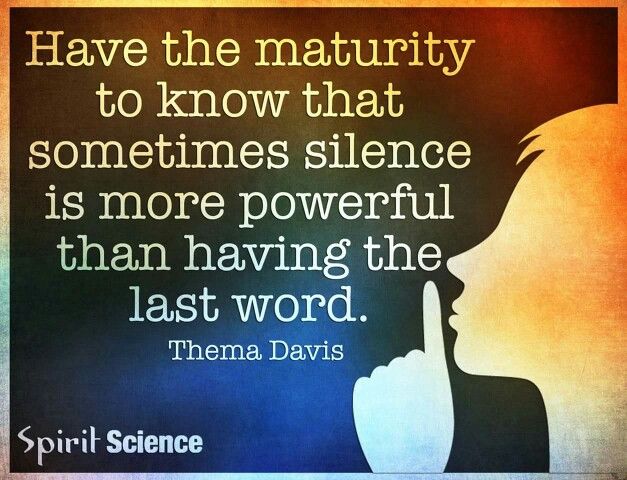
I love to engage in online discussions, but when they deteriorate into pointless arguments or worse yet, absolute rudeness, I bow out. One of my pet peeves is people who always have to have the last word. Don’t they realize that having the last word isn’t the same as winning?

I have seen great discussions on Facebook and other social media end in hurt feelings and broken friendships and I’ve seen people try so hard to prove how right they are that they end up making themselves look stupid. It’s just not worth it!

As Kenny Rogers sings in his hit song, The Gambler,

You’ve got to know when to hold ’em
Know when to fold ’em
Know when to walk away
And know when to run!

I admit that I like to be right too, but I’m deliberately practicing the discipline of not having to have the last word.

As a Christian, part of my mission is to be Christ-like in what I say and do, so I’ve been looking at His example. Jesus didn’t have to deal with social media, where people often say things that they might not say face-to-face, but the principle is the same. He often said things that were controversial or misunderstood, but when He was confronted, He didn’t engage in long-winded debates. He often spoke the truth and then simply walked away. Even when He stood before Pontius Pilate and his life was on the line, He made no reply to the accusations of the chief priests and the elders. (Matthew 27:12-14)

last word

Mezuzah

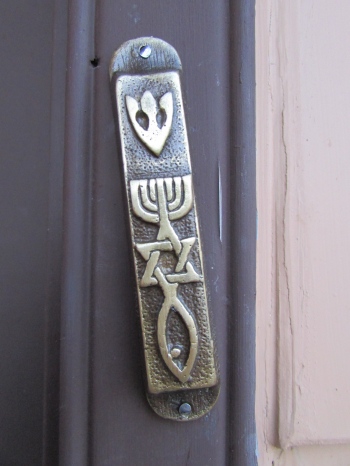
If you come to visit us, you’ll notice something on the doorpost at the entrance to our home that wasn’t there before our trip to Israel.

IMG_1363

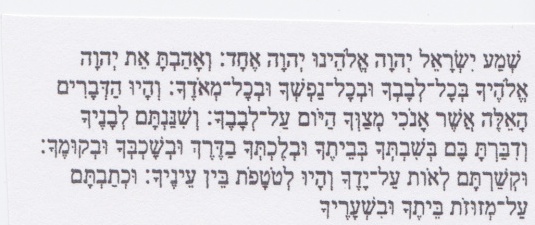
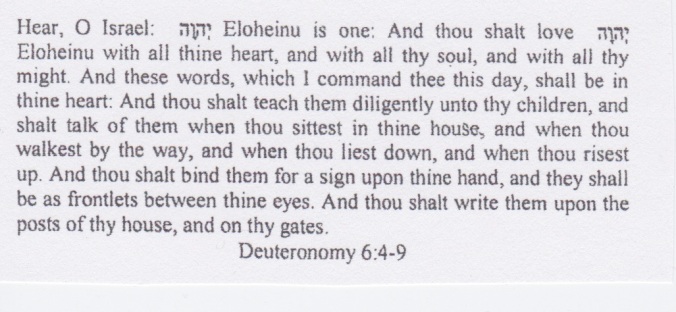
Four inches long and made of brass, it is a mezuzah container. Hidden inside are two tiny slips of paper, one in Hebrew and the other in English.

scan-1


Scan

Mezuzahs are fastened to the door frames of Jewish homes to fulfill the Biblical commandment to write the words of the Shema, the command that is central to the Jewish faith, on the door frames of their houses. (Deuteronomy 6:5-9)

“Love the Lord your God with all your heart and with all your soul and with all your strength.” 

If ours were a true Jewish mezuzah, there would be just one scroll inside. It would have been handwritten by a certified scribe with specially prepared ink on kosher parchment made of thinly shaved hide. If we were a Jewish family, we would have several mezuzahs, not just the one on the outside doorpost. Every doorway that leads into a proper room, except for the bathroom, would have its own mezuzah. Each of our hotel rooms in Israel had one.

A mezuzah is permanently affixed to the right doorpost, on the lower part of the upper third. It is traditionally hung on a slant, as shown in the photo above, with the top pointing inward. A special blessing is usually read or recited prior to affixing each mezuzah.

Mezuzah cases come in a variety of sizes and materials. Ours is a Messianic mezuzah made specifically for a Christian home. The symbol at the top is the Hebrew letter “Shin”, the first letter of Shaddai (Almighty), one of the Biblical names of God. Below it is the Messianic Seal of the Church of Jerusalem which incorporates a menorah (seven branched candelabra), a distinctly Jewish symbol, and a fish, which has been used as a symbol of Christianity since its very early days. The triangular base of the candelabra and the tail of the fish tie the two symbols together and form the Star of David, the national symbol of Israel.

The mezuzah at the entrance to our home will long be a reminder of our amazing pilgrimage to Israel, but also an expression of our faith in God.

“As for me and my household, we will serve the Lord.”  Joshua 24:15

Final day

Reflecting on and writing about our final day in Jerusalem seems like a perfect way to enter the Lenten season as we spent the day immersed in the final moments of Jesus’ life here on earth, visiting the sites surrounding his arrest, crucifixion, burial and resurrection!

Our morning started on the Mount of Olives overlooking the Kidron Valley. The sun gleamed off the golden Dome of the Rock, the Muslim mosque that now stands atop Mount Moriah where the Jewish temple once stood. Before us lay the route that He took on His triumphal entry into Jerusalem on the day that has become known as Palm Sunday. (Matthew 21:1-11)

IMG_1107 - Version 2

As we stood atop the Mount, we were reminded that, according to prophecy, that is where He will return someday! (Zechariah 14:4) Come, Lord Jesus!

Walking down the Mount, we came to the Garden of Gethsemane where Jesus spent the final moments before His arrest. Even with the sound of traffic in the background, the garden was a place of great peace. In our devotional time there, we were reminded so clearly of the great burden that our Lord bore that night as He prayed alone, feeling the weight of the sin of the entire world on His shoulders. Kirk, our devotional leader, compared it to the deepest of depressions. For me, our time of reflection in the garden was spiritually profound. As I thought about the extreme anguish that I once felt when I was betrayed by someone I loved and then tried to multiply that by the sin and betrayal of every person who has ever lived, it was beyond my ability to comprehend. Is it any wonder that He sweat drops of blood and prayed, “Father, if you are willing, take take this cup from me.” How thankful I am that He followed this up with “yet not my will, but yours be done.” (Luke 22:39-45) Without that willingness to carry the weight of our sins to the cross, we would be forever lost with no hope of salvation and eternal life.

We stopped for a quick look at the Gethsemane Basilica of Agony with it’s beautiful mosaics above the portico.

IMG_1189

Continuing down the hill and up the other side of the valley, we entered the walled city through the Lions’ Gate, which is also known as St. Stephen’s Gate or the Sheep Gate.

IMG_1200

IMG_1203 - Version 2

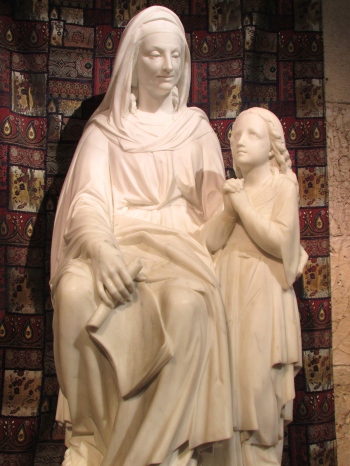
Inside the wall, we visited St. Anne’s Church where, when we sang Amazing Grace together, the acoustics were so amazing that each note hung in the air for a good four seconds! Though she isn’t mentioned in scripture, St. Anne was, according to tradition, the mother of Mary and the grandmother of Jesus. I was especially taken with the beautiful alabaster statue of a mother teaching her young daughter from scripture. The scroll in her hand has Deuteronomy 6:5 written on it in Hebrew. “Love the Lord your God with all your heart and with all your soul and with all your strength.” The delightful French Canadian priest told us that the church is often referred to as the “grandparents’ church” and reminded us of our Lord’s instruction to pass on His teachings to our children and grandchildren. (Deuteronomy 6:6-7)
IMG_1214

In the area, we also saw where the pools of Bethesda were once located. It was here that Jesus healed a man who had been crippled for 38 years. (John 5:1-15)
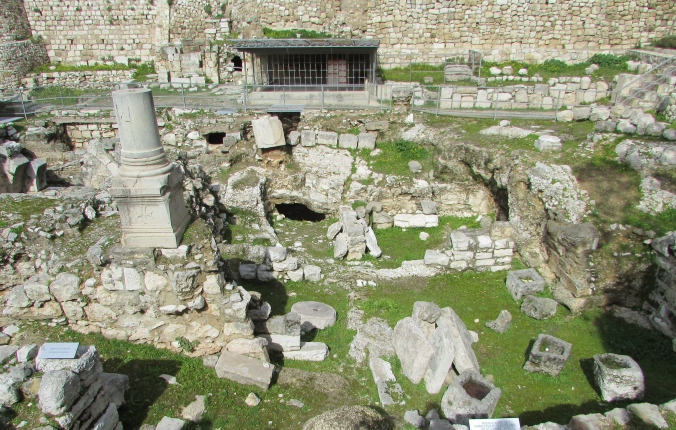
IMG_1218 - Version 2

A quick trip around the Temple Mount by bus took us to the Jaffa Gate where we entered Old Jerusalem and walked the narrow market streets to a tiny restaurant where we had lunch.

Our next stop was the Church of the Holy Sepulchre, a cavernous structure standing on the bedrock at a site said to encompass both Golgotha, or Calvary, the spot where Jesus was crucified, and the tomb (sepulchre) where His body lay. Filled with icons and incense, we could only think of what we saw as idolatry and, to me, it didn’t seem very different from what we’d seen in numerous Buddhist temples in Asia. Most disturbing to me was the Stone of Unction, or Stone of Anointing, a flat red stone some six metres in length and decorated with candlesticks and lamps that is located in the entrance of the church. It is purported to be the place where Jesus’ body was laid and prepared for burial after being taken down from the cross. It was surrounded by devoted pilgrims bowing before it, kissing it and rubbing their possessions on it in hope of receiving some sort of blessing. Personally, I was more than happy to leave. Apparently, people sometimes wait hours to enter the Edicule, an ornate cubicle that supposedly houses the empty tomb, but we had another tomb to visit!

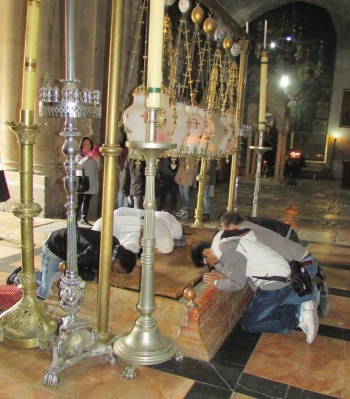
IMG_1253 - Version 2

IMG_1255

Some 2000 years after the fact, there is, of course, no way of knowing exactly where the cross of Christ stood or where the tomb that held his body was located, but the Garden Tomb seemed much more authentic to me. The guide who met us there, gave us many pieces of evidence pointing to the likelihood that this could be the place. If nothing else, there was a great sense of peace there that I didn’t feel in the Church. He first showed us the hillside that would appear to be Golgotha, meaning “the place of the skull”. Though the nose crumbled several years ago and a bus station has somewhat obliterated the lower portion, it’s easy to see a skull in the rocky hillside.
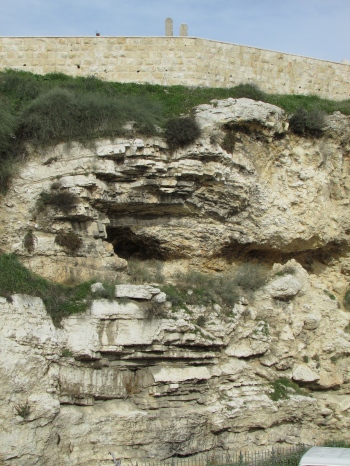
IMG_1272

Although I’ve always visualized the crosses standing at the top of a lonely barren hill, the guide explained that they were more likely positioned near the bottom beside a busy road and in the face of the throngs of passersby making their way into Jerusalem for Passover. That’s the way the Romans did things. He also pointed out the irony of thousands of lambs being brought into the city for the Passover sacrifices passing right by the true lamb of God hanging on the cross, but missed by the multitudes.

Next, he walked us through the garden to the empty tomb. Actually being able to enter and see the spot where Christ’s body may have lain was another very moving experience. The doorway has been enlarged and steps added to allow easier access.
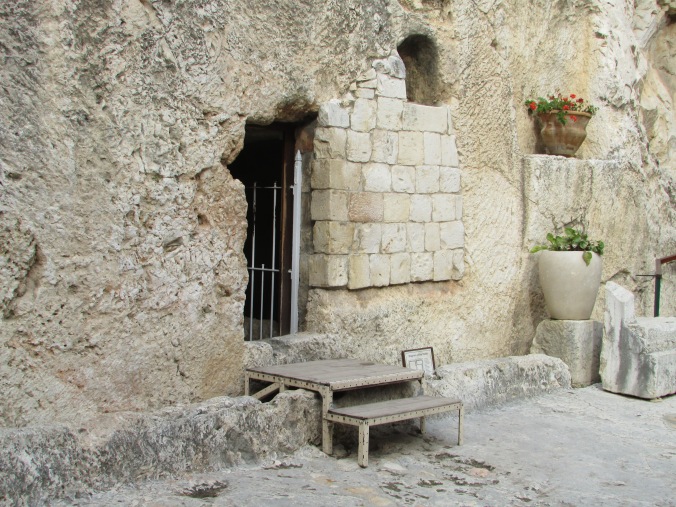
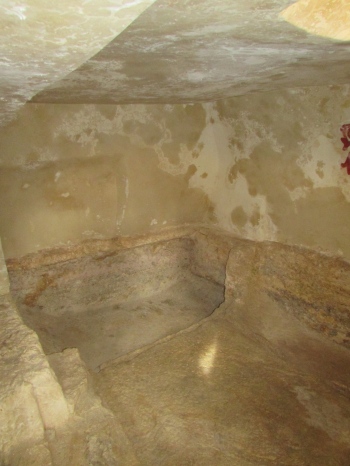
IMG_1278

IMG_1284

This is a similar tomb beside a road in Galilee that shows what the stone would have looked like.
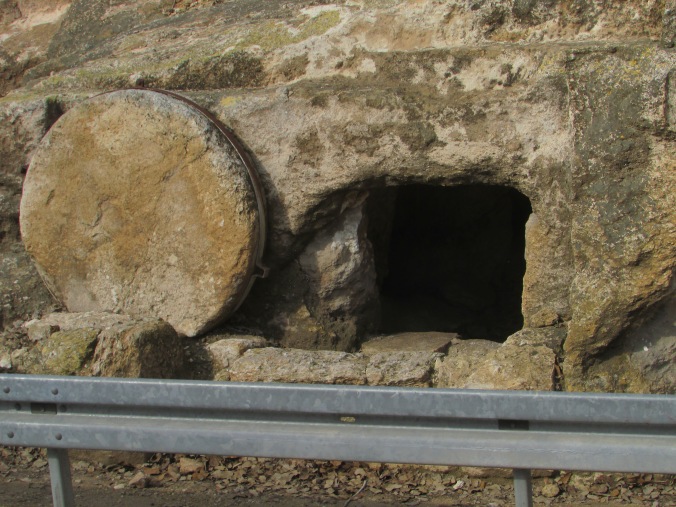
IMG_0247

After we’d all had a chance to enter the tomb, we gathered in a tiny well-lit chapel in the garden for a service of communion. We drank our wine from tiny olive wood communion cups which we were then given to bring home with us. Celebrating our risen Lord with a group of people that we’d quickly grown close to and experienced so much with was very meaningful! Though that would have been a suitable finale to our pilgrimage, we made three more quick stops before our busy day was over!

On Mount Zion, we first visited the place that is traditionally held to be the location of the Upper Room where Jesus and His disciples shared their Last Supper. (Matthew 26:17-30) The building is actually a 12th century Crusader structure, but archaeological evidence of Roman construction on the lower level supports the possibility that this area was indeed the location where our Lord shared a final meal with his disciples. Like so many others, the building has changed hands many times throughout history.

On the lower level, we visited one of the most holy Jewish sites, the traditional location of the tomb of King David. The men were required to don yarmulke, the skullcap traditionally worn by Jewish males, and entered one room while we women went into a smaller adjoining room. In our room, a few women quietly read their Hebrew scriptures, but we could hear quite a din from the other side of the partition. Our men exited shaking their heads and describing a crowded room full of ultra-Orthodox men shouting, wailing and banging on a central table as they bowed and bobbed. There is obviously much that we don’t understand about their religious practices!

Our final stop was the house of Caiaphas, the high priest, where Jesus was taken after his arrest. There is clear evidence that this time we were, indeed, standing in an authentic spot. The stone stairs leading up to the house are the very ones that Jesus would have climbed on His way to trial.

IMG_1307

Inside the house, we went down into the dungeon where Jesus likely spent His final night on earth. It was nothing more a large hole dug into the rock beneath the house. Somewhat overcome by all that we had seen and experienced, we sang our final hymn together.

Exploring ancient Jerusalem

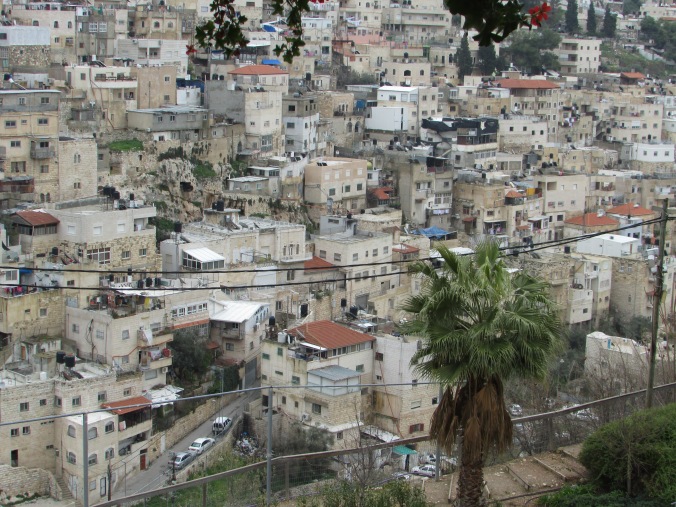
Are you tired of reading about archaeological ruins yet? Israel is truly an archeologist’s dream and Jerusalem is no exception. I must admit that by the second last day of our tour, I was beginning to experience information overload. That, combined with the fact that we were hurrying to stay ahead of a huge group of Taiwanese tourists when we visited the City of David, meant that I probably missed a few things, but there are some that stand out vividly in my memory. Located beneath the Arab neighbourhood of Wadi Hilweh and below the southern walls of Old Jerusalem, the City of David is the archaeological site of ancient Jerusalem of the pre-Babylonian exile era.

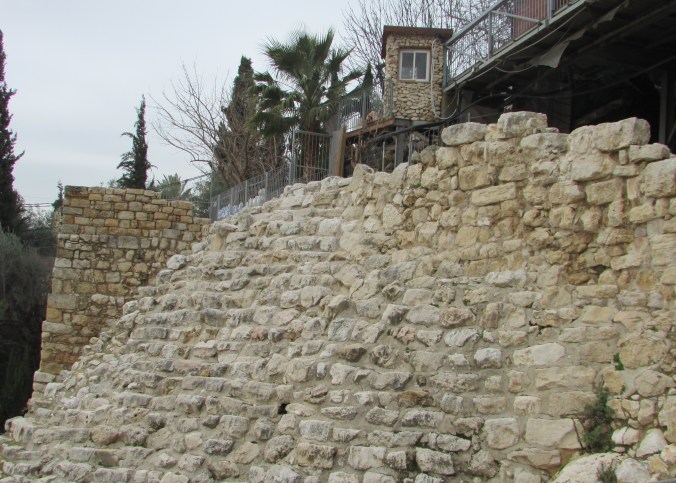
What stood out to me most was a section of wall from three different eras!

IMG_0989 - Version 2

Originally built by the Jebusites, a Canaanite tribe who built and inhabited Jerusalem prior to its conquest by King David, the tower to the left was added in David’s time. What interested me most was the upper right hand section of the wall where the stones are of slightly different size and colour. This is a section of the wall that was repaired under the direction of Nehemiah after the Jews returned from exile in Babylon. (Nehemiah 2-6)

Our local church here in Sedgewick is in the middle of a three year rebuilding project of our own. Over the years, we’d gradually let the church building and parsonage slip into disrepair. Our pastor used the story from Nehemiah to introduce the project and the accompanying need for extra funds to the congregation, so we chose to call it our Nehemiah Project. It gave me shivers to stand there and see with my own eyes a small portion of the original Nehemiah project!

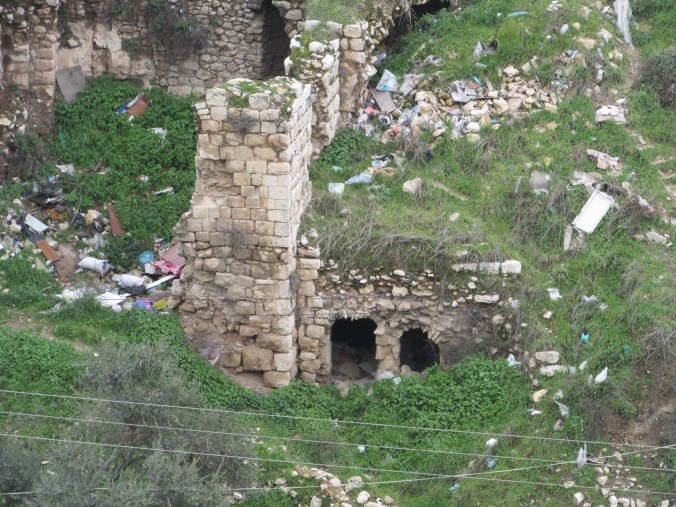
Looking across the valley to the bottom of the hill below the Arab village, we could see the entrances to ancient Jewish tombs with garbage scattered all around. It’s very easy to distinguish between Arab and Jewish communities in Israel. Jewish neighbourhoods and settlements are clean, orderly and prosperous looking while Arab ones are shabby and unkempt.

IMG_1000

Before leaving the City of David, we entered Warren’s Shaft which enabled the ancient Canaanite residents to draw fresh water from the Gihon Spring without leaving the city. Hezekiah’s Tunnel was later built under the direction of King Hezekiah to bring fresh water from the spring into Jerusalem. (2 Kings 20:20)

While we toured the City of David, we could hear the Arabs shouting at us, but since we couldn’t understand what they were saying, we paid them no mind. When we exited the water shaft, we had only a few hundred metres to go down a narrow street to what remains of the Pool of Siloam. Some tour groups were using shuttle vans for fear of being stoned, but we walked the distance briskly without any incident.

IMG_0986IMG_1024

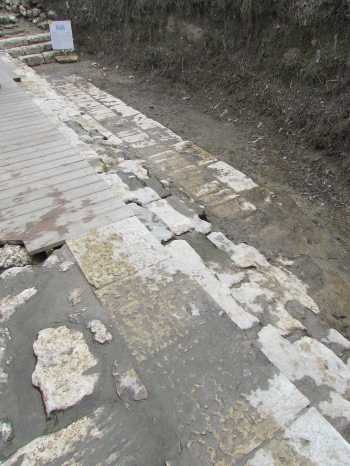
It was at the Pool of Siloam that Jesus healed a blind man by putting mud on his eyes and telling him to wash in the pool. (John 9:1-12) Only a portion of it has been excavated. The remainder is under property owned by a Palestinian family who refuse to relinquish it.

IMG_1029

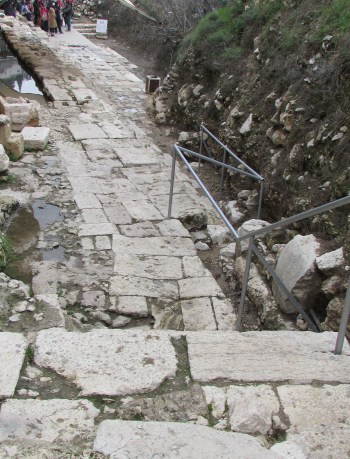
From the pool, we walked up another section of the Herodian road that we’d been on in the Western Wall tunnels the evening before, again walking on stones that our Lord undoubtably walked upon. This was the route used in His day to ascend from the Pool of Siloam to the Temple Mount.

IMG_1034 - Version 2

Next we made our way through the ancient city’s recently excavated central drainage tunnel which connects the west side of the Temple Mount to the Pool of Siloam area. Traversing the lengthy tunnel was definitely a “team building” experience as each of us called back to the ones behind us warning of slippery spots and low ceilings!

After further examining portions of the Western Wall, we had hoped to go to the southern steps, an enormous flight of stairs leading up to the Southern Wall, but the Muslim mosque above the area was in use and we couldn’t enter. Apparently, there have been incidents of people being stoned from above, so the area is closed when the mosque is in use!


The Western Wall

One of the questions that I’ve been asked most often since we returned from Israel is “Did you go to the Wailing Wall?” Yes, we did and it was quite an adventure, but before I tell that story, there are some misconceptions to clear up. First of all, while in Israel, we never heard it referred to as the “Wailing” Wall. That term isn’t used by the Jews. It is the Western Wall. Where the term, Wailing Wall, came from is uncertain, but it probably referred to the weeping of the Jews over the destruction of their temple.

I had always understood that the so-called Wailing Wall was the only remaining piece of the ancient temple and for that reason it had been set aside as a holy place of prayer. Not so! It is actually a relatively small segment of a much longer retaining wall that was originally built as part of the expansion of the second Jewish temple by Herod the Great. Although other parts of the retaining walls remain, this particular segment is closest to the location of the Holy of Holies, the inner sanctuary of the temple where God promised that His presence would reside. For that reason, it is considered by the Jews to be the holiest place to pray. (Leviticus 16:2)

While the visible portion of the Western Wall is approximately 60 metres in length, the majority of it has spent centuries hidden underground. It is only in recent years that excavation of the Western Wall Tunnels has allowed access to a further 485 metres extending beneath the Old City of Jerusalem. Entrance to the tunnels is limited to tour groups and must be booked months in advance.

This is where our story begins. Our group had a 5:45 pm appointment on January 28th. We left our hotel with plenty of time to spare, but as we neared our destination we found ourselves caught in traffic that was completely backed up along a narrow, crowded street. It wasn’t going anywhere! As minutes ticked by, it was obvious that we would miss our appointment if we didn’t do something, but what do you do with a tour bus caught in such a jam? Our trusty guide, Shimon, jumped off the bus and gave directions while Jimmy, our amazing driver, turned the bus around in a space that I probably couldn’t have turned our SUV! When we finally arrived by an alternate route, we discovered why the traffic was so heavy. The entrance plaza was filled with hundreds of people there for an Israeli Defense Forces swearing in ceremony during which new recruits receive their weapon and a Jewish Bible.

During our exploration of the tunnels we saw the biggest stone in the Western Wall. With a length of 13.6 metres, a height of 3 metres and an estimated width of between 3.5 and 4.5 metres, it is estimated to weigh approximately 570 to 600 tons! How it was moved into place without the use of modern machinery is a mystery. We also walked a section of the Herodian road which ran alongside the Temple Mount, stepping on worn stones that our Saviour undoubtably walked upon.

IMG_0942 - Version 2

Our feet on the Herodian road

By the time we emerged from the tunnels, the swearing in ceremony was over and we wound our way through the jubilant crowd who were busy congratulating and taking pictures of their young soldiers. The segment of the wall designated for prayer is separated into a section for men and one for women. The seven women in our group formed a human chain as we made our way through the crowd so that we wouldn’t become separated from one another! We each spent a few minutes praying at the wall before rejoining the guys and heading back to our hotel.

IMG_0953

Women at the Western Wall

Some in our group said that they felt the presence of God in a special way at the wall. I don’t want to question anyone else’s experience, but personally, I didn’t feel any closer to Him there than I do in many other places. I am so thankful that we serve a God who is with us wherever we are and that we don’t need a temple to experience His presence!

Jesus said, “I tell you that one greater than the temple is here.”  Matthew 12:6

Bethlehem, birthplace of our King

As the strains of John Starnes singing “Jerusalem: The Holy City” poured over the loudspeaker of our bus and the gleaming Dome of the Rock on the temple mount came into view, it was definitely a “Pinch me! Am I really in Jerusalem?” moment for most of us on our tour.

IMG_0719 - Version 2

We didn’t stay long, however. At that point, we were actually just passing through the city on our way to Bethlehem, just 7 km away. Bethlehem is in Palestinian territory and Israelis are not usually allowed to pass through the checkpoint in the wall or “security barrier” that separates Jerusalem from the Palestinians. As a tour guide, however, Shimon has a special permit that allows him to take groups into Bethlehem. He accompanied us for lunch and then to a business run by a Christian family who make and sell beautiful olive wood carvings. There he stayed, however, passing us off to a delightful guide who resides in Bethlehem because he doesn’t feel comfortable or safe being out and about on the streets of that small city.

IMG_0794

The wall

Our first stop was the Church of the Nativity, the supposed birthplace of Jesus. The church is administered jointly by the Greek Orthodox, Syriac Orthodox, Roman Catholic, and Armenian Apostolic churches. It consists of the main Basilica of the Nativity and the adjoining Church of St. Catharine. The Grotto of the Nativity, an underground cave located beneath the basilica, enshrines the site where Jesus is said to have been born. A large 14 pointed silver star set into the marble floor beneath an altar and surrounded by silver lamps and candles is said to mark the exact spot where Mary gave birth. A few feet away is the Grotto of the Manger, another shrine marking the spot where she apparently laid him in the manger.

IMG_0738

We went, we saw and we left. To be perfectly honest, it all seemed rather hokey to me and I found it somewhat disturbing to see other groups of pilgrims who appeared to be completely caught up in worshipping the place. I don’t mean to show disrespect for anyone else’s religious experience, but I do have to wonder how anyone can claim to know the “exact” spot where our Saviour was born in a humble animal shelter some 2000 years ago and, as I’ve said before, I don’t believe that there is any holy magic in the places where he was.

IMG_0758

From there, we descended to the Shepherd’s Fields, a park-like area commemorating the angel’s visit to the shepherds to announce the Messiah’s birth on that night so long ago as well as the fields of Boaz where Ruth the Moabitess gleaned. (Ruth 2:1-23) Notice that we descended to the shepherd’s fields. Again, the way I visualized things has been turned upside down! In my mind, I always pictured Bethlehem on lower ground and the shepherds tending their flocks on hillsides above town. In reality, communities throughout Israel are built on the tops of the hills. The shepherds and their sheep would actually have been on the hillsides below Bethlehem and they would have had to climb up to visit the newborn child. (Luke 2:8-17)

As we made our way back to Jerusalem to check into our hotel, I was reminded afresh how lucky we are to be Canadian. As we passed through the checkpoint, Shimon simply told the soldier on duty where we were from and we were sent on our way. Apparently, bus loads of Canadians and Americans pass through with ease while other nationalities are checked much more carefully. Vehicles driven by individuals are searched!