What’s in your little red wagon?

This is the last of a four part series based on the talks that I gave at a ladies retreat last weekend. You can find the other three here, here, and here. Although I was speaking to women, the contents of this post apply equally well to men.

In her book entitled Present Over Perfect, author Shauna Niequist describes what she calls “Leaving behind frantic for a simpler, more soulful way of living.” I especially loved this quote. “It’s like I was pulling a little red wagon, and as I pulled it along, I filled it so full that I could hardly keep pulling. That red wagon was my life, and the weight of pulling it was destroying me. I was aware that I was missing the very things I so badly longed for: connection, meaning, peace. But there was something that kept driving me forward – a set of beliefs and instincts that kept me pushing, pushing, pushing even as I was longing to rest.”

Do you ever feel that way? If so, are there some things in your little red wagon that maybe need to be taken out and put aside? Things that are taking up too much space in your life? Too much time or too much energy?

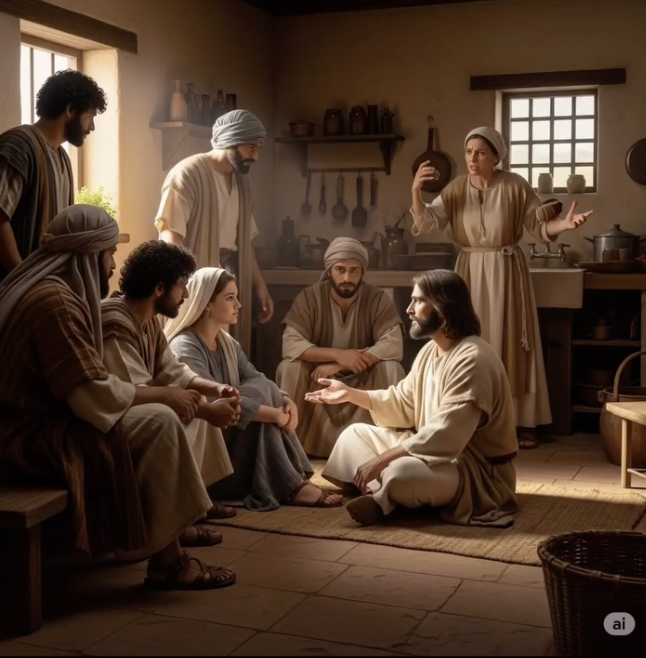
Take a moment to visualize Jesus in the flesh visiting your home, looking at your calendar, and watching how you spend your time. What would He say? He told Martha that she was worried and upset about many things, but that only one thing was needed. (Luke 10:38-42) What would he point to in your life? Where would he say, “That doesn’t need to consume so much of your time. You don’t need to devote so much energy to that.” I’m pretty sure He would tell me that I shouldn’t spend so much time scrolling on social media. Would he say to you, “You’re trying too hard. You expect too much of yourself. Come sit at my feet and listen to me.”

Choosing presence over perfection is a matter of establishing priorities and setting boundaries. Like a cross, a Christian’s priorities should focus on a vertical relationship with God first, followed by horizontal relationships with family and community.

While the amount of time we spend on certain activities is often an indicator of what our priorities are, that isn’t always the case. Our number 1 priority should always be our relationship with God, but it’s highly unlikely that we’ll ever spend more time praying and reading the Bible than we do working, keeping house, or caring for our families. God knows if you are home with little children and barely get any quiet time to spend with Him. He knows if you work long hours to help provide for your family, but He also knows when we put busyness or selfish pleasures above time with Him. If we want to have a productive, balanced, and purposeful life, we need to put Him first. So, the very first thing that we need to put into our little red wagons is our relationship with God. 

For those of us who are married, our marriage relationship should be our second priority. That goes into our wagon next. A strong marriage is the foundation of the family unit and provides stability and emotional security for both partners as well as their children. It’s very easy for us to get so caught up in all the other aspects of our busy lives that we end up neglecting our marriages and the results can be disastrous. For those of you who are still young, intentionally spending time with your spouse and nurturing your marriage relationship is also an important investment in your future. Children grow up and leave home, but marriage is intended to last a lifetime. Failing to prioritize the marriage while the kids are young often makes it difficult to reconnect later in life.

After our relationships with God and spouse comes family. When we have children at home, they require a great deal of our time, energy, and attention, so family goes into our wagon next. When our children grow up and leave home, although they’re still in our hearts, they no longer need to ride in our little red wagons. It’s time for them to start pulling their own wagons. Around that time though, we sometimes need to prioritize elderly parents who’re no longer able to pull their own wagons without help. 

Following God, marriage, and family come things like home, career, service in the church and the community, as well as self-care which I plan to write a separate post about sometime soon. As the seasons of our lives change, what we carry in our wagons continues to change. For many people, retirement removes a very heavy load and sometimes leaves them wondering what to fill their wagon with next. This is a time when service in the church or the community as well as other personal interests can begin to take up more space and we can pursue passions that we might not have had time and energy for when we were working and raising families. At any time, however, it’s very easy for our little wagons to become dangerously overloaded, so we also need to learn to establish boundaries.

Healthy boundaries are the limits we set to protect our time, energy, and emotional well-being. They’re not walls that shut people out. Instead, they’re more like property lines that say this is who I am, this is what I need, and this is what I can do. They protect your capacity to love and serve well and are necessary for creating a flourishing, purposeful life that honours God. 

As Christians, striving to honour God in all we do, it can be very difficult to set boundaries on our time and our energy because we know that we’re supposed to be loving and sacrificial, and we might fear being seen as selfish and unloving. In reality though, boundaries aren’t selfish. They are wise acts of stewardship that allow us to avoid burnout and enable us to give from a place of abundance. It’s very easy to fall into the trap of giving too much and losing sight of what we need in order to thrive.

When we establish healthy boundaries, we protect our mental, emotional, and spiritual health; we prioritize what truly matters and what aligns with our God-given purpose; and we also model self-respect, teaching others how to treat us. We keep our little red wagons from becoming so full that we can no longer push or pull them.

Setting appropriate boundaries means accepting the fact that we all have limits; that we aren’t perfect, that we can’t be and do everything for everybody all the time. It involves identifying what drains you and what fills you up and deciding what, if anything, you need to release in order to create space for the things that matter most. It means communicating limits clearly and being consistent about enforcing them. It means accepting the fact that just because you’re able to do something doesn’t mean you have to do it or that you should.

Setting boundaries involves learning to say no. When you never say no, you become the person that everyone comes to for everything and your little red wagon quickly becomes overloaded. Sometimes we even need to say no to good things because trying to do too many good things soon becomes a bad thing as it leads to stress and burnout. There’s no prize for being perfect, but there is a price to pay for trying.

Declining an invitation or saying no to a request can be surprisingly difficult, especially if you’re afraid of disappointing someone or worry that they’ll hold it against you, but sometimes it’s essential and it does get easier with practice. Learning how to say no without feeling guilty is one of the most important and most freeing lessons that I’ve learned in life, one that I wish I had learned much sooner.

One of the most important things to learn about saying no is that you don’t owe anyone an explanation or an apology. You can simply say no without giving a reason. It’s important to be polite, but firm, saying something like “I’m sorry, but I won’t be able to do that.” or “I’m flattered to be asked, but I’ll have to say no.”

One of the best strategies that I’ve adopted is not giving an immediate response to most requests. There are rare occasions when I will give an answer on the spot, but that doesn’t happen very often. I usually ask for time to check my calendar and think about an opportunity or a request before giving a definite answer. 

Of course, we don’t want to become the person who always says no. There are times when yes is the right answer. Sometimes God is opening a new door or calling us to a new challenge. It might even be one that involves stepping outside our comfort zone, but taking time to give an answer that we’ve thought about keeps us from becoming over committed. It could be that our wagon is already full and in order to say yes and add something new, we have to look at what we can take out, what we can say no to.

I want to end this series by sharing something that popped up on my Facebook feed while I was preparing this talk. Unfortunately, it sometimes takes a major shake-up to jar us into rearranging our priorities and realizing what’s most important in life. This was posted by a fellow cancer patient, but I don’t know who originally wrote it.

Before cancer, I cared more about the little things…
The things that don’t really matter.
The messy house.
The to-do list.
What people thought of me.
I thought those things were important.

After cancer… everything shifted.
Now I care more about the moments.
The quiet mornings.
The people I love.
The time I get to be here.

The little things I used to stress over…
don’t feel so big anymore.
Because when your life is shaken,
you realize what actually matters.
And it’s not perfection.
It’s not control.
It’s presence.
It’s faith.
It’s gratitude for one more day.

Present Over Perfect

Today I’m continuing a series based on the talks I gave at a ladies retreat on Saturday. You can find the first two posts here and here. I’m sorry guys, although the first two posts contained principles that apply to both men and women, this one really is for the ladies. Perhaps it would give you insight into what the women in your life are up against though.

The world as we know it sets an unreasonable standard of perfection for women that is impossible to meet. We are frequently told that we can and should “have it all”, that we should be able to effortlessly balance a successful career, a perfect family, and a beautiful home, all the while maintaining an often unattainable standard of physical beauty. A woman is told that she should have a well-toned body that is both thin and curvy, hair that’s never out of place, and skin that is flawless. At the same time, she’s supposed to be nurturing, empathetic, and kind and she should never look old or tired!

Social media has certainly contributed to this messaging, but those of my generation know that this it was around long before the internet. It just came to us in different forms through things like television, women’s magazines, and advertising. What social media has done is significantly increase the level of unhealthy competition between women. What we generally see on Facebook, Instagram, and TikTok are carefully curated highlights of other people’s lives and we’re often left feeling that we don’t quite measure up. We see perfection that isn’t real or sustainable.

Romans 12:2 tells us, Do not conform to the pattern of this world, but be transformed by the renewing of your mind. Then you will be able to test and approve what God’s will is—his good, pleasing and perfect will.”

“Do not conform to the pattern of this world” tells us to leave behind the heavy weight of comparison, competition, and exhaustion brought on by the messaging that bombards us. Like Mary of Bethany (Luke 10:38-42), we are to be counter-cultural Christian women, but how do we do that?

Before I try to answer that, let’s think about what messages the church gives us about who or what we should be. The New Testament tells us a lot about correct Christian character, but it’s the Proverbs 31 woman from the Old Testament who is often held up to us as an example of perfect or godly womanhood. In case you’re not familiar with this paragon of virtue, she is described as exceptionally wise and industrious. She is trustworthy, diligent, generous to the poor, and strong in character. She earns the praise of her husband, her children, and her community. As Christian women, many of us cringe when we hear her mentioned because her perfection is intimidating!

The book of Proverbs was written roughly 2700 to 3000 years ago, but the woman it describes isn’t actually all that different from us today. She’s a wife and a mother with a household to run, but she’s also a woman with a career. Scripture tells us that she’s both the owner of a vineyard and a profitable trader. She seems to fit the mold of “having it all” – a perfect balance of career, family, and personal well-being. Not only does she ensure that her family’s needs are met, but she works vigorously and demonstrates good business sense. We’re also told that she’s up before dawn and works well into the night, so I do question her time management skills and I have to wonder how exhausted she would actually have been!

The virtuous woman of Proverbs 31 is formidable and impressive, but her accomplishments and commitment to her family create unrealistic expectations for us. Rest assured however, she was never meant to be a checklist of tasks to perform or a measuring stick to beat ourselves up with.

Trying to extract and apply wisdom from ancient literature should be done very carefully. Most Bible scholars agree that this passage was probably written by Bathsheba, one of King David’s wives, advising her son, Solomon, who would someday be king, about the kind of wife she wanted him to choose. She wasn’t actually a real woman at all! This was a loving mother’s description of the perfect wife for her son and honestly, what mother doesn’t want a perfect spouse for her child? It also describes one who would be the wife of a king, a woman who would have far more resources than the average middle-class woman today, a woman with servants to help with many of her daily chores. Who among us wouldn’t like that?!

At the end of the lengthy description of this woman’s qualities and accomplishments, Proverbs 31:30 goes on to tell us, Charm is deceptive, and beauty is fleeting; but a woman who fears the Lord is to be praised.” It’s not the woman with a perfectly sculpted body who is to be praised. It’s not the mom with perfectly behaved children wearing matching, designer outfits or the woman with a spotless house. It’s not the woman who excels at her career, it’s the woman who fears the Lord! That’s the woman who is to be praised! That’s the woman we want to be. (If the word “fears” in this verse bothers you, there are several Bible translations and paraphrases that use terms like “honours,” “reveres,” or “respects” to convey the meaning of holy awe rather than the idea of being afraid of God.)

So, back to the question, how do we become counter-cultural Christian women, women who aren’t intimidated and burdened by all this pressure to be perfect?

Let’s take another look at Romans 12:2. Do not conform to the pattern of this world, but be transformed by the renewing of your mind.”

It’s not about striving for perfection. It’s about Jesus inviting us to sit at His feet and to allow His Holy Spirit to shape and refine us. It’s about actively allowing our thinking to change from worldly perspectives to godly ones, about allowing the Holy Spirit to reorder our thoughts to align with God’s will. It’s about shifting our focus from perfection to presence; presence with God, presence with family, presence in all the many tasks that fill our daily lives.

My next post, which will be the last one in this series, will give some practical pointers on how to live this “presence over perfection” lifestyle.


Sitting at His feet

I ended yesterday’s post with a question. How can we, like Mary of Bethany, sit at the feet of Jesus and learn from Him? (Luke 10:38-42) Today, I will try to answer that question by sharing a slightly edited version of the remainder of the first talk that I gave at a ladies retreat on Saturday. Again, although I was speaking to women, what I’m sharing applies to both men and women.

A.W. Tozer, a prominent 20th century pastor, author, and editor, said that “God can be known satisfactorily only as we devote time to Him” but how do we do that? I want to look at three answers to that question: Scripture, prayer, and community. There’s no one size fits all, perfect way to spend time with Jesus, but these three components are vital parts of a life with Him.

Let’s start with the Word of God. The Bible is so much more than just an ancient text. It’s filled with timeless truths and profoundly practical principles that are just as applicable today as they were when they were written thousands of years ago. The world in which we live has changed, but the principles are eternal.

There are many different ways to incorporate Scripture into our daily lives. Although there’s nothing inherently wrong with them, I’m not actually a big fan of read through the Bible in one year plans. You start off in Genesis with the stories of creation, Adam and Eve, Noah’s ark, Abraham, Isaac, Jacob, and Joseph. Exciting stories that keep you reading. Then you move into Exodus and read about God saving His people from slavery in Egypt, but after that comes Leviticus, a book about laws, rituals, sacrifices, and priestly duties. Perhaps you push through that only to find that Numbers is aptly named as the first few chapters detail a census counting the entire Israelite population by clan and family. By this point many people with great intentions get bogged down and give up. If that’s been you, you were probably left feeling frustrated and guilty, as if you’d failed at something important.

I really like something that our pastor said in his sermon several weeks ago. “The Bible isn’t a book to get through, it’s a book to get through to you.” 

If you do decide to read through the entire Bible from start to finish, doing it in one year might not be a manageable goal for you. That requires reading more than three chapters a day. Instead, if that’s more than you can realistically see yourself doing, try taking smaller, more manageable bites and really focusing on what you read. So what if it takes three or four years or even longer to finish? It’s not a race!

An option that I prefer for reading from Genesis through to Revelation is a chronological Bible that rearranges the text into the order that the events occurred historically, rather than the traditional order that we’re used to. It makes so much more sense to me that way. Many of the most commonly used versions are available in this format, but regardless of how you decide to incorporate Scripture into your daily life, make sure you choose a translation that you find easy to understand.

Instead of reading through the entire Bible, there are many other ways to incorporate Scripture into your busy days. There are, of course, print and online devotionals that provide short, daily readings and small portions of Scripture. Listening to an audio Bible is another great option that can be done almost anywhere.

Psalm 119:11 says, I have stored up your word in my heart.” Regardless of how we do that, our goal must be more than surface knowledge. Instead, we need to allow the truth of God’s Word to sink deep into our hearts and shape our lives. We need to be like Mary sitting at Jesus’ feet. I suspect that she hung on every word He said. I don’t think she was daydreaming. Her mind wasn’t wandering and she wasn’t dwelling on the next thing on her to-do list.

God knows what season of life each one of us is in. He knows that the amount of time that we’re able to carve out for Him will vary at different times in our lives. We just need to make sure that we’re giving Him quality time. Whether you read three chapters a day or just a few verses, It’s very easy to fall into the trap of simply performing another duty, something else to check off on your to-do list. Don’t just skim over what you read, take time to really think about what it’s saying to you.

While Scripture is God speaking to us, prayer is us in conversation with Him. It’s how we stay close to Him. Jesus often withdrew to desolate, quiet places to pray. If He, the Son of God, needed solitude with the Father, how much more do we?

While a place of solitude sounds great, that might not be realistic for you in the season of life that you’re in right now. I go into my den and close the door for a time of prayer every morning, but I realize that being retired, I’m speaking from a position of privilege. That hasn’t always been the case. My den used to be a child’s bedroom and in those days, mornings certainly didn’t look like they do now. They were a hectic rush of making sure that everyone was dressed, fed, and ready to leave for school on time. During the 18 years that I taught in the next little town down the highway, my prayer time was in the vehicle on the way to school and back. I also remember praying in the bath when that was my only alone time. The point isn’t isolation though, it’s presence. It’s sitting at the feet of Jesus whenever and wherever works best for you at this point in your life.

In 1 Thessalonians 5:17-18, Paul gives us a clear and challenging command, Pray without ceasing, give thanks in all circumstances; for this is God’s will for you in Jesus Christ.” He doesn’t describe a prayer time, but a prayer life, an ongoing conversation with our Lord. Intentionally setting aside a specific time and place to pray each day is an important spiritual practice, but we can also pray anytime, anywhere. Praying isn’t just speaking though, it’s slowing down, listening, sitting with God, and letting Him speak into the never-ending noise. It’s a relationship, not a request line and it isn’t something to be squeezed into the edges of life.

Also, our love for God isn’t measured by how perfect our prayers sound. If Jesus is our friend, as Scripture tells us He is, and as He was to Mary and her sister, Martha, then we can talk to Him as we would to anyone else. We can tell Him anything. If it’s important to you, it’s important to God. Whether it’s praying for an open parking space or an end to the war in Ukraine, there’s nothing too big or too small to talk to Him about.

Although making Scripture and prayer part of our daily lives are usually solitary activities, God didn’t design us to live the Christian life alone. It’s a group project, not a solo event. We can’t be all that He designed us to be without community. We don’t have what it takes to thrive on our own. We need each other’s gifts and each other’s presence. When we walk with others whose lives are aligned with the Word of God, they challenge us, encourage us, and help us see what we can’t see on our own. We need people who will remind us of what’s true when we falter, who will pray when we can’t find the words, who will walk beside us when we feel like we can’t go on. That requires more than simply doing church together on Sunday mornings. It means getting to know one another on a deeper level. That’s one of the benefits of being part of a small group Bible study.

In John 15:4, Jesus said, Abide in me, as I also abide in you.” He didn’t say visit occasionally or check in when it’s convenient. He didn’t say, see you next Sunday! He said abide, remain, sit at my feet.

I’m going to conclude with a slightly altered version of an illustration from the book, Living by the Word, by Seth M. Jones:

Abiding is like tending a fire in winter. You don’t just light it once and walk away expecting the warmth to last. You return to it. You feed it. You guard it from going out. Your presence is required. Prayer, scripture, and community are three of the logs we lay on that fire. Without them, our love for God cools into embers, but with them it burns bright, steady, and strong.

In my next post, I plan to share from the second talk that I gave on Saturday on the theme, Present Over Perfect.

Lessons from Mary and Martha

I was the speaker at a ladies retreat at our church yesterday. Although a late spring snowstorm kept a few women away, those of us who were able to be there had a wonderful time. Our theme was Present Over Perfect and I was given two Scripture passages to speak from. A lot of work went into preparing what I was going to say, so I’d like to share some of it with a broader audience. I’ll do a bit of editing and I’ll break it down into several posts as I doubt you’d want to read it all in one go. Please keep in mind that I was speaking to women, but I think there are principles here that apply to both men and women.

Have you ever felt overwhelmed trying to prepare a special meal for a dozen or more guests? Perhaps it was Christmas or Easter and you wanted everything to be just right. That was likely the case with Martha of Bethany. The story is just five verses in Luke chapter 10.

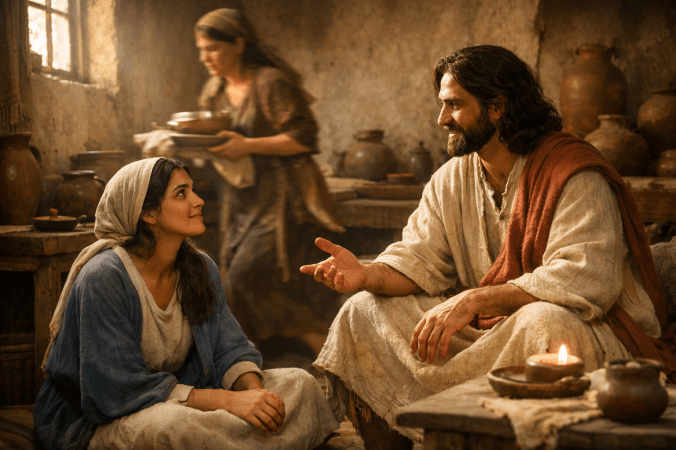
As Jesus and his disciples were on their way, he came to a village where a woman named Martha opened her home to him. She had a sister called Mary, who sat at the Lord’s feet listening to what he said. But Martha was distracted by all the preparations that had to be made. She came to him and asked, “Lord, don’t you care that my sister has left me to do the work by myself? Tell her to help me!”

“Martha, Martha,” the Lord answered, “you are worried and upset about many things, but few things are needed—or indeed only one. Mary has chosen what is better, and it will not be taken away from her.”

This wasn’t just any ordinary gathering. At the centre of the guests was Jesus himself. Martha knew Him as Messiah. She called Him Lord. No wonder she wanted everything to be perfect!

There’s a lot more going on here than meets the eye though, so let’s try to step into the story and look more closely at what’s happening. Luke doesn’t actually tell us that Martha was preparing a meal, although I think it’s safe to assume that she probably was. He simply says that she was “distracted by all the preparations that had to be made”. That could mean a lot of things. On occasion, Jesus was known to spend the night with Mary, Martha, and their brother Lazarus, so perhaps she was also preparing for overnight guests.

Keep in mind that this took place approximately 2000 years ago, in a time and place very different from our own. In order to correctly understand Scripture, it’s always important to be aware of the time, the place, and the culture that we’re reading about. In first-century Judea, there were no telephones. Martha likely had little or no warning that company was coming, no time to prepare in advance. In that time, cooking was a labor-intensive task. Meals were prepared from scratch using basic tools, locally sourced ingredients, and open-fire cooking. Martha didn’t have an instant pot, an air fryer, a microwave, or an electric oven. No wonder she was frazzled!

When this story is taught, I always feel bad for Martha. I think she often gets a bad rap. She was, in fact, doing exactly what would have been expected of her. In her culture, food preparation and serving in the home were exclusively the role the woman. Martha’s mistake was not in the work that she was doing, but in the fact that she allowed anxiety and frustration to steal her peace. Her mistake was in trying to be the perfect hostess instead of being present for her guests and especially in allowing her desire for perfection to rob her of time with Jesus.

I’m sure that most of us can identify with Martha. Like her, our lives are busy. We feel the weight of what needs to get done and there always seems to be more to do. In a culture that exalts multitasking and a “we-can-do-it-all” mentality, we too can become frustrated and overwhelmed. We get tangled up in our never ending to-do lists. Like Martha, it’s very easy for us to become “distracted” and “worried about many things”. Like her, we might find it hard to step away from the busyness of our lives to sit at the feet of Jesus.

So, what could Martha have done differently? What can we do differently? I don’t know what was on the menu at Martha’s house that day, but perhaps she was trying too hard. Perhaps she was going for perfection instead of good enough. Do we do that? Do you? Do we feel that our house has to look perfect before we can invite someone in? Do we plan an elaborate menu when our guests might be just as happy with a simple meal and a less stressed hostess?

We do know from both this story and other mentions of Martha in Scripture, that she was a close friend of Jesus. In fact, if she hadn’t been, I don’t think she would have spoken to Him the way she did. She was ticked off and she let Him know it! She was clearly angry with Mary for not helping her with the work that needed to be done, but I think she was also annoyed with Jesus for allowing it and she didn’t try to hide her feelings.

Perhaps in this way, Martha is a good example for us. Praying when we’re anxious, afraid, frustrated, or even angry with God is not only acceptable, it’s actually a good thing to do. Bringing our honest, raw emotions to Him is much healthier than bottling them up. Like Martha, it’s okay for us to say, “Lord, don’t you care?” God has all the time in the world to listen and He can handle our anger, our frustration, and our pain. Expressing those feelings is actually a sign that we truly trust Him with our full selves.

But what about Mary? Why wasn’t she helping her sister? It wasn’t unreasonable in that culture for Martha to expect Mary to be helping her serve their guests. In fact, that’s what everyone present would have expected of her; everyone except Jesus, that is.

Without understanding the cultural context, we might totally miss the significance of Mary sitting at the feet of Jesus. According to Jewish tradition, it was only men who would sit at the feet of a rabbi to learn from him. Sitting at his feet in this manner would identify a man as one of the rabbi’s disciples.

I don’t know about you, but I used to think of Martha as being the strong, dominant sister and Mary, the quiet, possibly subservient one, but that’s not actually the Mary we see here. She takes a bold and courageous stance when she chooses to join the men at Jesus’ feet. This would have been shocking to some and probably an embarrassment to her family. Mary, a woman in a male-dominated world, was breaking the social rules of her time. She was being totally counter-cultural.

In affirming her choice and telling Martha that Mary had chosen what was better, Jesus wasn’t just telling her to calm down or suggesting that she should come and sit at His feet with her sister. In a patriarchal society where men led and women followed, where men sat at the feet of a rabbi and women served, He was throwing a socially acceptable custom on its head. He was recognizing women as disciples and full-fledged members of the kingdom of God on equal footing with men.

Have you ever heard a message or read a devotional based on today’s story that asked, “Are you a Mary or a Martha?” Did it leave you feeling guilty because it seemed obvious that the answer should be that you’re a Mary, but in reality you know that you’re more like Martha, caught up in the busyness of serving others and finding it hard to make time for Jesus?

I’m here to tell you that that’s an unfair question! This isn’t an either-or situation. True disciples, male and female, are called to be both Mary and Martha, to sit and to serve, to have the heart of Mary and the hands of Martha. This story isn’t about “good vs. bad”. It’s about establishing right priorities. Mary wasn’t avoiding work, she was prioritizing presence.

So how do we do that? We can’t ignore the fact that Jesus told Martha that by sitting at His feet and listening to His teachings, Mary chose what was best, but how do we do that? That will be the topic of my next post, so I hope you’ll come back for more tomorrow!

A life transformed

Back in August when I wrote this post about several 50 year milestones in my life in 2025, I mentioned that In October it would be 50 years since I made the life-changing decision to follow Christ. A couple of readers mentioned that they would be interested in hearing more about how I reached that decision. I had already been thinking about sharing that story on the blog, so I decided I would do it today, the 50th anniversary of the day that my life was transformed.

As far back as I can remember, my family went to church every Sunday morning. I attended Sunday School and youth group and for several years, church camp was the highlight of my summers. In my early teens, I attended confirmation classes to learn more about the church and the Christian faith. The purpose of these classes was to prepare us for church membership, but when the classes ended and the minister asked me if I was ready to join the church, I said no. I felt that something was missing, but I didn’t know what it was. I knew that Jesus loved me and that He had died for me, but I felt that there must be more to it than that. When I discovered that all the other students in the class were going to join, however, I didn’t want to be the only one who was left out, so I changed my mind. After all, I was a good kid, a quiet kid who didn’t like to stand out from the crowd.

The summer before my final year of high school, my father took a job in the Northwest Territories and we moved from Vancouver to Yellowknife; from the third largest city in Canada to a small, isolated  community in the middle of nowhere. I had to leave my home, my friends, my school, my church, and everything else that mattered to a teenage girl. I wouldn’t get to graduate with my class. I was angry and I made a very conscious decision to rebel. I decided that I was going to find out how the other half lived. I quit going to church and started drinking and partying. I abandoned the morals that I had been taught and less than two years after leaving Vancouver, I entered into a teenage marriage that never should have happened.

We had only been married for a year and a half when my husband, a very charismatic narcissist, told me that he had fallen in love with someone else. He didn’t want our marriage to end though. Instead, he wanted to invite her to move in with us! I absolutely refused to allow that to happen and tried for another year to make our relationship work, but midway through my third year of university, it was over and we went our separate ways. I was broken. My dreams were shattered and I felt like unwanted, unloved garbage. That led to more unhealthy relationships.

In spite of all that was going on in my personal life, I managed to graduate from university with my teaching degree and I accepted a job in the very small town where we still live today. I realized that as a teacher in such a small community, my life would be on display for everyone to see. It was the mid 1970s and I was sure that if I continued to live the way I had been, parents wouldn’t want me teaching their kids.

Once again, I made a conscious decision to turn my life around. I thought I could do it on my own, but God had a much better plan. Richard was also a new teacher at the school that year. One evening early in the fall, he shared with me what it meant to be a Christian in a way that I had never heard before. He told me that if I acknowledged my sins, asked for God’s forgiveness, and surrendered my life to Christ, I could have a personal relationship with Him and my life would be transformed. I quickly realized that this was the missing piece that I hadn’t heard about growing up. I didn’t know that I had to make an actual decision to follow Christ or that I could have a personal relationship with Him.

At the same time, I also realized that making that decision would mean giving up control of my own life. Considering what a mess I’d been making of it up to that point, you would think that this would be an easy or obvious decision, but I wrestled with it. Eventually though, I couldn’t deny that God was calling me and I finally surrendered my stubborn will to His. When that happened my life changed completely. There were no flashes of lightning or tongues of fire, just an incredible peace that I had not known before. I felt like a brand new person, free of any guilt or shame over my past. I no longer had any desire to live the way I had been.

I quickly learned that God didn’t want to be a distant deity who cared about me, but who wasn’t personally involved in my life. Like a Japanese kintsugi artist, He began to fill the broken places in my life with gold and turn me into a vessel that He could use for His good purposes.

I wish that I could tell you that life was always easy after that, but of course, it wasn’t. In John 16:33, Jesus tells us, “In this world, you will have trouble. But take heart! I have overcome the world.” Over the past 50 years, I have suffered great loss and betrayal. I have spent the last 12 of those years fighting cancer, but I have never been alone in any of these dark times. One of my favourite Bible verses is Isaiah 41:10 which says, “Do not fear, for I am with you; do not be dismayed, for I am your God. I will strengthen you and help you; I will uphold you with my righteous right hand.” I can testify to the truth of that!

Whatever you take away from this post, please note that this is not about church or even about religion, it’s about an intimate, personal relationship with the Creator of the universe; a relationship that is available to everyone regardless of who you are and what you’ve done. If you have any questions or would like to chat about this, please feel free to comment below or send me an email at debock2@gmail.com.

Image: ChatGPT

I’m a Christian feminist

I’m a Christian feminist. Yes, there is such a thing and no, that f word isn’t an obscenity.

The label may not be a familiar one, but Christian feminism predates well known secular feminists and activists including Simone de Beauvoir, Betty Friedan, and Gloria Steinem. There is, in fact, a long history of Christian women devoting themselves to fighting for the status of women, and the right of women to vote, to own property, and to defend themselves in a court of law against rape and domestic abuse. Women like Nellie McClung who, based on her understanding of God’s intention for creation, together with Emily Murphy, Henrietta Muir Edwards, Irene Parlby and Louise McKinney, launched a legal challenge that would pave the way for women to be declared “persons” under law and to participate equally in all aspects of life in Canada. Thankfully, theirs is a rich tradition of pro-life feminism that continues today.

Within the Christian church, there are two schools of thought regarding the roles of men and women. Complementarians believe that men and women, though equal in worth, are meant to have distinctly different roles. Egalitarians, while agreeing that men and women are equal in worth, believe there should be no gender restrictions on what roles they can fulfill. Marriage and ministry are the primary points of disagreement between the two viewpoints.

When we first married, I was a baby Christian. I tried to be the submissive wife that my husband had been taught was his due simply because he was born with a Y chromosome and an extra appendage. It didn’t work. He wasn’t a good leader and, truth be told, I wasn’t a good follower. All the while, I wondered why God would want me to submit to a sinful man. Then I realized that He didn’t. We were meant to be partners, submitting to one another (Ephesians 5:21) with God as the head of our household.

But what about Ephesians 5:22-24 and Colossians 3:18, verses that exhort wives to submit to their husbands? We can’t simply ignore portions of scripture because they make us uncomfortable or dismiss the parts we don’t like. Sometimes we have to grapple with scripture. We have to understand the context and the time in which the words were written. We have to dig deep and seek to understand the principles being taught and then figure out how to apply them in our time and place.

“It’s dangerous to cherry-pick a few stand-alone verses, particularly when they are used as a weapon to silence and intimidate, effectively benching half the church… We can’t read letters written to specific people with specific situations in mind in a specific context and then apply them, broad-brush, to the whole of humanity or the church or even our own small selves.”  Sarah Bessey, Jesus Feminist

These select verses telling wives to submit to their husbands line up with the Greco-Roman household codes that were part of Pax Romana law at the time and in the place that the apostle Paul was writing his epistles. They were the law of the land at that time and, as in Romans 13:1-2, Paul is telling his readers that “everyone must submit himself to the governing authorities.”

Interestingly, just four verses after Colossians 3:18 instructs women to submit to their husbands, verse 22 tells slaves to obey their earthly masters. While wives must submit is a core teaching in most Christian churches today, no one takes that verse literally and suggests that slavery is actually a godly practice. I jokingly respond that if I have to submit to my husband, I also want my slave!

In addition to slavery, which is never actually prohibited in the Bible, the church has rightfully done away with many Biblical practices including polygamy, the buying and selling of daughters, stoning, the requirement that baby boys be circumcised, and many other ancient practices that were once culturally acceptable. Gender inequality is just one more example of an injustice that we need to let go of.

Nowhere in the Bible does it suggest that any of the gifts of the Spirt, which include teaching, pastoring, prophecy, evangelism and leadership (Romans 12, Ephesians 4, 1 Corinthians 12), are gender specific and yet many Christian churches today exclude women from these roles. Sadly, in spite of the fact that there are numerous examples of women leading, teaching, ministering, and prophesying in scripture, patriarchy is alive and well in many churches today. This is clearly contrary to Acts 2:18 which says “Even on my servants, both men and women, I will pour out my Spirit in those days, and they will prophesy.” Paul himself says in Galatians 3:28 “There is neither Jew nor Greek, slave nor free, male nor female, for you are all one in Christ Jesus.”

I served on the board of our previous church for seven years, but in our present church I would not be allowed to because I’m a woman. I’m okay with me not being on the board, but I’m not okay with half the church being denied full opportunity to use their God-given gifts simply by virtue of being female and I’m not okay with a church board not having the benefit of the female perspective. The very first chapter of the very first book of the Bible makes it abundantly clear that God created male and female in His image and gave THEM dominion over all that He had made.

According to Genesis, God did create Adam first, but He also said, “It is not good for the man to be alone. I will make a helper suitable for him.” The original word translated in English Bibles as helper or helpmeet is ezer, a word used twenty-one times in the Old Testament: twice in Genesis for the woman, three times for nations that Israel appealed to for military aid, and sixteen times for God Himself as Israel’s helper! God created His daughters to be ezers, strong and resourceful partners for His sons. He also makes it clear that in relationship, they are to become one. That’s partnership, not patriarchy! When a woman is held back, hushed up, minimized or lessened in any way, she is not free to walk in the fullness that God intended for her as His image bearer, His ezer.

“When half the church holds back – whether by choice or because we have no choice – everybody loses and our mission suffers setbacks.” Carolyn Custis James, Half the Church

So what do I make of 1 Corinthians 14:35 which says “If they want to inquire about something, they should ask their own husbands at home; for it is disgraceful for a woman to speak in the church.”? Again, if we were to delve into the historical context for this verse, we would find that it was written in direct response to disruptions that were occurring in the Corinthian church at that time. The underlying principle is not that women 2000 years later should be forbidden from speaking in church, but that a church service ought to be orderly, not chaotic, a topic that Paul actually begins to address at the beginning of chapter 11.

And what about 1 Timothy 2:12 “I do not permit a woman to teach or have authority over a man; she must be silent.”? Again, Paul’s restriction was given in the context of a personal letter to Timothy giving advice about a specific issue concerning false teaching that had arisen in the church at Ephesus. There is no suggestion that he was establishing church policy for all time. Neither is there any mention of this in the rest of Paul’s writings or elsewhere in the Bible. As has already been mentioned, there are clear examples elsewhere in scripture of women teaching, prophesying, and taking leadership roles.

So why do I, a Christian feminist, stay in a male-dominated church? First of all, there aren’t a lot of options in our small community. Fortunately, however, there are ways that I can use my spiritual gifts of teaching and faith within the confines of a patriarchal setting and I’ve always been comfortable worshipping with genuine believers who don’t see eye to eye with me on all matters. I also believe that God has placed me behind enemy lines, so to speak, for a reason. Though it likely won’t happen in my lifetime, I can pray for change and speak for justice for the women of the future. I may not be allowed to preach from the pulpit, which I don’t feel called to do anyway, but I can speak the truth, as I know it, when opportunity presents itself and I can certainly preach it from my keyboard!

For further reading on this topic, I highly recommend:

  1. Half the Church: Recapturing God’s Global Vision for Women, Carolyn Custis James
  2. Jesus Feminist: An Invitation to Revisit the Bible’s View of Women, Sarah Bessey
  3. The Making of Biblical Womanhood: How the Subjugation of Women Became Gospel Truth, Beth Allison Barr
  4. A Year of Biblical Womanhood, Rachel Held Evans

This is, of course, a controversial topic. I invite dialogue in the comment section, but I also insist that it remain a safe and respectful place for the expression of differing viewpoints and experiences.

International Women’s Day 2021

images

Today is International Women’s Day. It saddens me that we should even need to set aside a day to focus on women’s rights, to remind the world that women deserve equality. It was never meant to be this way. 

I’ve been focusing a lot on what the Bible has to say about womanhood in recent weeks as I’ve started leading a ladies Bible study on women of the Bible. The very first statement about women in the Bible comes in the first chapter of Genesis. Verses 27-31 say: 

So God created mankind in his own image, in the image of God he created them; male and female he created them. God blessed them and said to them, “Be fruitful and increase in number; fill the earth and subdue it. Rule over the fish in the sea and the birds in the sky and over every living creature that moves on the ground.” Then God said, “I give you every seed-bearing plant on the face of the whole earth and every tree that has fruit with seed in it. They will be yours for food. And to all the beasts of the earth and all the birds in the sky and all the creatures that move along the ground—everything that has the breath of life in it—I give every green plant for food.” And it was so. God saw all that he had made, and it was very good. 

Do you see what I see? First of all, we’re told that God created men and women in His own image! Both were meant to be His image bearers. Second, He gave both of them dominion over and responsibility for His creation. It was a joint assignment. God did not give men dominion over women! That was never His intention. And finally, God saw all that He had made, and it was very good. His plan was equality for men and women and it was very good

In chapter 2 of Genesis we’re given a more detailed creation story. Verse 18 says, “The Lord God said, “It is not good for the man to be alone. I will make a helper suitable for him.” The King James Version of the Bible uses the words help meet to describe the woman’s role. “Meet” is an archaic adjective meaning suitable or proper, so the phrase simply means a suitable helper. Perhaps this is where the idea that men should dominate came from, but that was never God’s intent. In the original language, the word translated as helper or help meet was ezer. Ezer is a word that appears 21 times in the Old Testament; twice in Genesis for the woman, 3 times for nations to whom Israel appealed for military aid, and 16 times to refer to God as Israel’s helper, their shield and defence. It was used consistently in a military context. That hardly brings to mind a meek or subservient helper! Perhaps strong helper would be a better translation. 

Sadly, God’s plan for a partnership between men and women didn’t play out in human history. It didn’t take long for the relationship to deteriorate to the point where women were simply possessions of their fathers or husbands, barely a step above their livestock. Their primary role was to serve the men in their lives and to produce sons to carry on their husband’s family line. 

These may be radical thoughts for a woman who attends a patriarchal church, but I’ve always been a bit of a rebel and women’s issues have been a passion of mine for a very long time. The reality is that we need to do much more than set aside one day a year to draw attention to the plight of women worldwide. It is something that needs to be addressed 365 days of the year! 

As long as there are places on this planet where parents sell their daughters because they can’t afford to feed them, where girls walk an average of 6 kilometres a day to collect clean water for their households, where they are denied education, where they are forced to undergo female genital mutilation and/or forced into child marriage, we must do more than celebrate the social, economic, cultural, and political achievements of women on International Women’s Day. It’s easy to turn a blind eye to the atrocities inflicted on women in foreign lands when they aren’t happening in our own backyard, but there are women living in abject poverty in Canada, the United States, and other developed countries. Objectifying and exploiting women is still alive and well in our culture. Violence against women is still prevalent. Human trafficking happens in our own neighbourhoods.  

Though the situation may have improved over the years, women have yet to achieve equality in the workplace. As a current example, women are at the forefront of the battle against Covid-19 as front-line and health sector workers, scientists, doctors and caregivers, yet according to a UN report, they get paid 11 percent less globally than their male counterparts!  

What, then, can we do to press for progress for women? First of all, we need to educate ourselves, to look beyond our comfortable lives and become aware of what the issues are and which reputable organizations are working to change them. If you’re serious about wanting to have an impact on the lives of women around the world, I would suggest that you begin by reading Half the Sky: Turning Oppression into Opportunity for Women Worldwide, by Pulitzer Prize winning journalists Nicholas D. Kristof and Sheryl WuDunn. This book was a life changer for me. Kristof and WuDunn are upfront and clear; they hope to recruit their readers to get involved, to become a part of a movement to emancipate and empower women by helping provide the economic resources that can help transform their lives.  Half the Sky not only inspires the reader to get involved, it gives many suggestions how.

It was after reading Half the Sky that I began making micro loans to women in third world countries through Kiva, the world’s first online micro-lending platform. It’s one small step, but it’s something I can do. Kiva is a non-profit organization that allows a person to lend as little as $25 to a specific low-income entrepreneur in one of 77 countries around the world. When a loan is repaid, the money can be withdrawn or used to fund a new loan. I choose to lend to women with children at home. All too often, money in the hands of men goes to alcohol and prostitution but in the hands of women, it nurtures children, feeds families and promotes education.

It’s International Women’s Day. What will you do? 

Banner-image-8

What fashion is NOT

LogoI’m noticing a common theme amongst the fashion bloggers that I follow and I completely identify. As the pandemic drags on and on, we’re finding it increasingly difficult to come up with new and interesting content. I refer to Following Augustine as a “lifestyle, travel, and fashion” blog, but when life is mostly stay-at-home, travel has been non-existent for almost a year, and I’ve only shopped for absolute essentials, what do I write about? I’ve been depending on my own closet for most of these weekly fashion features, trying to come up with new ways to wear old pieces, but I’m rapidly running out of ideas!


In preparation for a weekly study that I lead, I’ve spent quite a bit of time lately looking at what the Bible has to say about women, so I’m going to draw on that for today’s post. 1 Peter 3:3-4a says, “Your beauty should not come from outward adornment, such as elaborate hairstyles and the wearing of gold jewelry or fine clothes. Rather, it should be that of your inner self, the unfading beauty of a gentle and quiet spirit.” Does that mean that a Christian woman shouldn’t concern herself with style, dress in fine clothes, wear jewelry, use make-up, or write a fashion blog. Not at all! 

When looking at the Bible for guidance we need to ask ourselves what the timeless principles behind the scriptures are and how we can stay true to them in our day and age. First century Israel was under Roman rule. It was the practice of the upper class Roman women to flaunt their position by wearing elaborate hairstyles adorned with genuine jewels. They intentionally used their clothing and jewelry to set themselves apart from the lower class women. I believe that it was this attitude that the apostle Peter was warning against.  

46777e2aa293da928de45001227531de

Wall painting from the Vila San Marco, Stabiae, 1st century

I’ve written before about the 3Cs, the things I want my wardrobe to say about me. When I look in the mirror, I want what I’m wearing to say classy, confident, and comfortable. I could add to that casual and creative. I do NOT want my wardrobe to say that I think I’m better than anyone else! Fashion is not, or should not be, a competition! 

I actually had no idea where this post was going when I started writing it, but perhaps I’ll just leave you with this thought.

129944384_236449687835181_6603705724580703289_o

Having an Elijah moment

I don’t ever want to be one of those little old ladies in the nursing home who goes on and on endlessly complaining about her aches, pains, and infirmities to anyone who might be listening. On the other hand, while I’m determined to maintain a positive attitude, I’m not actually Wonder Woman and I do have my “Elijah moments”.

If you’re at all familiar with the Old Testament, you may remember the story of the prophet Elijah, who immediately after experiencing an amazing victory on Mount Carmel and defeating 450 prophets of the false god, Baal, flees into the desert when his life is threatened by the wicked queen, Jezebel. Exhausted and depressed, he sits down under a broom tree and prays to die. “I have had enough, Lord,” he said. “Take my life.” (1 Kings 19:4) Later, he goes on to say, “I have been very zealous for the Lord God Almighty. The Israelites have rejected your covenant, broken down your altars, and put your prophets to death with the sword. I am the only one left, and now they are trying to kill me too.” (1 Kings 19:10)

Poor Elijah! An emotional high followed by a crash. That’s what I call an “Elijah moment” and I can definitely identify!

As I shared in Wednesday’s post, I was elated to learn that afternoon that my cancer had not spread or grown. The very next day, however, I learned that my thyroid is no longer functioning as it should. I knew that this could happen as a result of my treatments, but it still seemed like one more in a long list of health related discouragements. In the past 5 years, since my first cancer diagnosis, there has been a second cancer, high blood pressure, prediabetes, osteopenia, and now hypothyroidism! Like Elijah, I felt like saying, “I have had enough, Lord!”

After all, I could argue that I have been very zealous about living a healthy lifestyle. I exercise regularly, I eat healthy, I don’t smoke, I drink in extreme moderation, I’ve never used illegal drugs. Heck, I don’t even drink coffee! Why me? Why another diagnosis? I was definitely having an “Elijah moment”!

But God didn’t leave Elijah under the broom tree wallowing in despondency. He sent an angel to give him food and water, then He let him rest. Later, He spoke to him in a gentle whisper, gave him someone to walk beside him and share in his work, and sent him out to continue. God wasn’t finished with Elijah yet and apparently He isn’t finished with me either! Within a few hours of learning about my failing thyroid, an email from a ministry that I’m involved with made that very clear. And so, like Elijah, I’ll keep on keeping on. I’m determined not to become that crabby little old lady who has nothing better to do than complain!

IMG_0243

Statue of Elijah on Mount Carmel – Israel trip 2016

Sometimes it’s hard to be humble

One of the characteristics of grace listed in yesterday’s post was “acts with humility, not pride.” As I pondered my One Word for 2018 and asked myself how I’m doing at becoming a woman of grace, I was also challenged to examine myself and wonder how I measure up in the area of humility.

The Bible has plenty to say about being humble. The book of Proverbs contains many warnings for those who refuse to put others before themselves and both the Old and New Testaments tell of blessings for those who do. Colossians 3:12 has become my life guide. “Therefore, as God’s chosen people, holy and dearly loved, clothe yourselves with compassion, kindness, humility, gentleness and patience.

There’s an old country and western song that says, “Oh Lord it’s hard to be humble when you’re perfect in every way!” I’ve also heard it said that if you think you’re humble, you probably aren’t. So how can we know if we’re humble or not?

After much reading and pondering, I came up with the following 20 characteristics of a humble person. I’m sure it’s not exhaustive, but I think it’s a reasonably good checklist.

A humble person…

  1. is not boastful
  2. is able to set aside personal preferences for the sake of others
  3. treats others with respect
  4. is not easily offended
  5. is grateful for what they have
  6. is able to rejoice with others
  7. is not wise in their own eyes
  8. is teachable
  9. is able to seek advice or ask for help
  10. willingly serves other people without drawing attention to themselves
  11. accepts their own limitations
  12. accepts correction without becoming defensive
  13. takes responsibility for their actions and apologizes when wrong
  14. is merciful, forgiving quickly and not holding grudges
  15. doesn’t get frustrated with the weaknesses of others
  16. is self-controlled
  17. listens to others and doesn’t feel the need to speak their mind in every situation
  18. is comfortable allowing others to have centre stage
  19. doesn’t always have to be right
  20. doesn’t insist on their own way

In a “me first” world, it isn’t always easy to be humble and there are many misconceptions about what it means. In the same way that being gracious is not the same as being wishy-washy or weak-kneed, humility is not a sign of weakness. Being humble is not belittling or undervaluing oneself, nor is it an indication of poor self-esteem. Like grace, humility is actually a strength.

Humility