Occasionally a piece of art speaks to my heart. That was certainly true of The Four by American artist, Tricia Robinson, when I saw it for the first time yesterday.
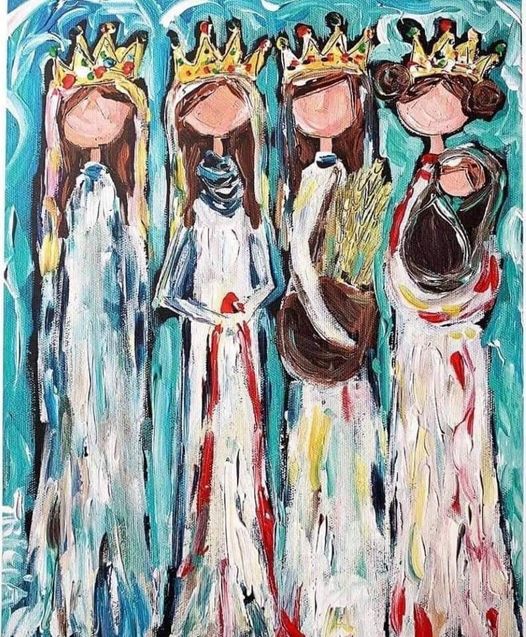
No, I wasn’t in an art gallery! Covid restrictions continue to keep me locked up at home. I actually saw the painting on Facebook! It was the vibrant colours and the simplicity of the figures that first caught my attention, but the artist’s description gave it much deeper meaning.
These four women: Tamar, Rahab, Ruth and Bathsheba have something in common. They are grandmothers in Jesus’ family tree! Grandmothers! Some had affairs, were prostitutes, lied and were truly not the starry eyed perfect princesses.
But God chose them, used them…. These four broken women.
And that’s why I gave them crowns. A symbol of grace and love from our Creator and Redeemer.
Christian author, Ann Voskamp, wrote this on her blog…
Four broken women—
women who felt like outsiders,
like has-beens,
like never-beens.Women who were weary
of being taken advantage of,
of being unnoticed
and uncherished
and unappreciated;women who didn’t fit in,
who didn’t know how to keep going,
what to believe,
where to go—
women who had thought about giving up.And Jesus claims exactly these who are
wandering
and wondering
and wounded
and worn out as
His.
These four women can be found in the pages of the Old Testament and all are part of the genealogy of Jesus found in the first chapter of the book of Matthew. Widowed at a young age and rejected by her second husband who also suffered an early death, Tamar, was left husbandless and without children. In her culture that made her worthless. Taking matters into her own hands, through an act of deception, she bore twin sons by her father-in-law who later admitted that “she is more righteous than I.” After Israel’s 40 years of wandering in the wilderness, spies were sent into the land of Canaan and found lodging with a prostitute named Rahab. After risking her life to hide them, Rahab asked that her life and the lives of her family be spared when the Israelites invaded. In the painting, she can be seen holding the scarlet cord that she was told to tie in the window of her home to mark it. Everyone inside the house would be spared. Another young widow, Ruth, left her homeland and her pagan gods to follow her aging mother-in-law back to her homeland where she would be a foreigner and an object of curiosity. She worked tirelessly gleaning in the fields at harvest time to provide for them until she was noticed by the landowner and became his wife. She eventually became the great grandmother of King David. Bathsheba suffered untold grief when the king, in an attempt to cover up an act of lust that resulted in an unplanned pregnancy, arranged to have her first husband murdered and then took her as his own wife. I can only imagine how much worse her grief became when the child of that union died. Her second son became the great King Solomon.
Yes, these were imperfect, broken women; women who’s lives didn’t go the way of little girls’ dreams, but they are also women who were cherished by God. I can identify. When I saw the painting and understood it’s meaning, I wanted to order a print to hang in my den, my room of prayer. Unfortunately, the artist doesn’t ship to Canada, so I will have to be satisfied with having it on my computer desktop where I can look at it often and be reminded that though, I too, am somewhat flawed and have been damaged by the trials of life, I am a beloved daughter of the one true God!
 Following Augustine