What’s in your little red wagon?

This is the last of a four part series based on the talks that I gave at a ladies retreat last weekend. You can find the other three here, here, and here. Although I was speaking to women, the contents of this post apply equally well to men.

In her book entitled Present Over Perfect, author Shauna Niequist describes what she calls “Leaving behind frantic for a simpler, more soulful way of living.” I especially loved this quote. “It’s like I was pulling a little red wagon, and as I pulled it along, I filled it so full that I could hardly keep pulling. That red wagon was my life, and the weight of pulling it was destroying me. I was aware that I was missing the very things I so badly longed for: connection, meaning, peace. But there was something that kept driving me forward – a set of beliefs and instincts that kept me pushing, pushing, pushing even as I was longing to rest.”

Do you ever feel that way? If so, are there some things in your little red wagon that maybe need to be taken out and put aside? Things that are taking up too much space in your life? Too much time or too much energy?

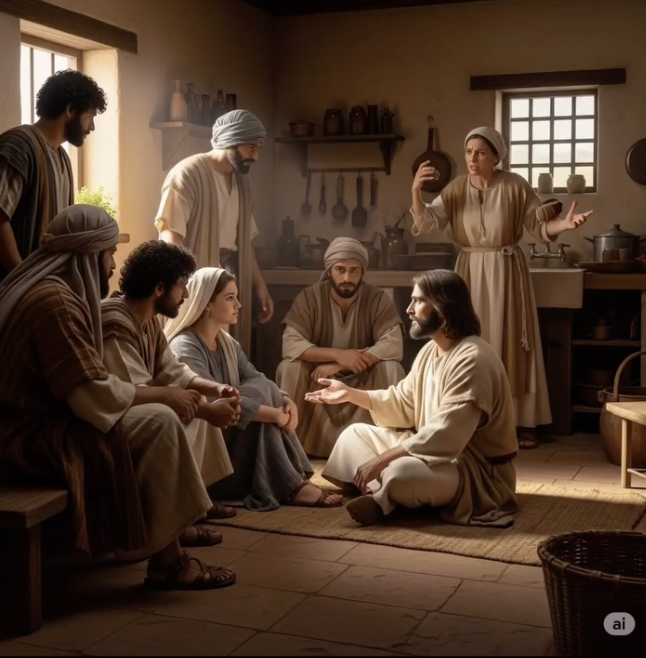
Take a moment to visualize Jesus in the flesh visiting your home, looking at your calendar, and watching how you spend your time. What would He say? He told Martha that she was worried and upset about many things, but that only one thing was needed. (Luke 10:38-42) What would he point to in your life? Where would he say, “That doesn’t need to consume so much of your time. You don’t need to devote so much energy to that.” I’m pretty sure He would tell me that I shouldn’t spend so much time scrolling on social media. Would he say to you, “You’re trying too hard. You expect too much of yourself. Come sit at my feet and listen to me.”

Choosing presence over perfection is a matter of establishing priorities and setting boundaries. Like a cross, a Christian’s priorities should focus on a vertical relationship with God first, followed by horizontal relationships with family and community.

While the amount of time we spend on certain activities is often an indicator of what our priorities are, that isn’t always the case. Our number 1 priority should always be our relationship with God, but it’s highly unlikely that we’ll ever spend more time praying and reading the Bible than we do working, keeping house, or caring for our families. God knows if you are home with little children and barely get any quiet time to spend with Him. He knows if you work long hours to help provide for your family, but He also knows when we put busyness or selfish pleasures above time with Him. If we want to have a productive, balanced, and purposeful life, we need to put Him first. So, the very first thing that we need to put into our little red wagons is our relationship with God. 

For those of us who are married, our marriage relationship should be our second priority. That goes into our wagon next. A strong marriage is the foundation of the family unit and provides stability and emotional security for both partners as well as their children. It’s very easy for us to get so caught up in all the other aspects of our busy lives that we end up neglecting our marriages and the results can be disastrous. For those of you who are still young, intentionally spending time with your spouse and nurturing your marriage relationship is also an important investment in your future. Children grow up and leave home, but marriage is intended to last a lifetime. Failing to prioritize the marriage while the kids are young often makes it difficult to reconnect later in life.

After our relationships with God and spouse comes family. When we have children at home, they require a great deal of our time, energy, and attention, so family goes into our wagon next. When our children grow up and leave home, although they’re still in our hearts, they no longer need to ride in our little red wagons. It’s time for them to start pulling their own wagons. Around that time though, we sometimes need to prioritize elderly parents who’re no longer able to pull their own wagons without help. 

Following God, marriage, and family come things like home, career, service in the church and the community, as well as self-care which I plan to write a separate post about sometime soon. As the seasons of our lives change, what we carry in our wagons continues to change. For many people, retirement removes a very heavy load and sometimes leaves them wondering what to fill their wagon with next. This is a time when service in the church or the community as well as other personal interests can begin to take up more space and we can pursue passions that we might not have had time and energy for when we were working and raising families. At any time, however, it’s very easy for our little wagons to become dangerously overloaded, so we also need to learn to establish boundaries.

Healthy boundaries are the limits we set to protect our time, energy, and emotional well-being. They’re not walls that shut people out. Instead, they’re more like property lines that say this is who I am, this is what I need, and this is what I can do. They protect your capacity to love and serve well and are necessary for creating a flourishing, purposeful life that honours God. 

As Christians, striving to honour God in all we do, it can be very difficult to set boundaries on our time and our energy because we know that we’re supposed to be loving and sacrificial, and we might fear being seen as selfish and unloving. In reality though, boundaries aren’t selfish. They are wise acts of stewardship that allow us to avoid burnout and enable us to give from a place of abundance. It’s very easy to fall into the trap of giving too much and losing sight of what we need in order to thrive.

When we establish healthy boundaries, we protect our mental, emotional, and spiritual health; we prioritize what truly matters and what aligns with our God-given purpose; and we also model self-respect, teaching others how to treat us. We keep our little red wagons from becoming so full that we can no longer push or pull them.

Setting appropriate boundaries means accepting the fact that we all have limits; that we aren’t perfect, that we can’t be and do everything for everybody all the time. It involves identifying what drains you and what fills you up and deciding what, if anything, you need to release in order to create space for the things that matter most. It means communicating limits clearly and being consistent about enforcing them. It means accepting the fact that just because you’re able to do something doesn’t mean you have to do it or that you should.

Setting boundaries involves learning to say no. When you never say no, you become the person that everyone comes to for everything and your little red wagon quickly becomes overloaded. Sometimes we even need to say no to good things because trying to do too many good things soon becomes a bad thing as it leads to stress and burnout. There’s no prize for being perfect, but there is a price to pay for trying.

Declining an invitation or saying no to a request can be surprisingly difficult, especially if you’re afraid of disappointing someone or worry that they’ll hold it against you, but sometimes it’s essential and it does get easier with practice. Learning how to say no without feeling guilty is one of the most important and most freeing lessons that I’ve learned in life, one that I wish I had learned much sooner.

One of the most important things to learn about saying no is that you don’t owe anyone an explanation or an apology. You can simply say no without giving a reason. It’s important to be polite, but firm, saying something like “I’m sorry, but I won’t be able to do that.” or “I’m flattered to be asked, but I’ll have to say no.”

One of the best strategies that I’ve adopted is not giving an immediate response to most requests. There are rare occasions when I will give an answer on the spot, but that doesn’t happen very often. I usually ask for time to check my calendar and think about an opportunity or a request before giving a definite answer. 

Of course, we don’t want to become the person who always says no. There are times when yes is the right answer. Sometimes God is opening a new door or calling us to a new challenge. It might even be one that involves stepping outside our comfort zone, but taking time to give an answer that we’ve thought about keeps us from becoming over committed. It could be that our wagon is already full and in order to say yes and add something new, we have to look at what we can take out, what we can say no to.

I want to end this series by sharing something that popped up on my Facebook feed while I was preparing this talk. Unfortunately, it sometimes takes a major shake-up to jar us into rearranging our priorities and realizing what’s most important in life. This was posted by a fellow cancer patient, but I don’t know who originally wrote it.

Before cancer, I cared more about the little things…
The things that don’t really matter.
The messy house.
The to-do list.
What people thought of me.
I thought those things were important.

After cancer… everything shifted.
Now I care more about the moments.
The quiet mornings.
The people I love.
The time I get to be here.

The little things I used to stress over…
don’t feel so big anymore.
Because when your life is shaken,
you realize what actually matters.
And it’s not perfection.
It’s not control.
It’s presence.
It’s faith.
It’s gratitude for one more day.

Present Over Perfect

Today I’m continuing a series based on the talks I gave at a ladies retreat on Saturday. You can find the first two posts here and here. I’m sorry guys, although the first two posts contained principles that apply to both men and women, this one really is for the ladies. Perhaps it would give you insight into what the women in your life are up against though.

The world as we know it sets an unreasonable standard of perfection for women that is impossible to meet. We are frequently told that we can and should “have it all”, that we should be able to effortlessly balance a successful career, a perfect family, and a beautiful home, all the while maintaining an often unattainable standard of physical beauty. A woman is told that she should have a well-toned body that is both thin and curvy, hair that’s never out of place, and skin that is flawless. At the same time, she’s supposed to be nurturing, empathetic, and kind and she should never look old or tired!

Social media has certainly contributed to this messaging, but those of my generation know that this it was around long before the internet. It just came to us in different forms through things like television, women’s magazines, and advertising. What social media has done is significantly increase the level of unhealthy competition between women. What we generally see on Facebook, Instagram, and TikTok are carefully curated highlights of other people’s lives and we’re often left feeling that we don’t quite measure up. We see perfection that isn’t real or sustainable.

Romans 12:2 tells us, Do not conform to the pattern of this world, but be transformed by the renewing of your mind. Then you will be able to test and approve what God’s will is—his good, pleasing and perfect will.”

“Do not conform to the pattern of this world” tells us to leave behind the heavy weight of comparison, competition, and exhaustion brought on by the messaging that bombards us. Like Mary of Bethany (Luke 10:38-42), we are to be counter-cultural Christian women, but how do we do that?

Before I try to answer that, let’s think about what messages the church gives us about who or what we should be. The New Testament tells us a lot about correct Christian character, but it’s the Proverbs 31 woman from the Old Testament who is often held up to us as an example of perfect or godly womanhood. In case you’re not familiar with this paragon of virtue, she is described as exceptionally wise and industrious. She is trustworthy, diligent, generous to the poor, and strong in character. She earns the praise of her husband, her children, and her community. As Christian women, many of us cringe when we hear her mentioned because her perfection is intimidating!

The book of Proverbs was written roughly 2700 to 3000 years ago, but the woman it describes isn’t actually all that different from us today. She’s a wife and a mother with a household to run, but she’s also a woman with a career. Scripture tells us that she’s both the owner of a vineyard and a profitable trader. She seems to fit the mold of “having it all” – a perfect balance of career, family, and personal well-being. Not only does she ensure that her family’s needs are met, but she works vigorously and demonstrates good business sense. We’re also told that she’s up before dawn and works well into the night, so I do question her time management skills and I have to wonder how exhausted she would actually have been!

The virtuous woman of Proverbs 31 is formidable and impressive, but her accomplishments and commitment to her family create unrealistic expectations for us. Rest assured however, she was never meant to be a checklist of tasks to perform or a measuring stick to beat ourselves up with.

Trying to extract and apply wisdom from ancient literature should be done very carefully. Most Bible scholars agree that this passage was probably written by Bathsheba, one of King David’s wives, advising her son, Solomon, who would someday be king, about the kind of wife she wanted him to choose. She wasn’t actually a real woman at all! This was a loving mother’s description of the perfect wife for her son and honestly, what mother doesn’t want a perfect spouse for her child? It also describes one who would be the wife of a king, a woman who would have far more resources than the average middle-class woman today, a woman with servants to help with many of her daily chores. Who among us wouldn’t like that?!

At the end of the lengthy description of this woman’s qualities and accomplishments, Proverbs 31:30 goes on to tell us, Charm is deceptive, and beauty is fleeting; but a woman who fears the Lord is to be praised.” It’s not the woman with a perfectly sculpted body who is to be praised. It’s not the mom with perfectly behaved children wearing matching, designer outfits or the woman with a spotless house. It’s not the woman who excels at her career, it’s the woman who fears the Lord! That’s the woman who is to be praised! That’s the woman we want to be. (If the word “fears” in this verse bothers you, there are several Bible translations and paraphrases that use terms like “honours,” “reveres,” or “respects” to convey the meaning of holy awe rather than the idea of being afraid of God.)

So, back to the question, how do we become counter-cultural Christian women, women who aren’t intimidated and burdened by all this pressure to be perfect?

Let’s take another look at Romans 12:2. Do not conform to the pattern of this world, but be transformed by the renewing of your mind.”

It’s not about striving for perfection. It’s about Jesus inviting us to sit at His feet and to allow His Holy Spirit to shape and refine us. It’s about actively allowing our thinking to change from worldly perspectives to godly ones, about allowing the Holy Spirit to reorder our thoughts to align with God’s will. It’s about shifting our focus from perfection to presence; presence with God, presence with family, presence in all the many tasks that fill our daily lives.

My next post, which will be the last one in this series, will give some practical pointers on how to live this “presence over perfection” lifestyle.


Sitting at His feet

I ended yesterday’s post with a question. How can we, like Mary of Bethany, sit at the feet of Jesus and learn from Him? (Luke 10:38-42) Today, I will try to answer that question by sharing a slightly edited version of the remainder of the first talk that I gave at a ladies retreat on Saturday. Again, although I was speaking to women, what I’m sharing applies to both men and women.
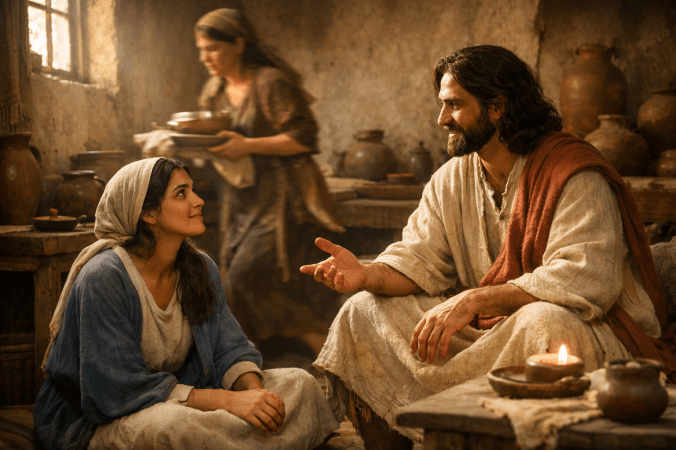
A.W. Tozer, a prominent 20th century pastor, author, and editor, said that “God can be known satisfactorily only as we devote time to Him” but how do we do that? I want to look at three answers to that question: Scripture, prayer, and community. There’s no one size fits all, perfect way to spend time with Jesus, but these three components are vital parts of a life with Him.

Let’s start with the Word of God. The Bible is so much more than just an ancient text. It’s filled with timeless truths and profoundly practical principles that are just as applicable today as they were when they were written thousands of years ago. The world in which we live has changed, but the principles are eternal.

There are many different ways to incorporate Scripture into our daily lives. Although there’s nothing inherently wrong with them, I’m not actually a big fan of read through the Bible in one year plans. You start off in Genesis with the stories of creation, Adam and Eve, Noah’s ark, Abraham, Isaac, Jacob, and Joseph. Exciting stories that keep you reading. Then you move into Exodus and read about God saving His people from slavery in Egypt, but after that comes Leviticus, a book about laws, rituals, sacrifices, and priestly duties. Perhaps you push through that only to find that Numbers is aptly named as the first few chapters detail a census counting the entire Israelite population by clan and family. By this point many people with great intentions get bogged down and give up. If that’s been you, you were probably left feeling frustrated and guilty, as if you’d failed at something important.

I really like something that our pastor said in his sermon several weeks ago. “The Bible isn’t a book to get through, it’s a book to get through to you.” 

If you do decide to read through the entire Bible from start to finish, doing it in one year might not be a manageable goal for you. That requires reading more than three chapters a day. Instead, if that’s more than you can realistically see yourself doing, try taking smaller, more manageable bites and really focusing on what you read. So what if it takes three or four years or even longer to finish? It’s not a race!

An option that I prefer for reading from Genesis through to Revelation is a chronological Bible that rearranges the text into the order that the events occurred historically, rather than the traditional order that we’re used to. It makes so much more sense to me that way. Many of the most commonly used versions are available in this format, but regardless of how you decide to incorporate Scripture into your daily life, make sure you choose a translation that you find easy to understand.

Instead of reading through the entire Bible, there are many other ways to incorporate Scripture into your busy days. There are, of course, print and online devotionals that provide short, daily readings and small portions of Scripture. Listening to an audio Bible is another great option that can be done almost anywhere.

Psalm 119:11 says, I have stored up your word in my heart.” Regardless of how we do that, our goal must be more than surface knowledge. Instead, we need to allow the truth of God’s Word to sink deep into our hearts and shape our lives. We need to be like Mary sitting at Jesus’ feet. I suspect that she hung on every word He said. I don’t think she was daydreaming. Her mind wasn’t wandering and she wasn’t dwelling on the next thing on her to-do list.

God knows what season of life each one of us is in. He knows that the amount of time that we’re able to carve out for Him will vary at different times in our lives. We just need to make sure that we’re giving Him quality time. Whether you read three chapters a day or just a few verses, It’s very easy to fall into the trap of simply performing another duty, something else to check off on your to-do list. Don’t just skim over what you read, take time to really think about what it’s saying to you.

While Scripture is God speaking to us, prayer is us in conversation with Him. It’s how we stay close to Him. Jesus often withdrew to desolate, quiet places to pray. If He, the Son of God, needed solitude with the Father, how much more do we?

While a place of solitude sounds great, that might not be realistic for you in the season of life that you’re in right now. I go into my den and close the door for a time of prayer every morning, but I realize that being retired, I’m speaking from a position of privilege. That hasn’t always been the case. My den used to be a child’s bedroom and in those days, mornings certainly didn’t look like they do now. They were a hectic rush of making sure that everyone was dressed, fed, and ready to leave for school on time. During the 18 years that I taught in the next little town down the highway, my prayer time was in the vehicle on the way to school and back. I also remember praying in the bath when that was my only alone time. The point isn’t isolation though, it’s presence. It’s sitting at the feet of Jesus whenever and wherever works best for you at this point in your life.

In 1 Thessalonians 5:17-18, Paul gives us a clear and challenging command, Pray without ceasing, give thanks in all circumstances; for this is God’s will for you in Jesus Christ.” He doesn’t describe a prayer time, but a prayer life, an ongoing conversation with our Lord. Intentionally setting aside a specific time and place to pray each day is an important spiritual practice, but we can also pray anytime, anywhere. Praying isn’t just speaking though, it’s slowing down, listening, sitting with God, and letting Him speak into the never-ending noise. It’s a relationship, not a request line and it isn’t something to be squeezed into the edges of life.

Also, our love for God isn’t measured by how perfect our prayers sound. If Jesus is our friend, as Scripture tells us He is, and as He was to Mary and her sister, Martha, then we can talk to Him as we would to anyone else. We can tell Him anything. If it’s important to you, it’s important to God. Whether it’s praying for an open parking space or an end to the war in Ukraine, there’s nothing too big or too small to talk to Him about.

Although making Scripture and prayer part of our daily lives are usually solitary activities, God didn’t design us to live the Christian life alone. It’s a group project, not a solo event. We can’t be all that He designed us to be without community. We don’t have what it takes to thrive on our own. We need each other’s gifts and each other’s presence. When we walk with others whose lives are aligned with the Word of God, they challenge us, encourage us, and help us see what we can’t see on our own. We need people who will remind us of what’s true when we falter, who will pray when we can’t find the words, who will walk beside us when we feel like we can’t go on. That requires more than simply doing church together on Sunday mornings. It means getting to know one another on a deeper level. That’s one of the benefits of being part of a small group Bible study.

In John 15:4, Jesus said, Abide in me, as I also abide in you.” He didn’t say visit occasionally or check in when it’s convenient. He didn’t say, see you next Sunday! He said abide, remain, sit at my feet.

I’m going to conclude with a slightly altered version of an illustration from the book, Living by the Word, by Seth M. Jones:

Abiding is like tending a fire in winter. You don’t just light it once and walk away expecting the warmth to last. You return to it. You feed it. You guard it from going out. Your presence is required. Prayer, scripture, and community are three of the logs we lay on that fire. Without them, our love for God cools into embers, but with them it burns bright, steady, and strong.

In my next post, I plan to share from the second talk that I gave on Saturday on the theme, Present Over Perfect.

Lessons from Mary and Martha

I was the speaker at a ladies retreat at our church yesterday. Although a late spring snowstorm kept a few women away, those of us who were able to be there had a wonderful time. Our theme was Present Over Perfect and I was given two Scripture passages to speak from. A lot of work went into preparing what I was going to say, so I’d like to share some of it with a broader audience. I’ll do a bit of editing and I’ll break it down into several posts as I doubt you’d want to read it all in one go. Please keep in mind that I was speaking to women, but I think there are principles here that apply to both men and women.

Have you ever felt overwhelmed trying to prepare a special meal for a dozen or more guests? Perhaps it was Christmas or Easter and you wanted everything to be just right. That was likely the case with Martha of Bethany. The story is just five verses in Luke chapter 10.

As Jesus and his disciples were on their way, he came to a village where a woman named Martha opened her home to him. She had a sister called Mary, who sat at the Lord’s feet listening to what he said. But Martha was distracted by all the preparations that had to be made. She came to him and asked, “Lord, don’t you care that my sister has left me to do the work by myself? Tell her to help me!”

“Martha, Martha,” the Lord answered, “you are worried and upset about many things, but few things are needed—or indeed only one. Mary has chosen what is better, and it will not be taken away from her.”

This wasn’t just any ordinary gathering. At the centre of the guests was Jesus himself. Martha knew Him as Messiah. She called Him Lord. No wonder she wanted everything to be perfect!

There’s a lot more going on here than meets the eye though, so let’s try to step into the story and look more closely at what’s happening. Luke doesn’t actually tell us that Martha was preparing a meal, although I think it’s safe to assume that she probably was. He simply says that she was “distracted by all the preparations that had to be made”. That could mean a lot of things. On occasion, Jesus was known to spend the night with Mary, Martha, and their brother Lazarus, so perhaps she was also preparing for overnight guests.

Keep in mind that this took place approximately 2000 years ago, in a time and place very different from our own. In order to correctly understand Scripture, it’s always important to be aware of the time, the place, and the culture that we’re reading about. In first-century Judea, there were no telephones. Martha likely had little or no warning that company was coming, no time to prepare in advance. In that time, cooking was a labor-intensive task. Meals were prepared from scratch using basic tools, locally sourced ingredients, and open-fire cooking. Martha didn’t have an instant pot, an air fryer, a microwave, or an electric oven. No wonder she was frazzled!

When this story is taught, I always feel bad for Martha. I think she often gets a bad rap. She was, in fact, doing exactly what would have been expected of her. In her culture, food preparation and serving in the home were exclusively the role the woman. Martha’s mistake was not in the work that she was doing, but in the fact that she allowed anxiety and frustration to steal her peace. Her mistake was in trying to be the perfect hostess instead of being present for her guests and especially in allowing her desire for perfection to rob her of time with Jesus.

I’m sure that most of us can identify with Martha. Like her, our lives are busy. We feel the weight of what needs to get done and there always seems to be more to do. In a culture that exalts multitasking and a “we-can-do-it-all” mentality, we too can become frustrated and overwhelmed. We get tangled up in our never ending to-do lists. Like Martha, it’s very easy for us to become “distracted” and “worried about many things”. Like her, we might find it hard to step away from the busyness of our lives to sit at the feet of Jesus.

So, what could Martha have done differently? What can we do differently? I don’t know what was on the menu at Martha’s house that day, but perhaps she was trying too hard. Perhaps she was going for perfection instead of good enough. Do we do that? Do you? Do we feel that our house has to look perfect before we can invite someone in? Do we plan an elaborate menu when our guests might be just as happy with a simple meal and a less stressed hostess?

We do know from both this story and other mentions of Martha in Scripture, that she was a close friend of Jesus. In fact, if she hadn’t been, I don’t think she would have spoken to Him the way she did. She was ticked off and she let Him know it! She was clearly angry with Mary for not helping her with the work that needed to be done, but I think she was also annoyed with Jesus for allowing it and she didn’t try to hide her feelings.

Perhaps in this way, Martha is a good example for us. Praying when we’re anxious, afraid, frustrated, or even angry with God is not only acceptable, it’s actually a good thing to do. Bringing our honest, raw emotions to Him is much healthier than bottling them up. Like Martha, it’s okay for us to say, “Lord, don’t you care?” God has all the time in the world to listen and He can handle our anger, our frustration, and our pain. Expressing those feelings is actually a sign that we truly trust Him with our full selves.

But what about Mary? Why wasn’t she helping her sister? It wasn’t unreasonable in that culture for Martha to expect Mary to be helping her serve their guests. In fact, that’s what everyone present would have expected of her; everyone except Jesus, that is.

Without understanding the cultural context, we might totally miss the significance of Mary sitting at the feet of Jesus. According to Jewish tradition, it was only men who would sit at the feet of a rabbi to learn from him. Sitting at his feet in this manner would identify a man as one of the rabbi’s disciples.

I don’t know about you, but I used to think of Martha as being the strong, dominant sister and Mary, the quiet, possibly subservient one, but that’s not actually the Mary we see here. She takes a bold and courageous stance when she chooses to join the men at Jesus’ feet. This would have been shocking to some and probably an embarrassment to her family. Mary, a woman in a male-dominated world, was breaking the social rules of her time. She was being totally counter-cultural.

In affirming her choice and telling Martha that Mary had chosen what was better, Jesus wasn’t just telling her to calm down or suggesting that she should come and sit at His feet with her sister. In a patriarchal society where men led and women followed, where men sat at the feet of a rabbi and women served, He was throwing a socially acceptable custom on its head. He was recognizing women as disciples and full-fledged members of the kingdom of God on equal footing with men.

Have you ever heard a message or read a devotional based on today’s story that asked, “Are you a Mary or a Martha?” Did it leave you feeling guilty because it seemed obvious that the answer should be that you’re a Mary, but in reality you know that you’re more like Martha, caught up in the busyness of serving others and finding it hard to make time for Jesus?

I’m here to tell you that that’s an unfair question! This isn’t an either-or situation. True disciples, male and female, are called to be both Mary and Martha, to sit and to serve, to have the heart of Mary and the hands of Martha. This story isn’t about “good vs. bad”. It’s about establishing right priorities. Mary wasn’t avoiding work, she was prioritizing presence.

So how do we do that? We can’t ignore the fact that Jesus told Martha that by sitting at His feet and listening to His teachings, Mary chose what was best, but how do we do that? That will be the topic of my next post, so I hope you’ll come back for more tomorrow!

Why Me? Coping with cancer and survivor’s guilt

This has been a very hard week.

I think it’s common for people to ask “Why me?” when they’re diagnosed with cancer or another life threatening illness, but that wasn’t my experience. In fact, I clearly remember thinking, “Why not me?” After all, nearly 2 in 5 Canadians are expected to develop cancer at some point in their lives. Why wouldn’t I be one of them?

There are times though when I do ask “Why me?” When I walk into the cancer clinic for an appointment and see patients who are so much worse off than I am, I can’t help wondering why I’ve been so fortunate and they haven’t. Surviving longer, having an easier time with treatments, and/or experiencing fewer side effects often cause cancer patients like me to experience what’s known as survivor’s guilt. This is a complex emotional response where survivors feel guilty, sad or unworthy for living and recovering while others don’t.

Once again, this week has left me asking, “Why me?” In a period of less than 48 hours, we lost two very special people to cancer. One, our son-in-law’s younger sister, was a woman in her 40s whose youngest child is still in high school. The second was a very dear friend who we first met in 2013 when we were teaching English in China and her husband was on staff with us. As couples, we did many things together, even traveling and climbing the Great Wall together. Since they retired to Mexico several years ago, we’ve visited them several times and had many more interesting adventures together. Why is it that, almost 12 and a half years after being diagnosed with an incurable cancer, I continue to live a fairly normal and productive life while both these women suffered much more than I have and are gone less than a year after diagnosis? Logically, I know that their cancers were more aggressive than mine, but I can’t help asking why I’m still here and they are not.

There are, of course, no answers to these questions.  I can only conclude that God isn’t finished with me yet and determine to make good use of whatever time I have left. In fact, that’s one of the recommended ways of dealing with survivor’s guilt and I suspect it’s the reason that I’ve felt driven these past few years to do many of the things I do. Things like editing loan descriptions for Kiva, a nonprofit organization that facilitates microloans to help alleviate poverty in underprivileged areas of the world. Things like writing letters for a Christian prison ministry and helping lead a provincial patient support group. These are things that help me find purpose and meaning in survival.

I also know that guilt, including survivor’s guilt, is one of the common stages of grieving. As I grieve the losses that we’ve experienced this week, I know that it’s normal for me to be feeling this way right now and so I acknowledge the feeling and don’t despair.

One word for 2026

At the beginning of each new year, I like to choose one word to inspire or guide me throughout the year ahead as well as a scripture verse to go along with it. For the past two years, my word was hope, a word that continues to inspire me to hold fast to a God who is who He says He is and can do what He says He will do.

Although I often find myself pondering what my new word should be during the final days of December, I’ve known since late summer or early fall what my one word for 2026 would be.

Joy!

The New Oxford American Dictionary defines joy as “a feeling of great pleasure and happiness” but joy is much more than that. Joy is a choice. It’s a a deep, enduring contentment that isn’t dependent on circumstances.  It’s a deeper emotion than happiness and often comes from having a sense of purpose or from meaningful relationships with other people. Happiness is fleeting, but joy sees beauty even during trying times. My goal this year is to be intentional about looking for moments of joy each day.

There were many Bible verses that I could have chosen to go along with my one word for 2026, but I settled on Romans 15:13 because it so beautifully ties this year’s word with my last one.

May the God of hope fill you with all joy and peace as you trust in him, so that you may overflow with hope by the power of the Holy Spirit.”

Have you chosen a word for 2026? I’d love to know what it is.

A life transformed

Back in August when I wrote this post about several 50 year milestones in my life in 2025, I mentioned that In October it would be 50 years since I made the life-changing decision to follow Christ. A couple of readers mentioned that they would be interested in hearing more about how I reached that decision. I had already been thinking about sharing that story on the blog, so I decided I would do it today, the 50th anniversary of the day that my life was transformed.

As far back as I can remember, my family went to church every Sunday morning. I attended Sunday School and youth group and for several years, church camp was the highlight of my summers. In my early teens, I attended confirmation classes to learn more about the church and the Christian faith. The purpose of these classes was to prepare us for church membership, but when the classes ended and the minister asked me if I was ready to join the church, I said no. I felt that something was missing, but I didn’t know what it was. I knew that Jesus loved me and that He had died for me, but I felt that there must be more to it than that. When I discovered that all the other students in the class were going to join, however, I didn’t want to be the only one who was left out, so I changed my mind. After all, I was a good kid, a quiet kid who didn’t like to stand out from the crowd.

The summer before my final year of high school, my father took a job in the Northwest Territories and we moved from Vancouver to Yellowknife; from the third largest city in Canada to a small, isolated  community in the middle of nowhere. I had to leave my home, my friends, my school, my church, and everything else that mattered to a teenage girl. I wouldn’t get to graduate with my class. I was angry and I made a very conscious decision to rebel. I decided that I was going to find out how the other half lived. I quit going to church and started drinking and partying. I abandoned the morals that I had been taught and less than two years after leaving Vancouver, I entered into a teenage marriage that never should have happened.

We had only been married for a year and a half when my husband, a very charismatic narcissist, told me that he had fallen in love with someone else. He didn’t want our marriage to end though. Instead, he wanted to invite her to move in with us! I absolutely refused to allow that to happen and tried for another year to make our relationship work, but midway through my third year of university, it was over and we went our separate ways. I was broken. My dreams were shattered and I felt like unwanted, unloved garbage. That led to more unhealthy relationships.

In spite of all that was going on in my personal life, I managed to graduate from university with my teaching degree and I accepted a job in the very small town where we still live today. I realized that as a teacher in such a small community, my life would be on display for everyone to see. It was the mid 1970s and I was sure that if I continued to live the way I had been, parents wouldn’t want me teaching their kids.

Once again, I made a conscious decision to turn my life around. I thought I could do it on my own, but God had a much better plan. Richard was also a new teacher at the school that year. One evening early in the fall, he shared with me what it meant to be a Christian in a way that I had never heard before. He told me that if I acknowledged my sins, asked for God’s forgiveness, and surrendered my life to Christ, I could have a personal relationship with Him and my life would be transformed. I quickly realized that this was the missing piece that I hadn’t heard about growing up. I didn’t know that I had to make an actual decision to follow Christ or that I could have a personal relationship with Him.

At the same time, I also realized that making that decision would mean giving up control of my own life. Considering what a mess I’d been making of it up to that point, you would think that this would be an easy or obvious decision, but I wrestled with it. Eventually though, I couldn’t deny that God was calling me and I finally surrendered my stubborn will to His. When that happened my life changed completely. There were no flashes of lightning or tongues of fire, just an incredible peace that I had not known before. I felt like a brand new person, free of any guilt or shame over my past. I no longer had any desire to live the way I had been.

I quickly learned that God didn’t want to be a distant deity who cared about me, but who wasn’t personally involved in my life. Like a Japanese kintsugi artist, He began to fill the broken places in my life with gold and turn me into a vessel that He could use for His good purposes.

I wish that I could tell you that life was always easy after that, but of course, it wasn’t. In John 16:33, Jesus tells us, “In this world, you will have trouble. But take heart! I have overcome the world.” Over the past 50 years, I have suffered great loss and betrayal. I have spent the last 12 of those years fighting cancer, but I have never been alone in any of these dark times. One of my favourite Bible verses is Isaiah 41:10 which says, “Do not fear, for I am with you; do not be dismayed, for I am your God. I will strengthen you and help you; I will uphold you with my righteous right hand.” I can testify to the truth of that!

Whatever you take away from this post, please note that this is not about church or even about religion, it’s about an intimate, personal relationship with the Creator of the universe; a relationship that is available to everyone regardless of who you are and what you’ve done. If you have any questions or would like to chat about this, please feel free to comment below or send me an email at debock2@gmail.com.

Image: ChatGPT

Where was God?

Sitting down to write a blog post seems almost frivolous in light of the horrific events that have unfolded in Texas and New Mexico over the past week and a bit. We’ve seen whole buildings washed downstream like bits of flotsam. We can’t look at the news or scroll through social media (something I admit to doing way too much of) without seeing the faces of adults and children who were swept away by a raging torrent. We read agonizing reports from those who sift through the debris searching first for survivors and now for bodies to bring some sense of closure to grieving families.

How can I, who loved going to summer camp year after year when I was growing up, wrap my head around Camp Mystic? As an adult, I’ve slept in dusty old camp cabins with groups of little girls under my care. Some of those same cabins were later swept away by a flood, but thankfully no one was in them at the time. As a parent, I’ve packed up my own children and sent them off to camp trusting that they’d come home with happy stories of their time away.

I can easily imagine the whispers and giggles of little girls settling into their bunks for the night, but then came the nightmare; the rushing waters that weren’t just a bad dream. How can we even begin to process that?

Where was God in this? Couldn’t He have stopped the flood? Couldn’t He have saved every one of those lives? Why did He let this happen? Those are hard questions. Questions that might shake a person’s faith. Questions that don’t have easy answers.

I’m not here to give pat answers, to try to explain the unexplainable. I will simply tell you what I know and that is that God is still present and He is still good. This tragedy is not a sign of His anger or His judgement. He was there in the chaos and He is there for those who were left behind to grieve. Yes, He could have stopped it from happening, but for reasons that are far beyond my understanding, He chose not to.

This is not a time for speculation as to causes or for blame. It is a time for grieving, for lament, for prayer, and for reflection. It is also a time when we are reminded of the brevity and the fragility of life. Perhaps it should be a time for reevaluation. A time to ask, what am I doing with the time I’ve been given? Will my life make a difference? Am I ready for eternity?

The most important things

I had a different idea in mind for this week’s post, but then I read something that caused me to pause and think about the important things in life. The truly important things.

If I were to ask many people what’s most important in life, their answers would probably include things like family, good health, happiness, financial or job security, and a safe place to live. Depending on their circumstances, they might even say enough to eat or clean drinking water. These are, after all, very important. In fact, it was some of these things that first came to mind when I started asking myself what’s most important in life, but then I thought of something else.

When Jesus was asked which commandment was most important, He replied, “‘Love the Lord your God with all your heart and with all your soul and with all your mind.’ This is the first and greatest commandment. And the second is like it: ‘Love your neighbour as yourself.'” 

My faith, my personal relationship with God, is the most important thing in my life because it’s the only thing of eternal value, but it was actually Christ’s second statement that I was thinking about when I sat down to write this post. “Love your neighbour as yourself.” The Bible actually has a lot to say about how we treat one another. In fact, the “golden rule” that we were taught as children actually comes directly out of Scripture. Luke 6:31 says, “Do to others as you would have them do to you.”

So why have I been thinking about the importance of how we treat one another? In Canada and the US, at least, and perhaps other parts of the world as well, we have become very polarized people. We are sharply divided along political lines. No sooner had Canadians drawn together in response to threats from our southern neighbour than our own federal election tore us apart again. As I feared would happen, we went from “elbows up” unity to attacking one another for our political views. Nowhere was worse than on social media where people tend to say things they wouldn’t say in person.

Politics is important, but is it the most important thing? Is it worth losing friendships over? Surely each of us is entitled to have our own opinion and to express it without condemnation. Can’t we disagree, but still treat one another with respect or must we vilify those who don’t see eye to eye with us?  After all, while we might not agree on which party is the right one to govern or which leader is the most competent, we all want the same things. We all want what’s best for our country, our families, and ourselves.

Perhaps the most important things in life aren’t things at all. Perhaps our character, who we are and how we treat others, is much more important.

Resurrection Sunday!

If you are one who usually reads my blog on Fridays, you will have noticed that there wasn’t a new post this week. We spent Good Friday with family and it was indeed a good day. In the morning, we attended a solemn service commemorating the final 24 hours leading up to our Lord’s crucifixion. I don’t think there’s any better way to explain the significance of Good Friday than by sharing the B.C. comic. It says it all. Jesus took my place. He took your place. And He did it willingly. Thankfully though, that wasn’t the end of the story.

Today is Easter, the day that we celebrate the fact (yes, it is a fact) that the broken, battered body that was laid in a borrowed tomb overcame death and rose again! A more fitting name for the day would actually be Resurrection Sunday.

It is thought that the word, Easter, which doesn’t appear in the Bible, was probably derived from the name of Eostre, a pre-Christian goddess in England who was celebrated at beginning of spring. Given the symbolism of new life and rebirth, it seems fitting to celebrate the resurrection of Jesus at this time of year, but the real reason that this time of year was chosen is the close proximity to the Jewish Passover. It was during the Passover festival that Jesus was executed.

Regardless of what we call it though, Easter is the most important day on the Christian calendar. It is the day that we celebrate victory over sin and death.

“Jesus said to her, “I am the resurrection and the life. The one who believes in me will live, even though they die.”  John 11:25

If you haven’t accepted Jesus as your Lord and Saviour, this verse might seem like nonsense to you. How can we live if we die? Look back at the comic. Death is the punishment for our sins, our wrongdoings. The Bible tells us that there is no one without sin, not even one, except for Jesus Christ, and He chose to take our punishment. Yes, our bodies will eventually die, but the essence of who we are is not this physical body. It is the spirit that lives within. On Resurrection Sunday, we celebrate the fact that if we accept His payment for our sin, the spirit that is the real me, the real you, will spend eternity with Him. We will not die!

This is not religion. It’s not a set of rules and regulations. It’s a relationship; a relationship with the one who made us and who willingly died for us.

How do I know that this is true? I know because almost fifty years ago He changed my life completely. He took a messed-up life that would surely have ended in despair and transformed it into one that experiences deep inner peace and joy even in the most trying of times. I know because He speaks to me. Like a child with a parent, I don’t always like what He says, but I’ve learned that He always wants what is best for me. I know because He is always with me. I am never alone.

If you don’t know this kind of peace, why not make this Resurrection Sunday the day you decide to accept His free gift of life? It’s as simple as ABC. Admit that you are a sinner (we all are!) Believe that Jesus willingly took your place, died for your sins, and rose again in victory over sin and death. Confess Him as Lord of your life and choose to live in obedience to Him. If you choose to do that today, please let me know, or if you have any questions, feel free to email me at elainedebock@gmail.com.

The tomb is empty. Happy Easter!