 My weekly Fashion Friday feature is taking a break today as I have something much more important to share. November 10 is World NET Cancer Day, a day set aside to raise awareness of neuroendocrine cancer, the disease that I’ve been fighting since 2013. Those of us who have been affected by NETS (neuroendocrine tumours) hope that for today our voices will rise above those of all the more well-known and prominent diagnoses. Today is our day to be heard by decision makers, health professionals and the general public. In addition to raising awareness, we want to encourage more funds for research, treatments, and patient support; and to advocate for equal access to care and treatment for NETS patients around the world.
So as not to disappoint those of you who came looking for a fashion post, here’s what I’m wearing today… my CNETS Canada t-shirt. I don’t usually wear graphic tees, but the message on this one is a vital one.
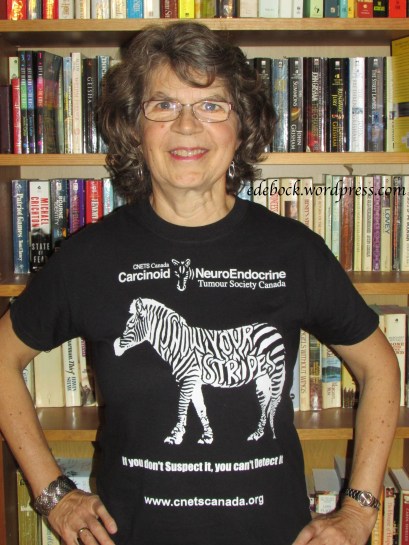
If you don’t suspect it, you can’t detect it.
So what’s with the zebras? Medical students are taught when hearing hoofbeats, to think of horses, not zebras. Neuroendocrine tumours are difficult to diagnose. Though they are the fastest growing class of cancers worldwide, their symptoms are usually vague and similar to more common health problems. Many family doctors have never encountered a NETS patient. When presented with symptoms like stomach pain and diarrhea, they naturally think of things like Irritable Bowel Syndrome, Crohn’s Disease or lactose intolerance. They think of horses, not zebras. Hence, the zebra became our symbol.
As with all cancers, early diagnosis is important. Sadly it doesn’t happen often. If the initial tumour is found before any secondary growths occur, it can often be removed surgically and the patient is considered cured. Once it has spread, however, the disease is incurable.
NETS arises from neuroendocrine cells which can be found anywhere in the body. The most common types are found in the lungs, bronchi, thymus, pituitary, thyroid, adrenal glands, intestines, pancreas, appendix, and rectum. They may also occur in other areas including the ovaries, cervix, testicles, and spleen. NETS is a slow growing cancer that is often misdiagnosed. By the time a correct diagnosis is made, the cancer has often spread. In fact, 60 to 80% of NET cancer patients are diagnosed with advanced disease.
My primary tumour was in my colon. At the time of diagnosis, I also had three tumours on my liver and one in a lymph node. It was estimated that I had already had the disease for ten years when it was detected quite by accident! Off and on for at least seven or eight years I had been experiencing most of the common symptoms which include abdominal cramps, diarrhea, flushing of the skin, pounding of the heart, and wheezing or shortness of breath. Neither I nor my family doctor had any idea why.
Today coffee shops across Canada and around the world, including The Wooden Spoon here in Sedgewick, will be raising awareness about NETS by using special coffee cups bearing the slogan “Lets talk about NETS” and handing out promotional material to help educate their customers about the disease.

What can you do to help? You can help us spread awareness by simply reposting this on your blog if you have one or posting a link to it on your Facebook page. Thank you so much!


