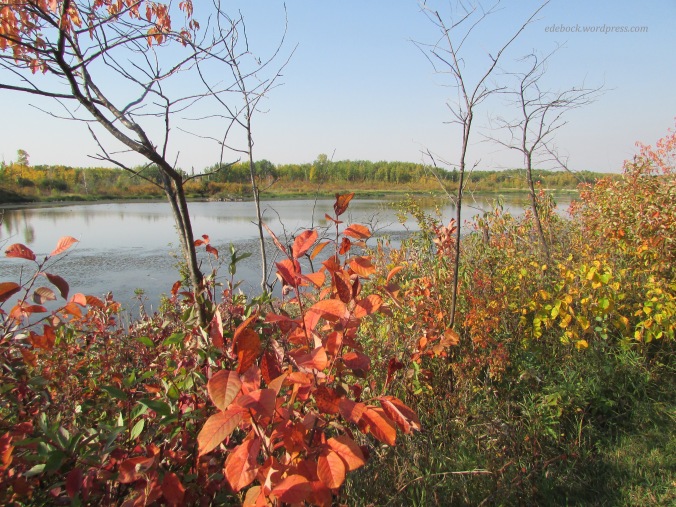
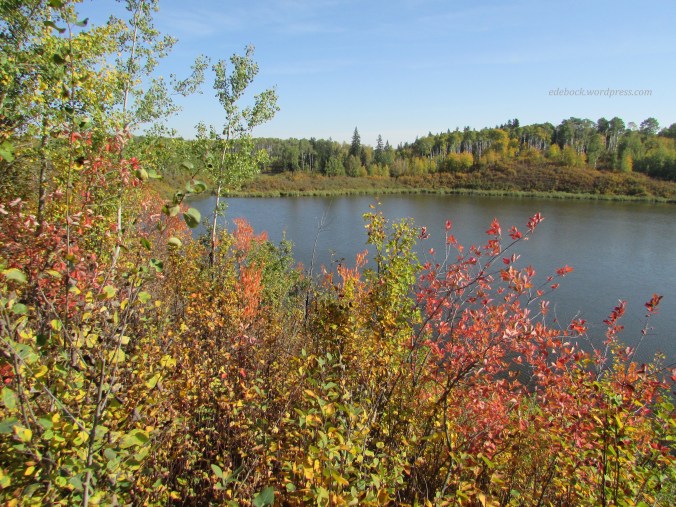
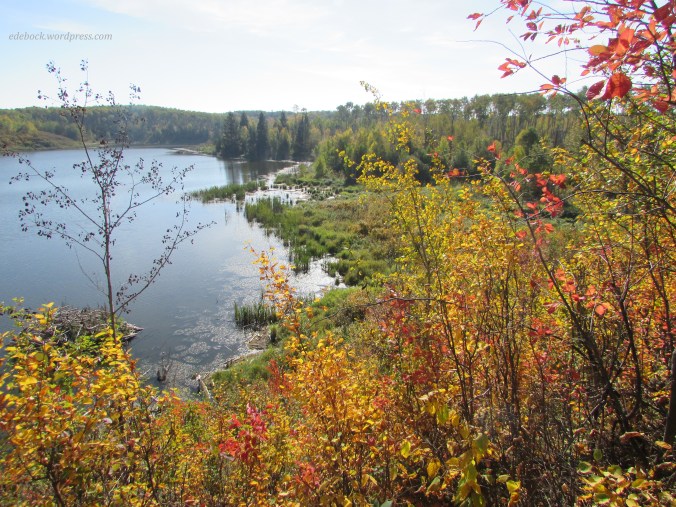
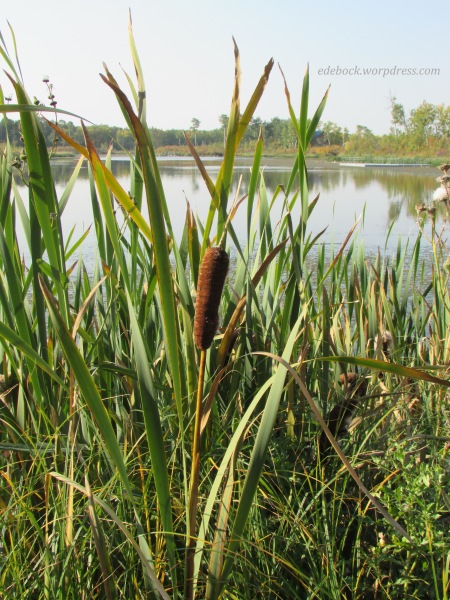
Sixteen years of blogging!

I published my very first blog post sixteen years ago today! It was also the shortest post I’ve ever written; a brief message announcing that hubby and I had just accepted positions teaching conversational English in Japan. The blog was meant to share that year-long adventure with friends, family and anyone else who might be interested. Never in my wildest dreams did I imagine that it would still be alive and well sixteen years later!

The title, Following Augustine, no longer fits the blog as well as it did in those early days, but since it’s what I’ve been known as in the blogosphere for more than a decade and a half, I hesitate to consider changing it. You can read about why I originally chose the title here.

Though I probably already had neuroendocrine cancer (NETS) when the blog was born, I didn’t know about it until several years later. When I finally received a correct diagnosis, blogging became a helpful way to process what was happening and to share the journey with friends and family. I also use the blog to raise awareness of NETS. I’m sure that this will continue to happen as I’ve recently become a member of a newly formed Advocacy Advisory Board that will report to the board of directors of the Canadian Neuroendocrine Tumour Society (CNETS).

When I started the blog, writing about fashion was the farthest thing from my mind. Several years ago, however, I starting following several fashion blogs and began to develop a greater interest in the topic. It was then that I decided to add the weekly Fashion Friday feature. At times, I find it a challenge to come up with a new fashion related topic every week, but it’s been a great way to connect with other women and to ensure that I post something at least once a week. Fashion Friday has a fairly small, but loyal following of interested readers, so I as long as I can continue to think of engaging content, I plan to keep the feature going.

As an avid reader, it was my passion for books that prompted me to add the latest feature to the blog, a monthly book review that first appeared at the beginning of February this year.

I refer to Following Augustine as a lifestyle, travel, and fashion blog, but in recent years, there hasn’t been as much travel content as I would have liked. First, the pandemic and then a number of other health issues, both mine and hubby’s, have limited our ability to spend as much time away from home as we would like, but our brand new ten year passports arrived in yesterday’s mail and we hope to be able to put them to good use in the future. If that happens, the blog will once again chronicle our wanderings.

Following Augustine will probably continue to undergo changes from time to time, but at this point, I don’t see it coming to an end anytime soon. Over the past sixteen years, I’ve published over 1400 posts and I expect that I’ll continue adding to that number until I’m no longer able!

3224919

Book of the month – October 2023

Iris & Ruby

Rosie Thomas

9780007173549-l19-year-old, Ruby, driven by her difficult relationship with her mother, runs away from her home in England and seeks refuge with the grandmother she hasn’t seen for many years. Her unexpected arrival on Dr. Iris Black’s doorstep in Cairo brings life and disorder into the elderly woman’s house.
After a lifetime of independent living, Iris recognizes in herself the early signs of dementia. Lovingly cared for by her servant, Mamdooh, and her cook, Aunty, she has become increasingly reclusive, but the arrival of her granddaughter changes that. An unlikely bond forms between the two as Ruby attempts to help her grandmother record her fading memories.

Iris & Ruby is a richly textured story of love, loss, and the power of family relationships.

Through Ruby’s experiences and Iris’ memories, the novel moves seamlessly between present day Cairo and the same city during World War II. Thomas’ writing is wonderfully descriptive drawing us into the glittering parties and the devastating wartime losses of the 1940s; the sights, sounds, and smells of the crowded marketplace of today; and the timeless and relentless desert that surrounds them both.

I was drawn to this novel by the fact that I would love to visit Egypt someday. While preparing to write this post, I discovered that Literary Tours in Egypt actually offers a Rosie Thomas’ Iris and Ruby 2-day tour of Cairo! What a cool idea!

Another Miquelon September

We spent several days this week camping at Miquelon Lake Provincial Park, less than an hour and a half from home. We’ve camped there several times in the past, always in September.

It’s definitely not the lake that keeps us going back. Shallow, saline, and shrinking rapidly, it’s a small fraction of the size that it was a century ago. In fact, we’ve seen the water level drop significantly over the past few years. No, it’s the well-maintained hiking trails that keep us returning to Miquelon.. 

IMG_6039

IMG_6040

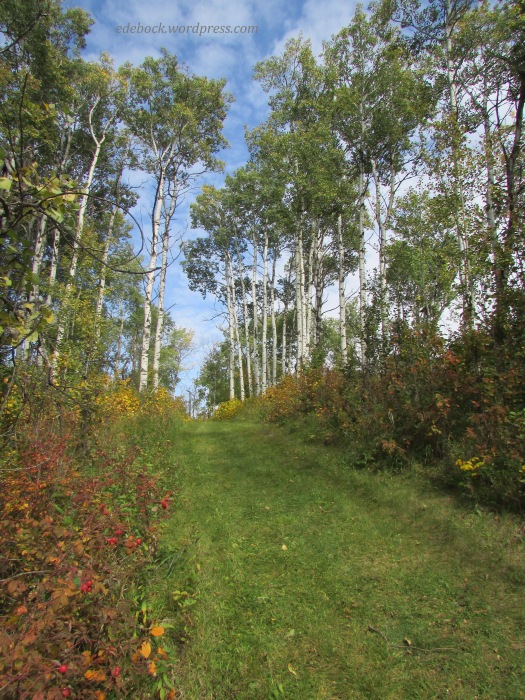
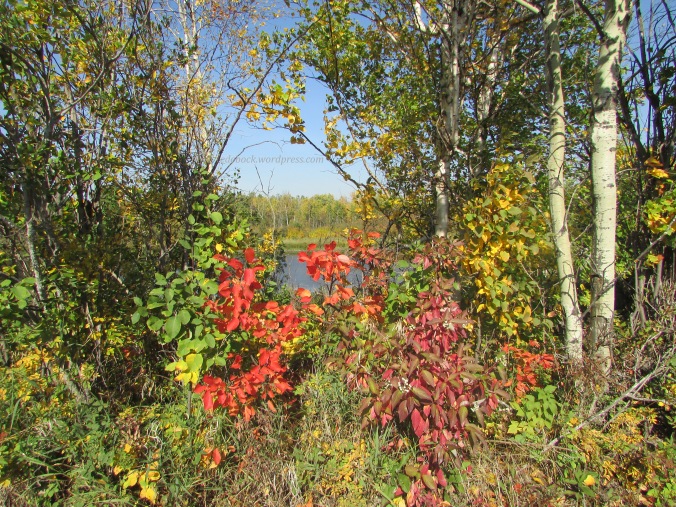
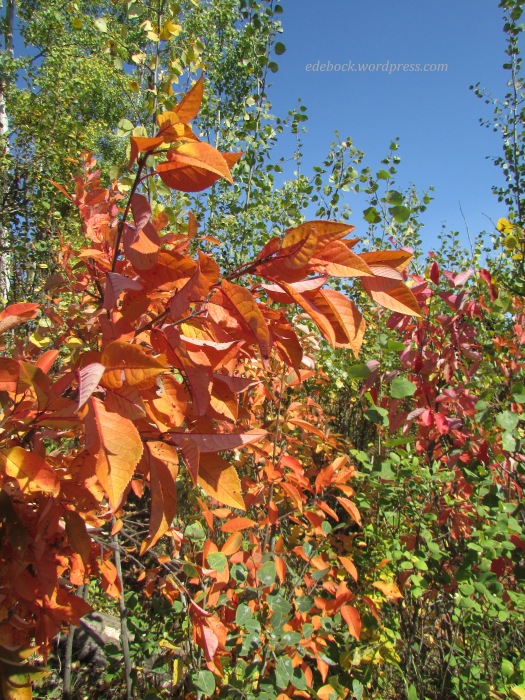
The “knob and kettle” terrain consists of hummocky mounds (the knobs) and water-filled depressions (the kettles). Hiking trails wind up and down, around and between the ponds and at this time of year, colourful foliage adds to park’s natural beauty. Here in Alberta, we don’t get the wide variety of fall colours that are found in eastern Canada, but Miquelon seems to be an exception! Is it any wonder that we love to go there in September?  

IMG_6046

IMG_6064

Over the past few days, we hiked a total of 26.5 kilometres (16.5 miles). As we made our way up and down the “knobs”, we definitely felt muscles that don’t come into play as much when we walk the level ground around home! Thankfully, our legs are in pretty good shape though. With just over 6 weeks to go, I’m only 32 km short of my goal of walking and/or hiking 350 km between May 1 and Oct 31! 

With our bear bell ringing, we didn’t see any of the larger wildlife, including deer, moose and elk, that live within the park, but there was clear evidence of their presence along the trails. Plenty of fresh hoof prints and droppings, including bear scat, told us that they weren’t too far off. We did see rabbits, squirrels, one garter snake, several grouse, and numerous other birds including an abundance of waterfowl. It was also clear that industrious beaver have been hard at work. 

The campground was very quiet during the week, but we were surprised to see how many rigs pulled in on Friday. Obviously, we aren’t the only ones who enjoy fall camping! 

IMG_6053

There were even a few hardy souls sleeping in tents. It must have been pretty chilly with nighttime temperatures dipping close to 0ºC (32ºF). We were toasty warm in our trailer bed though, except for the one night when the propane ran out and the furnace stopped running! Thankfully, fixing that problem was as simple as switching over to the second propane tank. 

IMG_6056

We’re hoping to fit in one more short camping trip before winter and I have no doubt that we’ll be back to Miquelon again another September. 

IMG_6062


Rowley, an Alberta ghost town

We spent several days camping this week and as a result, I don’t have a Fashion Friday post ready for you today. Instead, I’ll share one of the highlights of our short time away from home. After a horrendous storm Monday night, we woke to sunshine on Tuesday morning, but the wind was still much too strong to go golfing or kayaking and we’d already hiked the 6.5 km nature trail around a nearby lake. We didn’t want to spend the day sitting in the trailer though, so what should we do?

Hubby suggested a road trip to Rowley. In its heyday, Rowley, Alberta was an agricultural town of approximately 500 people, but at last count the population was 9. Yes, that’s right, 9 people and perhaps a few stray cats! Apparently, some of the residents don’t really like their hometown being referred to as a ghost town though that’s what it’s usually called. They take pride in the place and have worked hard to preserve the few remaining buildings and to turn it into a tourist destination. Once a month, the community association, made up of residents and people from the surrounding area, host a well-attended pizza and pub night to raise funds to help with the cost of maintenance.

As the ROWLEYWOOD sign at the turnoff on nearby Highway 56 suggests, the movies Legends of the Fall, The Magic of Ordinary Days, and Bye Bye Blues were filmed in the hamlet.

So, come walk with me and I’ll show you around Rowley, Alberta.

The Lion’s Oil Garage, complete with its old style gas pump, is a reconstruction of the building that originally stood on this site.

IMG_5901

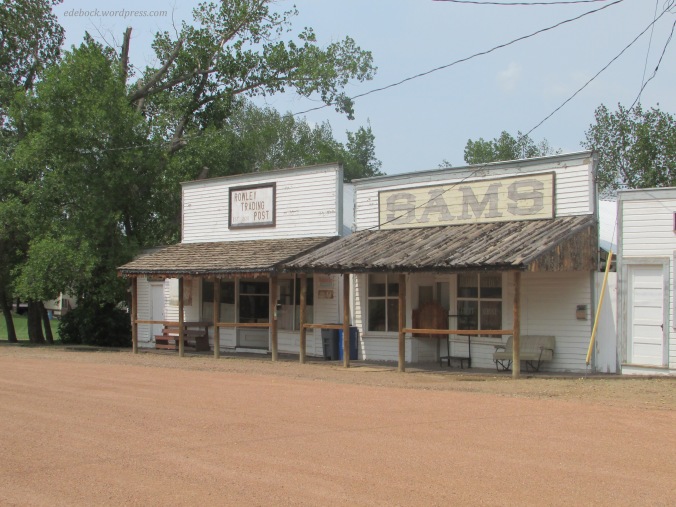
Walking down Main Street past Sams Saloon and the Rowley Trading Post, it’s easy to imagine ourselves transported back in time to the wild west. I could easily picture a couple of horses hitched to the rails and women strolling the boardwalk in old fashioned dresses. Built in 1920, the trading post was where Rowley residents purchased their dry goods and groceries until 1973 when it was the last business in town to close its doors.

IMG_5875

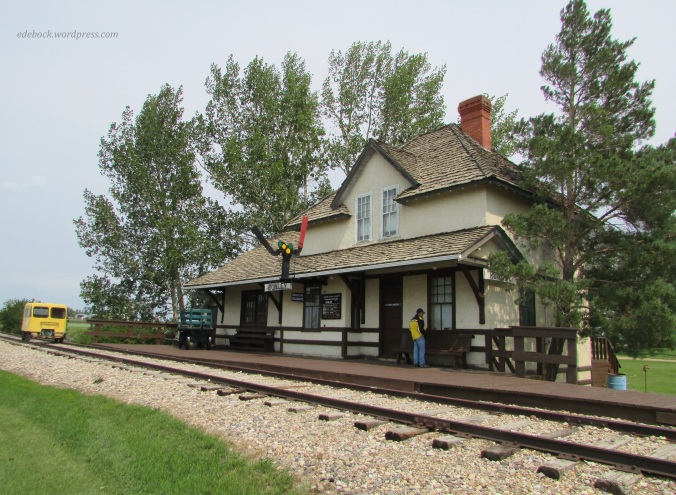
At the end of the street stands the beautifully preserved CNR train station. The station master and his family likely lived upstairs.

IMG_5878

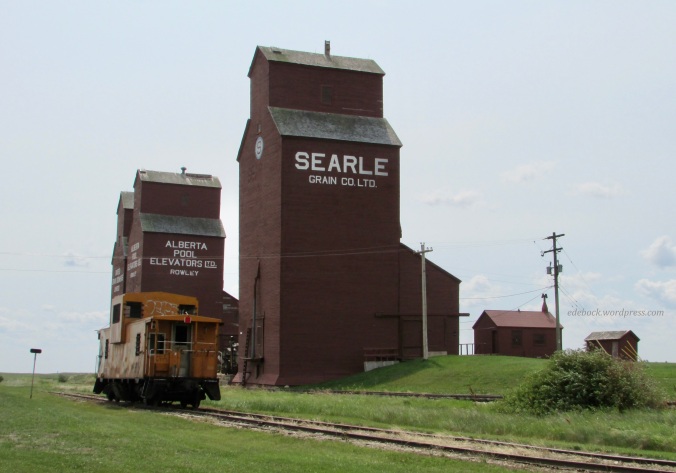
At one time, every little town on the Canadian prairie had its wooden grain elevators, but very few of these stately sentinels remain today.

IMG_5885

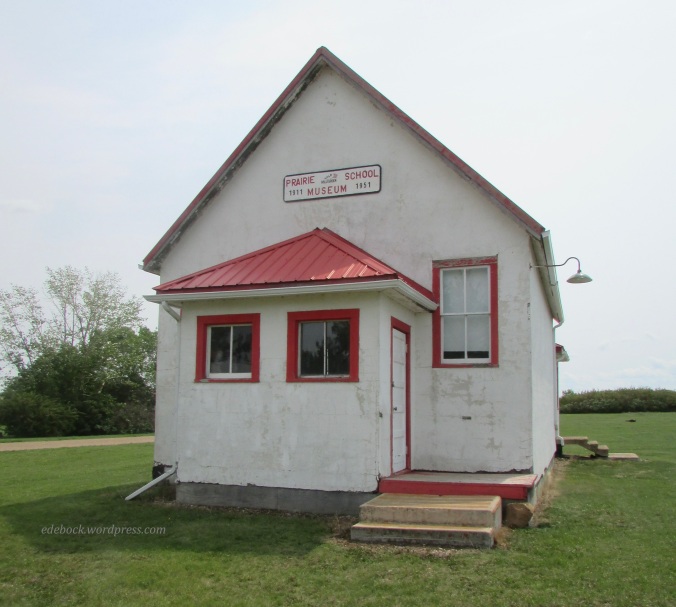
The Prairie School Museum is typical of the one room schoolhouses that dotted the prairie in days gone by. 

IMG_5891

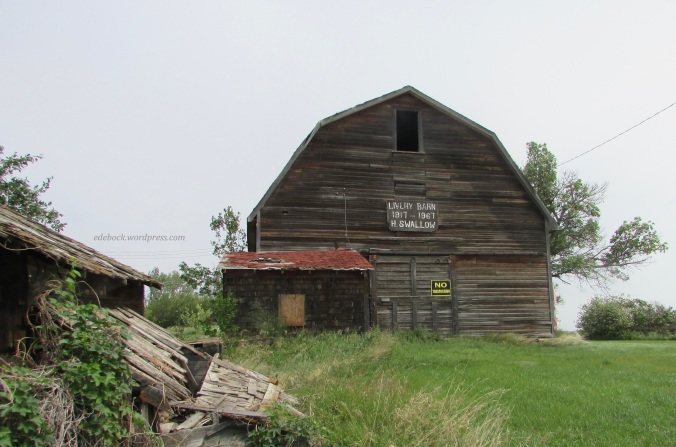
If you came to visit Rowley in the early days, you might have boarded your horse at H. Swallow’s livery barn. While some of the smaller structures around it are falling down, the barn still looks pretty sturdy.

IMG_5894

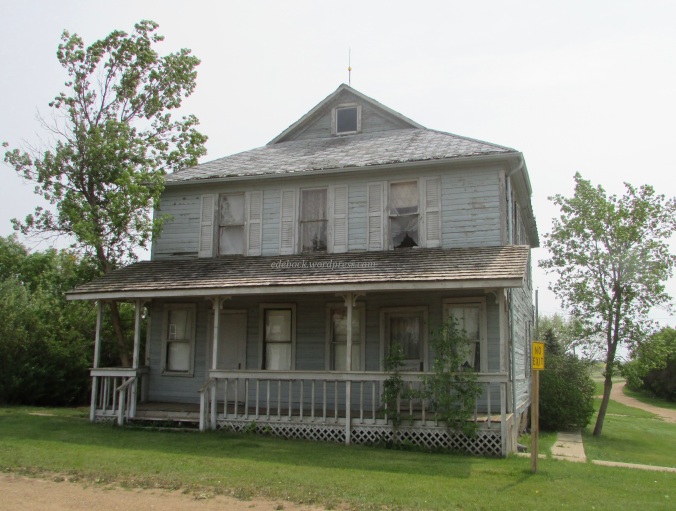
Circling back to the upper end of Main Street, we find this stately old house, weathered by time but still beautiful. Hubby and I thought that perhaps it had once been the town’s hotel, but after doing a bit of research I discovered that it was originally used as a hospital.

IMG_5897

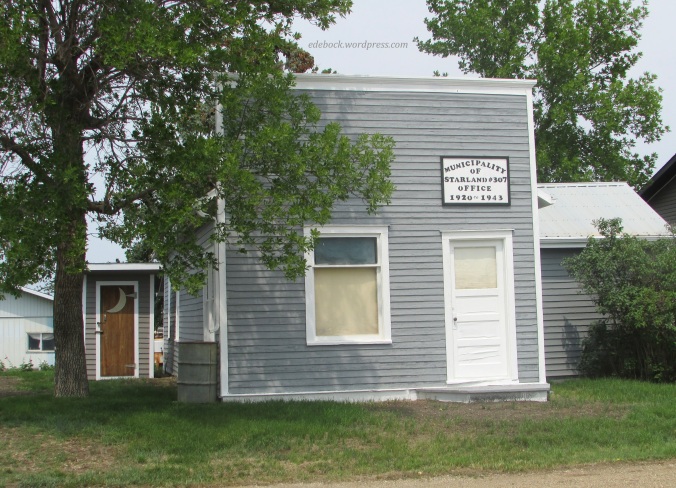
Across the street, the old municipal building has obviously undergone some fairly recent renovation. Though I’m happy to live in the day of indoor plumbing, we thought the backyard biffy was cute.

IMG_5898

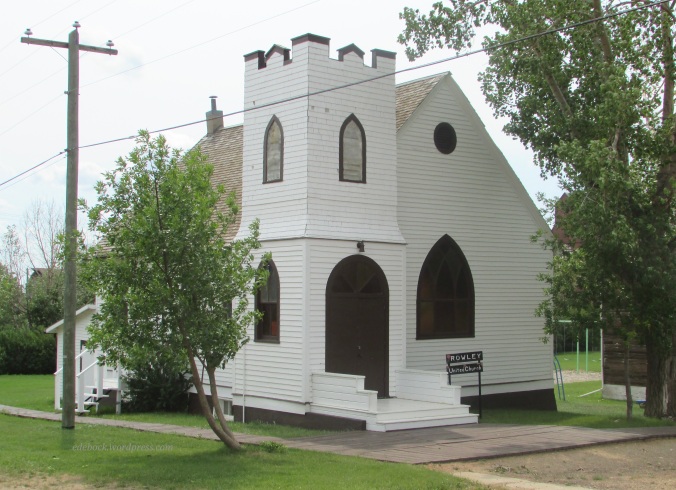
The Rowley United Church remained active until 1969 and continues to be used for the occasional wedding. 

IMG_5899

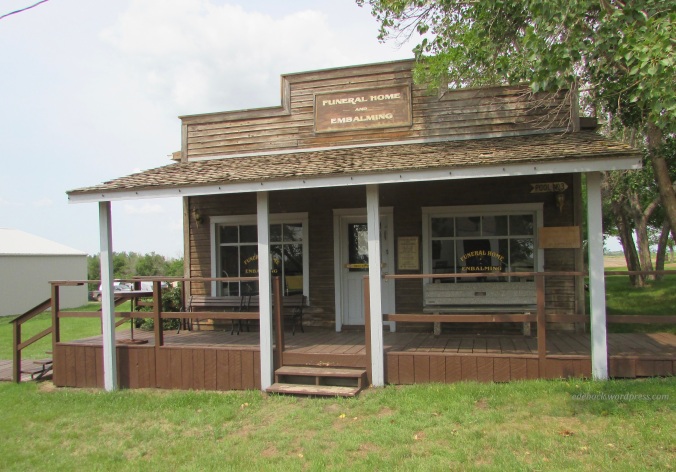
Like at least one other building in Rowley, not shown here, the funeral home across the street from the church was constructed specifically for the filming of the movie, Bye Bye Blues. Afterwards, the residents decided to turn it into a pool hall for their own enjoyment, but kept the front and signage intact. 

When we were there, we had Rowley almost entirely to ourselves and were content to peer through the windows at the artifacts housed inside the buildings, but should you wish to take a closer look, the Rowley community association hires local summer students to give free guided tours inside the buildings Thursday to Monday during July and August. 

Museum of Aboriginal Peoples’ Art & Artifacts

We spent a few days this week camping, hiking, and kayaking in Sir Winston Churchill Provincial Park near the small town of Lac la Biche, about two and a half hours northeast of Edmonton, Alberta. When I read that the Portage College campus in Lac la Biche is home to the Museum of Aboriginal Peoples’ Art & Artifacts, I knew that we had to go into town to see it. I recognized the names of well-known artists like Bill Reid, Alex Janvier, and Norval Morrisseau and was eager to see their work.

Arriving at the college, I expected to find a gallery showcasing the works of these and other Indigenous artists. Instead, the extensive collection of traditional and contemporary works lines the hallways of the school and we were free to wander and enjoy them. With only one class in session while we were there, it was as quiet and serene as any traditional gallery would have been.

IMG_5793

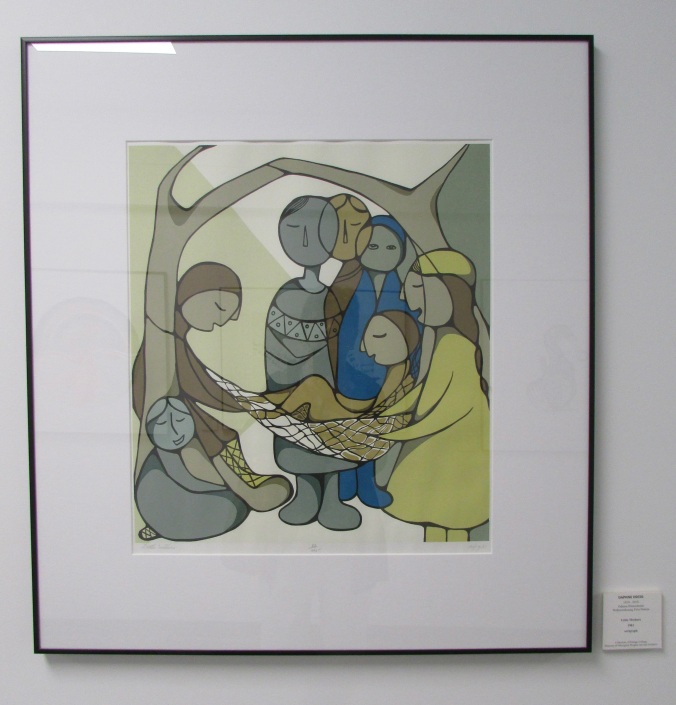
Little Mothers – Daphne Odjig

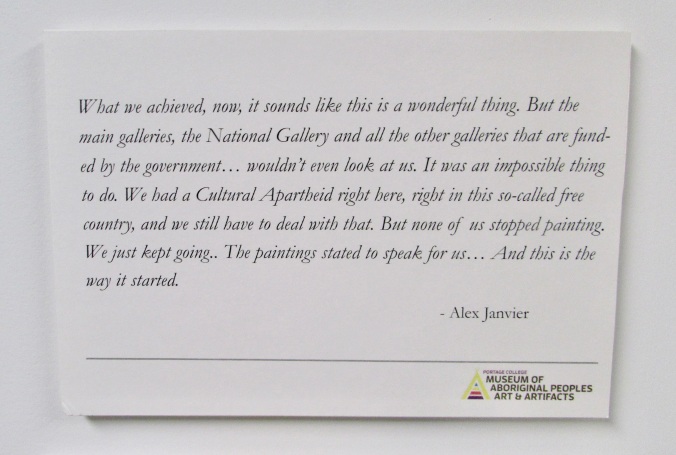
The Portage College museum features the world’s only permanent collection of works by the Professional Native Indian Artists Inc., also informally known as the Indian Group of Seven. The group was formed in 1972 after a series of gatherings in Daphne Odjig’s craft store and gallery in Manitoba and later incorporated as an attempt to be taken seriously as professional artists and to advocate for Indigenous art to viewed as fine art and to be included in galleries across the nation. The museum on the Portage College campus began in 1978 as a teaching collection for the college’s Native Arts and Culture programs and grew from there.

IMG_5783

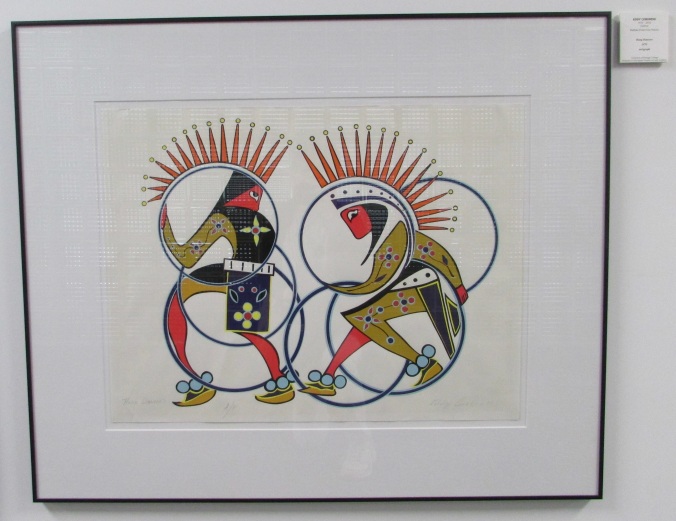
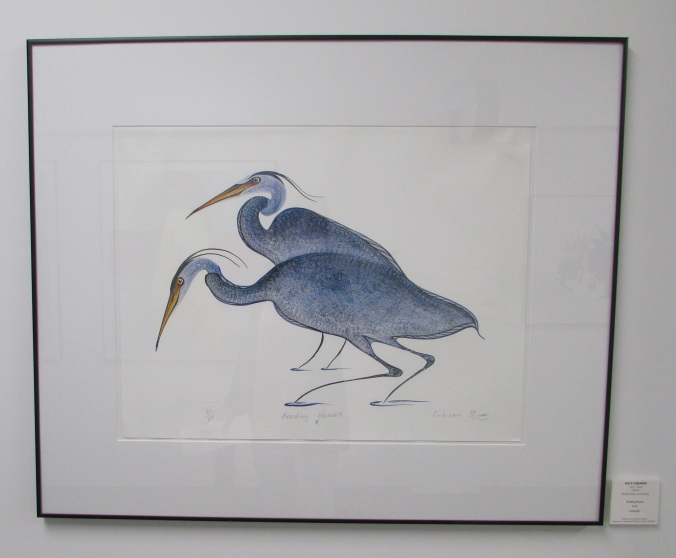
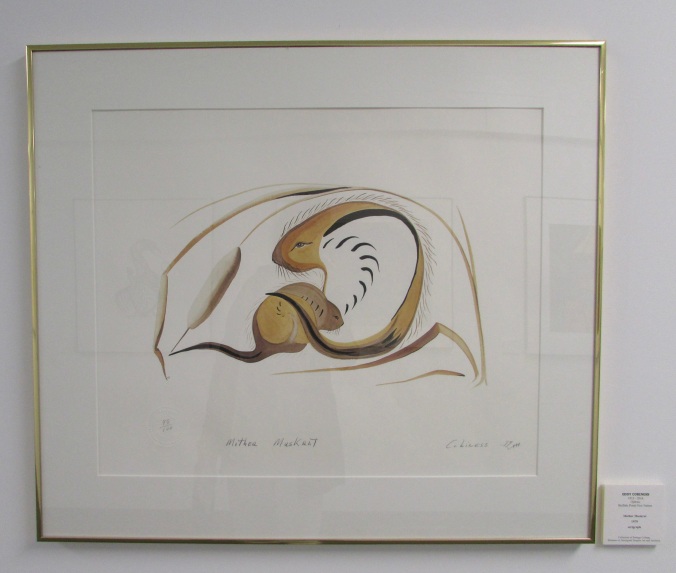
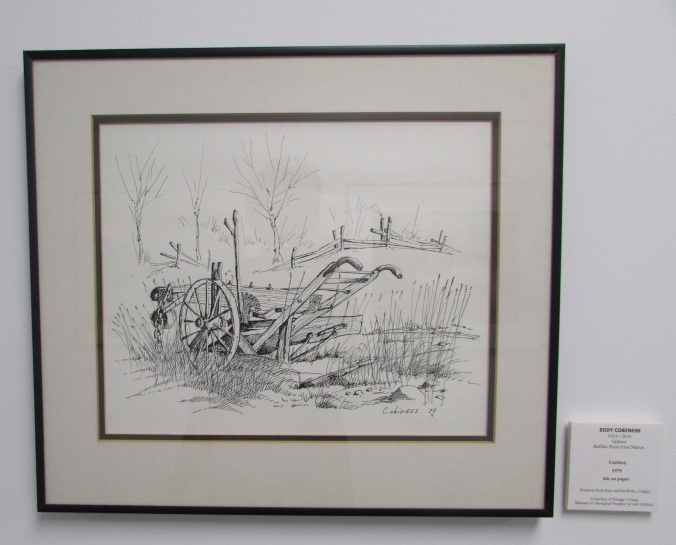
While I was impressed by most of what we saw, amongst the Group of Seven it was the work of Eddy Cobiness (1933-1996) that really stood out to me. Cobiness, of Ojibway descent, was born in Minnesota and raised on a reserve in Manitoba. Though I had not heard of him before, his art is held in many prominent private and public collections.

IMG_5777

Hoop Dancers – Eddy Cobiness

IMG_5805

Feeding Herons – Eddy Cobiness

IMG_5795

Mother Muskrat – Eddy Cobiness

IMG_5797

Untitled – Eddy Cobiness

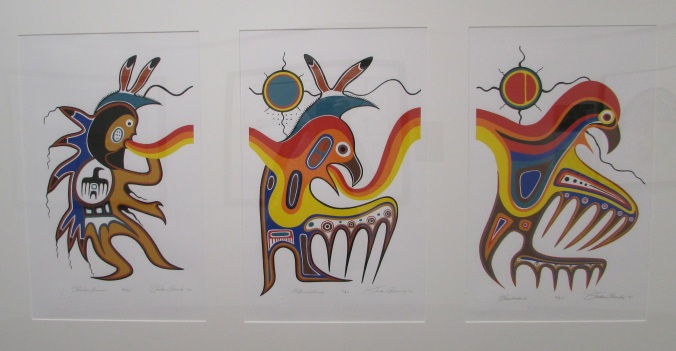
These three colourful designs by Jackson Beardy also caught my attention, probably because their style is somewhat similar to that of the Indigenous artists of the Northwest Coast that I love so much.

IMG_5788

Thunder Dancer / Metamorphosis / Thunderbird – Jackson Beardy

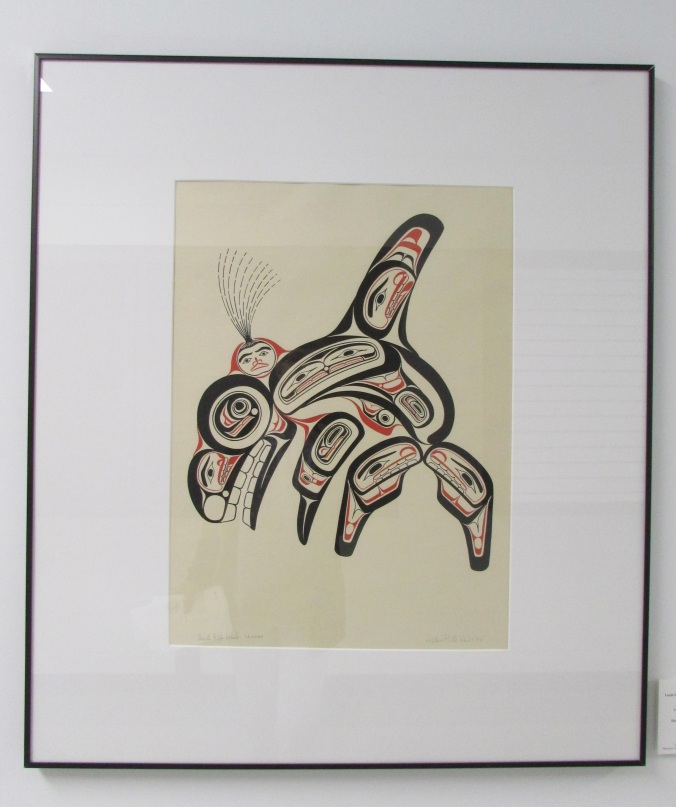
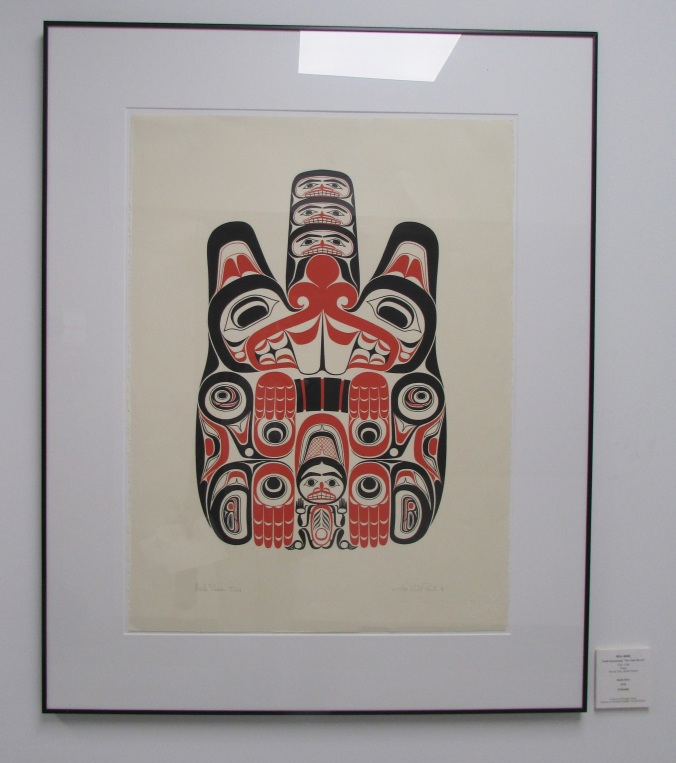
In addition to showcasing the work of the Professional Native Indian Artists Inc., the museum also features Northwest Coast and Inuit art. Bill Reid (1920-1998), was a prolific Haida artist, perhaps best known by many for his giant sculpture “Spirit of Haida Gwaii” on display in the international departures area of the Vancouver airport.

IMG_5821

Haida Killer Whale – Bill Reid

IMG_5819

Haida Bear – Bill Reid

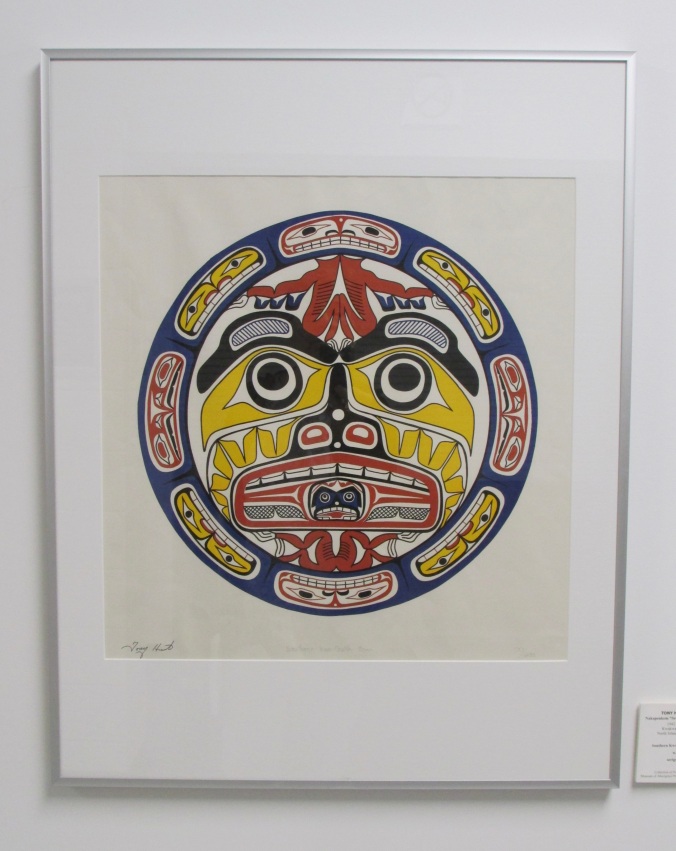
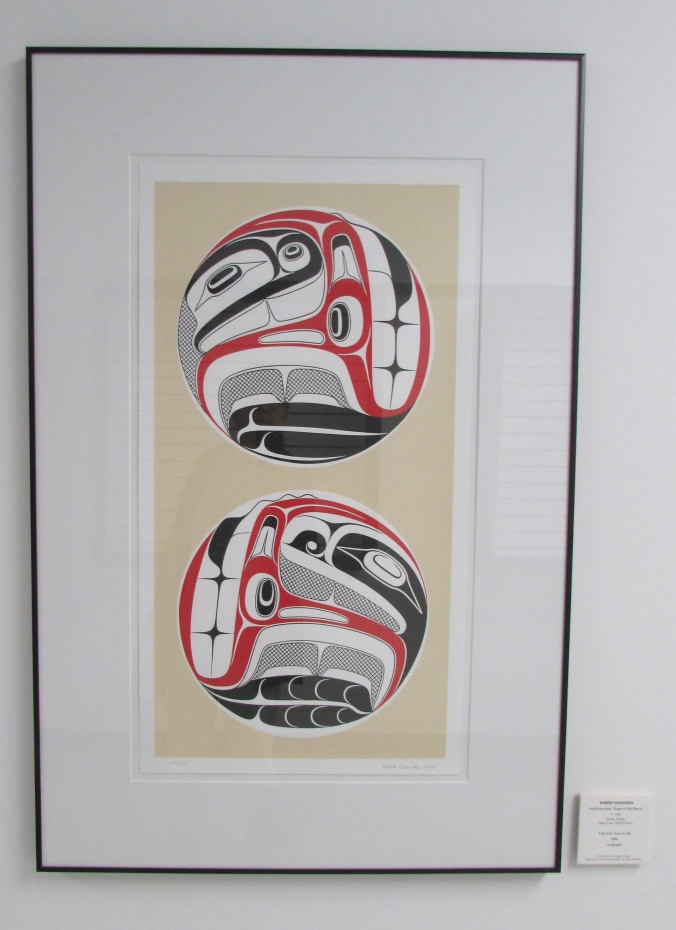
Other coastal artists whose work is on display in Lac la Biche include Tony Hunt Sr. (1942-2017) who was the hereditary chief of the Kwa-Gluth people and Robert Davidson who is of Haida and Tlingit descent.

IMG_5830

Southern Kwa-Gulth Moon – Tony Hunt Sr

IMG_5824

I am You, You are Me – Robert Davidson

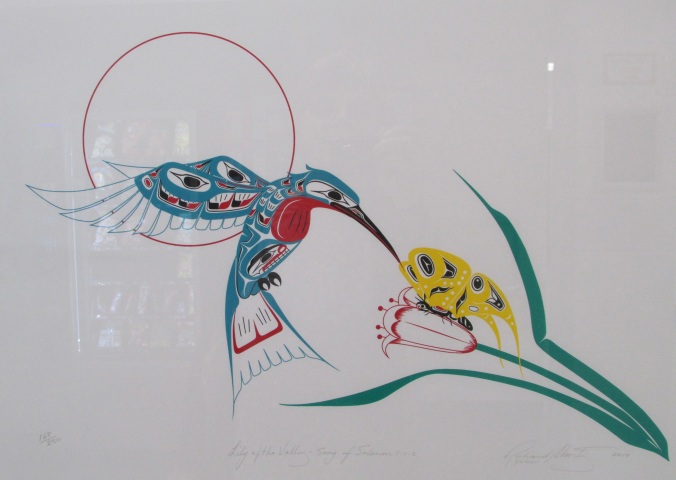
I thought this piece by Richard Shorty of the Tuchone Kwanlin Dun First Nation in the Yukon was absolutely exquisite. According to Northwest Coast tradition, the hummingbird represents love and beauty.

IMG_5833

Lily of the Valley / Song of Solomon – Richard Shorty

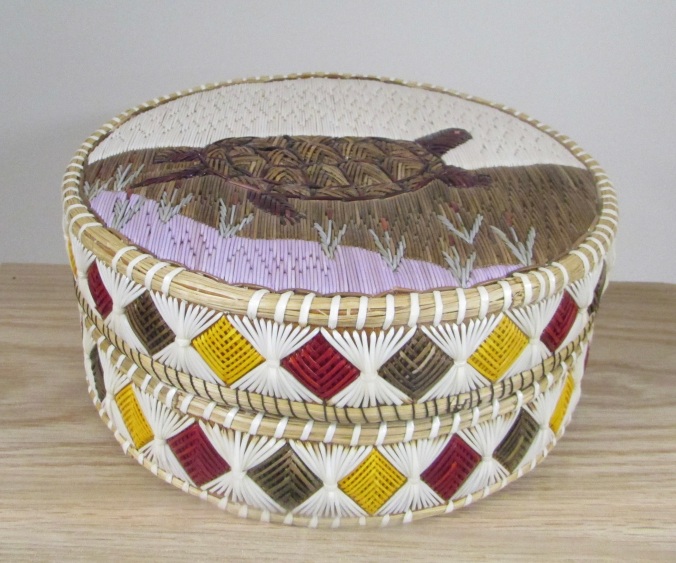
In addition to the framed work lining the corridors of Portage College, there are numerous glass cases containing carvings, baskets, beadwork, ceremonial clothing, moccasins and mukluks, headdresses, masks and more. Due to the reflective quality of the glass, it was difficult to get good photos, but I did manage to get one of this perfectly preserved Mi’kmaq porcupine quilled basket from the late 1700s or early 1800s.

IMG_5813

While I was thrilled to be able to spend a couple of hours enjoying this amazing collection of Indigenous art and artifacts, it saddens me that it’s hidden away in a remote location where few Canadians or visitors to our country will ever have the opportunity to see it.

Dress codes for travelers

Logo by SamWhenever you travel to a foreign country, it’s a good idea to learn a bit about the culture and traditions before you go. It’s also wise to know what to pack so that you don’t get into trouble by wearing something inappropriate or possibly even illegal.


It may not surprise you to know that modest attire is usually expected when visiting religious sites such as churches, temples, and mosques. Visitors to Cambodia’s famed Angkor Wat temple complex and to the Vatican are required to wear pants or skirts that fall below the knee and shirts that cover their shoulders. Sleeveless and low-cut garments, shorts that end above the knee, and miniskirts are not allowed and men entering the Vatican must also remove their hats. Some religious sites may require women to cover their heads, so it’s always a good idea to pack a scarf just in case.

Afghanistan is the only country that requires women to wear a burqa in public today, but did you know that there are countries where these garments are forbidden? That’s right! It is illegal to wear a burqa or a niqab in France, Belgium, the Netherlands, Cameroon, Chad, Congo-Brazzaville, Niger, and parts of Russia. In fact, face coverings of any kind including masks (with the exception of those worn to prevent the spread of Covid and other respiratory illnesses), scarves, motorcycle helmets, and balaclavas are illegal in France, Belgium, and the Netherlands.

I was surprised to discover a long list of countries that forbid the wearing of camouflage. Leave your camo at home if you plan to visit Barbados, St. Vincent, St. Lucia, Antigua, Grenada, Jamaica, Nigeria, Oman, the Philippines, Saudi Arabia, Trinidad and Tobago, Zambia, or Zimbabwe.

For your own safety, you aren’t allowed to wear sandals while driving in Spain and those who hike the steep, hilly terrain connecting the five villages of Italy’s Cinque Terre are prohibited from wearing flip-flops, sandals or high heels. High heels are also forbidden at some historic sites in Greece such as the Acropolis and Delphi to prevent damage to the ancient monuments.

Most dress codes are a matter of modesty and what is considered appropriate differs greatly from place to place. All women in Iran must cover their hair or wear a hijab in public areas. Women must have their arms and shoulders covered at all times in Oman. Swimwear is not allowed except at the beach in Majorca, Croatia, Maldives, Turkey, and some cities in Spain including Barcelona. In France, men must wear speedos in public pools. Boxers aren’t permitted! In Thailand, one must wear a shirt while driving and must always wear underwear in public (although how anyone would know if you weren’t, I’m not sure!)

Perhaps Saudi Arabia and Sudan have the strictest dress codes. In Saudi Arabia men are required to have their shoulders and legs covered at all times. They’re not even allowed to go shirtless at the beach! Women must dress modestly at all times, covering both their knees and shoulders. Sleeveless shirts, short dresses, loose tops, shorts, crop tops, miniskirts and bikinis are all forbidden. In some places they must also wear a headscarf. Similarly, in Sudan, men cannot wear makeup, shorts or sleeveless shirts and women cannot wear shorts, pants, sleeveless shirts, anything see-through, or skirts shorter than mid-calf.

I’m not sure why anyone would want to visit North Korea, but if you do and you’re a woman, you need to know that you can’t wear pants there either.

And I saved the funniest for last… it would be a good idea not to wear clothing with Winnie the Pooh on it near schools and playgrounds in Tuszyn, Poland. Apparently Pooh’s uncertain sexuality and indecent exposure (he doesn’t wear pants!) are proof that the loveable bear is “wholly inappropriate for children.”

Winnie-the-Pooh-10

Dress codes for airline travel

Logo by SamIf any of you are fortunate enough to be flying somewhere this summer, you might be interested in knowing that airlines have the right to refuse to board passengers who are deemed to be dressed inappropriately. By purchasing a ticket, you automatically consent to abide by the rules and conditions outlined in a legal contract known as the “conditions of carriage.”

United Airlines has the right to refuse to board passengers if they are “barefoot, not properly clothed, or whose clothing is lewd, obscene or offensive.” Similarly, American Airlines has a section in its conditions of carriage that instructs passengers to “Dress appropriately; bare feet or offensive clothing aren’t allowed.” Delta Airlines can refuse to transport passengers whose “conduct, attire, hygiene or odor” may create an unreasonable risk of offending or annoying other passengers. Their conditions of carriage also ban bare feet.  And the list goes on.

While comfort and safety take precedence over appearance, there are several reasons why passenger dress codes exist and why some frequent flyers suggest that they need to go beyond the minimum and somewhat vague standards mentioned above. Clothing that exposes too much skin or with offensive language on it can make other passengers feel uncomfortable, but what one person considers offensive might be perfectly acceptable to another. Keeping the peace is important when hundreds of people are packed into an aircraft, often for several hours.

According to the International Air Transport Association, the number of unruly passenger incidents worldwide increased by a shocking 37% in 2022 from the previous year. The organization reported one unruly incident for every 568 flights last year, up from one in every 835 flights in 2021. Psychologists believe that people tend to behave more respectfully when they’re dressed up. “When people dress better, they tend to behave better,” said Thomas Plante, a psychology professor at Santa Clara University in Santa Clara, California. “A dress code might help.”

So how should you dress for a flight? Think classy but comfortable. Choose clothing made of breathable fabric and items that allow for ease of movement. As always, I recommend dressing in layers. Planes are often chilly, so a scarf or a wrap can be a good addition to your travel wardrobe. Although I’ve never worn them myself, compression stockings are often recommended for long flights as they reduce the risk of developing blood clots when sitting for long periods of time. You’ll probably want to wear your bulkiest footwear, especially if you’re traveling carry-on only, but it’s important to ensure that your shoes are also comfortable. Hopefully, it never comes to this, but it’s also wise to choose clothing and footwear that would allow for smooth evacuation in the event of an emergency.

Airplane-flying-Facebook

Once you reach your destination, there might also be dress codes that you should be aware of, so we’ll look at what to wear when you travel the world next Friday. Some of the rules are quite unusual!

Downtown Calgary walking tour

Over the years, we’ve been to Calgary about a bazillion times. That’s because our daughter moved there immediately after graduating from high school 22 years ago to go to college and ended up staying. It had been many, many years, however, since we’d spent any time in the downtown core. Yesterday, however, we had a few hours to kill before picking up a friend who was traveling with us. We took a self-guided walking tour to see some of the weird and wonderful outdoor sculptures that add to the vibrant life of the city’s downtown. It was a cool, blustery morning, but thankfully, it rained very little. 

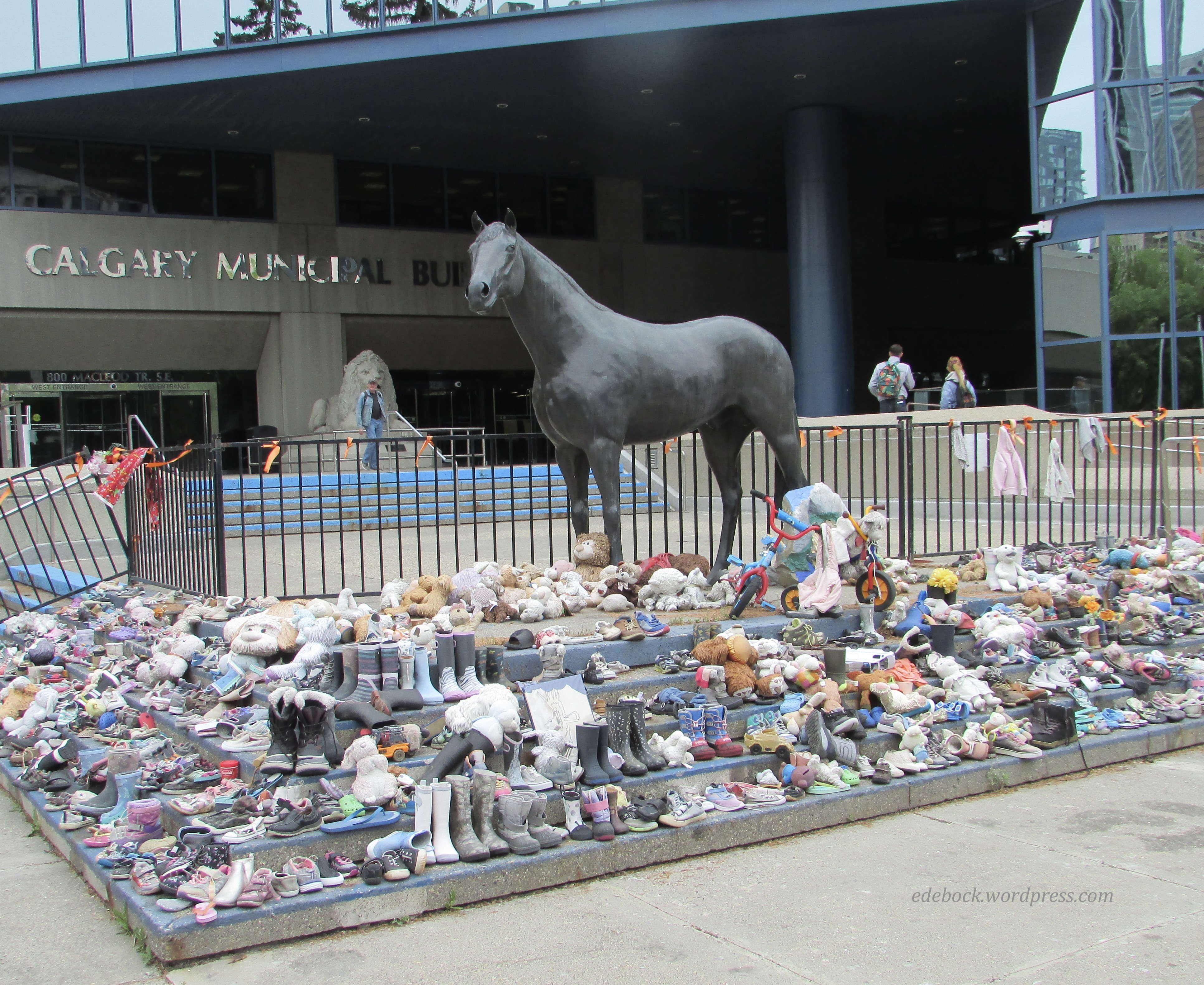
Our morning started at the somewhat pricey, but conveniently located City Hall Parkade and our first stop was just around the corner of the building. The Family of Horses, consisting of three statues, was donated to the City of Calgary by Spruce Meadows, a multi-purpose equestrian facility located near the city. The stallion shown in my photo is positioned in such a manner that he overlooks the foal and mare (not shown). At present, however, he stands guard over a temporary memorial to honour Indian Residential School survivors. The city intends to create a permanent memorial elsewhere once a location and design have been chosen. 

IMG_5682

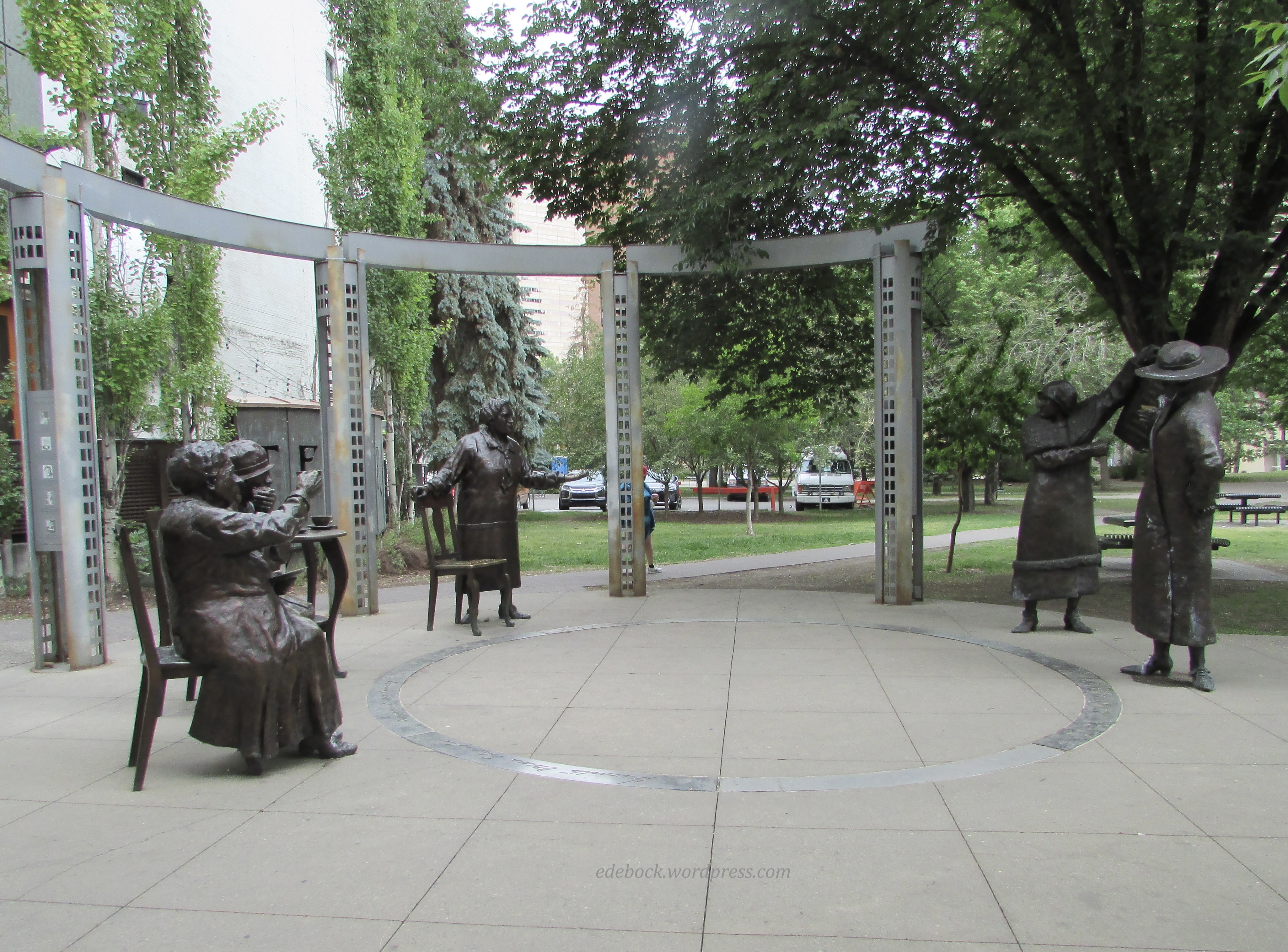
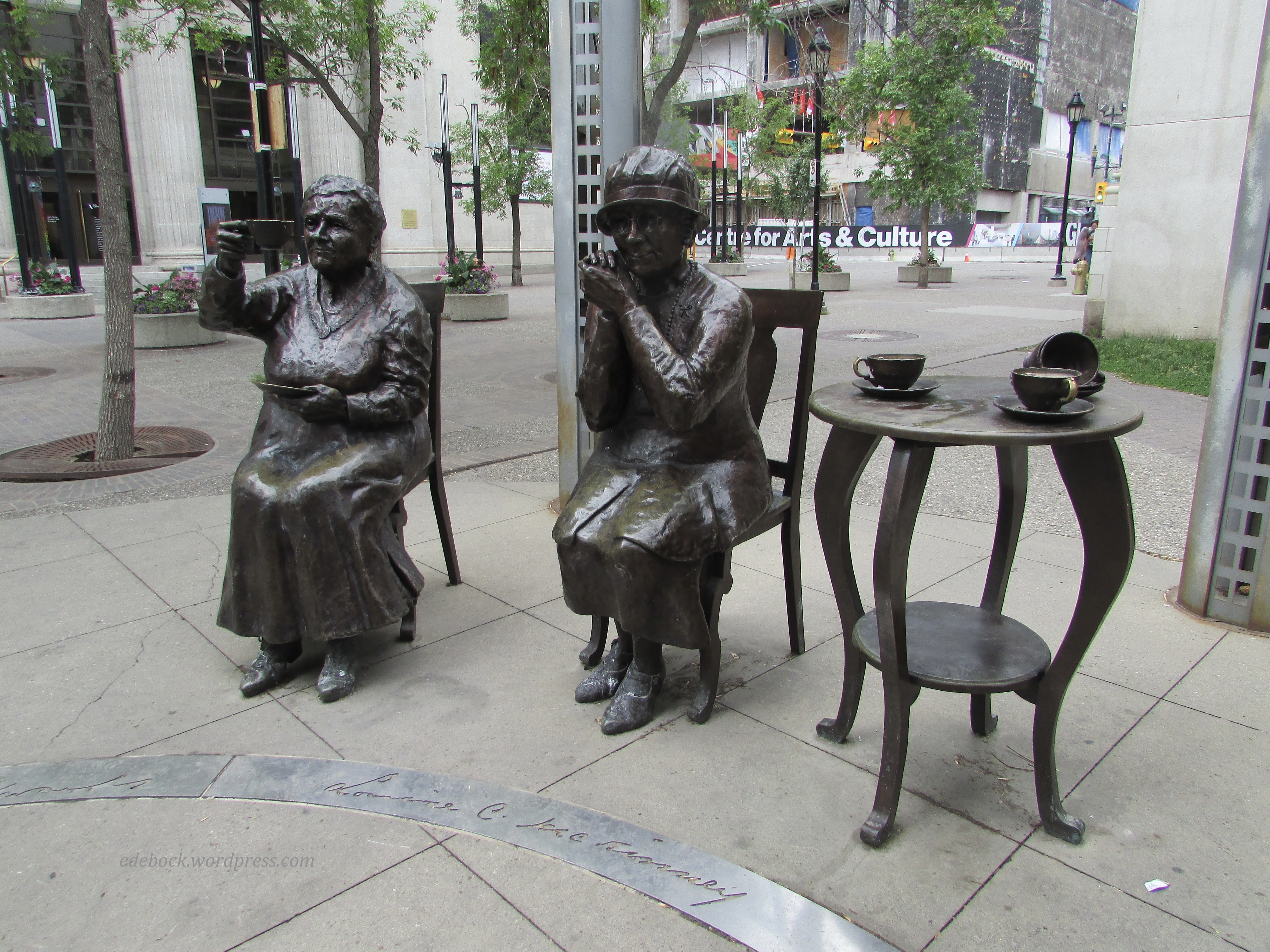
Next, the Women are Persons statues are located at the corner of Olympic Park. The monument recognizes the role played by Canadian women in the growth of the country and specifically honours the Famous Five, five persistent Alberta women — Emily Murphy, Nellie McClung, Irene Parlby, Louise McKinney and Henrietta Muir Edwards. Through their efforts, Canadian women were legally declared persons and given the right to vote on October 18, 1929. Seventy years later, the Calgary monument was unveiled on October 18, 1999 by then Governor General Adrienne Clarkson. Exactly one year later, a similar monument was unveiled on Parliament Hill in Ottawa. 

IMG_5686

IMG_5689

Of course I had to stop and sit with the famous ladies for a bit! 

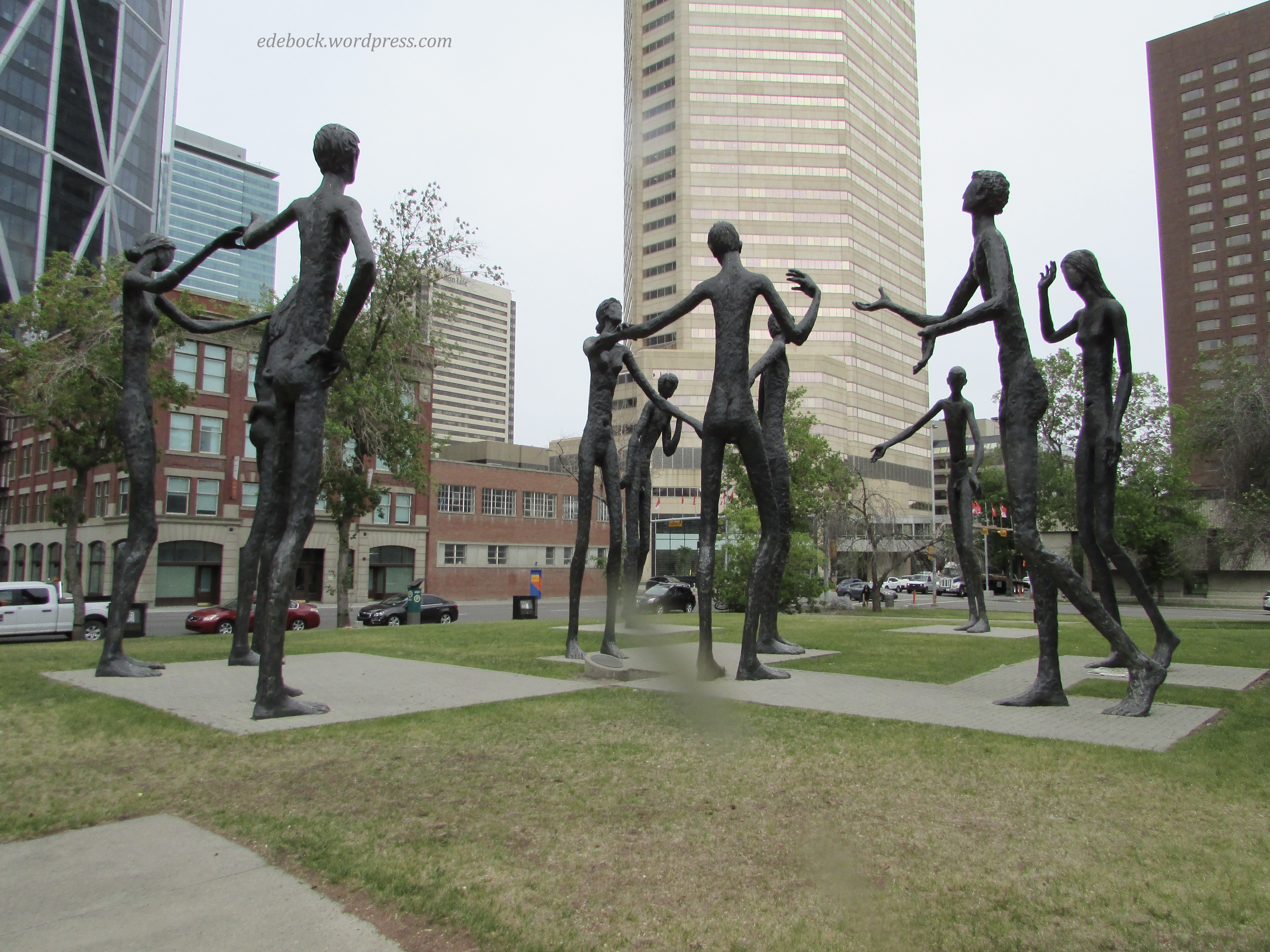
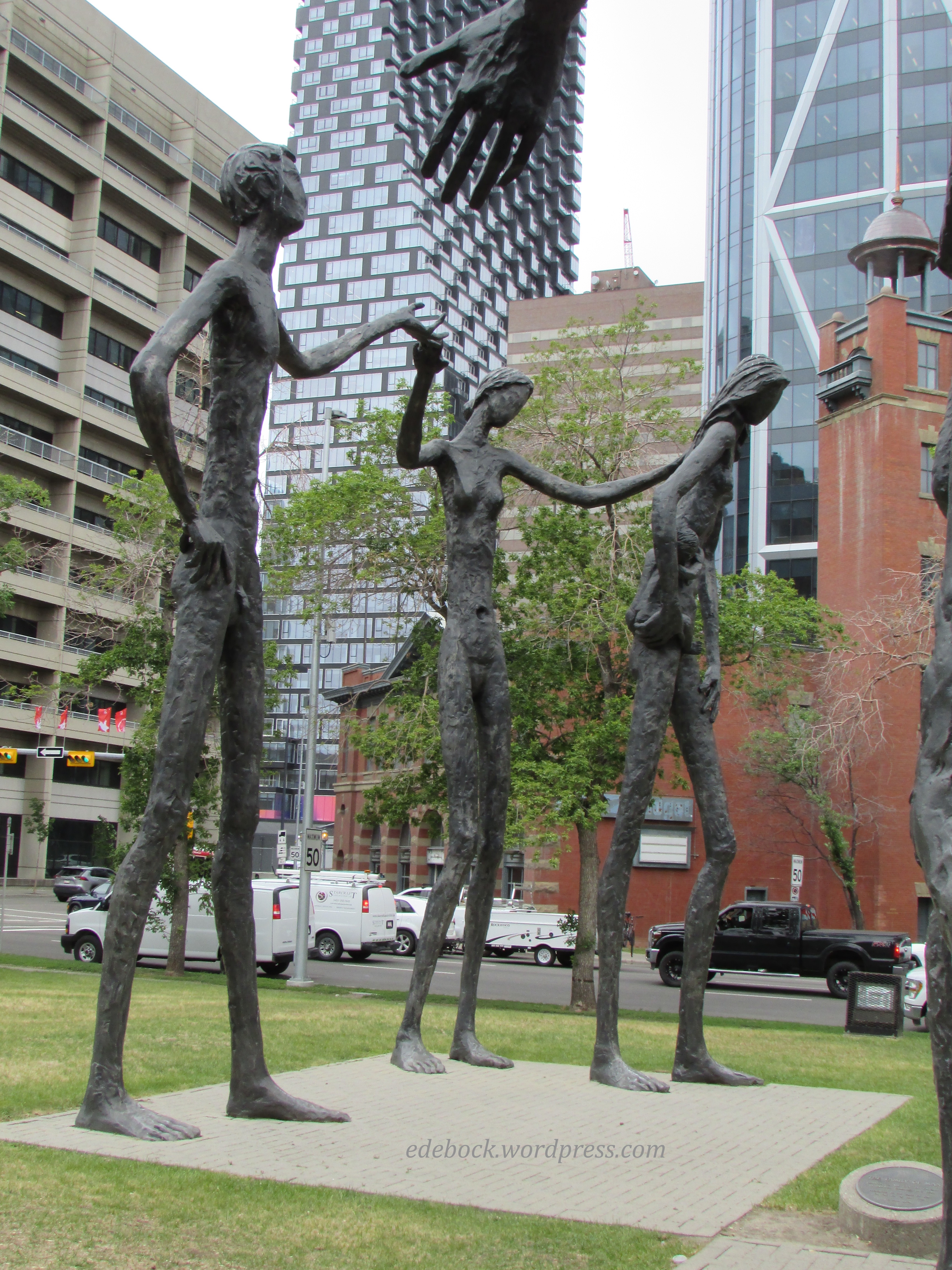
I remembered the 21-foot-tall Family of Man sculptures from my university days in Calgary in the early 1970s. Designed by Mario Armengol to be displayed at the British Pavilions at Expo 67, they were bought on behalf of Maxwell Cummings and Sons by Robert Cummings and later donated to the City of Calgary. The sculptures depict naked and faceless men and women, devoid of expression, but extending their hands in gestures of goodwill and fellowship. I’m sorry about the streak of rain across the first photo! The weather was at its most blustery at this point in our morning.

IMG_5695 

IMG_5697

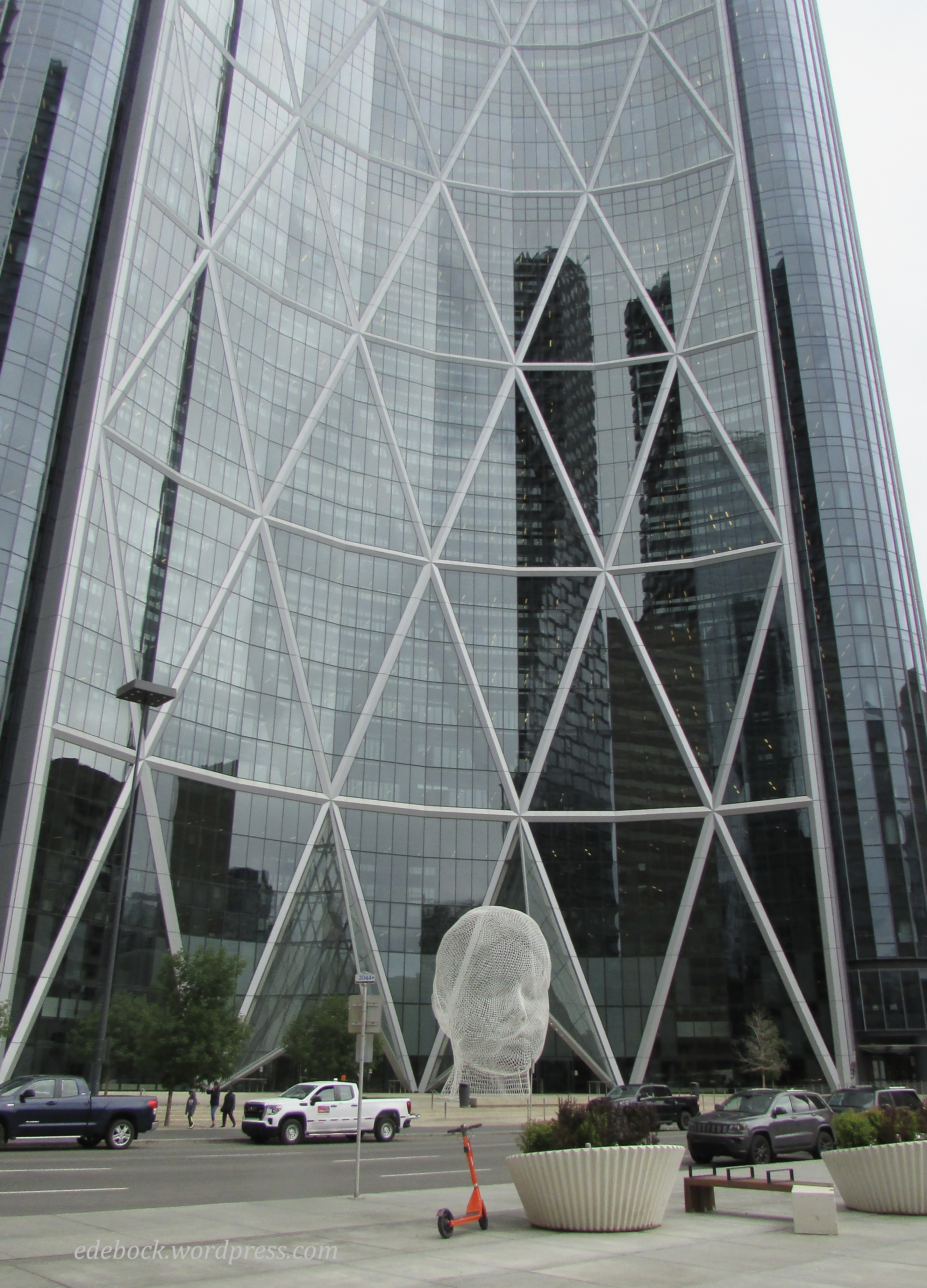
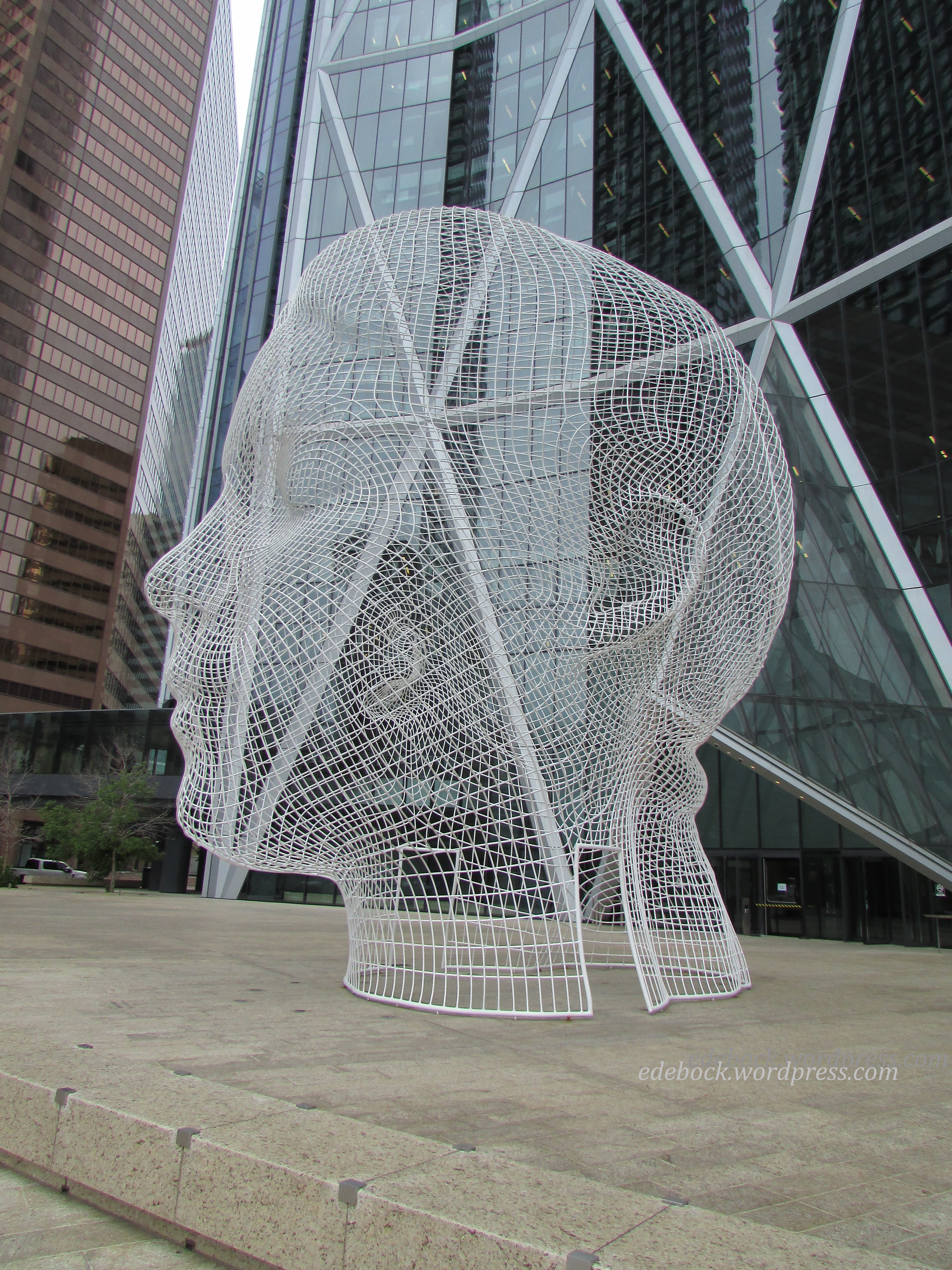
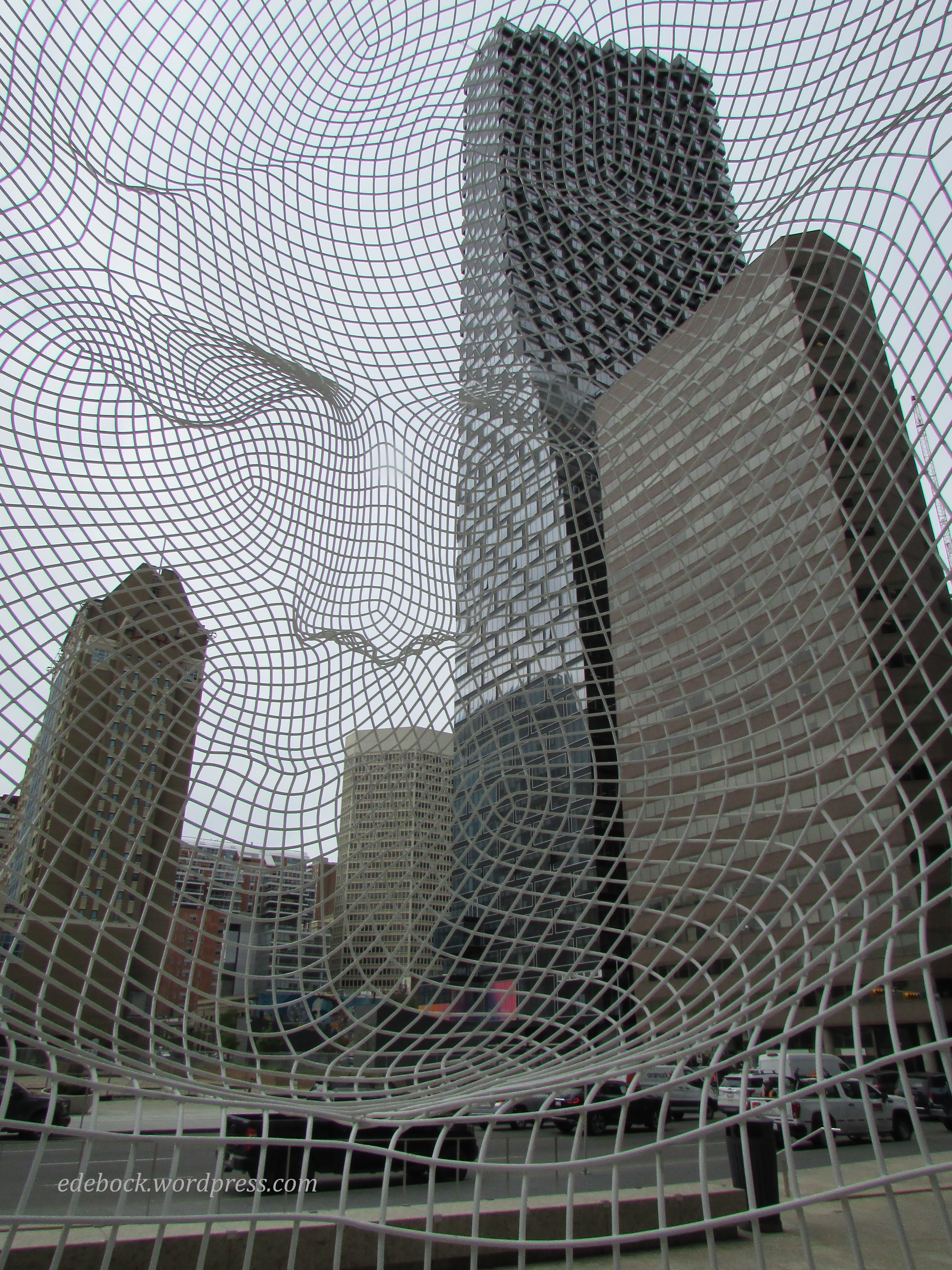
When Wonderland, a 39-foot-tall bent wire sculpture of a young girl’s head came into view, hubby’s comment was, “Look! It’s a giant radiation mask!” It did bear an uncanny resemblance to the fitted mask that I wore for every one of the 30 radiation treatments to my neck and jaw back in the summer of 2015. Thankfully, the statue has a much happier meaning. Located in front of the Bow, a crescent shaped skyscraper, it’s meant to represent the dreams of the young people of the province.

IMG_5704

IMG_5698

Unlike most sculptures, Wonderland allows visitors to view the artwork from the inside as well as out. This is definitely one of the most interesting looking photos I’ve ever taken! 

IMG_5702

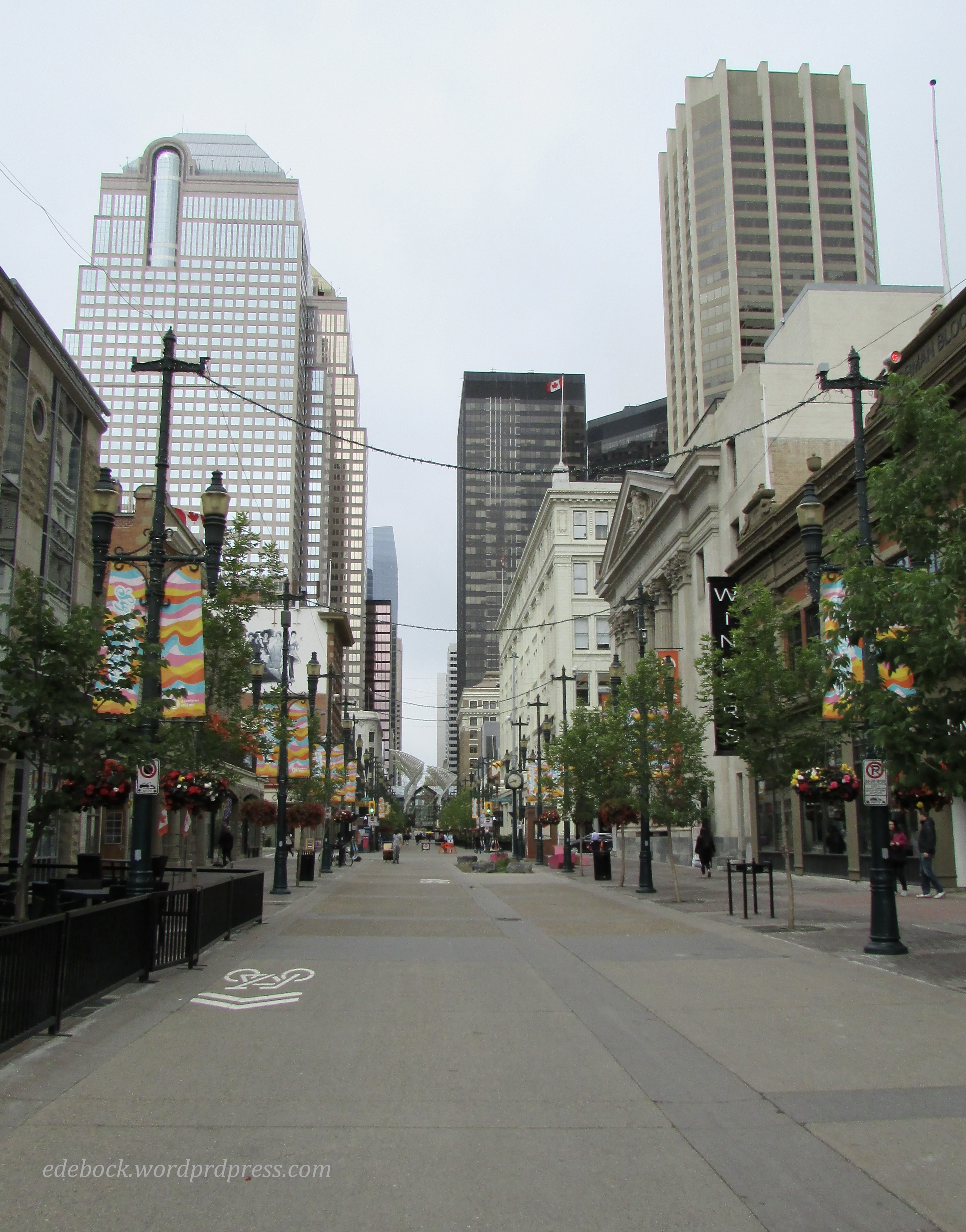
Lined with an eclectic mix of boutiques, high-end retailers, restaurants, cafés, pubs, and bars, as well as two hotels and the Telus Convention Centre, Stephen Avenue is a major pedestrian street stretching along 8th Avenue SW from 4th Street SW to 1st Street SE. 

IMG_5705

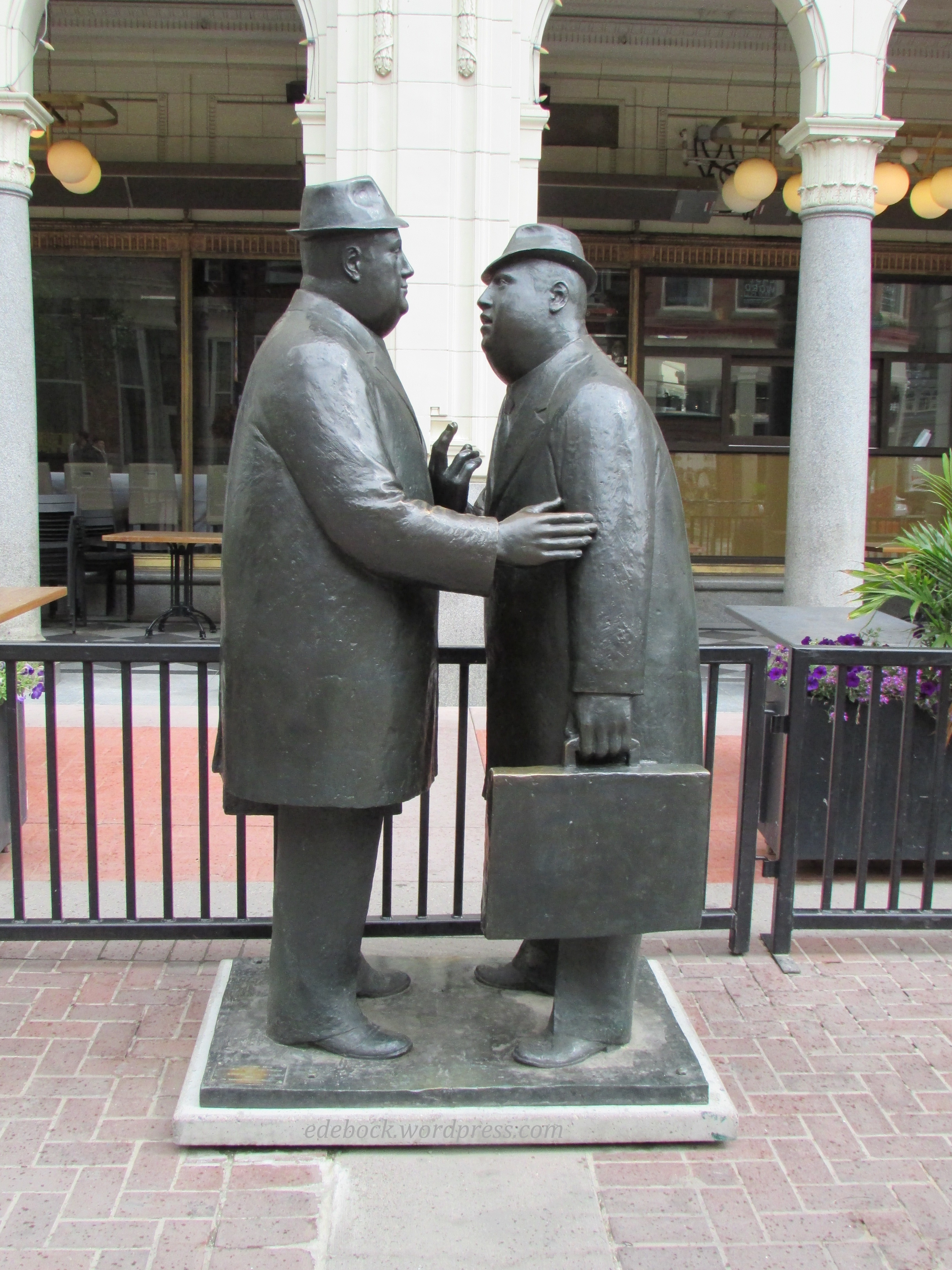
Usually a happening place, the avenue was quiet on a cool morning, but busier close to lunch time when we were headed back to the vehicle. It was along Stephen Avenue that we stopped to see The Conversation, a life-sized bronze statue of two businessmen deep in conversation. Created by William Hodd McElcheran, the popular sculpture originally belonged to Norcen Energy Resources who donated it to the City of Calgary in 1981. It has stood on Stephen Avenue ever since. 

IMG_5708

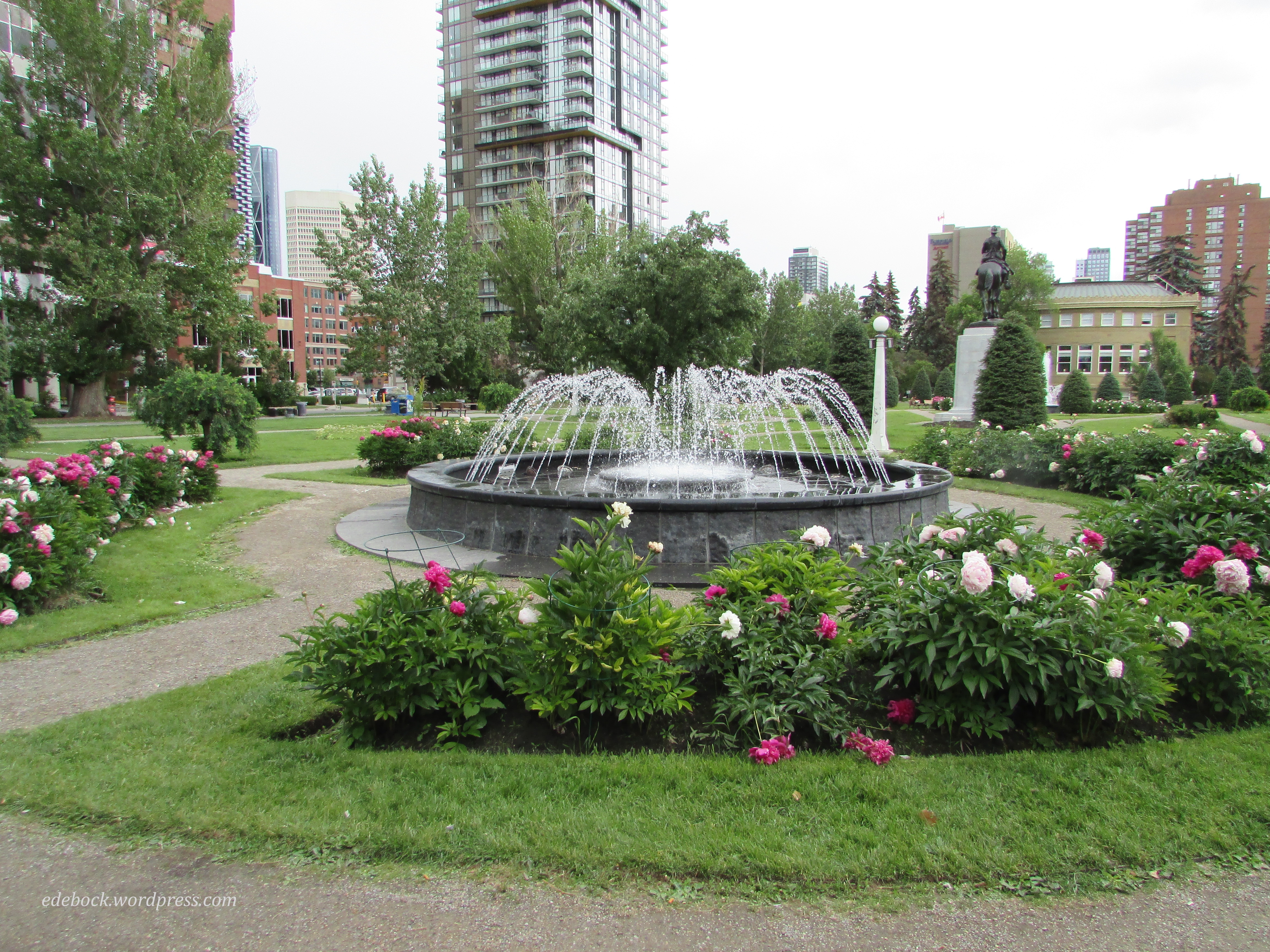
A little further in our walk, we came to Central Memorial Park. With the peonies in full bloom, it was a beautiful and peaceful spot.

IMG_5716

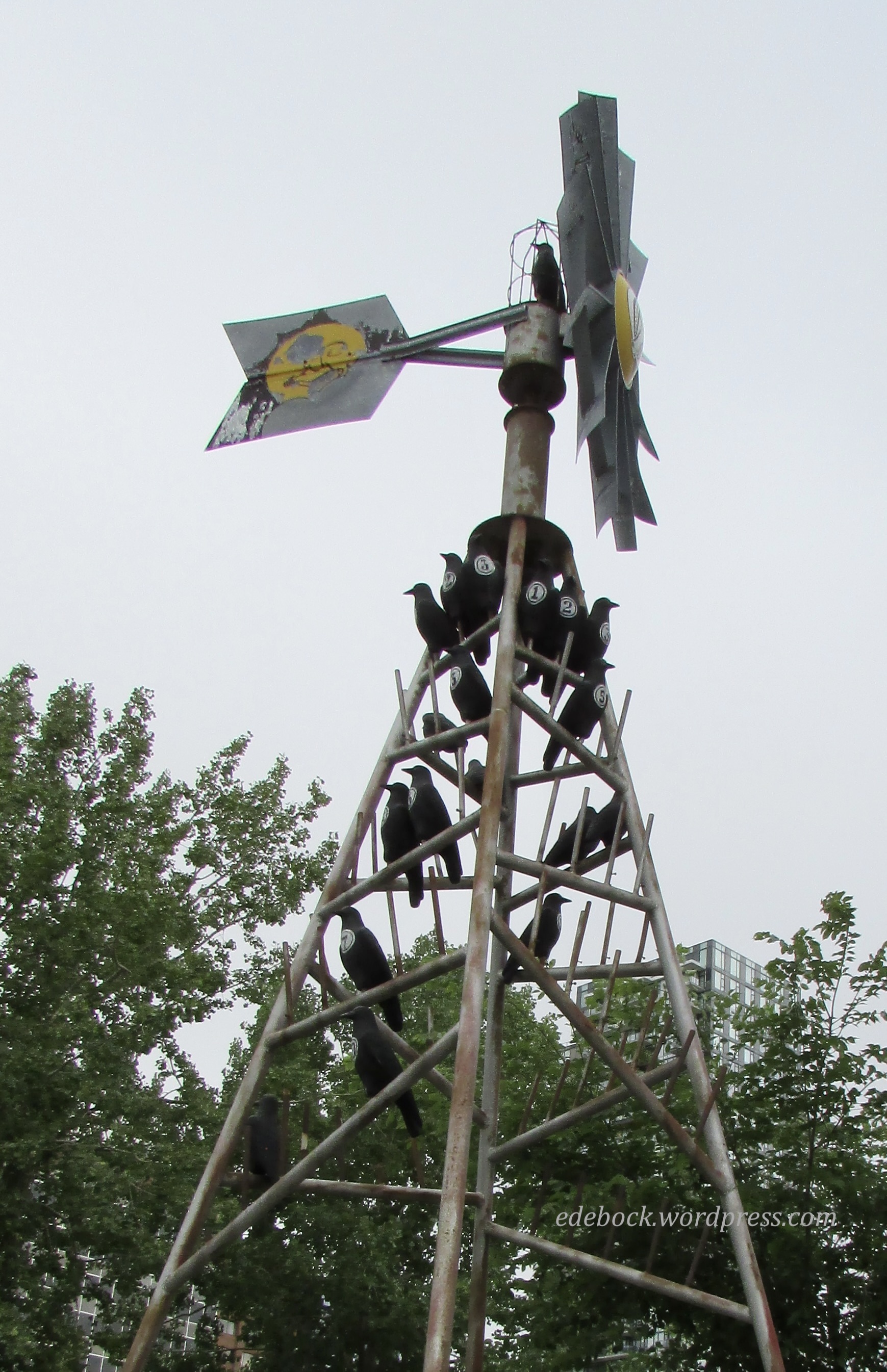
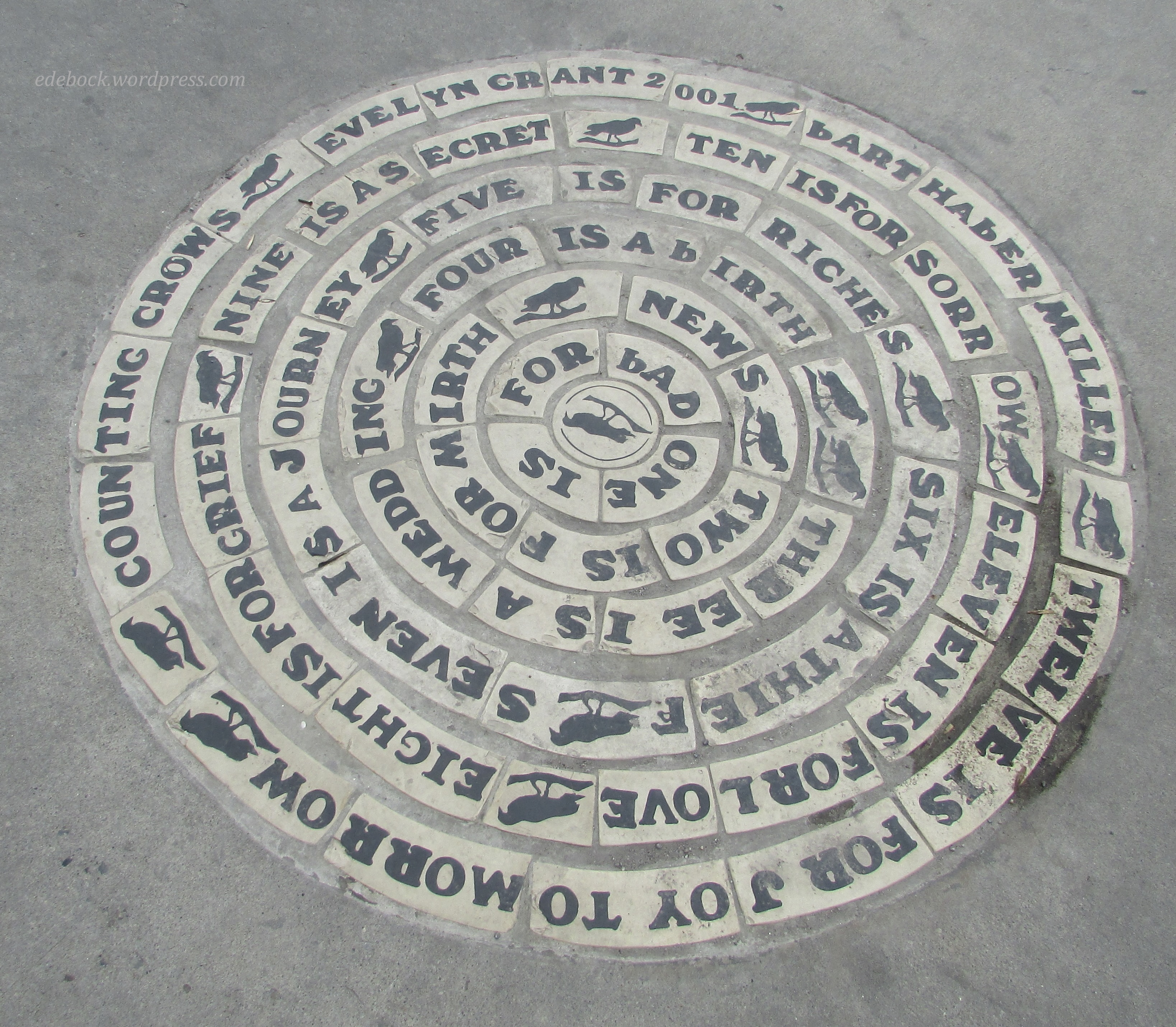
Across the street from the park at the corner of 4th Street SW and 13th Avenue SW stood what was definitely one of the strangest sculptures that we saw. Counting Crows was created by Calgary artist Evelyn Grant who handed it over to the city in 2001. Inspired by a traditional English rhyme that appears on the sidewalk below it, the sculpture resembles a windmill such as those that were once seen across the prairie. If you look closely, you’ll see that each realistic looking crow bears a number on its chest. 

IMG_5720

IMG_5723 2

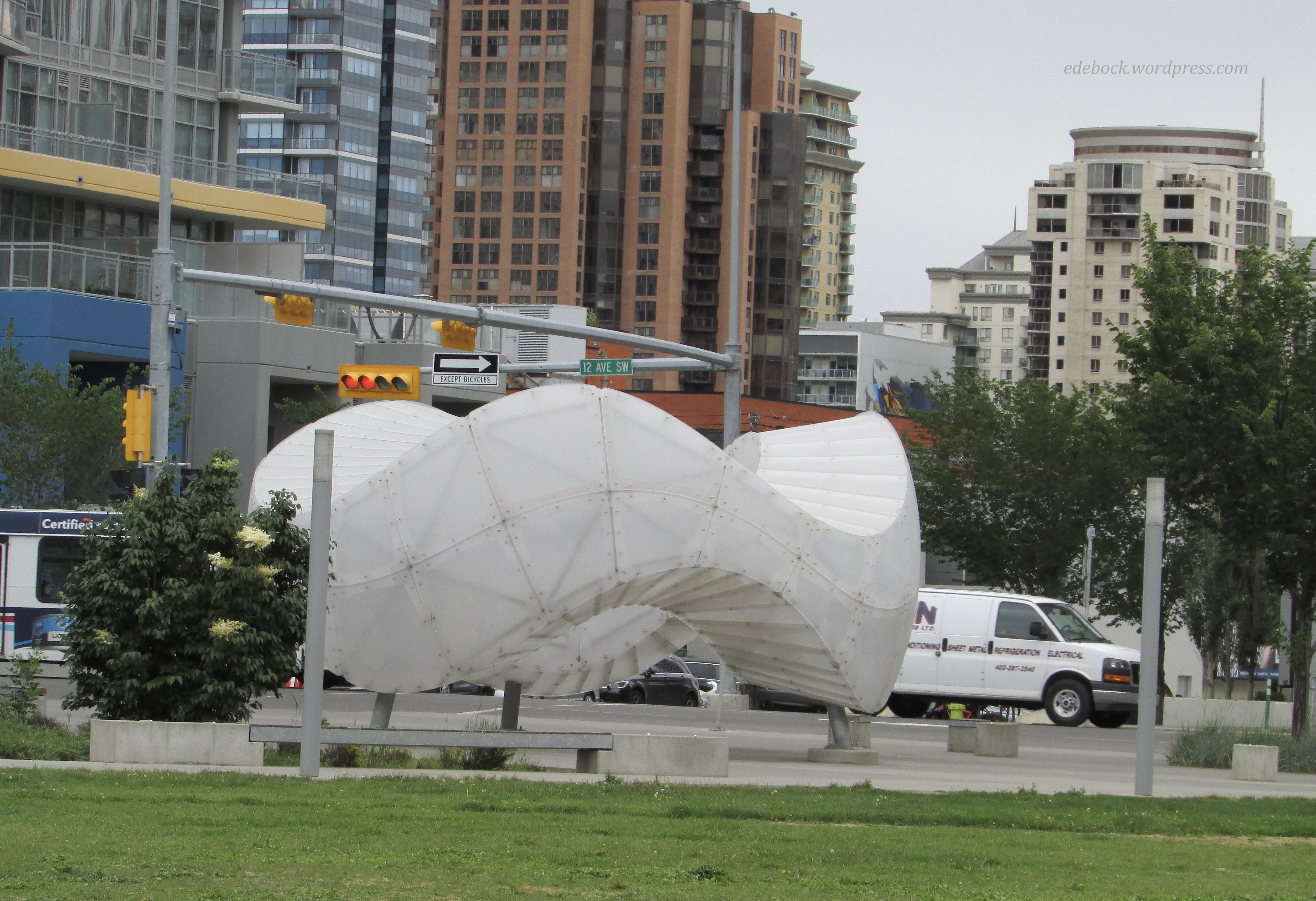
By this time we realized that we weren’t far from the Calgary Board of Education building where our daughter works, so we stopped in for a very quick visit before beginning the long trek back to our vehicle. Across the Barb Scott Park, next to her building, I spotted the last piece of public art that we’d see. The shape of Chinook Arc drew it’s inspiration from the historic Beltline Streetcar loop that once encircled the neighbourhood, as well as the Chinook arch, a unique cloud formation that occurs along the eastern slopes of the Rocky Mountains. Though we didn’t get close enough to investigate, I’ve since learned that it’s an interactive and illuminated installation that would likely be quite something to see lit up after dark. 

IMG_5731

As it was, we had to hoof it to meet our friend and get back to the parkade before our three hour time limit expired. We walked a total of 8.72 km (5.42 miles) and proved to ourselves once again that walking is the best way to see a city! 

Not a fashion post

I don’t have a Fashion Friday post for you today. Hubby and I spent a few days this week camping, hiking, and kayaking in one of our favourite locations, Big Knife Provincial Park. Though less than an hour from home, we had no internet or cell phone service. It was a total and wonderful disconnect from technology and from the cares of the world.

IMG_5606

People enjoy camping for many different reasons. For me, I love the solitude; the opportunity to get away from the busyness of day to day life and reconnect with nature. Sitting in camp reading a book, I heard nothing but the whisper of the breeze in the trees, the buzzing of insects, and the music of birdsong.  Occasionally the chatter of a squirrel or, in the evening, a distant chorus of coyotes, interrupted the quiet. From time to time, I enjoyed looking up from my book and watching a pair of small woodpeckers (yellow-bellied sapsuckers) industriously pecking away at a nearby tree. Working from morning til night, they’ll eventually kill the tree, but others will grow up to take its place. That’s the way of nature.

We spent part of each day hiking, exploring every trail in the park. I was thankful for the 60+ km that we walked last month, a good start toward accomplishing my goal of 350 km by the end of October. Our legs were more than ready to tackle the trails even in the extreme heat that our province has been experiencing recently.

IMG_5613

In places, stands of wolf willow (more commonly referred to as silver willow here because of the silvery colour of its leaves) were in bloom giving off the strong musky-sweet scent that is such a an unmistakable characteristic of the prairie at this time of year.

Because we were in bear country, we carried bear spray and kept the bear bell dangling from our backpack jingling. Unfortunately, that meant that we were less likely to see other wildlife, but we did see one deer and we were almost back to camp on one of our hikes when a beaver slipped soundlessly across the path right in front of us! If we’d been any closer, we probably would have tripped over it! In both cases, the animals moved too quickly for me to get a photo.

We saved our shortest, but most strenuous hike for our final morning. Leaving the marked paths, we followed a narrow trail that we first found several years ago. Though you can’t see the upper part of the trail in this photo, it follows the edge of the tree line all the way to the top of the hill then continues for some distance along the top of a ridge. In the second photo, I’m looking back.

IMG_5615

IMG_5619

IMG_5618

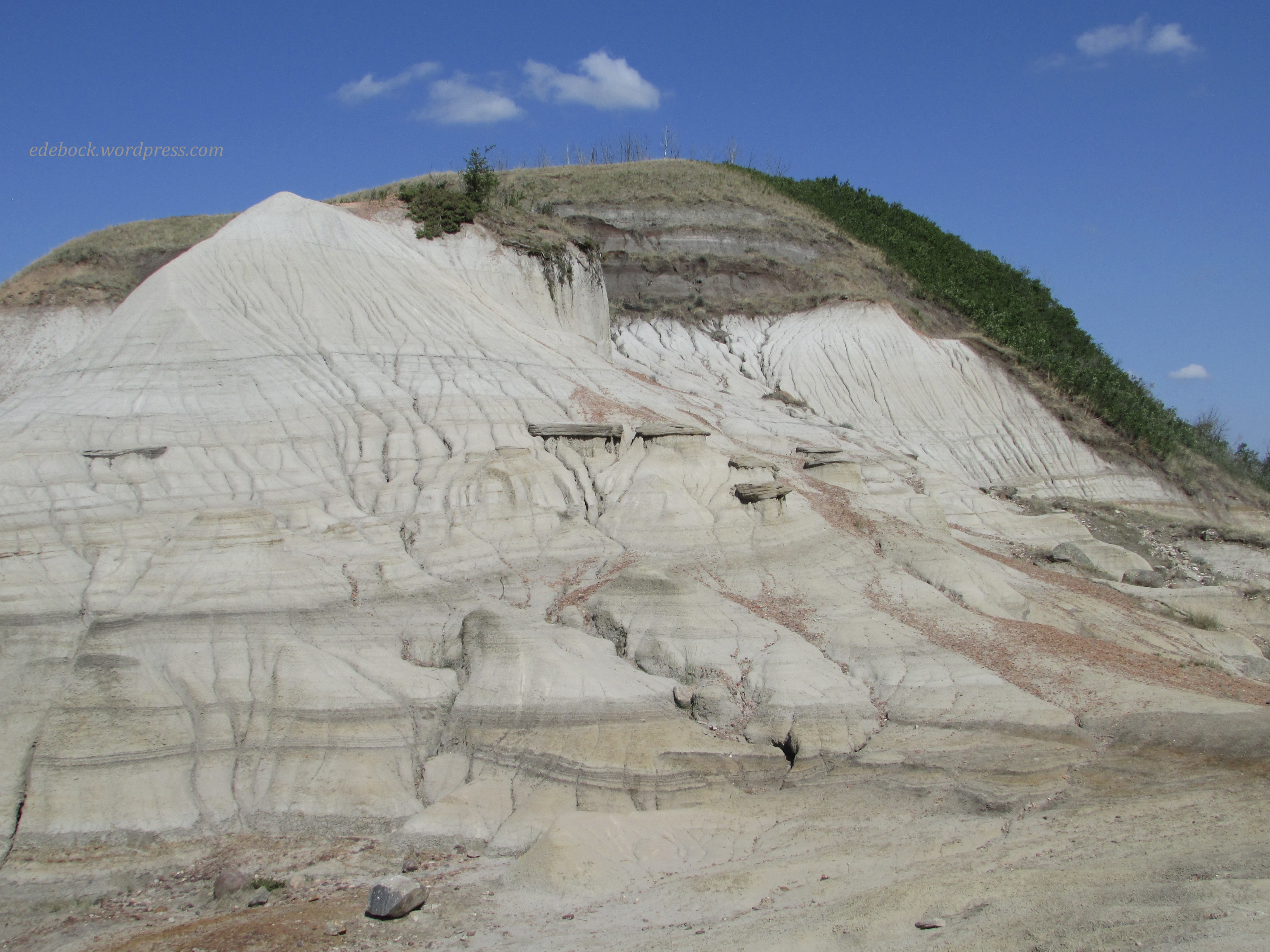
The trail led us to the hoodoos, a geological formation found throughout the Canadian badlands. Formed by erosion, a hoodoo is a pillar of soft sandstone with a capstone of harder, denser rock. This area is also accessible from one of the easier marked trails.

IMG_5628

IMG_5631

Not a fashion photo! 😄

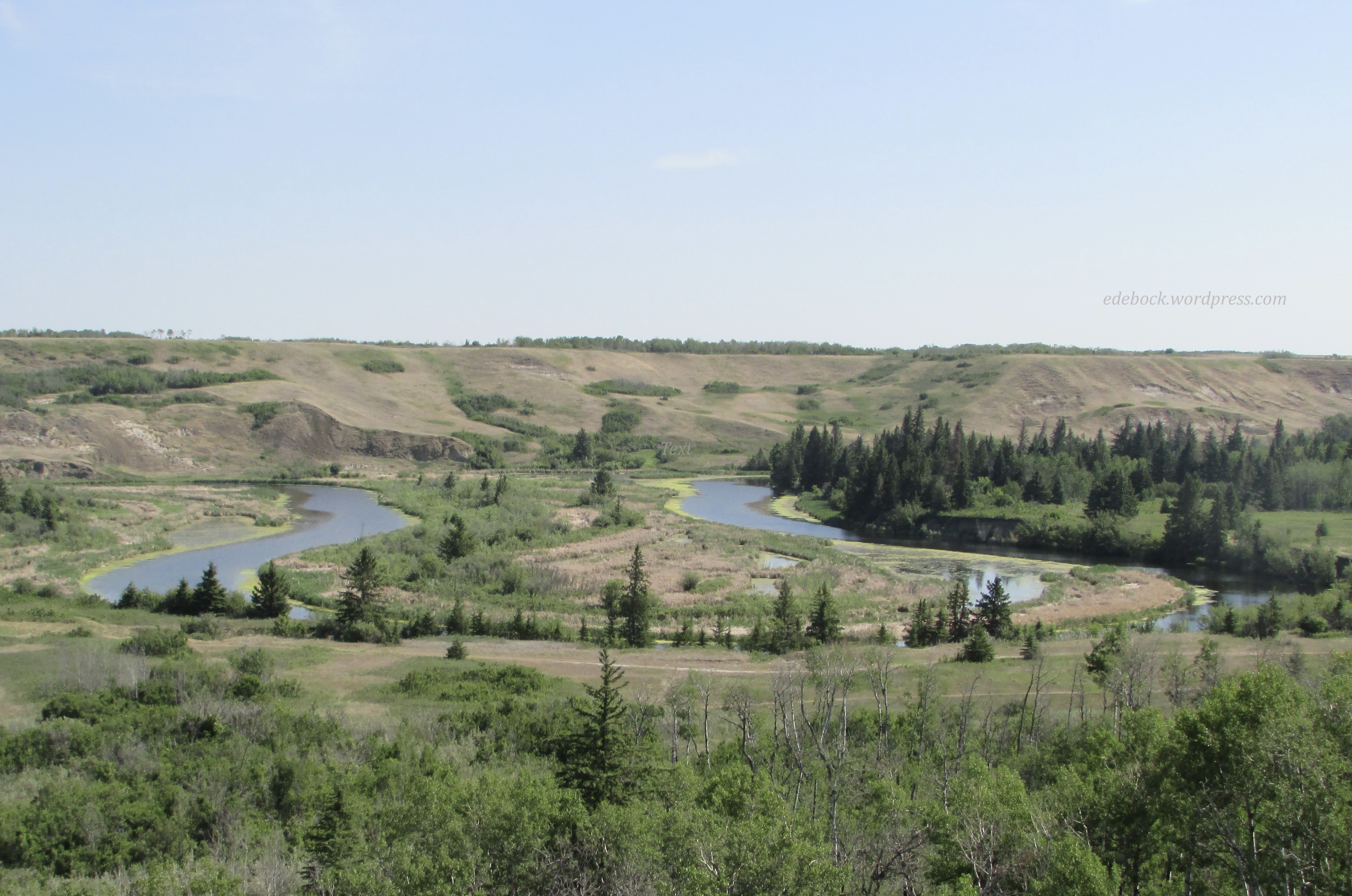
From the bluff above the hoodoos we had an amazing view of the meandering river below. Looking at the photo, it’s easy to see why we can paddle for a long time and not go very far as the crow flies! Our first time out on the water this trip, which was also the first time we had the kayak out this year, we paddled for over two hours. By the last half hour, I could feel the burn of muscles not used enough over the long winter months and started making promises to myself about dusting off the hand weights in the basement and starting to use them again!

IMG_5640

Fashion Friday could be a little hit and miss over the summer months as we hope to spend more time on similar excursions, but I’ll try to post something at least once a week, fashion or otherwise.

Book Club: The Next Chapter

Logo by SamLast Sunday evening, hubby and I went out for dinner and a movie. Like the original film, Book Club: The Next Chapter is hardly Shakespearean drama, but sometimes we just want to be entertained. What could be better for that purpose than something silly and fun starring four stellar actresses of our generation – Jane Fonda, Diane Keaton, Candice Bergen and Mary Steenburgen?

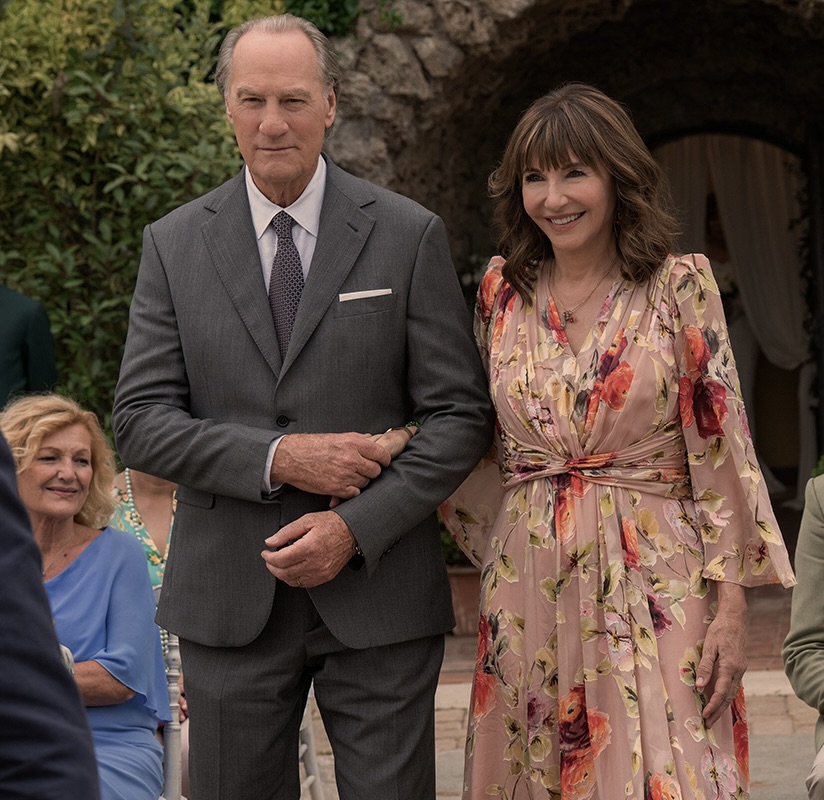
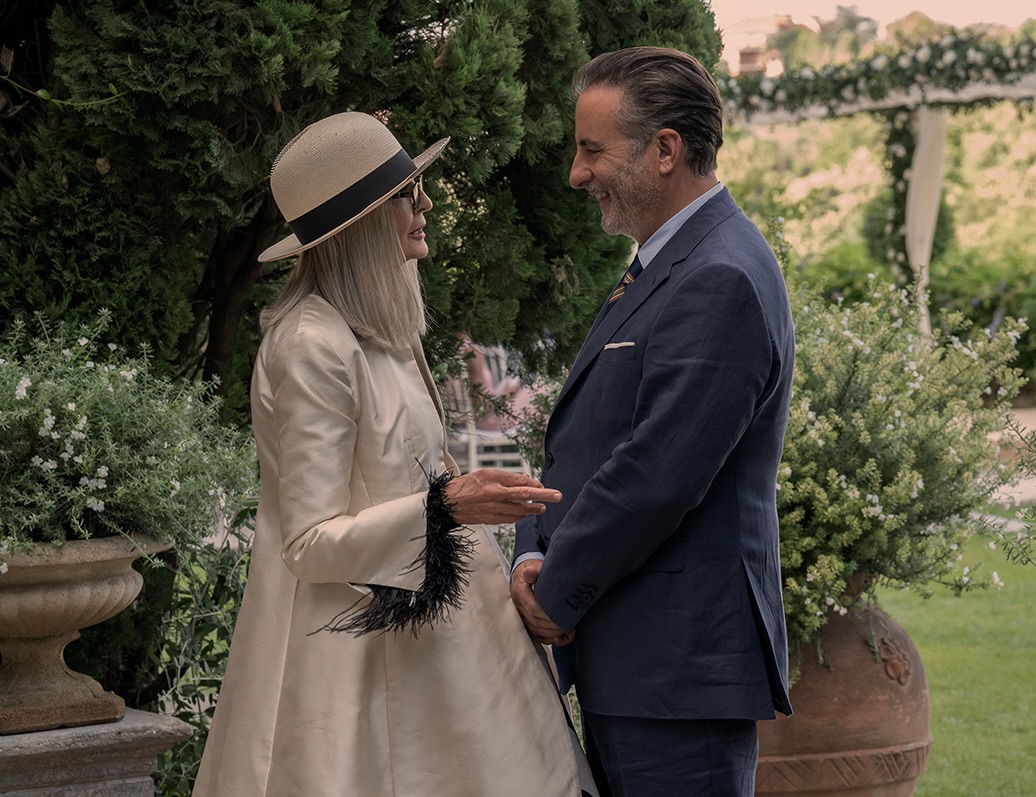
As much as I enjoyed the antics of four lifelong friends on a late-in-life bachelorette trip to Italy, it was their wardrobes that captured my attention. Fashion plays a key role in the movie, the clothes reflecting the fact that these women in their 70s and 80s are vibrant, sexy, and full of life.

In case you didn’t see the first movie, let me introduce the characters with this photo from the 2018 rom com.

Paramount Pictures

On the left, Diane Keaton plays Diane, a widow. Yes, she kept her own name as well as her quirky fashion sense. And look at that… she’s wearing a jean jacket! If you read my last post, you’ll know that some people are of the opinion that a woman over 40 should never be seen in a jean jacket. Candice Bergen plays Sharon, a self-deprecating judge who has been divorced for many years. Vivian, a flamboyant hotel magnate, is played by Jane Fonda and Carol, a successfully married restauranteur is played by Mary Steenburgen.

In the sequel which takes place immediately after pandemic restrictions are lifted, Judge Sharon has retired, Carol’s restaurant has closed, and Vivian, who reconnected with an old beau in the first movie, is engaged. At their first in-person get together after the shutdown, they decide to fulfill a long-time dream and travel to Italy together.

feature_book_club_fashion.jpg

1741.jpg

During their romp through Rome, Vivian wears a Bride to Be sash and veil over her leopard print blouse and the foursome visit a bridal salon where she tries on multiple wedding dresses. I wish I could show you an actual photo of 85-year-old Fonda rocking this amazing gown! She was as stunning as any young bride to be.

18503ba7-5599-46de-921e-0dc30809f682~rs_768.h

Losing their luggage (but thankfully not the wedding dress) meant shopping and an opportunity to push the envelope and make their looks a bit more daring, more colourful and exuberant. Steenburgen, the youngster in the crowd at 70, looks fabulous in a daringly low cut red gown, but again, I couldn’t find a photo, so you’ll have to watch the movie to see that one.

Costume designer Stefano De Nardis clearly had fun with this movie. “To me, ‘age appropriate’ means being able to have a personal style and let it out through clothing. I believe more in ‘personality appropriate,’ than ‘age appropriate.’” he says.

The plot might be somewhat thin, but in our ageist, youth-obsessed culture, the message that life is not over when we hit 60, 70, or even 80 is an important one. Senior women (and men) are still very much alive, engaged, and an important part of society. So, why not dress like it?

12 2

11 2