Rose gardens and city views

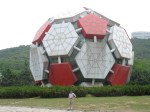
Located just a few blocks from the downtown train station in the shadow of Lushan Mountain, Labor Park is best known for its enormous red and white soccer ball that commemorates Dalian’s glory days as China’s famed football city. Like Dalian’s current football team, however, the park is a bit lacklustre in comparison to some of the more beautiful ones we’ve seen. It does have some pretty spots though as well as an amusement park and acres of space for relaxation. Though I read about “a game farm full of peacocks, deer, and cranes” we saw only a few beautiful cranes strutting around cramped and bare quarters and an empty pool that might have once housed otters or something of that nature.

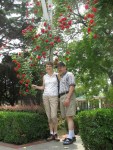
What the park does have is beautiful flowers, lots of statues and some great views of the city. When we passed it on the bus earlier in the spring, it was festooned with cherry blossoms but now the roses are in full bloom. We saw several bridal couples having photos taken in and around the rose gardens.

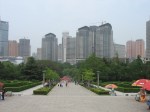
Yesterday afternoon, after strolling the broad avenue up the centre of the park, between the statues of the twelve animals of the Chinese zodiac (I’m a dragon) to the giant soccer ball, we took a chair lift up the mountain. As we passed over treetops and even a busy highway, I was glad that I’m no longer afraid of heights. I was even happier about that when we took the glassed in elevator to the observation deck high on the communications tower at the mountain’s peak. Though the day was a bit hazy and the ever present smog hung over the city, the views from the top were definitely worth the ride up. I’m glad we waited to do this until we’d been here for awhile and seen much of the city as it was fun to pick out the various places we recognized. Sadly, the smog and the dirty windows (nothing in China stays clean very long) made it virtually impossible to get good pictures.

Today, the second day of our Dragon Boat Festival holiday, was supposed to be a beach day with one of my students but the sky is grey and it’s pouring rain so that plan has been nixed. Instead, it might just be a relax at home day.

Charming Chinglish

Unless the weather changes dramatically in the next little while, this may be the first day in over three months that we don’t leave our little 390 square foot apartment! It’s been pouring rain and the wind has been howling all day long. Since we don’t work on Mondays and had nothing more than a trip to the supermarket to pick up a few groceries planned, it’s been a good day to stay indoors catching up on emails, reading, and playing a few games of Carcassonne. I won three in a row! It’s also a good day to reminisce about all the places we’ve explored since coming to China and to share with you some of the great examples of Engrish that we’ve found along the way!

Engrish, or Chinglish as it’s usually called in China, is what often happens when an Asian language is translated into English. You’ve probably seen some of it when you’ve tried to make heads or tails of the instructions that came with something produced in Asia. As a lover of words, I find Engrish highly amusing. I love to visit www.engrish.com, a website that posts one example of Engrish every day but I’m even more delighted when I find my own examples like the ones pictured below.

"Rain and snow carefully slip" appears beside an escalator in downtown Dalian. Richard waited patiently while I rode up and down several times trying to get the best picture possible!

The "Subsea UFO" sign is found in the aquarium that we visited with some of our students. We had no idea what it was referring to and it made absolutely no sense to any of us! Note that it includes the word harmonious which seems to be a very popular one in China. Even the students in my beginner level university class use this word frequently. The concept of harmony is clearly at the core of Chinese thought and culture. Confucius said, " Let the states of equilibrium and harmony exist in perfection, and a happy order will prevail throughout heaven and earth, and all things will be nourished and flourish."

I don’t know how well you can read the sign that we found at the entrance to Fu Jia Zhuang Park but I especially love #3 and #10. #3 reads "Pre-school age child or psychopath should be accompanied by a guardian." I’m having a hard time typing that one without laughing! #10 is longer. It reads "The tourist who suffers from heart disease, epi lepsy, cold, neuroticism, asthma, diabetes, high (low) blood pressure, rhinopharyngitis, earache or getting drunk are not allowed to dive and swim. If the tourist conceals the above-mention situation, he or she is responsible for the consequence if the accident happens."

One of many signs at the North Korean border warned, "Forbidden to cross border in border area." Um… where else might we try to cross it?

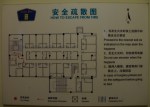
The How to Escape From Fire sign on the back of our hotel room door in Jinan also tickled my funny bone. Fortunately, we didn’t have to proceed to the nesrest exit but we did put on the safeguord before going to bed to prevent burglery from happening.

On our recent walk along the Daxishan Reservoir boardwalk there were many little wooden signs to guide our behaviour. We could figure out the intent of most of them but one was particularly entertaining. We did hold hands but it would have been pretty difficult to walk while holding our feet! The final sign was near the end of our walk. We had to look closely at the little icon to figure out what kind of nuisance people might commit. Believe it or not, though we haven’t actually seen anyone committing that kind of nuisance, we’ve definitely seen evidence of it on some of our walks!

I’m thinking about submitting a couple of these to www.engrish.com. Which ones made you chuckle?

Looking for peace and quiet

Chinese people tend to be quite loud and there are a LOT of them so this is definitely not a quiet place to live! The streets below our building are usually a beehive of activity. We jokingly call the scene outside our windows our reality show as there’s always something interesting to watch. Because the building has little or no soundproofing, the show comes complete with sound and now that the weather has warmed up and we often have the windows open, the volume has been turned up. Once in awhile, I wake during the night and marvel at the silence but sometimes there are people shouting or horns honking even in the wee hours.

When I was a child, if we asked my father what he wanted for his birthday, Father’s Day or Christmas, his answer was always the same. "Peace and quiet!" I must have inherited my appreciation for quiet places from him. It’s not easy to get away from the hustle, bustle and noise that surrounds us here but we did find a couple of slightly more peaceful places this weekend.

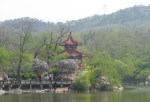
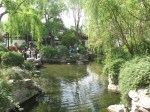
Yesterday afternoon, we visited the Dalian Botanical Garden with one of my university students. Chinese gardens, like Japanese, tend to be landscape style gardens that include one or more ponds, rock works, trees and gazebos or pavilions connected by winding paths. Though there may be flowers, they aren’t the main focus. The Dalian garden is on the outskirts of the city and surrounds a very large pond that is obviously well stocked with fish as there were many people with lines in the water. It was a beautiful Sunday afternoon and also Mother’s Day so there were plenty of families enjoying the park but in spite of that, there was a sense of peace that isn’t easily found here.

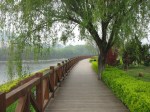
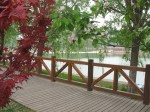
Today, we spent a couple of hours strolling along the boardwalk that skirts the Daxishan Reservoir, not too far from here. Though we were never far from the sound of traffic and there were others also out enjoying the walk, it wasn’t crowded. Again, there was a very welcome feeling of peace.

Second day in Qufu

If you had an entire day to do anything you wanted, what would you do? That’s the situation we found ourselves in this morning. We’d allowed ourselves two full days in Qufu thinking that one might not be enough to see all three Confucius sites that we visited yesterday.

Knowing that we had an entire day to fill, we were in no hurry to get up this morning. I haven’t been sleeping well lately largely due to the fact that I’m fighting a nasty cold so a bit of extra rest was very welcome.

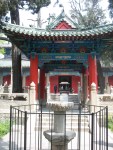
Once we were up and had had a late breakfast, we went to visit another ancient temple, this one dedicated to the memory of Yan Hui, a favourite disciple of Confucius. If it were located anywhere other than almost next door to the much larger and more impressive Confucius Temple complex, it would likely draw many visitors but we were almost alone and it was very peaceful. We could actually hear the birds chirping!

The Yan Temple has been undergoing renovations over the past few years. Apparently the cost of this massive facelift prompted a hefty increase to the admission fee which, I’m assuming, resulted in even fewer visitors. We learned, however, that if we could produce our combination tickets from yesterday, we would be admitted free of charge.

In addition to enjoying the tranquility of the temple grounds, we found the renovation project quite fascinating. One of the outer buildings houses a display of photos chronicling the meticulous work that has been done. The buildings that have been completed have received much more than a new paint job. Much dismantling and rebuilding was required to replace wooden parts and roofing that had deteriorated. Many of the intricate panels were taken down, painted and put up again.

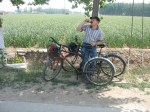
After leaving the temple, we headed over to the International Youth Hostel and rented bicycles. Leaving town, we rode out into the countryside to look at the farms where we saw corn, wheat and other crops that we couldn’t identify. Though they appear to have been seeded by machine, we saw many people, mostly women, out in the fields pulling weeds. Imagine doing that by hand on a Canadian farm! I have no idea how far we rode. I’m pretty sure my butt will be telling me about it tomorrow but it was well worth any discomfort I may have to put up with.

After an early supper, we were strolling back toward our hotel when we decided to rest for awhile on a stone bench near the main gate to the city wall, a great spot for people watching. Little did we know that we were in for an unexpected surprise. We were about to leave when someone began banging on the enormous drum atop the wall. It heralded the beginning of a gate closing ceremony complete with elaborately costumed guards, flag and lantern bearers, a herald and others we couldn’t identify. It was a perfect ending to our stay in historic Qufu!

A day with Confucius

Wheresoever you go, go with all your heart.
Confucius

We left Jinan yesterday morning and travelled south by bus to Qufu (pronounce Chu Fu). Small by Chinese standards, with a population of only about 86 000 people, Qufu is famous as the hometown of the great sage, Kong Fuzi, better known to us by the westernized version of his name, Confucius.

The old walled centre of Qufu is small and easy to get around on foot but the three principle sites; the Confucius Temple, the Kong family mansions and the Confucius Forest where the great teacher and his many descendants are buried, are absolutely enormous. We spent all day today exploring them.

When we stopped at the ticket office to purchase the combination tickets that would allow us to visit all three sites, we were also thinking about hiring an English guide but before we could, we were approached by a young college student who called himself Aku, an abbreviated version of his difficult to pronounce Chinese name, who offered to act as our guide for free if we would simply use his camera to take a few pictures of him throughout the day. We agreed and found him to be a delightful and knowledgeable companion.

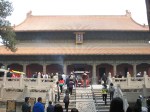
We started our day at the Confucius Temple, China’s second largest imperial building complex after the Forbidden City in Beijing which we hope to visit in July. The temple started out as a simple memorial hall some 2500 years ago but over the ages, it mushroomed to today’s compound which covers 327.5 acres and is 1.3 km in length from north to south.

Though there is some debate about whether Confucianism should be considered a religion or simply a system of philosophy, the temple was once a site where sacrifices were offered to Confucius. He was a great thinker, a teacher, editor, politician and a philosopher whose teachings emphasized personal and governmental morality, correct social relationships, justice, loyalty and sincerity. He was a strong proponent of ancestor worship which is something we have a hard time getting our heads around but I can’t help wondering if he ever intended that nations of people should worship him. Whether it was his intent or not, many Asian cultures including Chinese, Korean, Japanese and Vietnamese have been strongly influenced by Confucianism.

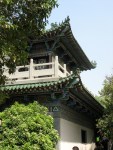
After spending all morning touring the temple complex we stopped for lunch then moved on to the Confucius mansions, a maze of 450 halls, rooms, buildings and passages where his wealthy and powerful descendants lived like kings. Emperors were known to drop in for visits and a special ceremonial gate near the main entrance was opened only when this happened. The complex included administrative offices and meeting rooms, family residences, kitchens, guest rooms, studies, libraries and a treasury. A peaceful garden of flowers and greenery are found at the rear. Aku told us that his dream would be to build a home like this one in the Chinese countryside but I only coveted the garden and a few unique features like the round doorways! I could also imagine children having endless hours of fun playing hide-and-go-seek in the many passageways!

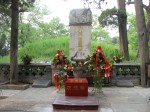
After relaxing over coffee, it was time for Aku to leave us as he had a bus to catch later in the day. We took a pedicab 2 km north to the Confucius Forest, the oldest and largest family cemetery in the world. There, Confucius and his descendants have been buried for more than 2000 years, a practice that continues up to the present time. The peaceful pine and cypress forest covers an area of more than 200 hectares. Burial mounds and memorial plaques are scattered haphazardly throughout the area. Confucius, himself, lies beneath a grassy mound enclosed by a low wall. Though most of the tourists crowded around the tomb were simply curious, there were those who knelt and others who made offerings of flowers.

After walking back to our tiny, family-run hotel where every room number begins and ends with 8, considered a lucky number by the Chinese, we’re spending a quiet evening resting our very weary feet. Our hosts don’t speak a word of English but they are clearly delighted to have us, their very first Canadian guests, staying with them.

To see what is right and not do it, is want of courage or of principle.
Confucius

Thank you, Dr. Bethune

Over the past few years we’ve stretched our comfort zones to such an extent that we don’t really know where the edges are anymore! I’m pretty sure we stepped outside them this morning, though, when we boarded a bus and headed out into the Chinese countryside with no definite idea how we’d get back to Jinan!

The bus dropped us off beside the highway and we walked two kilometres into the historic village of Zhujiayu. After the noise and pollution of city life in China, a walk in the country was literally a breath of fresh air! The crops on either side of the road were heading out already but it was a bit too soon to tell for sure if they were barley or bearded wheat.

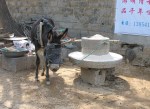
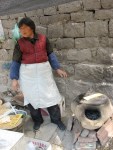
Walking the narrow stone streets of Zhujiayu is a journey back in time. Protected by hills on three sides and dating back to at least the Ming and Qing dynasties, it’s easy to see why it’s been used as a set for a number of movies and television dramas. Though the central street was crowded with vendors selling snacks and tacky tourist souvenirs, we were delighted to see that effort has been made to restore parts of the crumbling village including the wall that enclosed its northern flank and to bring history to life for those who visit. We watched a donkey grinding grain into course flour that was then sifted by hand and used to make the chive stuffed tortillas that we ate for lunch. They were cooked outdoors on a small clay oven.

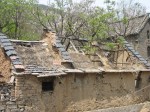
We found the construction of the now crumbling structures fascinating. Most were built of stone from the surrounding hillsides but others were made of brick covered with a layer of some kind of plaster, a building method still in use in this country today. Beneath the tiled roofs was a thick layer of thatch that would have acted as insulation.

After spending a few hours exploring almost every nook and cranny in the village, it was time to figure out how we’d get back to Jinan. According to our trusty Lonely Planet guidebook, there might be a bus that would take us to nearby Mingshui where we could catch another bus back to Jinan. If not, we could walk back to the highway and try flagging down any bus heading back toward Jinan.

As we exited the site, we stopped at the tourist services building to see if anyone there spoke enough English to advise us. Neither of the women on duty did but one of them hustled out to find someone who could. She soon returned with three smiling men. One of them spoke a few words of English but he phoned his wife who was somewhat more fluent and by passing the phone back and forth, we learned that her advice was that we walk back to the highway and flag down a bus. After the gentlemen produced their cameras and had their pictures taken with us, we headed off to do just that.

As we exited the gate, however, we were surrounded by taxi drivers offering to drive us into Mingshui or even the entire 80 km back to Jinan. Of course, they wanted an exorbitant amount in return for their services so we quickly said no and went on our way. I soon noticed that one of the men who’d crowded around us as we talked to the taxi drivers was following us on the opposite side of the road. When we got out of earshot of the others, he crossed the road and told us in broken English that if we would wait for ten minutes while he walked home and got his car, he would drive us to the bus station in Mingshui at no cost! We’ve found over and over again that the Chinese are more than willing to do things like this for us; in fact, they seem to consider it a privilege! As he drove, he explained that one of the reasons that the Chinese love Canadians is because more than fifty years ago, a Canadian doctor helped the Chinese people very much. He was, of course, speaking of Dr. Norman Bethune who died in China in 1939 while serving as a battlefield physician during the Japanese invasion of this country. He is considered a beloved hero to this day.

Though the bus from Mingshui delivered us to an unfamiliar bus station (Jinan has at least three of them) the taxi ride back to our hotel wasn’t much longer than it would have been from the main station where we caught our outgoing bus this morning. Another adventure was complete and our comfort zones, just a little bit bigger! Thank you, Dr. Bethune!

City of Springs

Our day began a few blocks from our hotel at Baotu Spring Park, Jinan’s most popular tourist site. "Spring" refers to the fact that the park is home to many of the 72 famous springs that are located in Jinan’s downtown district but today it could also have referred to the season and the new leaves on the the willows that overhang the many pools and the moat.

After wandering the crowded park for most of the morning, we rested our feet for almost two hours as we enjoyed a boat trip around the moat and across Daming Lake at the north end of the downtown district.

After a late lunch, we spent the remainder of the afternoon strolling along the moat and watching the crowds of holidayers enjoying their day in the sun. People here obviously don’t see very many foreigners. Everywhere we went, heads swivelled to take a second look and people pointed us out to their companions. Though few of them speak any English the word "foreigner" seems to be part of their vocabulary as we heard it often! Children seemed to be particularly startled by our strange appearance but in general, everyone seemed happy that we were out doing what they were doing, enjoying a beautiful day in a beautiful place.

One of the challenges to being in a foreign country where you don’t understand the language can be finding food. Though there are a proliferation of tiny restaurants within a few blocks of our apartment in Dalian, when it came to finding supper tonight, we couldn’t figure out where all these people ate! Though there are McDonalds and KFCs all over the place, we wanted something a little more nourishing and authentic. After a somewhat frustrating search, we found a delicious meal at a crowded and noisy food court just off the sprawling central square which I’ve also seen referred to as the livingroom of Jinan.

As "senior citizens", over the age of 60, we were able to enter Baoto Spring Park free of charge this morning, saving approximately $6.50 each! Although I laughed about being referred to as a senior citizen at the time, after being on my feet in the hot sunshine for most of the day, I feel a bit more like one this evening!

Statues by the sea

After figuring out where we went wrong trying to find our way last week, we did Dalian’s seaside walk today. Though it was misty over the ocean, it was a comfortable day for walking and according to my pedometer, we covered about 7.5 km.

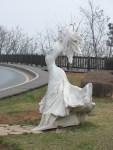
Dalian is a city of statues. I couldn’t begin to photograph all the ones we saw today but there were a few that stood out to me so I thought I’d share my favourites with you. We got off the bus and started our walk at the giant seashell at the entrance to Fujiazhuang Beach. Though a few hardy souls were swimming and a couple of wedding parties were having photos taken, most of the people on the beach were fishing or gathering seaweed and a few, like us, were just out for a stroll.

From Fujiazhuang, we followed a boardwalk that wandered along the coastline. At times, it offered great views of the ocean but some of the time it followed a busy road and the views were often blocked by construction. Along the way, I fell in love with the two white statues. They both captured the carefree feeling of a day by the sea.

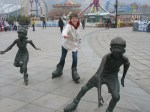
The inline skating statues near the end of our walk were by far the most fun though. Being a Monday, most of the city was at work and we shared the day with many seniors, some of them with young grandchildren in tow. I waited my turn while a group of older Chinese women took turns having their "skating" photos taken. They were clearly delighted to see that I was going to have mine taken too. In fact, they lingered to watch and offer advice on my pose! As foreigners, we’re a bit of an oddity here. People often take a second look when they see us and it isn’t unusual to notice someone taking our picture. They usually do it somewhat surreptitiously but these women were quite open about it. We couldn’t speak with one another but laughter is the same in any language!

Searching for the sea

Dalian is known for its impressive coastline and many beaches. Though I’ve lived on the Alberta prairie for well over 30 years, I’m still a coastal girl at heart and I’ve been looking forward to warmer weather so that we could begin exploring that part of the city.

When the temperature climbed to at least 15ºC each of the past two afternoons, I decided that today might finally be the day to visit the shore. The day dawned bright and sunny and though it was a little cooler, the wind wasn’t blowing. I couldn’t wait any longer!

Our Lonely Planet guidebook suggested taking the bus to Fujiazhuang Beach. From there, we could walk a combination of sidewalks and boardwalks that run along the coast to Xinghai Square, a distance of 4 or 5 km. If we wanted to, we could continue further along the seaside but we haven’t been to Xinghai Square, the biggest city square in Asia, yet so we thought we’d probably spend some time there instead.

The guidebook told us to catch bus 5 on Jiefang Lu not far from the railway station. We know that area fairly well now but we couldn’t find bus 5! After walking along Jiefang checking the various bus stops, which fortunately have signage in English as well as Chinese, we discovered that bus 22 went to Xinghai Beach so we decided to take that one and see where we ended up. As it turns out, we were about 2 km from Xinghai Square but in the opposite direction from where we intended to be. Since we don’t have a city map, we didn’t know that until after we got back to the apartment and I looked it up on Google Maps!

In the meantime, we were on a beach which was all that really mattered to me! The sound of the waves lapping the shore and the smell of the sea was exactly what I was looking for even if there was no boardwalk to stroll on. For a crisp April day, Xinghai Beach was a happening place. While not as crowded as I’m sure it will be when summer comes, there were plenty of people walking the pebbly beach, sitting in the sunshine or flying kites. While I picked up bits of sea glass to add to my collection, many of them were picking up seaweed to take home and cook for dinner! Others were fishing.

We walked the full length of the beach then wandered through an amusement park that’s located at one end. There we rode the rather squeaky and dilapidated ferris wheel in order to get a better view of the area but the windows were so badly scratched that my pictures didn’t turn out very well!

Heading back toward the bus stop hoping to retrace our route and find our way home, we noticed that the tram also ran by and stopped there. There are only three tram routes in Dalian and we hadn’t ridden one yet so when we saw that one was coming and heading in the right direction, we ran for the stop and jumped on. We didn’t know for sure where it went but we knew that it would eventually end up in the city centre. As it turned out, it was a much shorter and quicker ride than the bus would have been.

I’m still determined to do the seaside walk but it will have to wait for another day!

One step from North Korea

According to our Lonely Planet guidebook, after traversing the Great Wall we had two choices for returning to the parking area where we’d catch a ride back to Dandong. We could either follow the river on a narrow dirt path or choose a hiking trail along the cliff face. The couple we were travelling with expressed a preference for the easier riverside trail but I was secretly delighted when we couldn’t locate it and had to set off along the more challenging route instead! We shared it with many other people and didn’t actually see anyone below us so I’m assuming that the easier path isn’t there anymore. Instead, we looked down on the fence that ran along our side of the river and separated us from North Korea.

Even though I’ve pretty much managed to overcome my lifelong fear of heights, as we went along I was very thankful for the sturdy metal fence that provided both protection from falling and a handrail when it was needed. In places, the hike was an easy one but we also scrambled up, down and over some rocky faces that were quite challenging. Then, as we neared the end of the path, we came upon a suspension bridge! In the past, that would have finished me off but instead I was able to enjoy it and even provide encouragement for one of our companions whose fear was written all over his face.

Shortly before we reached the end of our journey, we reached the spot known as Yibukua or ‘one step across’, a particularly narrow part of the river between the two countries. Perhaps the water is high at this time of year because it would have taken more than one giant step to cross it but regardless, the barbed wire fence made it impossible for anyone foolish enough to try. Signs also made it very clear that we shouldn’t attempt to cross and if that wasn’t enough deterrent, the gun-toting North Korean soldiers patrolling in the distance definitely would be.

At no point did we feel that we were in any danger though. Chinese tourists do visit North Korea and we probably could too but I doubt that we ever will. I do feel like I should have a stamp on my passport that says that I was one step away though!