Mezuzah

If you come to visit us, you’ll notice something on the doorpost at the entrance to our home that wasn’t there before our trip to Israel.

IMG_1363

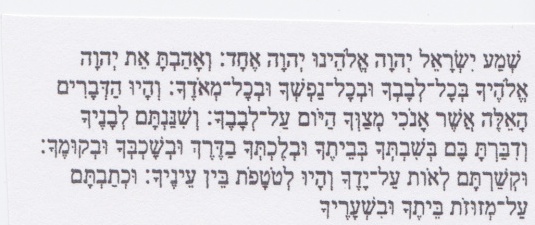
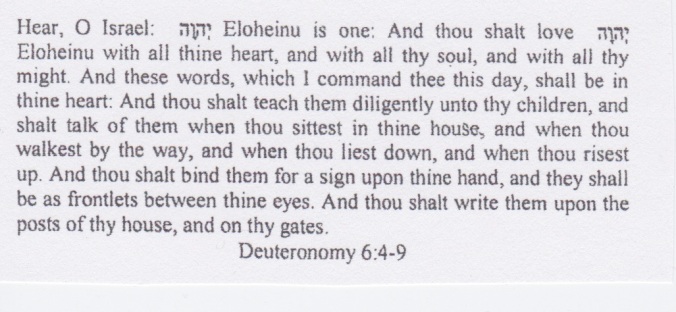
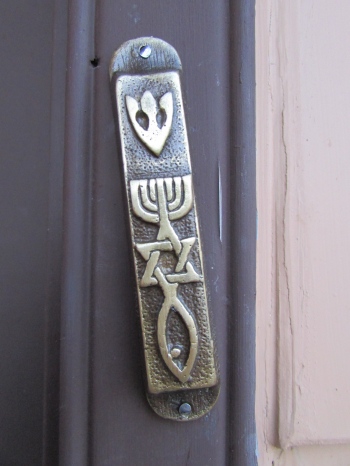
Four inches long and made of brass, it is a mezuzah container. Hidden inside are two tiny slips of paper, one in Hebrew and the other in English.

scan-1


Scan

Mezuzahs are fastened to the door frames of Jewish homes to fulfill the Biblical commandment to write the words of the Shema, the command that is central to the Jewish faith, on the door frames of their houses. (Deuteronomy 6:5-9)

“Love the Lord your God with all your heart and with all your soul and with all your strength.” 

If ours were a true Jewish mezuzah, there would be just one scroll inside. It would have been handwritten by a certified scribe with specially prepared ink on kosher parchment made of thinly shaved hide. If we were a Jewish family, we would have several mezuzahs, not just the one on the outside doorpost. Every doorway that leads into a proper room, except for the bathroom, would have its own mezuzah. Each of our hotel rooms in Israel had one.

A mezuzah is permanently affixed to the right doorpost, on the lower part of the upper third. It is traditionally hung on a slant, as shown in the photo above, with the top pointing inward. A special blessing is usually read or recited prior to affixing each mezuzah.

Mezuzah cases come in a variety of sizes and materials. Ours is a Messianic mezuzah made specifically for a Christian home. The symbol at the top is the Hebrew letter “Shin”, the first letter of Shaddai (Almighty), one of the Biblical names of God. Below it is the Messianic Seal of the Church of Jerusalem which incorporates a menorah (seven branched candelabra), a distinctly Jewish symbol, and a fish, which has been used as a symbol of Christianity since its very early days. The triangular base of the candelabra and the tail of the fish tie the two symbols together and form the Star of David, the national symbol of Israel.

The mezuzah at the entrance to our home will long be a reminder of our amazing pilgrimage to Israel, but also an expression of our faith in God.

“As for me and my household, we will serve the Lord.”  Joshua 24:15

Final day

Reflecting on and writing about our final day in Jerusalem seems like a perfect way to enter the Lenten season as we spent the day immersed in the final moments of Jesus’ life here on earth, visiting the sites surrounding his arrest, crucifixion, burial and resurrection!

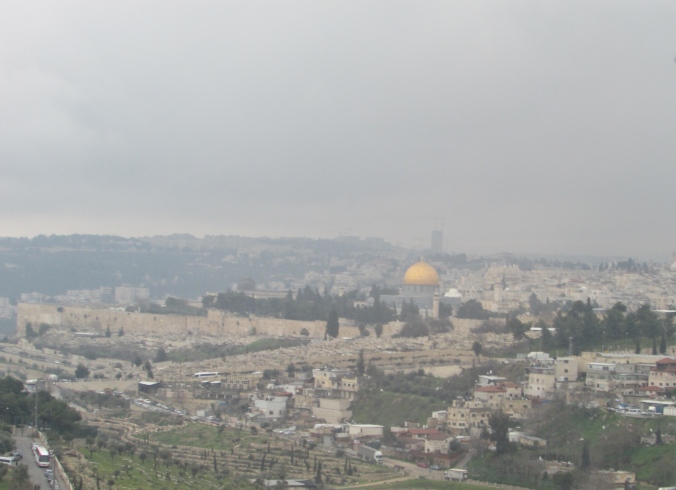
Our morning started on the Mount of Olives overlooking the Kidron Valley. The sun gleamed off the golden Dome of the Rock, the Muslim mosque that now stands atop Mount Moriah where the Jewish temple once stood. Before us lay the route that He took on His triumphal entry into Jerusalem on the day that has become known as Palm Sunday. (Matthew 21:1-11)

IMG_1107 - Version 2

As we stood atop the Mount, we were reminded that, according to prophecy, that is where He will return someday! (Zechariah 14:4) Come, Lord Jesus!

Walking down the Mount, we came to the Garden of Gethsemane where Jesus spent the final moments before His arrest. Even with the sound of traffic in the background, the garden was a place of great peace. In our devotional time there, we were reminded so clearly of the great burden that our Lord bore that night as He prayed alone, feeling the weight of the sin of the entire world on His shoulders. Kirk, our devotional leader, compared it to the deepest of depressions. For me, our time of reflection in the garden was spiritually profound. As I thought about the extreme anguish that I once felt when I was betrayed by someone I loved and then tried to multiply that by the sin and betrayal of every person who has ever lived, it was beyond my ability to comprehend. Is it any wonder that He sweat drops of blood and prayed, “Father, if you are willing, take take this cup from me.” How thankful I am that He followed this up with “yet not my will, but yours be done.” (Luke 22:39-45) Without that willingness to carry the weight of our sins to the cross, we would be forever lost with no hope of salvation and eternal life.

We stopped for a quick look at the Gethsemane Basilica of Agony with it’s beautiful mosaics above the portico.

IMG_1189

Continuing down the hill and up the other side of the valley, we entered the walled city through the Lions’ Gate, which is also known as St. Stephen’s Gate or the Sheep Gate.

IMG_1200

IMG_1203 - Version 2

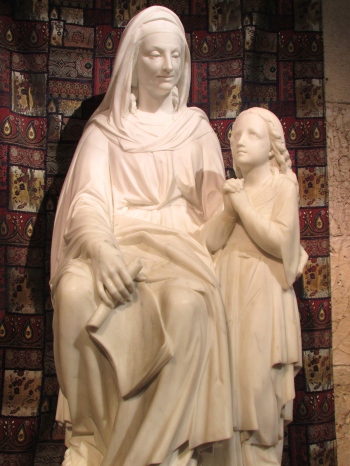
Inside the wall, we visited St. Anne’s Church where, when we sang Amazing Grace together, the acoustics were so amazing that each note hung in the air for a good four seconds! Though she isn’t mentioned in scripture, St. Anne was, according to tradition, the mother of Mary and the grandmother of Jesus. I was especially taken with the beautiful alabaster statue of a mother teaching her young daughter from scripture. The scroll in her hand has Deuteronomy 6:5 written on it in Hebrew. “Love the Lord your God with all your heart and with all your soul and with all your strength.” The delightful French Canadian priest told us that the church is often referred to as the “grandparents’ church” and reminded us of our Lord’s instruction to pass on His teachings to our children and grandchildren. (Deuteronomy 6:6-7)
IMG_1214

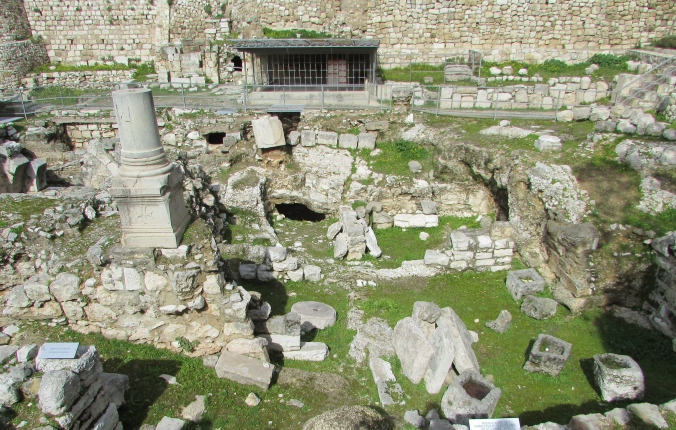
In the area, we also saw where the pools of Bethesda were once located. It was here that Jesus healed a man who had been crippled for 38 years. (John 5:1-15)
IMG_1218 - Version 2

A quick trip around the Temple Mount by bus took us to the Jaffa Gate where we entered Old Jerusalem and walked the narrow market streets to a tiny restaurant where we had lunch.

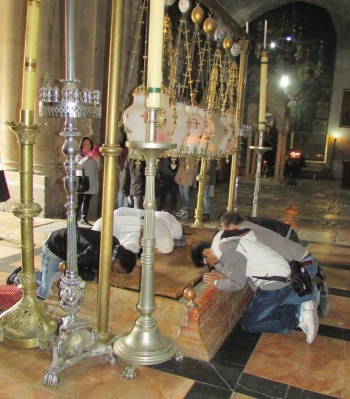
Our next stop was the Church of the Holy Sepulchre, a cavernous structure standing on the bedrock at a site said to encompass both Golgotha, or Calvary, the spot where Jesus was crucified, and the tomb (sepulchre) where His body lay. Filled with icons and incense, we could only think of what we saw as idolatry and, to me, it didn’t seem very different from what we’d seen in numerous Buddhist temples in Asia. Most disturbing to me was the Stone of Unction, or Stone of Anointing, a flat red stone some six metres in length and decorated with candlesticks and lamps that is located in the entrance of the church. It is purported to be the place where Jesus’ body was laid and prepared for burial after being taken down from the cross. It was surrounded by devoted pilgrims bowing before it, kissing it and rubbing their possessions on it in hope of receiving some sort of blessing. Personally, I was more than happy to leave. Apparently, people sometimes wait hours to enter the Edicule, an ornate cubicle that supposedly houses the empty tomb, but we had another tomb to visit!

IMG_1253 - Version 2

IMG_1255

Some 2000 years after the fact, there is, of course, no way of knowing exactly where the cross of Christ stood or where the tomb that held his body was located, but the Garden Tomb seemed much more authentic to me. The guide who met us there, gave us many pieces of evidence pointing to the likelihood that this could be the place. If nothing else, there was a great sense of peace there that I didn’t feel in the Church. He first showed us the hillside that would appear to be Golgotha, meaning “the place of the skull”. Though the nose crumbled several years ago and a bus station has somewhat obliterated the lower portion, it’s easy to see a skull in the rocky hillside.
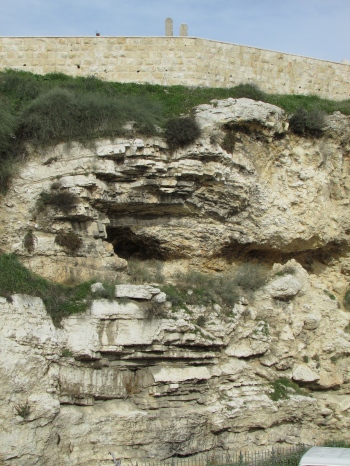
IMG_1272

Although I’ve always visualized the crosses standing at the top of a lonely barren hill, the guide explained that they were more likely positioned near the bottom beside a busy road and in the face of the throngs of passersby making their way into Jerusalem for Passover. That’s the way the Romans did things. He also pointed out the irony of thousands of lambs being brought into the city for the Passover sacrifices passing right by the true lamb of God hanging on the cross, but missed by the multitudes.

Next, he walked us through the garden to the empty tomb. Actually being able to enter and see the spot where Christ’s body may have lain was another very moving experience. The doorway has been enlarged and steps added to allow easier access.
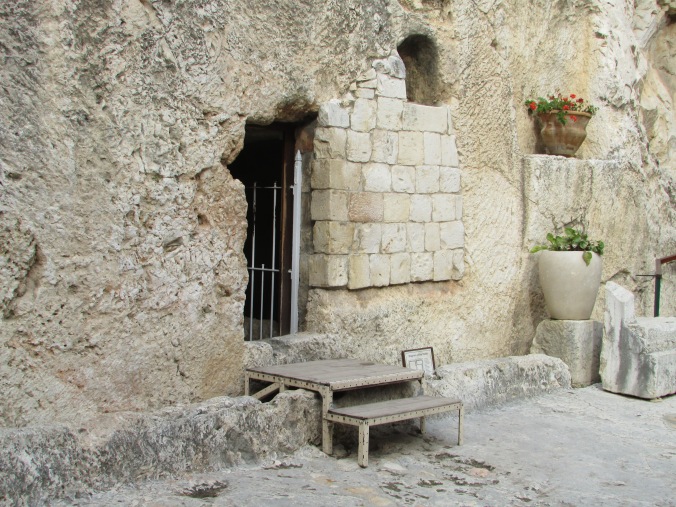
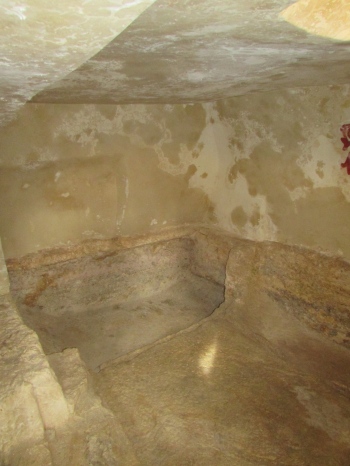
IMG_1278

IMG_1284

This is a similar tomb beside a road in Galilee that shows what the stone would have looked like.
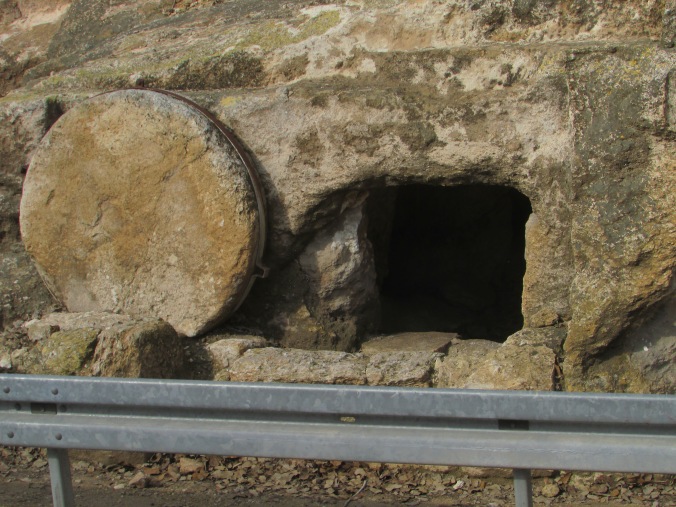
IMG_0247

After we’d all had a chance to enter the tomb, we gathered in a tiny well-lit chapel in the garden for a service of communion. We drank our wine from tiny olive wood communion cups which we were then given to bring home with us. Celebrating our risen Lord with a group of people that we’d quickly grown close to and experienced so much with was very meaningful! Though that would have been a suitable finale to our pilgrimage, we made three more quick stops before our busy day was over!

On Mount Zion, we first visited the place that is traditionally held to be the location of the Upper Room where Jesus and His disciples shared their Last Supper. (Matthew 26:17-30) The building is actually a 12th century Crusader structure, but archaeological evidence of Roman construction on the lower level supports the possibility that this area was indeed the location where our Lord shared a final meal with his disciples. Like so many others, the building has changed hands many times throughout history.

On the lower level, we visited one of the most holy Jewish sites, the traditional location of the tomb of King David. The men were required to don yarmulke, the skullcap traditionally worn by Jewish males, and entered one room while we women went into a smaller adjoining room. In our room, a few women quietly read their Hebrew scriptures, but we could hear quite a din from the other side of the partition. Our men exited shaking their heads and describing a crowded room full of ultra-Orthodox men shouting, wailing and banging on a central table as they bowed and bobbed. There is obviously much that we don’t understand about their religious practices!

Our final stop was the house of Caiaphas, the high priest, where Jesus was taken after his arrest. There is clear evidence that this time we were, indeed, standing in an authentic spot. The stone stairs leading up to the house are the very ones that Jesus would have climbed on His way to trial.

IMG_1307

Inside the house, we went down into the dungeon where Jesus likely spent His final night on earth. It was nothing more a large hole dug into the rock beneath the house. Somewhat overcome by all that we had seen and experienced, we sang our final hymn together.
Exploring ancient Jerusalem

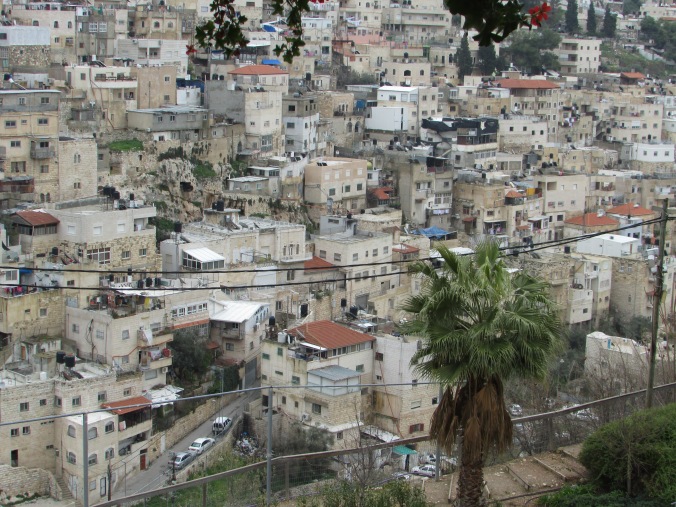
Are you tired of reading about archaeological ruins yet? Israel is truly an archeologist’s dream and Jerusalem is no exception. I must admit that by the second last day of our tour, I was beginning to experience information overload. That, combined with the fact that we were hurrying to stay ahead of a huge group of Taiwanese tourists when we visited the City of David, meant that I probably missed a few things, but there are some that stand out vividly in my memory. Located beneath the Arab neighbourhood of Wadi Hilweh and below the southern walls of Old Jerusalem, the City of David is the archaeological site of ancient Jerusalem of the pre-Babylonian exile era.

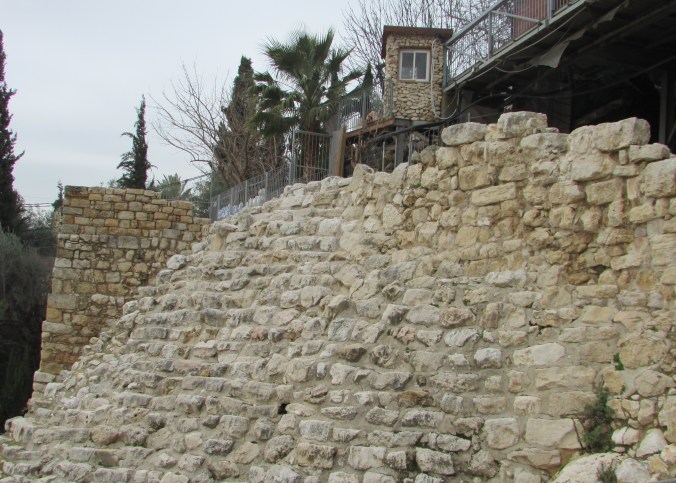
What stood out to me most was a section of wall from three different eras!

IMG_0989 - Version 2

Originally built by the Jebusites, a Canaanite tribe who built and inhabited Jerusalem prior to its conquest by King David, the tower to the left was added in David’s time. What interested me most was the upper right hand section of the wall where the stones are of slightly different size and colour. This is a section of the wall that was repaired under the direction of Nehemiah after the Jews returned from exile in Babylon. (Nehemiah 2-6)

Our local church here in Sedgewick is in the middle of a three year rebuilding project of our own. Over the years, we’d gradually let the church building and parsonage slip into disrepair. Our pastor used the story from Nehemiah to introduce the project and the accompanying need for extra funds to the congregation, so we chose to call it our Nehemiah Project. It gave me shivers to stand there and see with my own eyes a small portion of the original Nehemiah project!

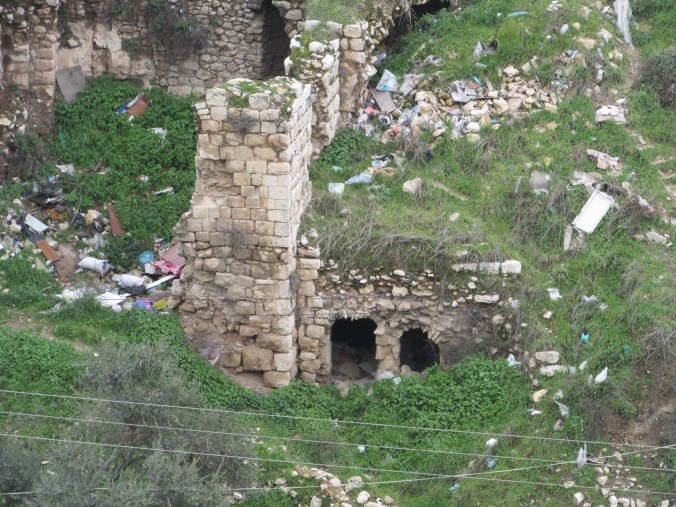
Looking across the valley to the bottom of the hill below the Arab village, we could see the entrances to ancient Jewish tombs with garbage scattered all around. It’s very easy to distinguish between Arab and Jewish communities in Israel. Jewish neighbourhoods and settlements are clean, orderly and prosperous looking while Arab ones are shabby and unkempt.

IMG_1000

Before leaving the City of David, we entered Warren’s Shaft which enabled the ancient Canaanite residents to draw fresh water from the Gihon Spring without leaving the city. Hezekiah’s Tunnel was later built under the direction of King Hezekiah to bring fresh water from the spring into Jerusalem. (2 Kings 20:20)

While we toured the City of David, we could hear the Arabs shouting at us, but since we couldn’t understand what they were saying, we paid them no mind. When we exited the water shaft, we had only a few hundred metres to go down a narrow street to what remains of the Pool of Siloam. Some tour groups were using shuttle vans for fear of being stoned, but we walked the distance briskly without any incident.

IMG_0986IMG_1024

It was at the Pool of Siloam that Jesus healed a blind man by putting mud on his eyes and telling him to wash in the pool. (John 9:1-12) Only a portion of it has been excavated. The remainder is under property owned by a Palestinian family who refuse to relinquish it.

IMG_1029

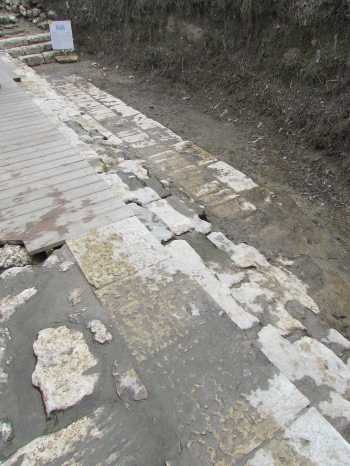
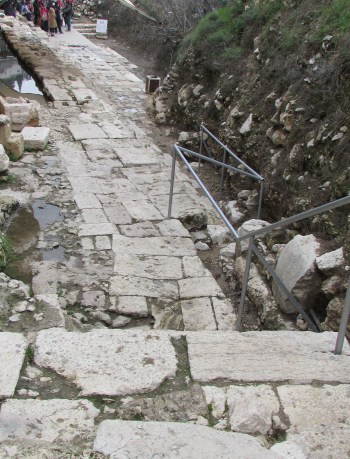
From the pool, we walked up another section of the Herodian road that we’d been on in the Western Wall tunnels the evening before, again walking on stones that our Lord undoubtably walked upon. This was the route used in His day to ascend from the Pool of Siloam to the Temple Mount.

IMG_1034 - Version 2

Next we made our way through the ancient city’s recently excavated central drainage tunnel which connects the west side of the Temple Mount to the Pool of Siloam area. Traversing the lengthy tunnel was definitely a “team building” experience as each of us called back to the ones behind us warning of slippery spots and low ceilings!

After further examining portions of the Western Wall, we had hoped to go to the southern steps, an enormous flight of stairs leading up to the Southern Wall, but the Muslim mosque above the area was in use and we couldn’t enter. Apparently, there have been incidents of people being stoned from above, so the area is closed when the mosque is in use!
 

The Western Wall

One of the questions that I’ve been asked most often since we returned from Israel is “Did you go to the Wailing Wall?” Yes, we did and it was quite an adventure, but before I tell that story, there are some misconceptions to clear up. First of all, while in Israel, we never heard it referred to as the “Wailing” Wall. That term isn’t used by the Jews. It is the Western Wall. Where the term, Wailing Wall, came from is uncertain, but it probably referred to the weeping of the Jews over the destruction of their temple.

I had always understood that the so-called Wailing Wall was the only remaining piece of the ancient temple and for that reason it had been set aside as a holy place of prayer. Not so! It is actually a relatively small segment of a much longer retaining wall that was originally built as part of the expansion of the second Jewish temple by Herod the Great. Although other parts of the retaining walls remain, this particular segment is closest to the location of the Holy of Holies, the inner sanctuary of the temple where God promised that His presence would reside. For that reason, it is considered by the Jews to be the holiest place to pray. (Leviticus 16:2)
While the visible portion of the Western Wall is approximately 60 metres in length, the majority of it has spent centuries hidden underground. It is only in recent years that excavation of the Western Wall Tunnels has allowed access to a further 485 metres extending beneath the Old City of Jerusalem. Entrance to the tunnels is limited to tour groups and must be booked months in advance.

This is where our story begins. Our group had a 5:45 pm appointment on January 28th. We left our hotel with plenty of time to spare, but as we neared our destination we found ourselves caught in traffic that was completely backed up along a narrow, crowded street. It wasn’t going anywhere! As minutes ticked by, it was obvious that we would miss our appointment if we didn’t do something, but what do you do with a tour bus caught in such a jam? Our trusty guide, Shimon, jumped off the bus and gave directions while Jimmy, our amazing driver, turned the bus around in a space that I probably couldn’t have turned our SUV! When we finally arrived by an alternate route, we discovered why the traffic was so heavy. The entrance plaza was filled with hundreds of people there for an Israeli Defense Forces swearing in ceremony during which new recruits receive their weapon and a Jewish Bible.

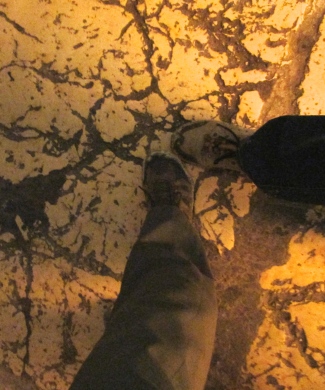
During our exploration of the tunnels we saw the biggest stone in the Western Wall. With a length of 13.6 metres, a height of 3 metres and an estimated width of between 3.5 and 4.5 metres, it is estimated to weigh approximately 570 to 600 tons! How it was moved into place without the use of modern machinery is a mystery. We also walked a section of the Herodian road which ran alongside the Temple Mount, stepping on worn stones that our Saviour undoubtably walked upon.

IMG_0942 - Version 2

Our feet on the Herodian road

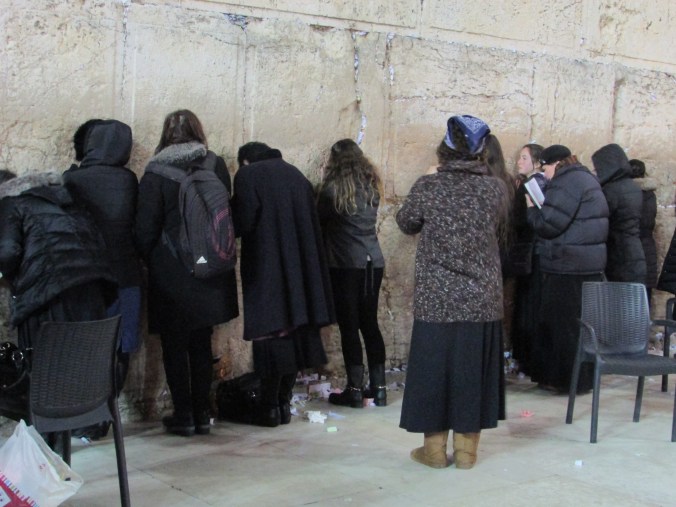
By the time we emerged from the tunnels, the swearing in ceremony was over and we wound our way through the jubilant crowd who were busy congratulating and taking pictures of their young soldiers. The segment of the wall designated for prayer is separated into a section for men and one for women. The seven women in our group formed a human chain as we made our way through the crowd so that we wouldn’t become separated from one another! We each spent a few minutes praying at the wall before rejoining the guys and heading back to our hotel.

IMG_0953

Women at the Western Wall

Some in our group said that they felt the presence of God in a special way at the wall. I don’t want to question anyone else’s experience, but personally, I didn’t feel any closer to Him there than I do in many other places. I am so thankful that we serve a God who is with us wherever we are and that we don’t need a temple to experience His presence!

Jesus said, “I tell you that one greater than the temple is here.”  Matthew 12:6

Bethlehem, birthplace of our King

As the strains of John Starnes singing “Jerusalem: The Holy City” poured over the loudspeaker of our bus and the gleaming Dome of the Rock on the temple mount came into view, it was definitely a “Pinch me! Am I really in Jerusalem?” moment for most of us on our tour.

IMG_0719 - Version 2

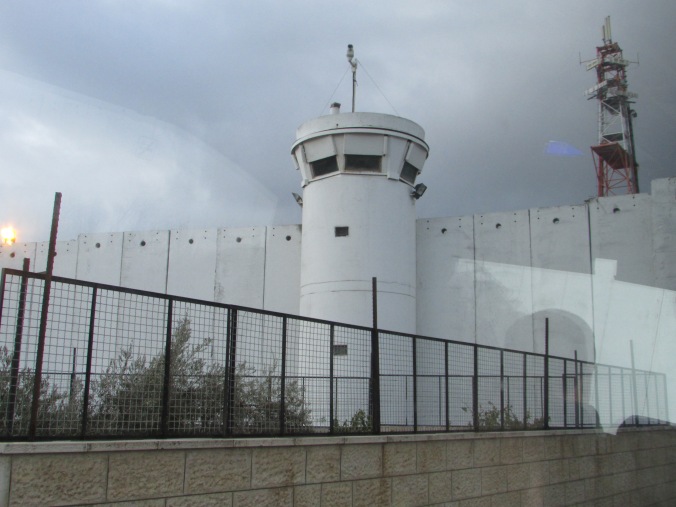
We didn’t stay long, however. At that point, we were actually just passing through the city on our way to Bethlehem, just 7 km away. Bethlehem is in Palestinian territory and Israelis are not usually allowed to pass through the checkpoint in the wall or “security barrier” that separates Jerusalem from the Palestinians. As a tour guide, however, Shimon has a special permit that allows him to take groups into Bethlehem. He accompanied us for lunch and then to a business run by a Christian family who make and sell beautiful olive wood carvings. There he stayed, however, passing us off to a delightful guide who resides in Bethlehem because he doesn’t feel comfortable or safe being out and about on the streets of that small city.

IMG_0794

The wall

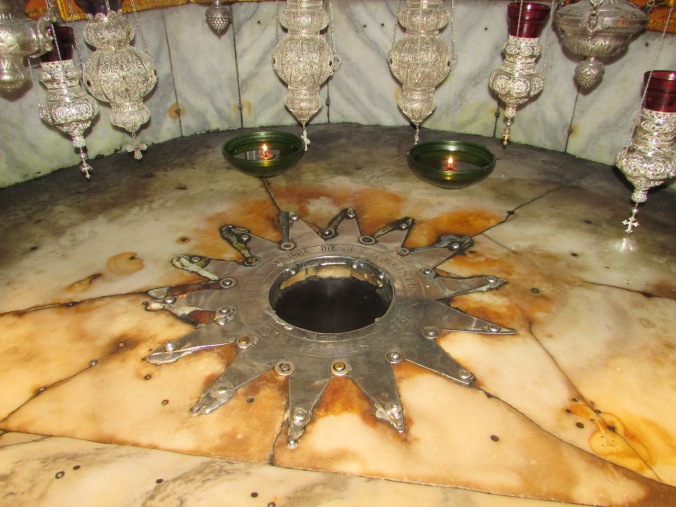
Our first stop was the Church of the Nativity, the supposed birthplace of Jesus. The church is administered jointly by the Greek Orthodox, Syriac Orthodox, Roman Catholic, and Armenian Apostolic churches. It consists of the main Basilica of the Nativity and the adjoining Church of St. Catharine. The Grotto of the Nativity, an underground cave located beneath the basilica, enshrines the site where Jesus is said to have been born. A large 14 pointed silver star set into the marble floor beneath an altar and surrounded by silver lamps and candles is said to mark the exact spot where Mary gave birth. A few feet away is the Grotto of the Manger, another shrine marking the spot where she apparently laid him in the manger.

IMG_0738

We went, we saw and we left. To be perfectly honest, it all seemed rather hokey to me and I found it somewhat disturbing to see other groups of pilgrims who appeared to be completely caught up in worshipping the place. I don’t mean to show disrespect for anyone else’s religious experience, but I do have to wonder how anyone can claim to know the “exact” spot where our Saviour was born in a humble animal shelter some 2000 years ago and, as I’ve said before, I don’t believe that there is any holy magic in the places where he was.

IMG_0758

From there, we descended to the Shepherd’s Fields, a park-like area commemorating the angel’s visit to the shepherds to announce the Messiah’s birth on that night so long ago as well as the fields of Boaz where Ruth the Moabitess gleaned. (Ruth 2:1-23) Notice that we descended to the shepherd’s fields. Again, the way I visualized things has been turned upside down! In my mind, I always pictured Bethlehem on lower ground and the shepherds tending their flocks on hillsides above town. In reality, communities throughout Israel are built on the tops of the hills. The shepherds and their sheep would actually have been on the hillsides below Bethlehem and they would have had to climb up to visit the newborn child. (Luke 2:8-17)

As we made our way back to Jerusalem to check into our hotel, I was reminded afresh how lucky we are to be Canadian. As we passed through the checkpoint, Shimon simply told the soldier on duty where we were from and we were sent on our way. Apparently, bus loads of Canadians and Americans pass through with ease while other nationalities are checked much more carefully. Vehicles driven by individuals are searched!

Bet She’an and Harod’s Spring

After three nights at the Sea of Galilee, we bid it farewell and began our journey south toward the Dead Sea. Our first stop was Bet She’an, Israel’s largest archaeological dig. It was here that the bodies of King Saul and his sons were fastened to the wall after their deaths at the hands of the Philistines on nearby Mount Gilboa. (1 Samuel 31)

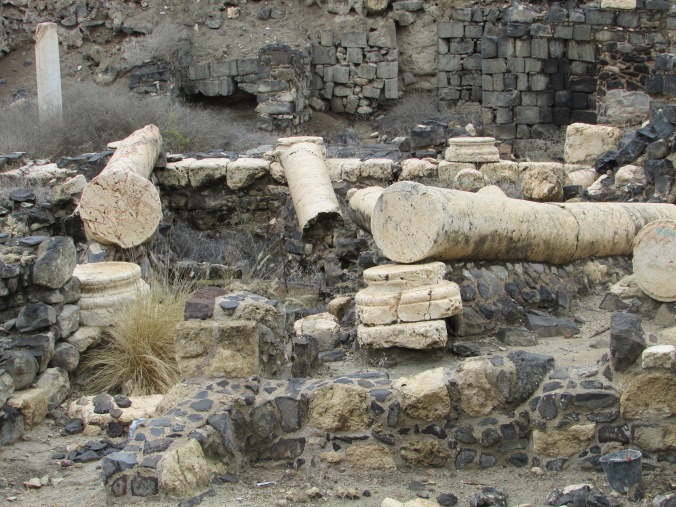
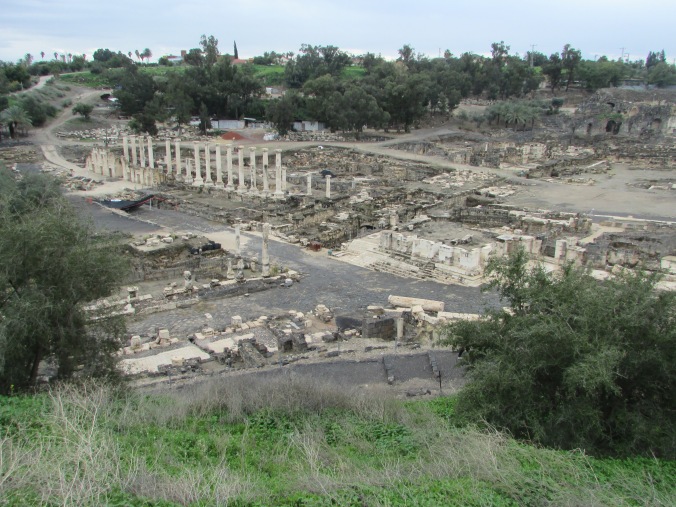
Archeologists are still excavating the ruins of the Roman era city of Jesus’ time that was destroyed by an earthquake in 740 AD. Strategically located at the junction of the Jordan River Valley and the Jezreel Valley, it was one of the ten cities of the Decapolis and would have been on the route that Jesus took whenever he travelled from Galilee to Jerusalem.

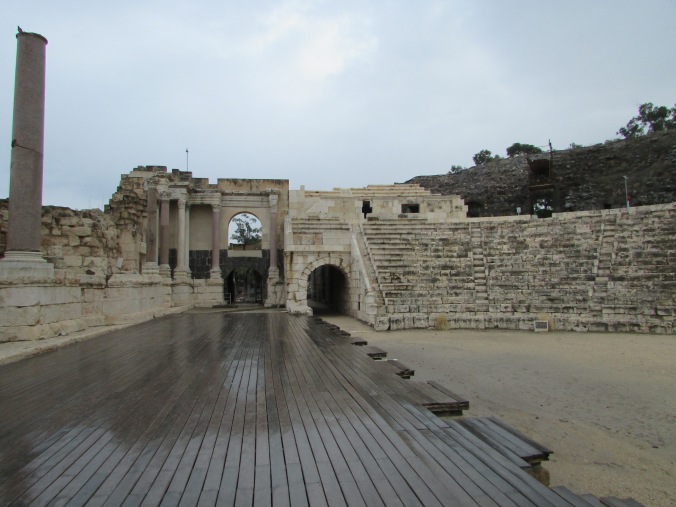
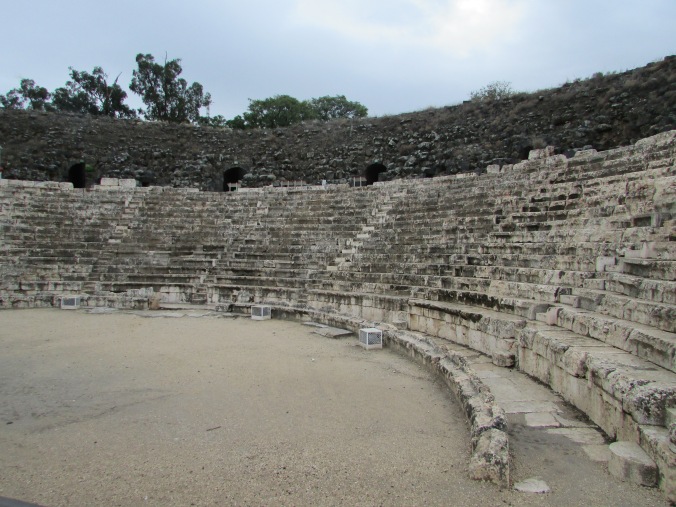
We started our tour at the impressive Roman theatre. The acoustics are so good that when one member of our group stood on stage and sang the rest of us could hear every word from far up in the bleachers.

IMG_0528

IMG_0529

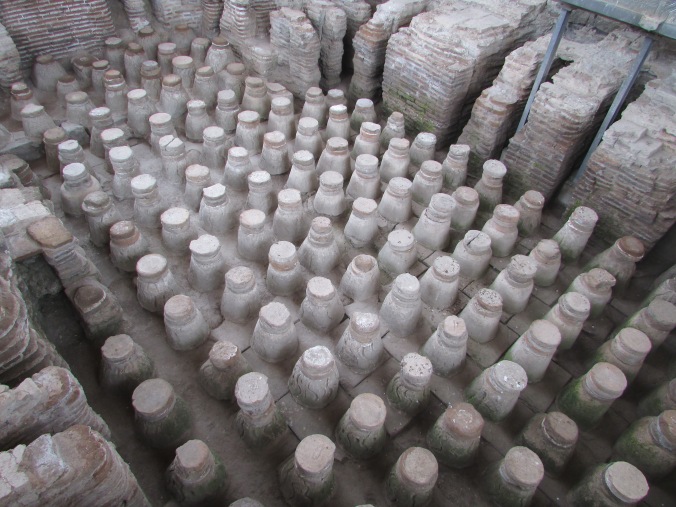
Next we moved on to the extensive bathhouse complex.

IMG_0541

The short pillars in the photo above held the floor of the bath. Hot air piped into the hollow space below the floor heated the water above. As our weather was damp and chilly, we all agreed that a soak in such a bath would have been welcome!

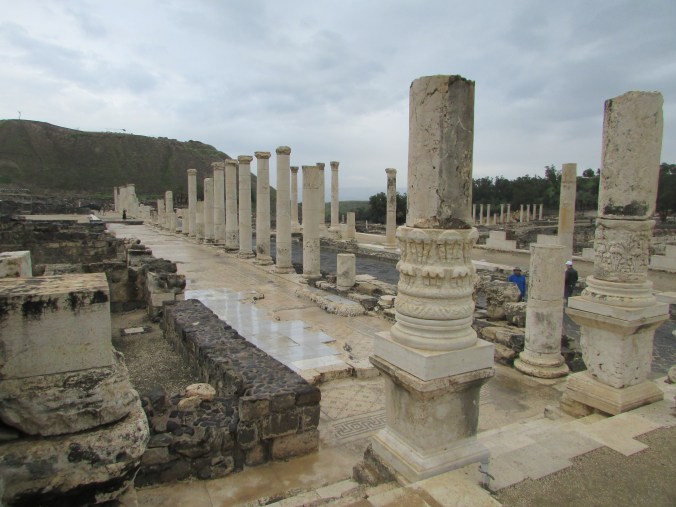
We continued our walk down the stone paved main street. In ancient days, its impressive pillars probably supported a covering over the road.

IMG_0542

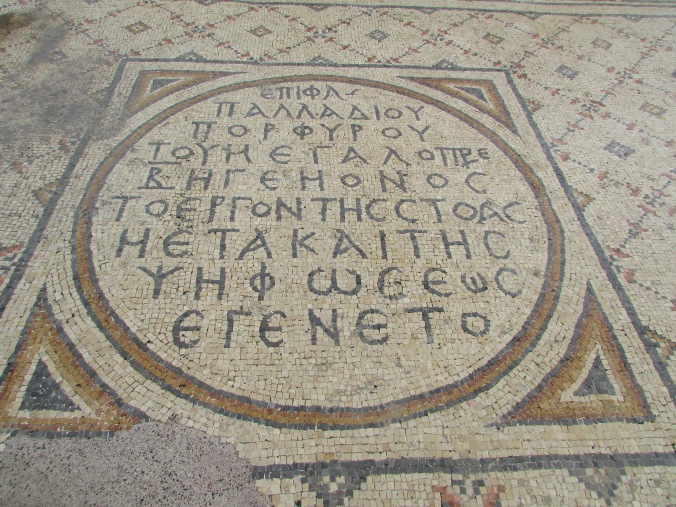
The mosaic pavement of the portico includes this Greek inscription which reads “In the time of Palladius, son of Porphyrus, the most magnificent governor, the work of the stoa together with the mosaic pavement was made.”

IMG_0547

IMG_0551

We appreciated the coolness of the day when we climbed the 163 steps to the top of the mound where we saw remains of the hilltop acropolis. From there, we had a spectacular view of the entire site. What was visible was only the downtown portion of the ancient city, however. Most of the residential areas are still under the ground.

IMG_0555

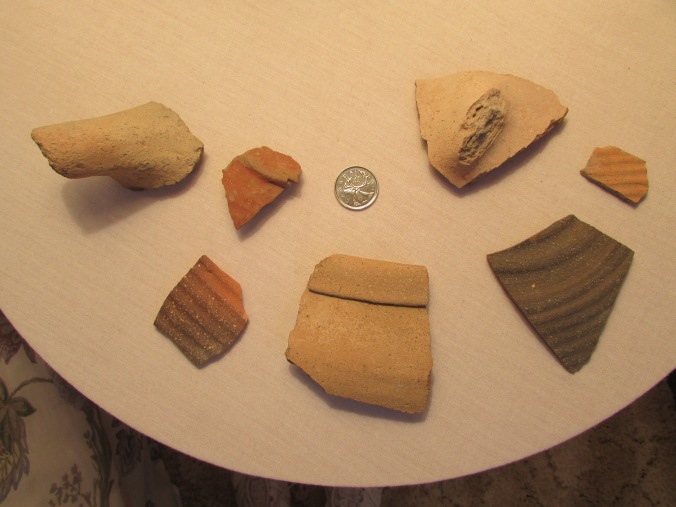
Everywhere we walked, the ground was strewn with tiny bits of pottery. On our way back down the hill, we discovered that recent rains had washed down hundreds of pieces. We immediately became amateur archeologists searching for treasure! Amazingly, we were allowed to take pieces home with us! There are simply so many of them that they are of little value or interest to those who seriously study the site.

IMG_1362

It still astonishes me that I can have in my possession a piece of someone’s kitchenware from a time when people still thought the world was flat! Who was that person? What did she carry in her container? Was she still alive when the earthquake destroyed her city?

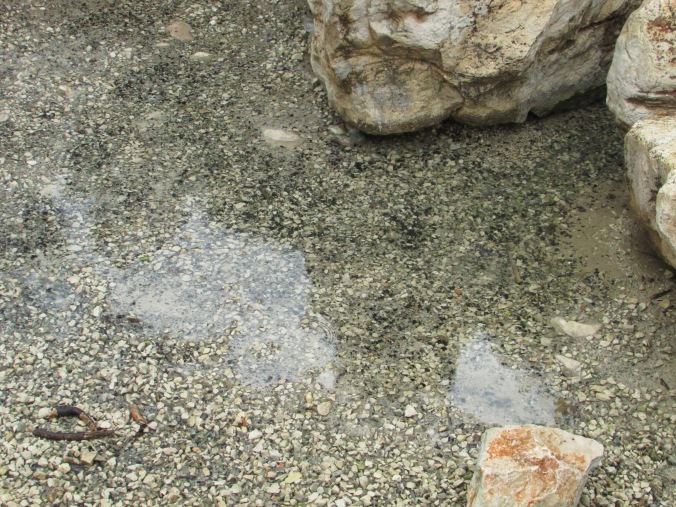
Leaving Bet She’an, we traveled next to Harod’s Spring where God instructed Gideon to reduce the size of his army from 32 000 to 300 and gave him victory over the Midianites. (Judges 7) When they were told to drink from the spring, 300 men lapped water with their hands to their mouths while the rest got down on their knees to drink. These were the ones that God told Gideon to take into battle with him. It was pointed out to us that those who used their hands to scoop up the water would have had their eyes forward, alert to their surroundings, while the others had their heads down. We, too, are admonished to be alert, on guard against Satan’s attacks. (1 Peter 5:8) In spite of recent rains, Harod’s Spring was almost dry, but with a bit of imagination, we could visualize what happened there.

IMG_0573


Tel Dan and Caesarea Philippi

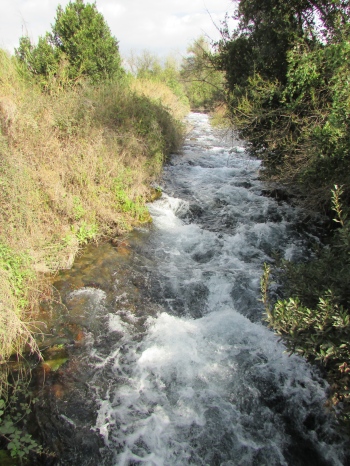
Tel Dan National Park in northern Israel is both a lush nature reserve and a fascinating archeological site. Unlike most of Israel, water is abundant there. It flows from underground springs with amazing force forming one of the main tributaries of the Jordan River.

IMG_0456

The area takes its name from the tribe of Dan who settled there during the 11th century BC after attacking the peaceful and unsuspecting people of the Canaanite city of Laish and burning it to the ground. (Judges 18) The Biblical history of this place goes all the way back to the book of Genesis! It was to here that Abraham and 318 trained men went in pursuit of those who had captured and carried off his nephew, Lot. (Genesis 14:11-16)

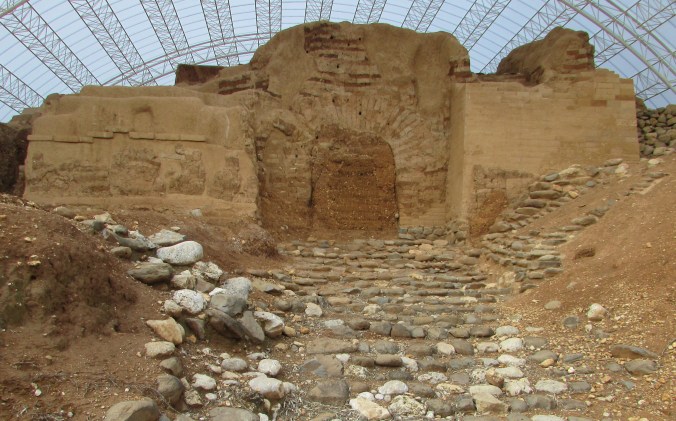
In 1979, the remains of a 7 metre tall gate constructed of sun-dried mud brick on a foundation of large basalt stones was unearthed. Now protected by an enormous canopy, it is the only one of its kind to have survived and is thought to date back to the days of Abraham, nearly 4000 years ago!

IMG_0492 - Version 2

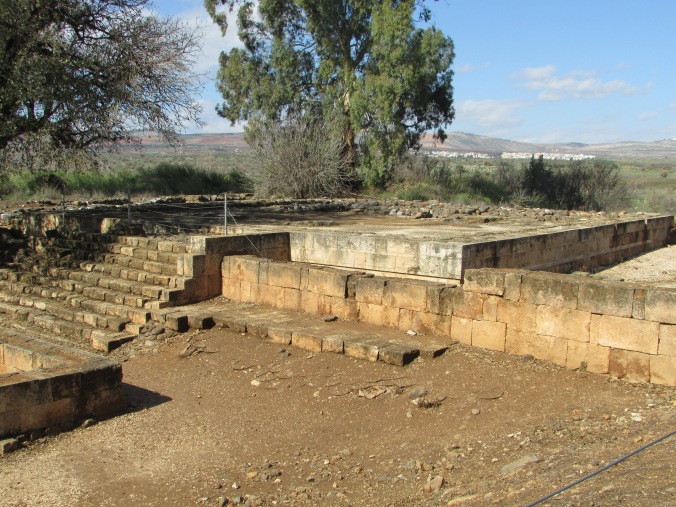
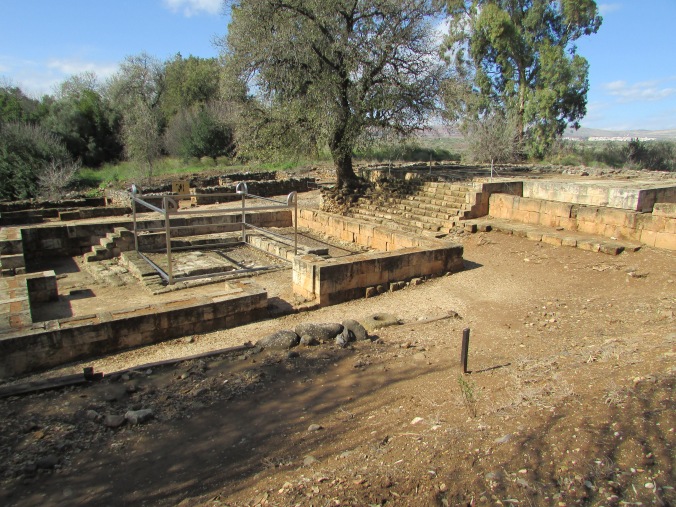
During several decades of excavation under the direction of Professor Avraham Biran of the Institute of Archaeology at Hebrew Union College in Jerusalem, many other significant remains dating back to kings Jeroboam, Ahab and Jeroboam II have been unearthed. Most impressive to me was the site constructed by Jeroboam to house one of the two golden calves that he set up as gods for his people as alternatives to going up to Jerusalem to worship. (1 Kings 12:26-30) I had often read of the “high places” where people of the Old Testament set up their idols, but I had always visualized them as hilltop shrines. In reality, Jeroboam’s high place was simply an elevated platform at the front of his place of worship. Archaeologists think that it was probably roofed.

IMG_0472

Jeroboam’s high place

IMG_0470

The metal frame in front of the high place indicates the size and shape of an altar that would have stood there.

IMG_0464

Probably used for the ritual cleansing of animals before they were sacrificed on the altar.

Another extremely significant find at Tel Dan was the David stone. Inscriptions on the broken slab provided the first historical evidence of the Bible’s King David, proving that he was a genuine historical figure.

From Tel Dan, we moved on to Caesarea Philippi, a historic site of New Testament significance. It was here that the apostle Peter first identified Jesus as Messiah and Christ declared, “On this rock, I will build my church and the gates of Hades will not overcome it.” (Matthew 16:18) It’s often thought that he was referring to Peter as the rock, especially since the name Peter means “rock”, but Peter’s given name was actually Simon meaning “He (God) has heard”. Once we saw the site, another interpretation made complete sense.

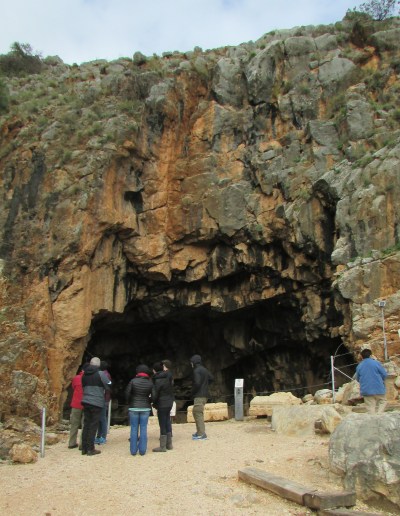
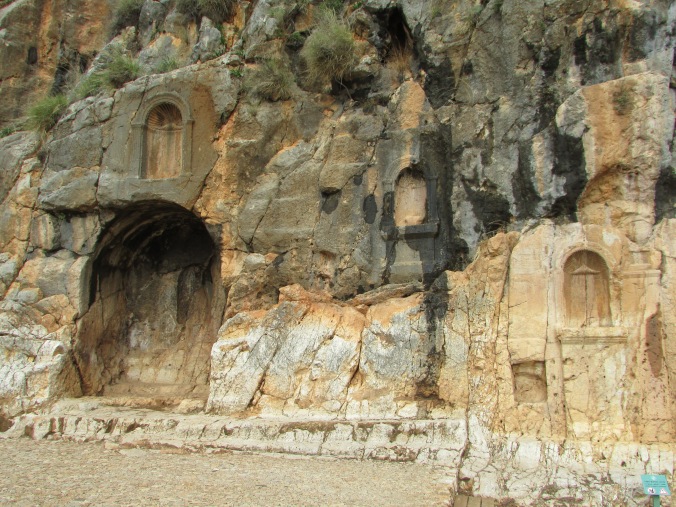
In Jesus’ time, Caesarea Philippi was dedicated to the worship of Pan; god of hunting, of shepherds and flocks, and of the mountain wilds. He was depicted as having the upper body of a man and the hindquarters, legs and horns of a goat. Being a rustic god, Pan was not worshipped in temples, but in natural settings, usually caves or grottoes. Caesarea Philippi was a place steeped in debauchery. Spirits were thought to come and go from the underworld through a giant cave known as “The Gate of Hades”. Adjacent to the cave is a rocky escarpment with a series of niches hewn into it. Statues of Pan were placed in these recesses. Human sacrifices were made by tossing the victims into a sinkhole at the back of the cave. It was in front of this rock that Jesus stood when he made his statement. I believe that it was his intention to establish his church in worldly places, places steeped in idolatry and sin, and even the hideous practices of a place like Caesarea Philippi would not stop him! We, too, are called to take the light of our faith into the dark places of the world.

IMG_0503 - Version 2

The Gate of Hades

IMG_0501

Galilee

The land of Galilee was nothing like I expected it to be. In the past, when I read accounts of Jesus teaching the multitudes and feeding the 5000, I visualized them sitting on grassy slopes. In reality, the rugged hillsides of Galilee are strewn with boulders of black volcanic basalt and I suspect that some of Jesus’ listeners chose to sit on rocks instead of on the ground.

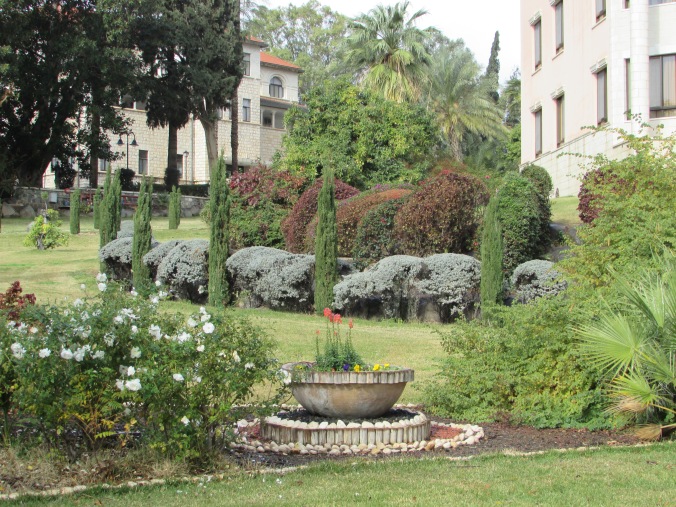
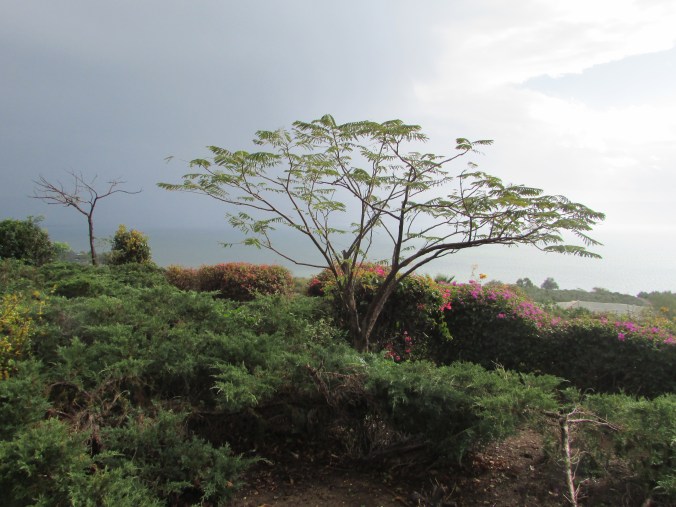
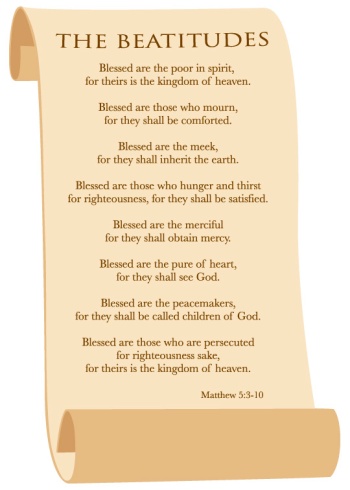
Today, a Catholic monastery surrounded by beautiful grounds is located on the Mount of Beatitudes where Christ delivered his Sermon on the Mount. After a short devotional in the gardens and singing Amazing Grace in the chapel where the acoustics were fabulous, we were sent off to read the sermon on our own. The storm that had been following us ever since our morning boat ride on the Sea of Galilee caught up to us about that time, however, and it was difficult to find a sheltered spot to do our assigned reading. The pages in that part of our travel Bible will probably be forever wrinkled, a reminder of standing in the wind and rain while we read Matthew 5:1-16!

IMG_0331

IMG_0346

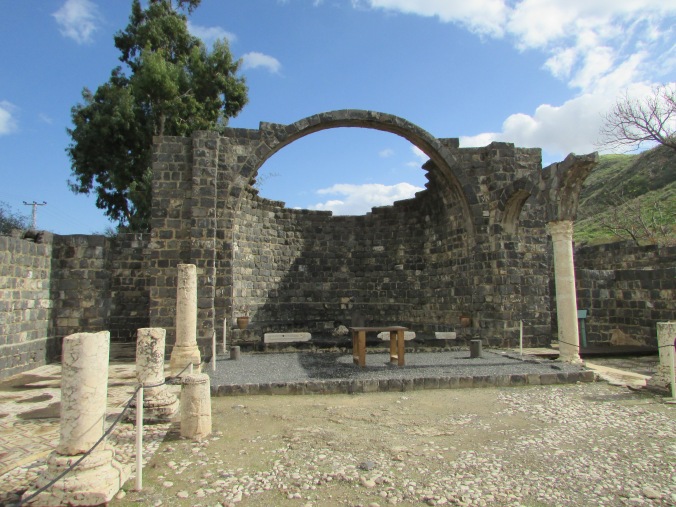
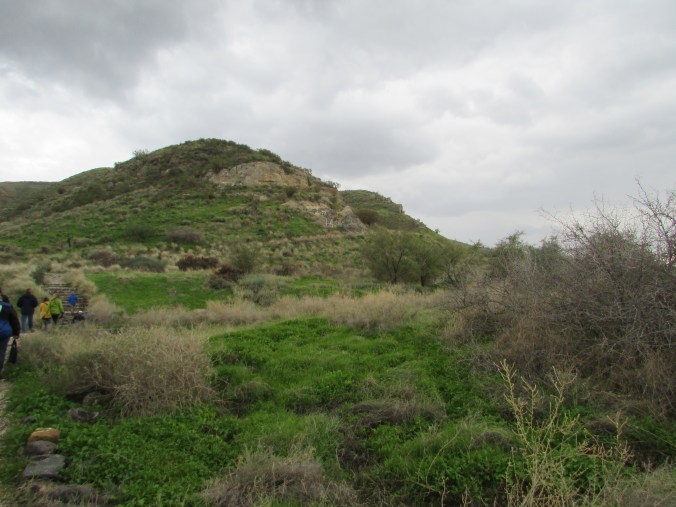
Fortunately, the rain didn’t last long and by the time we reached our next stop at Kurzi, which has been identified as the site where Jesus cast a legion of demons into a herd of swine (Mark 5:1-13), it had stopped. After investigating the remains of the oldest Byzantine church in Israel, we climbed the hillside to the probable location of the tombs mentioned in scripture. Looking down, it was hard to imagine the herd of pigs plunging into the lake and drowning because the water is actually quite a long way off. Remains of wharves have been found at the bottom of the hill, however, where bananas are now cultivated. Clearly the Sea of Galilee was significantly larger in Jesus’ day.

IMG_0355

IMG_0362

This is actually a major concern for Israel today as the Sea of Galilee is the country’s largest fresh water reservoir. Many years of below average rainfall have caused the water level to drop significantly as water is drawn from the lake for irrigation and other uses at a rate faster than it is replenished by nature.

Continuing on around the north end of the lake, we came to the recent excavation of the ancient city of Bethsaida where we walked on a stretch of cobblestone highway some 3000 years old!

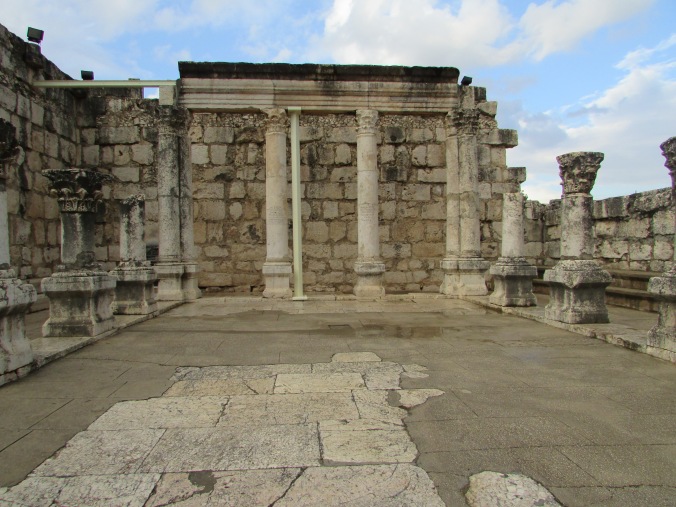
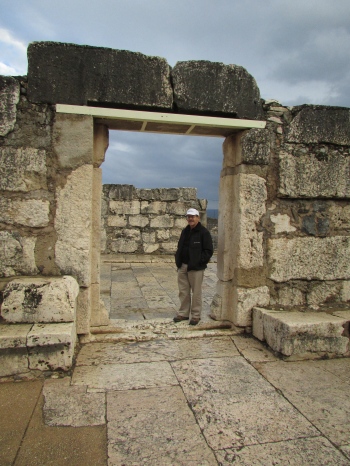
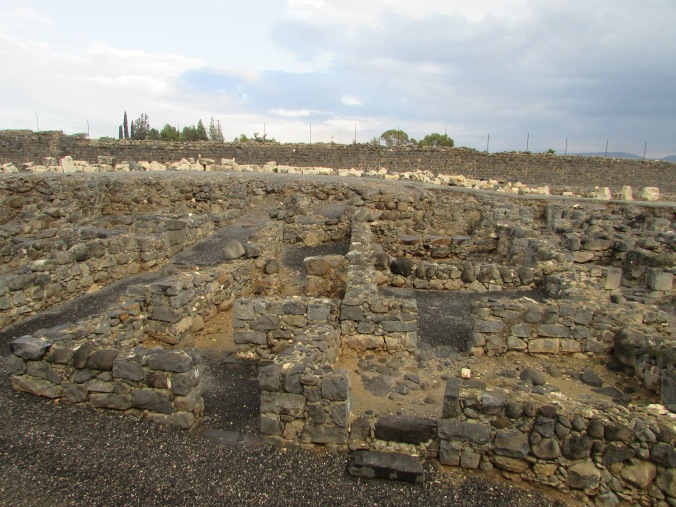
Our last stop of the day was Capernaum which was the centre of Jesus’ Galilean ministry. Here we saw the remnants of a beautiful 4th century synagogue that was built over the remains of the synagogue of Jesus’ day. Surrounding it were the remains of houses and other buildings. It is believed that the home of the apostle Peter, where Jesus is known to have spent a lot of time, lies beneath one of these.

IMG_0415

IMG_0417

IMG_0418

As we returned to our hotel in Tiberias, I felt privileged to have walked so many of the places where our Lord walked, but I also realized that Jesus was not particularly concerned about the places, but about the people who inhabited them. It was a blessing to walk where He walked physically, but how much more we need to walk as He walked spiritually, in humility and obedience, bringing salt and light to a lost and hurting world. (Matthew 5:13-16)

beatitudes

Boats on the Sea of Galilee

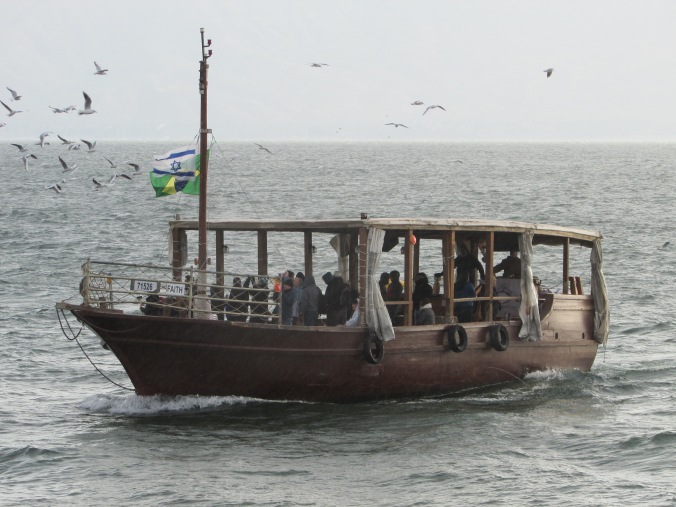
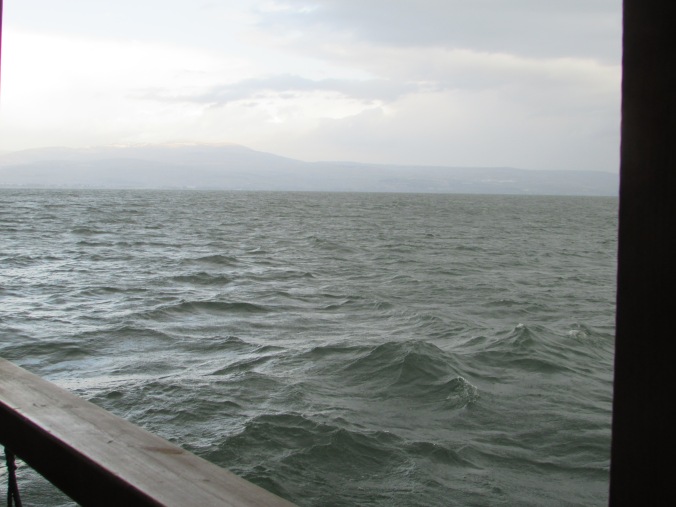
We arrived at our hotel in Tiberias overlooking the Sea of Galilee, or Lake Kinneret, shortly after dark on Saturday, January 24th. Sunday morning began with what was definitely one of the highlights of our pilgrimage to Israel; worshipping on a boat on a stormy Sea of Galilee! The original plan had been to travel by boat to another spot along the lake and have the bus pick us up there, but the water was too rough for that and since Jesus wasn’t there to calm the storm (Matthew 8:23-27), we went out and back to the same spot staying fairly close to shore. The boat was aptly named Faith and we all agreed that it was somehow very fitting that we were buffeted by wind and waves just as Jesus and his disciples had been.

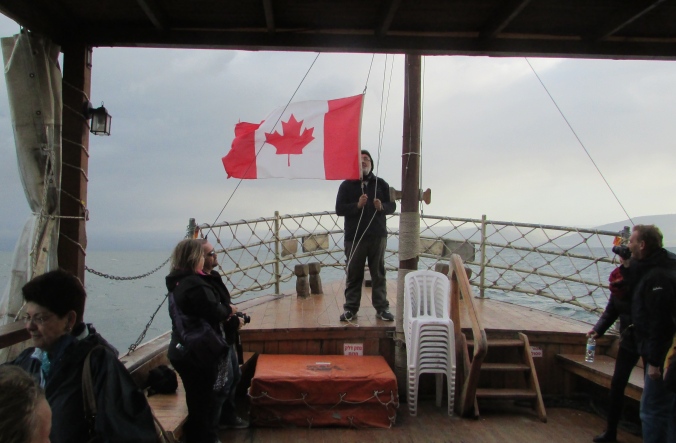
As soon as we put out from shore, the Canadian flag was raised and Captain Daniel Carmel, who is also a Christian singer and songwriter with an amazing testimony, declared the boat temporary Canadian territory and “the warmest spot in Canada today!” My heart was full as we all stood and sang O Canada. After a short devotional, we sang hymns and songs of praise and listened to Captain Daniel sing one of his own songs entitled Jerusalem. It was a very moving experience.

IMG_0299

IMG_0306 - Version 2

IMG_0310

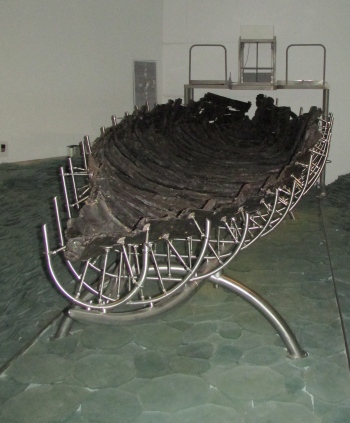
Too soon, we were back on shore and on our way to our next destination, the Jesus Boat Museum on a kibbutz at Ginosar. In 1986, at a time when the water level was particularly low, the remains of a 27 meter long fishing boat from the time of Jesus was discovered in the mud on the northwestern shore of the Sea of Galilee by brothers Moshe and Yuval Lufan. Of tremendous historical importance, it was unearthed by a team of archeologists who took particular care to keep the ancient wood wet so that it wouldn’t dry out and crumble. Encased in expanding foam, it was then floated to a spot where it could be lifted from the water by a crane and moved. It was submerged in a chemical bath for seven years to preserve the wood before it was finally put on display. Though there is no evidence to definitively connect the boat to Jesus or any of his disciples, it is an amazing relic from their day.

IMG_0322 - Version 2

Mount Carmel, Megiddo and Nazareth

Moving inland toward the Sea of Galilee, we stopped to visit several interesting and very significant sites. The first was Mount Carmel where the prophet Elijah called down the fire of God and defeated the prophets of Baal. (1 Kings 18:19-40) Unfortunately, fog obscured our views of the Kishon Valley below.

IMG_0243

IMG_0244

For most of our time in Israel, the weather was unusually cool and wet even for winter. Warm weather clothing stayed in our suitcases while we dressed in layers to fend off the chill. I was very happy to have taken gloves, a warm hat and an umbrella with me!

After Mount Carmel, we continued on to Megiddo (Hebrew for Armageddon) where many, many layers of archeological remains going back thousands of years have been excavated. Here, a giant fortress believed to have been built by King Solomon once stood.

IMG_0252

IMG_0258

IMG_0259

At Megiddo, we had the first of several underground experiences. Descending approximately 180 stairs deep into a shaft in the ground, we followed a tunnel that brought water to the fortress from a small spring outside its walls.

Moving on, our next stop was Nazareth, the childhood home of Christ, where we toured a recreated first century village complete with cultivated terraces and vineyards, an ancient winepress, an operating olive press and a synagogue representing the one where Jesus identified himself to his townspeople as the fulfillment of Isaiah’s prophecy of a coming Messiah. (Luke 4:14-30)

IMG_0274

IMG_0283

IMG_0288

IMG_0287

As we left the village, we were each given a tiny oil lamp, a reminder that we are called to be the light of Christ to a lost and hurting world.

IMG_1352