Book of the month – July 2024

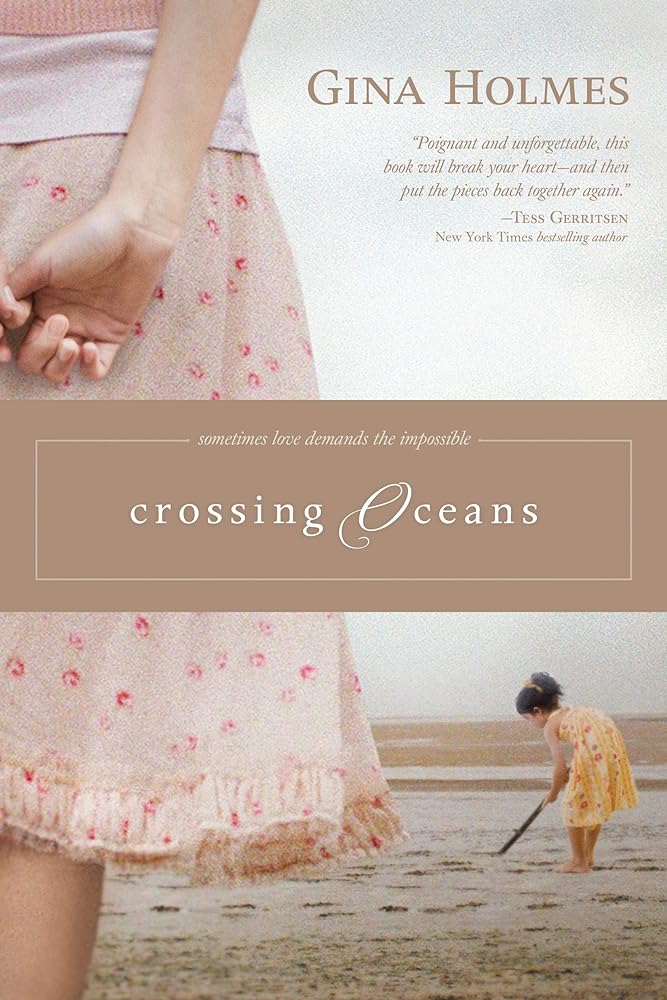
Crossing Oceans

Gina Holmes

9781414333052At the outset, Gina Holmes’ Crossing Oceans reminded me of a sappy Christmas movie. You know the ones… after several years away, beautiful young woman returns to her quaint mid American hometown where she encounters sweet, kindhearted, and inexplicably single man from her past who sweeps her off her feet and solves all her problems.

I was okay with that. Having just finished reading the memoir of an esteemed Chinese professor who lived through the horrors of the Cultural Revolution, I was ready for some fluff; some light summer reading.  

Crossing Oceans surprised me. First of all, I didn’t realize that it was a Christian novel. Had I known that, I might not have picked it up. As strange as it might sound, considering the fact that I’m a committed follower of Christ, I read very few Christian novels. Although there are exceptions, too many of them are unrealistic, happy ever after romances somewhat on par with those mushy Christmas movies. While the main characters in Holmes’ novel are professing Christians, it isn’t preachy. They are far from perfect, and their problems aren’t swept away because they believe in God. 

When Jenny Lucas left home, single and pregnant, she promised herself that she’d never look back. Six years later, knowing that she’s dying of cancer, Jenny returns to the sleepy North Carolina town where she grew up to decide who will raise her little girl when she is gone. Will it be her father with whom she has had a difficult relationship since the death of her own mother when she was a teen? Or will she choose Isabella’s dad who doesn’t even know that he has a daughter? Animosity between the two families adds to her dilemma. Can they put aside their differences and help both Jenny and Isabella face what lies ahead? 

This is a sad story, but not a depressing one. It’s a poignant story of love and loss, but also forgiveness and healing. Jenny faces her situation with determination, courage, stoicism, and even a sense of humour. As I neared the end, I couldn’t help wondering how the story could possibly end in a satisfying manner, but without giving anything away, I’ll simply tell you that I wasn’t disappointed.

Book of the month – May 2024

The Life I Stole

Nikola Scott

hbg-title-9781472260826-44Like many children in wartime Britain, 10-year-old Agnes Crawford was sent out of London to the safety of the countryside where she lived with the well-to-do McIntyre family. Tragically orphaned by the war, she stayed on afterward as their maid and close friend of their daughter, Isobel. When tragedy strikes again, Agnes adopts her deceased friend’s identity and with it the opportunity to become a medical student at a London university. 
The early 1950s were an exciting time for medicine in Britain as the National Health Service, in its infancy, began offering treatment to those who had previously been unable to obtain or afford it. It was also a challenging time for female medical students who faced discrimination in what was at that time a predominantly male environment. 

Agnes works hard to succeed all the while maintaining her secret, but discoveries about her family history, feelings of guilt, and a potential love interest make it increasingly difficult. Tension mounts as she tries to decide whether to continue the ruse or reveal her true identity and accept the consequences. I’m not going to tell you what she chooses to do. You’ll have to read the story yourself to find out!

I will tell you though that this novel brings post war London to life and explores issues of social class and women’s roles in a way that is both entertaining and informative. I found it hard to put down. 

Book of the month – April 2024

The gift shop at the Cross Cancer Institute in Edmonton where I go for most of my cancer care sells gently-used books. From time to time, they hold a giant book sale in the main lobby where the books sell for $1 each. When we arrived for my last appointment with time to spare, such a sale was underway, and that’s where I found this month’s book.

Not Our Kind

Kitty Zeldis

9780062844248_7102f355-50a2-4a5c-86b0-7389e84225aaNot Our Kind is the story of two very different women whose lives intersect on a rainy morning in June, two years after the end of World War II. A minor traffic accident in New York City brings together Eleanor Moskowitz, a bright young teacher on her way to a job interview, and Patricia Bellamy, a socialite whose difficult thirteen-year-old daughter, Margaux, recovering from polio, needs a private tutor. When Eleanor goes to work for the Bellamys, she forms an immediate bond with Margaux, but because they live in a restricted building, she has to conceal her Jewish identity.
Patricia’s boorish husband, her charming bohemian brother, the all-knowing housekeeper, and Eleanor’s hat maker mother round out a cast of interesting characters.

The story raises a number of issues including class distinctions, marital discord, sexual assault, and body image but deals with them somewhat superficially. We do get a sense of the anti-Semitism that pervaded post war America and I can’t help wondering how much that has really changed.

I would classify this novel as a light historical read with an added element of romance; not a deep read, but an enjoyable one.

Book of the month – March 2024

The Forgotten Bookshop in Paris

Daisy Wood

contentUntil the end, when the two finally come together, this is really two completely different storylines connected only by a specific location.
In 1940, war is closing in on the city of Paris. When the Germans take over the city, Jacques and Mathilde have only been married for a short time. Itching to resist in whatever way she can, Mathilde soon puts herself at risk and must flee to safety in the south of France while Jacques stays behind and continues to operate his beloved bookstore, La Page Cachée. Hiding first banned books, and then people seeking refuge and a way to escape the city, in a hidden storeroom in his shop, Jacques too becomes involved in the resistance.

In 2022, Juliette, whose deceased grandmother was born in Paris, and her husband, Kevin, take a long awaited trip to the city of love. Armed only with a photograph of a painting that used to hang in her grandmother’s house in America, Juliette searches for and locates the small city square depicted in the painting. Discovering that her husband has been having an affair, she decides to stay behind in Paris and forge a new life for herself. There she finds passion and purpose in purchasing a small abandoned bookstore on the square that appeared in her grandmother’s painting, renovating it, and opening The Forgotten Bookshop.

I loved this book! Partially, perhaps, because I’ve always thought that if I was ever to open a business, it would be a bookstore, but also because I became completely engrossed in both storylines. Each time the book switched from past to present or vice versa, I was almost disappointed because I was so captivated by whichever story I was reading at the moment! Both heartwarming and heartbreaking, the well-researched wartime story with its very believable characters could easily stand alone. The modern story was a little more cliched, but until the very end, it kept me wondering how the two storylines would come together.

Daisy Wood has written several works of historical fiction for children and this is her second adult novel. As soon as I finished it, I ordered her first, The Clockmaker’s Wife, from the library. While The Forgotten Bookshop in Paris is my favourite of the two, I enjoyed that one too.

Book of the month – January 2024

With today’s post, this monthly feature enters its second year! While these book reviews haven’t generated as much interest as some of my other posts, I know that there are several of you who look forward to them.

This month, I’m featuring two books by the same author, Heather Morris. If you haven’t read either of them yet, I would suggest starting with The Tattooist of Auschwitz, but that’s not essential. In fact, I read Cilka’s Journey first.

The Tattooist of Auschwitz

415TbkTEY4L._SL350_In 2003, Morris, was introduced to Lale Sokolov, an elderly gentleman who “might just have a story worth telling”. As their friendship grew, Lale entrusted her with the innermost details of his life during the Holocaust. She originally wrote his story as a screenplay before reshaping it into her debut novel, The Tattooist of Auschwitz.
In April 1942, Lale, a Slovakian Jew, is one of countless young men who are forcibly stuffed into railroad cars designed to carry livestock and taken to the concentration camps at Auschwitz-Birkenau. When his captors discover that he speaks several languages, he is put to work as a Tätowierer (the German word for tattooist) permanently marking his fellow prisoners.

Three months later, as he gently holds the arm of the young girl in front of him and etches a five digit number into her skin, he looks up into her eyes and thus begins a love story that lasts a lifetime. Her name is Gita and meeting her feeds Lale’s determination to survive the horrors of the camp. Imprisoned for more than two and a half years, he witnesses horrific atrocities, but also acts of bravery and compassion. Risking his own life, he uses his privileged position to exchange money and jewels from murdered Jews for food and medicine to help keep his fellow prisoners alive.

Cilka’s Journey

81sTaMNLkIL._SY522_In The Tattooist of Auschwitz, we are introduced to Cilka, a beautiful young prisoner who is forcibly separated from the other women by Johann Schwarzhuber, camp commandant, for his exclusive use. Quickly learning that her survival depends on it, she does what she has to do to stay alive. Although both books are historical novels, Cilka, like Lale, was a real person and at one point, he credits her with saving his life.
Cilka’s Journey picks up her story when the war ends and the surviving prisoners are liberated from Auschwitz-Birkenau. Charged as a collaborator for literally sleeping with the enemy, she is sentenced to another fifteen years in a Siberian prison camp. There she faces more challenges, some new and others horribly familiar, including the unwanted attention of the guards. When she meets a kind female doctor, she is taken under her wing and learns to care for the injured and ill in the camp. Working under brutal conditions, she discovers strength she never knew she had and finds that in spite of everything she’s been through, she’s still capable of falling in love.

While The Tattooist of Auschwitz and Cilka’s Journey are both vivid and harrowing stories of man’s inhumanity to man, they also testify to the resilience of humanity and love under the darkest possible conditions. They aren’t easy books to read because of their content, but I found that I couldn’t put them down.

Book of the Month – September 2023

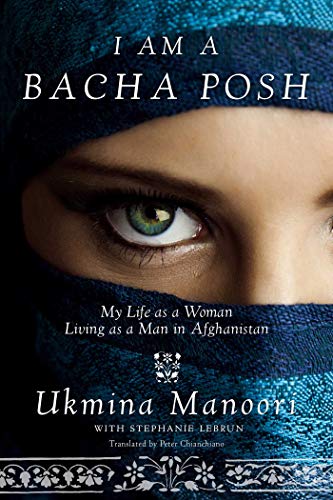
I Am a Bacha Posh

Ukmina Manoori

9781629146812-usThe subtitle of this short, but intriguing memoir, My Life as a Woman Living as a Man in Afghanistan, tells much about the content of the book, but it could also be misleading to those of us living in western cultures. This is not a book about living a trans experience.

You will be a son, my daughter.” With these stunning words young Ukmina learned that she was to spend the remainder of her childhood as a boy. This had nothing to do with gender confusion on her part. In Afghanistan’s heavily patriarchal, male-dominated society, it is customary for some families, especially those without sons, to choose a daughter to live, dress and behave as a boy, even taking on a boy’s name. These children are known as bacha posh which means “dressed up as a boy” in the Persian dialect, Dari.

Families have various reasons for making this choice and there are no statistics on how many families have daughters living as bacha posh. In most cases, due to the somewhat secretive nature of the practice, only the family, close friends, and necessary health and education officials know the bacha posh’s biological sex.

As a bacha posh, a girl has all the freedoms denied to her as a member of the female sex. Instead of staying at home cooking and cleaning, she can move about freely in public, attending school, running errands, playing sports, and sometimes finding work to help the family make ends meet.

Once a bacha posh reaches puberty, however, she is expected to revert to traditional female roles putting on the veil, staying at home unless accompanied by a male, and preparing for an early marriage. What makes Ukmina’s story unique is that when that time came, she refused. Confronting societal and family pressure, she continued to live as a man, not because of gender dysphoria, but because she doesn’t want to give up the the rights and privileges of a male in Afghan society.

Ukmina’s choice paved the way for an extraordinary destiny. She acted as a scout for the resistance when the Soviet Union invaded Afghanistan and ultimately commanded the respect of everyone she encountered. There did come a period of time when she lived in isolation and fear of the Taliban and even of some of her fellow villagers who didn’t agree with her life choices. Eventually, however, she entered politics and as an elected member of her provincial council, fights tirelessly to improve women’s rights.

Rather than telling you any more of her story, I’m simply going to share three quotations that I think wrap up Ukmina’s thoughts about her experience and the life of women in Afghanistan.

Living in men’s clothing has given me a certain freedom. A life as a woman in Afghanistan is a life of destruction.

I say to myself that I have sacrificed nothing. I have done what I had to do. I became what I was. I found my destiny. And there is nothing I lack.

I also told myself that women were beautiful creatures of God. Men were cruel. I often asked Allah: “Give me the power of men and the kindness of women.””

If a novel about bacha posh would be more to your liking, I would highly recommend The Pearl That Broke Its Shell by Nadia Hashimi.

Book of the month – July 2023

Breaking The Age Code

Becca Levy, PhD

Screenshot 2023-07-14 at 10.05.53 PMHow would you like to extend your life by 7.5 years? According to Dr. Becca Levy, Yale professor and leading expert on the psychology of successful aging, you might be able to do just that!

Breaking the Age Code is a fascinating book that could literally revolutionize how you think about aging. Levy’s premise is that our age beliefs, what we think about older people and about getting older, influence how we age. She presents both factual evidence and interesting anecdotes showing that having positive age beliefs results in better physical and mental health in our senior years and actually extends life expectancy. This makes sense when you consider that having positive age beliefs promotes physical exercise as well as social and intellectual engagement and diminishes stress.

Unfortunately, we who live in North America and Europe are constantly bombarded with negative age beliefs. Even saying that someone is having a “senior moment” suggests that there is truth to the all too commonly accepted stereotype that our brains inevitably deteriorate as we get older. In reality, people of all ages experience these momentary memory lapses and there is tremendous variability in how our brains function as we age.

Breaking the Age Code presents us with easy-to-follow techniques for shifting our age beliefs from negative to positive. The first step involves becoming aware of our own age beliefs as well as recognizing the ageism that is so prevalent in our society. The book is also a call to stand up against ageism and its negative effects.

Not only is Becca Levy one of the world’s leading experts on aging and longevity, but she’s also a wonderful storyteller. Her book is both informative and inspiring and would be of benefit to readers of all ages, those who will be old someday and those who already are.

Book of the month – June 2023

346298825_796475711644640_3455810401975110479_n

A Life Without Water

Marci Bolden

51358755After reading Rohinton Mistry’s A Fine Balance, a 713 page novel about life in India in the 1970s and 80s, and then Timothy Keller’s The Reason for God: Belief in an Age of Skepticism, I was looking for something light to read! Something frivolous and entertaining.

While A Life Without Water was a quick, easy read it wasn’t quite what I expected. Instead, it dealt with a number of serious issues including divorce, alcoholism, loss of a child, and terminal illness. It’s also a book about forgiveness and about finding peace in the midst of heartbreak.

Carol Denman is a recent widow, still dealing with the loss of her second husband, when the ex-husband that she hasn’t seen in more than 20 years barges back into her life. John Bowman is very sick and while he can, he has some amends to make and promises to fulfill. In order to do so, he needs his ex-wife’s help. His presence turns her life upside down and forces her to confront long suppressed feelings of anger, resentment, and grief. The fact that she goes along with the request that he makes of her seems rather unrealistic to me, but it does make for a good story. If you’re given to tears, you might want to have a few tissues on hand!

While A Life Without Water can be read as a standalone, it is the first in a series of three. A Life Without Flowers and A Life Without Regret continue Carol’s story.

Book of the month – May 2023

When it came time to write this month’s book post, I couldn’t decide which of two historical novels I wanted to feature, so I took the easy way out and wrote about them both!

The Letter Home

Rachael English

hbg-title-9781472264701-63.jpgRachael English is a novelist and a presenter on Ireland’s most popular radio programme, Morning Ireland. In her most recent novel, inspired by true events, the lives of three remarkable women are interwoven across time.

While back home in County Clare on Ireland’s west coast, Jessie Daly, whose life has recently fallen apart, agrees to help an old friend research what happened in that area during the terrible famine of the 1840s. Meanwhile in Boston, lawyer Kaitlin Wilson, after suffering a tragedy of her own, decides to research her family history. She knows only that her ancestors left Ireland for Boston in the 19th century. Separated by an ocean, and totally unknown to one another, the two women are drawn into the remarkable story of a brave young mother named Bridget Moloney and the terrible suffering that she and her little daughter, Norah, endured during the famine.

Even on a busy weekend celebrating the birthdays of two of my grandchildren, I had a hard time putting this book down! Perhaps I connected so strongly with the story because I’ve recently been sorting through a box of old family photos, inherited from my mother, and trying to correctly label them before the identities of the people in them are forever lost in the mists of time. Like Jessie and Kaitlin, I’ve taken to the internet to find out more about these ancestors of mine and their lives, but perhaps that should be a story for a different post!

If you enjoy historical fiction or genealogy is your thing, this is definitely a book for you. I enjoyed it so much that I’ve now loaded one of English’s earlier novels, The American Girl, onto my Kindle for future reading.

The Dictionary of Lost Words

Pip Williams9781984820747

Knowing that I’m a lover of words and a strong advocate of equal rights for women, my daughter recommended that I read this one. Australian novelist, Pip Williams, masterfully weaves a fictional story into and around the true historical events and people involved in compiling the first edition of the Oxford English Dictionary in the late 1800s and early 1900s.

The only child of a widowed father, Esme spends her early childhood in the Scriptorium, a converted garden shed in Oxford where her father and a team of dedicated lexicographers collect and compile words for the dictionary. From her place under the sorting table she collects stray word slips dropped or discarded by the men and hides them in a small trunk that she labels “The Dictionary of Lost Words”. As she grows up, she begins to realize that not all words are considered appropriate for inclusion in the dictionary, particularly words pertaining to the experiences of women and common folk; words that were considered coarse or vulgar, spoken but not usually written. And so she begins her own collection of words by seeking out the lower-class, less educated people and listening to their everyday speech.

A book about words might sound dreadfully boring to some, but The Book of Lost Words is much more than that. The years during which the Oxford English Dictionary was being compiled coincided with the women’s suffrage movement in England as well as World War I and both have a part to play in the story. More than just a book about words, it’s a book about love, loss, the roles of women, the meaning of service, and a book that asks the important question, whose words matter?

Book of the month – April 2023

From the Ashes

Jesse Thistle

9781982101213This month’s book was a difficult read because of the content, but at the same time, it was difficult to put down!

Abandoned at the age of 3, Jesse Thistle and his two older brothers were taken into care by the Saskatchewan Children’s Aid Society. After a short time in foster care, they were raised by their paternal grandparents in Brampton, Ontario. In his teens, struggling with the effects of generational trauma and loss as well as his identity as an Indigenous youth, Jesse succumbed to a self-destructive cycle of drug and alcohol addiction and petty crime that eventually led to a decade of homelessness.

Finally, realizing that he was going to die if he didn’t turn his life around, Jesse entered Harvest House, a residential rehab centre and began his healing journey. Today he is a husband, a father, an assistant professor at York University, and is working on his PhD. Once a high school dropout, he won a Governor General’s Academic Medal in 2016 and is a Pierre Elliot Trudeau Foundation Scholar and a Vanier Scholar. He is also the author of the Definition of Indigenous Homelessness in Canada, published through the Canadian Observatory on Homelessness.

It was never Jesse’s intention to write a memoir. The fourth step in his addiction recovery program involved writing a “fearless moral inventory” as part of making sense of all that had happened to him. In 2016, the Toronto Star published a profile of him that led to Simon & Schuster approaching him about a potential book deal. Fleshing out that original moral inventory became the book in which, through both poetry and prose, he details devastatingly painful scenes with brutal honesty and bluntness. It is, at times, a gut-wrenching read, but it is also a story of resilience and hope. As I read it, I couldn’t help thinking of all the other Jesses living on our streets and in our prisons. Every one of them has a story, but not all will end well.

One such story is that of Jesse’s father.

cyril--sonny--thistle-1-6084909-1664221809142

Cyril “Sonny” Thistle, who was born April 3, 1954, was last seen in 1981 in Brampton, Ontario, near McLaughlin Road and Queen Street East. At the time he went missing, he was described as having a fair complexion, light brown hair, a thick moustache, and a gap between his top two front teeth. He was 26 years old.

The Thistle family has been trying to locate Sonny for several years, without any success. Jesse and his brothers desperately want to know what happened to their father.

Anyone with information on Thistle is asked to contact investigators at 905-453-2121 ext. 2233. Anonymous information may also be submitted by calling Peel Crime Stoppers at 1-800-222-TIPS (8477) or by visiting www.peelcrimestoppers.ca.