Celebrating wellness

In 2021, Alberta Blue Cross launched the Faces of Wellness program to celebrate Albertans who are champions of wellness in their communities whether by making positive lifestyle changes, promoting a health-related cause, making the most of life while living with a chronic condition, standing up for mental health, or being a role model for others. I was completely unaware of the program until early last fall when I saw a post about how to apply or nominate someone else for the 2024 award. The deadline to enter hadn’t passed yet, so I thought “why not?” It would be another opportunity to educate someone about neuroendocrine cancer even if it was only the contest judges.

The application process involved writing a detailed story outlining the individual’s wellness experience, how they embraced the courage to overcome, and examples of how they live a life of wellness and regularly encourage others to do the same. I wasn’t sure how I could accomplish all that in the limited space that was allowed, but after writing a longer version and then seriously editing it, this is what I came up with.

Eleven years ago, I was diagnosed with stage 4 neuroendocrine cancer (NET), a disease that even my family doctor had never heard of. For several years, I had been experiencing symptoms similar to those of several more common conditions and my slow-growing cancer was initially misdiagnosed as gastritis.

My cancer isn’t curable, but ongoing treatment keeps it from growing and spreading. Since my NET diagnosis, routine scans detected 2 unrelated cancers which were removed surgically. More recently, I was also diagnosed with type 2 diabetes.

In spite of all this, I am thriving! I’m not dying of cancer, I’m living with it. Wellness is about more than physical health. Spiritual, emotional, and social well-being are equally important. I have a strong faith and supportive family and friends who make the journey easier. A positive attitude won’t cure my cancer, but it certainly makes living with it easier.

Maintaining wellness involves actively practicing healthy habits. Eating well and being physically active are vital. I’m almost 72, but I exercise 5 days a week and love nothing more than paddling my kayak, going for a hike, or playing a round of golf.

From the beginning of my NET journey, it has been my mission to educate people in my community and elsewhere about the disease. I’m actively involved in patient advocacy as a member of the Advocacy Advisory Board to the Canadian Neuroendocrine Tumour Society. I’m involved in initiatives to try to make the patient experience better for all of us including those who have not yet been diagnosed. It’s not uncommon for people to experience symptoms for 5 to 7 years before receiving a correct diagnosis. That needs to change! Neuroendocrine cancer is the fastest growing class of cancer worldwide, but it’s not well-known in the medical world. That, too, needs to change! I’m passionate about making a difference by being a voice for change.

I sent off my submission and hardly gave it another thought until sometime in December when I received an email informing me that I had been chosen as a runner-up and would be receiving a $25 Atmosphere gift card in the mail once the Canadian postal strike came to an end. Apparently this is a face of wellness!

And so now, for those of you who have been following my wellness journey, an update. February was a month of tests, scans, and appointments. I was supposed to meet with my specialist on Wednesday to discuss the results of many of those tests including a CT scan that was done the week before. That appointment had to be postponed, however, because the scan results weren’t available yet and let me tell you, scanxiety (scan + anxiety) is real! I had already seen the results of the other tests online and most of them were good, but there was one that concerned me and made me wonder if the cancer was beginning to grow or spread again. Thankfully, the scan results finally showed up online at 10 o’clock last night! While I don’t understand all of the medical jargon and will have to wait for the specialist to interpret some of it, the final statement was clear, “No evidence of progressive disease from November.” In other words, nothing has changed since my last scan three months ago!

Over the past month, I’ve also learned that my A1C (3 month blood sugar level) continues to be stable (with medication), my blood pressure is excellent (also with medication), and my bone density has not deteriorated over the past two years. This is all very good news and, in spite of having cancer, I’m feeling pretty blessed to be a face of wellness!

Finding hope during challenging times

It’s Friday, so normally this would be a fashion post, but considering the state of the world today, writing about clothing seems frivolous and I just couldn’t get my mind (or my heart) around the idea. These days, I just want to wear my favourite jeans and coziest sweaters on repeat.

It’s also the end of the month, so I should be writing a book review, but that isn’t happening either. Oh, I’ve been reading. In fact, I’ve been reading quite a bit, but I’ve been escaping into frivolous, fluffy novels, not the sort of thing that I would bother to review or recommend. 

As I was leaving my doctor’s office yesterday (more about that in a future post), I decided to stop at a thrift store on my way home. I immediately spotted this and it ended up being my only purchase. I’m not sure where it will eventually end up in my newly renovated home, but for now it’s in a spot where I see it every time I enter the kitchen.

You might remember that, for the second year in a row, hope is my one word for the year and if there’s ever a time when we need hope I think it might be now. So how do we find hope and hang onto it amidst the barrage of negative occurrences in the world around us today? One way of doing this is to focus on what is good and right in our day to day experiences. This doesn’t mean living with our heads in the sand, but it might mean less time watching the news or scrolling the internet. 

According to Wikipedia, hope is “an optimistic state of mind”. It’s a glass half full attitude. It’s being able to imagine positive outcomes and when possible, acting to achieve them. That’s what I want the new sign in my kitchen to remind me of.

Like the puddles on the street and the water dribbling out of our downspouts remind me that the long cold winter is almost over and spring is coming, I want to be reminded that there are still more people in the world who want equity and justice than those who are fighting for the opposite. Believing that gives me hope.     

What gives you hope today? 

The Canadian shopping conundrum

For the most part, I try to avoid mentioning politics on the blog, but as a Canadian I can’t sit by and say nothing when our closest neighbour, ally, and trade partner decides to become a bully and starts threatening our sovereignty. There might not be a lot that I can do about the situation, but I can’t do nothing. There’s too much at stake!

If there’s one thing that the present crisis has done, it has drawn Canadians together. We are seeing a kind of collective nationalism that goes far beyond cheering for the right hockey team. Canada is not for sale! We are not interested in becoming the 51st state and thousands of us are saying so with every grocery item we buy. Since money seems to be what the individuals behind the bullying understand best, I have joined an informal movement of fellow Canadians in boycotting products made in the United States. It’s first and foremost a shop Canadian movement, but beyond that, it’s about buying anything except American.

It’s not easy. Grocery shopping takes a lot longer these days as we squint at the small print on labels and try to figure out where the products we’re used to buying come from. Sometimes, as in the case of Campbell’s soups and some Kellogg’s cereals, the label reads “Product of USA” and we put the item back on the shelf, but it’s not always that straightforward. There’s “Made in Canada” which means that at least 51% of the total cost of the product’s creation had to have occurred in Canada. “Product of Canada” indicates that at least 98% of the total cost was incurred in Canada. But then there’s “Made in Canada with imported ingredients” or “Made in Canada from domestic and imported ingredients” with no indication where those imported ingredients came from. There’s also “Imported for _______” but again, nothing to say where the item is imported from.

I tried to do a bit of “investigative journalism” in preparation for writing this post and to help with my personal shopping decisions, but I wasn’t very successful. I already knew from reading the labels that Green Giant frozen vegetables are grown and packaged in Canada, but that the packaging is printed in the United States. When I emailed the company to ask why the printing wasn’t done in Canada, I received a very generic sounding response telling me that Green Giant is a brand that originated in the United States and that it has facilities in both Canada and the US, but that didn’t answer my question. Probing a bit further, I received a second reply assuring me that the company is proud to source their vegetables from farmers in Alberta, Ontario, and Quebec, but still no answer to my original question.

The label on my Kraft Peanut Butter jar says nothing about where it was made, but the KraftHeinz website told me that it was “proudly prepared in Canada”. While there’s a limited amount of peanut farming in southern Ontario, I know that it doesn’t produce enough to provide thousands of Canadian households with peanut butter. When I emailed KraftHeinz to ask where the peanuts are imported from, I was told all about how peanut butter is prepared and packaged and assured that “all ingredients used in Kraft products comply with our rigorous food safety standards” but after inquiring more than once, I still wasn’t told where the peanuts come from. I finally wrote, “I can only assume that your reluctance to give me this information is due to the fact that they are American grown and you realize that I, like many Canadians, am refusing to buy American products due to the fact that our closest neighbour and trade partner is now threatening our sovereignty. If I am wrong about this, please let me know.” I received no response to that, so Kraft Peanut Butter will no longer be on my grocery list. I had a very similar experience with Mondelēz International when I tried to find out where Triscuit crackers are imported from. 

Finding fresh produce is especially problematic in a country with long winters and a very short growing season, but I’ve been able to buy Canadian grown potatoes and carrots as well as tomatoes, lettuce, cucumbers, peppers, and mushrooms. I’ve been enjoying bananas from Guatemala and blueberries from both Mexico and Peru, but the only nice looking oranges that I’ve been able to find were grown in California, so they stayed in the store.

Of course, boycotting American products goes far beyond the grocery store. My favourite toothpaste is made in Mexico, but it’s a product of Colgate-Palmolive, a huge U.S. corporation, so where do we draw the line? The flouride gel that I’ve had to use every day since I lost one of my parotid glands to cancer over ten years ago, is made in Canada, but my skin care products, shampoo, and conditioner are all imported from the States. Obviously, I’ll have to look for other brands to try. I’ve already found a replacement for the Tide laundry detergent that I’ve used for years. I’ll be trying Canadian-made Tru Earth laundry strips.

Shopping ethically is further complicated for me by the fact that I try to avoid buying products from China which is notorious for its human rights abuses. Given the present situation, however, if forced to choose, I would probably buy a Chinese product over an American one.

Before I close, I want to assure my American readers that I fully understand that many of you are as dismayed as I am about what is happening in your country and our hearts go out to you at this difficult time. We also know that the tariffs that your leader is threatening to impose will be as hard on you as consumers as they are on us.


Cognac and olive inspired by Greetje

If you’ve been reading my fashion posts for very long, you might remember me mentioning Greetje, author of the blog No Fear of Fashion. I look forward to her entertaining posts every Sunday. In each one, she shares an outfit and tells a bit about what she’s done that week. Her outfits aren’t always new. Instead, she looks for new ways to combine pieces that she already owns. Greetje is Dutch and always chooses interesting locations for her photo shoots, so I also get to enjoy glimpses of life and architecture in the Netherlands when I read her posts.
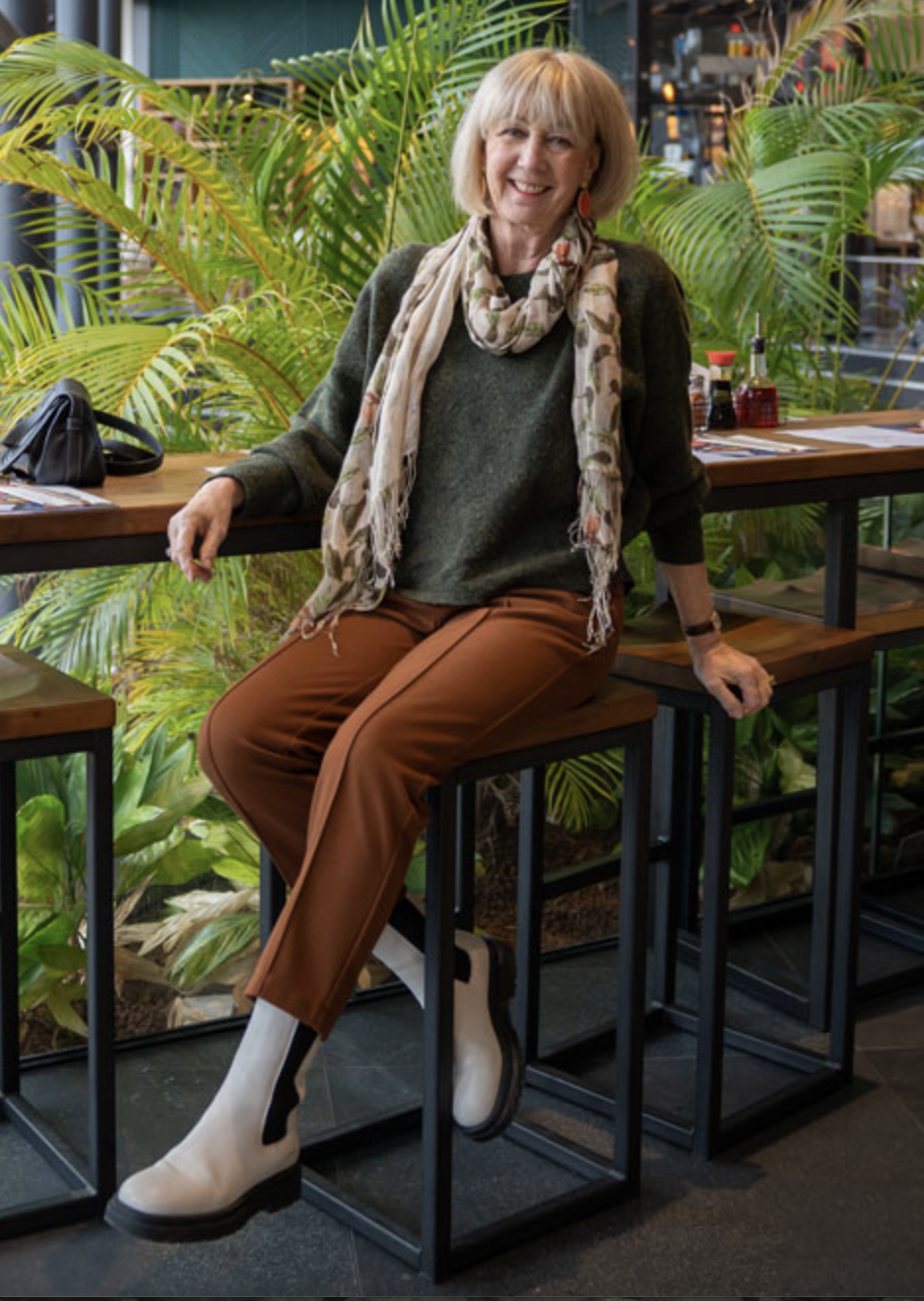
Greetje is very outgoing and her style is much more colourful and flamboyant than mine. She says that she writes to entertain, not to inspire, but once in awhile an outfit of hers does inspire me to put together something similar from my own closet. That’s what happened this week. 

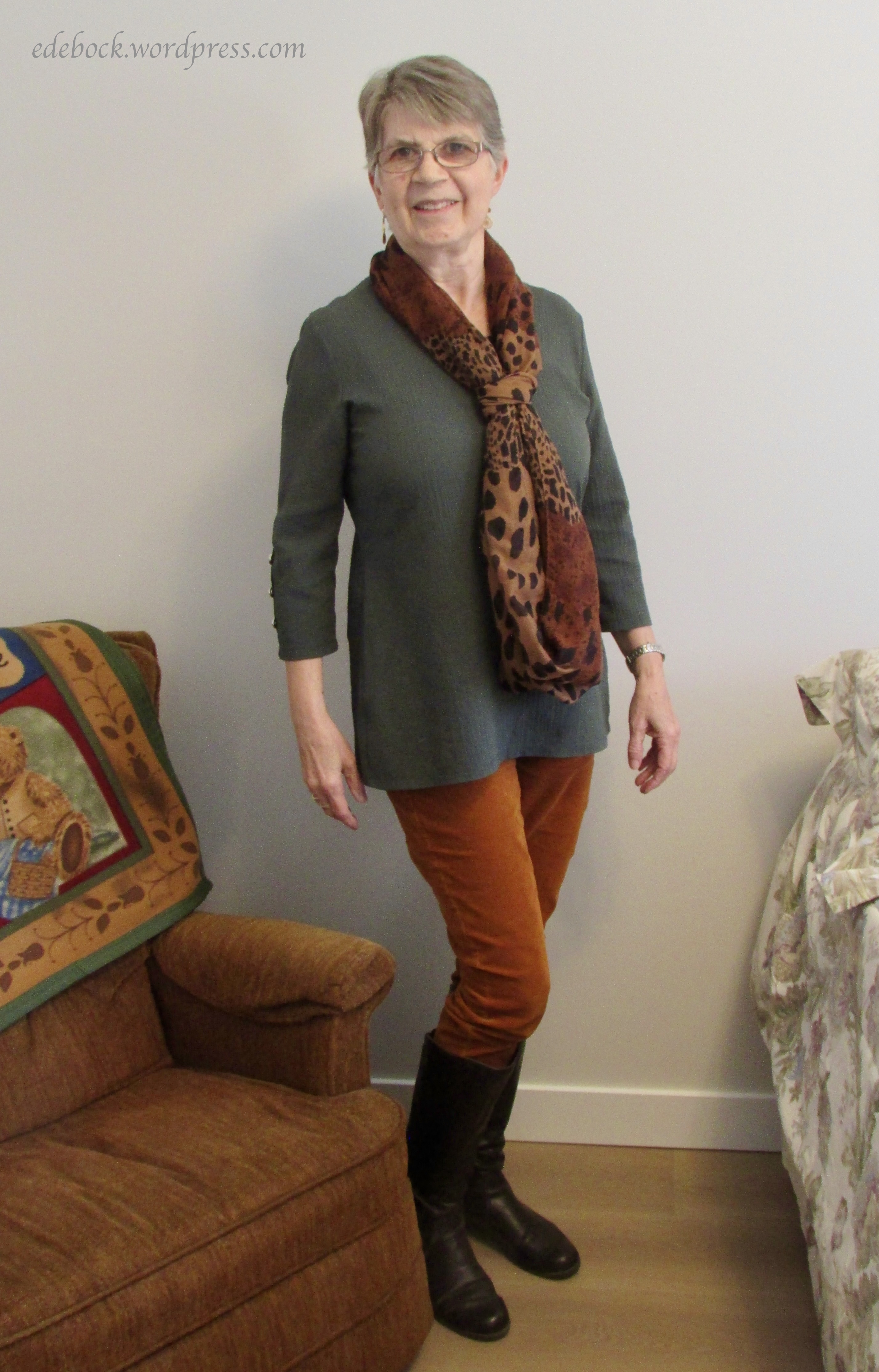
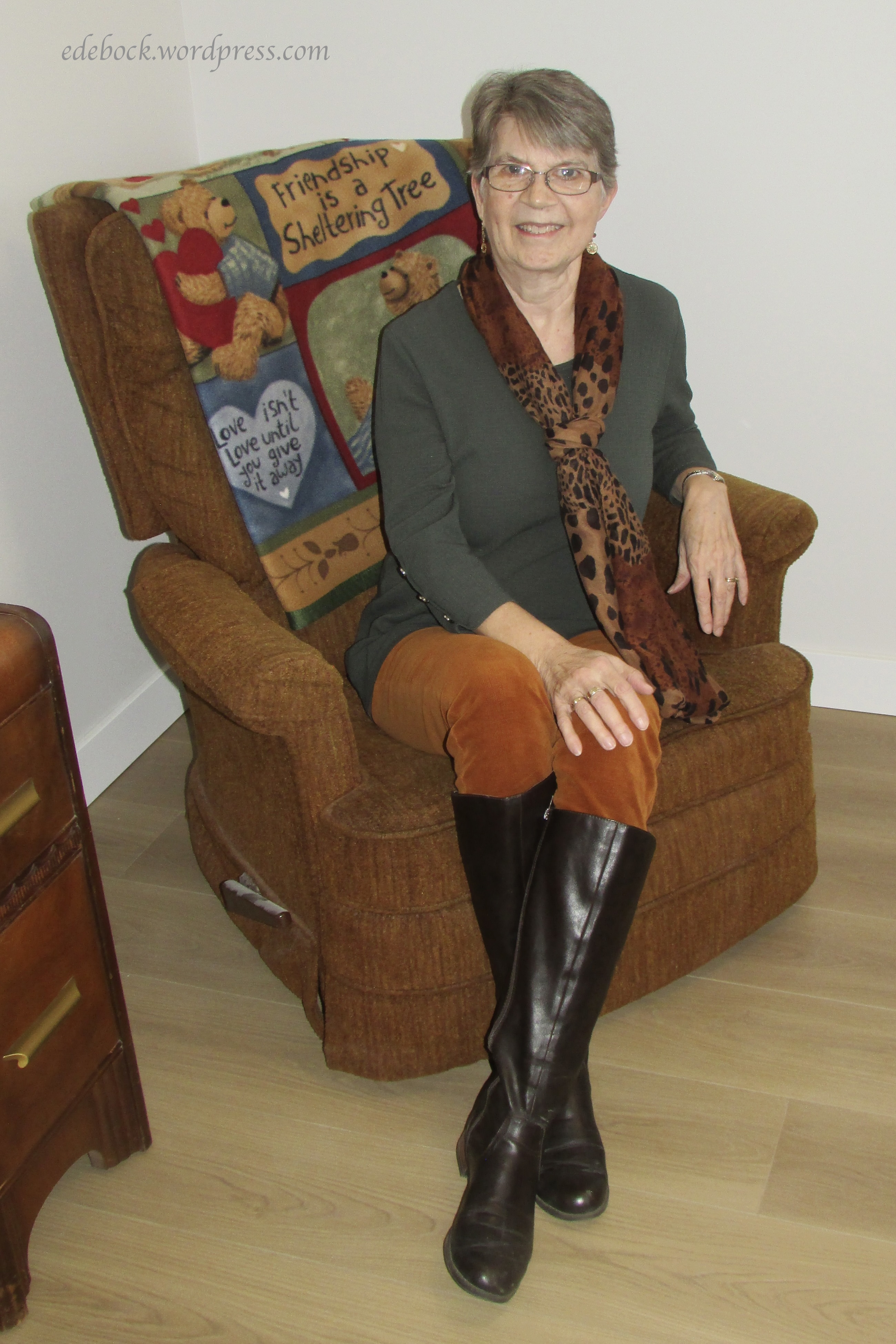
As soon as I saw Greetje’s cognac coloured trousers and green sweater in this post, I knew that I had similar pieces in my own closet, but couldn’t remember if I’d ever worn them together. I don’t have a scarf like hers nor do I have white combat boots, but the idea was to take inspiration from her outfit, not to copy it. Here’s the outfit I came up with. 

I didn’t like the bulk of the eternity scarf wrapped around my neck, but the colours worked so well with the outfit that I knotted it and wore it this way. The boots, top, and scarf are all thrifted items. Only the pants were bought new and they are several years old. 

This outfit fits all my style adjectives… classy, casual, comfortable, confident, and authentic… and I’ll definitely be wearing it again. Thank you, Greetje!

The Rule of 5… could you do it?

Throughout 2024, two of the bloggers that I regularly follow reported on their attempts to follow the Rule of 5. What’s that, you ask?

The vast overproduction of clothing by the fashion industry is responsible for almost 10% of greenhouse gas emissions worldwide. In 2022, Berlin’s Hot or Cool Institute determined that in order to meet the internationally agreed upon goal of limiting global warming to 1.5ºC, we should purchase no more than 5 new garments a year. That led to the Rule of 5.

Here’s how it works:

  1. Buy no more than 5 new items during the calendar year.
  2. Socks, tights, underwear, and nightclothes don’t count.
  3. Shoes, boots, and accessories DO count.
  4. Second-hand shopping is allowed, but don’t go overboard.
  5. Gifts count. (This is to prevent cheating by having someone else buy for you!)

I haven’t actually participated in the Rule of 5, but looking back I discovered that I inadvertently met the goal in 2023 before I’d even heard of it! I didn’t do as well last year, buying 8 items that would count. The bloggers that I follow didn’t meet the goal either, but they both agreed that trying had changed their shopping habits and made them much more intentional about what they bought. I’d consider that success.

Although the idea has merit, I haven’t committed to the Rule of 5 for this year either. I will continue to keep track of my purchases though and see how close I come. So far, 7 weeks into the year, I’ve only purchased one item, a colourful necklace that cost less than $10 at a tiny shop in the bus station in Xalapa, Mexico. The anchor and cross symbols are very meaningful to me, but if I’d been committed to the Rule of 5, I probably wouldn’t have bought it.

So, what do you think? Would you ever try the Rule of 5? Do you think you could do it?

Fashion and self-care

What comes to mind when you think of self-care? Eating nutritious meals? Exercising? Getting enough sleep? Scheduling some “me” time? In reality, there are a myriad of ways that we can take an active role in preserving or improving our own well-being, but when I asked what comes to mind when you think about self-care, you probably didn’t think about fashion.

The morning ritual of getting dressed is an often overlooked aspect of self-care, but it plays an important role in our well-being. In fact, a common symptom of depression is difficulty showering and getting dressed.

There are times, like during the incredible cold snap that we’ve experienced here in Alberta recently, when getting dressed truly is a matter of caring for our bodies. Keeping warm and protecting ourselves from the elements is priority #1.

But dressing contributes to self-care in ways far beyond keeping warm. Taking care of our mental and emotional well-being is just as important as caring for our physical comfort and fashion can play a vital role in that. We’ve all heard the term “dress for success”, but dressing mindfully is about more than impressing other people. It’s also about feeling confident, comfortable, and empowered. When we dress in ways that make us feel good about ourselves, we’re also more likely to participate in other self-care practices like exercising, eating well, engaging with others, or getting out in nature. In addition, intentional dressing sparks creativity which is also good for our physical and mental health.

Please note that this is not a post about “retail therapy”. Retail therapy is the act of shopping for clothes to make yourself feel better which may or may not actually work. Instead, as I’ve done before, I urge you to shop your closet. Take time to put together outfits that enhance your mental and emotional state; that make you feel truly good about yourself. If there are pieces in your closet that don’t do this for you, that drag you down emotionally, consider getting rid of them.

In the dark days of winter and a time when what’s going on in the world around us might seem overwhelming, it’s easy to begin to feel like we’re in an emotional rut. In times like this, more than ever, we need the boost that looking and feeling good in our clothes can give us.

World Cancer Day 2025: United by Unique

February 4 is World Cancer Day. There are more than 200 different kinds of cancer and every patient’s experience is different. That’s why the new World Cancer Day theme, United by Unique, resonates so strongly with me. While each of our stories is unique, we are united in our message and in our desire to raise awareness and see progress made in fighting this dreadful disease. 

The emphasis of the 3-year United by Unique campaign that kicks off today will be people-centred care. Behind every diagnosis lies a unique human story. These are stories of grief, pain, healing, resilience, love and so much more. A people-centred approach to care that listens to patients’ stories and fully responds to each individual’s unique needs with compassion and empathy will lead to the best possible outcomes.  

People living with cancer don’t always feel heard, seen, or understood. They are often bewildered, feeling isolated and voiceless at a time when they’re also learning to navigate an unfamiliar and confusing health care system and dealing with the emotional highs and lows of cancer diagnosis, treatment, or recovery. That’s why the first year of this campaign will focus on telling our unique stories.

I feel very fortunate to receive my cancer care at the Cross Cancer Institute in Edmonton, Alberta, Canada, a facility where it is common practice to look beyond the patient to the person as a whole and to consider the impact of their cancer on all aspects of their life. When I go for appointments, I’m routinely handed a clipboard with a questionnaire that delves into not only the physical symptoms that I might be experiencing, but also the psychosocial ones. The CCI offers a wide range of supportive services that go far beyond the patient’s physical well-being. The health care team there includes professionals in psychology, social work, spiritual care, nursing, and psychiatry and available services include individual, couple, and family counselling; professionally-led support groups; and practical supports for financial and other basic needs. While the need for these supports has not been part of my unique story thus far, I’m glad to know that they’re available should I ever need them and I wish that that was true for patients everywhere.  

I have been invited to share my unique patient story at a Canadian Neuroendocrine Tumour Society (CNETS) conference in May. The big challenge is going to be condensing the approximately 20 years from initial symptoms to present day into a 10 minute talk that educates, encourages, and inspires those in attendance, especially those who are in the early days of their journey and who need to know that it’s possible to live long and live well in spite of their diagnosis. 

United in our goals, unique in our needs.

Mexico City’s Palacio de Bellas Artes

We’re home from Mexico now, but we’re living in the middle of a construction zone while renovations continue in our house. Considering how much trouble I had just finding a pair of pants to wear our first morning home, I’m nowhere near ready to consider writing a fashion post just yet. I do have one more travel post to share with you though.

After checking into our hotel in Mexico City’s Centro Historico, we made our way to Francisco I. Madero Street, the busy pedestrian street that we have enjoyed on previous visits. Always busy, it was even more crowded than usual on a sunny Sunday afternoon!

Our destination, the Palacio de Bellas Artes (Palace of Fine Arts), was at the far end of the street. Two years ago, we enjoyed this spectacular view of the prominent cultural centre from the balcony of the 8th floor coffee shop in the Sears department store directly across the street.

Unfortunately, on that occasion, the Palacio de Bellas Artes was closed, but this time I was determined to see the inside. It definitely didn’t disappoint. While I enjoyed seeing some of the art work on display, it was the building itself that amazed me!

This photo was taken from the centre of the main floor looking up into the domes.

As far as the art work was concerned, it was the murals by famed Mexican artist, Diego Rivera, that I liked best. The first two panels shown here are part of his Carnival of Mexican Life series.

This one, painted in 1933 is called Russian Revolution or Third International.

I wasn’t able to get a photo of his entire The Man Who Controls The Universe mural partly because of the large tour group standing in front of it, but also because of the sheer magnitude of the piece which was painted specifically for the Palacio de Bellas Artes. It’s actually a replica of the original work which was painted in the lobby of the Rockefeller Center in New York City. The inclusion of Lenin’s face led to the destruction of the controversial piece.

Back outside, we also enjoyed the art on the exterior of the beautiful building.

In addition to the art museum housed in the front portion of the enormous marble structure, the Palacio is also home to Mexico’s largest concert hall. Unfortunately, that part wasn’t open while we were there.

Exploring Puebla’s Centro Historico

With friends who are permanent residents of Mexico, hubby and I spent a couple of days this past week enjoying the colourful Centro Historico district of Puebla, the country’s fifth largest city by population.  Come take a walk with me as I share some of what we saw.

Everywhere I turned, I was amazed by the architecture. Look at all the interesting shapes!

Tiles, or azulejos, are used to decorate many buildings inside and out.

And beautifully carved wooden doors add to the beauty of many buildings.

Of course, flowers in January add to that beauty!

The impressive 16th-century Catedral de Puebla occupies an entire city block in the centre of the district.  

Across the avenue to one side of the cathedral is the Biblioteca Palafoxiana. Founded in 1646, it is recognized by UNESCO as the first and oldest public library in the Americas. It has more than 45,000 books and manuscripts, ranging from the 15th to the 20th century.

This is just a taste of what there is to be seen and experienced in the historic centre of Puebla. There is, of course, the zócalo, a public square/park that’s found in the centre of almost every Mexican city or town, as well as several other parks. Hubby made a friend in one of the smaller ones! 

There are also upscale eateries and small “hole in the wall” places that serve delicious Mexican dishes as well as many, many shops and market stalls.

And finally, that’s a view from the rooftop patio of our Airbnb. That’s Popocatépetl (El Popo) in the background, the 18,000-foot-high active volcano that stands about 70 km (45 miles) from Puebla.


The Great Pyramid of Cholula

Tlachihualtepetl or the Great Pyramid of Cholula, the largest pyramid known to exist in the world today, isn’t in Egypt. It’s actually located in the city of Cholula, just a few kilometres west of Puebla, Mexico. Significantly shorter than Egypt’s Great Pyramid of Giza, it is much wider, covering an area measuring at least 300 by 315 metres. Partially hidden beneath what looks like a natural hill with the beautiful Iglesia de Nuestra Señora de los Remedios (Our Lady of Remedies Church) at the top, it’s actually a huge archaeological site. 

After our visit, the hardest part about writing this post was deciding which and how many of the 80+ photos that I took to include!


Unlike the Egyptian pyramids, the Great Pyramid of Cholula was built in stages beginning in the 3rd century BC and continuing through to the 9th century AD. As the ancient inhabitants of the area built on top of or modified previous structures the pyramid gradually took shape.

The earliest structures on the site were constructed of stones and adobe blocks made of clay, straw, and other plant material mixed with water. These were covered with a layer of stucco made of lime and sand. Over time, of course, the adobe broke down and nature took over. Legend also has it that when news of Spanish invaders arrived in the early 1500s, locals completely camouflaged the pyramid with mud and greenery to save the sacred place from being completely destroyed. What has been excavated and  is visible now is just a fraction of what lies under the hill. Archaeologists have dug about 8 km of tunnels into the pyramid. Unfortunately, the 800 metres that are sometimes open to the public were not when we were there, but what we saw above ground was astounding.  

The different phases of the pyramid were built by ancient Mesoamerican civilizations including the Olmecs, Toltecs and Cholutecs. Though much smaller, this large head reminded me of the colossal Olmec heads dating back to at least 900 BC that we saw in the Museo de Antropología in Xalapa on a previous visit to Mexico in 2019. 

The pyramid is thought to have had deep religious and ceremonial significance to the groups that held it at various times throughout history. Around its base and inside its walls, over 400 skeletons have been found. Disturbingly, many of these were the remains of children thought to have been sacrificed on the altar shown below during times of drought. It was believed that when they died they would carry messages to the rain god pleading for water for their people. 

The interior of this altar contained the remains of two people and the remains of eight others, including children, were found under its base. 

On a lighter note, how would you like to climb these stairs? 

While most of the site is cordoned off and we couldn’t have attempted those stairs if we had wanted to, this flight of 50+ narrow stone steps was accessible, so of course we had to climb them! 


Hanging onto the rope that’s firmly attached to the side, I made my way up. While the views from the ledge at the top were worth the climb, I soon discovered that there isn’t any other way down and wondered how I was going to manage the descent. Inching my way to the edge, I sat down and clinging to the rope, I made my way down on my butt! Thankfully, only hubby and our friends were there as witnesses!

As if that climb wasn’t enough, we also decided to take the steep walkway all the way to the top of the hill to see the church. Recognizing the religious significance of the pyramid mound, the Spanish chose to construct the Catholic church on top of it as a way of replacing the pagan cult of the past. It was constructed between May 1574 and August 1575 and consecrated on March 25, 1629.

On our way up the hill, we followed a procession playing music and carrying an almost life-sized statue of a saint. Gathering just outside the sanctuary, they waited until the priest came out and blessed them with a sprinkling of holy water before they entered the already full church and a service began. At that point, we were able to stand just outside the door and see some of the church’s beautiful interior.