A life transformed

Back in August when I wrote this post about several 50 year milestones in my life in 2025, I mentioned that In October it would be 50 years since I made the life-changing decision to follow Christ. A couple of readers mentioned that they would be interested in hearing more about how I reached that decision. I had already been thinking about sharing that story on the blog, so I decided I would do it today, the 50th anniversary of the day that my life was transformed.

As far back as I can remember, my family went to church every Sunday morning. I attended Sunday School and youth group and for several years, church camp was the highlight of my summers. In my early teens, I attended confirmation classes to learn more about the church and the Christian faith. The purpose of these classes was to prepare us for church membership, but when the classes ended and the minister asked me if I was ready to join the church, I said no. I felt that something was missing, but I didn’t know what it was. I knew that Jesus loved me and that He had died for me, but I felt that there must be more to it than that. When I discovered that all the other students in the class were going to join, however, I didn’t want to be the only one who was left out, so I changed my mind. After all, I was a good kid, a quiet kid who didn’t like to stand out from the crowd.

The summer before my final year of high school, my father took a job in the Northwest Territories and we moved from Vancouver to Yellowknife; from the third largest city in Canada to a small, isolated  community in the middle of nowhere. I had to leave my home, my friends, my school, my church, and everything else that mattered to a teenage girl. I wouldn’t get to graduate with my class. I was angry and I made a very conscious decision to rebel. I decided that I was going to find out how the other half lived. I quit going to church and started drinking and partying. I abandoned the morals that I had been taught and less than two years after leaving Vancouver, I entered into a teenage marriage that never should have happened.

We had only been married for a year and a half when my husband, a very charismatic narcissist, told me that he had fallen in love with someone else. He didn’t want our marriage to end though. Instead, he wanted to invite her to move in with us! I absolutely refused to allow that to happen and tried for another year to make our relationship work, but midway through my third year of university, it was over and we went our separate ways. I was broken. My dreams were shattered and I felt like unwanted, unloved garbage. That led to more unhealthy relationships.

In spite of all that was going on in my personal life, I managed to graduate from university with my teaching degree and I accepted a job in the very small town where we still live today. I realized that as a teacher in such a small community, my life would be on display for everyone to see. It was the mid 1970s and I was sure that if I continued to live the way I had been, parents wouldn’t want me teaching their kids.

Once again, I made a conscious decision to turn my life around. I thought I could do it on my own, but God had a much better plan. Richard was also a new teacher at the school that year. One evening early in the fall, he shared with me what it meant to be a Christian in a way that I had never heard before. He told me that if I acknowledged my sins, asked for God’s forgiveness, and surrendered my life to Christ, I could have a personal relationship with Him and my life would be transformed. I quickly realized that this was the missing piece that I hadn’t heard about growing up. I didn’t know that I had to make an actual decision to follow Christ or that I could have a personal relationship with Him.

At the same time, I also realized that making that decision would mean giving up control of my own life. Considering what a mess I’d been making of it up to that point, you would think that this would be an easy or obvious decision, but I wrestled with it. Eventually though, I couldn’t deny that God was calling me and I finally surrendered my stubborn will to His. When that happened my life changed completely. There were no flashes of lightning or tongues of fire, just an incredible peace that I had not known before. I felt like a brand new person, free of any guilt or shame over my past. I no longer had any desire to live the way I had been.

I quickly learned that God didn’t want to be a distant deity who cared about me, but who wasn’t personally involved in my life. Like a Japanese kintsugi artist, He began to fill the broken places in my life with gold and turn me into a vessel that He could use for His good purposes.

I wish that I could tell you that life was always easy after that, but of course, it wasn’t. In John 16:33, Jesus tells us, “In this world, you will have trouble. But take heart! I have overcome the world.” Over the past 50 years, I have suffered great loss and betrayal. I have spent the last 12 of those years fighting cancer, but I have never been alone in any of these dark times. One of my favourite Bible verses is Isaiah 41:10 which says, “Do not fear, for I am with you; do not be dismayed, for I am your God. I will strengthen you and help you; I will uphold you with my righteous right hand.” I can testify to the truth of that!

Whatever you take away from this post, please note that this is not about church or even about religion, it’s about an intimate, personal relationship with the Creator of the universe; a relationship that is available to everyone regardless of who you are and what you’ve done. If you have any questions or would like to chat about this, please feel free to comment below or send me an email at debock2@gmail.com.
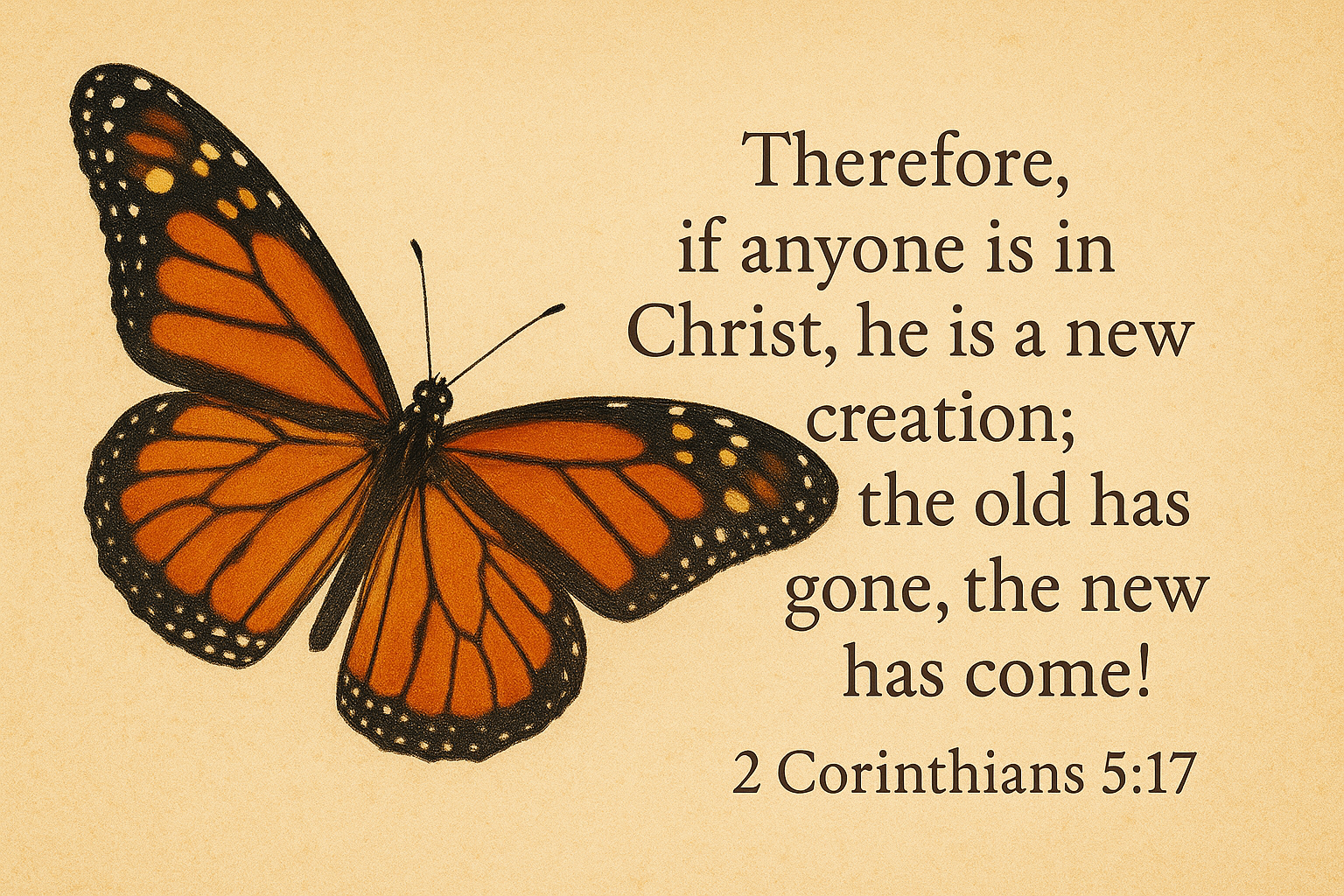
Image: ChatGPT

Elderly? Not yet!

I was a bit taken aback when a fellow blogger who’s a few months younger than I am recently referred to herself as elderly. I turned 73 earlier this week. Maybe I’m in denial, but I’ve never thought of myself as elderly! I still don’t. 

I recently read a trashy novel entitled The Best Exotic Marigold Hotel about a group of doddering old people living in a seniors home. I was  bothered by the fact that most of the “elderly” characters were younger than I am now! Did the author really think that that was an accurate representation of people in their 60s and 70s today? 

I don’t mind being called a senior. I’m happy to accept the discounts that go along with that and I certainly don’t mind the fact that the government has been paying me a monthly pension since I turned 65, but that doesn’t make me elderly.

This article explains the difference between senior and elderly in a way that sheds light on why I feel the way I do. “While “senior” is used to describe an age group, “elderly” refers to a matter of capability.” Senior denotes a person’s actual age, generally 65 or older, while elderly indicates diminishing ability due to aging. I may not be quite as spry as I once was, but I’m not there yet! In fact, I plan to go hiking today. 

It’s funny how our concept of age changes as we get older. When I was a child and my grandmother was younger than I am now, I certainly thought that she was OLD! When I started my teaching career, several colleagues who were nearing retirement seemed very old to me. Now I’m significantly older than they were then!

My grandmother when she was younger than I am now. 

Aging is a natural process and one we ought to embrace. One would hope that with age, we’ve gained experience and wisdom. It’s just that word elderly that I’m not ready to embrace yet!

Lessons from my fall wardrobe transition

As much as I hate to see summer come to an end, I have to quit denying reality and accept the fact that fall is here! The days are getting shorter, the furnace is coming on in the morning, coloured leaves are falling, and the farmers around us are finishing harvest. I actually love autumn, but it’s a bittersweet season because it means that our long, cold winter is just around the corner.

Another sign that fall is here is the fact that I recently found myself reaching for the warmer items in my closet. As a result, I finally made the switch from my summer wardrobe to my fall/winter one this week. As I moved my summer clothes into storage and brought out warmer ones, I tried to do a better job of purging than I’ve done in recent years. So, what went into the donate pile and what, if any, lessons can be learned?

  • Items that I bought because someone else said they looked good on me, but that I didn’t wear very often because they never really felt like me. Lesson: Don’t dress to please others. I need to consider my 5 style adjectives (classy, casual, comfortable, confident, and authentic) when I’m deciding whether or not to buy something.
  • Thrifted items that were too good to pass up, but that I’ve seldom worn.  Lesson: A bargain is only a bargain if you’re actually going to wear it.
  • Garments that no longer fit the way they should. Lesson: Dress for the body that I have today, not the one I used to have or wish I still had. My aging body is changing; there’s more around the middle than there used to be and that’s okay.
  • Items that I have too many of.  Lesson: A woman who hardly ever wears leggings doesn’t need 7 pairs!
  • Pieces that I’ve hung onto for sentimental reasons.  Lesson: I don’t need a closet full of nostalgia for my kids to clean out someday.

Now that I’ve finished sorting clothes, I need to do the same with footwear. Once that’s done, it will be time to take a close look at my wardrobe and decide whether or not there are any gaps that need to be filled before the really cold weather arrives. In the meantime, I’m hoping that our beautiful fall weather lasts for awhile longer!

Book of the month – September 2025

During our teaching careers, hubby and I had to learn numerous acronyms describing ND (neurodivergent) children: ADHD (Attention-Deficit/Hyperactivity Disorder), OCD (Obsessive-Compulsive Disorder), ASD (Autism Spectrum Disorder), ODD (Oppositional Defiant Disorder) and so on, but the book that I’m reviewing this month is an extreme example of what hubby calls PPS (Poor Parenting Syndrome)!

Wavewalker: A Memoir of Breaking Free

Suzanne Heywood

At seven years old, Suzanne Heywood set sail from England with her parents and younger brother on what was supposed to be a three-year trip around the world retracing one of Captain Cook’s voyages. What followed was a decade of isolation on a 70-foot sailboat crossing some of the world’s most dangerous oceans and surviving horrendous storms, shipwrecks, and reefs. What sounded like the romantic adventure of a lifetime became a child’s worst nightmare “trapped inside someone else’s dream”.

Deprived of safety, friendship, and education, Suzanne longed to return to the stability of England and the opportunity to attend school, but her parents saw this only as selfishness on her part and refused to entertain the idea. Determined to educate herself, she worked diligently on correspondence courses dropping lessons into the mail whenever and wherever the family went ashore. Ultimately her desire for independence and self-determination became so intolerable to her parents, particularly her mother, that at age 16, they dropped her off at an isolated cabin on the north island of New Zealand, leaving her responsible for her younger brother while they continued their travels around the South Pacific!   

It would be hard to read this book without becoming increasingly angry at the parents who, according to the epilogue, told their daughter later that she had a “privileged” upbringing! It is, however, a story of resilience and determination. At 17, finally escaping the constraints of her bizarre childhood, Suzanne was accepted into college at Oxford where she went on to earn her PhD.

While Suzanne’s childhood was one of neglect rather than physical abuse, there are strong parallels between her story and Tara Westover’s powerful memoir, Educated

What’s for lunch?

I started making bag lunches for my brother and I when I was in junior high. For three of my four university years, I lived off campus and carried a bag lunch almost every day. Then, throughout our teaching career, I made bag lunches for my husband, our children, and I. That’s over 40 years and thousands of sandwiches!

When we retired, I was excited that I’d never have to make bag lunches again, but then came the dilemma that I still live with 18 years later. What should I make for lunch today? In retrospect, making sandwiches every day was easier than having to decide what to feed us for lunch every single day for the rest of our lives!

When my parents were in their later years, they ate the same simple lunch almost every day. It consisted of Laughing Cow cheese and fresh buns from the bakery down the street from their apartment. How boring, I thought, but now I understand! While I don’t think hubby would go for that, he’d probably be happy with mac and cheese or eggs and toast every day. Me, not so much!

I decided to ask ChatGPT for ideas. If you’re not familiar with ChatGPT, it’s a free and easy to use artificial intelligence (AI) chatbot, a tool that can do everything from recommending a book for you to read to helping you plan a trip. In a matter of seconds, it gave me several possibilities. Some include ingredients that I won’t find in my small town grocery store, but others are very doable. I had to laugh though when I saw that the final item on the list was peanut butter and banana sandwiches, something that often appeared in those bag lunches!

The photo was also generated by ChatGPT.

Now it’s your turn. I’d love to hear some simple, nutritious lunch ideas! What are your favourite things to make for lunch?

Beaver watching at Miquelon Lake Provincial Park

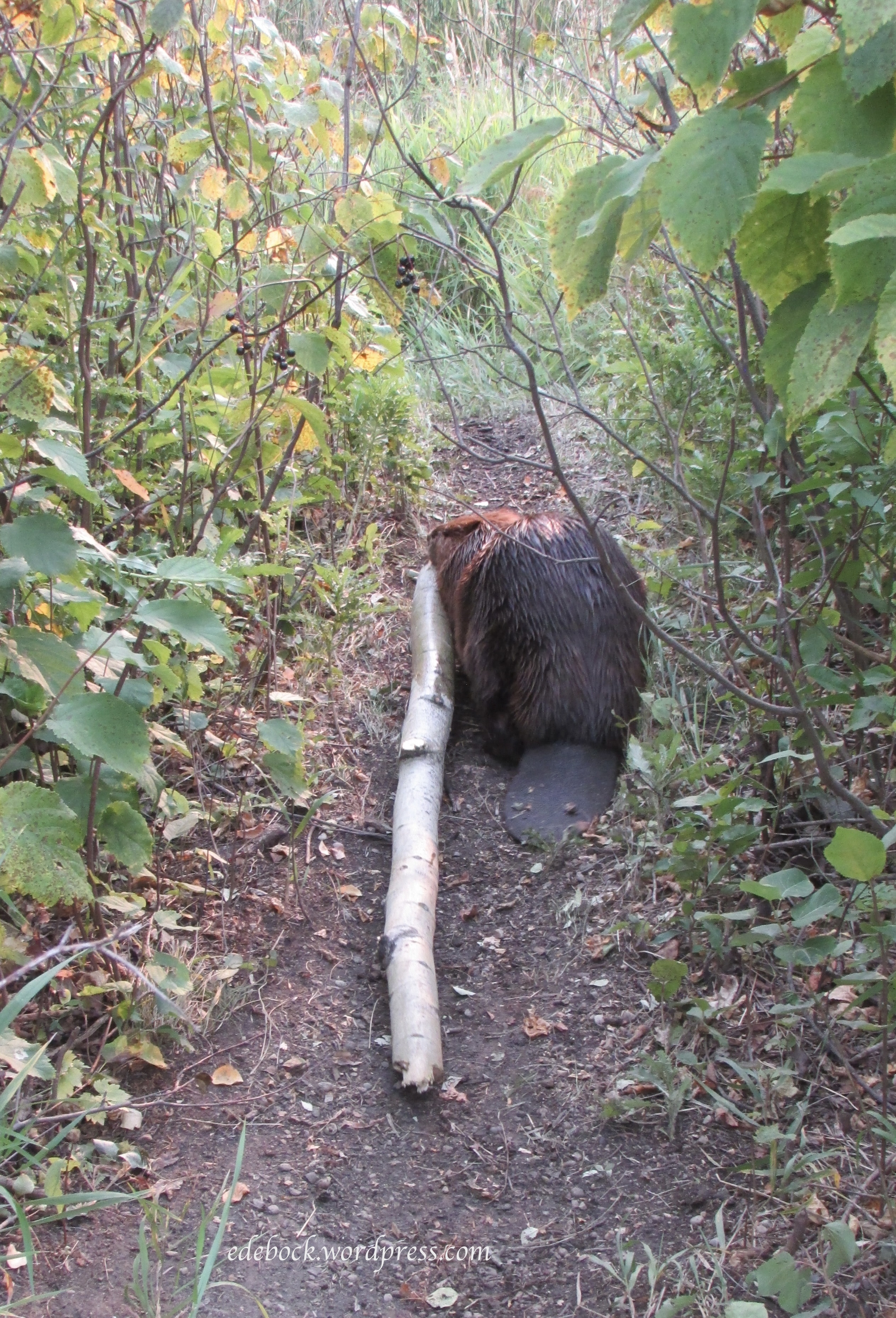
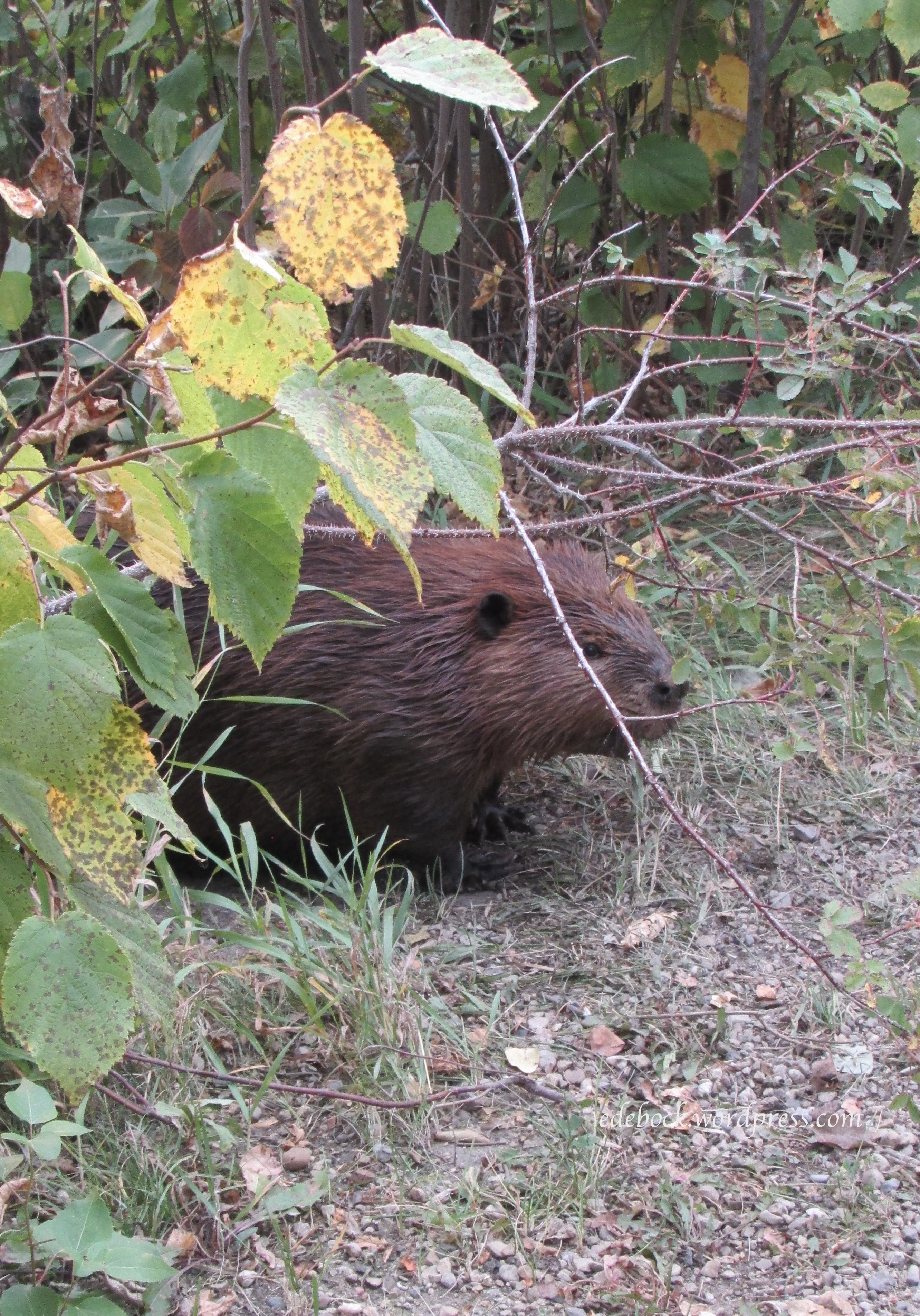
Earlier this week, we spent three days camping at Miquelon Lake Provincial Park. We hiked a little over 9 km (5.6 miles) one day and about half of that the following day, but by far the most fun we had was an hour spent watching a family of beavers hard at work. We came upon them quite by accident while enjoying an evening stroll alongside the Grebe Pond and stayed until my camera battery died! Of the many photos that I took, this one is my favourite.

The North American beaver, officially Canada’s national animal, is this continent’s largest rodent. The saying “busy as a beaver” is very apt. As we watched, the industrious critters constantly crossed the path in front of us on a well-worn trail from the water’s edge to the hillside above us. There we could hear them using their long orange incisors to busily cut branches from the trees that they felled before dragging them down to the shoreline.

Look at the size of the load that this one was hauling!

We’ve encountered a beaver in the water several times when we’ve been kayaking. If we get too close for comfort, it slaps its tail on the water with a thunderous splash and dives beneath the surface. At first, these ones were clearly surprised to see us watching them from just a few feet away, but they didn’t seem too bothered by our quiet presence. The young ones were the most cautious, first sitting still in the edge of the brush and peeking out before quickly scooting across in front of us.

With its big, webbed hind feet and its rudder-like tail, it’s no wonder that the beaver is such a good swimmer. Not only did they drag the branches down to the water’s edge, but then they swam across the pond with them to add them to their lodges on the other side.

We had thought that this would be our last camping adventure of the year, but we had such a good time that we’re thinking of trying to squeeze in one more. As I mentioned in my last post, I’m never quite ready to let go of summer!

How can it be fall already?

Do you remember when you were a kid and summer seemed to go on forever? Me too, but now it seems to fly by in a flash. I have a love/hate relationship with fall. I love the crisp autumn air and the changing colours, but fall means winter is just around the corner and I’m never ready for that!

I try to hold onto summer for as long as I can, but the signs are all around me. Days are getting shorter and leaves are beginning to change colour. Teachers and students are back in school and soon our regular fall/winter activities will be in full swing again. Still, I have a hard time accepting the changing season. Reality definitely hit this morning though. When I first looked out it was -1ºC (30.2ºF) and there was frost on the roofs across the street! Frost in the first week of September!

For me, summer seemed to go by faster than ever this year. Perhaps that’s because with all the traveling we did to far flung places like Armenia, Germany, and Alaska, we didn’t spend as much time doing the things we usually do during the summer months. We did manage to fit in a fair amount of golf and we hope to do more of that in the few weeks before the course closes, but we’ve only spent 11 nights in our trailer, less than half our usual 25 or more. We are planning to get out for one more short trip, but after that it will be time for hubby to winterize the trailer. We’ve only had the kayak on the water four times, so I sure hope we can do that again too.

As a retired teacher, the beginning of September always feels like the start of a new year to me. As such, it’s a good time to set some goals or make some “new years” resolutions. Sharing them with you will make me more accountable and help me actually accomplish them, so thank you for that!

When I think about this summer’s golf and kayaking season, one thing that stood out to me was the fact that over the past few years, I’ve lost strength in my shoulders and upper arms. No surprise, as I used to lift weights all winter. Doing that is more than I can handle now, but I need to do something, so I’ve decided to add some work with dumbbells to the morning exercises that are already an established part of my year round routine. This website has some good information and exercises for seniors, so I’m going to do a set of the 5 upper body weight training exercises every morning Monday to Friday.

It’s been ages since I last published a Fashion Friday post, so that’s also something that I plan to resume doing on a semi regular basis. I haven’t shopped for clothes in quite awhile, but I have been paying attention to what’s on trend for fall and here are a few things that I’ve been noticing…
  • chocolate brown, lots of chocolate brown
  • off-white and neutral tones
  • blazers with jeans
  • bulky, oversized sweaters
  • capes
  • dark wash jeans in almost any style, but not torn or distressed
  • suede boots, shoes and handbags
  • loafers and mary janes
  • statement belts
  • statement necklaces
  • scarves, both silk and knit

While lots of these are very wearable and make me want to rush out and start shopping, my first step will be my semi annual closet changeover (but not until after that last camping trip!) At that point, I’ll take a close look at what I already have, then figure out what, if anything, I actually need. Then I might look for a few pieces that fit with my existing wardrobe and that I’m likely to wear for more than one season, pieces that fit my style adjectives… classy, comfortable, casual, confident, and authentic.

What about you? Are you happy or sad that summer is over? Do you have any goals or plans for the new season? Will you be wearing any of this season’s trends?

Book of the month – August 2025

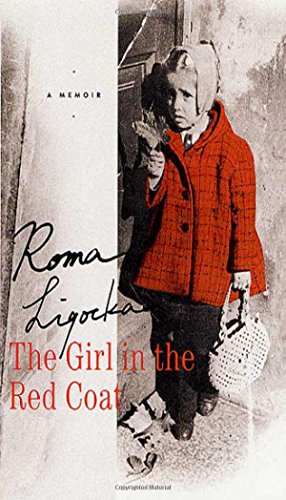
The Girl in the Red Coat: A Memoir

Roma Ligocka

The book opens with an elderly Jewish woman sitting in the elegant dining room of a posh hotel on the French Riviera. Suddenly and quite seamlessly it transitions to the dark Ghetto of Kraków, Poland during World War II and I was hooked!

Roma Ligocka was born to Jewish parents in Poland in November 1938, less than a year before the beginning of World War II. Told through the eyes of a child, the story of her early years living in the Jewish Ghetto of Kraków is a harrowing account of uniformed men in shiny black boots with snarling dogs, people being shot indiscriminately, her mother’s tears, and from her hiding place under a table, seeing her own grandmother seized by SS officers. After her father is arrested and taken to Auschwitz, Roma and her mother, with their hair dyed blonde and carrying falsified documents, escape the Ghetto and are taken in by a non-Jewish family who pass them off as visiting cousins. Sometime later, when her father escapes the concentration camp and is reunited with his family, she fails to recognize the haggard spectre that he has become.

Roma is just short of her seventh birthday when the war comes to an end, but her life continues to be marked by severe hardship. Within two years her father dies and the communists take control of Poland.

As her adult life unfolds, we see the results of the trauma that she endured as a child. Although she studied art and costume design at the prestigious Academy of the Arts and became a successful costume and set designer, she continued to confront her frightful memories and her adult life is characterized by anxiety, eating disorders, substance abuse and the inability to maintain lasting relationships.

Finally, at the age of 55, on March 2, 1994, Roma reluctantly attended the première of Steven Spielberg’s epic movie “Schindler’s List” in Kraków. The Academy Award-winning movie was shot entirely in black and white except for the image of a little girl in a red coat. Seeing something of herself in that little girl, Roma, who had had a bright red coat of her own as a wee child, finally felt inspired and strong enough to tell the story of her own experiences.

Interestingly, although I suspected it early on, until late in the book, Ligocka doesn’t reveal the fact that her cousin, Roman, with whom she had a close relationship, was none other than the famous director, producer, writer and actor, Roman Polanski.

My 12 year cancerversary!

Yesterday was my 12th cancerversary. Twelve years have passed since I heard those dreadful words, “It’s cancer and it has already spread.” At the time, that sounded like a death sentence, but two weeks later we learned that I have neuroendocrine cancer (NETS) which, while not curable, can be treated and usually grows more slowly than most other cancers.

One of the things that I learned early on was how important it is for patients to advocate for themselves. Last Friday proved that point. When I saw my oncologist in mid July to discuss the results of my latest CT scan which showed that a small tumour on my liver had started to grow, he referred me back to the interventional radiology specialist who did my radioembolization in March of last year. He expected that I would hear something within a couple of weeks, but when we returned from our recent trip, more than a month had passed and I’d heard nothing. On Friday morning, I called and left a message asking for confirmation that the referral had been received and, if possible, an update on what was happening. In less than half an hour, I had an appointment to see the doctor during her noon hour on Monday! I can’t help wondering how long I would have had to wait if I hadn’t called.

We actually had to wait quite awhile to see the doctor on Monday because she was tied up in a procedure that took much longer than expected. When we finally got in, she did an ultrasound and wasn’t able to find the tumour. Unfortunately, that doesn’t mean that it isn’t there. It simply means that it’s in a location that isn’t easy to see. After discussing the fact that the tumour is quite small and that I don’t have any symptoms, we decided on a tentative treatment plan, but we aren’t actually going to do anything until after my next CT scan on September 26. This battle is really a balancing act. We don’t want to treat too soon because that can limit what we might be able to do in the future, but we also don’t want to wait too long and let the tumour get too large.

After twelve years of living with this, I’ve become much more comfortable with waiting. Rather than worrying about what might or might not be happening inside me or about what the future might hold, I’m simply going to go on living my best life right now!

Image: Surya Ali Zaidan

If you would like to help, I’m still fundraising for neuroendocrine cancer research. Click here to visit my fundraising page. Although I’m nearing my $1200 goal ($100 for each of the 12 years that I’ve been fighting this disease) the campaign is still far short of what we need to fund research grants for the coming year. We could really use your help!

A Scenic Journey on the White Pass & Yukon Route

I first rode the narrow gauge White Pass & Yukon Route railway on a family holiday in the summer of 1967. I was 14 at the time. In those days, there was no road between Whitehorse in the Yukon and Skagway in southeast Alaska. We drove to Haines, Alaska, took a ferry to Skagway, and then, with our vehicle loaded on a flat car, rode the train to Whitehorse.


The White Pass & Yukon Route has a fascinating history. When gold was found in the Yukon in 1897, the news spread like wildfire and tens of thousands of fortune seekers steamed up the Inside Passage waterway to Skagway and Dyea to begin the treacherous overland trek to the Klondike. Each person was required to carry a ton of supplies. Some chose the shorter, but steeper Chilkoot Trail that started at Dyea while others chose the longer, less steep White Pass Trail from Skagway. Both led to the interior lake country where the stampeders could begin a 550 mile (885 km) journey through the lake systems to the Yukon River and the gold fields. 

On May 28, 1898 construction began on a railway over the coastal mountains from Skagway to Whitehorse. Thirty-five thousand men worked on the $10 million dollar project.  In just 20 miles, the track climbs from sea level at Skagway to almost 3000 feet (914 metres) at the summit! It features steep grades of almost 3.9%. Tight cliff-hanging curves required a narrow gauge railroad with tracks just 3 feet apart as well as the construction of two tunnels and numerous bridges and trestles. Against all odds, working through the dead of a northern winter, the 110 mile (177 km) project was completed in just 14 months. 

For decades following the gold rush, the White Pass & Yukon Route carried significant amounts of ore and concentrates to tidewater to be loaded onto ships, but with the opening of the Klondike Highway from Whitehorse to Skagway in 1978 followed by plummeting world metal prices, the railroad suspended operations in 1982. Six years later, it reinvented itself as a tourist attraction. 

When we looked at possible shore excursions to add to our recent Alaska cruise, the scenic railway was the one that caught our attention and I looked forward to riding the train again! For the most part, the photos will speak for themselves, but I’ll add a few details as you ride along with us. 

In the next photo, the line across the hillside on the far side of the gully is the Klondike Highway. 

In the early days and when I rode the train in 1967, it was pulled by a steam locomotive. While the railroad still has two of those vintage engines in their fleet, most of the excursions now use diesel engines like this one that passed us going down as we were still climbing. 

That’s the shadow of our train crossing a bridge at the bottom of the next picture. 

If you look very closely at the next photo, you’ll see a tiny slice of blue in front of the distant mountains and in the V between the hillsides. That’s the Skagway harbour far below. 

As the train approaches this broken trestle, it looks like it’s going to cross it, but it hasn’t actually been in use since 1969 and began to fall apart many years after that. It was a bit strange to look across at it and realize that I crossed it back in 1967. 

If you look very closely at this final photo taken near the summit, you can see one of the few remaining bits of the White Pass Trail that was traversed by thousands of gold seekers before the construction of the railway. 

If an Alaska cruise is in your future, I highly recommend the White Pass & Yukon Route shore excursion. You won’t be disappointed!