Lalaport

We were supposed to go on a church picnic this afternoon but it was canceled because it poured rain overnight and was still very chilly and wet this morning.   Since many people had packed picnic lunches, even more than usual stayed and ate together after this morning’s service.  Once again, we took advantage of this opportunity to spend time getting to know people.

Afterward, we headed off to Lalaport.  We’ve been told that it’s Asia’s largest mall and it’s right here in Funabashi!  Though it has over 500 stores, it isn’t as big as West Edmonton Mall and doesn’t have all the entertainment facilities found there.  I found the layout much more confusing, however.  Of course, I’ve been shopping West Ed since Phase One opened over 25 years ago so I’ve kind of grown with it.  Even so, I tend to prefer smaller malls and, if I ever have any serious shopping to do, I’ll probably return to one of the two smaller ones that we’ve already explored.  Of course, a cool wet Sunday afternoon might not have been the best time to visit a major mall!  Everyone in the Greater Tokyo area seemed to have the same idea and the crowds probably rivaled West Ed at Christmas time!  Since we were only browsing, however, the large number of people and the line ups at the tills didn’t really bother us.

We’ve sort of fallen into the habit of going out for supper on Sunday evenings.  After a day of exploring, it beats coming home and making a meal!  Since there are many restaurants to choose from within walking distance of home, we usually come back to our area to eat.  Tonight we decided to try an Indian restaurant that had been recommended by one of our fellow teachers.  I was a little worried about how the spicy food would affect my stomach, which has been bothering me again lately, but I think I must have shocked it into submission!  The curry was definitely hot but that was several hours ago now and I haven’t suffered any ill effects so far.  Touch wood!

Yukata

A yukata is a light cotton kimono.  Unlike the traditional kimono, which is a complicated and very expensive garment, the yukata is inexpensive and easy to wear.  Though they are apparently a common sight on summer evenings, they are more often used for relaxing at home.  Before we came to Japan, I had decided that I wanted one to use mainly as a dressing gown.   I bought it at Hayashi Kimono when we went to Ginza on Sunday.  It’s a tiny shop tucked into a narrow and crowded shopping arcade but is advertised as Tokyo’s largest kimono boutique for foreigners.   The staff speak English and the gentleman who waited on me was incredibly helpful.  In spite of the fact that it was obvious that I didn’t intend to spend a great deal, he encouraged me to try on as many garments as I liked before making a choice.  He graciously showed me a variety of colour choices and tied each one carefully so it would look it’s best on me.  My yukata is brighter and more colourful than many but the more subdued colours made me look completely washed out.

Each yukata comes with a narrow belt made of the same fabric but when the salesman showed me how much better they look with the wider silk sash in a contrasting colour, I decided to buy one of those as well.  The entire ensemble cost me only 5400 yen (about $54).  The fabric is a very fine cotton and is completely washable.

Before we came to Japan, our employer sent us a handy little book entitled “Living  Japanese Style”.  It gives a couple of important tips for wearing the yukata correctly.  Apparently, I need to remember to cross the left side over the right when dressing.  Crossing the right side over the left would be a terrible faux pas as this is done only when dressing a corpse!  Apparently, I would also be laughed at if I wore my yukata with shoes.  Since it would look completely ridiculous with most of my shoes, this won’t likely be a problem.  Special sandals and socks for wearing with kimono are sold here but I doubt I’d ever find any to fit.  If I ever do decide to go out in my yukata, I could probably get away with wearing it with my flip flops.

This one’s for Katie

Today was my day off and I’d decided that finding somewhere to get my hair cut was a priority. I usually have it cut every six weeks and it had been over eight. Thick and unruly at the best of times, it becomes even more curly and unmanageable in humid conditions such as we’re experiencing here. I was desperate!

Finding a salon was no problem at all. There are several within easy walking distance. Choosing one and making an appointment when I don’t speak the language was another matter. I was determined, however. Obviously, I couldn’t live here for a year without having my hair cut so I pulled out my trusty Japanese phrasebook and wrote down “yoyaku o shitai no desu ga” (I’d like to make an appointment) and “heya-kat-to” (haircut). Armed with my note and the phrasebook, which also lists handy things like the days of the week, I set out to conquer the problem.

The only salon that had been recommended to me was Earth Hair. It was also the first salon I saw when I arrived here and I walk by it almost every day. I had pretty much ruled it out, however. Earth Hair is big and it’s all windows, mirrors and stainless steel. Like most Japanese salons, the prices are listed outside and they are significantly higher than the other shops in the area. A cut and blow dry is 3900 yen (approximately $39) and that’s if it’s done by a lowly stylist rather than a managing stylist or one of the many other higher ups such as the artistic director. I had come to the conclusion that it was just a little too posh for the likes of me.

As I was walking walking by some of the other salons this morning, checking their prices and trying to decide which one to venture into, I passed by a girl handing out advertising fliers. This is not at all unusual in Japan. Often, I refuse the offering knowing that it will likely be printed entirely in Japanese and that it will be of absolutely no use to me. For some reason, this morning, however, I reached out and took what was offered and what do you suppose it was? An advertisement for a promotion at Earth Hair! Amongst the Japanese, there were four English words offering a cut and blow dry for 2500 yen, approximately the same price it would be at any of the other shops! Must be a sign, I thought, and headed back to Earth Hair!

As soon as I entered, I was greeted by a girl behind the front counter. I asked if she spoke English but she didn’t. Neither did either of the other two girls behind the counter. I pulled out the flier and pointed to the cut and blow dry ad. The girl asked me something and I must have looked blank so she pointed toward the stylists at work. I nodded not knowing for sure what I was agreeing to and she indicated that I should give her my coat. I didn’t have to make an appointment, I was being offered a haircut on the spot! Bonus! One of the other girls came around the counter and took my purse, hat and umbrella then gestured to the chairs in the waiting area.

As I sat down to wait, I knew that I still had one more hurdle to overcome. I had to communicate to the stylist that I wanted my hair thinned. The phrasebook was no help at all but I quickly grabbed one of the hairstyle books and found a picture of a fairly short textured looking cut. When I showed it to the stylist, he looked a bit dubious but got to work. Noticing that I was holding my glasses, he rushed off and came back with a glasses case for me to put them in. He worked meticulously, cutting my hair dry then wetting it and blowing it dry. When he finished, he handed me my glasses and held up the mirror for me to check the back. A look of great relief crossed his face when I smiled and gave him a thumbs up indicating that I was happy with the results. He handed me a key with the number 12 on it and headed to the front counter. Following him, I wondered what the key was for until I spotted the lockers and realized that my purse and other belongings were safely stowed in locker #12! One of the girls brought me my coat and helped me into it. As soon as I paid the stylist he rushed to the front door, held it open for me while I exited and, in true Japanese style, bowed to me as I left!

For those readers for whom today’s title makes no sense, Katie is my hairdresser back home in Sedgewick.  And no, this isn’t how I dress on a regular basis!  I’ll tell you about the outfit another day.

On being a visible minority

According to new census data released by Statistics Canada last week, visible minorities have surpassed the five million mark as immigrants from Asia continue to change the face of Canada at a staggering rate.  Visible minorities now comprise more than 16% of the country’s population and should that trend continue, Statistics Canada predicts that one in five Canadians will be a visible minority by 2017, when the country turns 150 years old.

So what is it like to be a visible minority?  In Canada, many face language barriers, discrimination, culture shock and the rejection of foreign credentials.  I completely understand the language barrier.  While we have found Japanese people very helpful, not knowing the language is definitely a handicap to daily living and were we planning to stay longer than a year, we would be making a much bigger effort to learn the language.   Of course, because we’re here to teach English, not knowing the language doesn’t stop us from working but in any other field, we’d be unemployable.

As a visible minority, we really have not experienced discrimination.  In fact, if anything, looking different from those around us is an asset.  People don’t expect us to understand the language or the customs and, though some just ignore us, most are very willing to help in any way they can.  On occasion, there are those who clearly choose not to sit next to us on the train but there are few of them and no one is outwardly rude to us.  That would be so unJapanese!  MIL has on staff, at the moment, several young teachers of Japanese American descent and I think life is actually more difficult for them. Because they look Japanese, people automatically assume that they are and expect them to understand the language and the culture.

For the most part, as I go about my daily life here in Japan, I forget how visibly different I am from those around me!  In fact, once in awhile when I catch my reflection in a train window, I’m surprised at how different I do look!  Japanese women value pale skin, however, so my difference is not looked at as unattractive.  MIL also employs several black teachers and I don’t know what their experience has been.

Perhaps the biggest handicap to immigrants in Canada, visible or otherwise, has been the rejection of their foreign credentials and work experience.  Of course, there need to be checks of some sort to ensure that their qualifications meet Canadian standards.  Obviously, I don’t want a doctor whose medical training has been inadequate operating on me.  On the other hand, we are facing a doctor shortage in Canada while we have medical professionals driving taxi!  Surely, if we’re going to allow or even encourage them to immigrate, something could be done to provide the upgrading that they might need in order to begin to practice.  Instead we have professionals working in low paying service jobs who could be contributing in much more valuable ways and whose lives would be much more fulfilling if they were able to pursue their chosen field.

Fortunately for us, our credentials as teachers are highly valued here in Japan.  In order to teach at a language school such as MIL, one doesn’t have to have a teaching degree, but Japanese law does require a university degree of some sort.  Richard and I are very highly respected, however, especially by the Japanese staff members and the students because we are “professional” teachers and it is clearly a feather in MIL’s cap that they are now able to advertise themselves as a school that employs professional teachers!

Ginza

After church yesterday we stayed and ate lunch with many of the people there then headed into Tokyo to see Ginza, one of the city’s famed shopping areas. It was an interesting place to browse but Ginza appears to me to be Japan meets downtown Manhattan or any of the world’s other snobbish and opulent shopping areas. It reminded me of walking Chicago’s Magnificent Mile when I attended a conference in that city some twenty years ago. The streets are lined with swanky stores like Gucci, Prada, Christian Dior, Tiffany’s and Chanel. Customers are greeted by uniformed doormen as they enter. We went into only one such store, a place where watches sell for upwards of $3000 and purses for over $1300! Needless to say, we didn’t open our wallets or stay long. It actually felt quite obscene to me!

On Sunday afternoons, many of the streets of Ginza are blocked to traffic. Seats are even set out in the middle of the street for those who want to take a break from walking or shopping. Interestingly, I noticed that, in spite of the wide open streets, the Japanese tended to stay to the sidewalks. Perhaps they feel more comfortable in a crowd!

Ginza had a much more international flavour than most of the places we’ve visited and many who were there were clearly tourists. I hope they see more of Japan than that or they really won’t have seen Japan at all!

Just before nightfall, we stopped at a luxurious little coffee shop where I enjoyed a cafe mocha and Richard sipped a maple milk latte while the sun went down. Starbuck’s seemed to be around every corner but this was a Tully’s and, with the exception of the Japanese signage, it could have been tucked into any North American city. Unlike everywhere else we’ve been recently, McDonald’s was conspicuously absent from Ginza!

Ginza was definitely a place to see lit up at night. In fact, the entire side of one tall building was an ever changing light show!

Shake, rattle and roll!

At 7:02 p.m. yesterday we experienced what one news report called a moderate earthquake.  Apparently it registered a magnitude of 5.0 and was centered about 60 km north of Tokyo, so not too far from here.

Richard and I were between classes at our respective schools so there was no one around except us and the Japanese receptionists.  In both cases, they seemed considerably more frightened than we did.  Perhaps we’re too naive to be afraid!  The buildings definitely rattled and shook but it wasn’t nearly violent enough to cause any damage or serious concern.

In spite of our somewhat relaxed attitude, earthquakes definitely are something to take seriously here.  Every school has a disaster response notice posted showing where we should evacuate to in the case of a serious quake.  A couple of weeks ago, we received by mail from the City of Funabashi a 62 page multilingual disaster prevention guide complete with maps of the area and information on safety precautions as well as evacuation areas and shelters.  It is provided specifically for the use of foreigners living within the city.  Hopefully we never have to use it!

I’m a nosy neighbour!

On the second floor overlooking the street below, our apartment is a perfect vantage point for watching what goes on in our neighbourhood. I may appear to be a nosy neighbour but what a wonderful way to learn about life in our new world! How else would we have figured out where to put our garbage for collection? And how would we have known that the little truck that moves slowly up and down the streets on Thursday mornings with music blaring is actually selling kerosene?

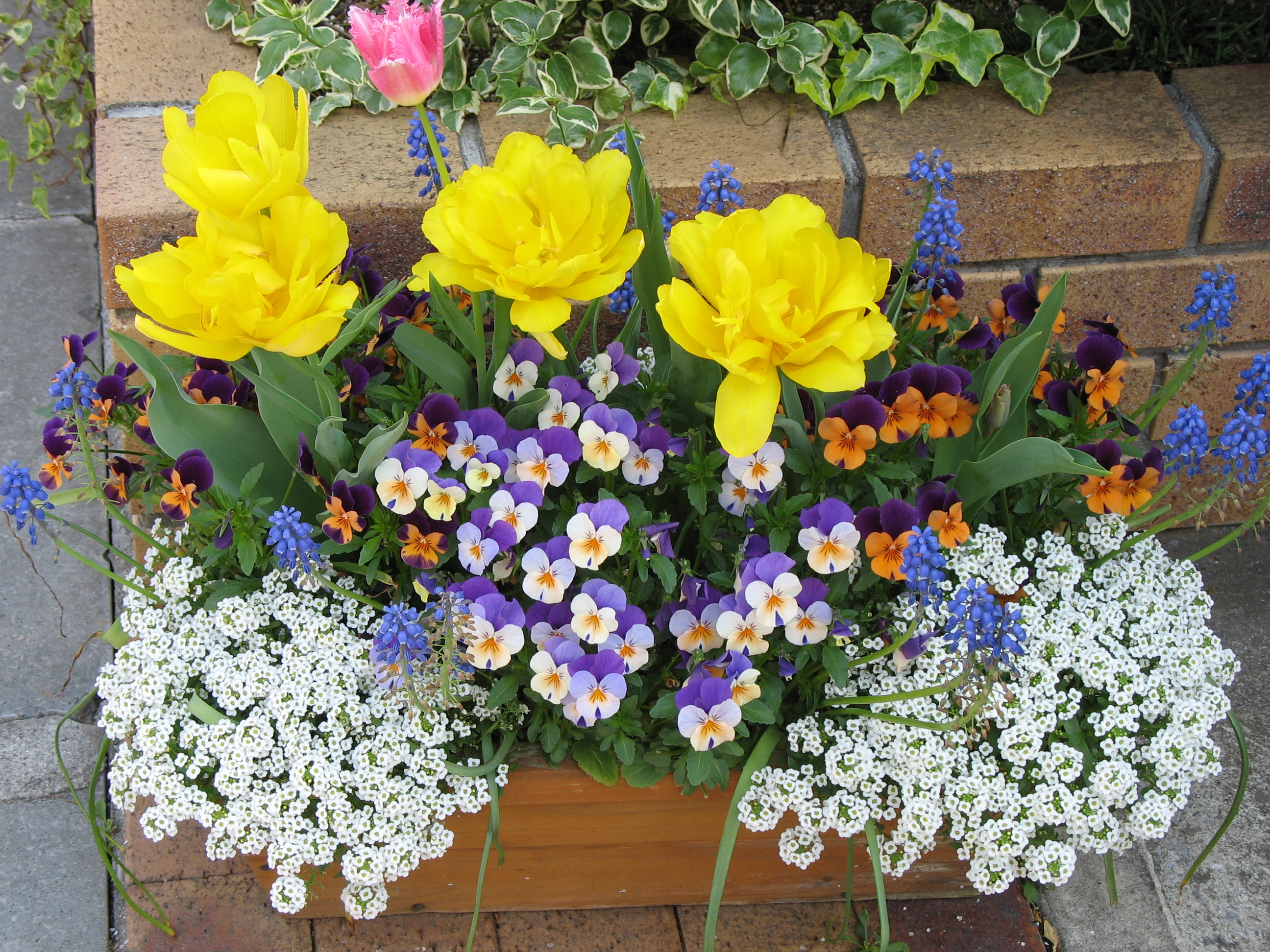
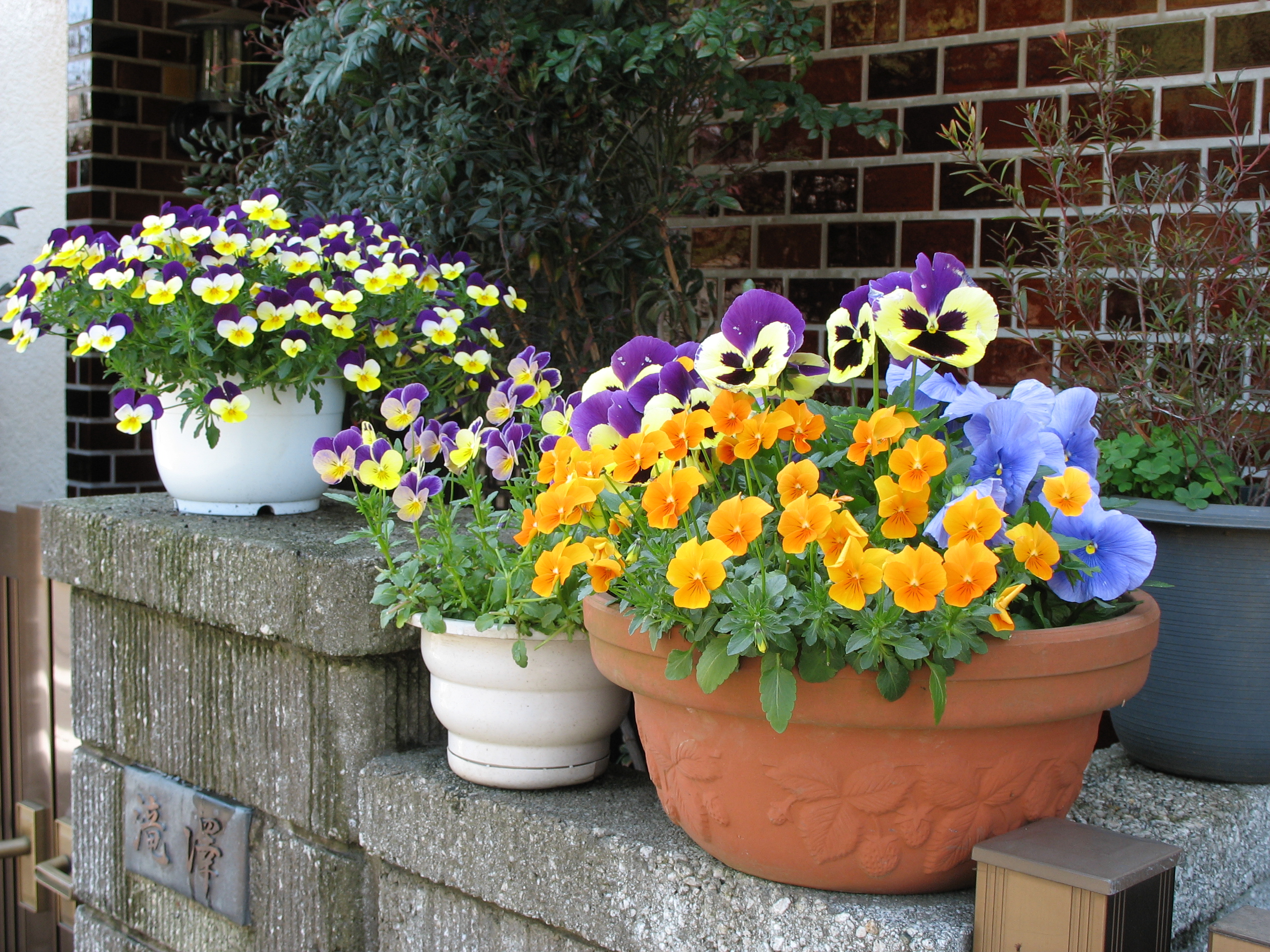
I especially love watching the little lady who lives in the corner house across from us. Whenever the weather allows, she’s outside in the mornings working on her planters and it’s been a delight to watch her flowers bloom. img_0996.jpg Like many elderly Japanese women, she is very stooped over, probably the result of malnutrition during wartime. She can hardly move around but she tends her plants with great care and keeps her yard looking absolutely clean and tidy. She appears to live alone but several women drop by on a regular basis. One, perhaps a daughter, is there most days.

Across from the elderly lady, an old man is often observed out working in his yard. One day I noticed that he was taking a break from gardening and practicing his golf swing. He didn’t have a club in hand but a fellow golfer recognizes that motion! I’m a little worried about him right now though as he has a terrible cough. Walls are thin here and I can hear him from here!

We also love watching the tiny children who gather with their mothers at the corner just down from us each morning to wait for the bright yellow bus that picks them up to take them to preschool. They look absolutely adorable in their little uniforms!

In addition to being able to watch life unfolding around us, there is a definite bonus to living where we do. On a very clear morning, we can see Mt. Fuji from our window!

Our neighbourhood

img_1059.jpgWe love our neighbourhood, a quiet residential area made up of small apartment buildings and private homes. Streets are narrow and buildings are close together but people do have small yards that they tend with great care. The area is safe, peaceful and very clean. Yesterday was a good example. On Tuesdays people put out recyclable cans and bottles for pick up. Sacks are provided for this purpose. Yesterday was extremely windy, however, and the sacks kept blowing over and emptying themselves. As pop cans rattled their way down the street, neighbours scurried out of their homes to pick them up! It was almost comical to watch. I’ve also seen people out sweeping the edge of the street in front of their property, cleaning up leaves and debris that have fallen from their trees. I can’t imagine such a thing happening back home.

Many of the homes in our area appear to be three generational with children, parents and grandparents living together. There are lots of kids in the neighbourhood. In fact, most mornings they’re our alarm clock as they pass beneath our window on their way to the nearby elementary school at about 7:45 every morning laughing and calling to one another. We’ve missed that this week as the school year ended recently. It’s basically year round schooling here, however, so they’ll be back in school next week.

Though our immediate surroundings are very peaceful, there are two train stations, one of our main schools and a busy commercial area all within easy walking distance. There are also two department stores each with a large grocery section less than a kilometer away. We’re fortunate in that two train lines intersect at one of our nearest stations so it’s easy to go in any direction from here.

Last week we acquired a bike from a teaching couple who were leaving to go back to the States. They sold it to us for 2000 yen, approximately $20! We also bought computer speakers from them for 300 yen and they threw in a folding canvas chair, a couple of cushions and a kitchen clock for nothing! I went for my first bike ride today and discovered a great park, also within easy walking distance from here. In fact, it’s right across the street from the post office. We’d seen the ball diamonds before but didn’t realize that they are at one end of the park which also contains tennis courts, gardens, a big playground area and many cherry trees! The park was crowded with people this afternoon and as is the custom at this time of year, many of them were picnicking under the cherry blossoms.

I wasn’t sure how well I’d navigate the bike up some of the hills around here but apparently all the walking this past month has been good preparation. Like most of the bikes here, ours is very basic with no gears but I cruised up the hills with little difficulty!

And now, about the bathroom

As I mentioned a week or so ago, our bathroom deserves a blog entry of it’s own. As is typical in Japanese homes, it’s actually two separate rooms as the toilet is always separate from the bath. Public toilets in Japan vary widely from the traditional squat toilet set into the floor to amazing high tech ones with heated seats, built in bidets and sound effects so that whoever is in the next stall can’t hear what you’re doing. As if they don’t know! After all, what are the options? Our toilet is pretty typical of those found in homes, however. In this day and age when we preach the virtues of water conservation, I really cannot figure out why this invention hasn’t found it’s way to North America. There is a tiny sink built into the top of the toilet tank. When the toilet is flushed, rather than clean water entering directly into the tank, it flows through the spigot into the little sink and is used first for hand washing.

Bathtubs in Japan are for soaking and relaxing in, not washing. Our bathroom is actually a large shower stall containing a short, deep tub and a small sink. One is supposed to shower outside the tub first then climb in to soak. Soap and shampoo are never supposed to be used in the tub. We, however, choose to bathe North American style keeping the water in the tub instead of all over the room.

The tub is only about 3 feet long but it’s significantly deeper than our tub at home so it is possible to enjoy a good soak. For those who enjoy long baths, it has a wonderful feature. At the push of a button, the water cycles through a heater and is warmed up almost instantly! No more having to get out because the water has cooled off.

In order to get hot water in the first place, we have to turn on the gas and the water heater but once that’s done there’s hot water almost instantly and as much of it as you want. The water to the kitchen sink works the same way. The bathroom sink only has a cold water tap but if you need hot water, the hand held shower is close enough to provide it.

img_1077.jpg

A day of contrast

We went to church this morning and what an awesome experience it was! Knowing that the service was at 10:30 but not knowing how long it would take us to get there, we left home early and arrived about half an hour before the service started which was great because a time of prayer and praise started about 10 minutes after we arrived and, though we didn’t understand a word of it, we enjoyed being there. Hope Church is definitely a place where God is present. We felt it the minute we entered.

The service itself was looong! The first hour was praise and worship and we learned that we could sing in Japanese! The words were projected on the wall in both Japanese characters and the Roman alphabet. As Japanese is an easy language to read and pronounce, we were able to join in even though we had no idea what we were saying. It was wonderful! After the announcements were made and the offering was taken, everyone greeted one another and then settled in for the sermon which also lasted about an hour. Headsets provide English translation of the announcements, the reading of scripture and the sermon. Following the sermon, there was another time of prayer before the service came to a close.

We estimated the congregation to be about 200 to 250 people and we were made to feel very welcome. All ages appeared to be represented except for teenagers and that’s only because the large youth group are presently on a trip to Seattle! People come from a long distance to worship together at Hope. Many bring their lunches and eat together in the fellowship hall/foyer after the service. We didn’t know this but in the future, we’ll join them. As all good Nazarene’s know, breaking bread together is a great way to get to know one another.

Hope Church is found in a very unusual location. It occupies one floor of a five storey building and is sandwiched between a bowling alley above and a pachinko parlour below. Pachinko, a pinball type game, is an extremely popular pastime in Japan and a pachinko parlour is basically a Japanese casino.

Following the service, we headed off by train to Narita. Wouldn’t you know it, it started to rain as soon as we got there! Fortunately, it was a light rain and we had our umbrellas in our daypack. We visited Narita-san Shinsho-ji, a huge Buddhist temple and enjoyed strolling through the beautiful park that surrounds it. Apparently the temple is one of the most visited ones in Japan, second only to those in the Kyoto area. It is dedicated to Fudo Myouou, the god of fire, and one of the buildings houses a huge and rather frightening looking figure, presumably Fudo Myouou himself. I couldn’t help but wonder how such a thing could inspire anyone to worship and was saddened to think that the world is full of people putting their hope in things like that. What a contrast from a morning spent with people who so clearly know and worship a living God!

img_1213.jpg