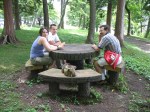
We climbed Mt. Fuji!

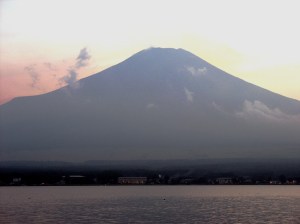
Our schools were closed yesterday and Richard took a yukyu (personal leave day) on Wednesday, which was already my regular day off. That gave us another two day break together which we used to climb Japan’s highest and most famous mountain. Most of the pictures that you see of Mt. Fuji are taken during the winter when it’s covered with snow and truly majestic looking. During the official climbing season, which lasts from July 1 to August 31, there are only small patches of snow. Even so, it’s a challenging climb.

From base to summit, the mountain is divided into 10 stations. These days all but the most die hard climbers start their ascent at one of the four 5th stations which can be reached by road. We arrived at the Kawaguchiko 5th station on the north side of Fuji by bus from Tokyo early Wednesday evening. Traditionally, Fuji is climbed at night. The climber’s goal is to reach the summit at dawn both to see the sunrise from the top and because the views are best early in the morning when the mountain is less likely to be shrouded in clouds. Climbing a mountain in the dark may seem a very strange thing to do but for me, it was perfect. Because all I could see was the part of the mountain that was illuminated by my flashlight, my fear of heights didn’t kick in and dampen my enthusiasm. Had I been able to look down and see what was below me, I’m not sure I could have done it! Instead, I was able to enjoy the stars overhead and when the full moon peaked over the edge of the mountain, I was thrilled.

Mt. Fuji rises 3776 meters (12 388 feet) above sea level. Kawaguchiko 5th station is located just below the tree line at an elevation of 2305 meters. From there, the climb seemed to be made up of three sections. The first was much like a steep but wide gravel driveway switchbacking up the hillside. Next came the serious climbing looking for the best footholds as we made our way up the rock. The route was very clearly marked. In fact, most of the way, it was chained off on both sides so that it would have been very difficult to stray too far in the wrong direction. The last part of the climb was mostly a loose gravel pathway again switchbacking back and forth. Lots of slipping back made upward progress slow.

Timing is important because you don’t want to reach the mountaintop much before sunrise as it’s usually very cold and windy. Even at this time of year, the temperature hovers around the freezing point at night. As on any mountain, the weather can be very changeable so it’s important to be well prepared. Though we had rain capes with us, we were fortunate not to need them. We took plenty of layers of clothing though and were happy to have them when we reached the top. The latter half of the climb was done in a pretty stiff wind. It didn’t bother us too much while we were climbing but we got chilly very quickly when we stopped to rest. The mountain is also high enough for altitude sickness to be a problem. We knew that cans of oxygen were available at the various huts scattered up the mountainside so we didn’t take any with us. Though we did see several people sucking back on oxygen, we decided that the best way to combat the effects of altitude was probably to give ourselves lots of time and to rest often along the way. That seemed to work well. We definitely noticed the shortness of breath as our elevation increased and at one point near the top, I had to stop for a few minutes when I noticed that my heart was racing.

We actually left the 5th station and began our climb earlier than we had originally planned. My research told me that there are several restaurants at the 5th station so we had planned on having a good supper before beginning our ascent. Unfortunately, when we arrived, we discovered that the restaurants were all closed! We were carrying food but didn’t want to break into it just yet so we set off right away and climbed to the first hut where we were able to purchase noodles, chocolate bars and pop. Perhaps not the most nutritious supper but we rationalized that the sugar would give us the energy we needed for climbing!

The climb was definitely more strenuous than we had anticipated after reading in our Lonely Planet guidebook that children and grandparents regularly reach the summit. We would probably have found it considerably easier 25 or 30 years ago! It was fortunate that we started climbing earlier than we had originally planned as Richard’s right hip began to hurt early in the climb and he had to take it pretty slow. With dogged determination, he just kept on going though.  He wore his knee brace, of course, and his bad knee didn’t bother him at all.  I must admit that about three quarters of the way into the climb, I could feel myself wearing out and I did begin to wonder if we’d make it but on we went.

When you’ve gone without hours of sleep and expended a great deal more energy than usual, your mind starts doing strange things. About 2 o’clock in the morning, as I stopped to wait for Richard as he plodded up the path behind me, I began to wonder what would happen if he had a heart attack on the mountainside! It was shortly after that that my own heart started racing so I guess it wasn’t him I should have been worrying about!

Climbing midweek early in the season, the mountain wasn’t overly crowded but we were never alone. Many languages and nationalities were represented amongst the climbers and regardless of whether or not we could understand one another, a sense of camaraderie quickly developed as we passed and greeted one another along the way. We did much of the climb with Blue who is stationed in Okinawa with the American military. We met him on the bus from Tokyo.

We reached the edge of the mountaintop crater just a while before the sky began to lighten and watched the lights of those on the path below us snaking toward the top. Sitting with so many others who had just made the same trek and watching the sun rise above the clouds far below us was absolutely amazing! As soon as the sun was fully up, someone came out of one of the huts and made a loud announcement, in Japanese, of course. I’m assuming that he was greeting the sun. I only recognized subarashi (wonderful, beautiful) and Ohayo gozaimasu (Good morning) which became a cheer rising from all of us, Japanese and non Japanese alike. It is a beautiful memory that will stay with me for a long time.

The actual summit or highest point of the mountain was located on the far side of the crater. Reaching it would have involved another hour of hiking before beginning our descent. We knew that our bodies didn’t have that in them, so like most others, we chose not to take that final step. It was only a few meters higher than the spot where we were standing and we had seen what we came to see.

When you’ve climbed to the top of a mountain, you’ve made a very serious commitment. Regardless of how tired and sore you are, you have to climb down again! For most of the way, there is a separate trail for descending Fuji. While it looks much easier, I’m not sure that it is. For me, the first challenge was overcoming my fear of heights. For most of the way, we descended on a wide gravel pathway. In my head, I knew that there was no way that I could fall off the mountainside from such a trail but the fear riding on my shoulder didn’t listen to reason and for the first while I was unable to enjoy the splendor laid out before us as the morning cloud cover burned off. After awhile though, I was able to shake it off and enjoy the sight. The descending trail was made up of a loose red gravel that reminded me of popcorn. It was very slippery and steep enough that keeping your footing and not landing on your behind was at times difficult. We found descending hard on the knees and I also began to experience cramping in my thigh muscles. It was also very dusty. Our eyes were pretty sore last night both from the lack of sleep and the grime. In spite of these difficulties, the descent still took less than half the time that the climb had taken.

When we got home, we cleaned up and walked over to our local hospital just a few blocks away. Fortunately, our visit had nothing to do with the climb nor was either one of us sick or injured. Before leaving Canada, we decided to have the immunizations that are recommended before traveling to some of the Asian countries that we hope to visit while we’re on this side of the globe. In Canada, the hepatitis A and B vaccine is given in three doses. We were able to have the first two before leaving the country but the third is given several months later so we planned to have it here. We’ve learned, however, that Japan only gives two doses. The doctor here decided to check our blood for the antibodies then decide whether or not we need more of the vaccine so we went to the hospital yesterday for the blood tests.

After supper at a nearby restaurant that we’ve been wanting to try, we fell into bed earlier than usual last night and both enjoyed a long, deep sleep. In spite of somewhat stiff and achy leg muscles and joints, we’re upright and walking fairly normally today and are definitely enjoying the fact that we’ve accomplished yet another long term goal!

We survived parents’ week!

The past week has been a tiring one because our children’s classes had parents’ day. Since each class meets only once a week, this went on for the entire week.

Parents’ week stress actually started several weeks ago because we were required to hand in parents’ day lesson plans to our school administrators ahead of time for their approval. The due date for these plans was originally set for June 27th but at our weekly staff meeting during the second week of June, we were told that this date had been bumped up to the 18th and we had no choice but to scramble and get them done in a rush. The reason that we were given for the sudden change was that this would give administration time to help those new teachers whose plans weren’t adequate. As I expressed at staff meeting, suddenly giving me six days to complete a job that I thought I had fifteen days to do wasn’t likely to be helpful at all!

In addition to the stress of having to hand in our plans early, we were also expected to spend plenty of time in recent weeks prepping the kids for parents’ day instead of moving forward with our teaching but at the same time, we have a certain amount of work that has to be completed by the end of term! Is it any wonder that we get frustrated with our employer? On the other hand, I keep reminding myself that MIL is my ticket to being here in Japan. This is definitely where I wanted to be and that hasn’t changed so I try to remain as positive as possible.

I feel that most of my parents’ day classes went well, though it was usually very difficult to judge the parents’ reactions as they sat very quietly and showed very little reaction to anything that happened. I did have one class today where the parents responded with laughter and obvious appreciation. Perhaps that’s because it was Saturday and there were fathers in attendance. They seemed more relaxed than the moms and it didn’t hurt that the kids in that class are very young and very cute.

On the other hand, one of my littlest and cutest students is Mahiro. I call him my little boyfriend because every Monday he meets me in the reception room at Katsutadai school, takes me by the hand and leads me upstairs to our classroom. He’s absolutely adorable. There are only two children in that particular class. The second child is Hana, a little girl who is just as sweet, but she didn’t show up for parents’ day. Poor little Mahiro was on his own with an audience made up of his mother, grandmother and older sister. Though he left his shyness with me behind many weeks ago, that was too much for him and he never said a word out loud the entire class! He did everything I asked of him but would only whisper!

There are CDs that go along with each of our children’s textbooks. Often the kids are asked to listen to the CD and repeat what is said. In one of my classes this week, the CD stuck. I didn’t even know a CD could do that but it just kept repeating “their…their…their” over and over again! The kids dissolved in fits of giggles, the tension in the classroom was broken and things went smoothly from then on! There are also silly songs on the CDs that use familiar tunes to reinforce the vocabulary that we’re teaching. After practicing for weeks on end, I know, without a doubt, that some New Year’s Eve, I’m going to hear Auld Lang Syne and what will be going through my head is “Whose keys are these? Whose keys are these? Whose keys are these? They’re mine!”

Anyway, we’re glad it’s over and are happy that parents’ week happens only once a year. As we sip our wine and relax this evening, we look forward to tomorrow. Sunday, our favourite day of the week!

Lights down, awareness up

With climate control and carbon dioxide emissions as one of the major topics on the agenda for the annual G8 summit meetings which are taking place in northern Japan this week, the Education, Science and Technology Ministry has been calling on Japanese households to join in a new “Tanabata Light Down” event this evening. The message has been spread primarily through primary, middle and high schools throughout the nation. For this country to achieve the emission reduction targets set out under the Kyoto Protocol, household emissions, which have been rising dramatically, have to be cut. Some estimates suggest that if every home in the country turned off their lights for two hours, greenhouse gas emissions could be reduced by 15 000 tons, equivalent to the amount of emissions from one million households in a 24 hour period.

The idea is not an entirely new one. In 2003 the Environment Ministry began calling on people to turn off their lights for two hours from 8 p.m. to 10 p.m. on the summer solstice each year. As the Japanese people are very aware of and concerned about the issues of climate control and emissions reduction, many have already been taking part in that event. This year the decision was made to introduce the July 7 event as well to coincide with the G8 summit.

With the exception of the bathroom lights, we have fluorescent lighting throughout the apartment. The kitchen is lit by an overhead light fixture as well as one over the sink. The other two rooms have overhead fixtures that each have three settings. On the brightest setting, two circular tubes are lit. On the lower setting only one of them is lit and on the lowest, a tiny night light bulb provides just enough light to prevent one from stumbling in the dark. It’s now just a few minutes past 8 p.m. and as I look out the windows, I still see plenty of light coming from homes around the neighbourhood and I’m not one to get overly excited about this issue but I’m going to do my part by keeping the lights on the lower setting and using only the light over the sink to cook by this evening. Trying to cook in complete darkness would be foolhardy. If I can figure out a way to light the candles that we were given as promotional gifts by a shoe store where Richard bought a pair of sneakers, perhaps we’ll also eat by candlelight tonight. We don’t have any matches though so that could be tricky!

Tanabata

July 7 is Tanabata in Japan, a day for making wishes and hanging them on bamboo trees.

Tanabata is based on a legend that goes something like this. A long time ago, Ten-kou, the god of the sky had a daughter called Orihime who spent her time weaving cloth for the gods. Ten-kou was worried because his daughter did nothing but work every day so he introduced her to Hikoboshi Kengyu, who spent all his time taking care of cows. When they met, they fell in love and soon spent all their time together. As a result, all the cows became sick and when the gods’ clothing wore out, there was no new cloth to make more. This made Ten-kou very angry so he took Orihime away to the other side of the river Amanogawa (the Milky Way) and wouldn’t allow the lovers to meet anymore. This made them so sad that they were unable to work. Eventually, Ten-kou felt so sorry for them that he decided to allow them to meet once a year on July 7 as long as they worked hard the rest of the year. Traditionally people hoped that the sky would be clear on that day so that the lovers could meet over the Milky Way. If it rained, the water level of the river Amanogawa would rise and they would be unable to cross. Originally people made this wish by writing it on a piece of paper and hanging it on a bamboo tree. Nowadays, people write their own wishes instead. Though adults sometimes participate, these days it is largely an activity for children.

When the Tanabata tradition came up for discussion in some of Richard’s adult classes this week, he was told that this weekend there would be a Tanabata festival on the street where our closest MIL school is located but we didn’t know when or where. We worked yesterday and went to church today. As usual, we stayed for lunch and visited for quite awhile after church then did a bit of shopping before heading for home. We didn’t really consider trying to take in the street festival because we thought it was likely a midday activity and that we had probably missed it. Since we’d had a big lunch after church and it was such a warm day, we decided to forgo cooking dinner at home, pick up a few goodies at the bakery and go to the park for a picnic supper. Before we headed out, I felt prompted to take the camera with us. At first, I ignored the thought but as we were leaving, I once again felt that I was being told to take it. I’ve learned to listen to these promptings and so it went into the bag.

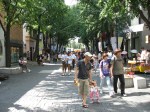
After picking up our dinner at the bakery, we headed for the park but as we got close, we could see bright lights and crowds of people a little further up the street. We decided to investigate and soon found ourselves in the middle of the Tanabata street festival! For several blocks, booths were set up along the sidewalk. Games of chance and booths selling all sorts of ready to eat foods were the main attractions. The sidewalk was a slow moving river of humanity. Many of the young girls were decked out in yukata (summer kimono) and everyone was in a festive mood. We quickly decided that our bakery goods would last until tomorrow and filled up on okinomiyaki, which might best be described as a Japanese omelet, and takoyaki, balls of batter covered octopus.

One of the side streets was blocked off and in the intersection, a musical group featuring a young female singer with a beautiful voice was entertaining the crowd. Though her pronunciation was somewhat difficult to understand, she was singing English songs. When she started into the Tennessee Waltz, we couldn’t resist the urge. Spotting an open space behind the group, we slipped into it, dropped our bags and enjoyed a dance before sliding back into the crowd and continuing on our way!

Palm trees and ocean breezes

Over the past few years, thanks mostly to my friend Louis, I’ve truly become a prairie girl but regardless of how many years go by, time can’t take the ocean out of my blood. As a child, I went to sleep to the sound of the waves and to this day, there is nothing I find more relaxing. The past two days at Nojimazaki on the southern tip of the Bozo Peninsula were truly subarashi (wonderful)!

We left home at 7:00 a.m. Wednesday morning, took the train to Chiba and went the rest of the way by bus arriving at Nojimazaki shortly before 11:00. Much of the trip reminded me of driving through parts of B.C. As we drove through forested hills, even the roadside signs reminding drivers to watch for wildlife looked familiar except that the animals depicted on the signs were monkeys! As we neared the southern coastline, however, the forest gave way to stately palm trees and other tropical looking plants.

Though there are some sandy beaches, the coastline is mostly very rocky and rugged. Immediately across from our hotel was Nojimazaki Park, a beautiful promontory jutting out into the ocean and topped by the Nojimazaki lighthouse. We arrived several hours before check in time at our hotel but were able to drop off our bags and begin exploring right away. We started with the lighthouse, climbing the 77 stairs that spiral upward followed by two ladders with twelve steps each. When we stepped out onto the viewing platform high above the ground, I was delighted to discover that, with a metal railing reaching nearly to my chin and spectacular views spread out before me, my usual fear of heights didn’t bother me at all! After touring the lighthouse, we spent many hours beach combing, examining tidal pools and enjoying the sights and sound of the surf. A favourite spot quickly became a bench perched high on the rock far out on the point where a marker indicated that we were looking directly south and were at the spot from which the sun could be seen both rising and setting over the ocean. We couldn’t read the Japanese script on the marker but a couple who were just leaving as we arrived at that spot for the first time, offered to take our picture there and also explained, mainly through gestures, what the significance of the spot and the marker were. Later in the afternoon, we spent an hour exploring further along the shoreline by bike and in the evening, after dark, we returned to the park again so that I could see the stars. Standing under the beam from the lighthouse as it swept across the water and passed over our heads was so very cool!

We were the only non Japanese staying at our hotel and we were treated like royalty. Thanks to our friend, Minako, who phoned ahead to confirm our reservation and alert the staff to the fact that we don’t speak Japanese, there was someone at the front desk when we arrived who was able to greet us in English. We had reservations for the 7:00 p.m. sitting at dinner and again, we were greeted by name and a waitress who spoke a little English was hovering nearby, obviously awaiting our arrival.

The dinner buffet was fantastic. We started off with a wide variety of salads as well as appetizers of raw fish. Though we both prefer the texture of fish that’s been cooked, we can also enjoy it raw. Next we filled our plates with more seafood and all sorts of meats, vegetables and things unknown. There were so many choices that we couldn’t possibly try everything but we did make sure we had some of the seafood and vegetable tempura that was being cooked as we served ourselves. Dinner wrapped up with a variety of little desserts including a delicious mango pudding. Breakfast the next morning was another buffet and included scrambled eggs, tiny sausages, fruit and a variety of breads as well as many salads and other foods that we were unfamiliar with.

Since Japan is known as the land of the rising sun and this was likely the only opportunity I would ever have to watch the sun rise over the Pacific Ocean, I set the alarm clock for 4:10 a.m. hoping to catch the sunrise from our hotel balcony. Amazingly, I awoke very suddenly from a deep sleep at 4:09, exactly one minute before the alarm was due to ring! Unfortunately, there was just enough cloud that I couldn’t actually see the sun break over the horizon but I did watch the clouds turn pink and then slowly fade to bluish gray before heading back to bed for a few more hours sleep.

After breakfast we walked the shoreline again watching with fascination the many, many locals far out on the rocks harvesting baskets full of sea life, presumably seaweed and shellfish though they were too far away for us to know for sure. Others came and went in small fishing boats.

In spite of the fact that this is supposedly rainy season, the weather was superb. The morning clouds burned off by noon and even though I used sunscreen, I came home with a bit of a burn especially on my neck and arms.

Travel planning – Hope Church style

Our school is closed this Wednesday.  By me taking Thursday, which is Richard’s regular day off, as one of the five yukyu (personal leave days) that I’m entitled to over the course of the year, we get a two day break together.  We decided to use it for a seaside getaway.  Funabashi is located at the upper end of the Boso Peninsula across the bay from Tokyo.  After asking around, we decided to go out to the far end of the peninsula but since that isn’t a usual destination for foreign tourists, finding hotel information in English was a problem.

I mentioned this to my friend, Minako, at the regular ladies meeting at church on Wednesday morning and she offered to help.  She promised to seek out a nice, inexpensive place for us to stay and bring the information to me at church this morning.   She chose what appears to be the perfect spot, a beach front hotel at the very end of the peninsula.  After church, she used one of the church computers to go online and make our reservation.  We’ll have a traditional Japanese room with bath, most likely with an ocean view.  The price of 12 100 yen (about $120) includes a Japanese buffet supper as well as breakfast the next morning and free bicycle rental to explore the area!  The hotel also has an onsen so we’ll probably enjoy the public bath experience again.  In addition to hotel information, Minako also brought us information on both bus and train transportation to and from the resort.

There’s every likelihood that the staff at the hotel won’t speak any English but I’m not worried.  My comfort zone is getting bigger and bigger every day and if something does go seriously wrong, I have Minako’s cell phone number.   We are so blessed to have friends like her.  I can’t quite imagine what our Japan experience would have been like if we hadn’t found Hope Church!

Summer?

In spite of the fact that it’s definitely warm enough, it doesn’t really feel like summer to me. I think there are two main reasons for that. The first is year round schooling. While our compatriots at home are rejoicing over the end of the school year and the long summer holiday stretching out before them, we will continue to teach.

The Japanese school year begins in early April and ends in late March with only a week or two between. They have a few days off in early May for Golden Week, a summer vacation in August during which many students attend cram school and a two week winter vacation over Christmas and New Years, much like the one we get at home. In addition, there are several one day national holidays. Though ours is a private language school, it follows the regular school schedule quite closely except that we only have a one week vacation in August. We work some of the national holidays but two compensation days were added to our Golden Week vacation and we get other days off in lieu that adjust the schedule so that each of our regular classes occurs the same number of times over the course of a year.

The other reason that this doesn’t feel like summer is because there are no long summer evenings like the ones we’re accustomed to in Canada. Since our latitude is between that of San Fransisco and Los Angeles and Japan doesn’t practice daylight savings time, the sun rose this morning at 4:26 a.m. and set at exactly 7:00 p.m. On Saturdays we only work until 7:00 p.m. so I actually walked home in twilight tonight but we usually work until 8:30 or 9:00 and come home after dark. I understand that the Prime Minister of Japan is in favour of instituting daylight savings time which I think is an excellent idea.

Though this really doesn’t seem like summer, it also doesn’t seem to be the rainy season that we’d been told to expect. In fact, there was more rain in May which is supposed to be one of the nicest months here than there has been in June, the first month of the rainy season. I’m not complaining though! We’ve seen enough rain to last us a very long time!

Different beginnings

There are two very special little boys in my life, Andrew and Ayumu, but I have yet to meet either one of them. Andrew, my first grandchild, was born in Canada on May 1st and I knew that I wouldn’t meet him until my year in Japan is over. Ayumu, on the other hand, was born here in Japan on June 14th, just in time to make his father the newest and possibly the proudest Daddy in church on Father’s Day morning.

I went to church this past Sunday hoping that my friend, Seiko, and her wee son might be there. It was then that I began to learn about the differences between giving birth in Canada and in Japan.

My daughter, Melaina, gave birth to Andrew at 4:21 in the morning and took him home around noon the following day. Because he was her first baby, she was required to stay in the hospital for his first 24 hours. Had he not been her first, she would probably have gone home later the day that he was born. Japanese women are absolutely astonished to learn this. Here, the mother and baby stay in the hospital for about a week.

Andrew was born on a Thursday and was in church that Sunday morning, hence my expectation that I might see Ayumu this past Sunday. He was, after all, eight days old by that time. It was then that I learned that after leaving the hospital, the Japanese mother retires, often to the home of her parents, where she spends the next couple of weeks resting in bed while family members care for the baby. She doesn’t usually go anywhere for the first month of her baby’s life. Wow! Personally, I think that sending new mothers and babies home within the first 48 hours is too hasty but a month of going nowhere! I’d have gone absolutely mad!

Even though he arrived two weeks before his due date, Andrew was a robust 8 pounds 1/2 ounce at birth. Japanese babies are only measured in grams but if I’ve done my math correctly, Ayumu, who arrived a week after his due date, weighed about 6 pounds 11 ounces. That’s considered an average birth weight here. Japanese mothers are encouraged not to gain much weight during pregnancy and low birth weights are preferred.

The naming of babies is another interesting cultural difference. Japanese babies are given only one name so Ayumu is Ayumu, plain and simple. Andrew, on the other hand, has three given names. He is Andrew David Richard. Like our oldest son, his middle names were given in honour of his two grandfathers. The Japanese find this custom very peculiar. The meaning of the Chinese characters used to spell a baby’s name are very important here. Ayumu’s name means “a walk with God”. How wonderful! I find this especially interesting because when Seiko and I talked about names before she and her husband, Atsuo, had chosen one for their son, I told her that though the meaning of names doesn’t have much significance to most North Americans, Janina, Matthew, Nathan and Melaina’s middle name, Jean, all mean “gift of God”.

When I finally do meet Ayumu, I’ll have the chance to use my newest Japanese word, kawai. Sounding almost like Hawaii except beginning with a k, it means cute. As I proudly showed off photos of Andrew, as all good grandmas do, I heard the word over and over again. It didn’t take long to figure out what it meant!

Deuteronomy 29:5

Before we came to Japan, I was under the impression that I wouldn’t be able to find clothes to fit so I was careful to make sure that I had enough to last the year if necessary.  As it happens, however, I’ve already bought a pair of pants, a skirt, two tops and a couple of hats!  Imagine that.  Hats!  I come from a family of big-headed people and I can’t usually find ladies hats to fit in Canada but here I’ve bought two; one for winter and one for summer!

Shoes are another matter, however.  I would have to search far and wide to find a pair to fit me.  It’s really quite unfortunate as there are so many cute shoes here.  Shopping could be such fun!  On the other hand, it’s easier on the budget this way and I do have to think about how much I can carry home.

I brought five pairs of shoes, a pair of sandals and a pair of flip flops with me.  That sounds like enough to last a year but considering how much walking we have to do and the fact that it’s all on pavement, I wonder if it will be.  I have two pairs of dressy flats that are suitable for wearing to school with skirts and capris.   The dress code doesn’t allow me to wear sandals.

After just a few trips to school and back, the heels of my black flats were completely worn down so today I paid a visit to the shoemaker in the corner of one of the local department stores.   Once again, I discovered how easy it can be to communicate my needs without a common language.  I indicated what I wanted done, he wrote down the time that I should come back and within an hour, my shoes had new heels and he’d even polished them for me!   The funny part of the whole thing is that I paid more to have the heels replaced than the original cost of the shoes!  Replacing the heels cost 1155 yen (approximately $11.50) which doesn’t seem at all unreasonable but I distinctly remember buying the shoes on sale at Zellers for only $9.00!

I’m more concerned about my other black shoes, the ones I wear most often because they’re very comfortable and look good with dress slacks.  They have thick rubber soles that will never wear out but I hope the shoes themselves stand up to a year of pavement pounding, especially considering how often they get wet.  They’re an inexpensive Payless purchase but I’ve had wonderful success with Payless shoes in the past so I have high expectations for these ones too.

I’m often reminded, as I wonder whether or not my shoes will last, that during the forty years that the Israelites wandered in the wilderness, their sandals never wore out.  I’m not wandering in the wilderness but, like the Israelites, I’m definitely in a place where I can’t replace my footwear so I’m counting on the same care from above!

No more pineapple

I’ve been bothered by some kind of irritation in my mouth for the past month or so and was beginning to get quite concerned about it because I really don’t want to have to go looking for a dentist or a doctor while I’m here. I tried rinsing twice a day with a mouthwash which seemed to help a bit at first but it definitely didn’t get rid of the problem.  I finally started to wonder if it was caused by something I’ve been eating.  Yesterday, the light bulb finally went on!  We’ve been eating pineapple for breakfast almost every day. Could that be the culprit?  Considering the fact that my daughter is allergic to pineapple, I’m surprised I didn’t think of it sooner.  Last night I did a Google search on mouth sores & pineapple.  The results were quite amazing. Article after article mentioned the relationship between acidic fruits and mouth sores and pineapple was almost always first on the list!

This is definitely an unfortunate development because not only do I really like pineapple but it’s also one of the cheapest fruits available to us here.  In fact, we’ve recently been able to buy a whole pineapple for approximately the same price as a single apple.  I’m quite delighted to buy a pineapple for 198 yen (less than $2) but I’m definitely not willing to pay that much for an apple!   Fortunately, both oranges and kiwis have come down in price recently.  I’ll have to be careful about the number of oranges I consume, however, as they’re also very acidic.

Apparently it’s possible to neutralize the acid in pineapple by soaking it in water with a very small amount of vinegar but I’m not that desperate and the pineapples that we’ve been buying recently haven’t been nearly as sweet as the ones that were available when we first arrived.   Those would have been much harder to give up.

Of course, it’s too soon to know for sure that pineapple is, in fact, the cause of my mouth sores but since mouths tend to heal quickly, I’m hoping to have a definitive answer within a few days.   In the meantime, no more pineapple!