Now that we’re home and the internet has been connected, it’s time to do some catching up. On Feb. 25, we moved out of our little apartment and flew to Hong Kong for one last Asian experience before returning to Canada.
Promoting itself as Asia’s world city, Hong Kong is clearly one of the world’s most international cities with a population of over 6.9 million people. It is made up of Hong Kong Island, Kowloon on the mainland side of Victoria Harbour, the New Territories to the north of Kowloon and many, many outlying islands.
Once a British colony, Hong Kong was returned to China on July 1, 1997 and is now a Special Administrative Region of the People’s Republic of China operating under the “one country, two systems” principle.
In spite of it’s large population, Hong Kong is a compact city with an excellent and inexpensive transit system. We stayed with friends in Pokfulam on Hong Kong Island. Their apartment block was located next to a major hospital which is at the end of the line for the minibus routes that run down into Central Hong Kong and to the piers. This made it very easy for us to get wherever we wanted to go.
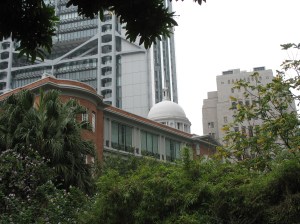
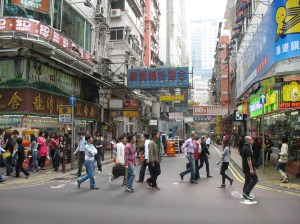
My pedometer died several months ago so I have no idea how far we walked but I’ve definitely come to the conclusion that this is the best way to see a city. We spent our first day wandering the Central and Western Districts. What a fascinating mix of old and new, traditional and ultra modern! We walked tiny streets lined with shops selling dried seafood and Chinese herbs and just a few short blocks away we strolled past exclusive high end shops like Gucci and Georges Armani. We saw old colonial structures such as the former French Mission building that now houses the Hong Kong Court of Final Appeal and St. John’s Cathedral, the oldest Anglican Church in the Far East, as well as many modern skyscrapers.
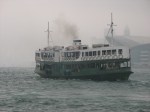 Crossing Victoria Harbour on the Star Ferry is a must for tourists visiting Hong Kong. Though the upper deck is slightly more expensive, I much preferred the lower deck where we rode with the locals and felt the ocean spray on our faces. On the Kowloon side, we strolled the seaside promenade and the Avenue of the Stars where plaques, handprints and statues celebrate Asian screen celebrities. We walked up busy
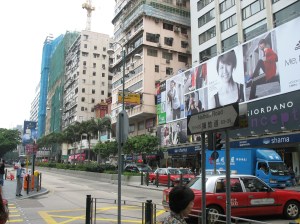 Nathan Road and wandered through Kowloon Park. We also took the MTR (Hong Kong’s light rail transit) further into Kowloon to visit the Yuen Po Bird Garden and the nearby flower market. The fascinating bird garden with its stalls selling caged birds, bird cages and every accessory imaginable, is also a gathering place for elderly men who come each day with their prized birds to enjoy the fresh air and the sound of the birds. The flower market, a colourful area with a stunning array of fresh blooms and potted plants, is the centre of the wholesale and retail flower business in Hong Kong.

Sunday was an interesting day. After attending Union Church with Tess and the children, we walked to nearby Hong Kong Park where the kids enjoyed the excellent playground and Richard got plenty of exercise pushing them on the swings. Another walk through Central proved very interesting as it seems that the entire Filipino population of the city floods into the area on Sundays. Most are domestic workers and Sunday is their day off. Some of the streets are closed to vehicles so that they can spread out blankets on the pavement and congregate together to eat and visit. We rode the top deck of one of the double decker trams, another tourist must, from Central to Kennedy Town then “raced” home. Tess and the boys went by taxi while the girls went by minibus with Richard and I. The minibus team won by about two minutes!
 Yet another must while in Hong Kong is a visit to the Peak overlooking the city. Though the weather was unusually warm while we were there, it was also very cloudy. We waited hopefully for a clear day to visit the Peak. When it was still misty and overcast on our second last day and the next day’s forecast looked even worse, we decided that time was running out and we’d better go even though conditions were far from ideal. (It was a good decision as our final day was rainy and we spent most of it indoors touring the excellent Museum of History.) First came a seven minute ride on the Peak Tram, Asia’s oldest funicular. At times, the incline was so steep that the city’s buildings looked like they were tilting! At the top, we enjoyed the views from the Peak Tower (though they would have been much more spectacular on a clear day), checked out a few of the shops, and enjoyed a delicious, though somewhat pricey, lunch in one of the restaurants. We did a bit of hiking around the Peak itself before beginning our descent via the Pukfulam Country Park trail, a steep path leading to the Pokfulam reservoir. Continuing alongside the reservoir, it eventually led us out onto Pokfulam Road not far from where we were staying.
Were we looking for another interesting place to settle for awhile, I could certainly see us choosing Hong Kong. It’s a dynamic city with a unique blend of Eastern and Western culture where one can manage very easily with only English. For the time being, however, we’re content to settle back into the quieter life of rural Alberta. Now, if I can just get this house back in shape!
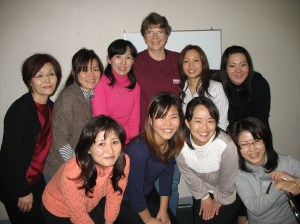
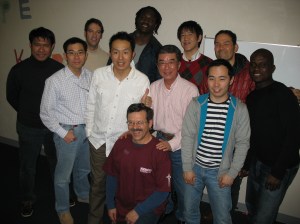
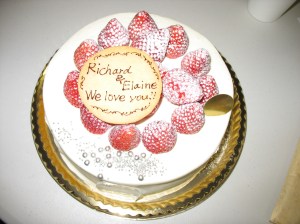 Though the gift of their words was the most meaningful to us, they also had a beautiful farewell cake for us and showered us with flowers and gifts including Hope Church t-shirts. We are so blessed!