An “aha” moment

LogoThis week I had an epiphany, a true “aha” moment.

Every time I’ve looked at my face in the mirror lately, especially without makeup, I’ve been unhappy with what I saw. My skin looks like parchment, the colour is uneven, and then there are those wrinkles, especially around my mouth! Thankfully, my glasses make the worry lines at the inner ends of my eyebrows less noticeable!

IMG_20201209_121129894

I’ve never been one to worry about trying to look younger than I am and I’m not about to go the way of Dolly Parton who’s had so much plastic surgery that even she admits to looking artificial, but I really didn’t like what I was seeing.

Then I read Alyson Walsh’s blog post about 1980s model, Jeny Howorth, modelling again at age 56, and I looked at these photos of her.

201119-jeny-howorth-liberty-sleepwear-4-1000x1417

Photo: Liberty

jeny-howorth-sundaytimes-prod-web-bin-df2406a2-63b3-11ea-8022-13d7c8930f6d-1000x1250

Photo: Sunday Times Style magazine

I looked more closely at her face and that’s when I had my “aha” moment!

There were the same wrinkles that I see on my own face, but when I looked at her I saw beauty and character!

Why are we women so hard on ourselves? Why do we dislike in ourselves what we barely notice in other women? Why do we fail to see in ourselves things that we appreciate in others?

I do take care of my skin. I use a cleanser at bedtime every evening and I moisturize both morning and night. I’m 68 years old and I’ve earned every scar and every wrinkle! From now on, when I look in the mirror I’m going to stop looking at flaws and remind myself that mine is simply a face with life written on it. I also need to remember that a smile goes a long way toward lighting up a face and minimizing lines around the mouth!

IMG_1742 - Version 2

So much anger!

We’re living in a very angry world, or so it seems to me. Everywhere we look, whether in person or on social media, people seem to be protesting or venting their anger. First it was the shutdowns, then masks, and now the prospect of a vaccine that isn’t even available yet.

Calgary-COVID-protest-Nov-28-20204

Calgary, November 28, 2020 – Global

What is really behind all this anger? It’s clearly a response to what’s going on in the world around us, but why so much anger? Why are so many people lashing out at one another and at those in positions of authority? I think it’s much more than being asked to wear a little piece of fabric over their mouth and nose or the thought of having to have an injection.

There are many different emotions that might result in anger, but anxiety, sadness, fear, frustration, disappointment, and worry are some of the most common triggers and who amongst us hasn’t experienced some of those feelings in recent months? Add to that the fact that we feel like we’ve lost control of our lives. Things that we’ve always taken for granted, like spending time with family, have been taken away. For many, the things that they’ve trusted in, things that have given them a sense of security, have also been swept away. Some have lost jobs, others have had to close businesses. Some are still working, but feeling isolated at home. In addition to all of this, with the incredible amount of false information and fear mongering being spread by irresponsible “news” sources and keyboard warriors, it should be no surprise that undiscerning people are being sucked into the swirling maelstrom of fear and anger that surrounds us. The virus is everywhere. There isn’t even anywhere we can go to escape!

Unfortunately, anger is one of the most divisive and destructive forces on the planet. It’s a poison that spreads with astonishing speed; faster perhaps than Covid itself. It turns crowds into mobs, inflicts deep wounds, and crushes the human spirit. Plus, it does absolutely nothing to alleviate the crisis that we all find ourselves in.

Anger itself isn’t the problem; it’s what you do with it. First of all, let’s look at what NOT to do.

Don’t be a spreader! Don’t spread the virus, don’t spread misinformation, and don’t spread anger.

Don’t spread the virus. Whether or not you fully agree with the measures that have been recommended or mandated in your area, suck it up and cooperate. Wear the mask, stay 6 feet (2 metres) from other people, and whenever possible, stay home. We’re all in this together. The sooner we really start working together to limit its spread, the sooner we’ll have any hope of reclaiming some of the things that we’ve lost. 

Don’t spread false information. The internet is awash with misinformation, much of it deliberately intended to mislead and to stir up fear and anger. Don’t add to the noise! Check your facts before passing something on. Chances are that your neighbour down the street or your friend from high school doesn’t know as much about epidemiology as the experts do. The lack of respect and support for doctors, scientists, and other health professionals during this pandemic is nothing short of astonishing. There is plenty of evidence to show that masks do make a difference and no, they aren’t harmful to your health. There are very, very few people who have legitimate reasons for not being able to wear one and those people should be staying home because they clearly have other issues that put them at high risk. Yes, the vaccines have been fast tracked, but that doesn’t necessarily mean that they’re dangerous. They’ve been through the same rigorous testing as any other vaccines, but because of the urgency of the present situation, they weren’t allowed to bog down in bureaucratic red tape the way things usually do.  

Don’t spread your anger. Denying that you’re angry or keeping it bottled up inside isn’t healthy, but taking it out on an unsuspecting cashier who’s simply attempting to do her job in trying circumstances doesn’t make the situation better. Neither does waving a protest sign or ranting on social media. 

So what CAN we do with our anger? What SHOULD we do? 

  • Think before you speak, post or repost.
  • Find constructive ways to express your concerns clearly and directly to the right people without trying to hurt or control anyone. This might include asking questions in an attempt to seek out the truth and understand the reasons behind measures that are being recommended or mandated.
  • Take a break. That might mean taking a self-imposed time out from social media or getting outside for some fresh air and exercise.  
  • Practice relaxation. Listen to music, write in a journal, do a few yoga poses or some deep breathing exercises… whatever works for you.
  • Pray. Pray for wisdom, understanding, and grace. Pray for those in positions of authority who are daily faced with making incredibly difficult decisions. 
  • Do something positive for someone else. Instead of writing that Facebook rant, why not write a note of encouragement to someone? Instead of attending a protest rally, look for an opportunity to volunteer in your community. 
  • Know when to seek help. If your anger feels out of control, reach out to a mental health professional. 

I’m as eager as the next person to see this pandemic come to an end, but I’m equally anxious to see us pull together and rise above the overwhelming flood of anger that threatens to crush us all. 

Why accessorize?

download

Accessories are the finishing touches that can take an outfit from drab to dramatic. They also add versatility to your wardrobe enabling you to create many different looks with the same basic outfit. Almost any outfit will benefit from a few carefully chosen accessories, but think beyond jewelry to watches, scarves, belts, shoes, handbags, gloves, and hats. These days even masks are accessories that can complement an outfit.

Accessories are an opportunity to express your personal style, taste, and preferences. They can add a pop of colour to an otherwise neutral outfit. Accessories can also draw attention to your finer points and away from those you might not want to accentuate. For example, a short necklace and statement earrings will draw the viewer’s eye to your face and away from your bust while a long necklace will make you look taller and leaner than you really are. In addition, some accessories have sentimental significance and add a feel good aspect to getting dressed. This could be something you’ve received as a gift or something you picked up while traveling. In my case, I also have a few pieces of jewelry that belonged to my mother. Rather than storing them away for safekeeping, I like to wear them occasionally.

Choosing which accessories to wear can be intimidating, so let’s look at a few tips from the style experts.

  1. Think of your outfit as a blank canvas. What does it need to enhance it? For example, is the neckline very plain and simple? Perhaps it needs a necklace or a scarf to fill it in.
  2. Create balance by giving centre stage to one dominant piece and adding more subtle accessories as supporting characters. For example, if you’re wearing a statement necklace, choose earrings that won’t compete for attention.
  3. Keep the proportion of your accessories appropriate to your body. If you are petite, you can still wear fashion jewelry, but smaller scale pieces will enhance your outfit rather than overwhelm or distract.
  4. Wear what suits your personality and makes you feel comfortable. Several months ago, a reader shared a quote from an O. Douglas novel that really resonated with me. “When you’re sure your clothes are right you can forget all about them. When you’re wrongly dressed you’re miserably aware of it all the time.” The same is true of accessories. If something makes you feel self-conscious, don’t wear it.
  5. Keep your accessories appropriate to the occasion. For example, you might wear the same little black dress to the office, to a funeral, and to a New Years Eve party (though maybe not this year!) but each circumstance would call for different accessories. The glitzy pieces that you might choose for a special evening event would be totally out of place in either of the other two situations.
  6. For a modern look, coordinate your necklace and earrings rather than matching them. The matchy-match look will immediately make you look dated. If you have a matching set, you don’t have to stop wearing them. Simply break them up. Wear the earrings with a scarf or a different necklace that has a similar “flavour” or feel. Do the same with the necklace.
  7. My last suggestion would be to store your accessories in such a way that they’re organized and easy to see. Unfortunately, I haven’t mastered that yet and I’m often found trying to untangle necklaces from one another! If and when I figure out a method that works well, I’ll share it on the blog. How do you organize and store your accessories?

Logo

Where do you find comfort?

If there was ever a time in most of our lives when we craved comfort, this is probably it. The combination of the upcoming holiday season + a worldwide pandemic is bound to be stressful. For many of us, the shorter, darker days of winter add to our feelings of disquiet. It’s a universal human trait to seek comfort when life becomes difficult, but where do we find that comfort? What do we turn to?

You’ve probably heard people refer to their “Quarantine 15”. In a poll of more than 1,000 WebMD readers, nearly half of the women and almost one-quarter of the men said that they had gained weight since March. This trend is no surprise. Food is one of the most common sources of comfort that people turn to in times of stress. There’s even a physiological reason for this. Chronic or ongoing stress causes the body to produce higher levels of the stress hormone, cortisol, which in turn triggers cravings for salty, sweet, or fried foods; foods that produce a burst of energy and pleasure.

Thankfully, this hasn’t been an issue for me. In fact, in times of distress I tend to lose my appetite. One of my main go tos for comfort is a cup of hot tea which is known to lower stress hormones. Since I drink my tea black, it has the added benefit of being calorie free.

tea-mugs-250x250

Soaking in a hot bath is another favourite source of comfort for me. There’s something about being surrounded by liquid warmth that soothes away anxiety and restores a sense of peace. Perhaps it’s reminiscent of returning to the womb! 

What are some other ways that you can comfort yourself, especially if you’re trying to avoid stress eating? Here are a few suggestions, but I’d love to hear your ideas in the comment section. 

  • Exercise. This one might be challenging if gyms and recreational facilities are closed in your area, but it goes hand in hand with the next suggestion. 
  • Spend time outdoors. 
  • Listen to music.
  • Do something creative… paint, sketch, knit, crochet, sew, embroider… the options are almost endless.
  • Keep a gratitude journal.
  • Practice mindfulness. Focus on whatever you’re doing at the moment. Notice the sights, sounds, and scents that surround you. 
  • Escape into fiction. Watch a movie or read a book. 
  • Work on a jigsaw, crossword, or sudoku puzzle.
  • Savour the routines in your life. If life seems chaotic, work on establishing some routines and focus on the comfort that you receive from that first cup of coffee in the morning, a regular devotional or prayer time, a few minutes of quiet reading or contemplation after work.  

We are living in tumultuous times and there seems to be no end in sight. We can’t see the big picture and have no idea how all this is going to work out for us individually or globally, but there is One who does know. Ultimately, true comfort is to be found in faith in God. Scripture is full of words of comfort. 

2 Corinthians 1-3-4

How to wear a sweater dress

LogoSweater dresses are a big hit this winter, perhaps because they’re so incredibly comfortable. If there was ever a year when we craved comfort, this has to be the one! I was fortunate to find this one on sale while doing some Christmas shopping recently. I bought it in midnight blue. 

Tall boots and sweater dresses are a very trendy look. They’re often shown with bare legs, but that doesn’t work in our climate, so I’m wearing mine with leggings. Since the boots are dark brown, I chose navy blue leggings rather than adding a third colour.  

IMG_1876

For a slightly edgier look, I switched the tall boots for a pair of black ankle boots and added a pair of cozy knit socks in almost the same shade as the dress.

IMG_1864

As far as footwear is concerned, almost anything goes with a sweater dress. In the remaining photos, I’m wearing a pair of flats, but the possibilities range from stilettos to sneakers. Come spring, I might try wearing the dress with bare legs and one of these pairs that both reside in my closet.

Some knits are loose or chunky and hide your figure, so cinching them in with a belt can be flattering. The heavier the knit, the wider you can go with the belt. Mine is a finer knit, so it looks best with a narrow belt. I’m not sure that it’s my best look though as it emphasizes the fact that I don’t have a very girlish waistline!

IMG_1877

Today’s photos aren’t as clear as I would have liked, so it might be a bit difficult to see that my dress has a split neck. In the next photo, I’ve buttoned it up to form a turtleneck. I haven’t worn turtlenecks much since my extensive neck surgery six and a half years ago because I haven’t found them comfortable, but this one was loose enough and soft enough not to bother me.

IMG_1886

As always, accessories complete a look. The finer the knit, the easier it is to dress up. The V created by a long necklace is flattering and elongates your look. Scarves are another way to enhance an outfit. This worked well enough with my turtleneck, but might look even better with a crew neck or V neck. 

IMG_1897

With Covid numbers escalating rapidly in our province and everyone being urged to stay at home, I probably won’t be shopping again for awhile, but I definitely wouldn’t mind adding another sweater dress to my wardrobe. They’re so versatile!

Who is the enemy?

One of the most valuable lessons I’ve learned about dealing with conflict in a relationship is the idea of standing shoulder to shoulder and attacking the problem together instead of face to face and attacking one another. If we all applied this principle to the fight against Covid-19, I think we’d have a much better chance of successfully containing the spread and minimizing the long term effects of this dreadful pandemic.

unnamed

The first step in fighting this battle together is identifying who or what is the enemy and perhaps even more important, who is NOT the enemy. The enemy is not the government, the public health authorities, or Bill Gates. The enemy is not 5G and it certainly isn’t your Facebook friend who thinks that Covid-19 is a hoax!

The enemy is a virus; a submicroscopic infectious agent that invades living cells and uses their chemical machinery to stay alive and to replicate itself. It doesn’t care whether or not we believe it’s real. It doesn’t care what our political views are, whether we’re young, old, or in-between, or if we’re good at math. It just needs an available host.

We can exhaust ourselves arguing about whether or not we should be wearing face masks and using hand sanitizer. We can wave protest signs and refuse to follow recommendations and requirements. We can spread rumours and accuse one another of all sorts of heinous things, but the virus doesn’t care! As long as we’re standing face to face and fighting with one another, it will simply continue its insidious attack. It will kill more of our elderly and vulnerable. Some of its victims will get off easy, but others will suffer long term physical and mental harm.

OR we can stop attacking one another and stand shoulder to shoulder against a common enemy. We can admit that we’re all in this together and that there are no quick fixes or easy answers. We can temporarily put aside our personal preferences and stop rebelling against every measure that is put in place to try to protect us.

header

How to care for your hands and nails during Covid

LogoThe cold, dry air of a Canadian prairie winter is always hard on exposed skin, but this year we have more than that to contend with. Constant hand washing and sanitizing might protect us from Covid, but it’s wreaking havoc on our poor hands!

I spent last weekend in the city on my annual Christmas shopping trip with three of my closest girlfriends. At the entrance to every store, we had to stop and use the hand sanitizer that was provided. On Monday, I was back in the city again as my hubby had a medical appointment. Before heading for home, we stopped to do a bit more shopping and, of course, more hand sanitizing. By Tuesday, four very brittle fingernails had broken and the skin on the back of my hands was stinging! It felt like I’d burned them! 

070716_handsanitizer_THUMB_LARGE

Alcohol-based hand sanitizers with a minimum of 60% alcohol are recommended for combatting viruses including Covid-19, but frequent use can lead to dryness, itching, cracking, and even eczema. Clearly, good hand and nail care is going to be more important than ever this winter.

Here are a few tips to help:

Wear gloves while doing anything that might irritate your skin such as washing dishes and cleaning house. 

Use hand sanitizer only when soap and water are not available. 

Stay well hydrated. In addition to other health benefits, drinking plenty of water helps prevent your skin and nails from drying out. 

Lock in the moisture. Keep your hands hydrated by gently drying them with a clean towel after washing and then, while they are still slightly damp, immediately apply a moisturizer. Work some of it into your nails to keep them from cracking, splitting, and breaking. If your hands are already irritated look for fragrance free products and ones that are formulated for sensitive skin. 

When you use hand sanitizer, apply a moisturizing cream or ointment immediately after the sanitizer dries. If you’re spending the day shopping, this may not be possible every time you enter a store, but carrying a travel sized lotion in your purse and applying it occasionally throughout the day will help prevent the distress that I suffered earlier this week. 

Rehydrate hands overnight. Apply a hand cream just before you go to bed at night and give very dry hands an overnight treatment by applying a heavy cream or petroleum jelly and wearing cotton gloves while you sleep. If you don’t have cotton gloves, a pair of socks will do. 

images

With Covid numbers steadily increasing, it looks like this is going to be a winter like none other, but hopefully with a bit of extra care, we can get through it with healthy, beautiful hands. 

4003270_f520


Digging deeper!

LogoNow that winter has arrived, challenging myself to wear skirts and dresses to church every Sunday has resulted in me digging much deeper into my closet. Last Sunday morning, the temperature was -10ºC (14F), a strong wind was blowing, and it was snowing. Clearly, dressing warm was a priority. 

IMG_1855

I started with a camel coloured pencil skirt that I bought in early 2013, just before we left for a teaching term in China. Named for it’s long, slim shape, a pencil skirt is a timeless garment that never goes out of fashion. It’s a basic wardrobe piece that many different outfits can be built around. In addition to this one, I have navy and grey pencil skirts that both date back to my teaching days. 

I wore the same tall brown boots and patterned top that were part of last week’s outfit. Though only barely visible in the photo, I wore a pair of dark brown leggings under the skirt, partly for warmth, but also because the skirt wasn’t quite long enough to cover the top of my boots and I didn’t want a sliver of bare skin breaking up the look. Next, I added my cozy Checkmate Jacket from cabi’s Fall 2019 collection which you’ve seen on the blog a couple of times before. 

IMG_1858

Costume jewelry can be a fun and inexpensive way to finish off an outfit. The name dates back to the early 20th century and simply reflects the use of the word “costume” to refer to what we now call an “outfit”. To complete Sunday’s “costume”, I chose a pair of dangly earrings and a simple bead necklace. The beads are made from coconut shell. We spent the summer of 2011 as short term missionaries on the Pacific island of Saipan and it was there that I purchased the necklace from a Chamorro woman who made them to sell to tourists. The Chamorro are the indigenous people of the Northern Mariana Islands. 

Now that winter has arrived, I’m not sure that I’ll continue wearing skirts and dresses to church every week, but it’s been fun digging deeper into my closet and coming up with new ways to style some of my older pieces. 


NET Cancer Day 2020

net-cancer-awareness

Once again, today is Worldwide NET Cancer Day, a day set aside to try to increase awareness of neuroendocrine (NET) cancers and to promote improved diagnostics, treatments, information, care and research. The focus of this year’s campaign is to highlight the challenges that patients and clinicians face around the early diagnosis of NETs.

A recent worldwide survey of NET patients showed that only 27% of them received a correct diagnosis the first time around. 44% of us, myself included, were misdiagnosed for several years before the correct source of our symptoms was discovered, often by accident. Globally, it has been taking 5 years on average from initial symptoms to diagnosis; 6 years here in North America which was also my experience.

122537054_3583258601716994_7578317130403807428_o

I’m part of the 36% who were initially diagnosed with gastritis, inflammation of the stomach lining. It was a GP who made that diagnosis based only on my symptom, a gnawing abdominal ache. I don’t fault him for that as NET cancer usually presents symptoms that mimic much more common ailments. Had we done a colonoscopy, however, the tiny tumour growing in my cecum would likely have been found before the cancer spread. It was several years later, when unusual spots on my liver showed up on a completely unrelated ultrasound, that suspicions were raised and I eventually learned that I had Stage 4 cancer! By that time, my symptoms had grown to include chronic diarrhea as well as occasional flushing and episodes of tachycardia (extremely rapid heart rate), all common characteristics of NET cancer.

There are 3 As that would significantly improve the outcome for many NET patients:

  1.  Awareness of symptoms  –  We need health care professionals at every level to be aware of this complex disease and to be able to recognize its symptoms. My family physician had been practicing medicine for approximately 20 years when I was diagnosed, but I was his first NET patient and he knew very little about it. I’ll never forget the locum who argued with me that neuroendocrine tumours aren’t malignant (some aren’t) and that I didn’t actually have cancer at all! 
  2.  Availability of diagnostic tools  –  The most precise tool for detecting NET cancer is the Gallium 68 PET scan, but I have never had one. In fact, only 18% of the surveyed patients worldwide have. It isn’t available at many cancer treatment centres. For the past few years, there’s been talk of one coming to the Cross Cancer Institute where I receive all my care, but as far as I know it hasn’t happened yet. 
  3.  Access to NET specialists  –  In the survey mentioned above, 24% of the patients had not even heard of a NET cancer specialist and many others travel long distances to see one. 

So, every year on November 10, and whenever I have the opportunity in between, I’ll do my bit to raise awareness, never giving up hope that eventually better diagnostics and treatments will be available to all NET patients and that ultimately a cure will be found!

unnamed

What’s the story?

IMG_1788

This is what I wore to church last Sunday. Before the service began, a friend who reads my blog regularly told me that she liked my skirt and asked if there was a story behind it. That got me thinking and I quickly realized that my closet is full of stories. Today I’m going to tell you how I put this outfit together and the story behind each piece.

Since our church reopened in early July, I’ve made a point of wearing dresses and skirts on Sundays so this outfit started with the skirt which has been in my closet for more than thirteen years. I don’t remember exactly when I bought it, but that’s how long I’ve been retired and I know that it dates back to my teaching days. It’s funny the things that stand out in your memory, but I distinctly remember wearing it to a district wide teachers’ event when it was new. I don’t recall where I was prior to the event or what I was doing, but I do remember arriving at the venue with my outfit for the evening in a bag and slipping into the ladies room to change!

When I decided to wear the skirt to church, I knew that I’d be wearing it with my tall, dark brown boots. They were a lucky find at our local thrift store early last winter when the pair that I’d been wearing started to leak. The closest shoe store is an hour away, so I was very fortunate to find a suitable replacement in my size in our small store.
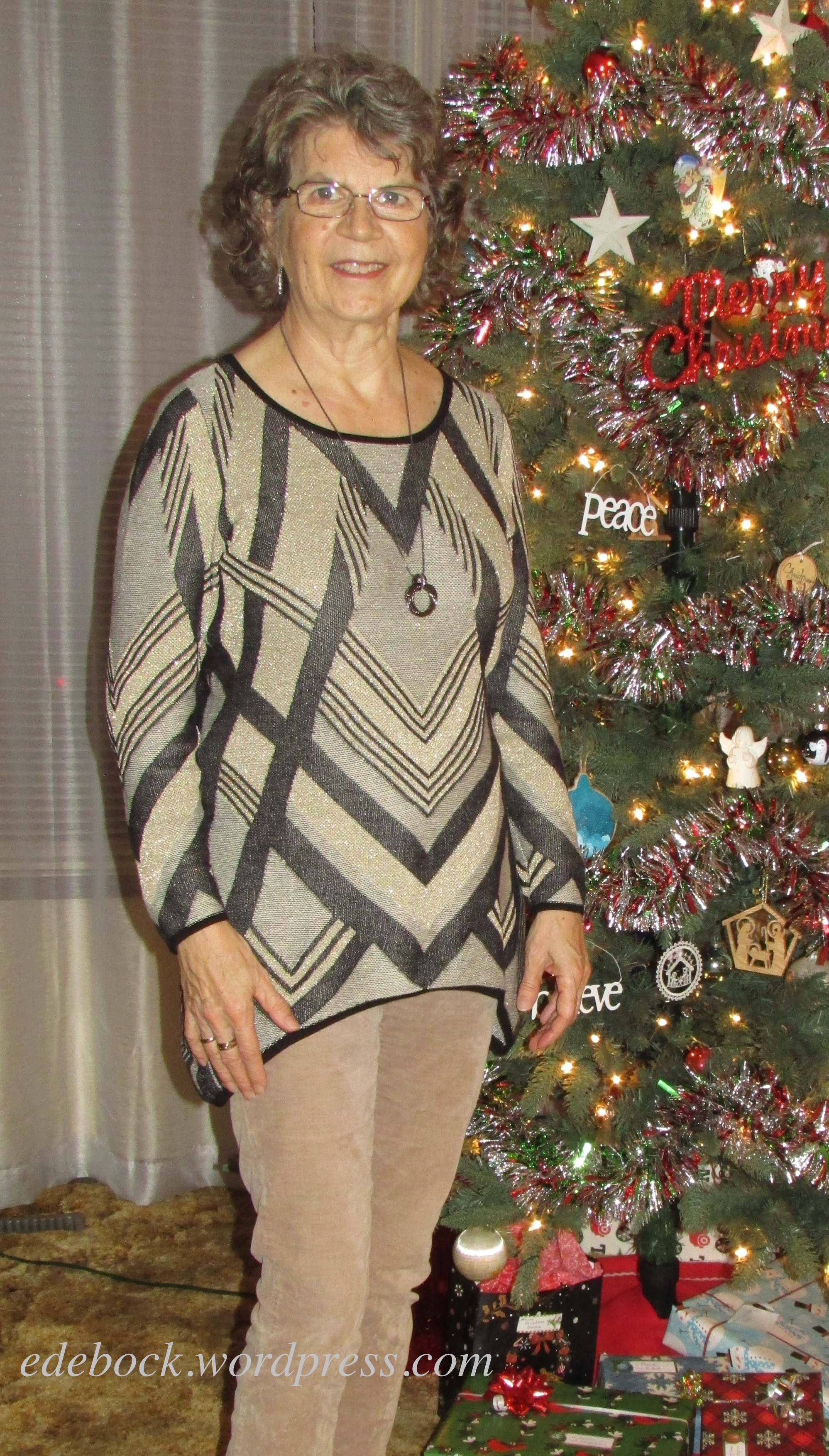
Next, I had to decide what to wear on my upper half. I decided that the sleeveless patterned top would add a bit of visual interest. It was purchased last November while I was on my annual Christmas shopping weekend in the city with several close girlfriends. In the 18 (soon to be 19) years that we’ve been making this trip, I’ve missed only two of them. In 2008 I was living in Japan and in 2013 I was isolated in a lead lined room at the Cross Cancer Institute.

It’s chilly in Alberta at this time of year, so I clearly wasn’t going anywhere in a sleeveless top without something over it. Would you believe that I tried on five different toppers before I finally settled on this one? It was given to me by my very generous sister-in-law several years ago and is one of those well loved pieces that remains in my closet even though I don’t wear it very often anymore.
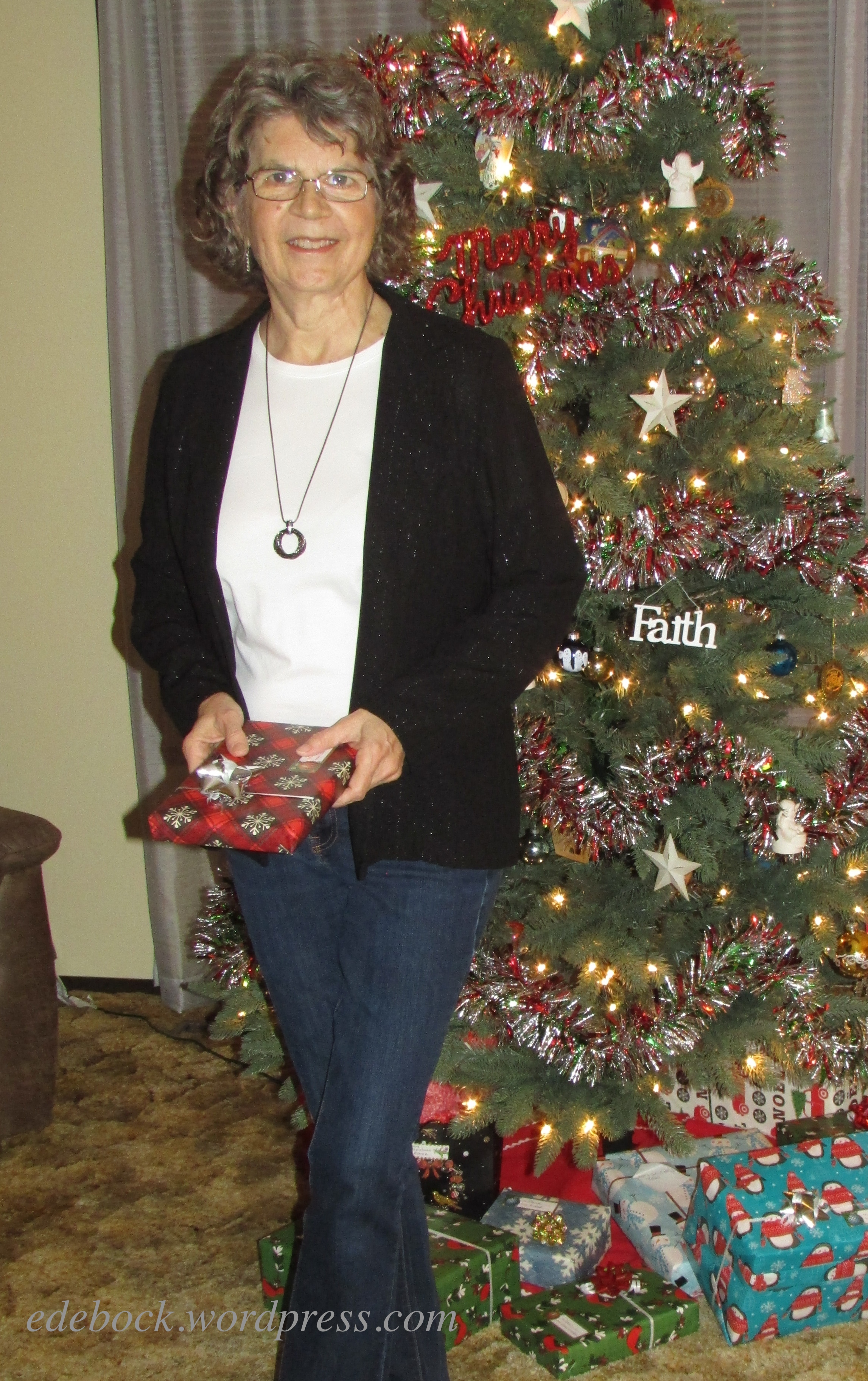
Accessories put the finishing touches on any outfit and the necklace that I chose to wear with Sunday’s outfit has a very special story.

IMG_1835

I was a young teenager in the 1960s when my aunt visited a friend who was teaching in Japan and brought the necklace back for me. Over 50 years later, it’s now considered vintage. (Perhaps I am too!) The back of the pendant is stamped with the name, Amita, a Kyoto company that started selling damascene jewelry like this in 1932. Damascene is made by etching an intricate design into oxidized metal and then pressing gold and/or silver metal into the chiseled design. The images on Japanese damascene are usually either pagodas or floral designs like this one. I have worn mine over and over throughout the years and it still looks as good as it did the day I received it.

Are there any stories in your closet? Why not share one of them in the comment section below.

Logo