September is safety awareness month in Japan so the focus of this week’s staff meeting was school safety. As Richard says, it looks like our best bet in terms of fire or serious earthquake is to pray that we don’t experience either one! Like most buildings in Japan, neither our schools nor our apartment are equipped with smoke detectors. None of the classrooms are at ground level. Most are on the third or fourth floor, often accessed by very narrow stairways, and none have proper fire escapes. There are rope ladders to use in the case of an emergency but I don’t want to be the teacher who has to convince a class of frightened five or six years olds to climb down one of those to the pavement below!
The instructions in case of a fire are much the same as they would be at home. Remain calm, account for all students, leave personal belongings behind, close doors and windows if possible, and relocate to a designated meeting area away from the school. Earthquake instructions are much the same but also include turning off gas and electrical appliances to prevent fire and watching out for falling objects and broken glass. While the building is still shaking, it’s advisable to take cover under a table or to stand inside a door frame. Bathrooms are also sturdier than most other rooms so they are considered good places to wait out a quake. Opening a door or window is recommended as once a building shifts, people are sometimes trapped inside because they can’t get the doors open. Fortunately, Japanese schools conduct earthquake drills, much like the fire drills that we’re familiar with at home, so the students are well acquainted with what to do should one occur.
At this time of year, the biggest safety concern is typhoons. A typhoon is the same thing as a hurricane. These are strong tropical cyclones with winds of up to 180 miles an hour and heavy rainfall. Typhoons that hit Japan are often accompanied by damaging high tides and landslides are also a serious concern. Schools generally close during a typhoon but our general manager doesn’t see fit to close MIL. Of course, teachers cannot always get there because trains often stop running and traffic comes to a standstill. Does this sound familiar to any of you Battle River teachers?
The good thing about typhoons is that they move slowly and there is always plenty of warning when one is on it’s way. When we see our neighbours securing or taking in all the movable objects from their yards and balconies, we’ll know there’s a typhoon coming. Our apartment is equipped with metal shutters to cover our large windows and keep them from shattering and the glass in the smaller windows is reinforced with wire. Some of our classrooms have large windows that don’t have shutters but there are places within each school where we could move the students during a severe storm so that they would be safe from flying glass. Japanese buildings are not well sealed (which helps explain how the insects get in) so leakage around windows and doors is also common during a typhoon.
So, does all this have me shaking with fright? Not at all. We knew that Japan was a land of earthquakes and typhoons before we left the relative safety of the Canadian prairie but I believe that this is where we’re meant to be and that we will weather whatever storms may lie ahead. Just think of the stories we might have to tell!
 Reconstruction has been ongoing since 1990 but the structures that are standing today are impressive and palace guards in period costumes added to the atmosphere.
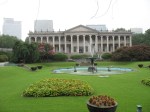 within the walls of a Korean palace. This huge stone structure with it’s European style rose garden and beautiful fountain looks quite startling surrounded by traditional Asian buildings.
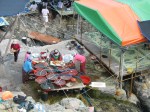
 also visited the Shinsaegae department store, the city’s oldest and definitely one of it’s finest. What a contrast! From the noisy, crowded market where much of the activity takes place in the street to the opulent department store where name brand items are tastefully displayed in spacious surroundings. Of course, the prices are just as different and so are the food venues – from street vendors selling both raw and ready to eat foods to an entire floor of classy restaurants.
 Our visit to Seoul also included a subway ride to Samneung Park to see some uniquely Korean royal burial mounds, a couple of hours at the National Folk Museum and a visit to Namsan Park, the upper portion of a small mountain in the centre of the city. We rode a cable car up into the park then ascended the Seoul Tower by elevator. From the observation floors, we enjoyed views of the enormous city spread out below us.


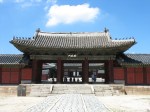 Our first full day in Seoul was especially memorable. After breakfast, we caught a bus to Changgyeong-gung, one of the three palace complexes that we visited. Though many of these historical buildings were destroyed by the Japanese at various times throughout history and have since been rebuilt, the throne hall at Changgyeong-gung escaped destruction and is said to be the oldest building of its kind in Korea. Much work has been done in recent years to restore the rest of the palace complex to its original state. The buildings were very similar in design to many that we have seen in Japan.
 Royal Ancestral Shrine where two long buildings house memorial tablets for many former kings, queens and other royal family members. Jongmyo is considered the most important shrine in Korea and one of its two main buildings is the longest traditional wooden building in the country. Once a year, in early May, a ritual Confucian ceremony is held here. During this six hour rite, special food and wine are offered to the spirits of each of the departed kings, ceremonial recitations are spoken and traditional musicians and dancers perform. A video presentation gave us a glimpse of that.
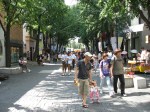 handmade lamp that we both fell in love with. We enjoyed lunch in a tiny, authentic Korean shop in Insa-dong. It was here that we first tried a popular Korean dish called bibimbap. Though we found much of the Korean food to be too hot for our liking, this dish was very tasty.
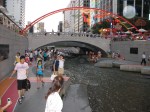 fountains, stepping stones and historical bridges it is clearly an asset to the city and drew many people on this hot summer afternoon! We decided to walk along it as it led in the general direction that we needed to go. What an amazing experience that turned out to be. At one point, we heard drumming
  in the distance and soon came across a colourful group of street artists
 performing traditional music. We sat and listened for awhile before continuing on to the end of the waterway where we discovered that the Korean Olympic committee had set up a huge TV screen, a stage where a live band was performing and even a huge electronic Olympic flame! As darkness fell, we joined the large crowd that had gathered there and watched the Korean women’s archery team win the gold medal! What a moment that was, complete with fireworks! The square rocked with loud music and cheering. It was a wonderful privilege to share that moment of national pride with the local people gathered there. Eventually, we moved on, stopping for a quick supper along the way. A little later, we once again heard music in the distance and were drawn to Seoul Plaza, an open grassy space in front of city hall. There we caught the finale of an open air symphony concert complete with vocalists and dancers!


 Following Augustine