We had a bit of misadventure on the way to our final destination for this trip this morning. We were supposed to change trains in Ludwigshafen, but somehow missed our stop. We were the only passengers to get off at the next stop, a small deserted station with no one on duty to provide assistance. Thankfully, a kind gentleman who spoke perfect English (a rare thing in this part of Germany) happened to be passing by and stopped to ask if we needed help. Since we knew that we’d be too late getting back to Ludwigshafen to make our connection to Mainz, he suggested that we go back two more stops to Mannheim, a much bigger centre where we’d have a better chance of catching a different train to Mainz. That worked perfectly and we were only about an hour later arriving than originally planned. In the words of Shakespeare, “all’s well that ends well!”
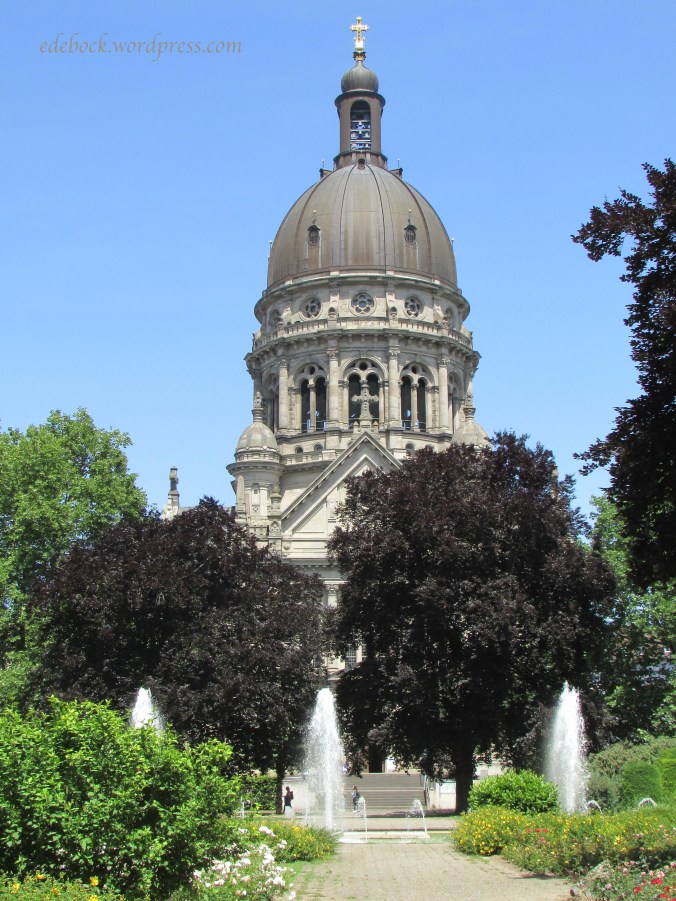
Our hotel here in Mainz is directly across from the train station. After checking in, we walked about 15 minutes to the riverfront promenade. On the way, we passed Christuskirche (Christ Church), a prominent Protestant landmark. Built between 1897 and 1903, it was destroyed during World War II, and rebuilt between 1952 and 1954.
After walking the riverfront promenade and dipping our feet in the Rhine River, we headed for the Gutenberg Museum.
We haven’t spent a lot of time in museums on this trip, but one that is devoted to the history of books, printing, and writing captured my interest and I was particularly interested in seeing the Gutenberg Bibles. The Gutenberg Bible was the first European book published on a printing press using moveable metal type. Only 49 of the approximately 180 that were printed right here in Mainz in the mid 1400s have survived and the museum owns two of them. Well, technically, one and a half. The huge Bibles were printed in two volumes, Old Testament and New Testament. Previously owned by the British Baronet Shuckburgh, the complete two-volume Bible was added to the museum’s collection in 1978. The second Bible, which was previously owned by the Solms-Laubach family, is incomplete, with only the second volume surviving.

The Bibles were only printed in black ink as two or more colours would have been too expensive and time-consuming. Spaces for coloured ornamentation were left empty and the books handed over to an illumination workshop. As a result, each surviving edition is different in its ornamentation.
 Following Augustine