World Cancer Day 2025: United by Unique

February 4 is World Cancer Day. There are more than 200 different kinds of cancer and every patient’s experience is different. That’s why the new World Cancer Day theme, United by Unique, resonates so strongly with me. While each of our stories is unique, we are united in our message and in our desire to raise awareness and see progress made in fighting this dreadful disease. 
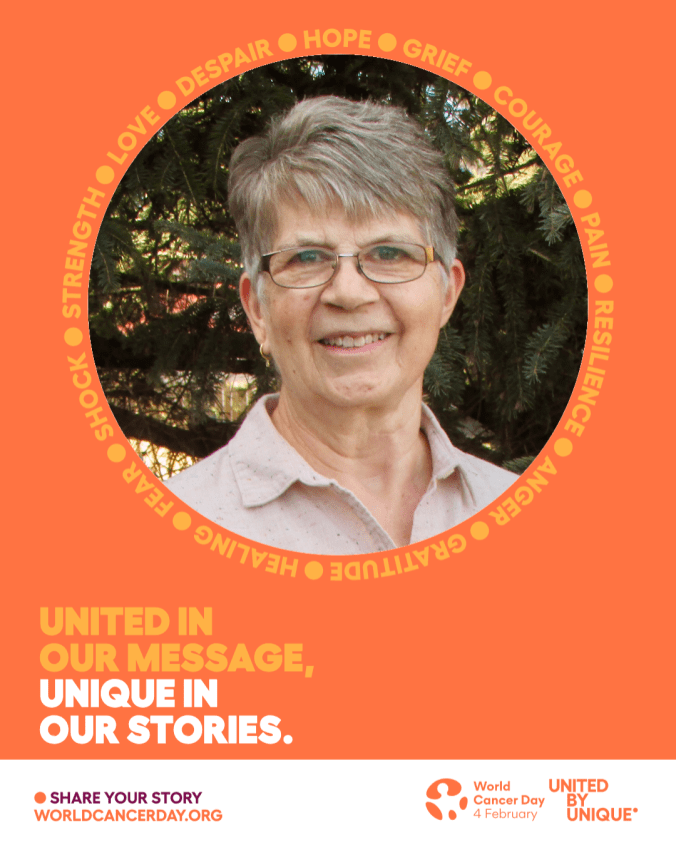
The emphasis of the 3-year United by Unique campaign that kicks off today will be people-centred care. Behind every diagnosis lies a unique human story. These are stories of grief, pain, healing, resilience, love and so much more. A people-centred approach to care that listens to patients’ stories and fully responds to each individual’s unique needs with compassion and empathy will lead to the best possible outcomes.  

People living with cancer don’t always feel heard, seen, or understood. They are often bewildered, feeling isolated and voiceless at a time when they’re also learning to navigate an unfamiliar and confusing health care system and dealing with the emotional highs and lows of cancer diagnosis, treatment, or recovery. That’s why the first year of this campaign will focus on telling our unique stories.

I feel very fortunate to receive my cancer care at the Cross Cancer Institute in Edmonton, Alberta, Canada, a facility where it is common practice to look beyond the patient to the person as a whole and to consider the impact of their cancer on all aspects of their life. When I go for appointments, I’m routinely handed a clipboard with a questionnaire that delves into not only the physical symptoms that I might be experiencing, but also the psychosocial ones. The CCI offers a wide range of supportive services that go far beyond the patient’s physical well-being. The health care team there includes professionals in psychology, social work, spiritual care, nursing, and psychiatry and available services include individual, couple, and family counselling; professionally-led support groups; and practical supports for financial and other basic needs. While the need for these supports has not been part of my unique story thus far, I’m glad to know that they’re available should I ever need them and I wish that that was true for patients everywhere.  

I have been invited to share my unique patient story at a Canadian Neuroendocrine Tumour Society (CNETS) conference in May. The big challenge is going to be condensing the approximately 20 years from initial symptoms to present day into a 10 minute talk that educates, encourages, and inspires those in attendance, especially those who are in the early days of their journey and who need to know that it’s possible to live long and live well in spite of their diagnosis. 

United in our goals, unique in our needs.
A World Cancer Day update

World-Cancer-Day-2024-1-1

When I posted a World Cancer Day graphic on Facebook this morning and mentioned that I’m currently waiting for a treatment to destroy a tumour on my liver, the outpouring of support from people near and far was immediate and heartwarming. I was also asked recently whether this was related to my original cancer or something new. In response, I decided that today would be a good day to share an update on what’s been happening in my ongoing battle with cancer.

For those of you who may be new to the blog, I was diagnosed with neuroendocrine cancer (NETS) in 2013. The primary tumour was in my cecum (a pouch at the beginning of the large intestine that the appendix is connected to) and, as is very common with NETS, it had already spread to lymph nodes and my liver. A series of radioactive treatments (PRRT) resulted in some shrinkage and stability that lasted until about 17 months ago when we started to notice gradual changes in my regular lab results and scans. As neuroendocrine cancer is usually a slow-growing disease, we took a cautious approach. We started monitoring more often and eventually changed the medication that I receive by injection every 28 days. Unfortunately, that didn’t have the desired result.

The last time I wrote an update on the blog was back on November 10, NET Cancer Day. At that time, it was clear that the tumours that had been basically dormant for several years, or at least the largest one which is on my liver, were growing and producing an excess of hormones again. I was waiting for the tumour board at the Cross Cancer Institute to discuss my case and make their recommendations.

Shortly after that, I was referred to the Interventional Radiology department at the University Hospital and my NET specialist told me that I would undergo a radiofrequency ablation, a fairly non-invasive procedure that would destroy the cancer cells without damaging much of the surrounding tissue. I was all for that. Let’s zap that tumour, I thought! As it turns out, however, at 5 cm (2 inches) my tumour is too large for that procedure to be successful. Instead, I’ll be undergoing a transarterial radioembolization, also known as a TheraSphere treatment. (I love words, but as a cancer patient, I’ve learned a lot of big ones that I wish I’d never had to hear!)

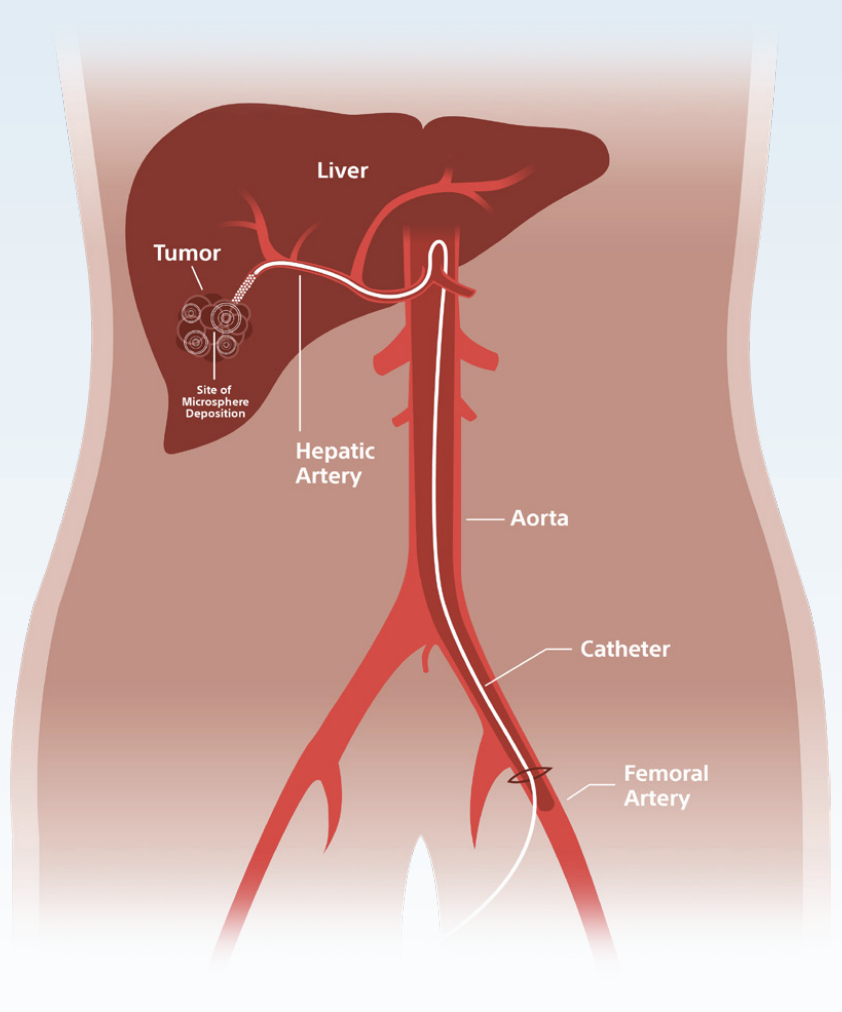
The treatment is a minimally invasive procedure that deposits millions of glass microspheres, each about one-third the width of a human hair, containing a radioactive isotope (Y-90) inside the blood vessels that supply a tumour. This blocks the blood supply to the cancer cells and delivers a high dose of radiation to the tumour. The treatment will destroy a significant portion of my liver, but thankfully, it has the amazing capacity to regenerate itself after damage.

Three weeks ago, I had a work-up which was basically a trial run. As will happen in the actual treatment, a catheter was inserted through the femoral artery in my groin and guided via x-ray to the hepatic artery supplying my liver. Mapping and measurements of the blood vessels feeding the tumour were done and then a contrast was injected and various images taken to ensure that the Y-90 would stay in my liver and not travel anywhere else in my body. During this entire time, which took several hours, and for four hours afterward, I had to lie on my back without raising my head or moving my right leg. It was a long and somewhat grueling day and after almost eleven hours, I was very happy to walk out of the hospital with no ill effects. I may not be quite as fortunate after the real deal. I’ve been told that common side effects include abdominal discomfort, nausea, and fatigue for a week or two afterward, but it will be worth it if it successfully destroys the tumour!

I was initially told that the treatment would take place two to five weeks after the work-up, but three weeks later, I haven’t been given a treatment date yet. Wheels often move very slowly in the medical world and waiting is something that patients have to get used to. It never seems to get any easier though!

To those of you who suggested in your very kind responses on Facebook this morning that you would be praying for me, I very much appreciate it. While I am enormously thankful to live in a part of the world where I have access to state of the art medical care at no personal expense, and I have a body of amazing doctors taking care of me, I know that God is ultimately my healer and it is He who holds my future. I continue to put my hope in Him!

Screenshot 2024-02-04 at 2.54.31 PM

Image: TheraSphere Patient Info – Boston Scientific

World Cancer Day 2015

World Cancer Day

When I first learned that today is World Cancer Day, a day in which the world comes together in unity in support of the global fight against cancer, I wasn’t sure how I felt about that. Do we really need an awareness day for everything? After all, isn’t everyone already aware of the devastation brought about by this dreadful family of diseases? Surely everybody has been touched by it in some manner. And what good does a day do anyway?

Cynical? Yes. Grouchy? Yup, that too! Perhaps my reaction has more to do with the fact that I’m resting on a heating pad because I wrenched my back yesterday than it does with whether or not we need a Cancer Day. It might also be related to the fact that I have a treatment next week followed by a scan that will tell us whether or not there has been any change in my own cancer. The days leading up to these scans are always a bit nerve wracking so I’d just as soon avoid the topic of cancer altogether today.

I’ve decided not to do that, however. The Lord has given me a voice (or in this case, a keyboard) and the least I can do is lend it to such a worthy cause. There’s really nothing that I can say about cancer that hasn’t already been said, but let’s begin with some alarming statistics:

  • Cancer is a leading cause of death worldwide and the leading cause among Canadians.
  • An estimated 191,300 Canadians were diagnosed with cancer in 2014 – 97,700 men and 93,600 women.
  • About 76,600 Canadians are estimated to have died of cancer in 2014 – 40,000 men and 36,600 women.
  • 45% of men and 41% of women will develop some form of cancer in their lifetime.
  • On average, 524 Canadians are diagnosed with cancer every day.
  • On average, 210 Canadians die of cancer every day.
  • About 30% of all cancer deaths are due to five leading behavioral and dietary risks: obesity, low fruit and vegetable intake, lack of physical activity, tobacco use, and alcohol use.
  • More than 60% of all new cases each year occur in Africa, Asia and Central and South America which account for 70% of the world’s cancer deaths.
  • Deaths from cancer worldwide are projected to continue rising, with an estimated 13.1 million deaths in 2030. I suspect that this is, in part, related to the fact that life expectancies are also rising.

Despite these gloomy numbers, cancer survival rates have doubled in the last 40 years. Awareness is making a difference!

The theme for World Cancer Day 2015 is “Not Beyond Us”. This year, the campaign is focusing on four key areas: choosing healthy lives, delivering early detection, achieving treatment for all, and maximizing quality of life. It takes a positive approach to the fight against cancer by highlighting new treatments and solutions that are within reach.

Today is World Cancer Day but the fight against cancer takes place every day. It takes place in research labs around the world but it also takes place all around you. It takes place in that home where a mother, father or child is fighting for life. It takes place in the hospitals and clinics where they receive treatment. It takes place in classrooms where good health habits are being taught and it takes place in communities, large and small, where fundraisers are held to benefit everything from individual patients to global research.

What will you do to make a difference in the fight against cancer? Will you make a donation, offer to drive an acquaintance to an appointment, or drop off a meal for the family when you know that Mom has had a treatment? Whatever you choose to do, you can make a difference!