Favourite fashion quotes

LogoFor as long as I can remember, I’ve been a collector of words, jotting down quotations that appeal to me whenever I run across them. Most of my favourite fashion quotes were coined by people in the fashion industry, but the first one listed here was spoken by a Greek philosopher in the 1st century AD. It still rings true today.

“Know first who you are, and then adorn yourself accordingly.”  Epictetus

The others are more current.

“To me, clothing is a form of self-expression – there are hints about who you are in what you wear.”  Marc Jacobs

“Style is a way to say who you are without having to speak.”  Rachel Zoe

“Don’t be into trends. Don’t make fashion own you, but you decide what you are, what you want to express by the way you dress and the way you live.”  Gianni Versace

“Fashion is not necessarily about labels. It’s not about brands. It’s about something else that comes from within you.”  Ralph Lauren

“To me, style is all about expressing your individuality freely and courageously.”   Timothy John Byford

“Real style is never right or wrong. It’s a matter of being yourself on purpose.”  G. Bruce Boyer

As I read through these, I realize that they’re all saying the same thing. I like them because they express my philosophy of style. What we wear is, or should be, an expression of who we are and shouldn’t be dictated by the current trends, the world of advertising, or by what everyone else around us is wearing.

My cabi stylist, Linda Kreamer, once put it this way, “Fashion is fashion, but style is your own.” (I’m sure she didn’t realize that I grabbed my notebook and pen and jotted that down when she said it!)

Our style is what makes us unique. While it’s great to take inspiration from what others are wearing, we each need to put our own stamp on a look. I’ve shared where some of my fashion inspiration comes from here.

There is no one more unique in the fashion world than Iris Apfel. I have a whole collection of quotes just from her, but this one fits well with today’s message.

“When you don’t dress like everybody else, you don’t have to think like everybody else.”  Iris Apfel

t-iris-apfel-bruce-weber-cop

Iris Apfel

Another of my favourite fashion quotes comes from a fictional character.

“You’re never fully dressed without a smile.”  Little Orphan Annie

And then, just for laughs, I can’t resist ending with these two somewhat irreverent fashion quotations.

“Clothes make the man. Naked people have little or no influence on society.”  Mark Twain

“Girls do not dress for boys. They dress for themselves and, of course, each other. If girls dressed for boys they’d just walk around naked at all times.”  Betsy Johnson


Abracadabra – the Christian and social media

We spent the final week of our recent vacation with over one thousand other people at Camp Harmattan, a Church of the Nazarene camp in the valley of the Little Red Deer River. While there, I attended an afternoon session that continues to resonate with me. The topic was the Christian and social media.

We talked about whether or not we, as Christians, should be using social media and whether this is a topic that the church needs to address. I think the answer to both questions is a resounding YES!

We cannot/should not/dare not hide our heads in the sand and avoid the world around us. The Old Testament tells the story of Queen Esther who, when her people faced extermination by the Babylonians, was told by her cousin, who urged her to speak to her husband on their behalf, “Who knows but that you have come to royal position for such a time as this.” (Esther 4:14 – italics mine) We, too, have been born for such a time as this. Our place in history is not random or some accident of fate. I firmly believe that God intended each one of us to be here on earth at this exact time. In other words, we were meant to be living in the age of social media and if that’s the case, we ought to use it, but we ought to use it well.

The Bible, particularly the book of Proverbs, has much to say about how we communicate. “Reckless words pierce like a sword, but the tongue of the wise brings healing.” (Proverbs 12:18) The same might be said of the keyboard.

Though the origin of the magician’s incantation, abracadabra, is uncertain, it is thought to derive from early Aramaic or Hebrew. The Hebrew word bara means “create”, while dabar means “word” or “speak”. Together they become abracadabara, literally meaning “I create as I speak” or “I speak therefore I create”.

When we use social media, what do our words create? How do they shape the people we interact with? Whether written or spoken, our words have the power to tear down or to build up, to encourage or to destroy.

It isn’t a matter of whether we, as Christians, should use social media, but rather a matter of how. Colossians 5:6 reminds us to “Let your conversation be always full of grace”. Before we post or respond, we need to consider the possible effect of what we write. What will our words create? Will they result in conflict, pain or discouragement? Or will they be a blessing? We also need to keep in mind that the written word, which lacks the non-verbal cues of face to face conversation, such as tone of voice and facial expression, can be more easily misunderstood. What we intend to communicate and what the reader understands may be two very different things.

We should also be very careful about what we repost. Before we do, we need to ask ourselves some very important questions. How reliable is the source? What are its biases and underlying convictions? What is the motivation or purpose behind the post and why do we want to share it? Very often, we should also take the time to do some fact checking to ensure that it’s actually true.

Our session on social media also touched on its addictive nature and some of the negative effects that it can have on our lives. While there’s no official medical recognition of social networking addiction as a disease or disorder, it has become the subject of much discussion and research and some studies seem to indicate that it is as addictive as nicotine. Some suggest that spending excess time on social media networks can even trigger anxiety, depression and ironically, isolation from others. Perhaps social media addiction might simply be defined as spending so much time using Facebook, Twitter and other forms of social networking that it interferes with other aspects of daily life such as careers and relationships.

Extensive use of social media also has the tendency to place a person at the centre of their own universe. As Christians, we definitely want to guard against becoming so caught up in the “selfie” world that we find ourselves constantly wondering or checking to see how we are being admired and followed by those in our social media circles. Instead, we want to use social media to strengthen relationships and connections and to have a positive impact on our world.

Just remember, abracadabra! Our words are powerful!

powerofwords

One word

As a mentor for a course that I helped edit this past summer, I was given a thought provoking New Year’s challenge that you might also want to consider. I was asked to choose one word to inspire or guide me in the coming year and to choose a scripture verse to go along with it. As a lover of words, this was a perfect assignment for me!

After pondering for awhile, I chose still as my word and Psalm 46:10, “Be still and know that I am God” as my verse. This well-known scripture has sustained me through some very difficult times over the past few years and I trust that it will continue to do so.

14900494_10154564065440915_4717300428074088917_n-version-2

But why still? Why a word that at first glance seems to suggest inactivity, perhaps even lack of effort or progress? When I looked up definitions of still I found beautiful words like “deep silence and calm” “free from turbulence or commotion” “quietude” and “tranquility”. These are definitely characteristics that I want to exhibit in my life and in my relationships. I want to be calm in the face of whatever storms 2017 might bring.

I also discovered that still is a verb, an action word meaning “to quieten” “to settle” or “to soothe”. In 2017, I want to be one who brings stillness and calm into the lives of others, especially those whose lives are torn and broken.

As I further searched the concept of stillness, I came across a lot of new age thinking about finding it within ourselves or by being in tune with the cosmos. Sadly, though, there is no stillness to be found within our own souls unless the Lord resides there and it most certainly can’t be found in the world around us, a world characterized by economic crisis, terrorism, war and natural disaster. Psalm 46:10 tells us that true stillness comes from knowing the great I AM, the creator of the cosmos. He is the source of the peace and calm that I want at the centre of my life in the coming year and for all eternity.

What about you? Can you think of a word to inspire or guide you in this new year?

Don’t get your knickers in a knot!

logo

If you’ve known me or followed this blog for very long, you know that I’m a self professed word nerd. It may be quirky, but I love words. Who else do you know who would watch a lecture series entitled The Secret Life of Words: English Words and Their Origins while walking on a treadmill?

So, it only makes sense (to me, at least) that a word nerd with an interest in fashion would be fascinated by some of the words used in the fashion business. Today I’m focusing on fashion words that are used differently in different countries. For me, they add to the fun of reading fashion blogs from around the world.

When I was a child, I often wore a jumper to school, but did I wear this

jumper-3

or this?

sweater

Here in Canada, as well as in the US, the first picture is a jumper, but in the UK and Australia, a jumper is what we in North America would call a sweater! The jumpers that I wore are known as a pinafores in the UK.

While we in North America understand the meaning of trousers, that’s not a word we’d likely use. Instead, we’d talk about our pants. That could be confusing if we were in the UK, however, where people would be embarrassed if anyone saw their pants. There the term is slang for underpants!

Depending on which side of the Atlantic you’re on, you might not want to get your knickers in a knot or your panties in a twist! Knickers is the British word for a lady’s underpants while here in North America, we usually call them panties.

Of course, men have different underwear words too. Some British men wear y-fronts, those old fashioned underpants with an inverted y shape in front. North American men usually refer to their underwear as briefs, shorts or boxers depending on the style they prefer.

Even babies get in on the underwear confusion. British and Australian babies wear nappies, but in North America, they wear diapers.

What do you call these?

coveralls

Here in North America, we call them coveralls, but in the UK they’re overalls. Here, overalls are bibbed pants/trousers held up by over-the-shoulder straps. In Britain, however, those are dungarees.

Are you confused yet? Can you think of any other examples?

Is it a journey or a battle?

There are many metaphors that people use to describe cancer… a dark scary cave, a parasite, an obstacle, a roadblock, a hard stroke of fate, a great burden, a marathon, a drama, a dance. Understandably, Lance Armstrong, visualized his cancer as the most important bicycle race he’d ever entered.

I entitled my very first blog post about cancer “A new journey…” using one of the most common analogies for the disease. Is it any wonder that someone like myself, struck with wanderlust, would use a travel metaphor? It seemed to come naturally to me, and I have continued to use it ever since.

Having cancer is like going on a journey without a map. We have no idea how long the trip will be or where it will take us. There are unexpected twists and turns and bumps in the road. Thankfully, I don’t travel it alone. Just as he was always by my side as we explored various parts of Asia, Richard is my traveling companion. The journey is as much his as mine and the outcome will affect him as much as me. Unlike many of our wanderings in countries like South Korea, Vietnam and Cambodia, we don’t make this trip without travel guides. We have a whole team of medical professionals showing us the way and a host of friends and family cheering us on.

This is not the only metaphor that I use to refer to my cancer, however. The military metaphor seems to have fallen from favour in recent times, but I believe that it is apt and I, for one, will continue to use it. As fellow neuroendocrine cancer warrior, Ronny Allan, recently wrote on his blog,

“I don’t like Cancer – it attacked me, it attacked my family, it attacked others I know, it has killed people I know……. it has killed millions of people and changed many lives.  I’m ‘fighting’ Cancer.  I’m in a ‘battle’ with Cancer.”

Yes, Ronny. Yes, you are. We both are. We’re fighting for our lives and cancer is the enemy!

Apparently, there are both bloggers and professionals who don’t think that we should use this kind of language. Some claim that such language is inherently masculine, power-based and paternalistic. Really? Girls can’t fight? You just watch me! Others feel that using a military metaphor suggests that if one loses the war against cancer, she must not have fought hard enough. Nonsense! If I lose this battle, it will be because the weapons of this war are not yet perfected and our understanding of the enemy is limited.

We do have weaponry, however. We fight with surgical tools and with chemical and nuclear warfare. Like soldiers, we strive to carry ourselves through battle with courage, grace, and dignity and most of us have scars to show that we’ve been engaged in battle.

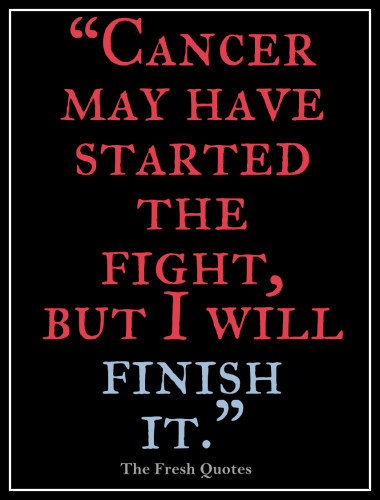
Cancer-may-have-started-the-fight-but-I-will-finish-it.-380x500

What the heck is vegan leather?

Lately, I’ve noticed more and more ads and fashion blogs referring to garments and handbags made of vegan leather. Really? What the heck is that? As a lover of words, I was compelled to find out.

Vegans are usually defined as a strict vegetarians who omit all animal products, including dairy, from their diets, but The Vegan Society offers a much broader definition. “Veganism is a way of living which seeks to exclude, as far as possible and practicable, all forms of exploitation of, and cruelty to, animals for food, clothing or any other purpose.” Hence, vegan leather.

In reality, though, vegan leather is nothing more than fake or faux leather by a different name. Pleather, as it was once known, is a synthetic leather usually made out of petroleum byproducts such as polyurethane or PVC bonded to a fabric backing. A few are cork or kelp based. Though once deemed tacky, under its new and classier name, pleather is suddenly seen as eco-chic.

Make no mistake though, the production of these synthetic leathers involves excessive levels of toxic substances and since they aren’t fully biodegradable, they produce micro-particles that are ingested by animals and thus enter the food chain at all levels.

Animal-friendly or not, synthetic leather offers advantages to both fashion designers and consumers. The softer, realistic-looking material is a popular choice with designers as it offers them a flexible, versatile textile to work with; one that can be made to sparkle or shine or even be saturated with a rich or bright shade that no tanning process could mimic. Not everyone in the industry is happy to call the fabric vegan leather, however. Some would prefer to avoid the connotation that their clothing is designed exclusively for animal-cruelty advocates.

Like many consumers, I simply like the fact that faux leathers are a nicely priced alternative to the real thing. I can’t help thinking that the new term sounds overly pretentious though and I’ve also noticed that the so-called vegan leather products that I’ve seen advertised tend to be pretty pricey. Could it be that people are paying more for the sense of superiority that comes with the fancier moniker and the feeling that they’re doing something good? With apologies to William Shakespeare, a faux leather by any other name is just as fake!

IMG_5693

One of my latest thrift store finds. The label says it’s “100% polyurethane with 100% rayon woven backing.” It doesn’t say vegan leather. It doesn’t pretend to be anything it isn’t!

Scanxiety

Since being diagnosed with cancer almost 18 months ago, I’ve learned a lot of words that I, a self-professed word nerd, would rather not have had to know. Words like neuroendocrine tumour (I have five of them lurking inside of me) and carcinoid syndrome (a group of symptoms linked to the excess hormones released by the type of neuroendocrine tumour that I have). I could bore you with several others but the word that best describes my life the past few weeks is scanxiety.

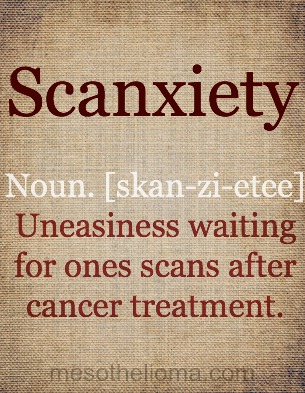
Scanxiety

Scan + Anxiety = Scanxiety

Though my cancer is incurable, I go for a treatment about once every ten to twelve weeks that is designed to keep it from growing and spreading. I am injected with Lutetium-177, a radioactive therapy that adheres to specific receptor cells in my tumours and destroys them. The morning after each treatment, I have a full body scan that shows us exactly what has been happening with the disease since the previous treatment. Fortunately, I don’t have to wait long for the results. I meet with a doctor immediately afterward to view the pictures and talk about what they show.

For the most part, I’ve been at peace and have approached each treatment and scan without a lot of anxiety but this time was different. Since my last treatment in mid November, I’ve been experiencing intermittent stomach pains. They’re short-lived, lasting only a few minutes. It’s easy to second guess every ache or twinge and wonder if it’s related to the cancer but this was more than that. Stomach pain is one of the most common symptoms of carcinoid syndrome and one I’d experienced prior to diagnosis. I began to wonder if this was a sign that the cancer was growing or spreading.

Worry often begins as a little thing but it seems to feed on itself. Soon I was carrying a heavy burden of anxiety. It continued to grow until I was quite sure that I would hear bad news when I went for this week’s treatment and scan.

Then, on Tuesday night as I was brushing my teeth and preparing for bed, I heard the Lord say, “It’s going to be okay!” Oh, it wasn’t a booming voice thundering through the ceiling of our tiny ensuite bathroom. It wasn’t an audible voice at all but it might as well have been. I knew without a doubt that it was God speaking to my heart. He even said it several times. “It’s going to be okay!” I walked out of the bathroom feeling like the world had been lifted off my shoulders, crawled into bed and had a great sleep. Then, the next morning, I climbed out of bed, picked up the heavy load of anxiety and put it squarely back on my shoulders!

As we drove to Edmonton for my treatment and throughout the hours that followed, I tried to tell myself that everything was going to be okay, but I kept hearing the other voice, the one that said, “Are you sure it was God that you heard? It wasn’t God, it was only your own wishful thinking! You were right in the first place; the news is going to be bad!” Foolishly, I listened and my anxiety grew.

I was thankful for the visits that kept me sane that evening. First, an acquaintance from years gone by that I’ve recently reconnected with. We could have talked for hours! Then, my dear hubby who has walked every step of this cancer journey with me. I was also thankful that the treatment had made me tired enough to sleep.

The next morning, I prayed for the entire half hour or so that I was being scanned and then it was time to find out which voice I should have listened to. I walked into the consultation room where Dr. Sandy McEwan, head of the neuroendocrine tumour clinic at the Cross Cancer Institute, and Dr. Dean Ruether, leader of the provincial endocrine tumour program, sat waiting with smiles on their faces and I heard the words I’d been longing to hear, “Everything’s okay! There’s been no change.”

My cancer is stable! I can relax until mid April when we go through the whole thing again, hopefully without as much scanxiety! Oh, there are still the stomach pains to deal with but I’m even wondering if they will subside now that the burden of anxiety has been lifted. I’m going to be monitoring their frequency and intensity for the next few weeks to see if they’re actually lessening, as I think they may have been. If not, the solution might be as simple as increasing my monthly dose of Sandostatin which controls the carcinoid symptoms or as complicated as surgery to remove the primary tumour from my colon.

For now, I’m simply going to relax and give thanks to the One whose voice I should have listened to!

Somewhere between pushy and patient

Very early on in my battle with cancer a dear friend gave me some very wise advice. “Please don’t be afraid to advocate for yourself,” she told me. “You will have to wait at times but there is also a place for you to pick up the phone and ask for results, action, a timeline.”

It’s called being proactive.

proactive

Being proactive falls somewhere between pushy and patient. Pushy is defined as “excessively or unpleasantly self-assertive or ambitious.” Though waiting for appointments, waiting for test results, waiting to find out what’s going to happen next is is a huge part of this journey, I don’t want to be pushy. I don’t want to be excessively or unpleasantly assertive. I don’t want to phone too often and make a complete nuisance of myself but I’m not willing to be overly patient either. Patient means “able to accept or tolerate delays, problems or suffering without becoming annoyed or anxious.” No thanks!  I’m definitely not willing to accept or tolerate unnecessary delays and I do become anxious!

Being proactive is all about balance and it has been especially important since my second cancer was diagnosed. I’m not willing to simply sit back and assume that all the experts involved in caring for my two entirely different cancers are talking to one another and coordinating their efforts. I’m being proactive and advocating for myself. I can’t control the situation or cause things to happen but I can ask questions and I can ensure that everyone involved in one part of my care knows what’s going on in the other part.

Regardless of how proactive I am, waiting is still a big part of the process, but lately things seem to have sped up. Surgery was just three weeks ago. I’ve already been back to the city for two appointments since then and I have another one tomorrow. Due to the size of the tumour that was removed and the fact some cancer cells may have been left behind, the next step is 30 radiation treatments over a six week period. At tomorrow’s appointment, molds will be taken to make a mask that will ensure that my head remains in the correct position and the radiation targets exactly the right spot each time. Because radiation to the jaw can cause dental problems and I need to learn how to prevent that from happening, I also have a dental consultation booked for the end of next week. Radiation will begin soon after that.

In the meantime, treatment of my neuroendocrine tumours is on hold, but a CT scan on June 12 will tell us whether or not there has been any change and I will be proactively advocating for resumption of a regular treatment schedule as soon as radiation is finished.

Being proactive doesn’t come naturally to me, but it’s getting easier all the time and it gives me some sense of control in a situation that is largely out of my hands.

In what areas of life have you had to be proactive?

Speaking Canadian, eh?

IMG_3571_2

Am I wearing a tuque or a knit cap? That depends on what part of the English-speaking world you’re from. Here in Canada, it’s called a tuque which rhymes with duke. Though used by 100% of Canadians, I was surprised to learn that the word is almost unheard of beyond our borders.

A recent article in the Edmonton Journal listed several other words that are used almost exclusively in Canada or that have different meanings here than elsewhere. While English speakers in most of the world, use parking garage or parking deck to describe a multi-level concrete parking structure, here in Canada, we park our vehicles in a parkade. At the beginning of each school year, we buy our children a new package of pencil crayons but in the US, they’re called colored pencils and the British call them colouring pencils. On hot summer days, we give our children freezies, popsicle like treats that come in plastic sleeves. Elsewhere, these are known by a variety of other names including ice pop and freezer pop. Adults might prefer a treat from a mickey, the term Canadians use to describe a 375 mL bottle of liquor. Using that word could get us into trouble in the US, however, where it’s slang for a date rape drug!

Beatles-Abbey-Road-album

If you’re as old as I am, you probably recognize the famous photo from the Beatles’ Abbey Road album cover. In Canada, we’d say that George, Paul, Ringo and John are in a crosswalk. It wasn’t until I taught English in Japan that I discovered that English speakers in some parts of the world refer to it as a zebra crossing!

Even within our borders or within families, we sometimes have difficulty agreeing on which words to use. Instead of using pencil crayons, children often colour with felt-tipped pens. In our family, we always referred to them as markers but my daughter-in-law insists that they should be called felts. According to my father, we use serviettes at the table but the rest of us call them napkins. In my parents’ livingroom, we sat on the chesterfield but in our house, we call it the couch. Others call the same piece of furniture a sofa. What an interesting and confusing language English is!

The dinner/supper conundrum is the one that has confused me the most. I think it’s a regional thing. Growing up on the BC coast, we ate lunch at noon. Supper and dinner were interchangeable words used to describe the main meal which was usually eaten around 6:00 pm. When I settled on the prairie, however, I found that people here often refer to the noon meal as dinner. If we’re invited to someone’s home for dinner, I’ve learned to ask what time they’d like us to come. Their answer tells me which meal they’re referring to! If I’m issuing the invitation, I’m careful not to use the word dinner at all. Everyone understands lunch and supper but dinner is just too confusing!

As Canadians, we’re probably best known for our use of the little word eh? which we tack onto the end of statements to turn them into questions as in “It’s sure been a cold winter, eh?” We do it without even thinking about it and it’s this unique Canadianism that often identifies us as being from north of the border when we travel in the US.

Following Augustine has readers from all over the English-speaking world. I’d love to know where you’re from and what words and phrases are unique to your part of the world. Please leave a comment!

Who’s your googleganger?

Googleganger!

Isn’t that an awesome word? Okay, I admit it; I’m a word nerd, but you’ve just got to love the sound of that one!

As part of getting back on track, I’ve walked 8.5 miles (almost 14 km) on the treadmill over the past nine days. In addition to enjoying scenic pathways in Hawaii, Egypt and along Italy’s Amalfi coast via virtual walk DVDs, I’ve also gone back to watching my video course, The Secret Life of Words: English Words and Their Origins. That’s where I came across the word, googleganger.

Voted the 2007 Most Creative Word of the Year by the American Dialect Society, (yes, there are organizations for word nerds like me!) a googleganger is a person with your name who shows up when you Google yourself. It’s an adaptation of the word, doppelganger, meaning a ghostly double of a living person or someone who looks eerily like you but isn’t a twin.

Picture 2

Believe it or not, I don’t have a googleganger. There are no other Elaine DeBocks to be found on the internet! The closest is Lisa Elaine Debock, a lawyer in New York state.

Most of the DeBocks in North America are descendants of Joseph Leopold DeBock who left his homeland, Belgium, as a young man of 25 and settled in the United States in 1870. Some branches of the family have since dropped the capital B so it’s possible that Lisa Elaine is a distant relative.

If I really want a googleganger, however, I can find plenty of them by searching my maiden name which is much more common. The best known among those is a 1950s film star!

So, who is your googleganger? You have Googled your name haven’t you?