Book of the Month – September 2023

I Am a Bacha Posh

Ukmina Manoori

9781629146812-usThe subtitle of this short, but intriguing memoir, My Life as a Woman Living as a Man in Afghanistan, tells much about the content of the book, but it could also be misleading to those of us living in western cultures. This is not a book about living a trans experience.

You will be a son, my daughter.” With these stunning words young Ukmina learned that she was to spend the remainder of her childhood as a boy. This had nothing to do with gender confusion on her part. In Afghanistan’s heavily patriarchal, male-dominated society, it is customary for some families, especially those without sons, to choose a daughter to live, dress and behave as a boy, even taking on a boy’s name. These children are known as bacha posh which means “dressed up as a boy” in the Persian dialect, Dari.

Families have various reasons for making this choice and there are no statistics on how many families have daughters living as bacha posh. In most cases, due to the somewhat secretive nature of the practice, only the family, close friends, and necessary health and education officials know the bacha posh’s biological sex.

As a bacha posh, a girl has all the freedoms denied to her as a member of the female sex. Instead of staying at home cooking and cleaning, she can move about freely in public, attending school, running errands, playing sports, and sometimes finding work to help the family make ends meet.

Once a bacha posh reaches puberty, however, she is expected to revert to traditional female roles putting on the veil, staying at home unless accompanied by a male, and preparing for an early marriage. What makes Ukmina’s story unique is that when that time came, she refused. Confronting societal and family pressure, she continued to live as a man, not because of gender dysphoria, but because she doesn’t want to give up the the rights and privileges of a male in Afghan society.

Ukmina’s choice paved the way for an extraordinary destiny. She acted as a scout for the resistance when the Soviet Union invaded Afghanistan and ultimately commanded the respect of everyone she encountered. There did come a period of time when she lived in isolation and fear of the Taliban and even of some of her fellow villagers who didn’t agree with her life choices. Eventually, however, she entered politics and as an elected member of her provincial council, fights tirelessly to improve women’s rights.

Rather than telling you any more of her story, I’m simply going to share three quotations that I think wrap up Ukmina’s thoughts about her experience and the life of women in Afghanistan.

Living in men’s clothing has given me a certain freedom. A life as a woman in Afghanistan is a life of destruction.

I say to myself that I have sacrificed nothing. I have done what I had to do. I became what I was. I found my destiny. And there is nothing I lack.

I also told myself that women were beautiful creatures of God. Men were cruel. I often asked Allah: “Give me the power of men and the kindness of women.””

If a novel about bacha posh would be more to your liking, I would highly recommend The Pearl That Broke Its Shell by Nadia Hashimi.

Book of the month – May 2023

When it came time to write this month’s book post, I couldn’t decide which of two historical novels I wanted to feature, so I took the easy way out and wrote about them both!

The Letter Home

Rachael English

hbg-title-9781472264701-63.jpgRachael English is a novelist and a presenter on Ireland’s most popular radio programme, Morning Ireland. In her most recent novel, inspired by true events, the lives of three remarkable women are interwoven across time.
While back home in County Clare on Ireland’s west coast, Jessie Daly, whose life has recently fallen apart, agrees to help an old friend research what happened in that area during the terrible famine of the 1840s. Meanwhile in Boston, lawyer Kaitlin Wilson, after suffering a tragedy of her own, decides to research her family history. She knows only that her ancestors left Ireland for Boston in the 19th century. Separated by an ocean, and totally unknown to one another, the two women are drawn into the remarkable story of a brave young mother named Bridget Moloney and the terrible suffering that she and her little daughter, Norah, endured during the famine.

Even on a busy weekend celebrating the birthdays of two of my grandchildren, I had a hard time putting this book down! Perhaps I connected so strongly with the story because I’ve recently been sorting through a box of old family photos, inherited from my mother, and trying to correctly label them before the identities of the people in them are forever lost in the mists of time. Like Jessie and Kaitlin, I’ve taken to the internet to find out more about these ancestors of mine and their lives, but perhaps that should be a story for a different post!

If you enjoy historical fiction or genealogy is your thing, this is definitely a book for you. I enjoyed it so much that I’ve now loaded one of English’s earlier novels, The American Girl, onto my Kindle for future reading.

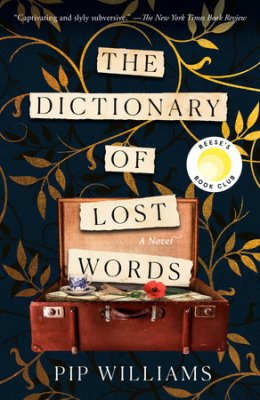
The Dictionary of Lost Words

Pip Williams9781984820747

Knowing that I’m a lover of words and a strong advocate of equal rights for women, my daughter recommended that I read this one. Australian novelist, Pip Williams, masterfully weaves a fictional story into and around the true historical events and people involved in compiling the first edition of the Oxford English Dictionary in the late 1800s and early 1900s.

The only child of a widowed father, Esme spends her early childhood in the Scriptorium, a converted garden shed in Oxford where her father and a team of dedicated lexicographers collect and compile words for the dictionary. From her place under the sorting table she collects stray word slips dropped or discarded by the men and hides them in a small trunk that she labels “The Dictionary of Lost Words”. As she grows up, she begins to realize that not all words are considered appropriate for inclusion in the dictionary, particularly words pertaining to the experiences of women and common folk; words that were considered coarse or vulgar, spoken but not usually written. And so she begins her own collection of words by seeking out the lower-class, less educated people and listening to their everyday speech.

A book about words might sound dreadfully boring to some, but The Book of Lost Words is much more than that. The years during which the Oxford English Dictionary was being compiled coincided with the women’s suffrage movement in England as well as World War I and both have a part to play in the story. More than just a book about words, it’s a book about love, loss, the roles of women, the meaning of service, and a book that asks the important question, whose words matter?

Because you can

We’re nearing the end of another federal election campaign here in Canada. Monday, October 21 is election day, but since we’ll be far from home that day, we plan to vote in the advanced polls tomorrow. That will be Thanksgiving Sunday here in Canada which I think is quite appropriate. I’m very thankful that I live in a democratic country where I have the right, the responsibility, and the privilege to vote.

Sadly, many people don’t seem to feel that way. Voter turnout for the October 2015 federal election was 68.5%, a significant increase from 61.1% in the previous election. In my opinion, that’s still quite disgraceful. What is the matter with people? Why does 30 to 40% of our population fail to cast a ballot? Are we Canadians really that apathetic?

I will vote, if for no other reason than because I can. It’s a privilege that I don’t take lightly. Women before my time fought long and hard so that I could exercise this right. Women like Nellie McClung, well-known advocate and popular speaker on the subject of women’s suffrage in the early 1900s, who said “Our worthy opponents will emphasize the fact that women are the weaker vessel. Well I should think that a woman who cooks for men, washes and bakes and scrubs and sews for her family could stand the extra strain of marking a ballot every four years.”

The United States began allowing women to vote in 1920, after the ratification of the 19th Amendment to their Constitution. Here in Canada, many women voted for the first time the following year, but it wasn’t until much later that all Canadians had the right to vote. Most “people of colour” were prohibited from voting at the provincial and federal level until the late 1940s and it wasn’t until 1960 that every Canadian of age had the right to vote. That’s right! 1960! Prior to that time, aboriginal Canadians were required to give up their treaty rights and renounce their status under the Indian Act in order to qualify for the vote.

On election day, get off your butt and VOTE! Don’t make excuses. Don’t be one of the apathetic masses. Vote, if for no other reason than because you can! Before you vote, however, do your homework. Don’t cast your ballot based on how your parents or your grandparents have always voted and please look beyond social media for direction. Examine the record of those who’ve been leading us, look at the party platforms, and above all, consider the character of those who are vying for leadership positions. The future of our country depends on it!

canada-vote

Because I can

Here in Canada, we are nearing the end of the longest federal election campaign in recent history. When we go to the polls on October 19th, 78 days will have passed since Prime Minister Stephen Harper asked Governor General David Johnston to dissolve Parliament and call a general election. 78 days of rhetoric and sadly, 78 days of name calling and fear mongering. How glad I am that I don’t live in the US where the electoral process goes on for many months!

Regardless of which country you live in, however, when election day finally rolls around, VOTE! Consider the issues, research the candidates, and then VOTE!

Official turnout for our last federal election, held on May 2, 2011, was 61.1%, only 2.3 percentage points higher than the all-time low of 58.8% in 2008! What is the matter with people? Why does 40% of our population fail to cast a ballot? Are we Canadians really that apathetic?

I will vote, if for no other reason than because I can. It’s a privilege that I don’t take lightly. Women before my time fought long and hard so that I could exercise this right. Women like Nellie McClung, well-known advocate and popular speaker on the subject of women’s suffrage in the early 1900s, who said “Our worthy opponents will emphasize the fact that women are the weaker vessel. Well I should think that a woman who cooks for men, washes and bakes and scrubs and sews for her family could stand the extra strain of marking a ballot every four years.”

The United States began allowing women to vote in 1920, after the ratification of the 19th Amendment to their Constitution. Here in Canada, many women voted for the first time the following year, but it wasn’t until much later that all Canadians had the right to vote. Most “people of colour” were prohibited from voting at the provincial and federal level until the late 1940s and it wasn’t until 1960 that every Canadian of age had the right to vote. That’s right! 1960! Prior to that time, aboriginal Canadians were required to give up their treaty rights and renounce their status under the Indian Act in order to qualify for the vote.

While I consider our record abysmal, there are places where the situation is much worse. Women in Saudi Arabia are registering to vote for the first time in history, but keep in mind that they won’t be able to drive themselves to the polling stations as they are still completely banned from driving. They won’t even be able to leave their homes to go and vote without being accompanied by a male guardian!

On election day, get off your butt and VOTE! Don’t make excuses. Don’t be one of the apathetic masses. Vote, if for no other reason than because you can!

canada vote

International Women’s Day 2015

Tomorrow, March 8, is a day set aside to celebrate the economic, political and social achievements of women past, present and future. Women’s rights have come a long way since the first International Women’s Day in 1911 but we still have a long way to go. This year’s theme is ‘Make It Happen’, a slogan aimed at encouraging effective action for advancing the rights and treatment of women. We need to make it happen in those workplaces where women still earn less than men, in countries where women are regularly sexually abused and forced into marriage, and for girls who are still denied an education or forced to undergo female genital mutilation.

makeithappen

I couldn’t help laughing at the tongue in cheek parody of the lists that women are given to prevent rape that has been circulating on the internet today. At the same time, I felt guilty for laughing. I realize that rape is never a laughing matter but sadly, there are still those who believe that women are to blame for their own abuse.

Rape prevention

I was absolutely incensed when I read this week’s news reports about one of the men convicted in a 2012 gang rape and murder case in Delhi, India. In an interview from jail, 26-year-old Mukesh Singh said that women who went out at night had only themselves to blame if they attracted the attention of gangs of male molesters. “A girl is far more responsible for rape than a boy,” he said.

Singh also claimed that had the 23-year-old victim and her male friend, who were returning from an evening at the cinema, not tried to fight back, the gang would not have inflicted the savage beating from which she died two weeks later. Describing the killing as an “accident” he said, “When being raped, she shouldn’t fight back. She should just be silent and allow the rape. Then they’d have dropped her off after ’doing her’.”

Equally appalling was this comment made by one of the lawyers in the case. “If my daughter or sister engaged in pre-marital activities and disgraced herself and allowed herself to lose face and character by doing such things, I would most certainly take this sort of sister or daughter to my farmhouse, and in front of my entire family, I would put petrol on her and set her alight.”

I wish I could say that things like this were unique to India, but that’s far from the truth and as long as my granddaughter is growing up in a world where any man, anywhere thinks it’s okay to rape a woman, we need to do more than celebrate the achievements of women; we need to ‘Make It Happen’. I am neither a man hater or a radical feminist but I dream of a world where every child has the right to an education and every woman feels safe.