Celebrating wellness

In 2021, Alberta Blue Cross launched the Faces of Wellness program to celebrate Albertans who are champions of wellness in their communities whether by making positive lifestyle changes, promoting a health-related cause, making the most of life while living with a chronic condition, standing up for mental health, or being a role model for others. I was completely unaware of the program until early last fall when I saw a post about how to apply or nominate someone else for the 2024 award. The deadline to enter hadn’t passed yet, so I thought “why not?” It would be another opportunity to educate someone about neuroendocrine cancer even if it was only the contest judges.

The application process involved writing a detailed story outlining the individual’s wellness experience, how they embraced the courage to overcome, and examples of how they live a life of wellness and regularly encourage others to do the same. I wasn’t sure how I could accomplish all that in the limited space that was allowed, but after writing a longer version and then seriously editing it, this is what I came up with.

Eleven years ago, I was diagnosed with stage 4 neuroendocrine cancer (NET), a disease that even my family doctor had never heard of. For several years, I had been experiencing symptoms similar to those of several more common conditions and my slow-growing cancer was initially misdiagnosed as gastritis.

My cancer isn’t curable, but ongoing treatment keeps it from growing and spreading. Since my NET diagnosis, routine scans detected 2 unrelated cancers which were removed surgically. More recently, I was also diagnosed with type 2 diabetes.

In spite of all this, I am thriving! I’m not dying of cancer, I’m living with it. Wellness is about more than physical health. Spiritual, emotional, and social well-being are equally important. I have a strong faith and supportive family and friends who make the journey easier. A positive attitude won’t cure my cancer, but it certainly makes living with it easier.

Maintaining wellness involves actively practicing healthy habits. Eating well and being physically active are vital. I’m almost 72, but I exercise 5 days a week and love nothing more than paddling my kayak, going for a hike, or playing a round of golf.

From the beginning of my NET journey, it has been my mission to educate people in my community and elsewhere about the disease. I’m actively involved in patient advocacy as a member of the Advocacy Advisory Board to the Canadian Neuroendocrine Tumour Society. I’m involved in initiatives to try to make the patient experience better for all of us including those who have not yet been diagnosed. It’s not uncommon for people to experience symptoms for 5 to 7 years before receiving a correct diagnosis. That needs to change! Neuroendocrine cancer is the fastest growing class of cancer worldwide, but it’s not well-known in the medical world. That, too, needs to change! I’m passionate about making a difference by being a voice for change.

I sent off my submission and hardly gave it another thought until sometime in December when I received an email informing me that I had been chosen as a runner-up and would be receiving a $25 Atmosphere gift card in the mail once the Canadian postal strike came to an end. Apparently this is a face of wellness!

And so now, for those of you who have been following my wellness journey, an update. February was a month of tests, scans, and appointments. I was supposed to meet with my specialist on Wednesday to discuss the results of many of those tests including a CT scan that was done the week before. That appointment had to be postponed, however, because the scan results weren’t available yet and let me tell you, scanxiety (scan + anxiety) is real! I had already seen the results of the other tests online and most of them were good, but there was one that concerned me and made me wonder if the cancer was beginning to grow or spread again. Thankfully, the scan results finally showed up online at 10 o’clock last night! While I don’t understand all of the medical jargon and will have to wait for the specialist to interpret some of it, the final statement was clear, “No evidence of progressive disease from November.” In other words, nothing has changed since my last scan three months ago!

Over the past month, I’ve also learned that my A1C (3 month blood sugar level) continues to be stable (with medication), my blood pressure is excellent (also with medication), and my bone density has not deteriorated over the past two years. This is all very good news and, in spite of having cancer, I’m feeling pretty blessed to be a face of wellness!
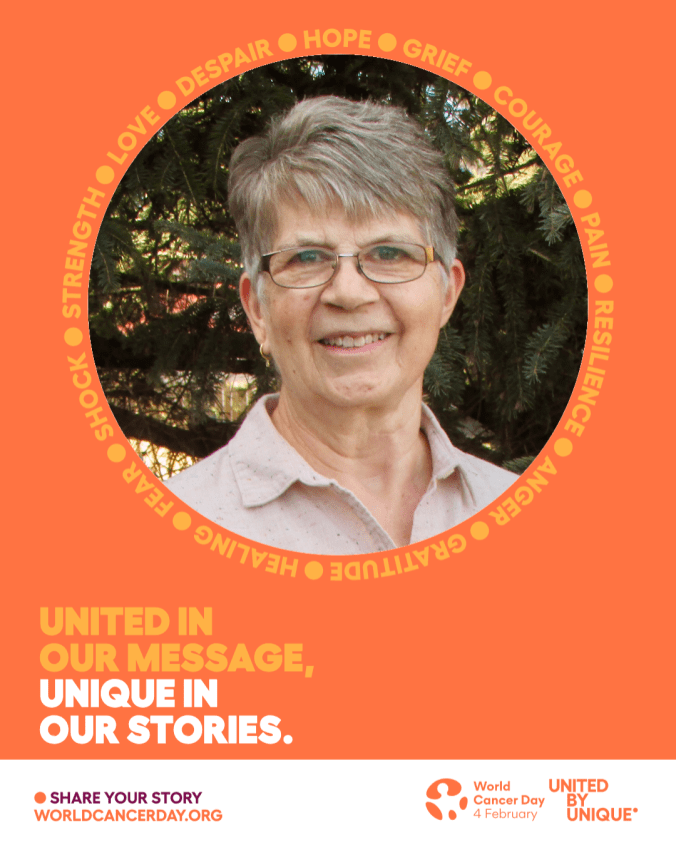

World Cancer Day 2025: United by Unique

February 4 is World Cancer Day. There are more than 200 different kinds of cancer and every patient’s experience is different. That’s why the new World Cancer Day theme, United by Unique, resonates so strongly with me. While each of our stories is unique, we are united in our message and in our desire to raise awareness and see progress made in fighting this dreadful disease. 

The emphasis of the 3-year United by Unique campaign that kicks off today will be people-centred care. Behind every diagnosis lies a unique human story. These are stories of grief, pain, healing, resilience, love and so much more. A people-centred approach to care that listens to patients’ stories and fully responds to each individual’s unique needs with compassion and empathy will lead to the best possible outcomes.  

People living with cancer don’t always feel heard, seen, or understood. They are often bewildered, feeling isolated and voiceless at a time when they’re also learning to navigate an unfamiliar and confusing health care system and dealing with the emotional highs and lows of cancer diagnosis, treatment, or recovery. That’s why the first year of this campaign will focus on telling our unique stories.

I feel very fortunate to receive my cancer care at the Cross Cancer Institute in Edmonton, Alberta, Canada, a facility where it is common practice to look beyond the patient to the person as a whole and to consider the impact of their cancer on all aspects of their life. When I go for appointments, I’m routinely handed a clipboard with a questionnaire that delves into not only the physical symptoms that I might be experiencing, but also the psychosocial ones. The CCI offers a wide range of supportive services that go far beyond the patient’s physical well-being. The health care team there includes professionals in psychology, social work, spiritual care, nursing, and psychiatry and available services include individual, couple, and family counselling; professionally-led support groups; and practical supports for financial and other basic needs. While the need for these supports has not been part of my unique story thus far, I’m glad to know that they’re available should I ever need them and I wish that that was true for patients everywhere.  

I have been invited to share my unique patient story at a Canadian Neuroendocrine Tumour Society (CNETS) conference in May. The big challenge is going to be condensing the approximately 20 years from initial symptoms to present day into a 10 minute talk that educates, encourages, and inspires those in attendance, especially those who are in the early days of their journey and who need to know that it’s possible to live long and live well in spite of their diagnosis. 

United in our goals, unique in our needs.

My 150 day walking goal

If you’ve been following my blog for long, you may remember that several times in the past few years I’ve challenged myself to walk or hike a specific distance over the summer months. The first time, back in 2020, I walked as part of a fundraiser for NET cancer research, but after that I recalled how good all that walking felt and how much having a specific goal kept me motivated. Last year, I challenged myself to walk 350 km between May 1 and October 31 and actually exceeded that by approximately 60 km.

Today, recognizing that I’ve been unusually lazy over the past winter and realizing how badly I need to get out and walk again, I decided that I would attempt to walk 300 km between now and my 72nd birthday on October 5, which happens to be exactly 150 days from now. (For my American friends, 300 km is equal to 186.4 miles.) Not only does having a goal motivate me, especially on those days when I’m feeling sluggish or just plain lazy, but being accountable to someone else is another driving force. That’s where you come in and the reason why I’m writing this post! 

walking-for-weight-loss-tips-1588694143-1

So why walk?

Walking has many benefits including:

  • It’s accessible, easy, safe, and free.
  • It reduces stress and decreases symptoms of depression and anxiety.
  • It improves heart health and reduces the risk of cardiovascular disease.
  • It increases blood flow and therefore improves energy levels.
  • It improves blood pressure and cholesterol levels.
  • It reduces the risk of some cancers.
  • It boosts the immune system.
  • It helps prevent the onset of Type 2 diabetes (which I already have).
  • It burns calories.
  • It promotes more restful sleep.
  • It improves flexibility and helps ease chronic pain and stiffness.
  • It improves brain function.
  • It’s a weight bearing exercise that reduces the risk of osteoporosis.
  • It has even been linked to longer life expectancy!

If you’d like to partner with me, I’d love to share this walking challenge with you. Just choose a distance that you think is reasonable for you and share it in the comment section below.

There are several ways to measure the distance that you walk. In and around town, I use MapMyWalk which allows you to create and save routes that you use regularly. All Trails gives information and distances for trails around the world and I use a handheld Garmin GPS to measure unmarked hiking trails. 

Debunking common cancer myths

Penn Medicine

Image: Penn Medicine

The post that I recently wrote about what not to say to someone with cancer clearly resonated with a lot of people. In fact, it rapidly became one of my most read posts of the past year.

As I thought about the things that people say and particularly the advice that is often given, I realized that much of it is the result of common myths and misconceptions that people have accepted as truth. As a result, I decided to write a companion piece to try to debunk some of those popular cancer myths.

The internet, and social media in particular, have been responsible for spreading vast amounts of dubious or misleading information as well as much that is entirely false, but cancer myths existed long before the advent of the internet. In the early 1980s, when our daughter was dying of leukemia, I was told by a well-intentioned gentleman that I simply needed to boil up some spruce needles and give her the resulting tea to drink and she would be fine! That may not be one of the more common myths, but it is the kind of miracle cure that cancer patients are routinely advised to try. According to this study from a few years ago, almost 40% of Americans believe cancer can be cured solely through alternative therapies.

So, without further ado, here are 12 popular beliefs about cancer that are not true.

Sugar feeds cancer and makes it grow faster.

All cells in the body, both healthy and cancerous, depend on glucose, a type of sugar, to function. There is, however, absolutely no scientific evidence showing that eating sugar will make cancer grow or spread more quickly or that cutting out sugar will slow its growth or prevent the disease. This is not to say that there is no connection between sugar and cancer. Consuming too much sugar causes weight gain and obesity does increase the risk of developing certain cancers.

Artificial sweeteners cause cancer. 

According to the National Cancer Institute, questions about artificial sweeteners and cancer arose when early studies showed that cyclamate in combination with saccharin caused bladder cancer in laboratory animals. Further studies, however, including one with more than half a million participants, found no evidence that artificial sweeteners increased the risk of cancer or posed any other threat to human health.

An acidic diet causes cancer and an alkaline diet cures cancer.

Although it’s true that cancer cells can’t live in a very alkaline environment, neither can any other cells in our body. While our blood may become slightly more acidic or alkaline after eating certain foods, it will not remain that way for any meaningful amount of time. Our kidneys ensure that our blood stays in its healthy, slightly alkaline range. If or when our blood becomes too acidic or too alkaline, our body automatically eliminates the excess through our urine. A healthy balanced diet, with lots of fruits and vegetables, plenty of whole grains, and healthy sources of protein, can help maintain a healthy body weight and reduce the risk of cancer, but there is no evidence to show that diet can significantly change our body’s pH, or that a diet of a certain pH has any impact on cancer.  

Cancer is a fungus and can be cured with baking soda. 

No, cancer is not a fungus! Scientists have proven that cancer begins when mutations within our own cells cause them to grow in an uncontrolled way. Oddly though, even if cancer were a fungal infection, baking soda (sodium bicarbonate) wouldn’t be an appropriate or recommended treatment. In fact, high doses of sodium bicarbonate are poisonous and can lead to very serious consequences.

Herbal medicines can cure cancer.

There is no evidence that herbal medicines can effectively treat or cure cancer, but certain complementary and alternative therapies, such as acupuncture, meditation, and yoga, are known to help with the psychological stress associated with cancer and some of the side effects of its treatment.

Plastic bottles and containers cause cancer. 

Reducing the use of plastics definitely has environmental benefits, but it will not affect your cancer risk. Drinking from plastic bottles (including those that contain BPA) and using plastic containers and bags to store food have not been proven to cause cancer. Although studies have shown that certain chemicals in plastics may end up in the things we consume, the levels are very low and within a range considered safe for humans. This is even true in experiments where plastics are heated for many hours at a time.

5G, wifi, cell phones and power lines cause cancer. 

Behind these myths, which I’ve lumped into one, is the misunderstanding that these emit radiation that can damage DNA and cause cancer. High energy radiation (often called ionising radiation), such as UV rays from the sun, do indeed release enough energy to damage DNA, but these technologies transmit radio frequency radiation (non-ionising), which is very weak in comparison. It doesn’t have enough energy to damage DNA or cause cancer. 5G, wifi, and mobile phones are still relatively new technologies so long term effects can’t be completely ruled out and research is still ongoing. At this point, however, several large-scale studies in people have been conducted and have found no clear evidence that these technologies cause cancer. Cell phone use has risen dramatically over the last few decades, with billions of people now using them around the world, and yet no significant rise in the rates of conditions such as brain, thyroid or salivary cancers has been observed.  

Microwaves cause cancer. 

Just like cell phones, microwaves emit non-ionising radiation that is too weak to damage DNA and cause cancer. Despite some common misconceptions, microwaves do not make your food radioactive and it’s safe to stand in front of the microwave oven while your food is heating.

Deodorants cause breast cancer.

This popular myth probably grew out of the fact that women are asked not to wear deodorants or antiperspirants when they go for mammograms. That’s because deodorants and antiperspirants contain aluminum which can mimic calcium on an X-ray or mammogram and interfere with the test results. Studies so far have found no evidence linking the chemicals typically found in antiperspirants and deodorants with changes in breast tissue or an increased risk of breast cancer.

Attitude affects cancer outcome. 

There is no scientific proof that a positive attitude gives you an advantage in cancer treatment or improves your chance of survival. It does, however, improve your quality of life during cancer treatment and beyond. People with a positive attitude are more likely to stay active and maintain social connections that provide the emotional support they need to cope with their cancer.

Cancer spreads when exposed to air during surgery or biopsy. 

There is absolutely no evidence that exposing a tumour to air causes it to grow more rapidly or to spread to other parts of the body. The chance of surgery causing cancer to spread is extremely remote and surgeons take many precautions to prevent this from happening. The reality is that many cancers are aggressive and will spread. This is because of the biology of the cancer, not because of a biopsy or surgery.

The cure for cancer already exists, but the pharmaceutical companies are keeping it secret.

First of all, cancer is really more than 200 different diseases. There is not, nor will there ever be, a one size fits all cure. In spite of this fact, the claim that a cure for cancer has actually been found and is being suppressed by pharmaceutical companies who make money off the disease is a popular one. Logic would say, however, that it would be in the best interest of those pharmaceutical companies to reveal such a cure if it actually existed because huge sales of the antidote would be sure to follow. It’s also important to remember that doctors, medical researchers, and the people who work for pharmaceutical companies also get cancer. Their loved ones get cancer. The idea that they would intentionally withhold a cure from their own loved ones is rather difficult to believe. Surely someone who is part of that nefarious plot would break and the secret would be out of the bag!

This is by no means an exhaustive list of all the cancer myths that are out there, but I’ve tried to address the most common ones. You many not agree with everything I’ve said, but please know that if you disagree, you will also be disagreeing with many of the primary cancer organizations around the world and the researchers that they support.