Book of the month – August 2025

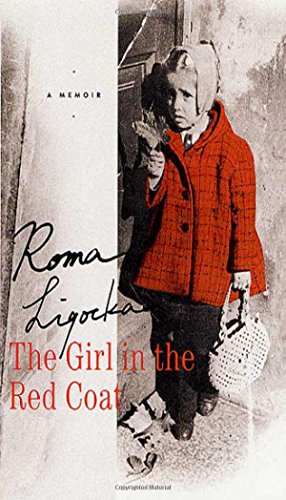
The Girl in the Red Coat: A Memoir

Roma Ligocka
The book opens with an elderly Jewish woman sitting in the elegant dining room of a posh hotel on the French Riviera. Suddenly and quite seamlessly it transitions to the dark Ghetto of Kraków, Poland during World War II and I was hooked!

Roma Ligocka was born to Jewish parents in Poland in November 1938, less than a year before the beginning of World War II. Told through the eyes of a child, the story of her early years living in the Jewish Ghetto of Kraków is a harrowing account of uniformed men in shiny black boots with snarling dogs, people being shot indiscriminately, her mother’s tears, and from her hiding place under a table, seeing her own grandmother seized by SS officers. After her father is arrested and taken to Auschwitz, Roma and her mother, with their hair dyed blonde and carrying falsified documents, escape the Ghetto and are taken in by a non-Jewish family who pass them off as visiting cousins. Sometime later, when her father escapes the concentration camp and is reunited with his family, she fails to recognize the haggard spectre that he has become.

Roma is just short of her seventh birthday when the war comes to an end, but her life continues to be marked by severe hardship. Within two years her father dies and the communists take control of Poland.

As her adult life unfolds, we see the results of the trauma that she endured as a child. Although she studied art and costume design at the prestigious Academy of the Arts and became a successful costume and set designer, she continued to confront her frightful memories and her adult life is characterized by anxiety, eating disorders, substance abuse and the inability to maintain lasting relationships.

Finally, at the age of 55, on March 2, 1994, Roma reluctantly attended the première of Steven Spielberg’s epic movie “Schindler’s List” in Kraków. The Academy Award-winning movie was shot entirely in black and white except for the image of a little girl in a red coat. Seeing something of herself in that little girl, Roma, who had had a bright red coat of her own as a wee child, finally felt inspired and strong enough to tell the story of her own experiences.

Interestingly, although I suspected it early on, until late in the book, Ligocka doesn’t reveal the fact that her cousin, Roman, with whom she had a close relationship, was none other than the famous director, producer, writer and actor, Roman Polanski.

Book of the month – April 2025

I often pick up books to read at the local thrift stores, so they’re not always recent releases. The book I’ve chosen for this month’s review was published in 2015.

The Hummingbird

Stephen P. Kiernan

This book is really three stories in one, each distinct, but all connected. Deborah Birch is a seasoned hospice nurse assigned to care for an embittered and lonely history professor whose career ended in academic scandal. As his life slowly ebbs away, the professor, an expert in the Pacific Theater of World War II, begrudgingly puts his trust in Deborah and begins to share with her an unpublished book that he wrote. As she reads to him from his story about a Japanese fighter pilot who dropped bombs on the coastline of Oregon, he challenges her to decide if it is true or not.
The chapters that Deborah reads to the professor alternate with chapters of the primary story. At first I found that disconcerting. I even wondered if it would be okay to skip those, but I’m very thankful that I didn’t as they are an essential part of the story. Like Deborah, I was soon drawn into the substory and wanted to know if it was factual. I even found myself searching the internet to find out!

At home, Deborah’s husband, Michael, has recently returned from his third tour of duty in Iraq. Suffering from PTSD and haunted by the faces of those he had to kill, he is a changed man. While gently helping the old professor die, Deborah also struggles to help her husband heal and to restore the loving marriage that they once had. It is through the professor’s book that she begins to understand Michael and how to help him conquer his demons.

The author does a masterful job of intertwining the three stories and tying them together. The Hummingbird is a powerful, thought-provoking book that deals very sensitively with human frailty, dignity in dying, the effects of war, and the healing power of love. Ultimately, it is a deeply moving story of forgiveness and redemption.

Often, when I finish reading a second-hand book, I return it to the thrift store for someone else to buy, but this one’s definitely a keeper!

Amsterdam by bus, boat, and on foot

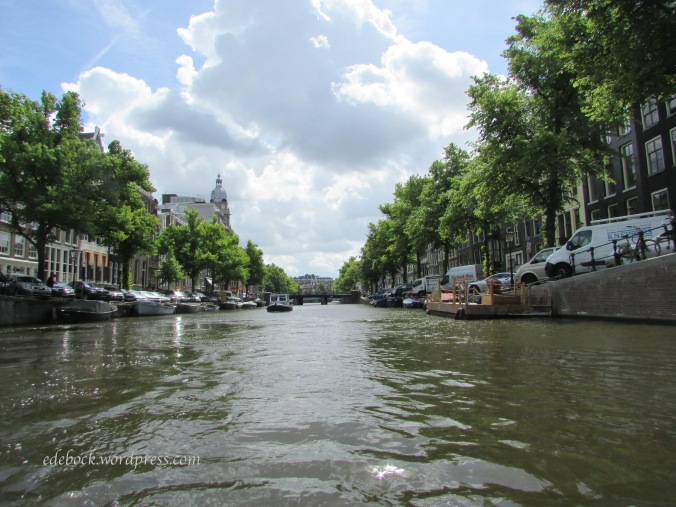
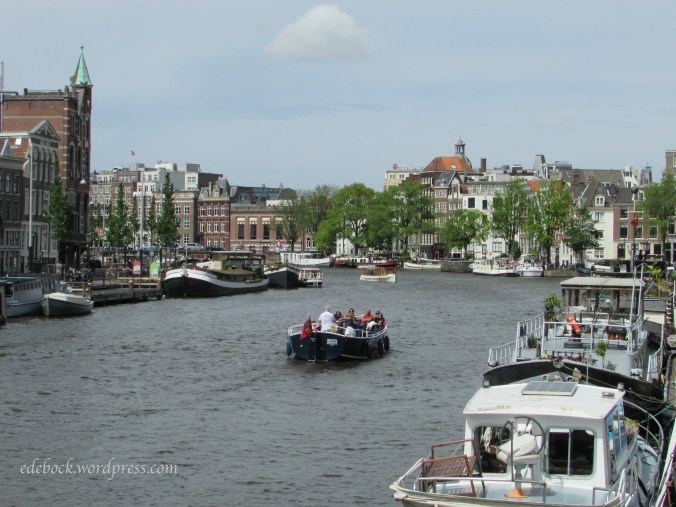
Just like the other European cities that we’ve visited, Amsterdam has major museums and galleries, but for our last two days before heading home, we were looking for something more laid back. We spent most of the day yesterday touring the city via Hop On, Hop Off bus and boat. We didn’t hop off a lot. We just took in the sights and got a feel for the city.

Amsterdam is sometimes called “Venice of the North” and actually surpasses Venice for number of canals. In fact, it’s the most watery city in the world with over 100 kilometres of canals and more than 1500 bridges.

IMG_9342

IMG_9346

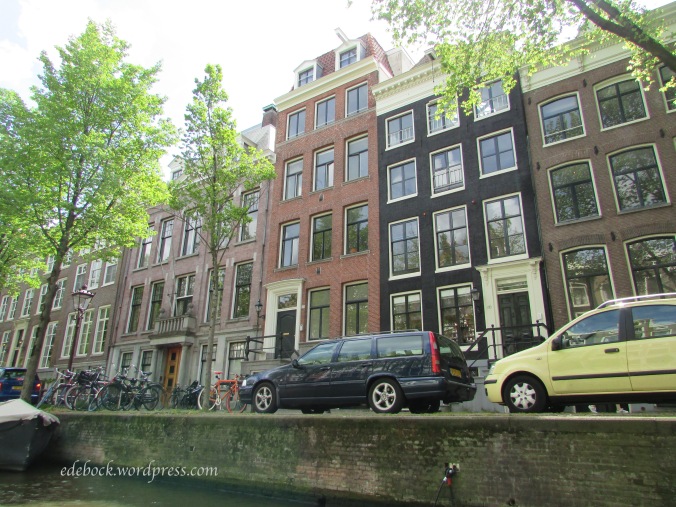
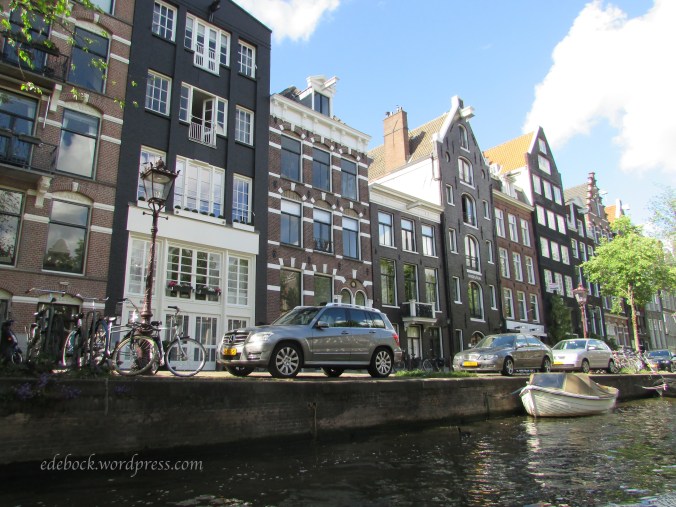
The tall elegant canal houses with their many different gable styles are so picturesque.

IMG_9357

IMG_9343

Did you notice the beams extending out from some of the gables? Because the houses are so tall and skinny, staircases are steep and narrow. Moving furniture up and down them is often impossible, so the beams have hooks on them and winches are used to lift heavy or bulky objects to the upper storeys. There are very few private canal homes anymore. Most either contain offices or have been divided up into apartments.

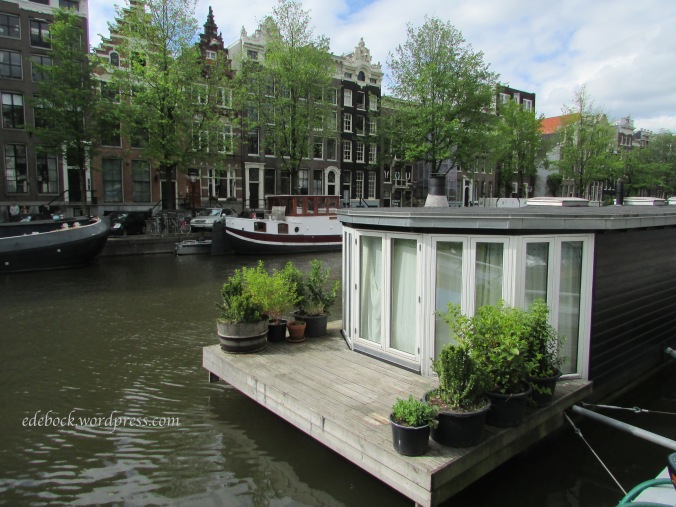
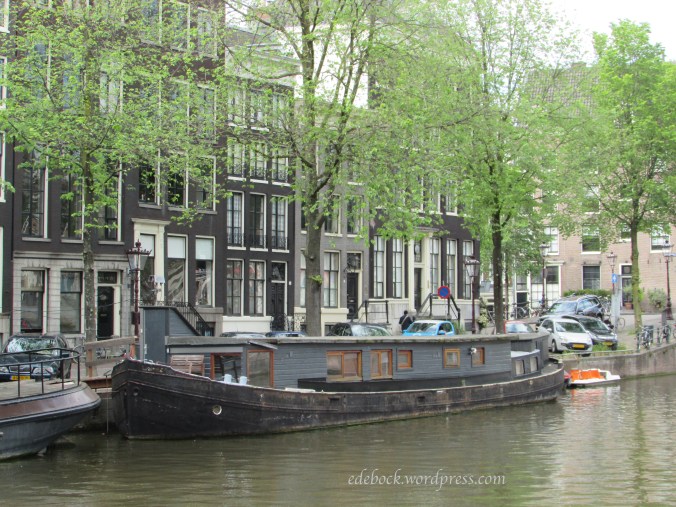
Houseboats also line the sides of many of the canals. Some were clearly built as floating homes while others are old canal boats that have been converted for the purpose.

IMG_9450

IMG_9452

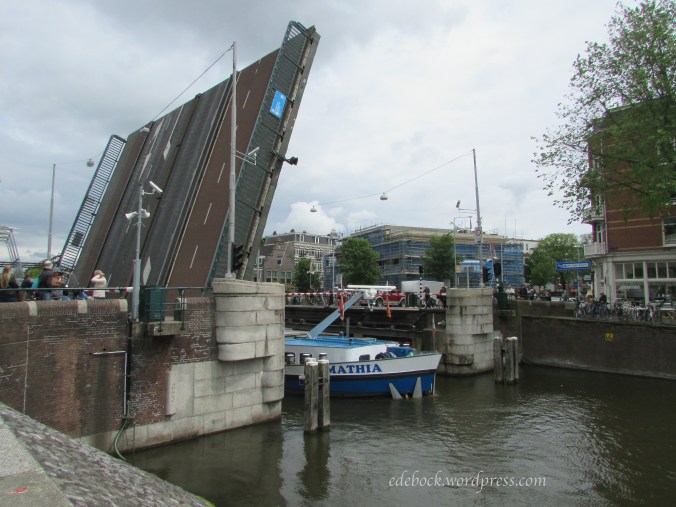
Watching canal bridges open to let larger boats through was interesting.

IMG_9394

After yesterday’s tour of the city we enjoyed supper at the very popular Pancake Bakery in what was once a 17th century warehouse owned by the Dutch East India Company. The restaurant is just 300 metres from the Anne Frank House where young Anne, her family, and four other Jewish people were hidden in a secret annex for 25 months before being discovered by the Gestapo on August 4, 1944. Only Otto Frank, Anne’s father, survived the war. Photography is not allowed inside the house, but I would urge anyone who visits Amsterdam to see it for themselves. It’s a sobering, but very worthwhile experience. Just be sure to book your tickets and time slot well in advance.

IMG_9365

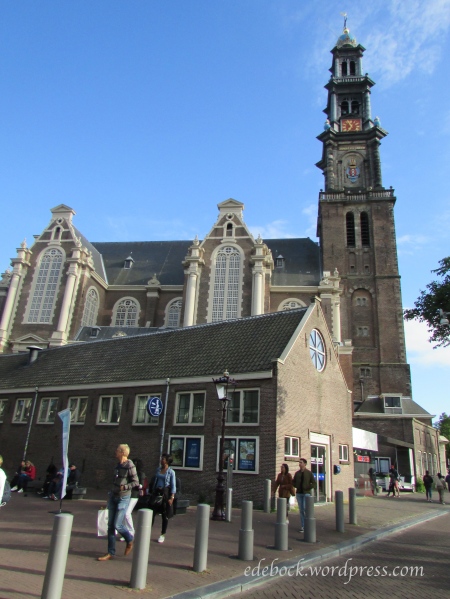
In her diary, Anne wrote about hearing the bells of Westerkerk, this nearby church, from the hiding place.

Before arriving in Amsterdam, we learned that there would be a nation wide public transit strike today. Buses, trams, and trains would not be running. As our hotel is some distance from the central part of the city, that presented a challenge. We didn’t want to spend our last day in Europe holed up in our hotel and we knew that taxis are expensive and that waits would be long, so we walked. And walked. And walked! According to Google Maps, we walked approximately 10 km! Fortunately, Amsterdam is flat!

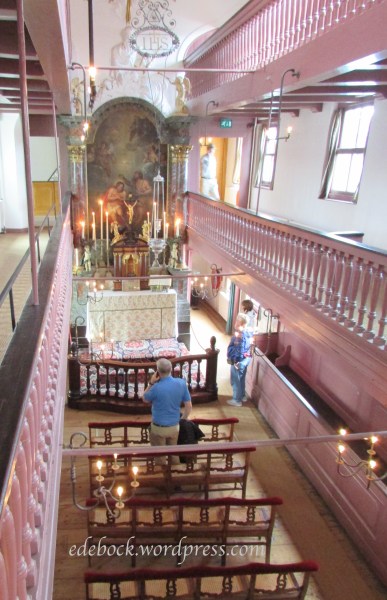
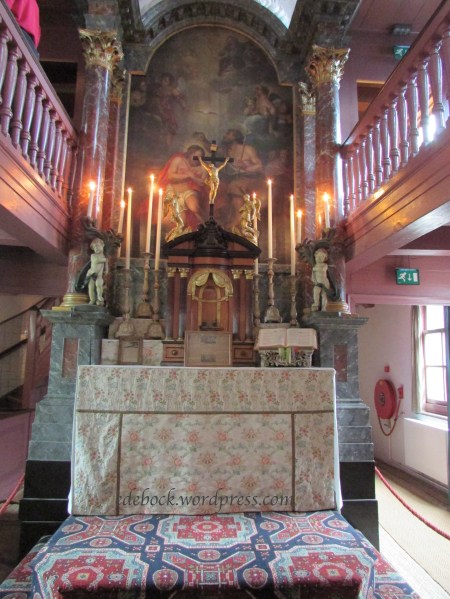
Our main goal was to get to Museum Ons’Lieve Heer Op Solder, also known as Our Lord in the Attic. Built in 1630, it looks like any other canal house from the outside, but inside it contains a hidden secret, a church in the attic! Roman Catholicism and other non Protestant faiths were banned in Amsterdam during the 17th century, so people turned to small house churches hidden from the public eye. The authorities knew that they existed, but looked away. Well-to-do merchant, Jan Hartman, came to Amsterdam from Germany in 1661 and bought not only the canal house on the Oudezijds Voorburgwal, but also the two houses behind it. He had the top floors of the three buildings connected and they became the spectacular attic church. The museum, complete with 17th century furnishings throughout the houses, provides an interesting and thought provoking glimpse into history.

IMG_9425

IMG_9419

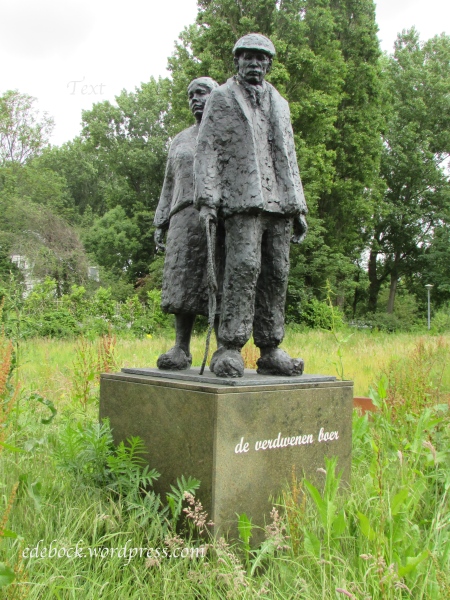
We saw some other interesting things on our long walk today. This statue is located just across the road from our hotel. The inscription, “de verdwenen boer” means the missing farmer. As Amsterdam grew during the last century, the city annexed surrounding villages. Families who had been farming here for generations were bought out or had their land expropriated and were forced to move. Children and grandchildren of these displaced farmers had the statue erected as a tribute to them.

IMG_9372

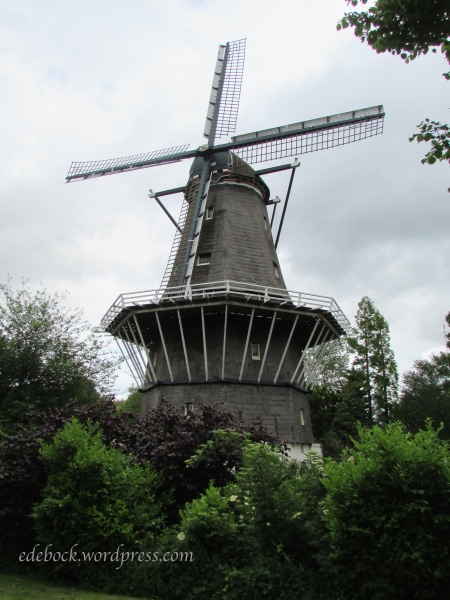
Windmills are almost synonymous with the Netherlands and there are still a few of them in the city. We saw one while on the bus tour yesterday, but I was able to get better photos of this one when we passed by this morning.

IMG_9376

While we enjoyed Amsterdam by bus, boat, and on foot, we didn’t try the most common form of transportation; bicycle. Everyone here seems to ride a bike. In fact, there are more bikes than people in Amsterdam and far more bikes than cars! There are fabulous bike lanes everywhere and there are even traffic lights for bicycles!

IMG_9379

Backroads of Belgium

At nine o’clock on Saturday morning the taxi dropped us off at the Avis car rental office in Bruges, Belgium where we picked up our wheels for the day, a brand new SEAT Ibiza with only 61 km on it!

IMG_9247

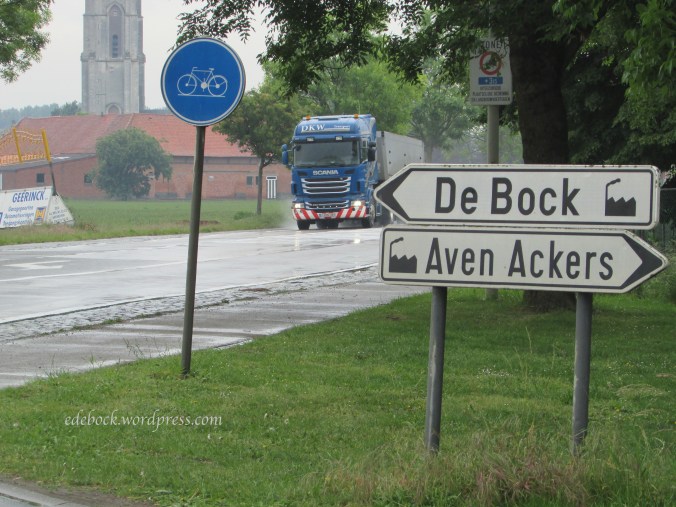
Sticking to smaller highways and backroads, we set off across country to the small community of Verrebroek, not far from Antwerp. It was from Verrebroek that Richard’s great grandfather, Joseph Leopold DeBock, emigrated to America as a young man. Here’s the very first thing we saw when we pulled into town!

IMG_9196

A bit of online research prior to our trip had taught me that there were large De Bock businesses in the area, but unfortunately they’re closed on Saturdays or we would have dropped in to say hello. Interestingly, the North American branches of the family that descended from Joseph Leopold spell DeBock without a space between the e and B while in Belgium it’s spelled with a space. We assume that, as often happened in the past, immigration officials probably made an error in recording Joseph’s surname when he arrived in the country.

We visited the Verrebroek cemetery and found a number of De Bock graves. Clearly, there must be an older cemetery somewhere in the area, but everyone we talked to directed us to the one we visited. One of the oldest graves there belonged to Leopold De Bock who was born in 1883 and died in 1960, no doubt a relative.

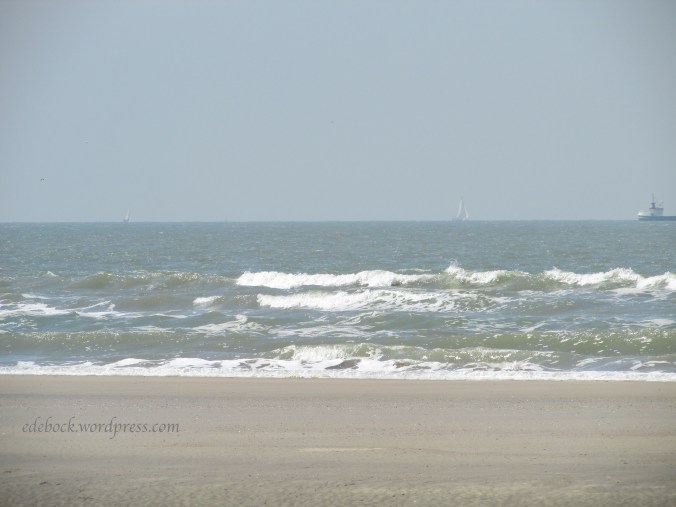
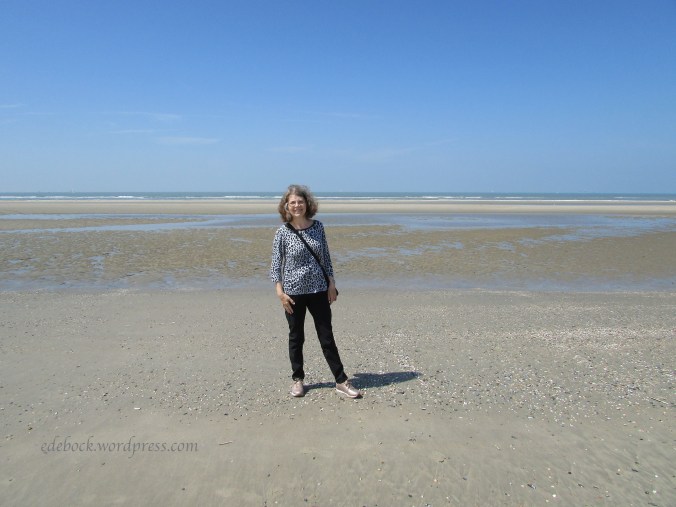
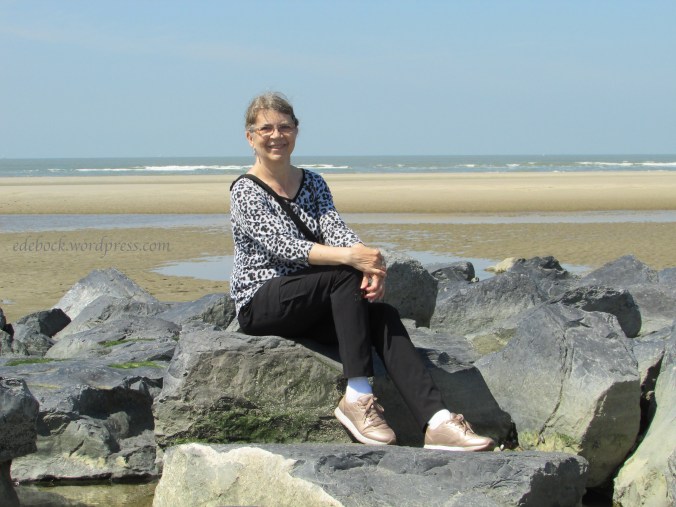
After eating lunch in a little sandwich shop in town, we set off again retracing our path partway back to Bruges and then turning toward the ocean and following the coastline. Just past Zeebrugge, we stopped to spend some time strolling on the wide expanse of sandy beach that seemed to go on forever. This misplaced coastal girl needs a bit of sea air once in awhile!

IMG_9246

IMG_9241

IMG_9238

IMG_9227

IMG_9237

Everywhere we went in Belgium, we saw bright red poppies blowing in the breeze. I took this picture beside the road where we parked when we visited the beach. As I walked the sandy beach trail, I recited bits of John McCrae’s famous poem, In Flanders Fields. Little did I know that within a couple of hours, I’d be standing by his grave!

IMG_9220

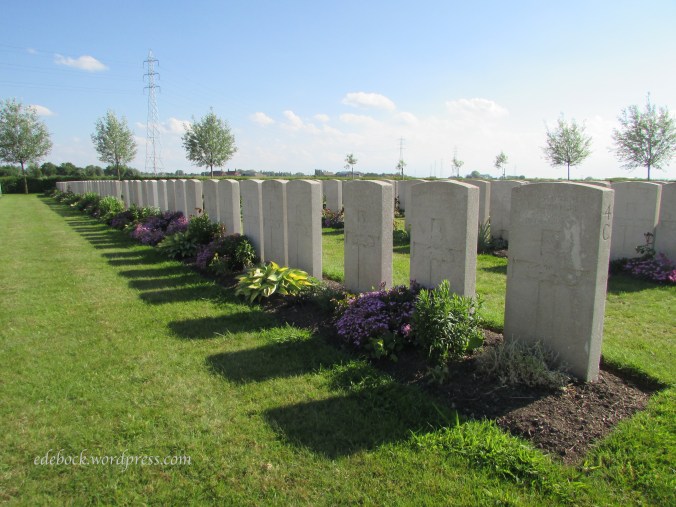
Just past Oostende we turned inland again and headed toward Ypres. Belgium is a beautiful country; a lush coastal plain where we saw sheep, goats, and dairy cattle and small fields in every stage of growth from recently seeded to approaching harvest. The easiest crop for us to recognize was the bright yellow canola in bloom. Belgium hasn’t always been so pastoral though. Our main purpose for visiting Ypres was to see the World War I cemetery there, a sober reminder that the beautiful countryside has been torn by war on more than one occasion. We weren’t sure how to find the cemetery, but suddenly before we reached the town, there it was.

IMG_9288

IMG_9274

IMG_9256

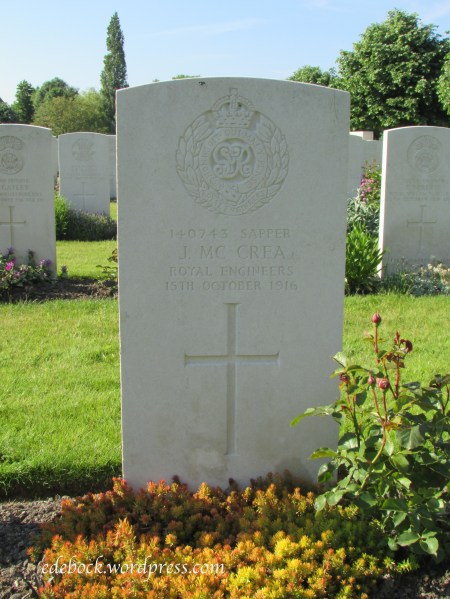
It would take hours to read every headstone and many of them are weathered to the point where it’s difficult to make out the names, but of the ones I read, there were some that stood out to me.

IMG_9295

“A Soldier of the Great War”

Like the other unidentified soldiers in the cemetery, the inscription at the bottom of the headstone says “Known Unto God”. All that is known for sure is that this young man was a member of the 72nd Canadian Infantry Battalion. Whose son was he? Whose brother? Which family was left wondering what had become of their loved one? Where his body lay?

IMG_9271

These three newer headstones stand separately at one side of the cemetery and don’t actually mark graves. They have names on them, but the one on the left says “Known to be buried in this cemetery” across the top and the other two say “Believed to be buried in this cemetery”.

IMG_9277

This one says “Ein Unbekannter Deutscher Krieger” (an unknown German warrior). He was the enemy, but he was also someone’s son, someone’s brother. In death they’re all the same.

Visiting the cemetery and seeing the graves of so many young men was sobering, but realizing that a kilometre or so down the road, there was another one with more than 1200 more graves in it was overwhelming. This was the Essex Farm cemetery and it was in this vicinity that Doctor John McCrae penned his famous poem while working at the medical station that had been set up there. It was also here that I found his grave.

IMG_9297

Just over the rise behind the Essex Farm cemetery is this beautiful scene, but notice the white sign on the nearest tree.

IMG_9321

Here’s what it says:

IMG_9318

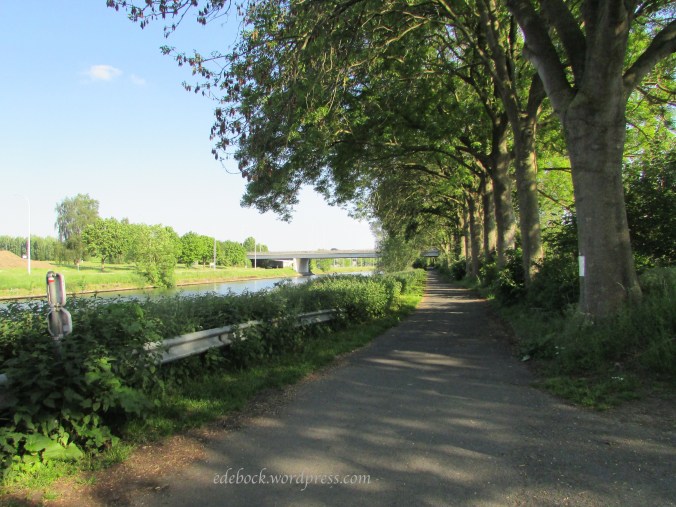
When we left the second cemetery, we turned back toward Bruges. We returned the car 11 hours and 327.5 km after picking it up. With the help of a paper map and the vehicle’s navigation system which didn’t speak any English, we’d covered a significant portion of Belgium and managed not to get lost!

Remembrance

Imagine looking out the window of the family farmhouse at Seba Beach, Alberta and seeing the military vehicle pull into the yard. Pearl’s heart must have pounded as the men in uniform came up the walk with a telegram in hand. It was 1944 and three of her sons were in the midst of battle in Europe. Which one was it? Had she lost one of them?

telegram

Glen was my father-in-law. He enrolled in the army in October of 1943 and was deployed in early January of the following year. He was just 18 years old.

We don’t know a lot about his wartime experiences. Like many who saw the gruesome face of war firsthand, he didn’t talk much about what he went through over there. We’ve only been able to piece together bits and pieces from the few things he did say and more recently, from his military record which our son requested from the Canadian Archives in Ottawa. We do know that he once spent several days in a foxhole behind enemy lines waiting to be rescued and we know that he probably suffered from what is now known as post traumatic stress disorder. According to Mother, for the rest of his life he would occasionally wake up cowering on the floor beside the bed. He was back in that foxhole terrified that, at any moment, an enemy soldier would find him and his life would be over.

Father had been in Europe for only nine months when he was seriously wounded and unable to return to action. A second telegram dated October 19, 1944 brought the incorrect news that the nature of his injury was “bomb fragment wounds to face and head.” A letter dated November 27, 1944 contained more accurate information.

“I am directed to inform you that official information has now been received from Canadian Military Headquarters Overseas advising that when your son, M-8247 Pte. Glen Marion DeBock, was wounded in action on the 6th October 1944, he suffered a bullet wound to the right orbit into the sphenoid sinus resulting in the loss of the right eye.”

He was lucky to be alive. Imagine taking a bullet to the head and surviving! He spent the remainder of 1944 in hospitals in the UK followed by another three months in Shaughnessy Hospital in Vancouver before finally being discharged with a prosthetic eye.  Life would never be the same for this young farm boy, however. He often suffered excruciating headaches and like many of his compatriots, he took to drowning his vivid memories in alcohol. It wasn’t until the final years of his life that he gave up drinking and found peace in a personal relationship with Jesus Christ.

On November 11, as we pause to remember, we give thanks for so many young boys who went off to war with high ideals and ended up paying for our freedoms with their lives; many making the ultimate sacrifice and others, like Father, surviving with shattered dreams and broken bodies. In reality, these are the men who gave us freedom of religion, freedom of speech, and all the other freedoms that we take for granted in this great land.

Let us never glorify war but let us remember those who were willing to go and fight on our behalf and those who continue to do so.

shortly after discharge      Picture 1

Kids helping kids

We went on our second Mission to MARS this week!

That’s right! Two years ago, on the island of Saipan, we directed a Vacation Bible School program with an outer space theme. This week, we brought the same program, Mission to MARS (Meet A Risen Savior), to our own local church. Every morning approximately 30 excited children between the ages of 5 and 12 gathered for games, crafts, songs and Bible stories.

One of the verses that they learned was 1 Chronicles 16:29 which speaks of bringing an offering. With this in mind, we wanted to incorporate a Missions project that the children could identify with and contribute to throughout the week.

MARS
The escalating civil war in Syria has left an increasing number of families in chaos. According to the United Nations, an estimated two million refugees have fled into Lebanon, Jordan, and surrounding countries while more than four million people have been displaced within the country itself.  Schools across Syria are closing as children and families flee dangerous areas, and the public schools in Lebanon and Jordan are overcrowded. They simply can’t continue to absorb the number of refugee children who are flowing in. Many Syrian children have already lost a year of school due to violence and transition.

The Church of the Nazarene runs four schools in Jordan, Syria, and Lebanon. These schools are in neighborhoods where Syrian refugees and internally displaced people are struggling to survive but they can’t operate without funding. Many displaced, traumatized families have little or no income and are unable to pay school fees.

With the beginning of a new school year just around the corner, this was an issue that our VBS kids were easily able to identify with and they amazed us with their compassion and generosity.

  • $400 will enroll a Syrian child in a Nazarene school for an entire year
  • $100 will provide books and clothes for the school year
  • $45 will support a child’s school fees for one month

My faith was small. When I made up the poster shown below, I set $100 as our goal for the week but with the help of the church’s mission committee who agreed to match the children’s offerings dollar for dollar, we surpassed that amount on Wednesday! I was going to add another column to the poster that evening but one of our older girls suggested that I’d better make that two. Even that wasn’t enough! After taking this morning’s offering and adding in the matching amount from the missions account (shown in teal on the poster), we had raised $335.10!

IMG_3094

In a country where we take so much for granted and where most children will soon go off to school wearing brand new clothes and carrying backpacks stuffed with shiny new supplies, it was gratifying to spend the week with kids whose hearts were touched by the plight of boys and girls in a faraway land whose lives have been uprooted by the tragedy of war.