Why traveling together is good for your marriage

I inherited my wanderlust from my parents who visited 66 countries together, mostly during their retirement years. When I was a child, we took long holidays as a family. We drove the west coast as far south as San Diego and traveled north all the way to Alaska. When I became a teacher, my plan was to spend my summers traveling, but hubby had different ideas. Growing up, his summers were spent working on the family farm. He’d only ever been on one short holiday to visit relatives. He wanted to spend his summers at home playing ball, golfing, and going to the beach.

Marriage meant compromise, but I knew that I wouldn’t be happy if I couldn’t travel. Before we tied the knot, I told him that I would be spending part of each summer traveling. It was something that I simply had to do. He was welcome to join me, but if he’d rather that I went alone and he spent that time pursuing his own interests, I was okay with that. Thankfully, he chose to join me and we have enjoyed so much of the world together! We’ve also learned that traveling together is good for a marriage.

Travel teaches you teamwork and communication skills.

While I do most of our travel planning, I always consult with hubby about major decisions like which flights to take or where we should stay, but there are also small day to day choices to make. Should we walk or take the bus? Where should we go for lunch? It’s often these little things that require clear communication and test our ability to compromise.

Travel teaches you how to work together to overcome obstacles.

When you’re travelling together, problems are shared. When we failed to get off the train at the right stop in Germany last week, we put our heads together and figured out how to get to our destination (with the help of a very kind gentleman). Having had a similar experience in Japan many years ago, I’m sure that either one of us could have dealt with this minor mishap on our own, but it’s so much better when you have someone to share the momentary panic with!

Traveling as a couple teaches you to be more patient with one another and with yourself.

When you’re together 24/7 in an unfamiliar environment, especially one where English isn’t the first language of the people around you, there are bound to be moments of frustration. Whether it’s figuring out directions, handling delays, or trying to figure out how to buy tickets for the train, we’ve learned that there’s always a solution to every problem. Sometimes finding that solution just requires a little patience.

Shared adventure adds spark to a tired relationship.

When a couple gets married, going on a honeymoon allows them time to be fully present with one another and to delight in each other’s company. In time, however, the distractions and busyness of daily life take over. Work, family, household chores, and individual interests often leave little time for one another. Traveling together offers a couple a chance to reconnect and to enjoy uninterrupted time together. The destination is less important than the simple act of spending time together and getting away from the noise of daily life. Even an occasional weekend getaway together can help reinvigorate your relationship.  

Finally, travel gives you lasting memories to share.

Some of our most cherished memories have been made while traveling together. There are big moments like our first glimpse of the terra cotta warriors in Xian, China or seeing the golden Dome of the Rock in Jerusalem come into sight for the first time, but there are others that were also amazing moments for us. Memories like staying in a very basic $12 a night guesthouse in Siem Reap and taking an early morning tuktuk ride out to Angkor Wat to watch the sun rise over the enormous temple complex. Memories of traveling the length of Vietnam on overnight buses and arriving in Saigon late on New Years Eve without a place to stay! We even love to reminisce about the time that we accepted a ride from a total stranger in the middle of rural China! Not necessarily recommended, but it was an amazing experience! You can read about it here.

With all the traveling that we’ve done together, you’d think that I’d have more photos of the two of us, but I love this one taken in Heidelberg last week, so I’ll share it again.

A very long short month

Winter in Canada is long and cold with short hours of daylight. I always start to feel very confined by this time of year and the pandemic has definitely added to that. February might be the shortest month of the year, but this one has felt very long!

The recent rebellion in our capital city and at border crossings across the nation followed almost immediately by Russia’s attack on Ukraine have added to my gloom. The so-called Freedom Convoy in Ottawa and blockades at the border so disgusted me that I pretty much avoided the news for awhile. I blocked so many sources and unfollowed so many people on Facebook that my newsfeed became almost boring! Believe it or not, one person posted something yesterday suggesting that news about the invasion of Ukraine is just meant to distract us from the injustices happening in our own country and we need to be alert! What? Are you kidding me? With that kind of thinking swirling around me, is it any wonder that I feel like burying my head under a blanket and ignoring the whole wide world?

Unfortunately, at least in my opinion, in spite of the fact that Covid is far from over, our provincial government has decided to give in to the protesters and as of tomorrow almost all health restrictions will be lifted. Many are celebrating and I understand the feeling, but for some of us, that means less freedom, not more. I’m not immunocompromised and I’m triple vaxxed, but I’ve fought too hard for the past eight and a half years to stay alive and well to put my health at unnecessary risk, so I’ll still be wearing a mask and avoiding close contact, especially with the unvaccinated.

Not being able to travel has definitely added to my frustration. At our age, we definitely feel like our time clock is ticking and opportunities are passing us by. In their retirement, my parents visited 66 countries. Earlier this month, I spent some time reading through the journals that my father kept when they traveled; everything from short two or three day trips to nineteen months wandering Asia, Europe, and the Middle East, living most of that time in their Volkswagen camper van. Reading about their adventures was the next best thing to traveling myself and took my mind off current events, but it also reignited my wanderlust thus adding to my frustration.

A few days ago, realizing that my current state of mind was not a healthy one, I looked back at two of my earlier posts, one written in September 2020 about hitting the Covid-19 wall and the other, written seven months later, about languishing.

hitting-the-wall-resize-1

I realized that my feelings of frustration and discouragement weren’t entirely new. I’d been there before. I got over the wall on those occasions and I would again. In the meantime, I decided to look back over the very long shortest month and think about the positives. What were some good things that happened this month?

  • I read eight books; three novels, three memoirs, and two non-fiction books. That’s double the number that I usually read in a month.
  • I may not be able to visit yet, but I started chatting online with our friend, Richard M, who lives in Mexico in Spanish! My daily online language lessons are beginning to pay off.
  • I edited 53 Kiva loans, significantly more than the 40 a month that I committed to when I took on the volunteer position.
  • After seeing a physiotherapist on February 1, I’ve revamped my morning exercise routine, started a new lifting program, and I’m back on the treadmill regularly.
  • Walking in town is treacherous due to icy conditions, but we discovered a mostly unused road not far from town where we can walk safely and enjoy a breath of fresh air when the weather isn’t too cold.
  • I’ve tried several new and delicious recipes using the InstantPot that I received for Christmas.

Mental stimulation, learning something new, doing something for someone else, physical exercise, fresh air, eating well… all of these are key to getting through the doldrums that may, at times, seem overwhelming. The fact that the days are becoming noticeably longer also reminds me that spring is coming and better days are ahead!

The next little while will be busy with another whirlwind of medical appointments. Hospitals and clinics aren’t my favourite places to hang out, but at least they’ll still be following Covid precautions! Sometimes you just have to look at the bright side!

Hitting the Covid-19 wall

hitting-the-wall-resize-1

Do you feel like you’ve hit a wall where Covid-19 is concerned? Have you simply had enough with all the restrictions imposed by the pandemic? I know I have!

I admit that as retirees, we’ve had it easier than many. We don’t have jobs or a business to worry about or children at home. My father, our last remaining parent, passed away ten days before the World Health Organization declared the rapidly spreading coronavirus outbreak a pandemic, so we don’t have elderly parents in care facilities to worry about. Nevertheless, I’ve definitely hit the proverbial wall. Like many others, I’m tired and frustrated.

Experts tell us that this isn’t unusual. Dr. Aisha Ahmad, Associate Professor of Political Science at the University of Toronto who has has conducted fieldwork on conflict dynamics in Afghanistan, Pakistan, Somalia, Lebanon, Mali, and Kenya, recently summed it up this way: “The 6 month mark in any sustained crisis is always difficult. We have all adjusted to this “new normal”, but might now feel like we’re running out of steam. Yet, at best, we are only 1/3 the way through this marathon. How can we keep going? First, in my experience, this is a very normal time to struggle or slump. I always hit a wall 6 months into a tough assignment in a disaster zone. The desire to “get away” or “make it stop” is intense. I’ve done this many times, and at 6 months, it’s like clockwork.”

With the pandemic dragging on and no end in sight, it’s easy to become discouraged. In our part of the world summer is over. The days are getting shorter and the hours of darkness longer. We’ve enjoyed beautiful fall weather throughout the month of September, but the long cold winter is just around the corner. People will soon feel more shut in than ever. Add to that the fact that Thanksgiving is almost upon us (we celebrate it in October in Canada) and not long after that, Christmas. Those are times when families usually come together to celebrate, but much of the spread of Covid-19 over the summer has been the result of family gatherings. There’s a lot of uncertainty in many families about how to observe these holidays this year. 

One of my greatest sources of frustration is the urge to travel. It may not make sense to a lot of people, but wanderlust (a deep, uncontrollable desire to travel and explore the world) is real. With interprovincial travel discouraged and international borders closed, I’m beginning to feel trapped. Yesterday, I jumped in the vehicle and drove down country roads just to try to appease that feeling! 

Then there’s frustration over the divisiveness of this thing. With more than 1 million deaths due to Covid worldwide, there are still those who believe that it’s a hoax or a conspiracy cooked up by “the” government to take control of our lives. I still haven’t figured out which government they’re referring to or why they think that all the governments of the world would come together to destroy their own economies! I was actually told yesterday that it’s all a plot to derail the upcoming election in the United States! What ever happened to calamity drawing people together? It certainly hasn’t happened this time! 

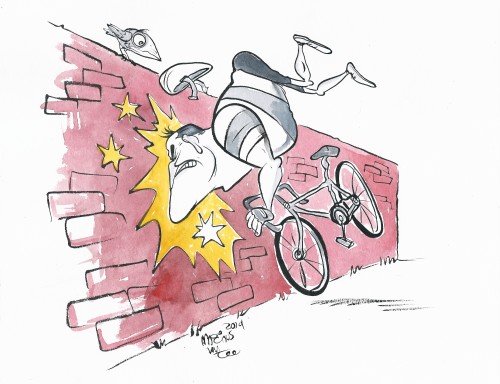
Anyway, enough of my ranting! Thankfully, Dr. Ahmad also offers hope. “This is my first pandemic, but not my first 6 month wall. So, what can I share to help you? First, the wall is real and normal. And frankly, it’s not productive to try to ram your head through it. It will break naturally in about 4-6 weeks if you ride it out.” I sure hope she’s right! 

In the meantime, what can we do to help alleviate that hitting the wall feeling? Nicole Haughton, a registered psychologist based in Toronto, suggests that that maintaining a proper diet, exercising regularly, going out for fresh air, and engaging in spiritual practices or mindful meditation can be beneficial to mental health during this time.

For me, writing about my feelings is cathartic, but here are a few other suggestions:

  • Give yourself something to look forward to. I can’t plan a major trip right now, but I can plan an overnight getaway for our upcoming anniversary. 
  • Step back from social media and limit the amount of news you consume. I definitely need to take this one to heart!
  • Clean out or reorganize something. It could be the kitchen cupboards, a closet, a filing cabinet, or the garage. The simple act of bringing organization to chaos where we’re able to can be very freeing. I did a lot of this back in the early days of Covid-19, but it’s been awhile. Now it’s time to do my seasonal wardrobe switch and reorganize my closet for winter. Having some “new” clothes to wear might also be a pick me up. 
  • Start a gratitude journal. It’s easy to spiral into negativity, but even in these strange and somewhat difficult days, we all have much to be thankful for.  

Finally, psychologist, Dr. Heather McLean, asks her clients to rate themselves on this scale and tells them, “If you see you are on the low end of any of these these, get busy and problem solve, think outside the box, and ask others for help on how to fix it.” 

Screen Shot 2020-09-29 at 11.50.11 AM

Though the pandemic is likely going to be with us much longer than anyone hoped or predicted, I do trust that it will come to an end. For now, I just need to focus on getting through this blasted six month wall instead of bashing my head against it!

The notion of “home”

When and where are you truly at home?

Except for short stints of five months to a year spent living in Asia, I’ve lived in the same small Alberta town for more than four decades, but there’s always been deep within me a yearning to be somewhere else, to be traveling, to see new places. The dictionary calls it wanderlust.

When I did live overseas for a time, it sometimes felt almost surreal. I remember walking the streets of Funabashi, Japan shortly after our arrival there and marvelling that this place, so foreign, so different, and yet so fascinating was actually my home. I lived there!

IMG_1050

Funabashi

img_1059

The view from our apartment

A friend who has been an expat for almost six years, living in China, Cambodia, Vietnam, and now Mexico, recently said this: “I am very comfortable here, but every once in a while, say, once in six months, I will be out walking in my lovely colonial town, which looks nothing like what I grew up with, and all the sounds I hear are in a language which I did not grow up hearing, and it is like I am in some kind of strange dream place, and I wonder what is going on.” That got me thinking about the notion of “home.” What makes a place home and why is it that I always have that yearning to go somewhere else, to see someplace new?

I have a theory about why I feel this way. In the New King James Version of the Bible, 1 Peter 2:11 calls us “sojourners and pilgrims.” The New International Version translates it “foreigners and exiles.” The writer of Hebrews says that “we are looking for the city that is to come” (13:14), “longing for a better country—a heavenly one. (11:16) At best, we are temporary residents here. We are pilgrims on a journey. While there is much to be experienced and enjoyed along the way, I believe that there is deep within me a longing for that eternal home. That, I believe, is the source of my wanderlust, the reason that I could probably settle almost anyplace and yet not truly feel at home anywhere.

Interestingly, I was in the middle of sorting through my thoughts and had already started writing this post when I attended the funeral of a long time resident of our small community. Though she was only 71 years old, the lady who passed away had suffered debilitating illness and endured a great deal of pain in the final years of her life. In his message, entitled “Home Sweet Home”, the pastor told us of her readiness to go “home.” He referred to 1 Corinthians 5:1. “For we know that if the earthly tent we live in is destroyed, we have a building from God, an eternal house in heaven, not built by human hands.” Our bodies are but tents, temporary dwellings! Like refugees, we live in them until the time comes when we can go to a more permanent home.

Don’t get me wrong; I’m not in any hurry to vacate my tent! In fact, with the help of medical professionals, I’m doing everything I can to keep it intact. Though life is often far from easy, it’s a wonderful thing to be able to enjoy all that we’ve been blessed with during our sojourn here on earth and I’m in no hurry to see that come to an end! I’ll have all of eternity to enjoy my heavenly home. In the meantime, I will continue to wander this globe, perhaps never feeling quite at home, but marvelling at all the good things that this life has to offer.  There is, after all, a lot of world that I haven’t yet seen!