Dandong, gateway to North Korea

Friday’s anticipated four hour bus trip to Dandong turned into more than five when it took an hour and a half for the bus to wend it’s way through congested holiday traffic and get out of Dalian! We were riding on a modern long distance bus, however, so it wasn’t too gruelling. Once outside the city, the four lane highway was in great shape all the way so it was a comfortable ride. Signs along the highway were posted in both Chinese characters and Pinyin (the system used to transcribe Chinese characters into Roman script) with occasional signs in English as well. I found it cute that the right hand lane was labelled Carriage Way and the left, Overtaking Lane but the sign that we enjoyed the most was the one warning drivers Do not drive tiredly!

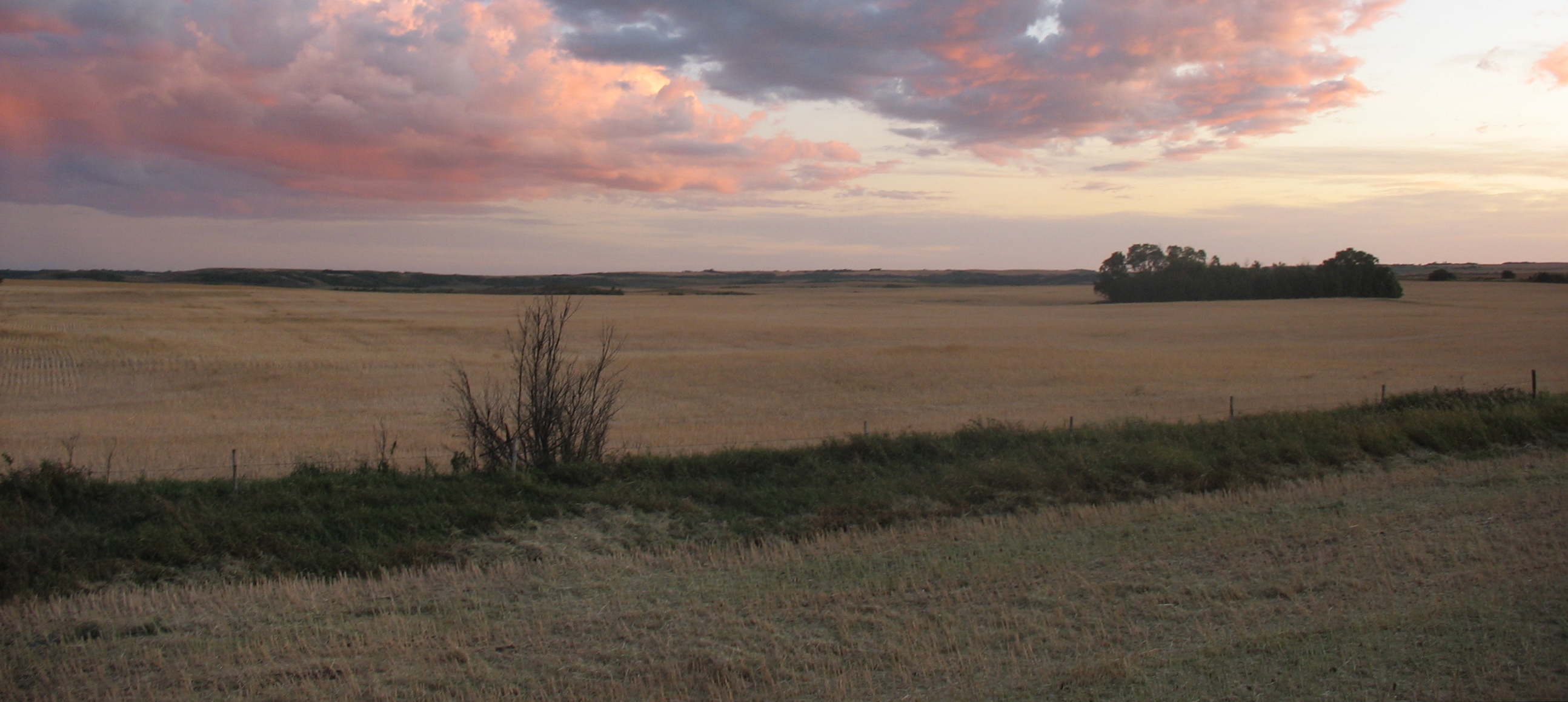
Liaoning Province is largely agricultural so we rode by many orchards, fields, rice paddies and a vast number of greenhouses. Work has just begun in the fields and everything that we saw happening was being done by hand. With the exception of one donkey and two horse-drawn carts, we didn’t see any livestock.

When we arrived in Dandong, it took awhile to figure out where and how to purchase our return tickets. It’s a good thing we did that right away though as many of yesterday’s buses were already sold out and the earliest one we could get on didn’t depart until 3:15 in the afternoon. The language barrier was a hindrance, of course, but as always, people were extremely helpful, particularly the young security guard at the bus station who, when we asked for directions to our hotel, walked us all the way there, a distance of 3 or 4 blocks!

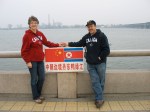
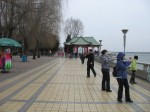
After settling in and having a late lunch in the hotel restaurant, we set off on foot for the Yalu River which separates Dandong’s lively riverfront promenade from the more desolate looking city of Sinuiju, North Korea on the other side.

China is North Korea’s only major economic supporter and Dandong, a city of about 750 000 people and the principal gateway between the two countries, thrives on trade with North Korea. We watched trucks rumble slowly across the Sino-Korean Friendship bridge which is the official border crossing.

Pedestrians are not allowed on the bridge and we actually saw Chinese soldiers escort a couple back to the Chinese side of the bridge. Perhaps they were simply on the wrong bridge. In 1950, during the Korean War, American troops bombed the older bridge between the two countries in an attempt to cut off Chinese supplies to North Korea. The North Koreans dismantled the mangled end of the bridge leaving only a row of support columns standing in the river. The Broken Bridge stands next to the Friendship Bridge and is open to the public who want a closer view of North Korea. Admission to the bridge is normally 27 yuan but when we noticed that seniors over the age of 60 with an ID card qualify for a lower price, I decided that we should show the ticket agent our resident permits to see if they would give us the reduced rate. Sure enough, we were admitted for only 10 yuan each or approximately $1.60 Canadian!

The Broken Bridge wasn’t the nearest that we got to North Korea nor was Dandong itself our main reason for heading north on our three day break from school. Rather than making this post too long, however, I’ll be breaking it into a series. Come back tomorrow to find out the biggest reason we chose Dandong as our destination. For the moment though, let’s just say that it was Great and truly unforgettable!

Tomb Sweeping Day

Tomorrow, April 4th, is Qingming Festival in China. Pronounced Chingming and known as Tomb Sweeping Day in English, this is a day to honour dead ancestors by travelling to the family tomb to sweep, clean and place flowers and offerings of food and drink on the grave.

Burning paper that is meant to resemble money in hope that the deceased is not lacking anything, is also a common practice; so common, in fact, that the authorities are urging people to take precautions and not allow fires to get out of control. Apparently, across China, a total of 520 million people visited their ancestors’ tombs during last year’s festival and 200 forest fires were reported during the three day holiday!

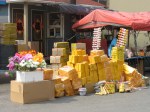
This week, we see huge stacks of the gold coloured paper everywhere. Looking something like fancy paper napkins, it’s piled in the marketplace and outside stores waiting for people to purchase it and burn it, sometimes on the graves but not always. Paper burning was also part of the Lantern Festival that took place at the end of the Chinese New Year celebrations. That night, as fireworks exploded overhead, bonfires lined the streets outside our building and we already saw a couple of people burning a pile of the paper a couple of evenings ago on the sidewalk directly across the street from where they purchased it.

In addition to remembering dead ancestors, in modern times Qingming has also been seen as a time to pay respects to those who’ve died in incidents considered sensitive in China, incidents such as the Tiananmen Square massacre that took place in Beijing on Tomb Sweeping Day in 1976.

Qingming is celebrated on the 104th day following the Winter Solstice or the 15th day after the Spring Equinox. In addition to being a time of remembrance, it’s also a time to celebrate the coming of spring and in farming communities, it marks the time to begin plowing and seeding. Outdoor pursuits including kite flying are popular Qingming activities. Though spring seems a little late this year, the past couple of days have been the warmest since we arrived in China. The grass is finally starting to turn green and I was delighted to notice tiny buds on one of the trees we passed on our walk this afternoon.

We hope that the beautiful spring weather continues for the next few days as we’re off to Dandong for our three day Tomb Sweeping holiday. Dandong, a 4 hour bus trip north of here, is located just across the Yalu River from North Korea but more about that when we get back!

The heart of the city

We’ve spent the last couple of Sundays with students but today we were on our own so we decided to explore the heart of downtown Dalian.

In spite of the fact that Dalian is a city of some 3.4 million people, it’s quite compact and easy to get around by bus. Since almost everyone lives in an apartment and there are virtually no single family dwellings, it’s not a sprawling metropolis like a lot of North American cities are.

We started our day by catching a bus to the train station. Long-distance buses depart from various points around the station so we scouted around and figured out where the buses to a couple of the places we’re hoping to visit in the not too distant future leave from. Once we’d found what we were looking for, we set off on foot for Zhongshan Square stopping for lunch along the way.

KFC and McDonald’s are probably the most popular western fast food restaurants in Asia. They seem to be everywhere. I think the last time we ate at KFC was in December 2008 in Hanoi, Vietnam. We don’t eat at KFC in Canada and hadn’t really planned on it here either but we’d both reached the point where we were craving a meal that didn’t involve either rice or noodles and the KFC that we passed on the way to Zhongshan Square was just too unique to pass by!

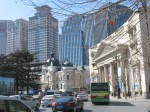
Zhongshan Square (which is actually circular) is the hub of Dalian’s business district. With ten roads radiating out from its central roundabout, it is encircled by ten buildings dating from the early 1900s that have been declared cultural heritage buildings under the protection of both the Chinese government and the Dalian municipal government. Though the central part of the square is undergoing reconstruction at the moment, I was so enthralled by the classical architecture surrounding it that I hardly noticed. We walked the entire circle admiring each of the stately buildings and remarking on the contrast with the much more modern structures that formed a backdrop for them before continuing our walk north along Shanghai Road toward Russian Customs Street.

Dalian was originally a Russian seaport. In 1898, the Russian Empire leased Liaoning Peninsula from the Chinese Qing dynasty and laid out a modern city that they named Dalny. After the Russo-Japanese war in 1905, Dalny was yielded to Japan and its name became Dairen. Prior to the unconditional surrender of Japan in August of 1945, Dairen was liberated by the Soviets who once again governed the city until it was presented to the Chinese Communist government without any compensation in 1950. Dalian’s many squares with their sculptures, lawns and western-style fountains were constructed by Russian architects who were enamoured with French culture and design.

Russian Customs Street retains some of the flavour of Dalian’s Russian days but I was disappointed by the aggressiveness of the many vendors hawking Russian stacking dolls and other cheap souvenirs. I’m not sure if any of them were genuine. I did purchase a cute scarf but it was made in Taiwan!

From Russian Customs Street it was a short walk back to the train station to catch a bus back home where we’re spending a quiet evening resting our tired feet!

Things are different here!

We’ve spent quite a bit of time in Asia over the past few years. As a result, we haven’t really experienced culture shock since arriving in China but there have definitely been some surprises. In no particular order, here are a few random differences that we’ve noticed so far.

  • Waking up in the middle of a densely populated city and hearing a rooster crow! We haven’t figured out where the rooster resides but we did see a chicken wandering beside the street one day. I wonder if it ended up in someone’s cooking pot?
  • Two or more girls walking arm in arm or holding hands. This is extremely common amongst women of all ages and is nothing more than a sign of friendship. I quite like it.
  • Spitting! Everywhere. All the time. That I don’t like! The spitting itself is bad enough but it’s the loud hawking up of phlegm that precedes the shot that really gets me. I have to constantly remind myself that these people (men and women) aren’t being intentionally rude or gross. This is simply an accepted practice in their culture. I must admit to giving the man who nearly hit my shoe at the street market on Sunday morning a very dirty look though!
  • Using paste to attach a stamp to an envelope. I still chuckle when I think of the expression on the face of the post office clerk when I licked the back of a stamp the first time we mailed something! He hastily pointed to the pot of paste and the worn out brush that I was supposed to use to apply it to my stamps. I’ve been careful to do it the right way ever since even though it doesn’t work half as well as licking the stamp!
  • Toilet paper without a cardboard core. You can buy it with the core but it isn’t as common and since we have nothing to hang the roll on, it isn’t needed. Also, when the roll gets small it fits easily into a coat pocket or purse which is very handy considering the fact that toilet paper isn’t provided in public bathrooms including the ones at the school.
  • People burning stuff whenever and wherever they choose. I was about to hang some towels out to dry one morning last week when I noticed a group of men burning a large pile of trash directly below our window. The fire smouldered all day while the towels dried indoors!
  • I’m not sure what the law says but in practice, pedestrians DO NOT have the right away in Dalian and since parking on the sidewalks is commonplace, one needs to be constantly vigilant while walking. We take our life in our hands each time we cross a street!
  • The city employs an army of street sweepers. Dressed in green and yellow, they use straw brooms to sweep the gutters and gather up the ever present garbage. Their efforts seem somewhat futile as people think nothing of throwing more trash on the ground.
  • In an environment where cleanliness doesn’t seem to be a priority, who would have expected to find scented kleenex? I’m not sure if all the tissues here are perfumed but the ones we bought have a lovely lavender scent! Richard doesn’t particularly care for them but I think they’re great. He may suggest that we look for unscented ones next time but since we can’t read the labels, he could be out of luck!
  • Many of the vehicles on the road are made by North American, European or Japanese manufacturers and look just like the ones we’d see at home but some are also manufactured by Chinese companies. It’s the three wheeled ones that make me giggle every time I see one! They look like Mr. Bean should be behind the wheel!


The bathroom

Foreign bathrooms fascinate me! If someone would finance the travel required to do my research, I think I’d write a book entitled Bathrooms of the World.

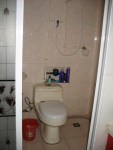
As is common in many parts of Asia, our bathroom is also a shower stall. We don’t have a bathtub and the shower isn’t a separate entity. You simply stand in the bathroom and the water goes everywhere! Most of it ends up going down the floor drain, of course, but the entire bathroom is wet after a shower. Rubber sandals sit outside the bathroom door to keep your feet dry when you enter.

The tank that’s attached to the wall above the toilet supplies hot water to both the bathroom sink and the shower but not the kitchen sink. We have to carry that from the bathroom. Fortunately, the kitchen sink is located just outside the bathroom door.

Squat toilets are still very prevalent in China but, thankfully, our apartment is equipped with a dual flush western style toilet. Most public buildings including our school are not. Toilet paper is not flushed; it goes into the little garbage can that sits beside the toilet and is carried out with the rest of the trash. This, too, is common in many parts of Asia.

One feature that I do like about our bathroom is the heat lamps! There are four of them and you can turn on either two or all four at once. They keep the bathroom warm while you shower and help it dry more quickly afterward. They’re also nice for those nighttime trips to the bathroom that are common at our age! Since we only heat the bedroom at night, venturing out to the bathroom is a chilly experience.

I do miss having a bathtub as I much prefer bathing to showering and there’s nothing more relaxing than a good soak. It would have been especially nice after this afternoon’s very long walk. We spent a couple of hours out in the sunshine exploring on foot.

Wursday, blursday

We crossed the International Date Line and lost a day this week. The day we did have, which I’m calling Wursday, started when the alarm went off in our Leduc hotel room on Wednesday morning at 5:15 a.m. and ended about 29 hours later when we climbed into bed in our Dalian apartment. It was already after one o’clock Friday morning here. Thursday had disappeared in a blur of airports and flying.

Other than being an exceptionally long and tiring day, the trip went very well with absolutely no problems or delays. We made our way through security at the Edmonton, Vancouver and Shanghai airports without incident in spite of the fact that Richard’s knee brace always sets off alarms. Passing through immigration in Shanghai was a simple matter and we were waved through customs without having to answer a single question! To top it off, none of our luggage was lost, delayed or damaged. We travelled all the way with China Eastern Airline and couldn’t have asked for better service.

The best part of the trip was, without question, our stopover in Vancouver where we enjoyed a visit with daughter-in-law, Robin, and grandsons, Sam and Nate! The Vancouver airport houses an impressive collection of Northwest Coast native art. We met in the international departures area beside the "Spirit of Haida Gwaii" by well known Haida artist, Bill Reid. After checking out every detail of the giant sculpture we headed upstairs to the observation area where we were able to see planes coming and going and watch one of them being unloaded.

Before long it was time to say good bye and continue on our way. We took with us a special bag of goodies that the boys had helped their mom put together for us. Because China starts with C, everything in our bag began with that letter… carrot sticks, celery, cookies, cupcakes, clementines and even candy canes!

The stopover in Shanghai was longer but much less entertaining. By the time we got there, we’d been up for over 20 hours and I much of it trying to catch a few winks.

Now we’re nearing the end of our second day here. We’re unpacked and settled in and have already walked many miles exploring our new neighbourhood. We’re soaking up the sights, sounds and tastes of our new surroundings but we’re still suffering the effects of jet lag and trying to readjust our body clocks. It will probably be another day or two before I’m clearheaded enough to adequately describe our first impressions. To whet your appetite, he’s a couple of views from our apartment.

More family drama

There’s nothing like a late night phone call to get your heart racing and the adrenaline pumping! I had just crawled into bed at about 11:45 last night when the phone on my bedside table rang. It was our son, Matt, calling to tell us that Dad’s high rise apartment building had been evacuated a couple of hours earlier and Dad’s whereabouts were unknown!

apartment

photo credit: Vancouver Sun

While conducting a search warrant for drugs on the 11th floor of the 29 storey building, Burnaby RCMP officers found more than they were looking for… 10 sticks of dynamite and several small bombs! As soon as Matt heard the news on Twitter, he headed over to Grandpa’s to make sure that he was okay.

Dad is a distinctive looking man. Though slightly stooped by age, he once stood 6 feet 6 inches tall and only weighs about 170 pounds (yes, that’s definitely where I got my skinny genes!). He’s fairly frail and walks with a cane. The officer that Matthew spoke with knew immediately who he was looking for and told him that he had seen Dad waiting in the lobby earlier. He assumed that he had had gone to the nearby community centre that had been opened as an evacuation centre and directed Matthew there. Dad wasn’t there nor was he at the care facility where Mom lives. Unable to find him, Matt headed home and called me.

I assumed that Dad might have called someone from his church and that they had picked him up but I had no way of knowing for sure. I called my sister who agreed that that was a likely scenario but neither of us had a name or a phone number to call. We discussed the fact that Dad is of sound mind and wouldn’t just wander away into the night. We agreed not to panic and I crawled back into bed.

That’s when the phone rang a second time! It was Matt’s wife, Robin. The evacuation centre had called. Dad was there and Matt was on his way back to pick him up. Their plan was to bring him back to their place for the night but when Matt got there, he was told that the order was about to be lifted. He waited with Dad then took him back to the apartment. All was well!

It wasn’t until this morning that I learned that when Matt went over the first time, Dad was actually sitting in a warm bus outside the building waiting to see what was going to happen. He sat there for an hour and a half before being taken to the evacuation centre.

Dad doesn’t carry a cell phone and he probably wouldn’t have called anyone if he did. He knew he was okay and had no idea that anyone was worrying about him. As my niece pointed out, he doesn’t understand how fast news travels these days. We’re just relieved to know that he was in a safe, warm place where he was able to sit and wait in relative comfort! We’re also very grateful that something of this nature didn’t happen while Mom was still living at home. That would have been a much greater ordeal.

I think I’m going to escape all this family drama and go to China! We leave later this afternoon!

Packing 105: To fold or to roll, that is the question

Though some people roll their clothing to pack it in a suitcase claiming that it takes up less space and doesn’t wrinkle as much, I prefer to fold most of ours.

I learned to fold and pack from a master. When I was a child my father spent several years commuting between Powell River and Vancouver almost every week. Every week my mother did his laundry, starched and pressed his dress shirts and repacked his suitcase. I remember watching her with fascination. She could fold a shirt so that it looked like it had just come out of it’s original package.

Every summer, our family of six would pile into the big blue and white International Travelall and set off on a camping adventure that often lasted several weeks. Mom would pack everything we needed into the back of the vehicle. There was no such thing as a nylon tent in those days but she could fit the bulky canvas tent, six sleeping bags, foam sleeping mats, the Coleman stove, dishes, food, clothes, life jackets and fishing gear and a multitude of other things into the space behind the back seat.

Travelall_2

One summer we chartered a float plane and flew into Garibaldi Lake nestled high in the coastal mountains. Mom had to weigh every single item that went on that trip to make sure that we didn’t exceed the plane’s weight limit. Yes, she was definitely a packing wizard!

Float plane_2

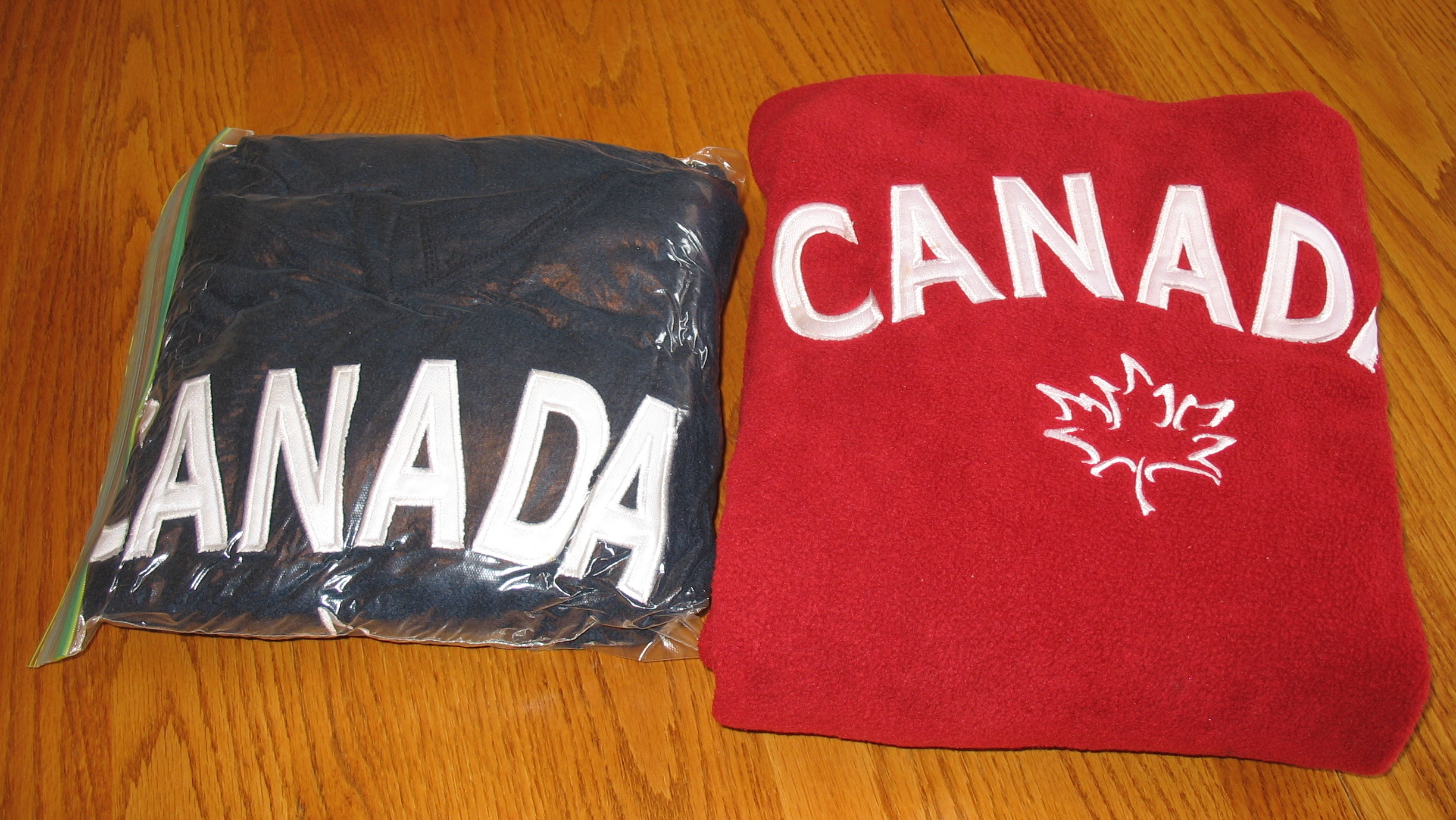
But I digress! Though I fold the majority of our clothing, I often roll things like pyjamas to fit into small unused spaces between other items. On our upcoming trip to China, I’m also going to try a packing technique that I’ve never used before. By packing bulky items in ziploc bags and squeezing the air out before sealing them, they’ll take up much less room in a suitcase. Richard’s navy blue fleece hoodie is two sizes larger than my red one but look at how much less space it needs.

IMG_0757

And before I bring this packing series to an end, here’s one last tip: It’s amazing how much you can pack inside the shoes that go into your suitcase. Stuff them full of socks, underwear, pantyhose, pill bottles, anything that will fit!

Do you fold or roll?

No more mountain!

We have our visas!

After the panic that I was thrown into three weeks ago when we learned that we had to have complete medicals done before we could apply for our work visas, our trip to the Chinese visa application centre was quite anticlimactic. We drove to Calgary on Monday, going directly to the centre when we arrived in the city. Though there were nine spaces at the counter for serving customers, we were the only ones there. After carefully checking all of our documents, the representative took our passports and told us to return on Thursday. It was that simple.

When we went back this morning, there were a few people there but we didn’t have to wait. Within minutes, we had our passports with the visas in them. We checked them carefully, paid the required fees and were on our way. The mountain had moved!

In spite of the unexpected stress involved in getting our visas, there’s also been a bit of humour involved. Carefully following the instructions provided by our employer in China, when we completed our visa application forms we entered “employment” as my main reason for going to China but “to accompany my wife” as Richard’s! His is also a work visa but apparently it was faster for them to acquire a single invitation letter and work permit for the two of us than it would have been to treat us as two entirely separate entities.

With the exception of the Mosuo tribe, a small ethnic group living in Yunnan province, China is not a matriarchal society. The only reason we can think of that I appear as the head of the family on our documents is that I’m the one who has done most of the communicating with our employer. Whatever the reason, I’ve definitely had fun calling Richard my consort and teasing him that he’s only going along as my companion!

No more mountain! Thank you for your prayers!

No more mountain! Thank you for your prayers!

Packing 104: What else will I pack?

Packing, especially for a long stay, isn’t only about clothes. As I mentioned in my first packing post, we’ve been advised to bring a sufficient supply of medications and other essentials to last for the duration of our stay. There are also all sorts of random things that will be tucked into our luggage when we leave for China.

Depending on where you’re going, packing a towel might be a good idea. If you stay in 4 or 5 star resorts you certainly won’t need one but if you frequent $12/night guest houses like the one we stayed in in Cambodia, you’d better take one with you! Our apartment in China will be fully furnished. Dishes and bedding are provided but we’ve been told that towels are not. We can buy them there, of course, but after travelling and hanging around airports for over 24 hours, we’ll probably want to shower and fall into bed when we arrive! I think I’ll pack a couple of towels.

If necessary, laundry can be done almost anywhere. I always pack a small container of powdered laundry soap for those occasions when something needs to be washed out by hand. I learned a valuable lesson on our last international trip, however. ALWAYS pack that container in a ziploc bag! Airline baggage handlers are not kind to luggage and it’s amazing where powdered soap can end up when it’s released from it’s container and allowed to wander freely. Fortunately, the container was in an outside pocket of our suitcase but I was brushing soap from between the pages of my Bible for a long time afterward and I just recently found some hiding inside the case that holds my spare pair of glasses!

If you have eyesight like ours, an extra pair of glasses should always travel with you and it’s a good idea to take a copy of your current prescription as well. Add a pair of sunglasses and you’re ready to go.

Believe it or not, when I shop for clothes, I almost always think about how well an item will pack. How much space will it take up in a suitcase? How badly will it wrinkle? The second question is less important this time as I’ll also be packing our dual voltage travel iron which usually resides in our travel trailer. It’s not something that I’d bother packing for a shorter vacation trip but there won’t be an iron in our apartment in China so it will be essential. We’ll also take an adapter plug that will allow us to plug it in as outlets in China are different from those in Canada.

Voltage also varies from country to country. Here in Canada, we use 120 volts but China uses 220. Fortunately, our laptop computer, which will travel as a carry-on, has its own power converter. A camera is absolutely essential, of course, and at least a couple of memory cards. That, too, will travel in our carry-on luggage.

Wherever we go, we love to walk and hike. Since I’m always curious to know how far I’ve gone, I’ll be sure to pack my pedometer. A compass doesn’t take up much space and can be very handy so we’ll take one of those too. If we planned on geocaching, we’d also take our handheld GPS unit but caching hasn’t really caught on in China yet and I’ve also read that it’s illegal to use a GPS there without a permit! I’m not sure if that’s true or not but since there will be so many other things to see and do, we’ll leave that pastime until we get home again.

A travel alarm clock and a tiny flashlight will also be tucked into our suitcases. Though July and August are Dalian’s rainiest months, it’s on the coast and we’ll definitely need umbrellas. I’m sure we could buy them there but we have several folding ones so we’ll pack a couple of them including a tiny one that fits into my purse.

China is officially an atheist country but we are allowed to take a Bible with us for our personal use. We don’t travel anywhere without one so our compact ultra thin edition will go with us. Our Lonely Planet guidebook is bigger but it will definitely go too. I’m also hoping to fit a few paperback books into our baggage that we can leave behind when we finish reading. We probably should have invested in an e-reader by now as we’re both avid readers but I still like the feel of a book in my hands. It would be handy when we travel though, especially when we spend lengthy periods of time in countries where English is difficult to find.

Reminders of home are important if you’re away for an extended amount of time. A few family photos will definitely go to China with us. Our orientation handbook also suggests that we bring items that show the culture and history of our country to share with our students but I haven’t figured out what those ought to be. Any suggestions?

Maybe I should also pack a few twist ties. That’s the one thing we had a hard time finding in Japan!