Book of the month – September 2025

During our teaching careers, hubby and I had to learn numerous acronyms describing ND (neurodivergent) children: ADHD (Attention-Deficit/Hyperactivity Disorder), OCD (Obsessive-Compulsive Disorder), ASD (Autism Spectrum Disorder), ODD (Oppositional Defiant Disorder) and so on, but the book that I’m reviewing this month is an extreme example of what hubby calls PPS (Poor Parenting Syndrome)!

Wavewalker: A Memoir of Breaking Free

Suzanne Heywood

At seven years old, Suzanne Heywood set sail from England with her parents and younger brother on what was supposed to be a three-year trip around the world retracing one of Captain Cook’s voyages. What followed was a decade of isolation on a 70-foot sailboat crossing some of the world’s most dangerous oceans and surviving horrendous storms, shipwrecks, and reefs. What sounded like the romantic adventure of a lifetime became a child’s worst nightmare “trapped inside someone else’s dream”.

Deprived of safety, friendship, and education, Suzanne longed to return to the stability of England and the opportunity to attend school, but her parents saw this only as selfishness on her part and refused to entertain the idea. Determined to educate herself, she worked diligently on correspondence courses dropping lessons into the mail whenever and wherever the family went ashore. Ultimately her desire for independence and self-determination became so intolerable to her parents, particularly her mother, that at age 16, they dropped her off at an isolated cabin on the north island of New Zealand, leaving her responsible for her younger brother while they continued their travels around the South Pacific!   

It would be hard to read this book without becoming increasingly angry at the parents who, according to the epilogue, told their daughter later that she had a “privileged” upbringing! It is, however, a story of resilience and determination. At 17, finally escaping the constraints of her bizarre childhood, Suzanne was accepted into college at Oxford where she went on to earn her PhD.

While Suzanne’s childhood was one of neglect rather than physical abuse, there are strong parallels between her story and Tara Westover’s powerful memoir, Educated

A Scenic Journey on the White Pass & Yukon Route

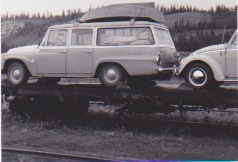
I first rode the narrow gauge White Pass & Yukon Route railway on a family holiday in the summer of 1967. I was 14 at the time. In those days, there was no road between Whitehorse in the Yukon and Skagway in southeast Alaska. We drove to Haines, Alaska, took a ferry to Skagway, and then, with our vehicle loaded on a flat car, rode the train to Whitehorse.


The White Pass & Yukon Route has a fascinating history. When gold was found in the Yukon in 1897, the news spread like wildfire and tens of thousands of fortune seekers steamed up the Inside Passage waterway to Skagway and Dyea to begin the treacherous overland trek to the Klondike. Each person was required to carry a ton of supplies. Some chose the shorter, but steeper Chilkoot Trail that started at Dyea while others chose the longer, less steep White Pass Trail from Skagway. Both led to the interior lake country where the stampeders could begin a 550 mile (885 km) journey through the lake systems to the Yukon River and the gold fields. 

On May 28, 1898 construction began on a railway over the coastal mountains from Skagway to Whitehorse. Thirty-five thousand men worked on the $10 million dollar project.  In just 20 miles, the track climbs from sea level at Skagway to almost 3000 feet (914 metres) at the summit! It features steep grades of almost 3.9%. Tight cliff-hanging curves required a narrow gauge railroad with tracks just 3 feet apart as well as the construction of two tunnels and numerous bridges and trestles. Against all odds, working through the dead of a northern winter, the 110 mile (177 km) project was completed in just 14 months. 

For decades following the gold rush, the White Pass & Yukon Route carried significant amounts of ore and concentrates to tidewater to be loaded onto ships, but with the opening of the Klondike Highway from Whitehorse to Skagway in 1978 followed by plummeting world metal prices, the railroad suspended operations in 1982. Six years later, it reinvented itself as a tourist attraction. 

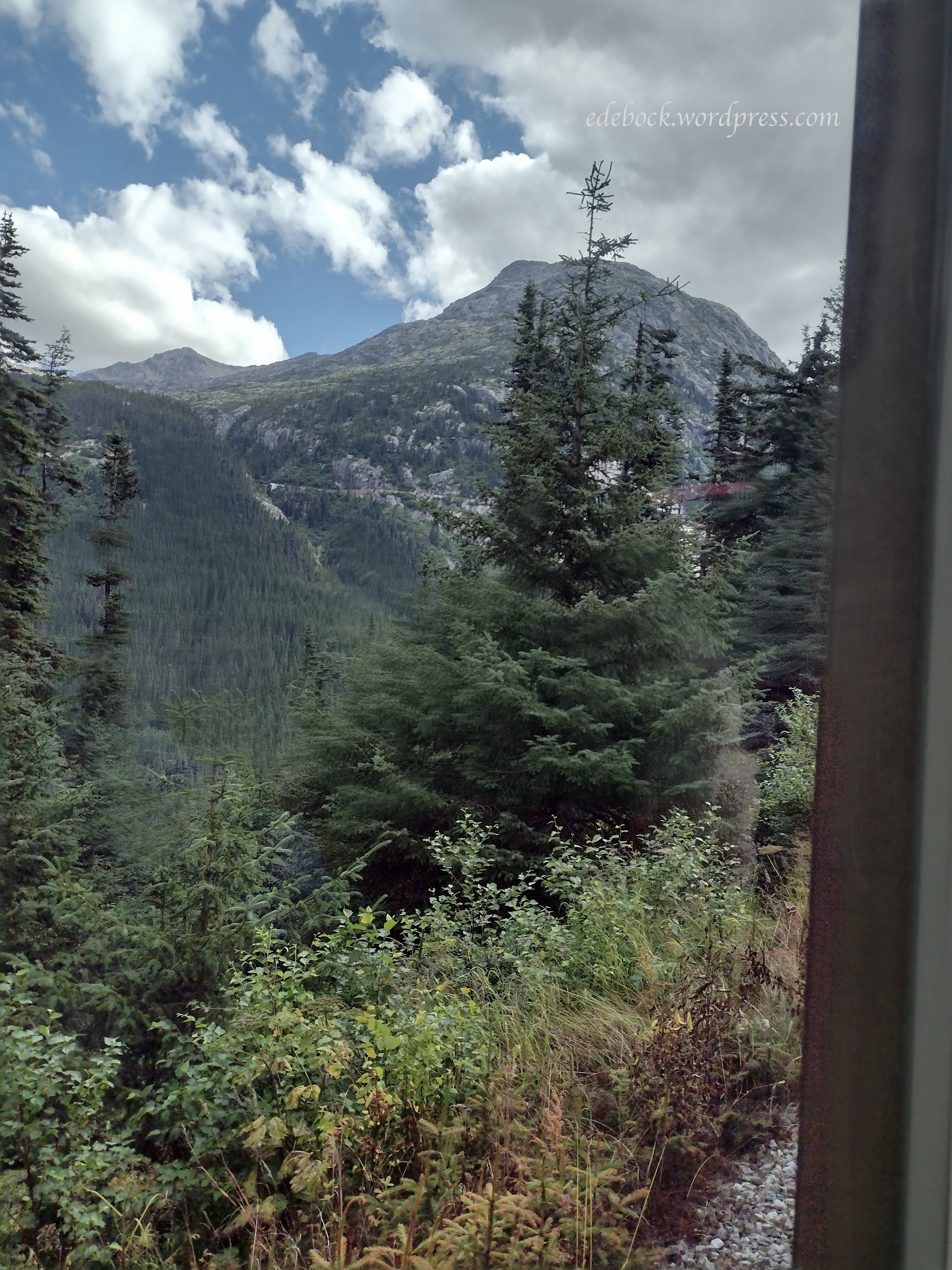
When we looked at possible shore excursions to add to our recent Alaska cruise, the scenic railway was the one that caught our attention and I looked forward to riding the train again! For the most part, the photos will speak for themselves, but I’ll add a few details as you ride along with us. 

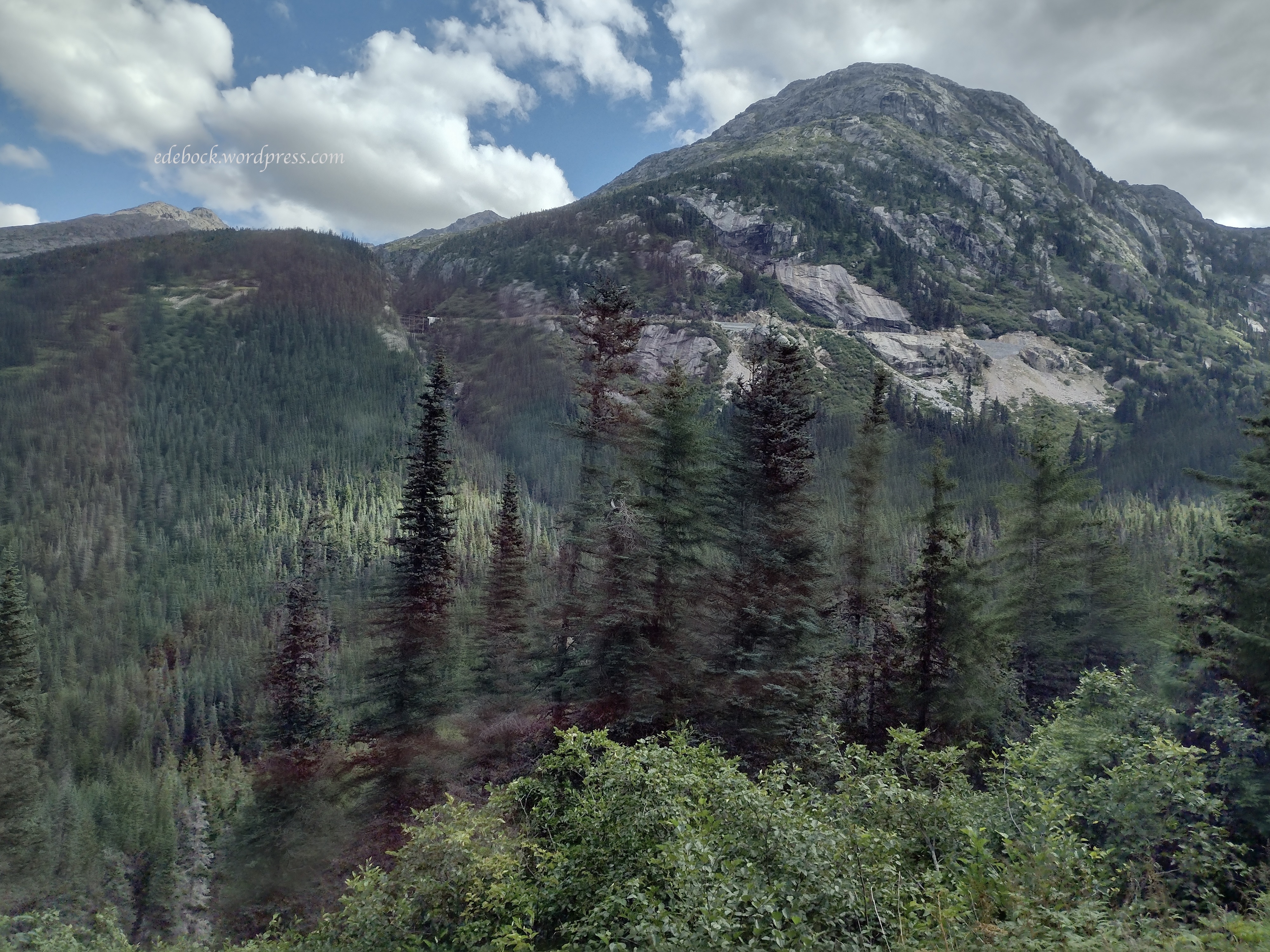
In the next photo, the line across the hillside on the far side of the gully is the Klondike Highway. 

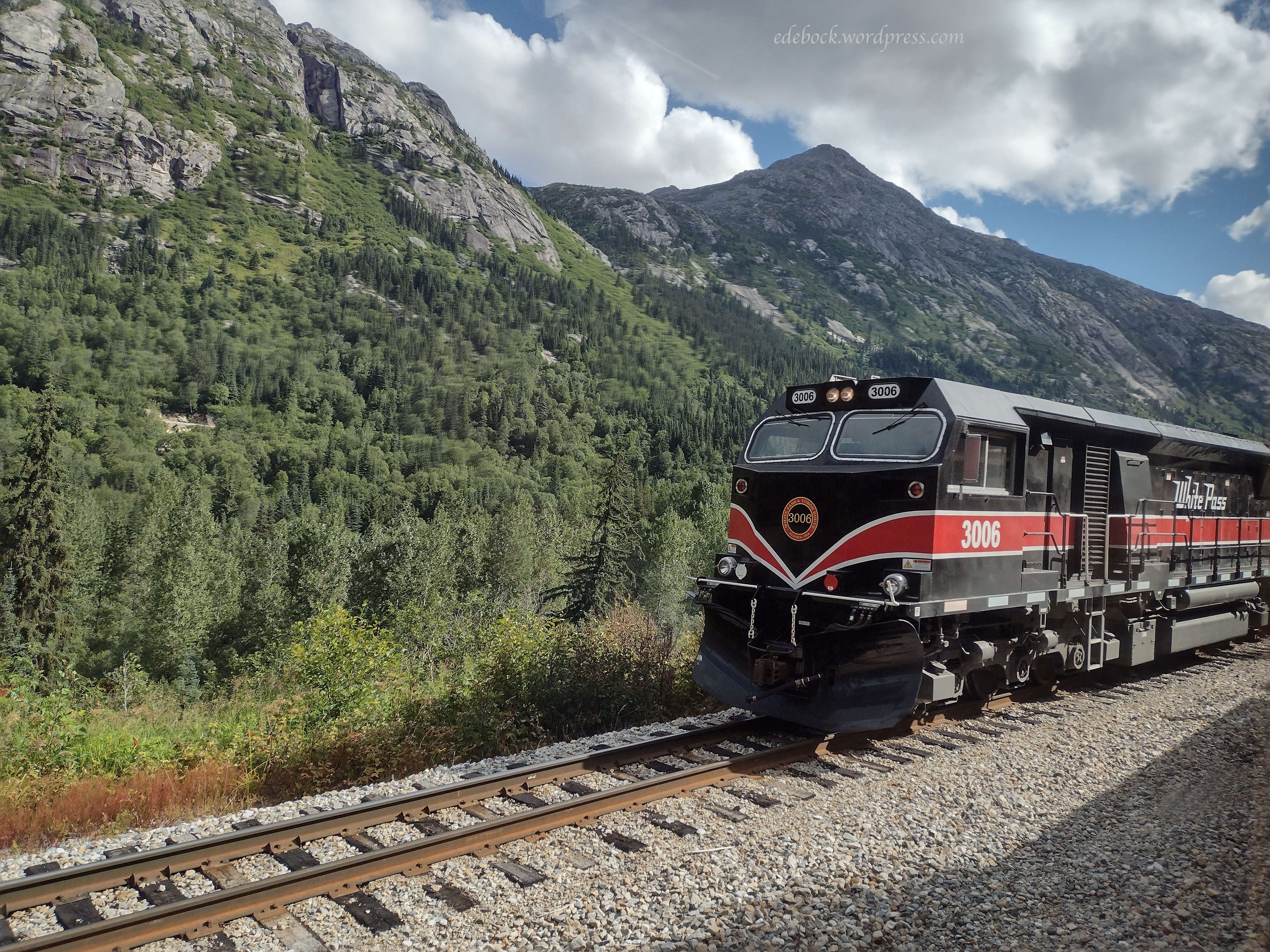
In the early days and when I rode the train in 1967, it was pulled by a steam locomotive. While the railroad still has two of those vintage engines in their fleet, most of the excursions now use diesel engines like this one that passed us going down as we were still climbing. 

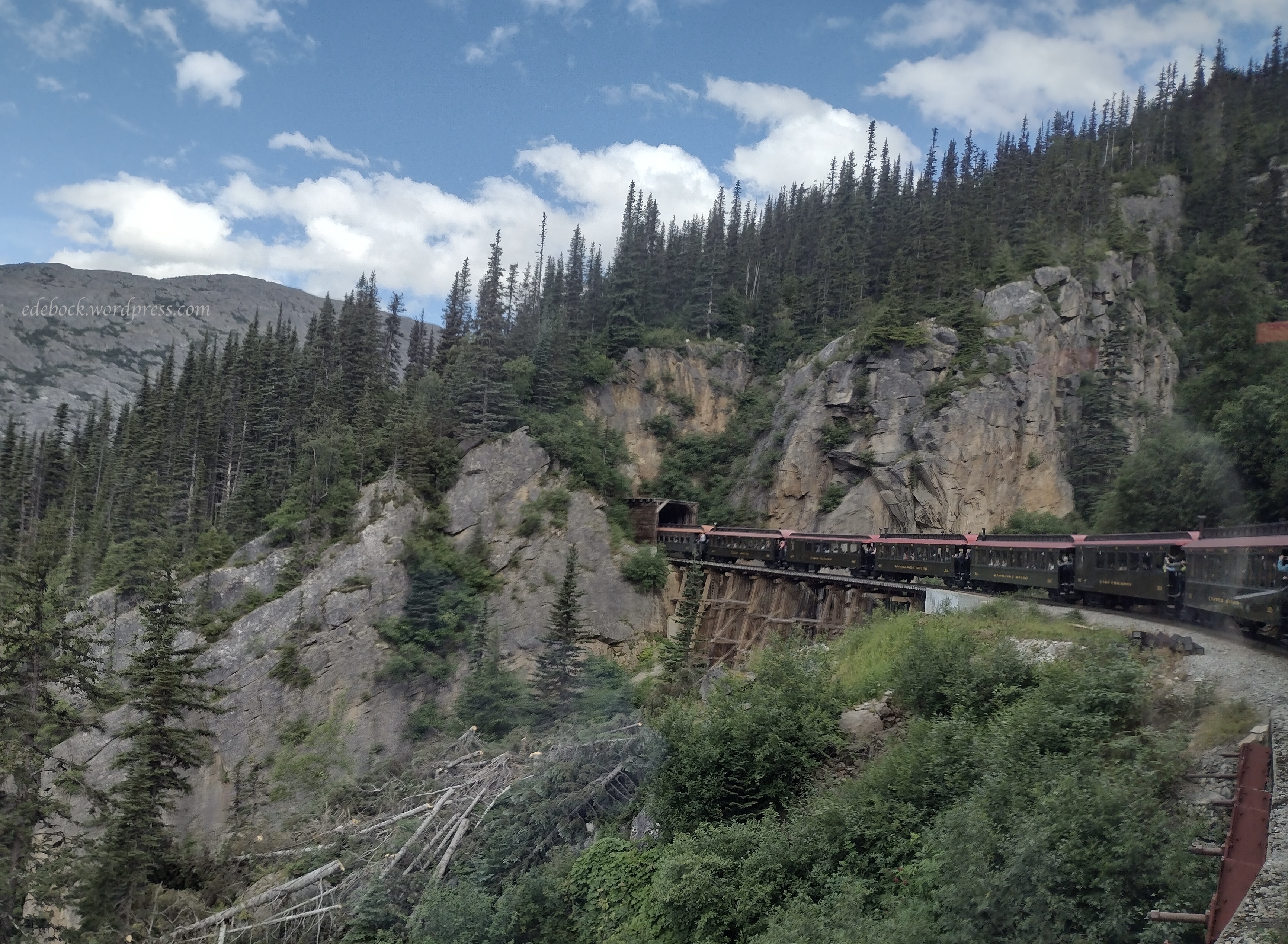
That’s the shadow of our train crossing a bridge at the bottom of the next picture. 

If you look very closely at the next photo, you’ll see a tiny slice of blue in front of the distant mountains and in the V between the hillsides. That’s the Skagway harbour far below. 

As the train approaches this broken trestle, it looks like it’s going to cross it, but it hasn’t actually been in use since 1969 and began to fall apart many years after that. It was a bit strange to look across at it and realize that I crossed it back in 1967. 

If you look very closely at this final photo taken near the summit, you can see one of the few remaining bits of the White Pass Trail that was traversed by thousands of gold seekers before the construction of the railway. 

If an Alaska cruise is in your future, I highly recommend the White Pass & Yukon Route shore excursion. You won’t be disappointed! 


Alaska cruise: Exploring Juneau, Skagway, and Ketchikan

As I mentioned in my last post, our 7-Day round trip Alaska cruise from Vancouver stopped at Juneau, Skagway, and Ketchikan and also included a side trip up Endicott Arm to see Dawe’s Glacier.
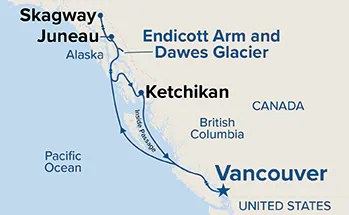
There were a vast number of possible shore excursions to choose from at each location, but we chose only one, the White Pass Scenic Railway at Skagway. Rather than purchasing other shore excursions, I did what I usually do when we travel. I researched each location and planned our own self-guided tour.

Juneau, Skagway, and Ketchikan all depend heavily on tourism in the summer and each has what my sister-in-law refers to as “trinket alley”, a street close to the cruise ship wharf that’s lined with shops selling souvenirs. We wanted to go beyond those areas to see more of each community.

Juneau  
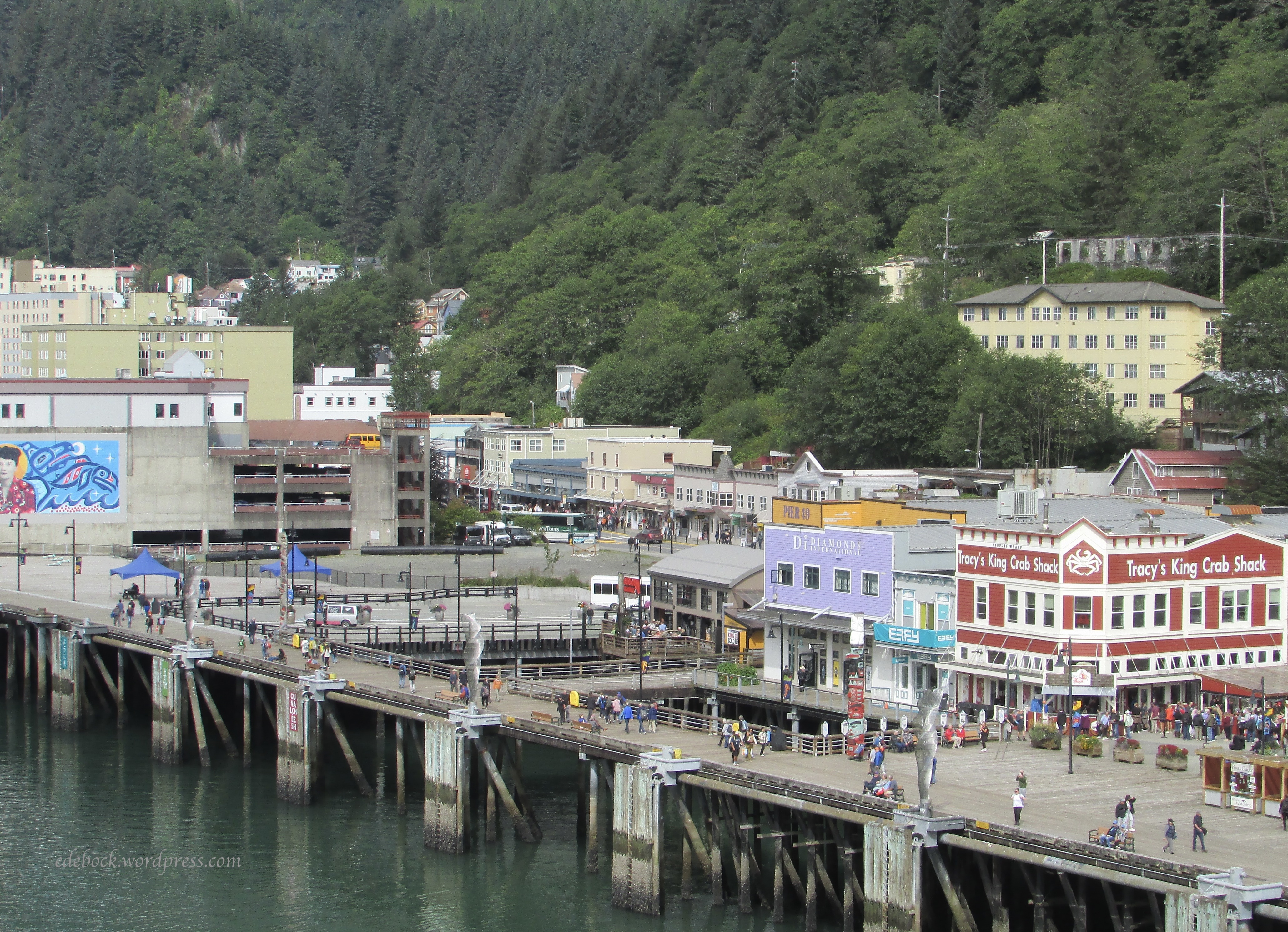
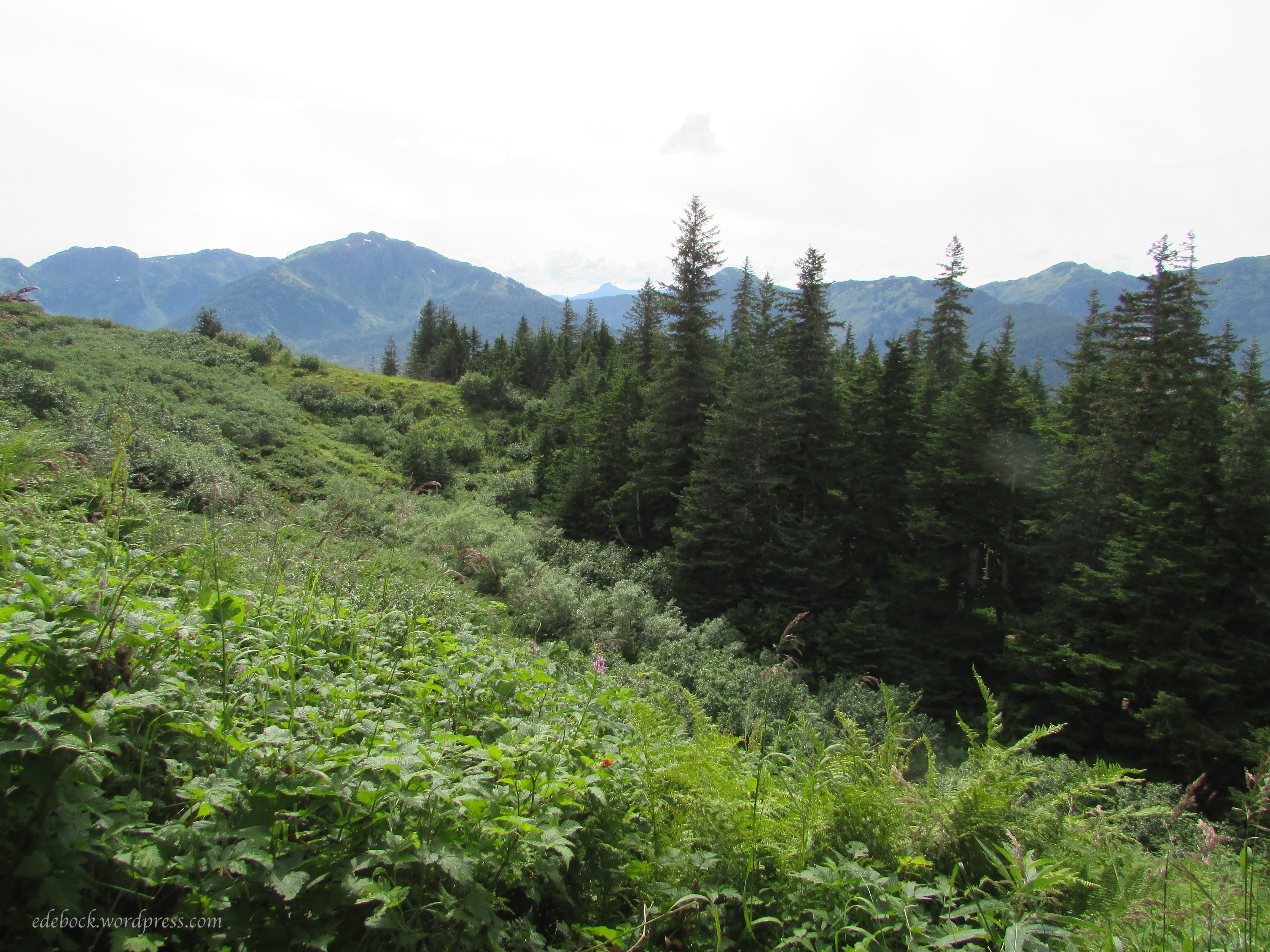
After 48 hours at sea, we docked at Juneau, the capital city of Alaska. As soon as we disembarked, we headed for the Goldbelt Tram, just steps from the cruise ship dock and took a six minute ride up Mount Roberts to a height of about 550 metres (1800 feet).

There we did a short hike and enjoyed the spectacular views. That’s our cruise ship, the Grand Princess, in the bottom left corner of the first photo. She didn’t look as big from up there!

Before descending and beginning to explore the town, we watched Seeing Daylight, an 18-minute award-winning film on Tlingit history and culture, in the Chilkat theatre. The Tlingit are one of three Indigenous people groups living in Southeast Alaska. The other two are the Tsimshian and the Haida. I was particularly interested in the fact that these groups are matrilineal societies. 

In the heart of downtown Juneau, we visited the Sealaska Heritage Institute. Dedicated to perpetuating and showcasing the Tlingit, Tsimshian, and Haida cultures, it houses a cedar clan house and an exhibit gallery. I love Northwest Coast Indigenous art and was amazed by the stunning glass screen at the front of the clan house. Made by Tlingit glass artist Preston Singletary, it is apparently the largest glass screen in the world. 

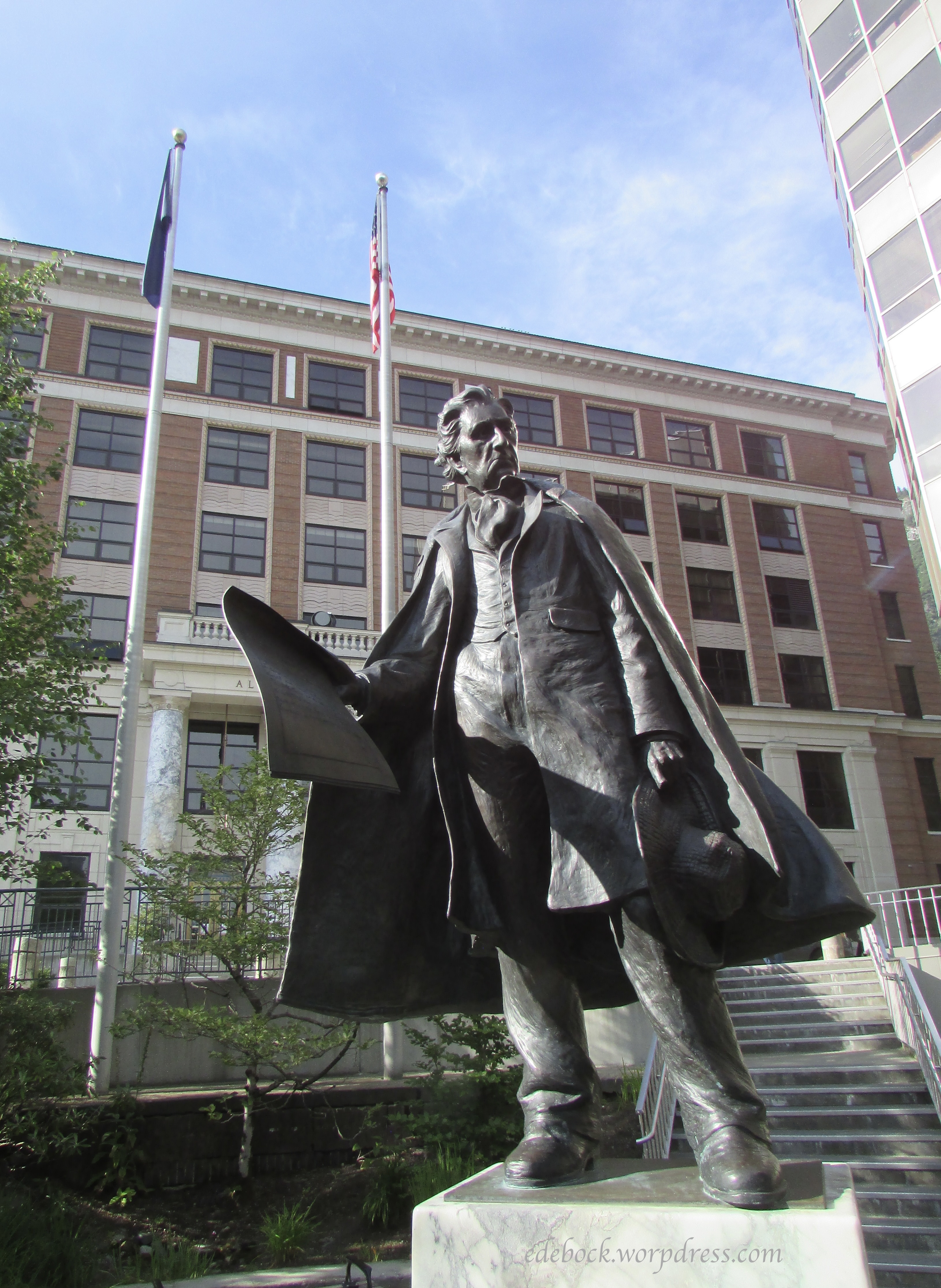
Like most coastal towns, Juneau is built on a hillside. We walked up a few steep blocks to see the Alaska State Capital building and the nearby statue of U.S. Secretary of State William Henry Seward who orchestrated the purchase of Alaska from Russia in 1867.

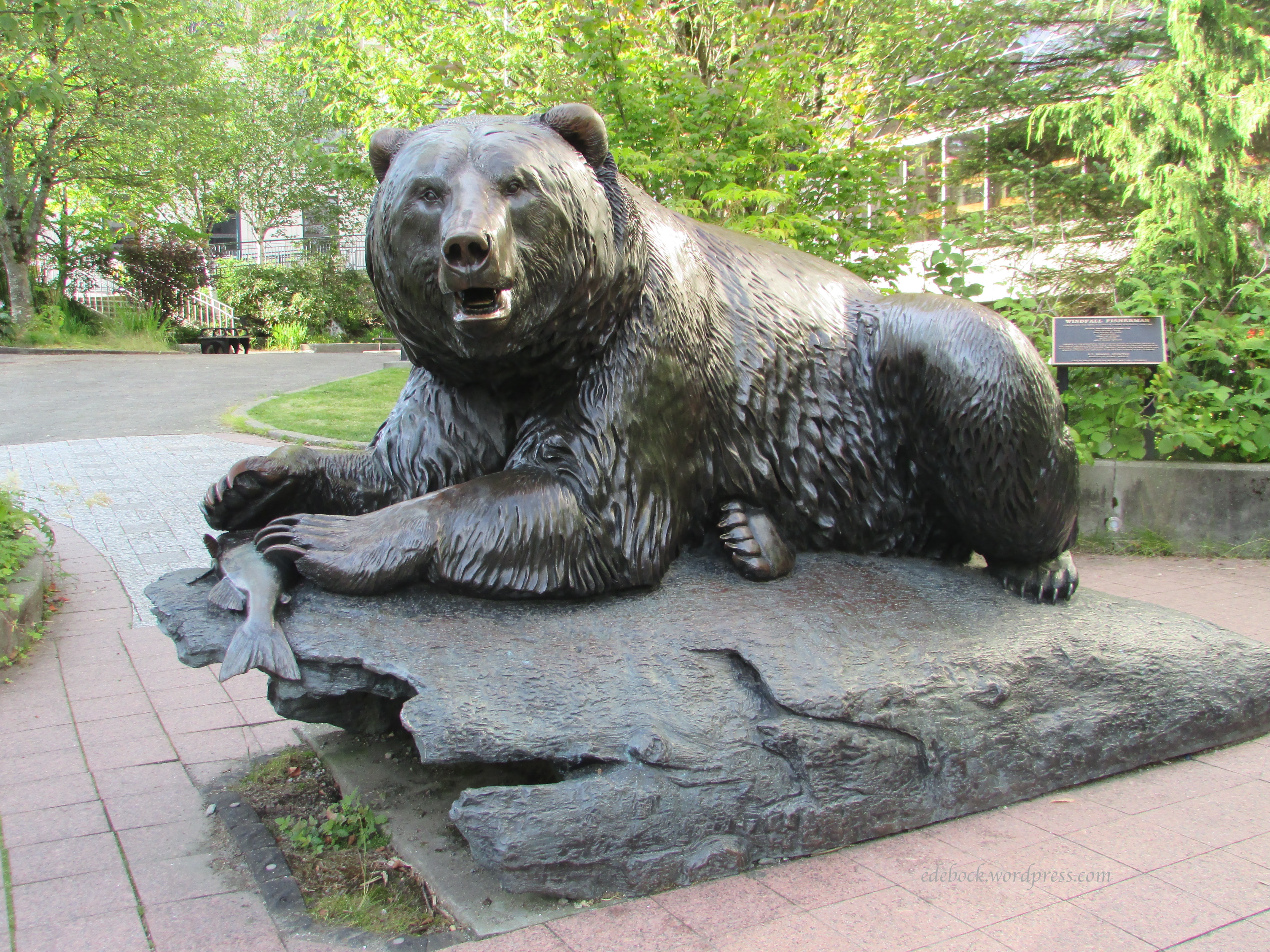
Close by was another bronze statue called Windfall Fisherman, a life-sized and very realistic brown bear by artist R.T. Wallen. 
Hubby’s feet were getting sore by this point, so we headed back downhill toward the waterfront and the seawalk where many of the city’s totem poles are found. Here’s just one example, the Ishkahittaan pole by Tlingit carver, Jon Rowan. At the top is Raven with the Box of Daylight. According to oral tradition, Raven opened the box and released the sun, bringing daylight to the world. Below Raven, you can see Frog and Sea Lion. 

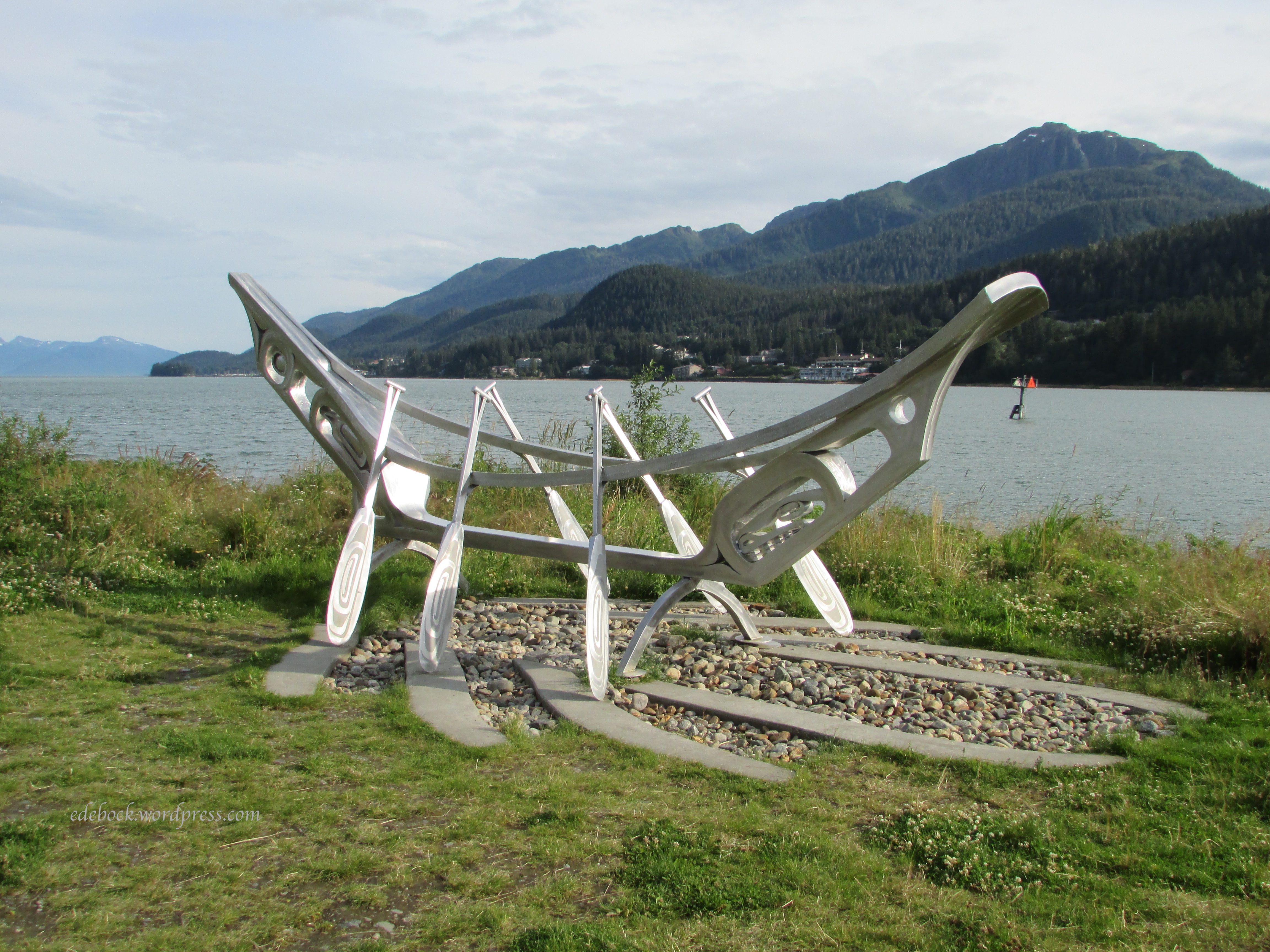
I loved the aluminum sculpture of a 20-foot 9-inch canoe, Yaadachoon, by native artist Robert Mills. The name means “straight ahead” in the language of the Tlingit. 
Although we didn’t see any whales close up while on our cruise, we did see Tahku, the life-sized bronze sculpture depicting a breaching humpback whale, also by artist R.T. Wallen, at the end of the seawalk. 

Skagway

I awoke very early the next morning to the haunting sound of the ship’s horn warning others of our presence. Standing on our stateroom balcony breathing in the heavy fog that surrounded us, I was transported back to my childhood on the waterfront. Crawling back into bed I fell back to sleep to the familiar sound of the foghorn. Later, when I woke again, the sky had cleared, the sun was shining, and we were docking at Skagway. 

Skagway is rich in Klondike Gold Rush history. 1897 and early 1898 saw tens of thousands of fortune-seekers pile off steamships, eager to head overland to the Yukon gold fields via the White Pass Trail from Skagway or the Chilkoot Trail from nearby Dyea.

It was from Skagway that we took the scenic White Pass rail excursion, a 40 mile, 2 hour and 45 minute round trip to the White Pass summit. Considering how long this post is becoming and how much I still have to share, I’m going to save that for a separate post. 

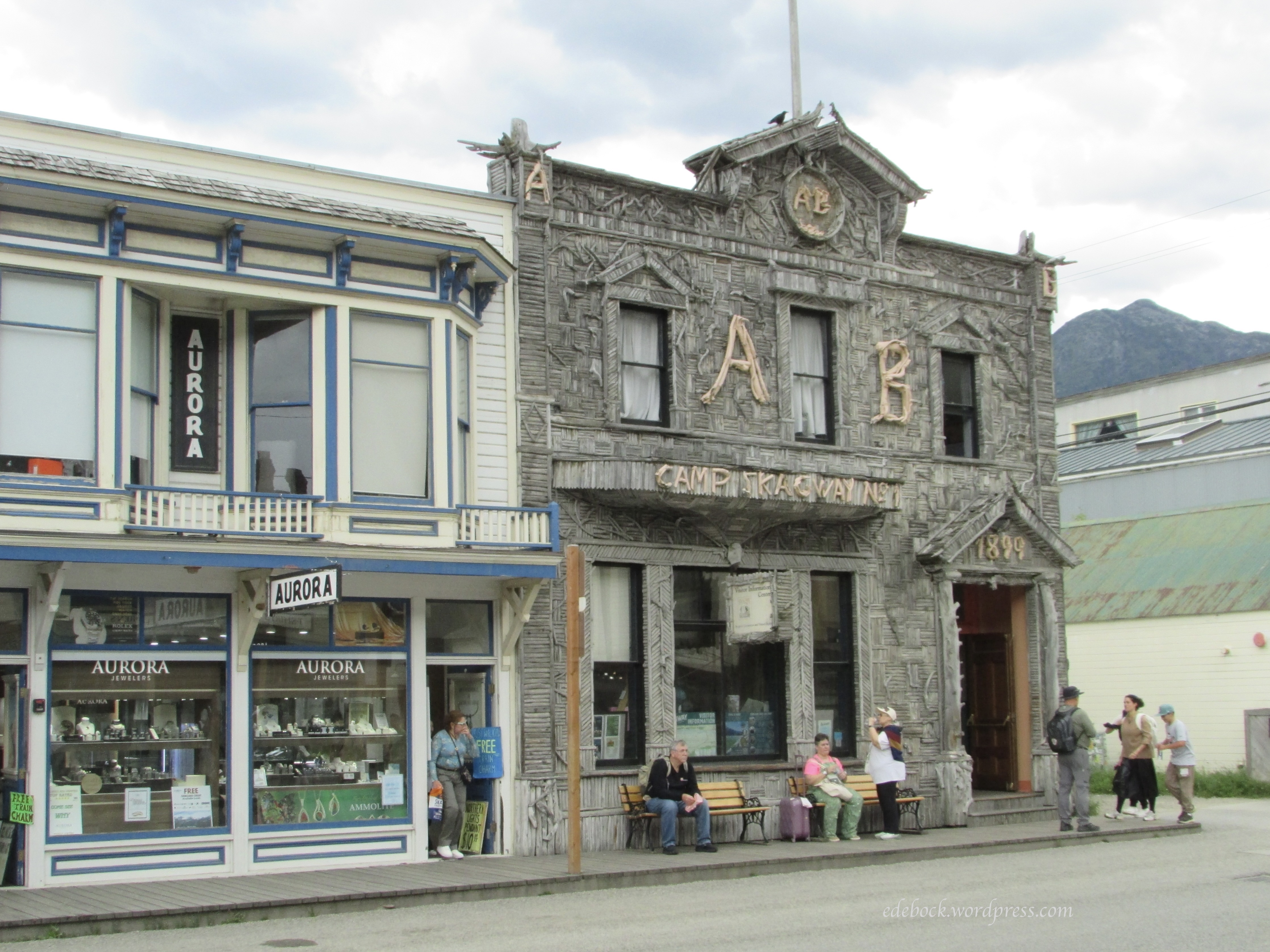
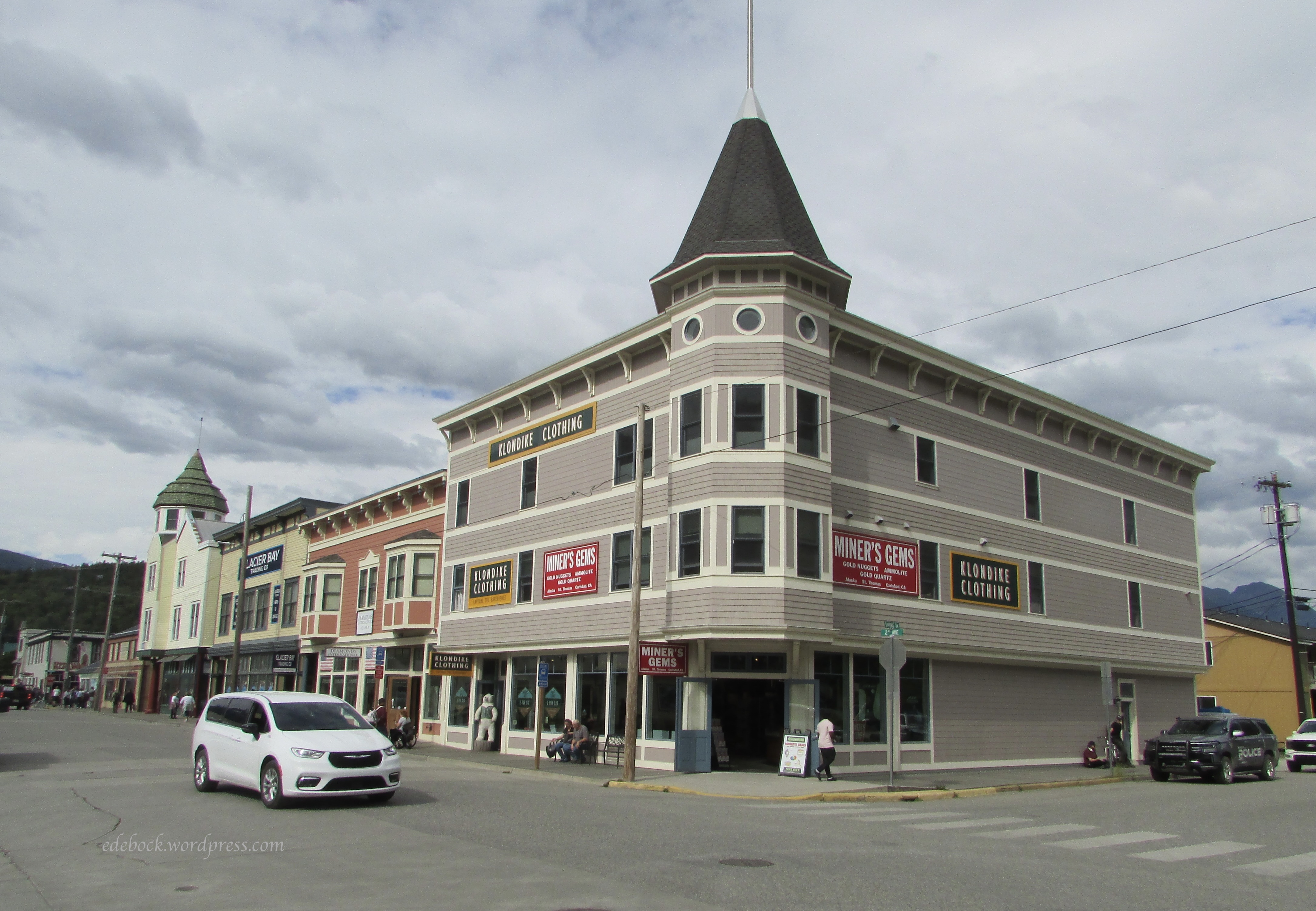
When we disembarked from the train, we were met by hubby’s sister and her husband who live across the Canadian border near Whitehorse in the Yukon. They drove about two hours each way to spend the afternoon with us. They took us to their favourite fish and chips restaurant for lunch and then we just walked around town while we visited. Hubby and I had been to Skagway by road many years ago and were well versed in gold rush history from our previous visits to the Yukon, so I didn’t take very many photos. Here are just a few to show you what the town, which has a year round population of about 1200, looks like. Most of the shops that cater to tourists are closed during the winter months. 
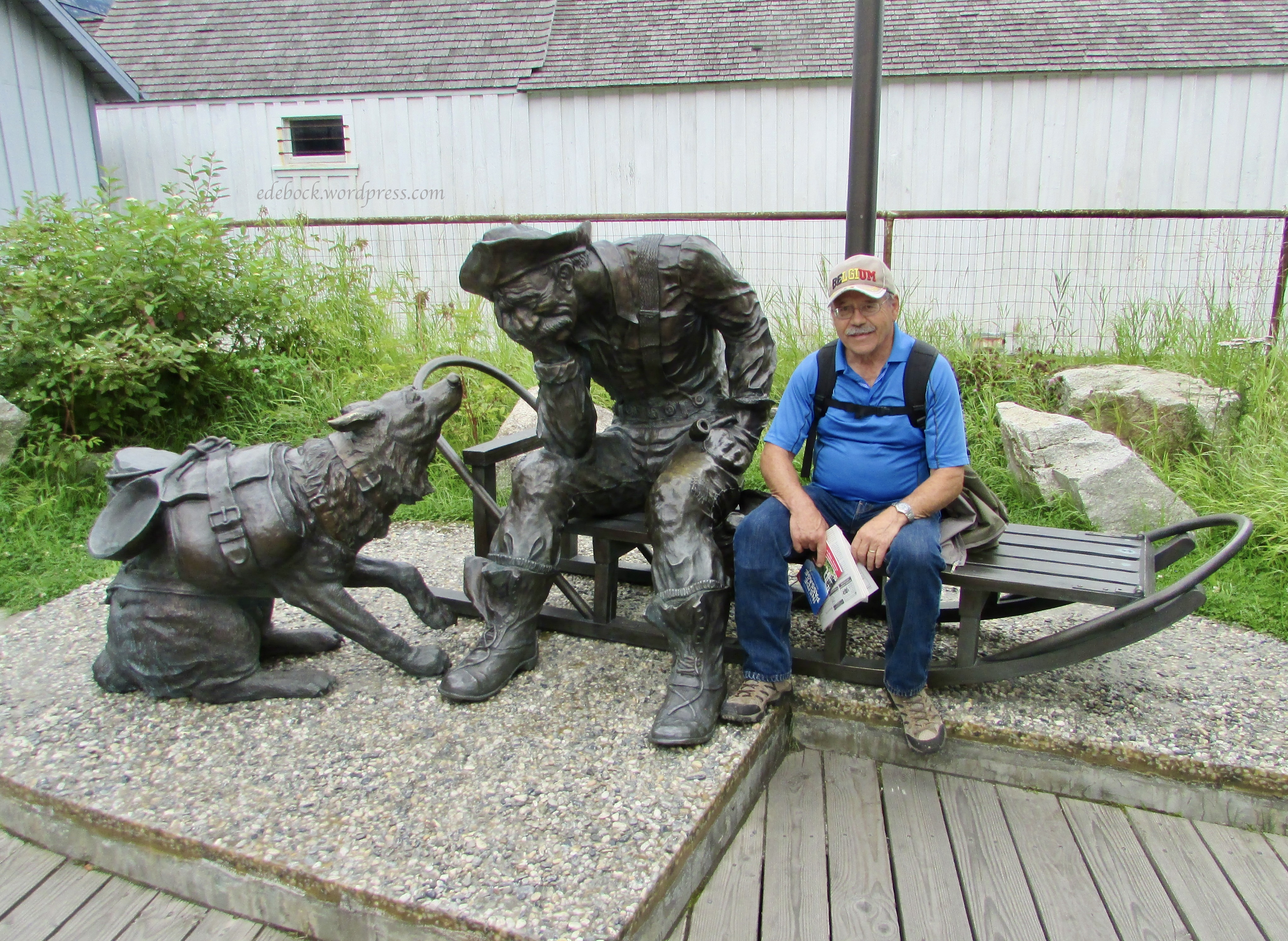
Here’s hubby hanging out with an exhausted gold seeker and his dog. 
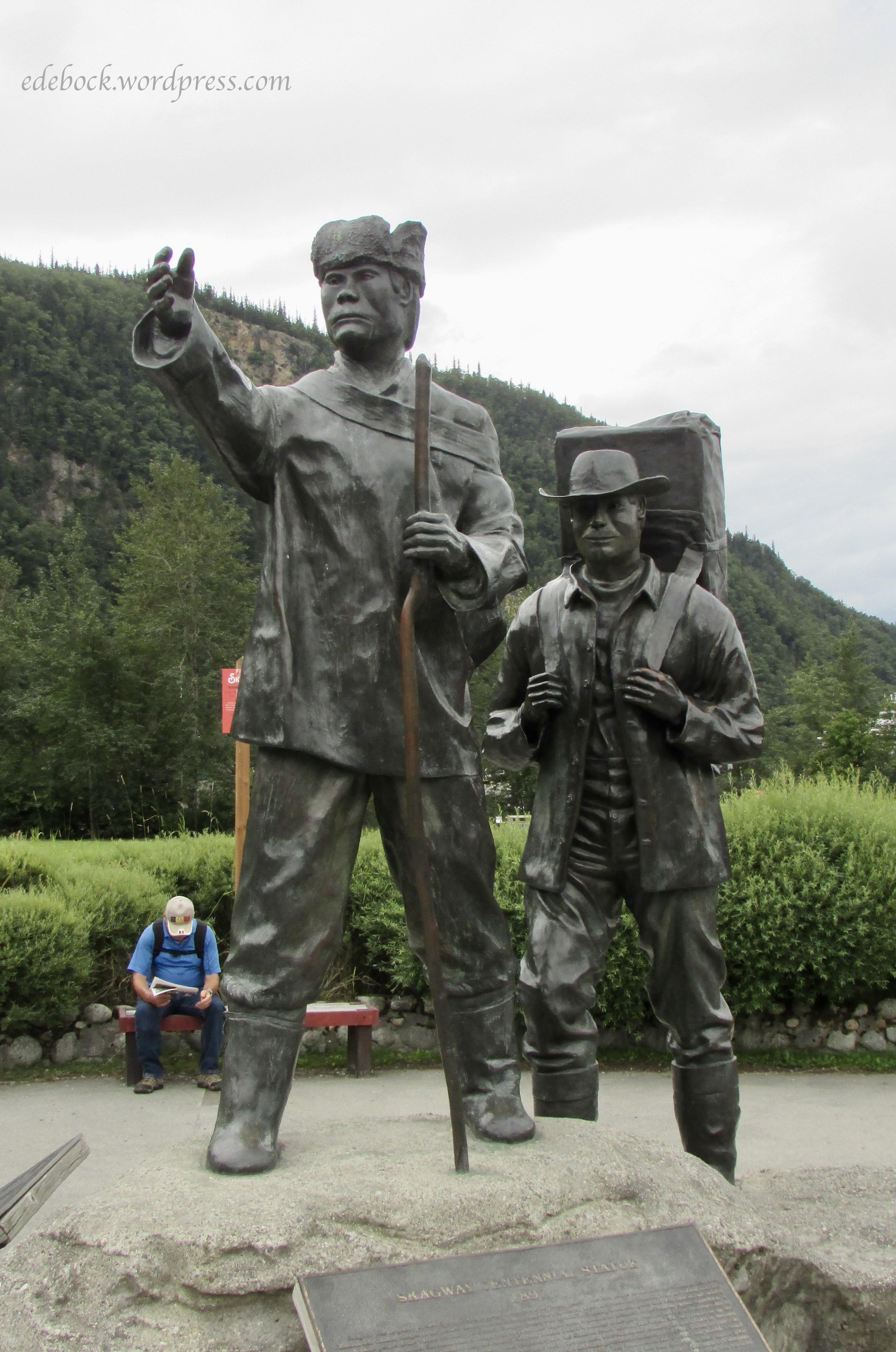
And perhaps you can spot him in this photo too. This is the Skagway Centennial Statue erected in 1997 in a park close to the train station.  
Endicott Arm and Dawes Glacier

Next on our itinerary was a scenic cruise up Endicott Arm to view the Dawes Glacier. The further up the beautiful Arm we cruised, the more and bigger chunks of ice we began to see in the water. 

There were other glaciers like this one along the way, but they were high in the mountains and far from the shore. 
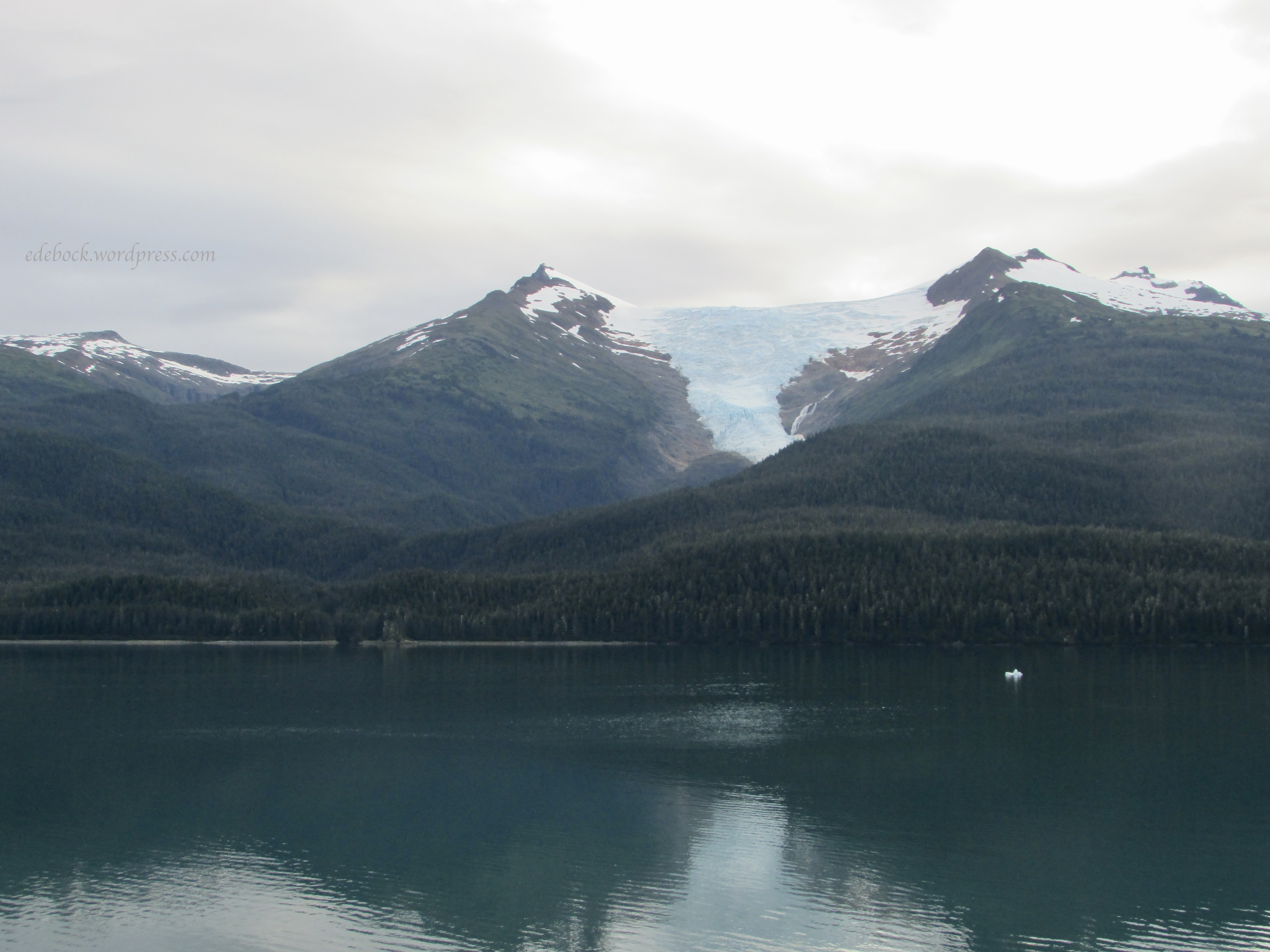
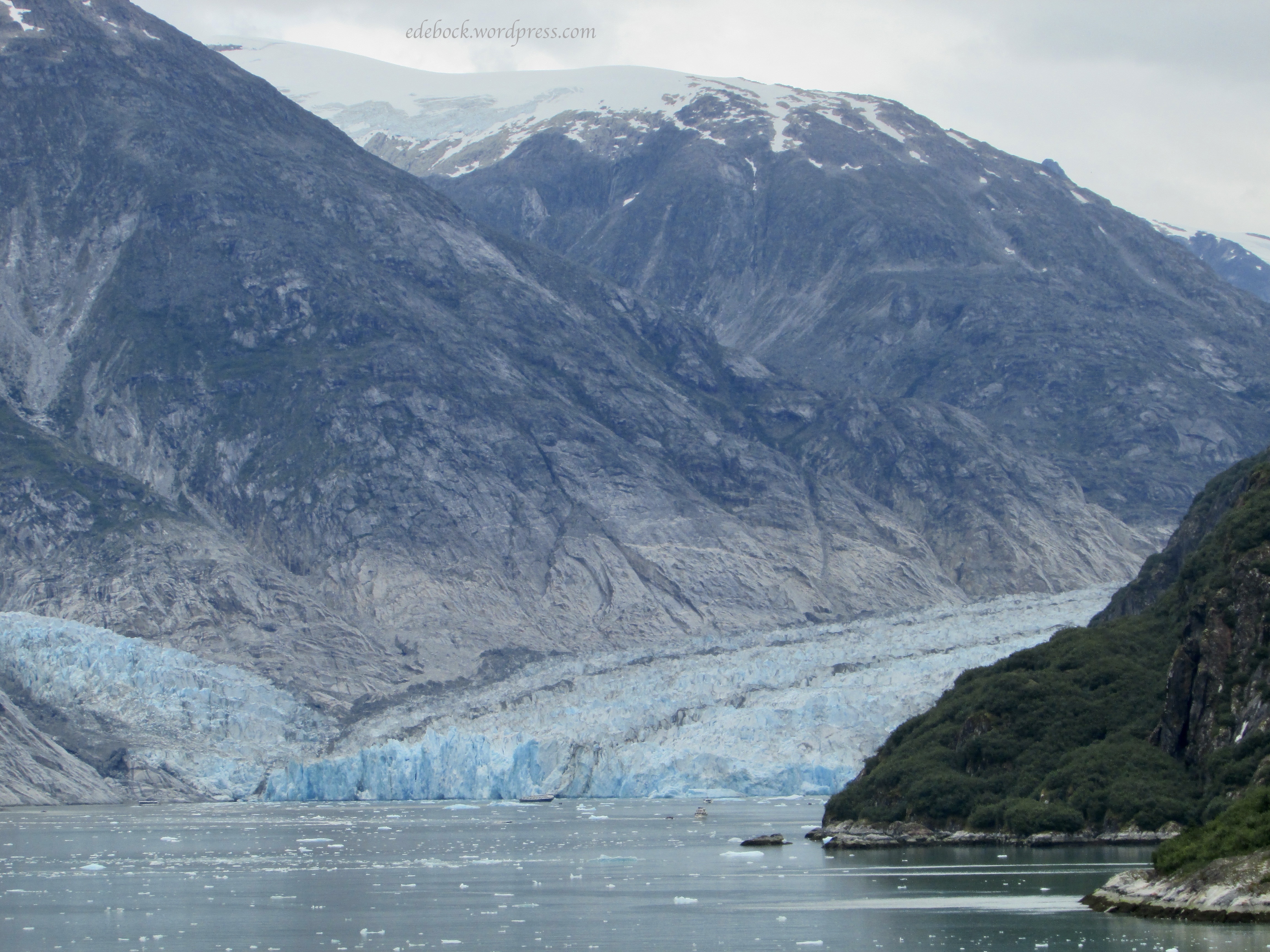
Eventually Dawes came into view. 

Because of the enormous size of our ship, we couldn’t get as close to the glacier as smaller ones could, so this was one of the times that we were very happy to have binoculars with us. The captain turned the ship in a complete slow circle so that everyone on either side could get a good view and lots of photos. 
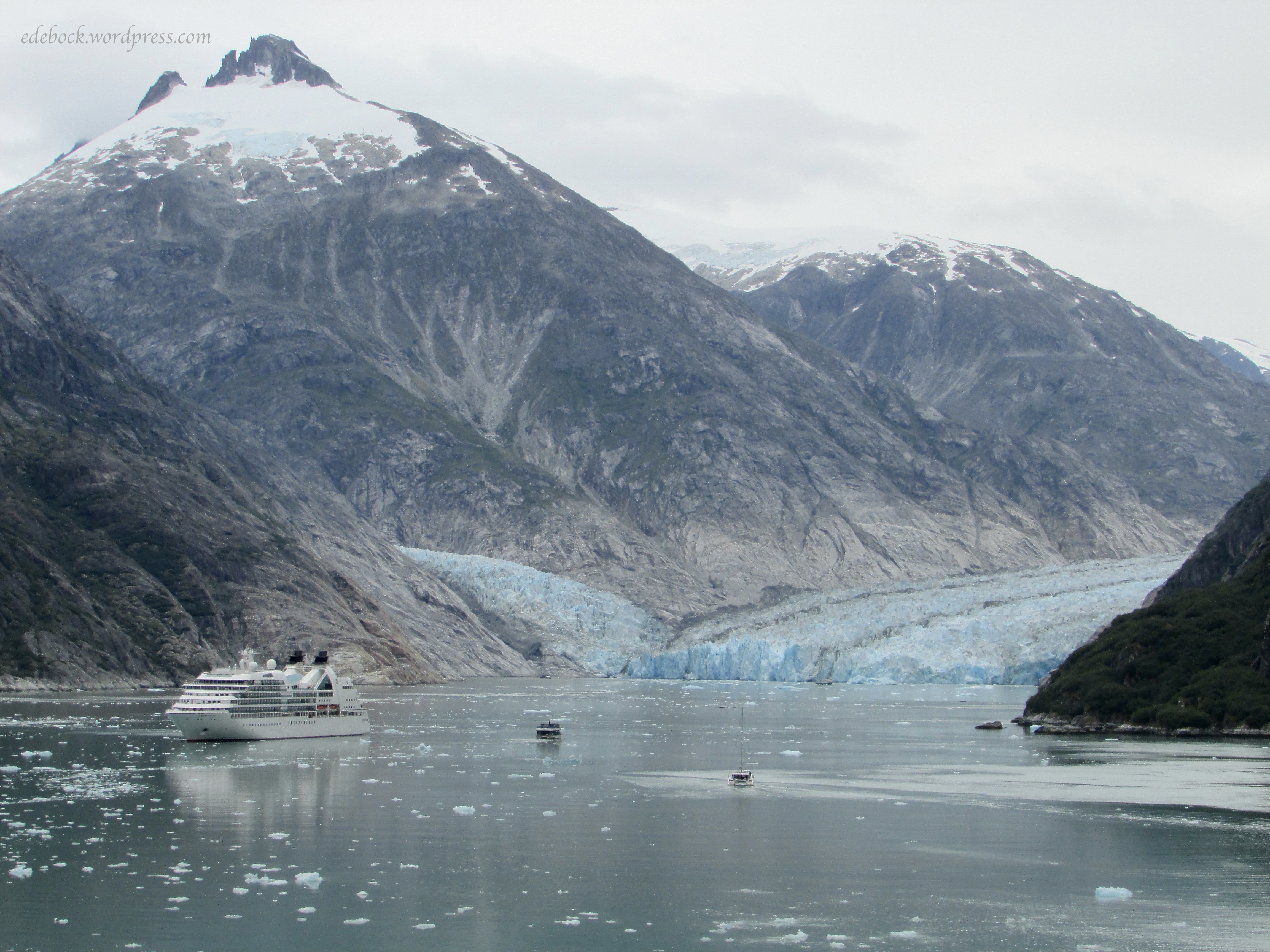
Why is the glacier blue, you ask? The naturalist on board explained that that’s because the ice is incredibly dense, having lost almost all of its air over time due to the immense weight of snow that compacted it. This dense ice absorbs most of the long-wavelength colours of white light, such as red and green, while allowing the short-wavelength blue light to pass through or scatter, which is what we see.

Ketchikan
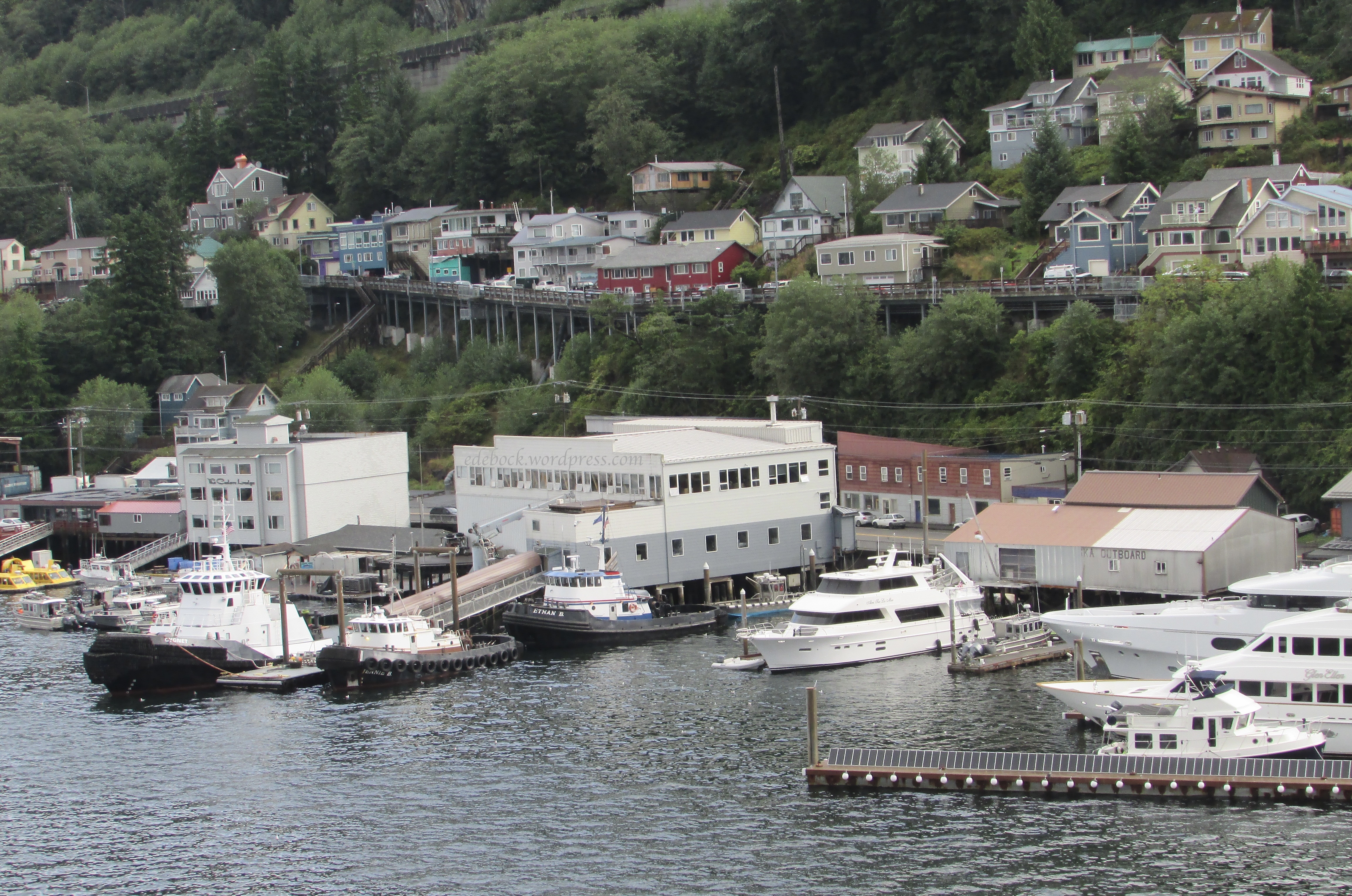
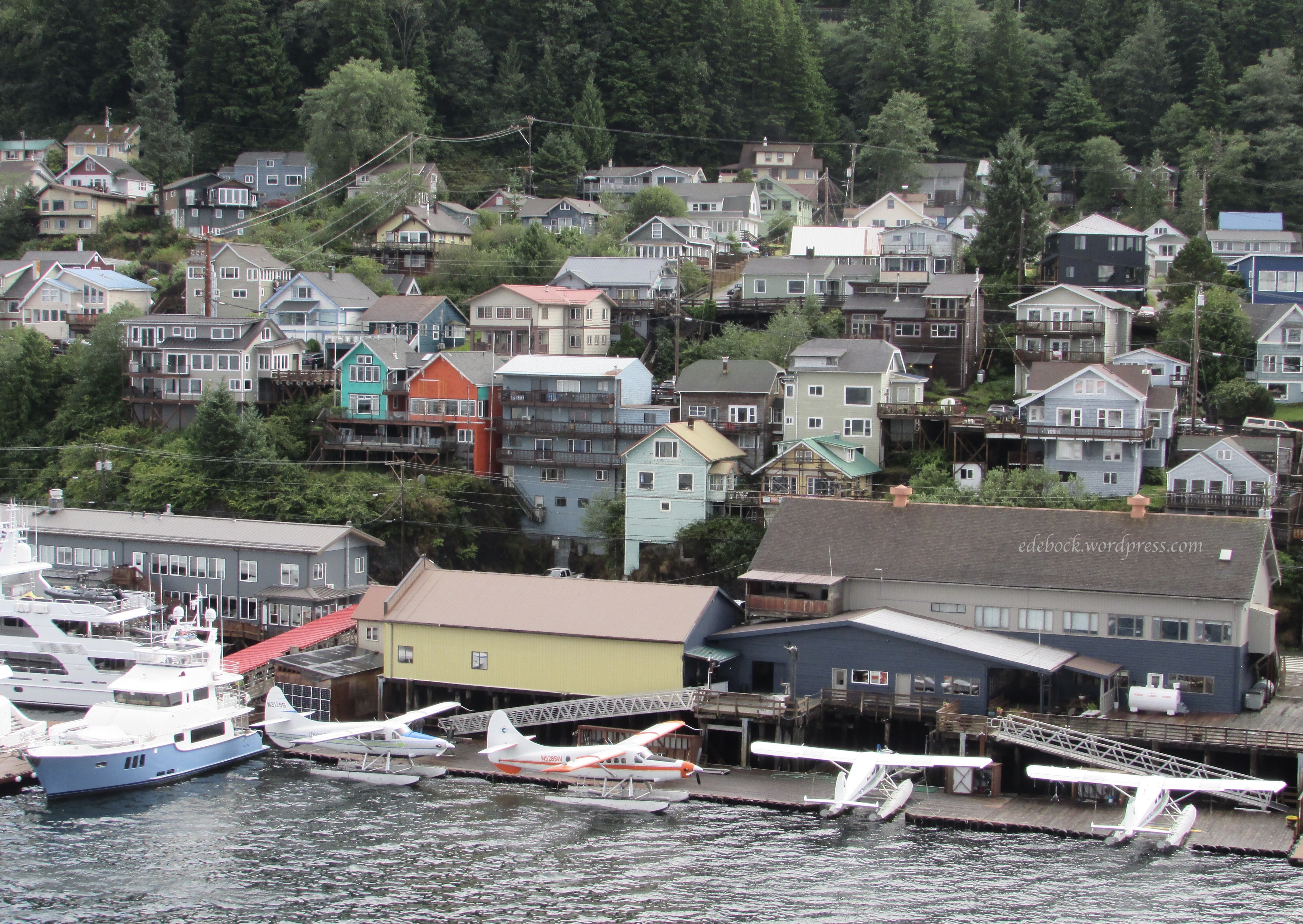
Ketchikan, with a permanent population of about 8000, was our last port of call. Like Juneau, it is inaccessible by road. It receives an average of approximately 150 inches of rainfall a year. Some of that fell while we were there, but we didn’t let that put a damper (pun intended) on our once in a lifetime opportunity to be there and see the sights.

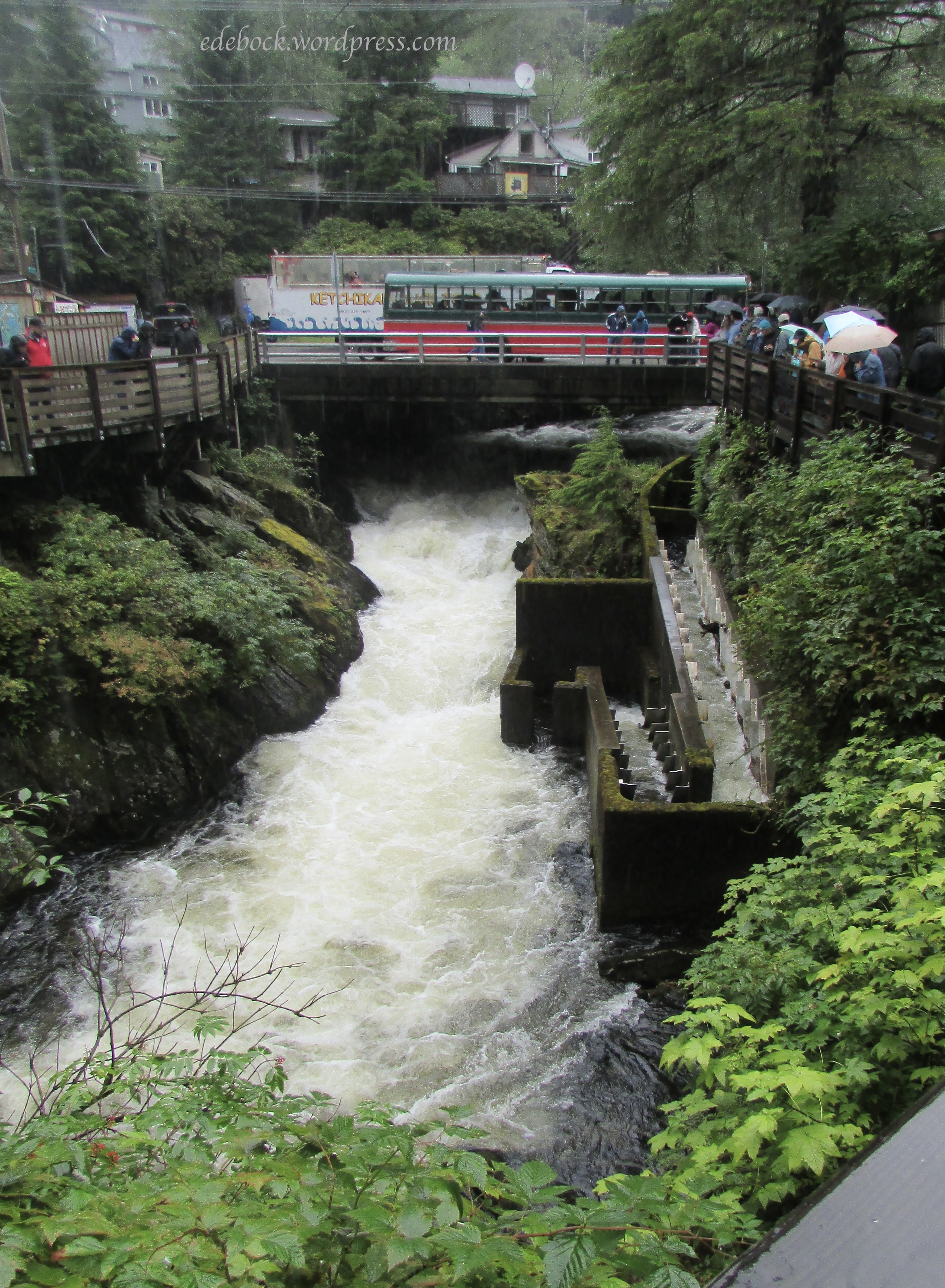
We started by walking the 1.5 mile (2.4 km) Salmon Walk which is dedicated to the importance of salmon to the area and to encouraging good stewardship of the fish and their habitat. The walk upstream along Ketchikan Creek  in the direction that the salmon swim took us past a fish ladder and a hatchery, then along a forest trail before continuing back into the downtown area. 
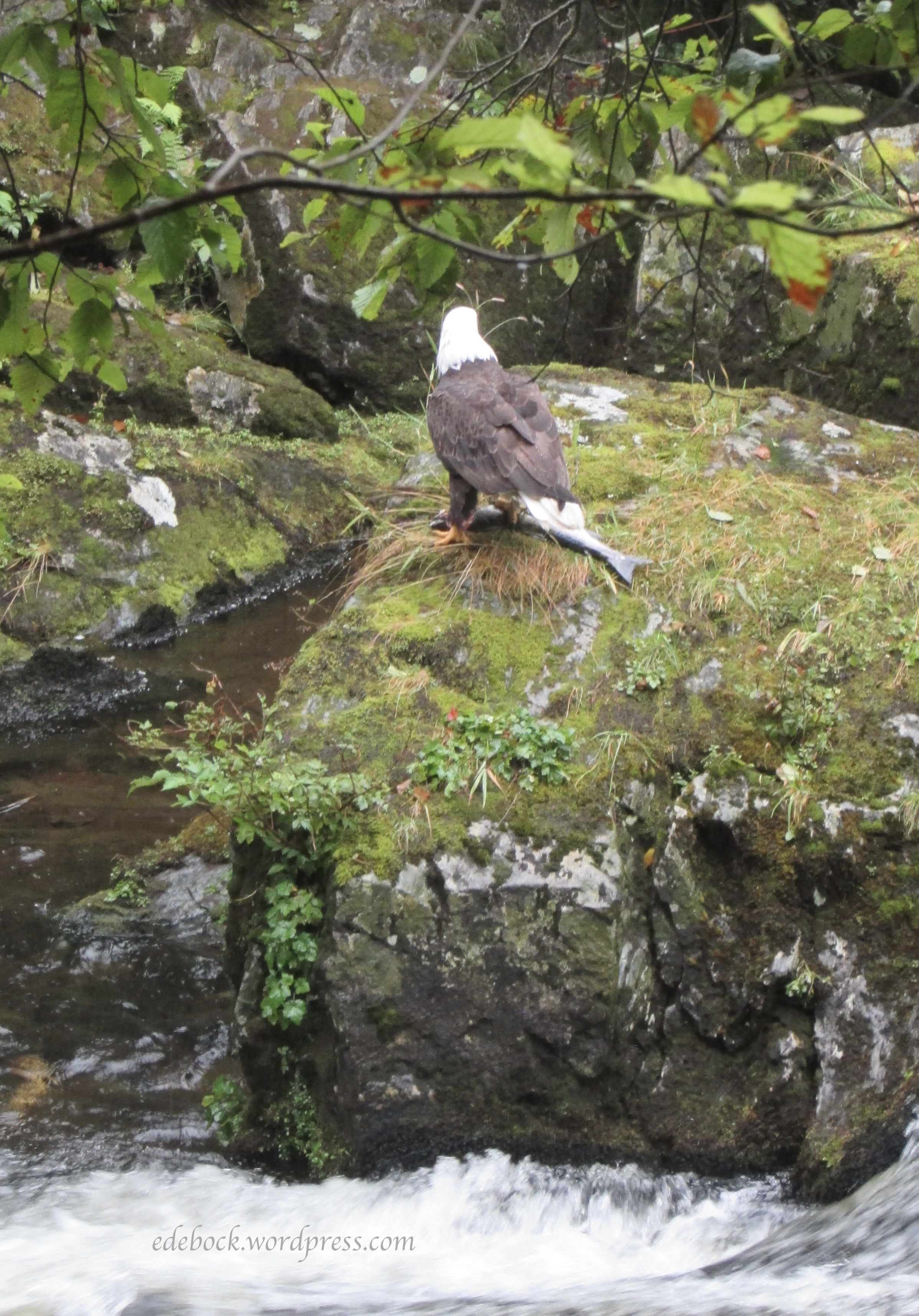
Along the way, we stopped to watch a bald eagle eating a freshly caught salmon. Unfortunately, it wouldn’t turn around and pose for me!
Halfway through the walk, we stopped at the Totem Heritage Center which houses an invaluable collection of 19th century poles retrieved in the 1970s from some of the nearby islands. It was a good place to escape the rain for a little while! 

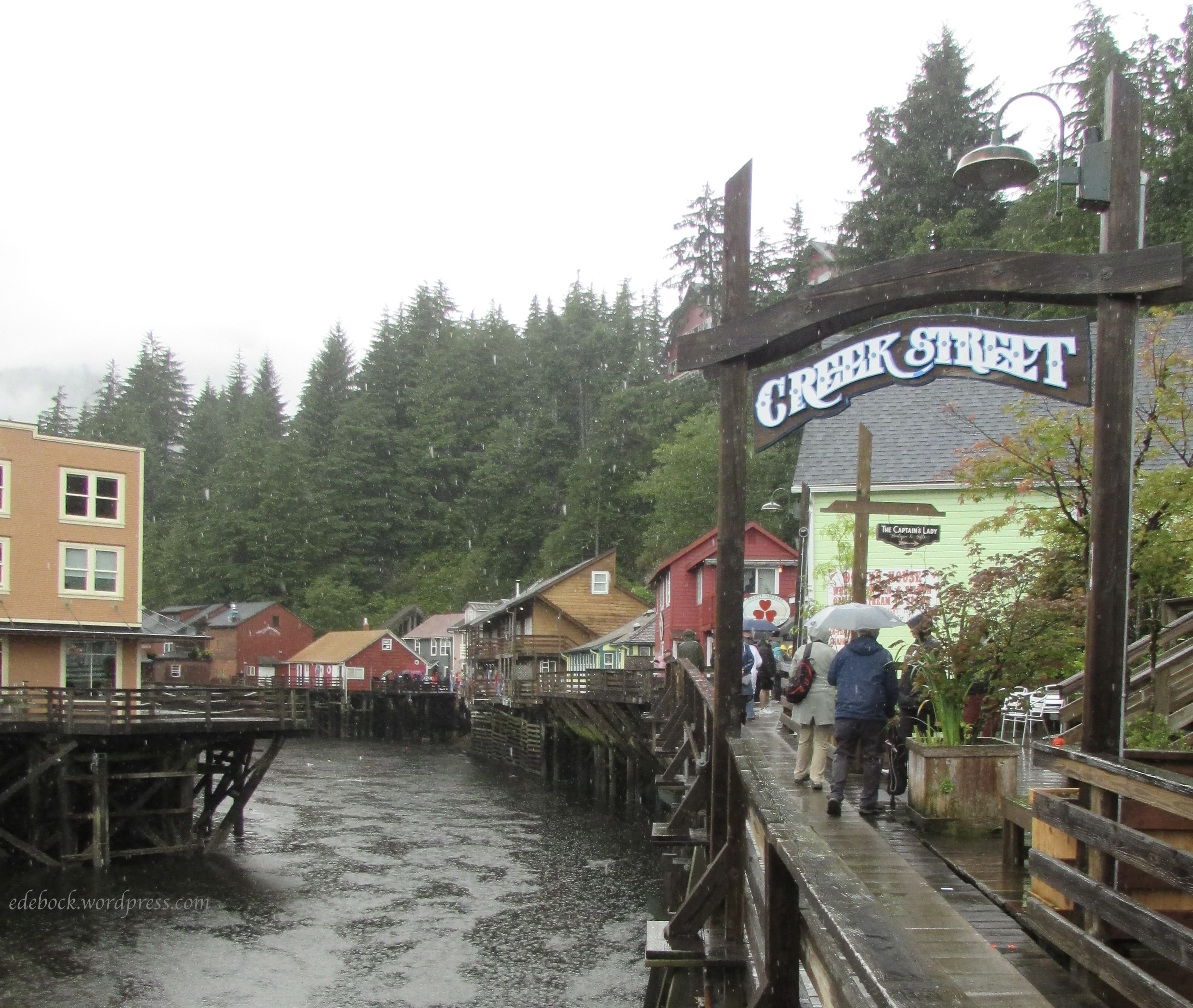
Our walk ended with a stroll along Creek Street, once the town’s red light district, but now a charming historic area known for it’s picturesque boardwalk built over the creek. We watched a couple of seals cavorting in the water there. 
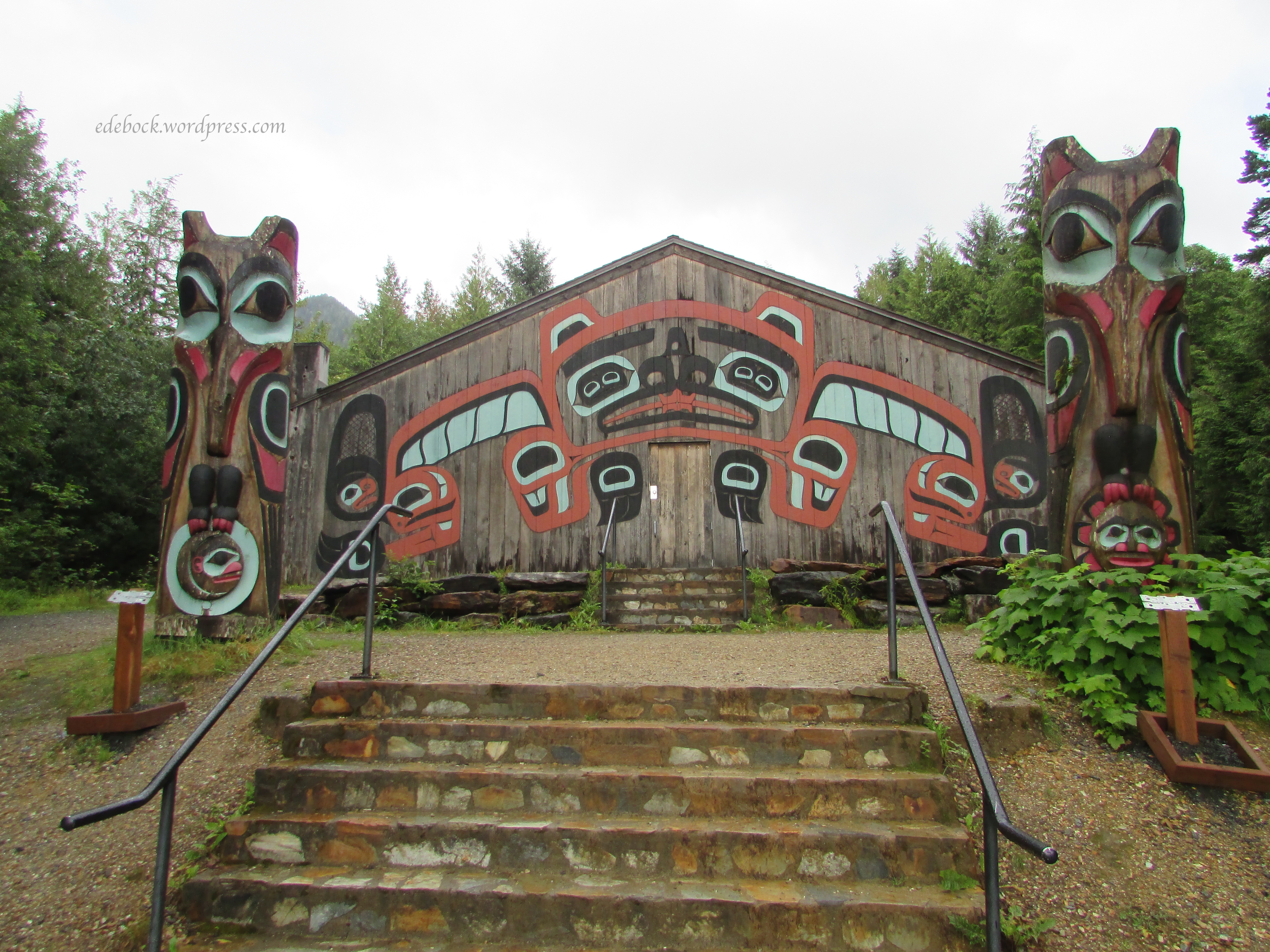
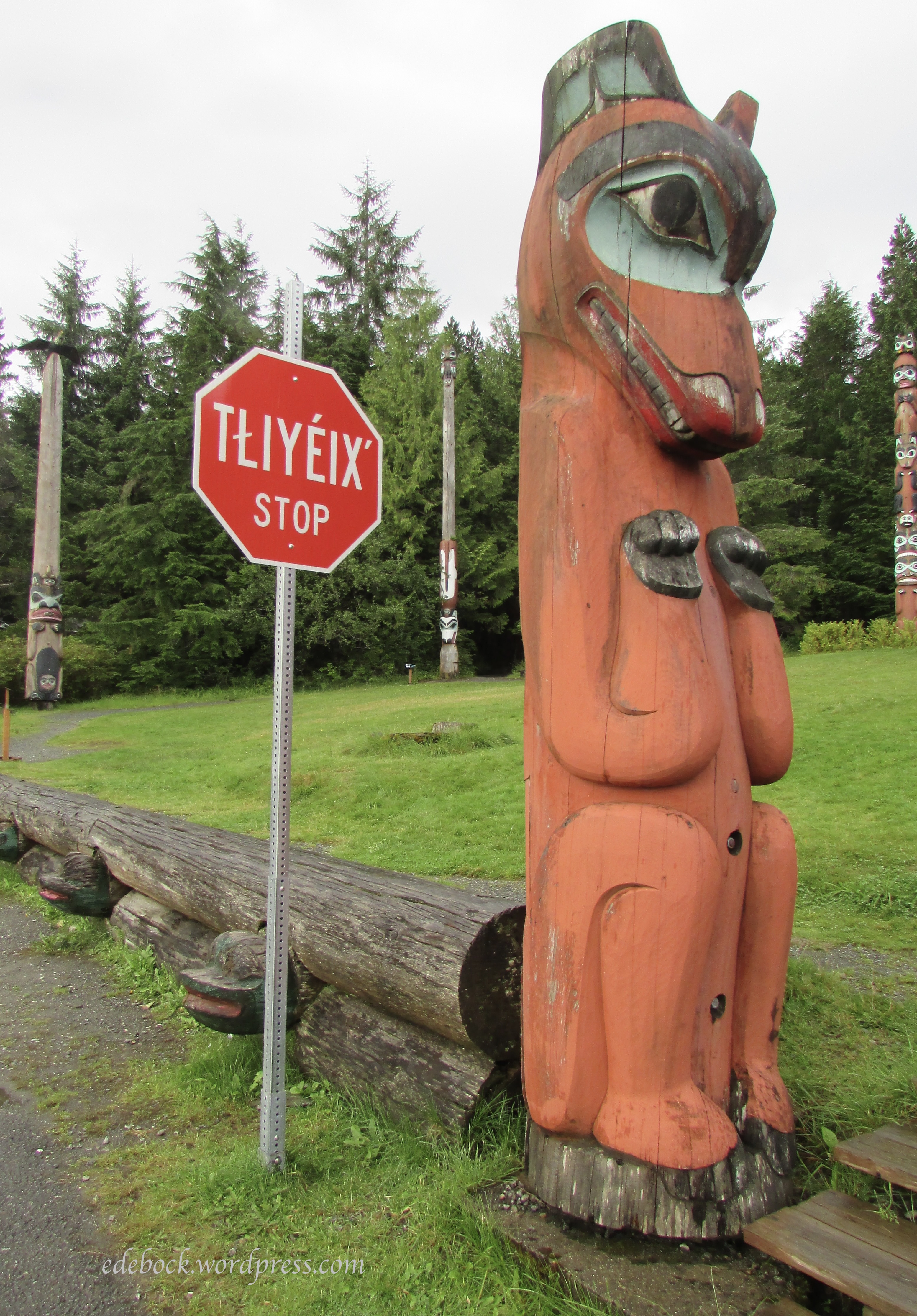
After returning to the ship for lunch, we took a taxi to Saxman Totem Park about 2.5 miles (4 km) south of Ketchikan because we didn’t want to walk that far in the rain and the city bus only goes once an hour. Of all the things we saw and did on this this trip, Saxman was the only one that we considered to be a bit of a rip off. We were charged $8 USD apiece to walk around and look at the collection of totem poles, authentic replicas of original poles that were left in abandoned villages in the past. There was no map available to guide us and most of the descriptive signs were missing. The traditional clan house and the carving centre were closed and all that was open was the gift shop!  We did manage to tag along with a tour group that made a very quick stop there and heard the stories of a few of the poles from their guide. 
And that brings this very long post to a full STOP. If you’ve stuck with it and read this far, you are to be commended! 
 

North to Alaska!

I love trip planning and we tend to be independent travellers, so we don’t have much experience with organized tours and luxury cruises. In fact, with the exception of a three day river cruise in China in 2013, our recent Alaska cruise was our first.

I grew up on the BC coast and the ocean has always been my happy place, so in spite of the fact that it was very different from our usual kind of travel, this trip was something that had been on my unwritten bucket list for a long time. We chose Princess Cruises for two reasons. First, it’s reputed to be one of the more relaxed, laid-back cruise lines and secondly, they offered exactly what we wanted, a 7 day Inside Passage cruise departing from Vancouver on August 12, fitting perfectly with our other reasons for being in Vancouver. 

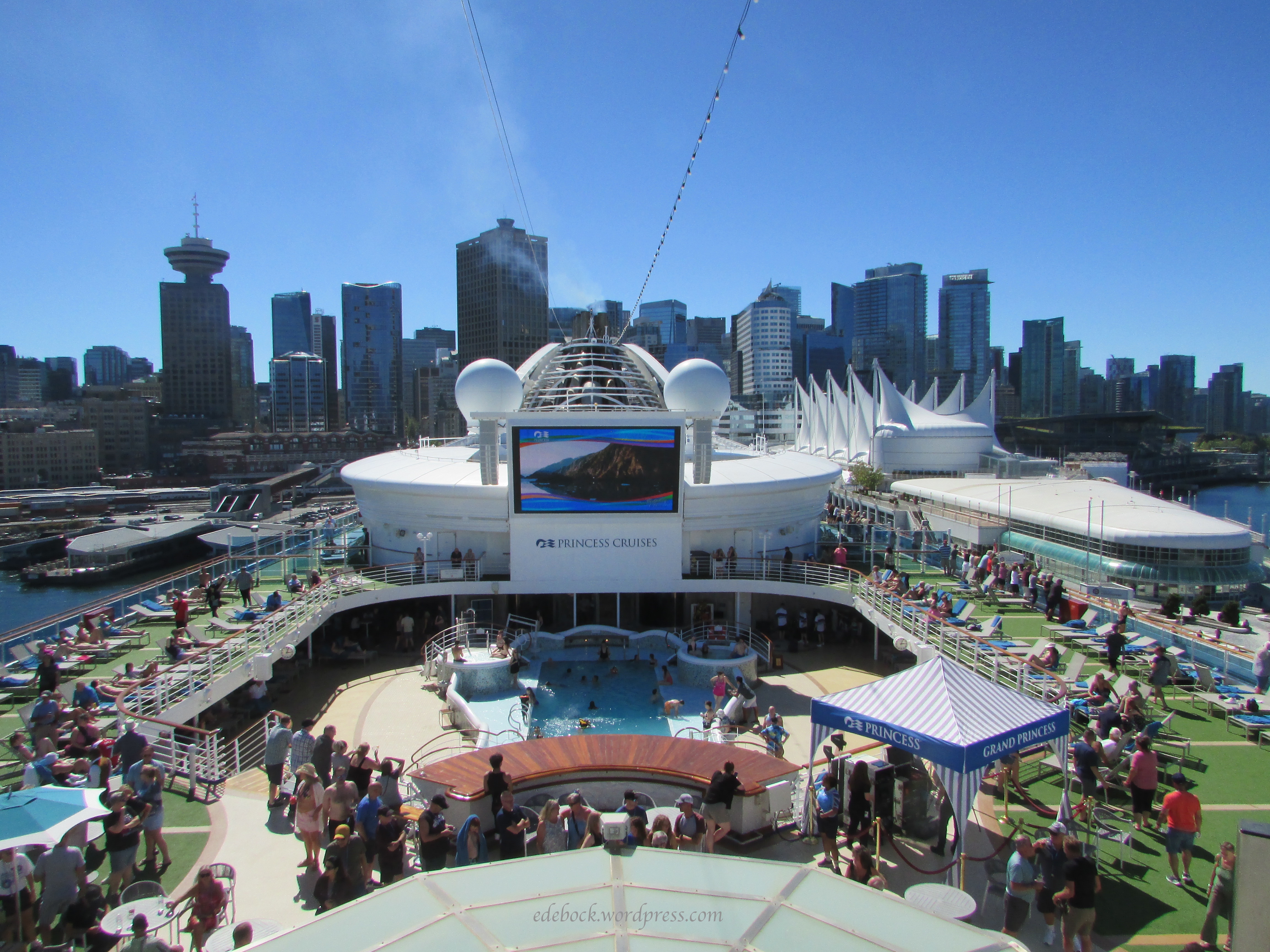
With 3500+ people on board (passengers and crew), swimming pools, theatres, multiple restaurants and bars, a spa, and a casino, the Grand Princess was really a floating resort.

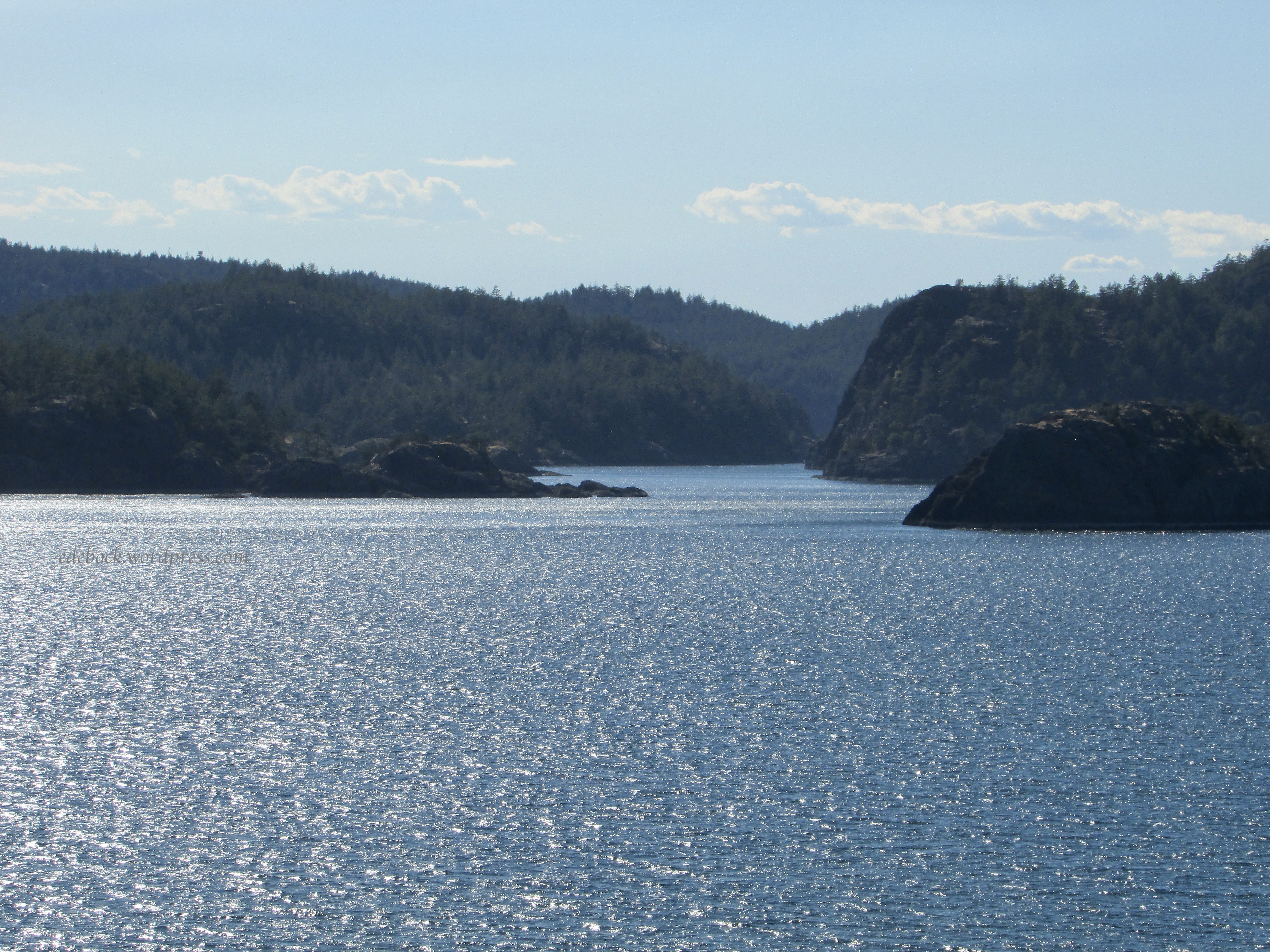
We sailed under the Lions Gate Bridge and out of the Vancouver harbour on a stunningly beautiful afternoon.

Mount Baker, approximately 140 km (87 miles) to the south in the state of Washington, was clearly visible looming over the city skyline.

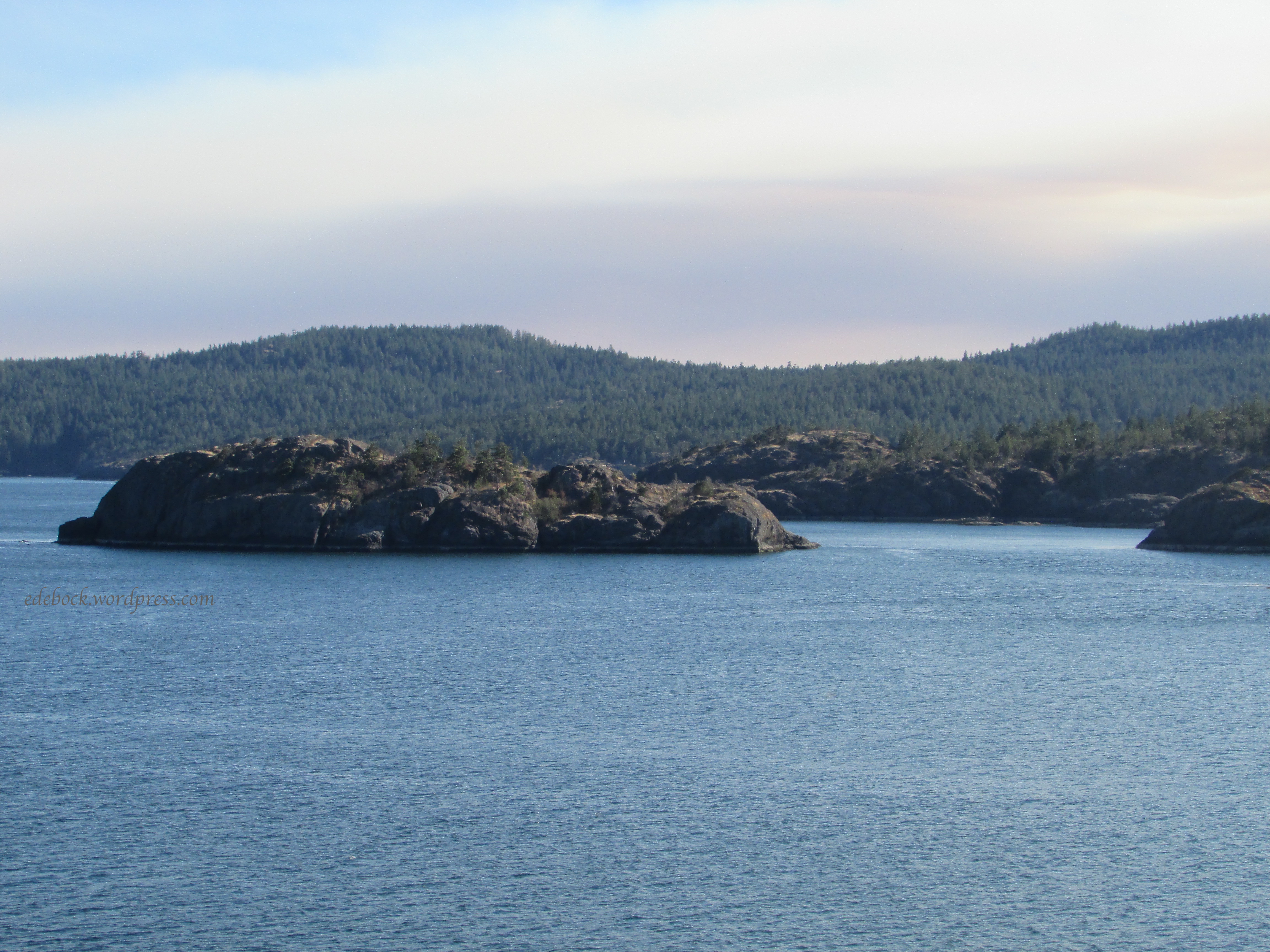
It was the beautiful coastal views, enjoyed from the solitude of our stateroom balcony, that thrilled my heart the most though.

There’s a vast array of activities to take part in on board a cruise ship. We enjoyed attending sessions with award-winning author and photographer, Nick Jans, and retired Alaska forest ranger, Pete Griffin. Although we tried our luck at the cheapest slot machines in the casino, we didn’t spend much time there and didn’t come away any wealthier! The evening shows in the Princess Theatre were superb and rather than spending time in the bars, we chose to sip wine on our balcony while enjoying the scenery.

The food was excellent and, of course, I loved the fact that I didn’t have to cook for the whole week! We chose to eat breakfast and lunch at the ship’s buffet and dinner in the dining rooms where we ordered from excellent and varied menus. While there were many other options, I love seafood and what better place to enjoy it than on the ocean? I even tried a couple of kinds of fish that I hadn’t tasted before. As a diabetic, my favourite part was the fact that there were sugar-free desserts available at every meal! I definitely indulged and the bathroom scale tells me that I gained five pounds. I’m hoping that all the walking that I’m doing as part of my Hoofing It fundraiser for neuroendocrine cancer research will wear it off.

Typically, a 7 day cruise includes two formal nights when passengers are encouraged to dress up. I wasn’t sure how we’d deal with those. I’d seen packing lists that included tuxedos and evening gowns, but we don’t own such things and considering how challenging it was to pack for this three part trip, I had no intention of hauling hubby’s suit along with us. I did pack a couple of simple dresses for myself and dress pants, a dress shirt, and a tie for him. As it turns out, we had nothing to worry about. While a few people did dress more formally, even in the dining rooms most weren’t dressed any fancier than we were.

August is one of Alaska’s rainiest months and the weather can be quite chilly, so packing lists also included warm sweaters, insulated jackets, and rain gear. While we were happy to have warm clothing to bundle up in while viewing a tidewater glacier and looking for whales (we only caught glimpses at a distance) and we did have rain at one of our ports of call, we mostly enjoyed good weather.

Our cruise included stops at Juneau, Skagway, and Ketchikan, and a side trip up Endicott Arm to see Dawes Glacier, but I’ll write about those in a separate post.

Traveling again: family time

Prior to yesterday’s post, the blog had been silent for three weeks. That’s because I was traveling again! For much of that time, I didn’t have internet access and when I did, I was too busy to write about what I was doing. Now that I’m home again, I’m looking forward to reliving some of those experiences as I share them with you.

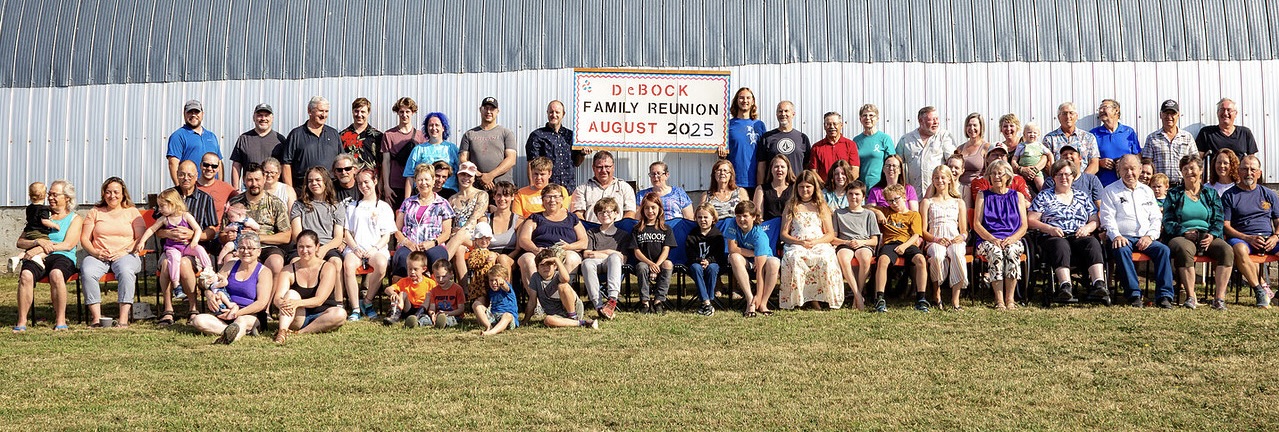
Our most recent trip was really three in one and, as such, was definitely the most difficult one I’ve ever had to pack for. It started with a family reunion at the beginning of August. Over 70 of hubby’s relatives gathered at his youngest brother’s farm for a fun-filled long weekend.

It was a time of visiting, catching up, food, games, campfires, and even some shenanigans!

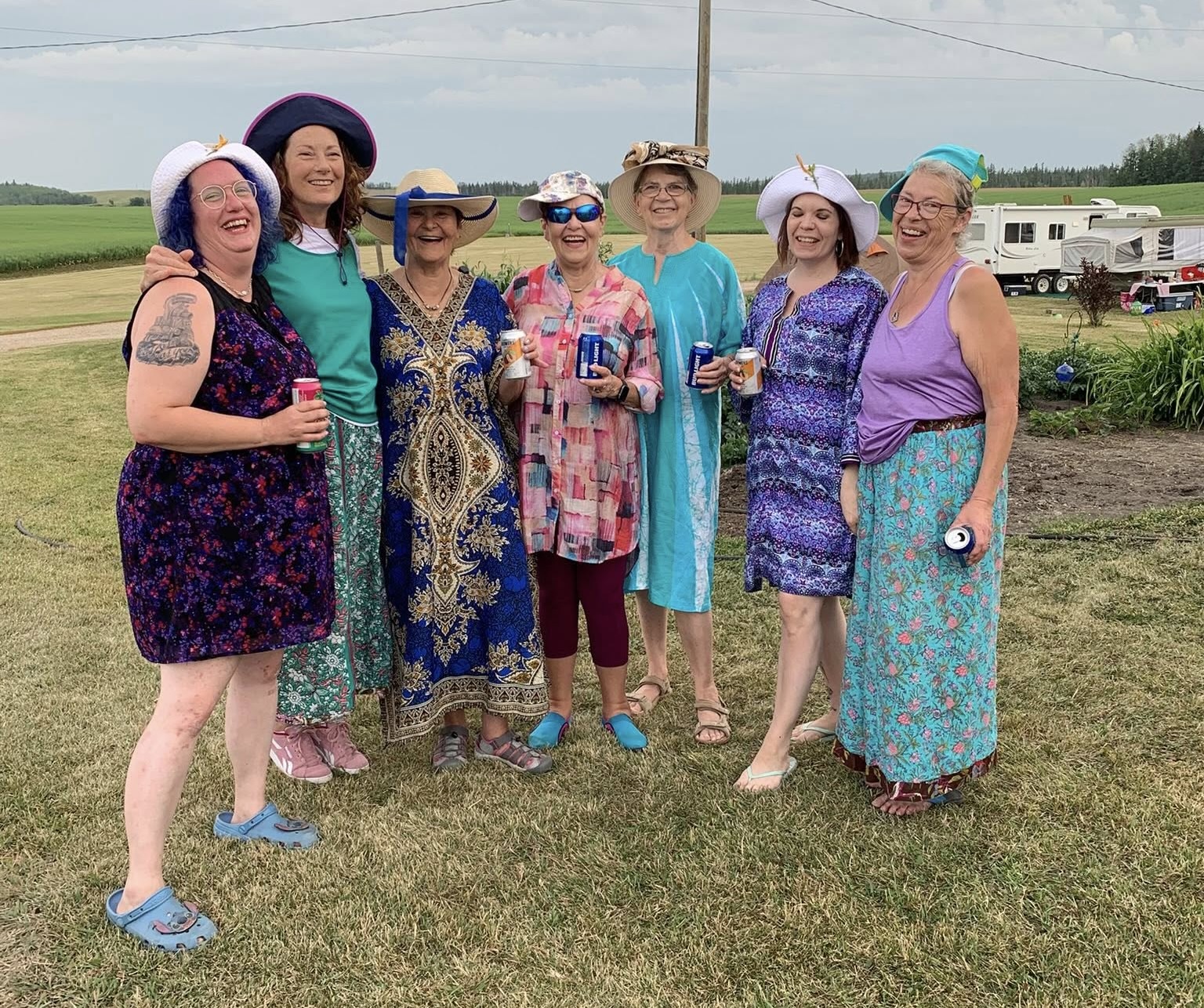
When one of the brothers went a little overboard teasing his younger sister about the bright caftans and wide brimmed hat that she wore to protect herself from the sun, a bunch of us gals decided to join her! In spite of our wacky outfits, I love this selfie of my daughter and I.

It was especially fun to watch the children. Second and third cousins, many who’d never met before, quickly became fast friends. Within minutes of arriving, our 11-year-old autistic grandson was part of a “cult” with creative code names like “Walmart Shopping Bag” and “Ikea Dining Table”! On a hot afternoon, a rousing game of Human Battleship with water balloons morphed into a giant water fight. A visit to the nearby cemetery to place refurbished headstones on old family graves was a more sombre moment and I was very moved by the response to a silent auction to raise funds for neuroendocrine cancer and Parkinson’s disease research. Half the proceeds put me within $100 of my Hoofing It fundraiser goal.

Like most of the crowd, we stayed in our trailer during the reunion, but then we left it at the farm and picked it up again after the second and third parts of our vacation which included a road trip to Vancouver and an Alaskan cruise. That’s why packing was such a conundrum! I could easily pack for any one of the three, but making the transition from trailer to road trip to cruise was a challenge even for someone with as much packing experience as I have!

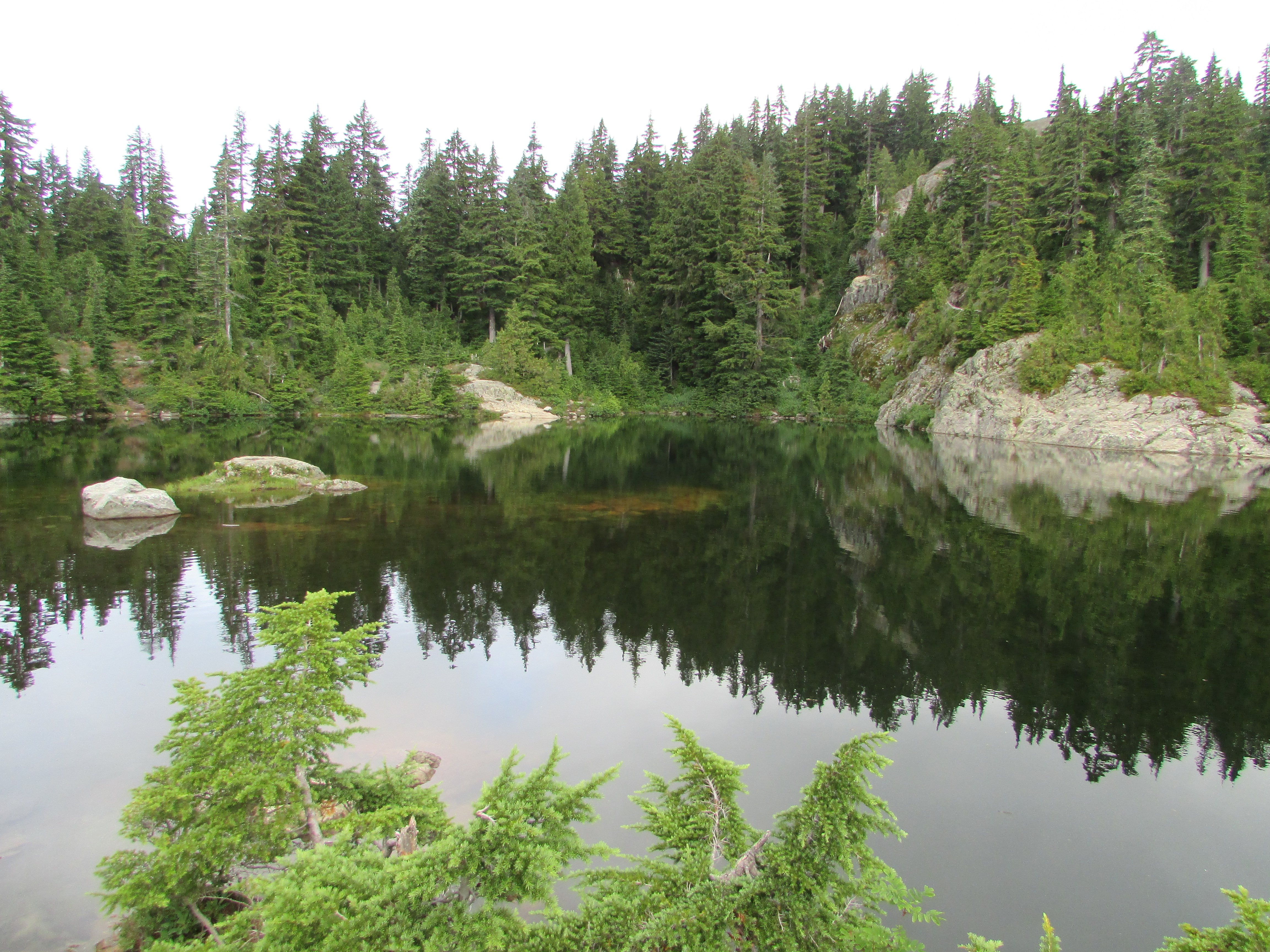
The trip to Vancouver was also about family. It was the first time since our father passed away at the beginning of March 2020, less than a week before the Covid pandemic shut the world down, that all three of my siblings and I were able to be in Vancouver at the same time. In his younger years, Dad was an avid mountaineer and mountains were his passion, so it only seemed fitting that his final resting place be on one of the mountains overlooking the city where he was born and spent much of his life. On the morning of August 9, nine family members hiked the short, but fairly steep trail to beautiful Mystery Lake and selected a secluded spot nearby to finally lay his ashes to rest. 

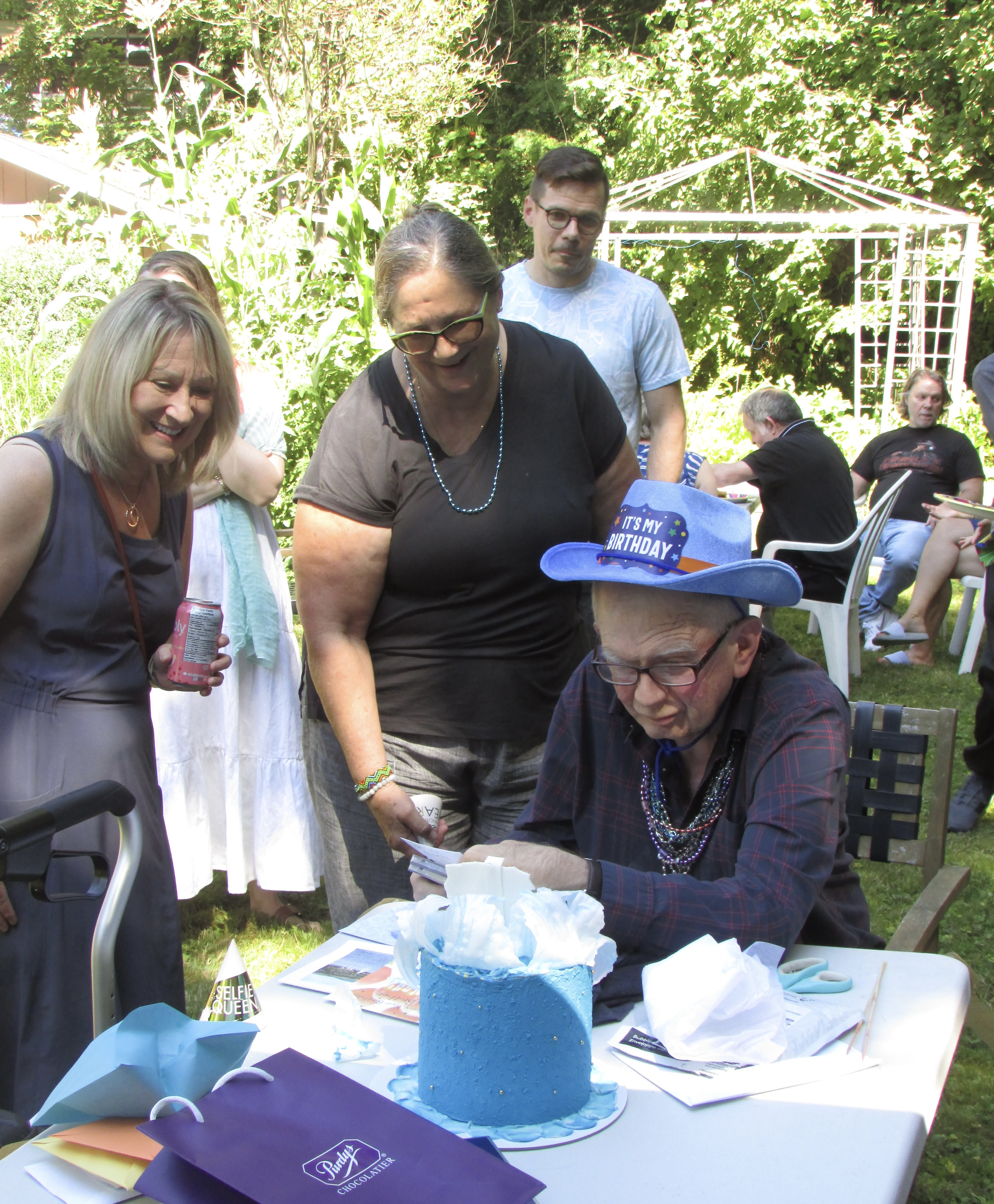
The following day we celebrated my beloved older brother’s 75th birthday. Surrounded by family, friends, and caregivers, Donald was the man of the hour! 

To read Donald’s story, visit this post that I wrote more than a decade ago. It was later published in the Community Living Society’s quarterly publication, The Communicator. 

Part three of our trip was the Alaska cruise. In order to keep this post from becoming too long and because I’m still sorting through the 300+ photos that I took on that portion of the trip, I’ll share it in a separate post (or maybe even more than one) within the next few days. 

18 years of retirement!

With the school year coming to an end this week, hubby and I have been retired for 18 years. 18 years! How is that even possible? That’s the same length of time that I taught at Lougheed School, a small prairie school that closed a couple of years later due to declining enrolment. Perhaps it says something about our chosen career that 18 years of teaching seemed like a very long time while the past 18 have flown by!

When I reflect on all that we’ve experienced in the past 18 years, I realize how full and how rewarding they have been. Retirement has included fulfilling long held dreams like teaching English in Japan and later, China. One might argue that that wasn’t really retirement. After all, we were employed and we earned a paycheque, but it wasn’t really about the work or the money. Those were simply what allowed us to be there. It was all about adventure; about living shoulder to shoulder with the people of another land and learning about their culture. It was about traveling to other locations in Asia during our holiday breaks. We also spent one summer on the Pacific island of Saipan serving as short term missionaries.

Living with cancer for the past 12 years has curtailed our ability to spend extended periods of time outside the country and the pandemic kept us home for a couple of years, but tourist travel has also been a big part of our retirement years. We’ve visited Mexico six times, ziplined over the rainforest in Costa Rica, toured Israel, and visited several European countries as well as nine Canadian provinces, one territory, and numerous US states.

Speaking of retirement, my father always said that there were no end of things that one could do as long as they didn’t need to be paid to do them and we have certainly found that to be true. Volunteering in various capacities in our church, our community, online, and most recently in a far and distant land, has helped give meaning to our retirement years.

Retirement has brought some unexpected surprises. Learning to operate a tractor and a combine definitely wasn’t part of this city bred girl’s retirement plan, but several years of helping a friend at seeding time and harvest gave me more joy than I could ever have imagined.

Since we retired, our family has grown to include eight grandchildren who have made our lives so much richer. In fact, that’s why this post is a day later than I’d originally planned. We visited three of them earlier this week and now another three are visiting us. As much as I love to write, going on adventures and playing games with the grandkids and late night cuddles and chats with one who has trouble sleeping are far more important than anything I could ever post on here.

To say that our retirement years have been rich would be an understatement. I’m incredibly thankful that, in spite of our health challenges, we have been able to experience so much. As time flies by I sense an urgency to continue seeing and doing as much as we can while we’re still able, but I don’t see us slowing down anytime soon, so here’s to a few more years of purposeful and productive retirement!

Why traveling together is good for your marriage

I inherited my wanderlust from my parents who visited 66 countries together, mostly during their retirement years. When I was a child, we took long holidays as a family. We drove the west coast as far south as San Diego and traveled north all the way to Alaska. When I became a teacher, my plan was to spend my summers traveling, but hubby had different ideas. Growing up, his summers were spent working on the family farm. He’d only ever been on one short holiday to visit relatives. He wanted to spend his summers at home playing ball, golfing, and going to the beach.

Marriage meant compromise, but I knew that I wouldn’t be happy if I couldn’t travel. Before we tied the knot, I told him that I would be spending part of each summer traveling. It was something that I simply had to do. He was welcome to join me, but if he’d rather that I went alone and he spent that time pursuing his own interests, I was okay with that. Thankfully, he chose to join me and we have enjoyed so much of the world together! We’ve also learned that traveling together is good for a marriage.

Travel teaches you teamwork and communication skills.

While I do most of our travel planning, I always consult with hubby about major decisions like which flights to take or where we should stay, but there are also small day to day choices to make. Should we walk or take the bus? Where should we go for lunch? It’s often these little things that require clear communication and test our ability to compromise.

Travel teaches you how to work together to overcome obstacles.

When you’re travelling together, problems are shared. When we failed to get off the train at the right stop in Germany last week, we put our heads together and figured out how to get to our destination (with the help of a very kind gentleman). Having had a similar experience in Japan many years ago, I’m sure that either one of us could have dealt with this minor mishap on our own, but it’s so much better when you have someone to share the momentary panic with!

Traveling as a couple teaches you to be more patient with one another and with yourself.

When you’re together 24/7 in an unfamiliar environment, especially one where English isn’t the first language of the people around you, there are bound to be moments of frustration. Whether it’s figuring out directions, handling delays, or trying to figure out how to buy tickets for the train, we’ve learned that there’s always a solution to every problem. Sometimes finding that solution just requires a little patience.

Shared adventure adds spark to a tired relationship.

When a couple gets married, going on a honeymoon allows them time to be fully present with one another and to delight in each other’s company. In time, however, the distractions and busyness of daily life take over. Work, family, household chores, and individual interests often leave little time for one another. Traveling together offers a couple a chance to reconnect and to enjoy uninterrupted time together. The destination is less important than the simple act of spending time together and getting away from the noise of daily life. Even an occasional weekend getaway together can help reinvigorate your relationship.  

Finally, travel gives you lasting memories to share.

Some of our most cherished memories have been made while traveling together. There are big moments like our first glimpse of the terra cotta warriors in Xian, China or seeing the golden Dome of the Rock in Jerusalem come into sight for the first time, but there are others that were also amazing moments for us. Memories like staying in a very basic $12 a night guesthouse in Siem Reap and taking an early morning tuktuk ride out to Angkor Wat to watch the sun rise over the enormous temple complex. Memories of traveling the length of Vietnam on overnight buses and arriving in Saigon late on New Years Eve without a place to stay! We even love to reminisce about the time that we accepted a ride from a total stranger in the middle of rural China! Not necessarily recommended, but it was an amazing experience! You can read about it here.

With all the traveling that we’ve done together, you’d think that I’d have more photos of the two of us, but I love this one taken in Heidelberg last week, so I’ll share it again.

Last day in Germany

Today was our last day in Germany. As much as I’ve enjoyed the last week, I’m tired with a capital T and I’m ready to go home. Even though it was just over three weeks, it seems like forever ago that we set out on this big adventure.

We walked a lot again today, but at a very leisurely pace. It was 31ºC (88ºF) this afternoon and we had plenty of time to see Mainzer Alstadt, the old town centre of Mainz. There are many historic churches throughout the city, but three stand out and are worth a mention here. Because of the narrow, crowded streets, it isn’t always easy to get good photos of the exteriors, but I’ll share the interiors of the two that we were in today.

St. Stephan’s is located high on a hill overlooking the old town. We arrived just as the doors were being opened and were delighted to find a musical performance happening inside. The acoustics, as is true in so many of these old stone churches, were amazing.

St.Stephan’s is known for it’s brilliant blue stain glass windows created by Jewish artist Marc Chagall (1887 – 1985). They cast a mystical light throughout the interior of the church and reminded me of flowing water.

Only the three long panels at the front of the church contain figures like these ones.

Even though my blog takes it’s name from one of my ancestors, not St. Augustine, the church that bears his name was something I had to see. St. Augustine Church is tucked into a narrow pedestrian street.

The inside is absolutely spectacular. I have trouble wrapping my head around so much money being spent on a place of worship in a world where people go hungry, but at the same time, I can’t help but appreciate the beauty.

By far the most imposing structure in the old section of Mainz is the enormous St. Martin’s Cathedral. Photos simply don’t capture how massive the 1000 year old structure is.

Friday is market day in the main square next to the cathedral and if I lived in Mainz, this is where I’d be doing my weekly grocery shop. Fruit, vegetables, cheese, meat, baked goods, eggs, honey, wine, and even flowers can all be found in the giant outdoor market. It reminded me of shopping in Mexico and in China when we lived there.

After our stroll around the old town and through the market, we returned to the nearby river and walked along the promenade again.

Embedded in the largest wine-growing region in Germany, Mainz is known as the country’s wine capital, so we ended our self-guided tour with a glass of wine by the Rhine!

Now our suitcases are packed and we’re ready to leave. We’ll catch a train to the Frankfurt airport early tomorrow morning and fly out at noon. The blog will probably be silent for a few days while I recover from jet lag and get back into routine, but we have more travel plans for later this summer , so don’t go away!

We made it to Mainz!

We had a bit of misadventure on the way to our final destination for this trip this morning. We were supposed to change trains in Ludwigshafen, but somehow missed our stop. We were the only passengers to get off at the next stop, a small deserted station with no one on duty to provide assistance. Thankfully, a kind gentleman who spoke perfect English (a rare thing in this part of Germany) happened to be passing by and stopped to ask if we needed help. Since we knew that we’d be too late getting back to Ludwigshafen to make our connection to Mainz, he suggested that we go back two more stops to Mannheim, a much bigger centre where we’d have a better chance of catching a different train to Mainz. That worked perfectly and we were only about an hour later arriving than originally planned. In the words of Shakespeare, “all’s well that ends well!”

Our hotel here in Mainz is directly across from the train station. After checking in, we walked about 15 minutes to the riverfront promenade. On the way, we passed Christuskirche (Christ Church), a prominent Protestant landmark. Built between 1897 and 1903, it was destroyed during World War II, and rebuilt between 1952 and 1954.

After walking the riverfront promenade and dipping our feet in the Rhine River, we headed for the Gutenberg Museum.

We haven’t spent a lot of time in museums on this trip, but one that is devoted to the history of books, printing, and writing captured my interest and I was particularly interested in seeing the Gutenberg Bibles. The Gutenberg Bible was the first European book published on a printing press using moveable metal type. Only 49 of the approximately 180 that were printed right here in Mainz in the mid 1400s have survived and the museum owns two of them. Well, technically, one and a half. The huge Bibles were printed in two volumes, Old Testament and New Testament. Previously owned by the British Baronet Shuckburgh, the complete two-volume Bible was added to the museum’s collection in 1978. The second Bible, which was previously owned by the Solms-Laubach family, is incomplete, with only the second volume surviving.

The Bibles were only printed in black ink as two or more colours would have been too expensive and time-consuming. Spaces for coloured ornamentation were left empty and the books handed over to an illumination workshop. As a result, each surviving edition is different in its ornamentation.

Heidelberg Castle and the Philosopher’s Walk

Every year, the ruins of Heidelberg Castle attract approximately one million visitors from around the world making it by far the most visited site in the area. This morning, we caught a bus in front of our hotel and then rode the funicular up the north side of Königstuhl hill to the imposing structure that overlooks the city’s Old Town. An hour long English tour with a delightful and extremely knowledgeable guide was an excellent way to begin exploring the site. He managed to fit hundreds of years of history into a very short time!

The earliest castle structure dated back to the 13th century, but in the 1600s when it became home to Prince-Elector Friedrich V and his wife, Elizabeth Stuart, daughter of King James I of England, it underwent major expansion and became one of the grandest palaces of the Renaissance period. In the late 17th century, it was repeatedly attacked and severely damaged by the French. Later, the local populace began to rebuild it, but in 1794, two devastating lightning strikes caused further damage and the once majestic residence was almost completely burned out. Citizens of Heidelberg used stones from the ruins to build their homes until Count Charles de Graimberg began an effort in 1800 to conserve what remained. Had he not done that, there might not be much left for visitors to enjoy today!  

In addition to all that he added to the castle, Friedrich V commissioned a great garden to be built on the hillside above the castle. Gunpowder was used to carve out terraces to accommodate ornamental flower beds, labyrinths, pergolas, and water features. While the gardens were never completed, the area provides visitors today with amazing views of the castle and the town below. 

A walk on the once fortified wall in front of the castle also offers spectacular views of the Old Town. The prominent building in the top left quadrant of the second photo is the Church of the Holy Spirit. Constructed between 1398 and 1441, it’s still in use today over 600 years later!

After exploring the castle and its grounds, we took the funicular back down the hill and walked through town to the Old Bridge. Hubby wasn’t too keen about climbing the steep hillside on the other side of the river to the Philosopher’s Walk, given that name during the 18th century because of the many Heidelberg professors and philosophers who enjoyed the path for its solitude, natural beauty, and great views. Perhaps I should have listened to him, but it was on my list of things to do in Heidelberg and I didn’t want to miss it. Although I’d been warned, the climb was longer and steeper than I had imagined! Once we reached the path, we only walked a fairly short segment of it, but the views of the river and the town below were worth it.