Book of the month – November 2023

The Tea Girl of Hummingbird Lane

Lisa See

81URNOpF3vL._SY522_I read mostly for enjoyment, but I love a book that transports me to another place or perhaps another time and a book that teaches me something. The Tea Girl of Hummingbird Lane was such a book. Before reading it, I knew absolutely nothing about the Akha people, a minority hill tribe who live in small villages in Thailand, Myanmar, Laos, and Yunnan province in China.

As the story opens in the late 1980s, the families of Spring Village are living a very traditional lifestyle without modern conveniences and with very little contact with the outside world. Traditional beliefs and rituals dominate their existence and their lives are aligned around the seasons and the growing of tea. When twins are born to a young village couple, the father is required to kill his babies and the couple is banished from the village.

That’s when I had to put the book aside to do a bit of research. Who were these Akha people? Did they really exist? Were they still living that way in the late 1900s? I learned that indeed they were. The Akha believed that only animals could give birth to more than one offspring, therefore until about 20 years ago, twins were considered an extremely ominous occurrence and were killed immediately, as were babies born out of wedlock.

Now, back to the story… Gradually, the outside world begins to encroach on Spring Village. Li-yan, daughter of the local midwife and one of the few educated girls on the mountain, slowly begins to reject the customs that shaped her early life. When she gives birth to a baby out of wedlock, she rejects tradition and travels with her newborn daughter to a nearby city. There she leaves the baby, wrapped in a blanket with a tea cake tucked in its folds, near an orphanage.

While Li-yan eventually leaves her village for further education, a job, and city life, her daughter, Haley, is raised in California by loving adoptive parents. Despite her privileged childhood, Haley wonders about her origins and across the ocean, Li-yan longs for her lost daughter. Over the years, each searches for meaning in the study of Pu’er, the tea that has shaped their family’s destiny for centuries.

Perhaps the well-researched story tells us more about the history and the production of tea than we really care to know, but it’s also an enthralling family saga; a captivating story of mothers and daughters, families, fate and love. A secondary narrative depicts what it might be like to be one of the many Chinese girl children adopted by American families.

My favourite quote? “Those who suffer have earned contentment.”

373533072_273279982227296_6534294399832151140_n

Fashion Friday will return next week. 

Tea at the Empress

IMG_3824

Victoria’s iconic Fairmont Empress hotel, overlooking the city’s inner harbour, started serving Afternoon Tea when it opened on January 8, 1908 and continues to serve freshly prepared scones, pastries, and tea to over 80,000 guests every year! Yesterday, we joined that number.

IMG_3816

From our comfortable corner table by the fireplace, we had a gorgeous view of the harbour as we lingered over our lunch.

IMG_3818

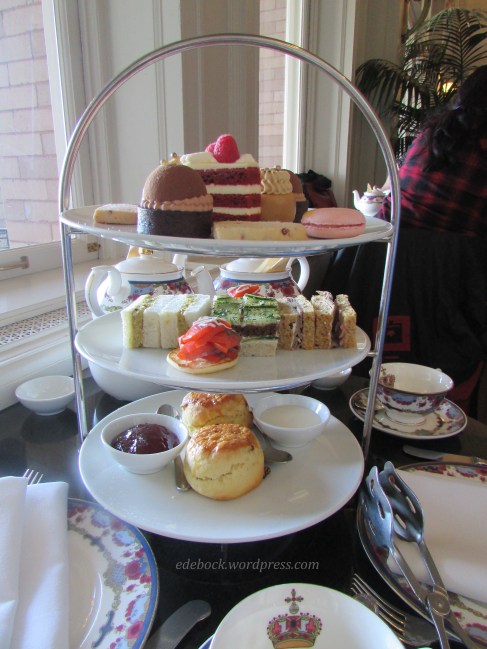
The set menu, made from fresh, locally-sourced ingredients, arrives on a three tiered tray. On the bottom layer are raisin scones with clotted cream and strawberry preserve. I must admit that, until yesterday, I didn’t know what clotted cream was! The name brought to mind something lumpy and gross, but it is far from that! It’s smooth and soft, similar in flavour to a high-quality unsalted butter and somewhere between butter and whipped cream in richness. The second layer consisted of finger sandwiches, mini quiches, and cold smoked salmon on tiny blinis. It doesn’t look like a lot of food, but we were getting full by the time we reached the top layer that held five delectable mini desserts for each of us. We ate two of them and packaged the rest to bring back to our hotel for later.

IMG_3815

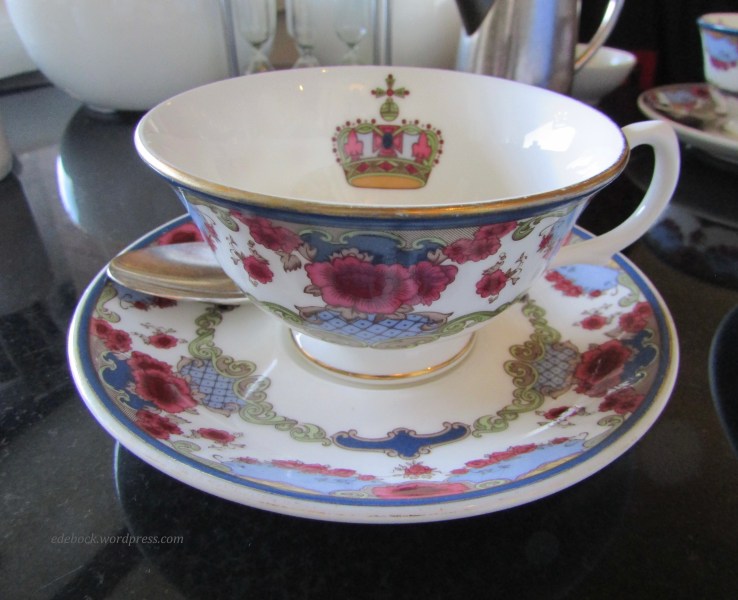
We had our choice from a vast selection of teas, so we chose two different ones and sampled both. The original china was gifted to the Empress by King George VI and Queen Elizabeth (the Queen Mother) on a visit to Canada in 1939 and the pattern is reproduced exclusively for the Empress.

Tea at the Empress is pricey. So pricey, in fact, that my frugal nature almost convinced me that we shouldn’t indulge. Hubby insisted, however, and I’m glad he did! It’s definitely worth doing if you’re ever in Victoria.

IMG_3822 2

Tea, the universal drink

After water, do you know what the world’s most widely consumed beverage is? Would you say coffee? Beer? Wine? Coke? Wrong every time! It’s actually tea!

There was always tea available in our house when I was growing up in the 1950s and 1960s, but only plain black tea. We drank green tea on the rare occasions when we went to a Chinese restaurant. Now I drink two mugs of green tea every morning and the basket of other teas in my kitchen cabinet is overflowing.

In Canada, our increasingly multicultural society plays a large part in the growing popularity and availability of so many different teas. Over the years, the world has come to us and it has brought its teas with it.

Screen Shot 2019-02-25 at 9.03.21 PMDrinking tea is a tradition that is said to date back to 2737 BCE. According to legend, Chinese emperor Shen Nung was sitting under a tree while his servant boiled drinking water. When some dried leaves from the tree blew into the water, Shen Nung decided to try the infusion that was created and found it to his liking. Since then, tea drinking has spread around the world.

While black tea is more popular in Western countries, green tea is preferred in China and Japan where it is a common part of daily life. Green tea is unoxidized, giving it a lighter taste and aroma than black tea. The tea that is used in the traditional Japanese tea ceremony is matcha which is powdered and not infused. This means that the leaves themselves are consumed resulting in a much higher concentration of the antioxidants, minerals, and vitamins that make green tea healthy. For this reason, matcha has become quite trendy.

Taiwanese bubble tea is a modern innovation. This high calorie tea has as its base an iced tea (typically black, green, jasmine or oolong) with milk and a sugary syrup. The “bubbles” are actually tapioca pearls. As much as I like tea, this one has never appealed to me!

From Thailand comes the very popular Thai tea. Made from strong black tea, often spiced with ingredients such as star anise, crushed tamarind, and cardamom, it’s usually sweetened with sugar and condensed milk and served over ice.

India produces and consumes more tea that any other country in the world. It is best known for it’s chai blends that mix black tea leaves with spices like cinnamon, ginger, nutmeg, cloves, cardamom, and black pepper. Assam is another popular variety of black tea which is grown in the Assam region of India. It is used in many breakfast blends including English Breakfast and Irish Breakfast, but is also consumed on its own. It has a strong, malty flavour, a reddish colour, and is high in caffeine. Darjeeling is yet another tea that is grown in India, specifically the mountainous Darjeeling region in the northern part of the country.

In Morocco, drinking tea is more than simply a social custom, it’s also part of doing business. If you find yourself in a Moroccan market, you’ll likely be sat down and offered a glass of mint tea by a vendor wanting to sell you a beautiful carpet. This is touareg tea, a green tea prepared with spearmint leaves and sugar.

It was Portuguese and Dutch traders who first brought tea to Europe in the early 1600s. By the mid 18th century it had become Britain’s most popular beverage with the East India Company using fast ships called tea clippers to bring the leaves from India and China.

Then there are the herbal teas which aren’t considered “real” tea at all because, unlike black, white, and green teas, they aren’t made from the leaves of the tea bush (Camellia sinensis). Popular among the herbal teas is rooibos or bush tea from South Africa which is made from the leaves of the red bush, a broom-like member of the Fabaceae family.

One of my favourite teas is Earl Grey, a black tea flavoured with oil from the rind of the bergamot orange, a fruit grown mostly in Italy. It is thought to have been named for Charles Grey, 2nd Earl Grey, who was British Prime Minister from November 1830 to July 1834. In addition to regular Earl Grey, I have Vanilla Earl Grey, Lavender Earl Grey, and even Double Bergamot Earl Grey in my collection!

There are apparently all kinds of health benefits to drinking tea, especially green tea. The comparative lack of processing means that it has a higher level of antioxidants and polyphenols. Studies have shown that it may:

  1. lower cholesterol
  2. lower blood pressure
  3. reduce the risk of heart attack and stroke
  4. reduce the risk of neurological disorders like Alzheimer’s and Parkinson’s diseases
  5. lower blood sugar
  6. encourage weight loss
  7. aid digestion
  8. inhibit intestinal inflammation
  9. strengthen the immune system
  10. help fight infection
  11. help fight various cancers
  12. prevent bone loss
  13. reduce plaque buildup and tooth decay
  14. help cells regenerate and repair
  15. help slow down aging
  16. increase mental alertness
  17. lower stress hormone levels
  18. prevent arthritis

If nothing else, it’s a flavourful way to stay hydrated, it contains no calories, and it has less caffeine than coffee.

Tea, the healing beverage that knows no borders! 

IMG_7153

That’s 3 of my grandchildren on the cup!