NET Cancer Day 2024

ncd-logo-newI wish there wasn’t a need for NET Cancer Day and that I didn’t feel compelled to write about it again this year, but there is and I do. Those of you who have been reading the blog for very long might think that I’m  starting to sound like a broken record, but it’s just so important for people to become more aware of this frequently misdiagnosed cancer.

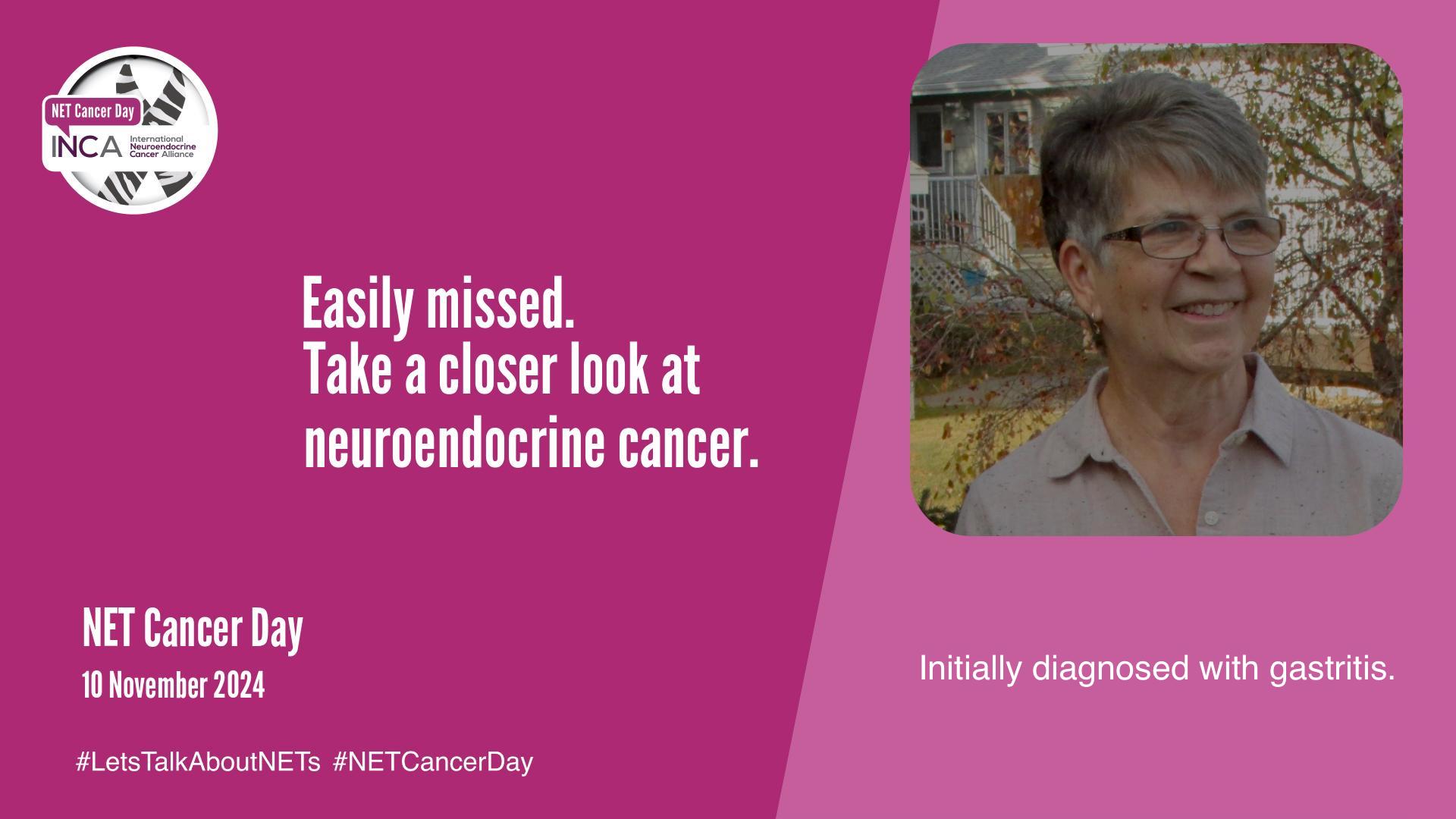
The incidence of neuroendocrine tumours (NETs) is on the rise and symptom awareness is key to earlier diagnosis and ultimately to better outcomes. Last year’s campaign slogan “Easily missed: Take a closer look at neuroendocrine cancer” was such a vital one that the NET Cancer Day campaign is reaffirming that message by using it again this year. More common than brain, ovarian or cervical cancer, neuroendocrine cancer continues to be frequently missed and misdiagnosed.

Globally, it takes an average of 5 years from initial symptoms to actual diagnosis; longer in North America. In my case, doctors estimate that I had had the disease for 7 to 10 years before it was diagnosed and based on symptoms, I’m sure they’re right. By then the cancer had already spread to distant parts of my body. Like many, many other NETs patients, my cancer was Stage 4 and no longer curable. Clearly, a greater awareness of NETs amongst the global community and especially the medical profession is needed.

The NET Cancer Day campaign has traditionally been focused on highlighting the common symptoms that are often interpreted as other conditions, but can also be signs of neuroendocrine cancer. These include facial flushing, abdominal pain, digestive problems, diarrhea, rapid heartbeat, chest pain, shortness of breath, wheezing, coughing, and/or persistent fatigue. People with NETs are often misdiagnosed with more common conditions such as anxiety, menopause, Irritable Bowel Syndrome, gastritis, or asthma.
poster

I’m not able to give you an update on my own health today as I’m presently waiting for the results of lab work that was done this past week and I’ll be going for CT scans again on Wednesday. Instead, I’ll tell you a bit more about what I’ve been involved in since last NET Cancer Day.

Since very early in my cancer journey, The Canadian Neuroendocrine Tumour Society (CNETS) has been a valuable source of information and support. When the opportunity to get involved as a volunteer member of a newly forming patient advocacy advisory board came to my attention, I knew immediately that that was something I wanted to do. It was time for me to start giving back.

After meeting in Montreal in April for an “advocacy bootcamp” with a prominent Canadian health advocate and policy consultant, we came away with a list of priorities and tactics in the areas of education and awareness, treatment and diagnostic access, and research. With two other members of the board, I’ve been working on a graphic representation of both the current and the ideal pathways to diagnosis for neuroendocrine patients in Canada which we hope to use to inform patients, medical practitioners, and health authorities. This fall, we were fortunate to have our project approved for funding by the International Neuroendocrine Cancer Alliance (INCA) which is allowing us to work with a patient-led consultancy group out of Germany to take our initial work to a higher, more professional level.

Over the past few months, in addition to the advocacy board work, I’ve also been involved in an initiative with Ipsen, the pharmaceutical company that produces the medication that I’m injected with every 28 days, to improve the patient experience with that drug.

These are baby steps in the overall work that needs to be done to improve diagnosis and treatment of neuroendocrine cancer, but I’m happy to be doing what I can to raise awareness and move the work forward.

Screenshot 2024-11-09 at 7.19.36 PM

NET Cancer Day 2022

ncd-logo-newOnce again, today is Worldwide NET Cancer Day, a day set aside to increase awareness of neuroendocrine (NET) cancers and to promote improved diagnostics, treatments, information, care and research. As a patient who has been living with this cancer for the past nine years, this is, of course, very close to my heart.

Once again this year, we are urging people to

Know the symptoms.

Push for diagnosis. 

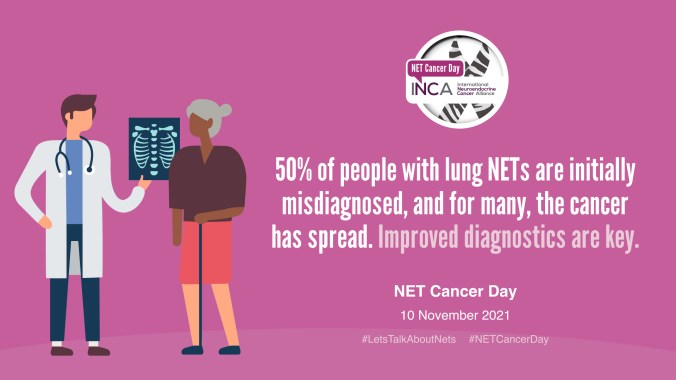
Less than 30% of neuroendocrine cancer patients receive a correct diagnosis the first time they reach out for help. In fact, it often takes five to ten years from onset of symptoms to correct diagnosis. During that time, of course, the cancer quietly spreads.

Screen Shot 2022-11-10 at 9.46.22 AM

Here are some facts about neuroendocrine cancer:

  • NETs are a unique group of cancers that arise from neuroendocrine cells and can be found in many organs of the body.
  • NETs generally affect people over the age of 50, but not always.
  • Symptoms of NETs vary and are often non-specific due to their ability to secrete an excess of different hormones.
  • Symptoms depend on the organ where the tumour is located and may include abdominal pain, diarrhea, nausea and vomiting, weight loss, skin flushing, chest pain, coughing, wheezing, shortness of breath, and/or back pain. 
  • As a distinct class of tumours, NETs require specialized tests and treatments.
  • NETs are often found unexpectedly during unrelated medical procedures or imaging tests.
  • NETs are the second most common cancer of the digestive tract.
  • Gastrointestinal NETs are often found in the appendix, colon, and rectum, but can also affect the stomach and small intestine.
  • Lung NETs comprise 20 to 25% of all invasive lung tumours.
  • The incidence and prevalence of pancreatic NETs (the form of neuroendocrine cancer that claimed the lives of Steve Jobs and Aretha Franklin) have been steadily increasing over time and now comprise about 7% of all pancreatic cancers.
  • Merkel Cell Carcinoma, a rare skin cancer, is a form of neuroendocrine cancer.

One of the most important things I’ve learned since my diagnosis is how important it is to advocate for yourself. Know your body. Know what’s normal for you. Pay attention when something feels off. Take note of unusual symptoms and talk to your doctor as soon as possible. If you don’t get the answers you’re looking for, PUSH! Don’t give up.

Thankfully, at this point, my cancer is stable. Constant surveillance is important though, so I’ll be having CT scans and other tests again next month. In the meantime, since hubby’s diagnosis with prostate cancer this summer, my health has temporarily taken a back seat. Now that his name is on the five to six month waiting list for robotic prostate surgery, we’re breathing a sigh of relief and getting on with life. Though there is no cure for me, I continue to trust that I’m not dying of NETs, I’m living with it! 

NET Cancer Day 2021

ncd-logo-new

Once again, today is Worldwide NET Cancer Day, a day set aside to increase awareness of neuroendocrine (NET) cancers and to promote improved diagnostics, treatments, information, care and research.

The theme of this year’s campaign is

Know the symptoms.

Push for diagnosis. 

Less than 30% of neuroendocrine cancer patients receive a correct diagnosis the first time they reach out for help. In fact, it often takes five to ten years from onset of symptoms to correct diagnosis. During that time, of course, the cancer quietly spreads. Thankfully, compared to many other cancers, NETS is slow growing, but like many of my fellow patients, I was Stage 4 at diagnosis. This means that my cancer had already spread from its origin to distant parts of my body. At this point, 8 years after diagnosis, treatment has halted it’s progress and resulted in some shrinkage, but there is no cure.

Know the symptoms. 

23213264_715559725308228_7678779028864335896_o

Once considered rare, neuroendocrine cancer is actually the fastest growing class of cancers worldwide. Unfortunately, many health care professionals have never seen a case and know little or nothing about this complex disease. In order to achieve early, correct diagnosis for every patient, we need every primary care physician to know and recognize the symptoms. When they are presented with stomach pain, it makes sense for them to suspect gastritis (inflammation of the stomach lining), but we also need them to wonder if it could be neuroendocrine cancer. When the stomach pain is accompanied by severe diarrhea, irritable bowel syndrome is a definite possibility, but we also need the doctor to be aware that it could be NET cancer. When a woman complains of facial flushing, rather than simply assuming that it’s due to menopause, we need her doctor to ask himself if it could be NETS. Depending on the location of the primary tumour, other symptoms may include nausea and vomiting, rapid heartbeat, anxiety, skin rash, shortness of breath or wheezing, lack of appetite, unexplained weight loss and/or lack of energy.

Push for diagnosis. 

Message-5-16_9-Key-Messaging-Infographic

Diagnosing neuroendocrine cancer is complex. In addition to recognizing the symptoms, we need doctors to order the correct laboratory tests and scans. It’s also important for patients to push for correct diagnosis. One of the most important things I’ve learned since my diagnosis is how important it is to advocate for yourself. Know your body. Know what’s normal for you. Pay attention when something feels off. Take note of unusual symptoms and talk to your doctor as soon as possible. If you don’t get the answers you’re looking for, PUSH! Don’t give up. Years before I was finally diagnosed, I remember thinking “at least it’s not cancer” but I was wrong! If I’d pushed for answers then, perhaps it would have been caught much sooner and the outcome might have been very different!

Know the symptoms.

Push for diagnosis.