Book of the month – October 2025

When the Body Says No: The Cost of Hidden Stress

Gabor Maté, MD
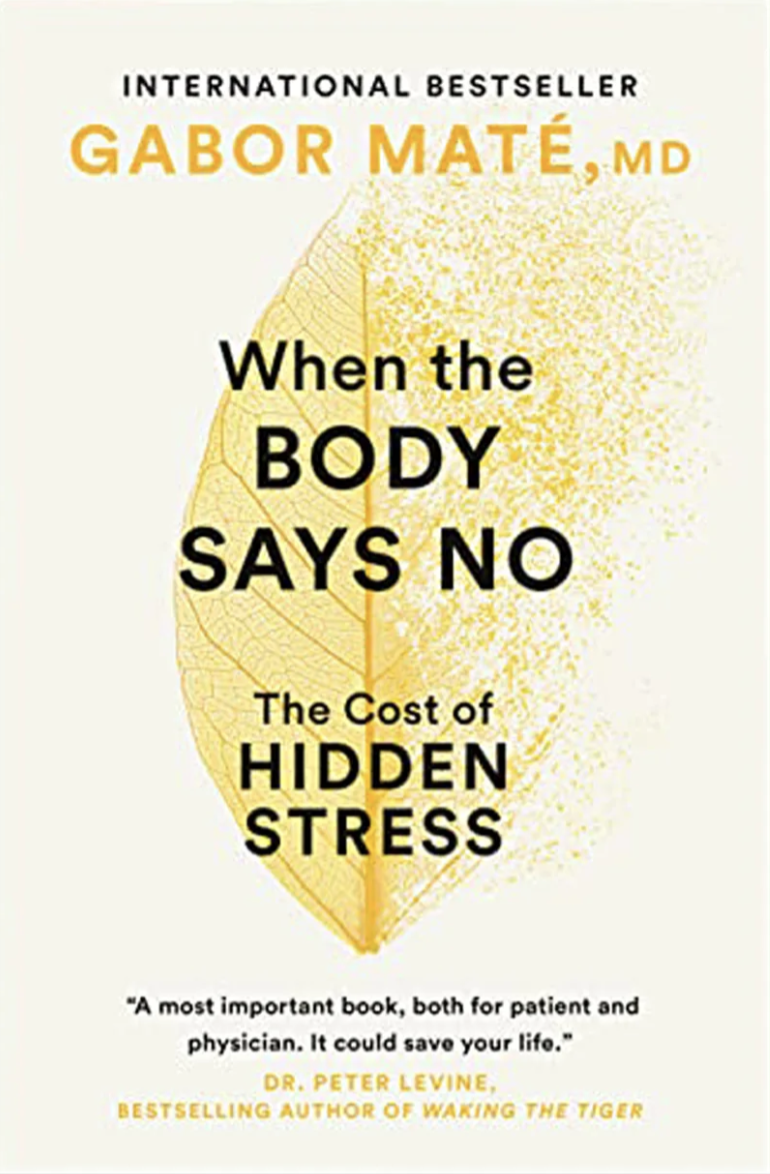
In this international bestseller, renowned mental health expert and speaker, Dr. Gabor Maté, provides insight into the critical role that stress and emotions play in the development of many common diseases.

Although written for a general audience, When the Body Says No definitely wouldn’t be everybody’s cup of tea. It’s like reading a textbook, but my daughter and I both read it recently and when I discovered that another friend was also reading it, I decided that it might appeal to more of you and that it would be worth reviewing here.

Dr. Maté has experience as a family practitioner and a palliative care physician and has also worked with the addicted men and women of Vancouver’s Downtown Eastside. He weaves together scientific research, numerous case histories, and his own insights and experience to explain the relationship between psychological stress and the onset of chronic illnesses including arthritis, cancer, diabetes, multiple sclerosis, Alzheimer’s disease, and heart disease. While I don’t agree with everything he says and he definitely needs to update the section on prostate cancer (the book was published in 2003 ), a lot of it makes very good sense. 

What I liked best was the fact that Dr. Maté validated what I have believed for years; that the stress I endured prior to and especially during the early decades of our marriage and the anger that I suppressed during those years contributed to my present health conditions. In fact, the author would probably say that they caused my cancers. As he says, all of us probably have within our bodies the occasional rogue cell that could multiply and become cancer. In most cases, the body has the resources to destroy those cells before they spread, but chronic stress and repressed anger reduce the body’s ability to do that and magnify the risk of developing the disease.  

In the final chapter of the book, Dr. Maté addresses what he calls the seven A’s of healing: acceptance, awareness, anger, autonomy, attachment, assertion, and affirmation. He believes that pursuing these will help us grow into emotional competence and empower us to be our own health advocates.

Note:  This book was published in the US under the title When the Body Says No: Exploring the Stress-Disease Connection.


Where do you find comfort?

If there was ever a time in most of our lives when we craved comfort, this is probably it. The combination of the upcoming holiday season + a worldwide pandemic is bound to be stressful. For many of us, the shorter, darker days of winter add to our feelings of disquiet. It’s a universal human trait to seek comfort when life becomes difficult, but where do we find that comfort? What do we turn to?

You’ve probably heard people refer to their “Quarantine 15”. In a poll of more than 1,000 WebMD readers, nearly half of the women and almost one-quarter of the men said that they had gained weight since March. This trend is no surprise. Food is one of the most common sources of comfort that people turn to in times of stress. There’s even a physiological reason for this. Chronic or ongoing stress causes the body to produce higher levels of the stress hormone, cortisol, which in turn triggers cravings for salty, sweet, or fried foods; foods that produce a burst of energy and pleasure.

Thankfully, this hasn’t been an issue for me. In fact, in times of distress I tend to lose my appetite. One of my main go tos for comfort is a cup of hot tea which is known to lower stress hormones. Since I drink my tea black, it has the added benefit of being calorie free.

tea-mugs-250x250

Soaking in a hot bath is another favourite source of comfort for me. There’s something about being surrounded by liquid warmth that soothes away anxiety and restores a sense of peace. Perhaps it’s reminiscent of returning to the womb! 

What are some other ways that you can comfort yourself, especially if you’re trying to avoid stress eating? Here are a few suggestions, but I’d love to hear your ideas in the comment section. 

  • Exercise. This one might be challenging if gyms and recreational facilities are closed in your area, but it goes hand in hand with the next suggestion. 
  • Spend time outdoors. 
  • Listen to music.
  • Do something creative… paint, sketch, knit, crochet, sew, embroider… the options are almost endless.
  • Keep a gratitude journal.
  • Practice mindfulness. Focus on whatever you’re doing at the moment. Notice the sights, sounds, and scents that surround you. 
  • Escape into fiction. Watch a movie or read a book. 
  • Work on a jigsaw, crossword, or sudoku puzzle.
  • Savour the routines in your life. If life seems chaotic, work on establishing some routines and focus on the comfort that you receive from that first cup of coffee in the morning, a regular devotional or prayer time, a few minutes of quiet reading or contemplation after work.  

We are living in tumultuous times and there seems to be no end in sight. We can’t see the big picture and have no idea how all this is going to work out for us individually or globally, but there is One who does know. Ultimately, true comfort is to be found in faith in God. Scripture is full of words of comfort. 

2 Corinthians 1-3-4

What to do when life seems overwhelming

What do you do when life seems overwhelming?

Overwhelmedphoto

Recent circumstances have resulted in us leaving the church that was our strong support system for many years. We’re living in the midst of a home renovation project gone very wrong and trying to figure out how to deal with that. I’m off to the city early next week to see a specialist about a lump growing on my gums that my dentist hasn’t been able to find the cause of. We’re moving into the busiest season of the year for me in one of the volunteer positions that I hold. And to top it off, we seem to be living through the winter that will never end.

You’ve probably lived through similar seasons. Maybe you’re there right now. You may be dealing with an enormous stressor such as job loss or the death of a loved one or it might simply be an accumulation of smaller aggravations that have left you feeling completely swamped.

So what should we do when life leaves us feeling like we’ve reached the end of our rope?

If you’re a young parent, you probably feel this way a lot of the time and with very good reason! I asked my daughter what her advice would be and her reply was, “In my case the answer is don’t bite off more than you can chew!” That’s good advice for all of us. Sometimes we’re the cause of our own stressful predicaments. We simply take on more than we can handle. None of us has an infinite amount of time available, so perhaps in those cases the answer is learning to prioritize, learning better time management skills, or simply learning to say No!

But what can we do when we’re overwhelmed by circumstances that are beyond our control? I’m reminded of a dear friend who often asks, “In the light of eternity, does this really matter?” Sometimes we need to take a step back and look at the situation from a wider perspective. Yes, the new ceiling surface that was applied throughout the main floor of our house on Saturday is a superb example of shoddy workmanship and will have to be redone. We’re not sure how or when that’s going to happen. As stressful and aggravating as that is, it isn’t life threatening and years down the road, it won’t seem as big a deal as it does right now.

The lump on my gum, however, could be a big deal. When you’re a cancer patient, any inexplicable lump or bump is reason for concern, but the same wise friend once reminded me that 99% of the things we worry about never come to pass and all the worrying in the world won’t prevent the other 1%.

Whether we’re overwhelmed by the busyness of life, legitimate concerns, or distressing circumstances that are not of our own making, there are things we can do to help alleviate stress when it threatens to overcome us. What works for me, might not necessarily work for you, but here are a few suggestions to try.

  1. Focus on getting through one day or even one hour at a time. Matthew 6:34 gives this wise advice, “Do not worry about tomorrow, for tomorrow will worry about itself. Each day has enough trouble of its own.
  2. Don’t skip meals. When I’m severely stressed my appetite is the first to go, but our bodies need fuel. Eat regularly to avoid low blood sugar, fatigue, and brain fog.
  3. Drink a cup of tea. My automatic response to crisis situations has long been to brew a pot of tea, but now studies conducted in the UK have actually shown that drinking a single cup of tea can significantly reduce anxiety levels after suffering a stressful experience.
  4. Escape. Go for a walk or a drive in the country, lose yourself in a good book, get out of the office over your lunch hour. Do whatever it takes to get away from the stressful situation even for a short time.
  5. Exercise. According to experts at the Mayo Clinic, exercise in almost any form acts as a stress reliever, providing a distraction from worry and boosting the production of endorphins, the brain’s feel-good neurotransmitters.
  6. Pray. Prayer is an age old stress reliever that doesn’t require a prescription! Taking a few quiet moments to pray can help you gain perspective and find peace in the midst of turmoil. When the situation is so overwhelming that you can’t even find the words to pray, remember that Romans 8:26 tells us that “We do not know what we ought to pray for, but the Spirit himself intercedes for us through wordless groans.
  7. Soak in a hot bath. Add a few drops of lavender oil which is commonly known for its relaxing effects on the body.
  8. Sleep. It may be difficult to quiet your mind enough to get to sleep when life seems overwhelming, but getting a good night’s rest should be a priority. A cup of chamomile tea half an hour before bedtime is widely regarded as a mild tranquilizer and sleep-inducer. Lavender oil can also be helpful here. Rub 2 or 3 drops on the palms of your hands and inhale deeply then wipe your palms on your pillow to leave a hint of lavender there.
  9. Don’t try to handle everything on your own. Delegate, ask for help, share your struggles. When stress doesn’t go away, and you’ve tried your best to manage it, you may need talk to a doctor or mental health professional about it. There’s absolutely no shame in that.

School dreams and stress

For many years, in spite of the fact that I enjoyed my teaching career, I had what I called my “school dreams” in the days leading up to each new school year.  These were dreams in which everything went wrong.  All a teacher’s worst nightmares would visit me as the end of August approached! One of the things that I’ve really enjoyed about retirement has been the absence of these dreams; until recently that is.

Why in the world would I be having school dreams again more than seven years after retiring from the classroom? It happened again last night. This time, I was trying to teach a high school English lesson to a large class of students in a crowded area at the back of a busy hairdressing salon! Yes, my school dreams are like that; a curious mixture of realistic and just plain weird. Midway through the lesson, all but two of the students got up and went upstairs to some sort of student lounge. In spite of my pleading and threatening (definitely not effective teaching strategies), they refused to come down again. Over the years students leaving class and refusing to come back has been a fairly common theme in these dreams.

Teaching is a stressful occupation and during my career, though I anticipated the beginning of each new school year with excitement, I recognized that my strange dreams were a symptom of that stress.

Over the past 14 months, my life has been a series of one stressful event after another. I thought I was coping well but little by little, with each ensuing event, the stress built up until now it’s beginning to bubble over. According to the Holmes and Rahe Life Events Stress Test, which is supposed to give a rough estimate of how stress affects health, events including death of a close family member (Mom), major personal illness (cancer) and major change in health of a family member (Dad) have given me a 50-50 chance of succumbing to stress-related illness. I’m doing my best to combat that by continuing to eat well, exercise regularly and by ensuring that I get enough sleep but it’s absolutely amazing what’s stored away in the deep recesses of our brains. Apparently, mine still connects stress to teaching and  is reacting to my current stress level with school dreams! How weird is that!

Now the challenge is to find ways to reduce the build up of stress and manage it better in the future.

Any suggestions?


Second wind

A few days ago, I was ready to write a post called Growing Weary but it didn’t happen because I was too tired to write it! It’s probably just as well as I would likely have grumbled and complained unnecessarily.

We don’t, even for a moment, regret coming here. It’s been a fabulous experience and very good for both of us but living in a completely foreign environment where you don’t understand the language or the culture can be exhausting. China is a rapidly developing country where we see change happening all around us but the standard of living is still far below what we’re accustomed to and it’s easy to start finding fault, especially when you’re tired.

I had three goals for this month:

  • Complete and submit the annual reports that are required of me as Missions President for my church back home, a position that I’ve been filling from a distance since coming here in February.
  • Make up the final exams for my university courses.
  • Plan the trip that we want to make through China after our contract expires at the end of June and make arrangements for our return trip to Canada.

The past couple of weeks flew by as I fought with our frustratingly slow and undependable internet to send and receive emails, spent extra hours at the school photocopying, cutting and pasting (the old fashioned way with scissors and glue) and gradually crossed things off my many lists. As a result, the Missions reports have been submitted and the final exams are ready to be handed over to the office staff who will photocopy them for me.

I’m most excited about our travel plans. I usually do all our trip planning myself but this time we’ve decided on a tour. It won’t be the sort of thing where we pile off a bus and follow a flag waving tour guide through all the designated sites however. Instead, someone else is making all the travel arrangements and reservations for us and we’ll have our own driver and/or guide at each location along the way. I’ve been working closely with the travel agent to assure that the tour includes the things we most want to see and do. To date, 32 emails have passed back and forth between us! This a more expensive way to travel, of course, but in a country where there’s so little English and where we’ve discovered that doing things on your own always takes much longer than you expect, this will be a much more relaxing way to end our time here and we’ll actually be able to see and do a lot more than if we were doing it on our own. I won’t go into details at the moment but the tour begins in Beijing, includes a luxury cruise on the Yangtze River and ends in Shanghai where we’ll spend a weekend with Japanese friends who live there before we fly back to Canada. That’s definitely the icing on the cake!

I’ve discovered that even this kind of travel planning isn’t completely stress free. Most of these tours are booked by overseas travellers who pay in American dollars but we wanted to pay in Chinese currency. That meant that our money had to go into a different account than theirs but when the travel agent sent me the information that I’d need to take to our local Bank of China branch to pay our deposit, she inadvertently gave me the wrong account number. With extremely limited English, the bank clerk managed to communicate that there was a problem and that I couldn’t make the deposit. A couple of emails between the travel agent and I sorted that out and it took a second visit to the bank but the deposit has now been made and we’re waiting for final confirmation of all the travel arrangements.

Other than booking the tour, all I had to arrange were our flights from Dalian to Beijing and from Shanghai back to Canada. Even that was stressful though, especially when I discovered how much the prices have gone up since we crossed the ocean in February. Yikes! The completion bonus that we’ll receive at the end of our contract was supposed to cover the cost of our flight home but it definitely won’t. Oh well, going home isn’t optional so the tickets have been purchased anyway.

The beautiful month of May almost slipped away while I was busy with all of these concerns but now that my goals have been met, my weariness has also passed and I seem to have my second wind! Our university classes end in just over two weeks and then our not very heavy teaching schedule will be even lighter. I think the time has come to sit back, relax and coast a little as we enjoy our final weeks here!

Tangled knots of tension

This has been an eventful week.

On Monday, I learned that my Dad had finally made the decision to seek permanent care for my Mom. She’s 90 years old and suffers from Alzheimer’s disease. In addition, she’s virtually blind, incontinent and confined to a wheelchair. Dad has been burning himself out trying to be her primary caregiver and most of the time she doesn’t even know who he is.

I was relieved! I would be able to leave the country knowing that Mom was being well cared for and that Dad could finally relax and possibly regain his flagging health and strength. Then came Wednesday and a phone call from my sister. Dad was suffering from chest pains and she was catching a plane that afternoon to fly out to Vancouver to be with them!

I was already feeling stressed over the delay in getting our visas. This news was almost more than I could handle! Questions and doubts flooded my mind. What was I thinking of? Was going to China at this point sheer insanity? We’d already signed our contracts! What choice did I have now?

I don’t handle stress well. Apparently, neither does my father! His chest pains were not an indication of an impending heart attack as we feared but, as far as we can tell, the result of stressing about the decision he’d made and all its implications. He had lain awake for long hours Tuesday night worrying about where Mom would end up, how he’d get her there, what he should pack for her, whether or not she’d adjust well to her new surroundings and so on and so on until the pain began.

We knew that initially, at least, Mom would go into the first appropriate long term care bed in their area. We prayed that it would be easily accessible by bus so that Dad, who no longer drives due to failing eyesight, could visit her regularly. God did even better than that! Tomorrow morning she’s moving into a care facility just down the street from the apartment building where my parents have lived for over 20 years! It’s literally about 500 metres away, close enough for Dad to walk over anytime he wants!

After more than 64 years of marriage, tonight will be the last night that my parents will spend together. It’s sad, but Alzheimer’s is sadder. In a sense, Mom has already been gone for quite a long time. I’m just glad that Dad will still be able to spend time with her each day and that my sister is there to help them with the transition.

Now, if only the results of our blood tests come back soon so that we can head to Calgary to apply for our visas. Then maybe the knots in my stomach will begin to untangle!