What to do with worn out clothes

LogoAfter a full month of wearing only six items from my closet, I have thoroughly enjoyed getting dressed this week! In fact, I’ve worn something different every single day!

As promised last week, I also went through my closet, tried on a lot of things, and put aside a few to be donated. I usually do this twice a year when I switch my closet from summer to winter and then back again in the spring, but after a month of not missing some of the items in my closet I knew that a few more could probably be moved out.

This exercise led me to think about the different things that can be done with clothing that we no longer want or need. Often, the obvious answer is to donate them or consign them so that they can be enjoyed by someone else, but what about those items, including sheets and towels, that are too worn out to be donated?

A conservative estimate is that clothing and textiles make up 5 to 7% of what occupies landfills globally. Many believe that this figure is closer to 12%. The average American citizen reportedly throws away 70 pounds (31.75 kg) of clothing and other textiles each year. The figures are probably similar in other first world countries. I’ve never weighed my wardrobe, but 70 pounds of clothing sounds like an awful lot to me! What can we do to keep this fabric waste out of the landfill?

Here are a few ideas:

  1. Cut them up to use for cleaning rags. Towels and sweatshirts are particularly good for this purpose.
  2. Some thrift stores do accept worn out fabric that can be cut up and sold as industrial rags.
  3. Take advantage of the H&M Garment Collecting programme. Simply bag any unwanted clothes or textiles, by any brand, and in any condition, then take them into an H&M store and hand them to a cashier. In return, you will receive a thank you voucher to use toward a purchase. Anything that is still wearable will be sold second-hand. Textiles that are no longer suitable to be worn will be turned into other products and those that can’t be used in any other way will be shredded into textile fibres that are often used as insulating material. Several other brands including The North Face, Zara, Patagonia, Levi’s, and Uniqlo have similar programs. 
  4. Check with a local animal shelter. Many will take old towels, sheets, and other soft or fuzzy fabrics to use for bedding.
  5. Compost natural fibres. Remove attachments such as buttons and zippers, then shred the fabric finely and add it to your compost alongside fresher, wetter material such as vegetable peelings or garden cuttings to help it break down faster. Find more information about how to to this properly here.
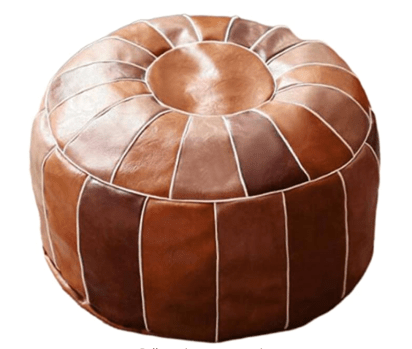
  6. Purchase an unstuffed pouf style hassock such as the one pictured below and fill it with old bedsheets, towels, and clothing. Again, remove any attachments like buttons and zippers that might poke through the cover. If you’re like me, it might take half a lifetime to fill a hassock, but you can do the same thing on a smaller scale by filling  an unstuffed throw cushion.
Screen Shot 2021-12-07 at 8.57.55 PM

Unstuffed pouf from Amazon.ca

Do you have any ideas to add to this list? What do you do with old, worn out clothing?
One more day and what have I learned?

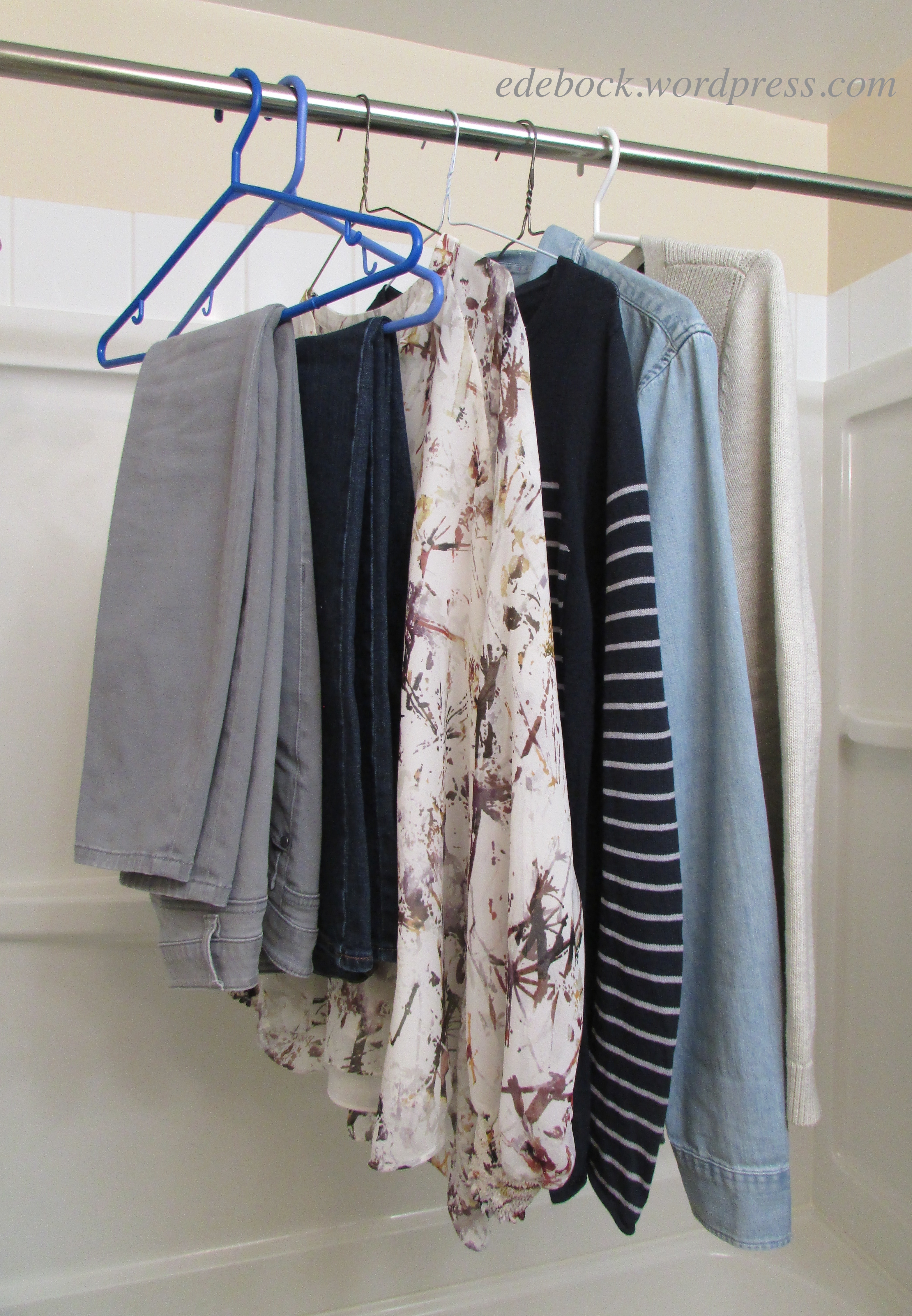
LogoTomorrow is the final day of my “six items or less” fashion fast! It went by faster than I thought it would and now it’s time to share what I learned. Again, let’s take a quick look at the two pairs of pants, three tops, and one cardigan that I’ve been wearing for the past month. 

IMG_3313

The first thing I learned was that we don’t need as much as we think we do. Dressing in just six items for an entire month was much easier than I thought it would be. In fact, not having a lot of clothes to choose from every morning was quite liberating. It took the work out of having to decide what to wear each day. 

Apparently Steve Jobs and Albert Einstein understood this concept. Jobs wore the same black turtleneck, blue jeans, and New Balance sneakers every day. I hope he had duplicates of the turtleneck and the jeans or they would have become awfully smelly! Einstein was known for owning several variations on the same grey suit so that he wouldn’t have to waste time deciding which outfit to wear each morning. Both men understood that they had a finite amount of brainpower for making well thought out decisions and intentionally determined not to waste it on deciding what to wear!

Secondly, I learned to be more creative. Even though I wasn’t going out a lot and being seen by other people, wearing the same six items day in, day out did get boring. As the month wore on, I started to look for ways to use accessories to make little changes to my outfits. Instead of wearing the same few pairs of earrings over and over again as I usually tend to do, I brought out some that hadn’t been worn for years. Some days I wore funky patterned socks instead of plain ones and at least half a dozen scarves came out to play. Here’s one of my most creative looks. 

IMG_3365

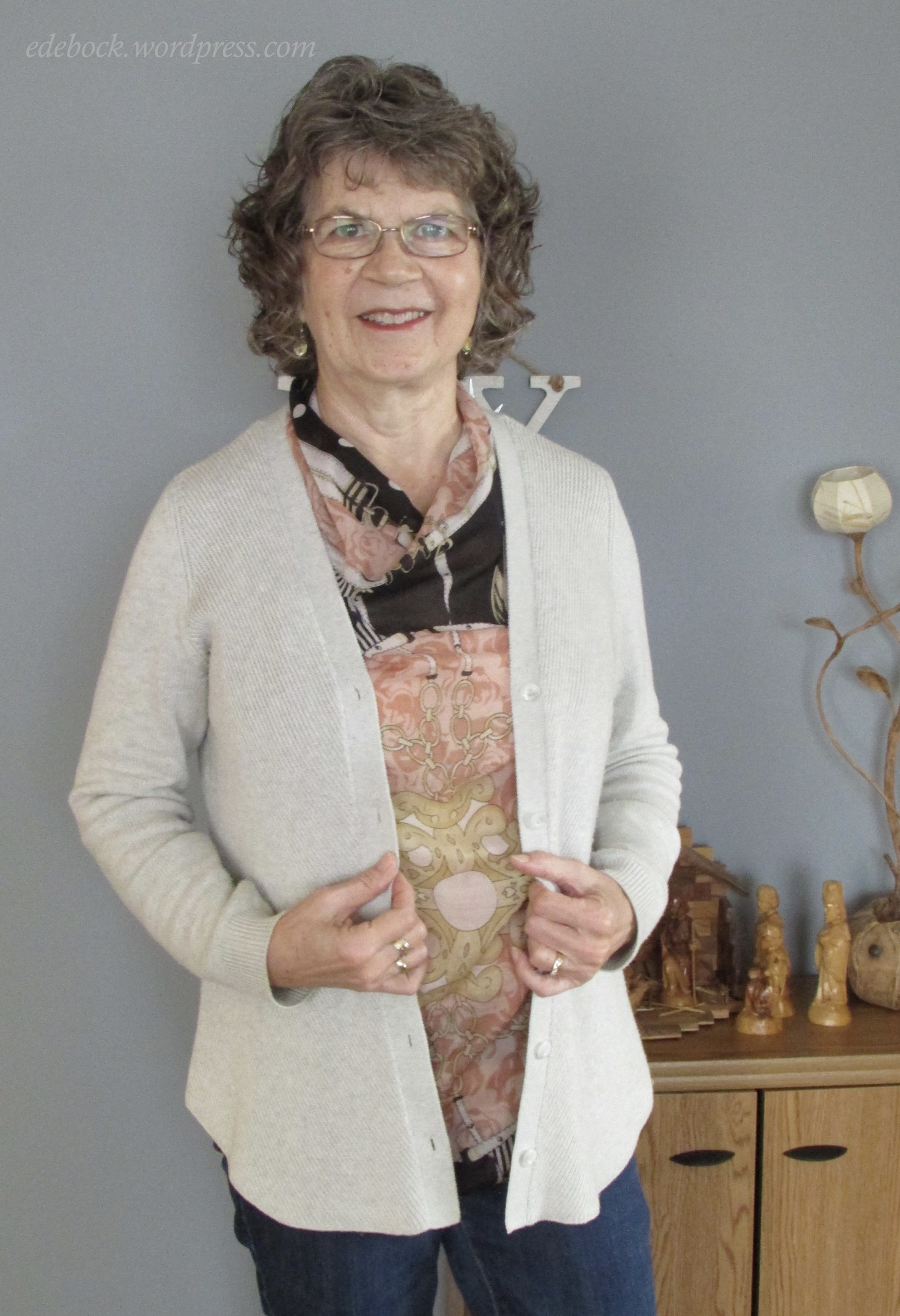
No, I didn’t cheat! That’s not a blouse that I’m wearing under the cardigan. It’s a large, square scarf! I held it in front of myself, tied the two top corners behind my neck and the two bottom corners behind my waist, and voila! It looks like a blouse, but it isn’t.

This trick could revolutionize packing when we finally feel comfortable flying again. After managing three and a half weeks in Europe pre-pandemic with carry-on luggage only, we’re committed to traveling that way in the future. A scarf takes up hardly any space in a suitcase, but what a great addition to a limited wardrobe! 

I learned that I missed colour. My wardrobe tends to be made up mostly of neutrals and I intentionally chose a limited colour palette for this exercise so that the six items could be mixed and matched to create many different outfits, but as time went by it definitely began to feel bland. 

I also learned that I need to take a closer look at what’s in my closet and let a few things go. When I started this exercise, I thought about moving the six items to a different, empty closet so that I didn’t have to look at the clothes I wasn’t going to wear, but I’m glad I didn’t do that. As I looked into my closet each morning, I found myself yearning to wear some of what I saw, but other pieces didn’t call out to me at all. If, after a month, I didn’t miss them, do I really need them? I’m going to do another closet purge this coming week. If I didn’t miss it, I probably don’t love it, and if I don’t love it, maybe it’s time to donate it. I’ll be asking myself questions like: Do I love it? Do I wear it? Does it still fit properly? Does it go with other things I own?  

Today though, I’m just dreaming of what I’m going to wear on Sunday and Monday and…  

I’ll definitely be keeping the six items in rotation, but I probably won’t be wearing them for a little while. Except for the blue jeans, that is. Over the past month, I wore those at least twice as often as the grey skinnies. I’ve always been a blue jeans kind of girl and I don’t think that’s about to change! 

It’s a start

LogoI was thinking about a topic for this week’s fashion post when I came across a news article that fit very well with what I said last week about boycotting products that are made in China.

The Canadian Border Service Agency (CBSA) recently intercepted a shipment of women’s and children’s clothing that originated in China on the grounds that the garments were made by forced labour. This was the first interception of its kind since new federal laws came into place in July 2020 officially banning the import of goods made partially or wholly by forced labour. Just as there is no way for us as consumers to know what conditions our purchases were made under, there is no visual indicator to show a border services officer the labour standards by which a particular good was produced. This makes this a very difficult situation to deal with, but the CBSA says that it will continue to investigate complaints and allegations pertaining to imports made using forced labour. Hopefully this will lead to further interceptions of this kind and will ultimately result in retailers ensuring that they don’t order goods that have been produced unethically. At least it’s a start. 

So what exactly is forced labour? According to the International Labour Organization (ILO), forced or compulsory labour is “all work or service which is exacted from any person under the threat of a penalty and for which the person has not offered himself or herself voluntarily.” It refers to a form of modern slavery in which people are coerced to work through the use of violence or intimidation, or by more subtle means such as manipulated debt, retention of identity papers, or threats of being handed over to immigration authorities. In China, Uyghurs and other Turkic minority ethnic groups are being subjected to forced labour in Xinjiang province. As well, a recent CBC Marketplace investigation found that several Canadian retailers, including one of my favourites, had brought hundreds of shipments of clothing into Canada from a Chinese factory suspected of secretly using North Korean forced labour. The factory is located in the city of Dandong, just across the Yalu River from North Korea.

The more I learn about unethical clothing production in China, the more convinced I am not to support it with my fashion dollars! I know I’m only one and I’m not even a big spender when it comes to clothing, but if I can convince even one of you to consider not purchasing clothes that are made in China, it’s a start. 

DAY+22

And now, are you wondering how the six items or less challenge is going? At the end of the second week, I must admit that wearing the same things over and over again is a bit boring, but there are also advantages. Getting dressed in the morning is easy and so was packing for a weekend away to meet our brand new baby granddaughter! I simply wore two items and packed the other four along with some socks, underwear, and pjs. Easy peasy! No thought involved. 

More about the six

LogoFacebook comments in response to last week’s post about my self-imposed “six items or less” challenge ranged from “I could absolutely NOT do this!” to “I’ve been living in the same set of clothing since I retired.”

Today, after one full week, I thought I’d share a bit more about each of the six pieces that I’m wearing for the duration of the one month challenge. None are new and they’ve all appeared on the blog at one time or another in the past. First, let’s take another look at the photo…

IMG_3313

From left to right:

  1. Grey skinny jeans  –  cabi  –  purchased new in fall 2018  –  made in China
  2. Dark wash jeans  –  Old Navy  –  gifted in early 2018  –  made in China
  3. Patterned blouse  –  cabi  –  thrifted in fall 2020  –  made in China
  4. Navy striped pullover  –  cabi  –  purchased new in fall 2017  –  made in China
  5. Denim shirt  –  Uniqlo  –  purchased new in early 2021  –  made in Bangladesh
  6. Cardigan  –  cabi  –  purchased new in late 2016  –  made in China

It wasn’t until I’d carefully chosen all six pieces that I realized that four of them were cabi! In addition to the fact that I simply have a lot of cabi, I think that there are a couple of other good reasons for that. First of all, cabi intentionally produces clothing that coordinates well with previous and future seasons. This makes building a cohesive wardrobe very easy. Second, cabi clothing is good quality. It lasts! I suspect that many fast fashion pieces that are sold today wouldn’t hold up to a month of steady wear and washing. Instead, they fall apart after a few wearings and end up in the landfill.

As someone who is attempting to be an ethical shopper, I was also surprised and somewhat alarmed to see that five of the six items were made in China! While shopping in Superstore last week, I passed up a super cute pair of leopard print sneakers. The deciding factor, in addition to not really needing them, was the fact that they were made in China. Having lived in that country for several months, I’m conflicted about buying anything that is produced there. I know that the majority of the population is extremely poor and that garment factories provide much needed employment, but I also know that the conditions in many of them are abhorrent. Men and women work in unsafe surroundings 10 to 12 hours a day, 360+ days a year for a mere pittance. In addition, there are political reasons for boycotting Chinese products. I see China as a threat to Canadian security and although the two Michaels were released in September, it’s clear that they were held for almost three years on trumped up charges in retaliation for Canada’s arrest of Chinese high-tech executive Meng Wanzhou. That’s simply not a country I want to support with my fashion dollars!

My justification for having five made in China items on the list of six is threefold. First, two of them were thrifted or gifted. My intention is to try to avoid purchasing new items that are made in China. Second, the new items were purchased prior to 2019 when I made a commitment to begin shopping more ethically. And third, four of the five items are cabi. I’ve been assured by two independent cabi stylists that their products are made in socially and environmentally responsible factories. In spite of that, I was happy to see that my most recent cabi purchase, which you’ll see on the blog later this winter, was made in Vietnam. I suspect that this means that cabi, like many other companies, is moving their factories out of China, not for political reasons, but because the cost of production there has risen significantly and other locations in Asia are more cost efficient. In any case, I’ll feel better about buying cabi in the future if it’s made elsewhere.

And now, before I close, here are a couple of the outfits that I wore this week. On Tuesday, when I went to my weekly Bible study and ran some errands, I layered the denim shirt over the patterned blouse and paired them with the grey skinny jeans. I dressed the outfit up with my newest boots and a necklace, both thrifted.

IMG_3321

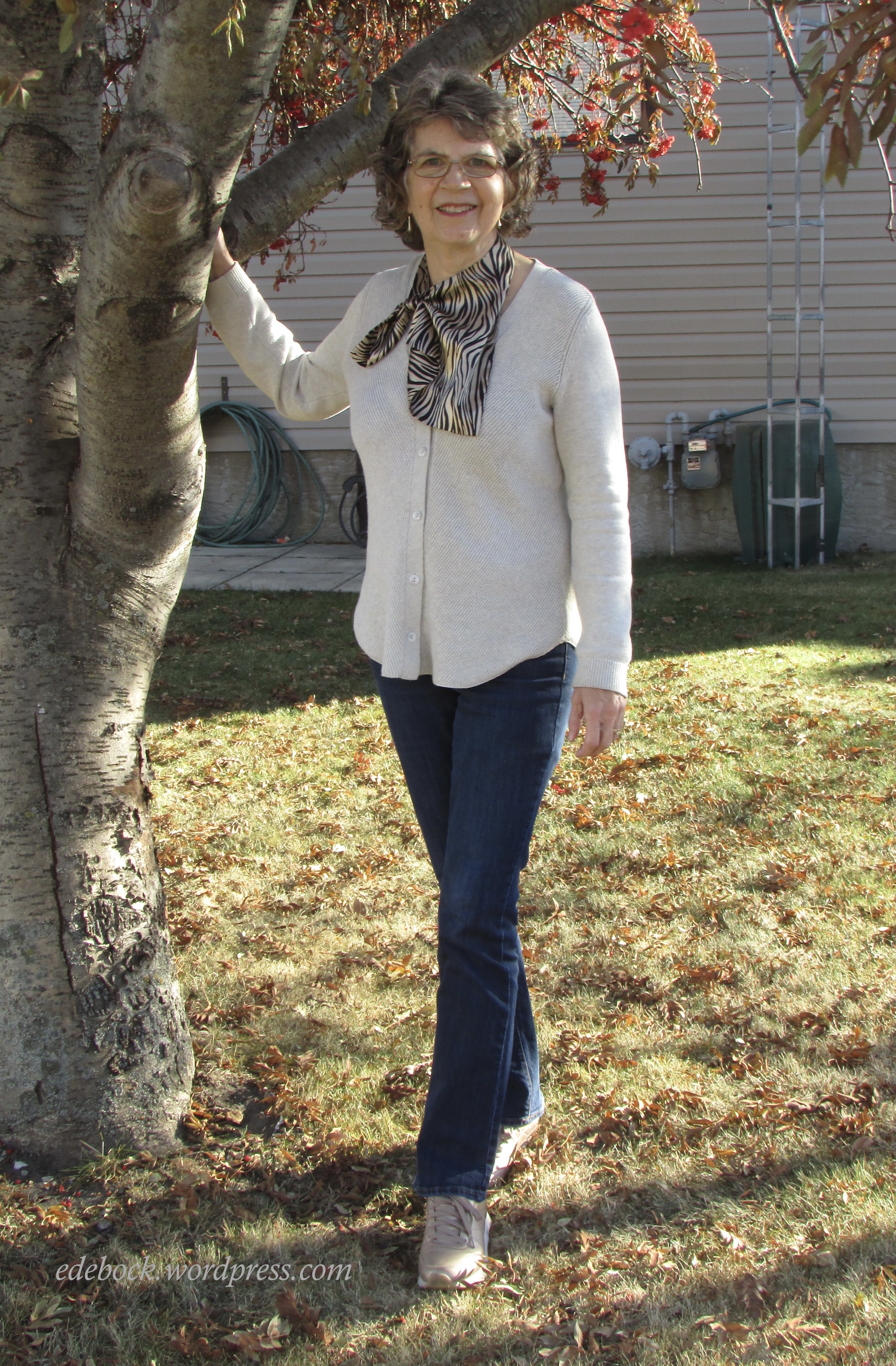
Though I’ve never worn the cardigan this way before, I knew when I decided to include it as one of the six that I would probably try buttoning it up and wearing it with a scarf. When you only have six items to work with, you have to be creative!

IMG_3337

I wore it this way on Wednesday. We bowled in the morning, so I needed something that was comfortable and easy to move in. This Wednesday was also NET Cancer Day and since the zebra is our symbol, I wanted to wear a touch of zebra stripes that day. Interestingly, I purchased the scarf in a shop on Russian Street in Dalian, China when we lived there, but it was actually made in Taiwan! According to the somewhat sketchy instructions that came with it, it can be worn ten different ways, but I’ve yet to figure out most of them.

I don’t know if you can tell, but I was freezing during the taking of these pictures! The temperature was barely above 0ºC (32ºF), but as you can see, we don’t have any snow yet, so we decided to take advantage of that and squeeze in a couple more outdoor shoots.