Wearing the poppy

logo

Today is supposed to be Fashion Friday here on Following Augustine, but publishing a typical fashion post on Remembrance Day seems frivolous, almost disrespectful. Instead, let’s take a look at how and why we wear the iconic symbol of this sombre occasion, the little red poppy.

For some of my readers, a bit of explanation may be needed. Here in Canada, as well as in the UK and other Commonwealth countries, November 11 is known as Remembrance Day. It is a solemn day for remembering and honouring those who have given their lives in war, more like Memorial Day in the US than Veterans Day.

Inspired by the World War I poem “In Flanders Fields” written by Canadian physician, Lieutenant Colonel John McCrae, the Remembrance Day poppy is an artificial flower that has been worn since 1921. Though some say that its red colour represents blood shed in war, more truthfully, it is simply the colour of the common field poppies that were the first flowers to grow on the disturbed earth of the battlefields of northern France and Belgium and on the graves of countless soldiers.
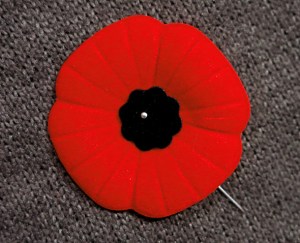
remembrance-day-poppyIn Canada, millions of poppies are distributed freely in the days leading up to Remembrance Day. Donations received by the Canadian Legion Poppy Fund are used to support veterans and their families in need. Prior to 1996, our poppies were made by veterans with disabilities in workshops in Montreal and Toronto and served as a small source of income for them and their families. In 1996, the Legion awarded a contract to a Canadian company to produce the poppies but it maintains strict control over their production .

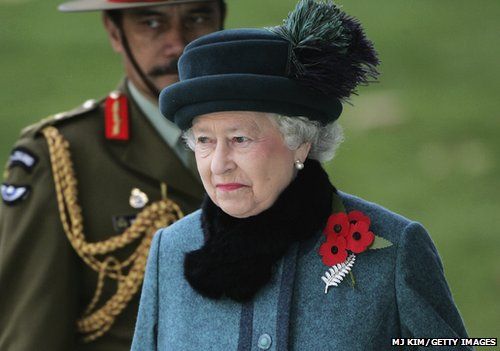
There are many questions about how the poppy should be worn. According to Canadian tradition, the poppy is worn on the left breast or lapel symbolizing that you keep those who died close to your heart, but in Britain many say that men should wear it on the left and women on the right. This year I’ve decided to wear mine on the right because, like most right-handed women, I carry my handbag over my left shoulder. It seems to me that knocking my poppy off and leaving it lying in the dirt or covering it with my purse strap would be much more disrespectful than wearing it on the wrong side. Queen Elizabeth II, who isn’t usually hindered by a purse, wears hers on the left. Unlike most of us who wear a single poppy, she also chooses to wear a cluster of them.
queen

The British poppy has a small green leaf that is often positioned at 11 o’clock representing the eleventh hour of the eleventh day of the eleventh month, the time that World War I formally ended. The leafless Scottish poppy, like our Canadian one, is more botanically accurate and also less expensive to produce.

In spite of the fact that I have tried to convince my husband that he shouldn’t replace the pin on his poppy with something else to make it more secure, he insists on using a tiny Canadian flag or maple leaf pin to hold his in place. The Canadian Legion’s position is that nothing should be substituted for the poppy’s original straight pin. Unfortunately, redesigning the poppy to better secure it to clothing would increase production costs. There are ways to prevent it from falling off, however. The tiny plastic sleeve that is often used as a pierced earring back works perfectly. If you don’t have such a thing available, a bit of clear tape also works well.

I like what the Royal British Legion says: “There is no right or wrong way to wear a poppy. It is a matter of personal choice whether an individual chooses to wear a poppy and also how they choose to wear it. The best way to wear a poppy is to wear it with pride.”

in-flanders-fields

Rav4 in the Mohave Desert

When I agreed to go to Las Vegas with three of my closest girlfriends, I knew that I would want to get away from the glitz and glamour for a little while and see the Mohave Desert but would the others agree? I know that they would do almost anything for me but would they enjoy it?

See for yourself. Do they look like they’re having fun?

IMG_4504

At first, we considered a tour. In fact, we almost booked a 4 hour Pink Jeep tour. After all, one of the girls loves all things pink and frou frou. Look carefully and you’ll see her pink iPhone in the photo! What could be better than a pink Jeep?

Practicality led the way, however, and we decided that renting a vehicle would be a better option. We wanted a small SUV so we reserved a Toyota Rav4. Sadly, when we went to pick it up early Tuesday morning, that model was unavailable and we were offered an “upgrade” to a minivan. A minivan… are you kidding? Our kids are grown and we’re past our Minivan Mom days! We wanted something sporty! In fact, we’d even considered renting a convertible but again, our practical sides and our purse strings said otherwise. A minivan was what was available though, so minivan it was. No problem, we’re flexible. We simply decided that we were the Rav4 and a group nickname was born!

Renting was definitely the right choice as it allowed us to go at our own pace, spending as much time as we wanted wherever we wanted. The half hour drive out to the Red Rock Canyon National Conservation Area was an easy one. Our first stop was the Visitor Center where we were given a map, some great advice about where to stop and hike, and some valuable tips such as “Watch where you put your hands and feet. Rattlesnakes, scorpions or venomous spiders may be sheltered behind boulders or under rocks and shrubs.” Fortunately, though we saw lots of holes where they may have been hiding, we didn’t see any of those creatures!

IMG_4497

We were a bit disappointed that we didn’t see any of these ones either!

The 13 mile one-way scenic drive gave us ample opportunity to see the area from the vehicle but we were there to hike and explore. Our first stop was the Calico Hills where we were allowed to climb and clamber wherever we wanted. The sights were spectacular and the red rock against the brilliant blue sky was absolutely stunning.

IMG_4499

It was November 11, Remembrance Day or Veteran’s Day as it is known in the US, so we stopped and built a small inukshuk, a Canadian symbol adopted from the Inuit people of our far northern region, and pinned a poppy to his lapel.

IMG_4517

Throughout the Commonwealth, the poppy is a familiar Remembrance Day symbol and people on the streets of Las Vegas recognized us as Canadians because we were wearing them.

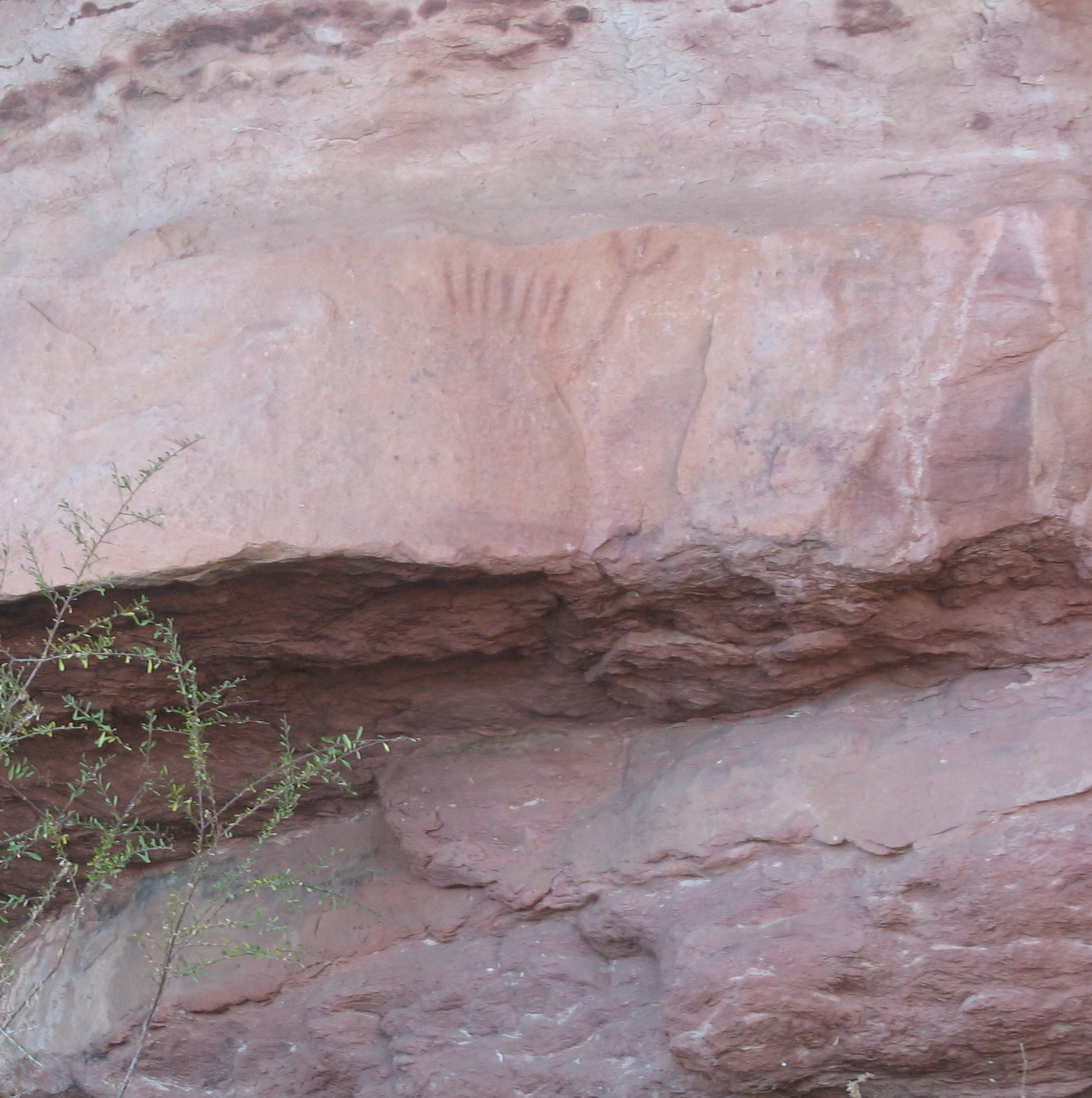
On our second hike, in the Willow Springs area, we saw the remnants of an ancient agave roasting pit as well as one of the “Hands Across Time” pictographs waving to us from the canyon wall, reminders of those who made their home in the desert centuries ago.

IMG_4545 - Version 2

There was abundant and interesting plant life in the area, much of it looking like something out of a a Dr. Seuss storybook!

IMG_4561

IMG_4541 - Version 2

As much as I enjoyed Las Vegas itself, it was when we drove away from Red Rock Canyon that I truly felt like I’d had a holiday!

IMG_4563

Remembrance

Imagine looking out the window of the family farmhouse at Seba Beach, Alberta and seeing the military vehicle pull into the yard. Pearl’s heart must have pounded as the men in uniform came up the walk with a telegram in hand. It was 1944 and three of her sons were in the midst of battle in Europe. Which one was it? Had she lost one of them?

telegram

Glen was my father-in-law. He enrolled in the army in October of 1943 and was deployed in early January of the following year. He was just 18 years old.

We don’t know a lot about his wartime experiences. Like many who saw the gruesome face of war firsthand, he didn’t talk much about what he went through over there. We’ve only been able to piece together bits and pieces from the few things he did say and more recently, from his military record which our son requested from the Canadian Archives in Ottawa. We do know that he once spent several days in a foxhole behind enemy lines waiting to be rescued and we know that he probably suffered from what is now known as post traumatic stress disorder. According to Mother, for the rest of his life he would occasionally wake up cowering on the floor beside the bed. He was back in that foxhole terrified that, at any moment, an enemy soldier would find him and his life would be over.

Father had been in Europe for only nine months when he was seriously wounded and unable to return to action. A second telegram dated October 19, 1944 brought the incorrect news that the nature of his injury was “bomb fragment wounds to face and head.” A letter dated November 27, 1944 contained more accurate information.

“I am directed to inform you that official information has now been received from Canadian Military Headquarters Overseas advising that when your son, M-8247 Pte. Glen Marion DeBock, was wounded in action on the 6th October 1944, he suffered a bullet wound to the right orbit into the sphenoid sinus resulting in the loss of the right eye.”

He was lucky to be alive. Imagine taking a bullet to the head and surviving! He spent the remainder of 1944 in hospitals in the UK followed by another three months in Shaughnessy Hospital in Vancouver before finally being discharged with a prosthetic eye.  Life would never be the same for this young farm boy, however. He often suffered excruciating headaches and like many of his compatriots, he took to drowning his vivid memories in alcohol. It wasn’t until the final years of his life that he gave up drinking and found peace in a personal relationship with Jesus Christ.

On November 11, as we pause to remember, we give thanks for so many young boys who went off to war with high ideals and ended up paying for our freedoms with their lives; many making the ultimate sacrifice and others, like Father, surviving with shattered dreams and broken bodies. In reality, these are the men who gave us freedom of religion, freedom of speech, and all the other freedoms that we take for granted in this great land.

Let us never glorify war but let us remember those who were willing to go and fight on our behalf and those who continue to do so.

shortly after discharge      Picture 1