A World Cancer Day update

World-Cancer-Day-2024-1-1

When I posted a World Cancer Day graphic on Facebook this morning and mentioned that I’m currently waiting for a treatment to destroy a tumour on my liver, the outpouring of support from people near and far was immediate and heartwarming. I was also asked recently whether this was related to my original cancer or something new. In response, I decided that today would be a good day to share an update on what’s been happening in my ongoing battle with cancer.

For those of you who may be new to the blog, I was diagnosed with neuroendocrine cancer (NETS) in 2013. The primary tumour was in my cecum (a pouch at the beginning of the large intestine that the appendix is connected to) and, as is very common with NETS, it had already spread to lymph nodes and my liver. A series of radioactive treatments (PRRT) resulted in some shrinkage and stability that lasted until about 17 months ago when we started to notice gradual changes in my regular lab results and scans. As neuroendocrine cancer is usually a slow-growing disease, we took a cautious approach. We started monitoring more often and eventually changed the medication that I receive by injection every 28 days. Unfortunately, that didn’t have the desired result.

The last time I wrote an update on the blog was back on November 10, NET Cancer Day. At that time, it was clear that the tumours that had been basically dormant for several years, or at least the largest one which is on my liver, were growing and producing an excess of hormones again. I was waiting for the tumour board at the Cross Cancer Institute to discuss my case and make their recommendations.

Shortly after that, I was referred to the Interventional Radiology department at the University Hospital and my NET specialist told me that I would undergo a radiofrequency ablation, a fairly non-invasive procedure that would destroy the cancer cells without damaging much of the surrounding tissue. I was all for that. Let’s zap that tumour, I thought! As it turns out, however, at 5 cm (2 inches) my tumour is too large for that procedure to be successful. Instead, I’ll be undergoing a transarterial radioembolization, also known as a TheraSphere treatment. (I love words, but as a cancer patient, I’ve learned a lot of big ones that I wish I’d never had to hear!)

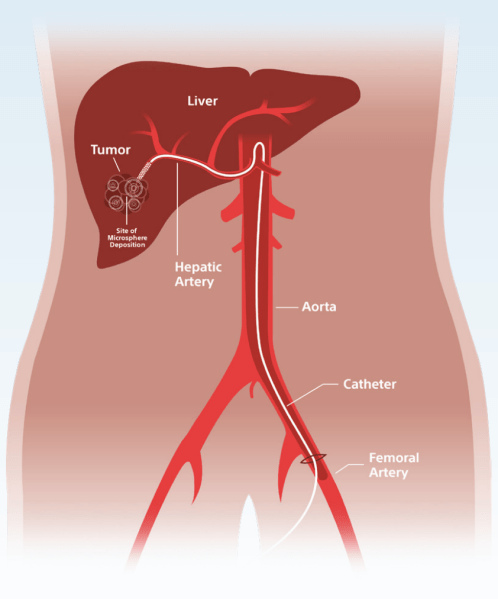
The treatment is a minimally invasive procedure that deposits millions of glass microspheres, each about one-third the width of a human hair, containing a radioactive isotope (Y-90) inside the blood vessels that supply a tumour. This blocks the blood supply to the cancer cells and delivers a high dose of radiation to the tumour. The treatment will destroy a significant portion of my liver, but thankfully, it has the amazing capacity to regenerate itself after damage.

Three weeks ago, I had a work-up which was basically a trial run. As will happen in the actual treatment, a catheter was inserted through the femoral artery in my groin and guided via x-ray to the hepatic artery supplying my liver. Mapping and measurements of the blood vessels feeding the tumour were done and then a contrast was injected and various images taken to ensure that the Y-90 would stay in my liver and not travel anywhere else in my body. During this entire time, which took several hours, and for four hours afterward, I had to lie on my back without raising my head or moving my right leg. It was a long and somewhat grueling day and after almost eleven hours, I was very happy to walk out of the hospital with no ill effects. I may not be quite as fortunate after the real deal. I’ve been told that common side effects include abdominal discomfort, nausea, and fatigue for a week or two afterward, but it will be worth it if it successfully destroys the tumour!

I was initially told that the treatment would take place two to five weeks after the work-up, but three weeks later, I haven’t been given a treatment date yet. Wheels often move very slowly in the medical world and waiting is something that patients have to get used to. It never seems to get any easier though!

To those of you who suggested in your very kind responses on Facebook this morning that you would be praying for me, I very much appreciate it. While I am enormously thankful to live in a part of the world where I have access to state of the art medical care at no personal expense, and I have a body of amazing doctors taking care of me, I know that God is ultimately my healer and it is He who holds my future. I continue to put my hope in Him!
Screenshot 2024-02-04 at 2.54.31 PM

Image: TheraSphere Patient Info – Boston Scientific
Mostly good news

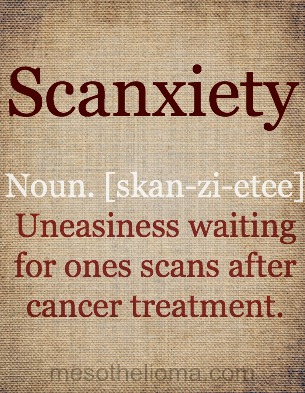
For the past couple of weeks, I’ve been riding a roller coaster that is known in the cancer world as scanxiety (scan + anxiety = scanxiety). 

scanxiety

Over the 9+ years since my stage 4 neuroendocrine cancer (NETS) was diagnosed, I’ve had more scans of various kinds than I want to count. The morning after each of my 12 radioactive PRRT treatments I had an octreotide scan to determine whether or not my tumours had grown or spread since the previous treatment. Any scanxiety that I experienced back then was short-lived because I met with the doctor immediately after the scan to review the results. Not so with the CT scans that I’ve had at 6 month, and more recently 9 month, intervals since completing my treatments in June of 2019. After each of those, I’ve had to wait about a week to find out the results. A week can feel like a very long time if you’re riding the scanxiety roller coaster, but because I’ve been doing so well for so long, that hasn’t usually been a big problem for me. 

This time was different. About three weeks prior to each scan, I have a whole battery of lab tests. The results of those are available to me online, so before I even had the CT scan, I knew that something might be amiss. Two markers that are of particular significance for NETS patients are chromogranin A in the blood and 5-HIAA (5-hydroxyindoleacetic acid) in the urine. Both had been gradually climbing and were now flagged as being higher than the normal range. That’s when the roller coaster ride began! 

360_F_141399140_3bi2tLZvTs4ek3a81nu6aSkeNc8pjsNd

In my lowest moments, I was sure that cancer was rapidly spreading throughout my body, but I did what I’ve done before in times like this. I called on a dozen godly women who share my belief in the power of prayer and asked them to pray. The ride was smoother after that. I still knew that something might be wrong, but I felt more at peace. I’d be a liar if I said that I wasn’t anxious at all, but I didn’t dwell in the low spots any longer. I also focused on one of my favourite passages from scripture, Philippians 4:6-7. 

Do not be anxious about anything, but in every situation, by prayer and petition, with thanksgiving, present your requests to God. And the peace of God, which transcends all understanding, will guard your hearts and your minds in Christ Jesus.

By the time the doctor phoned today for our follow-up appointment (saving us a 5 hour round trip to the city) I truly did feel at peace about whatever it was that she was about to tell me. She gave me the good news first. Nothing of concern appeared on the scans. In fact, a tumour in a lymph node that had been there since diagnosis in 2013 has completely disappeared! That’s amazing news, especially considering how long it’s been since I had my last treatment. I don’t think anyone expected that the PRRT would still be resulting in shrinkage of tumours three and a half years later. The good news was somewhat overshadowed though by the fact that those elevated levels in my blood and urine still indicated that something is happening. So what happens next? 

I’m going to be going for a Gallium-68 dotatate PET scan sometime in January. This newer imaging technique is similar to the octreotide scans that I’ve had in the past, but much more sensitive. It will be able to pick up even the tiniest growths that might have been overlooked on the conventional CT scan. The results of that will dictate what the next steps will be, but for now I’m not going to worry about it. I’m determined not to climb back on that roller coaster. Instead, I’m going to focus on having an enjoyable Christmas!

The scan did reveal something totally unrelated to my cancer. Apparently, I now have a 1.3 cm Thornwaldt cyst lurking in my head! This is a rare, benign growth that develops in the nasopharynx, above the soft palate and behind the nose. If it continues to grow or becomes infected, it has the potential to start causing things like headaches, postnasal drip, blockage of the eustachian tubes, and/or halitosis. If that occurs, it can be drained or removed surgically. I’ll cross that bridge if and when I get there. For now, it’s just one more thing to add to my long list of weird and not so weird diagnoses! 

One less cancer!

It’s been several months since I wrote an update about my health which is usually a good thing because it means that there’s been nothing new to report. This week saw something very big happen though! Before I get into that, let me begin with a bit of history for those who are new to the blog.

In the early fall of 2013, I was diagnosed with neuroendocrine cancer (NETS) which is incurable, but often treatable. Exactly seven months later, a second completely unrelated cancer was found in a my left parotid (saliva) gland. Treatment on the first cancer was halted while that one was removed surgically and followed up with thirty radiation treatments. Once I’d had time to heal from that, treatment on the first cancer resumed. I entered a clinical trial that involved 12 radioisotope treatments (PRRT) over a period of approximately five years. Each of these treatments left me highly radioactive for a week, but I responded well and there was some shrinkage of my tumours. In the fall of 2018, toward the end of that regimen, scans detected something suspicious in my thyroid gland which eventually proved to be yet another unrelated cancer. Since only a small percentage of papillary thyroid cancers are aggressive in nature, the decision at that time was to watch and wait. My body had been through enough and we could afford to give it time to heal before deciding how to address this latest discovery.

Skipping ahead three years to last fall, my neuroendocrine cancer continued to be stable. In fact, 20 months after my last PRRT treatment, I was still experiencing some decrease in tumour size. I was feeling great and able to live a normal, active life. Though there had been no change to the thyroid cancer, we decided that the time had come to remove it rather than taking a chance on allowing it to begin growing or spreading.

Then began the long wait due to Covid hospitalizations delaying surgeries! Finally, on Thursday morning, the same amazing surgeon who did my previous neck surgery removed my thyroid. I woke up very early that morning with two distinctly different kinds of cancer and a few hours later I had only one again! It’s taking awhile for the reality of that to truly sink in.

After an overnight stay in the hospital, I’m home and feeling remarkably well considering. I’ve needed nothing more than Tylenol for pain which is such a blessing as heavy duty pain killers make me nauseous. My neck feels a bit like someone held me in a headlock for an extended period of time which is probably pretty similar to what happened during the 3.5 hours of surgery! I have a very husky voice as the result of some difficulties with the breathing tube, but that should gradually heal over the next couple of weeks. I had a super good sleep last night and now I’m just going to lean back and take it easy for a few days! During the first week of March, I’ll be back in the city for a follow up appointment with the surgeon as well as CT scans to check on the neuroendocrine cancer. In the meantime, I’m just rejoicing over having one less cancer!

1479468594421-V9D5BEZF2RTMCO558E0E

Good news!

In these days of political turmoil, Covid variants, earthquakes, avalanches, and ice storms, we seldom seem to hear any good news, but today was different for us.

great news

It started with a phone call 45 minutes before we were planning to leave for the city to meet with the doctor to receive the results of the CT scans that I had last Friday. Scans that would tell us whether or not my neuroendocrine cancer (NETs) had grown or spread. Would I be okay with a phone consultation instead of meeting with the doctor in person? You bet I would! I’ve been feeling fine. I didn’t have any specific reason for needing to see the doctor in person and a phone call would save us four and a half hours of driving! 

The really great news came with that second phone call, the call from the doctor himself. Almost immediately, I heard the word I’d been hoping for. Stable! But then I heard, “for the most part.” For the most part? What did that mean? “It’s good news” he hastened to assure me.

There has been a change, but it’s a change for the better! Twenty months after my final PRRT treatment, after feeling like I was stepping off a cliff because I would no longer be on any treatment other than the monthly injection that I’ve been receiving since diagnosis in 2013, I’m still improving! A spot on my liver has decreased in size since the last scan almost seven months ago!

Another indication of how I’m doing showed up in the blood work that accompanied my scans. Chromogranin A, a protein released by neuroendocrine cells, is the most valuable marker of neuroendocrine tumours. In December 2019, six months after that final PRRT treatment, my Chromogranin A level was 112, which in the words of my doctor, was “at or slightly above normal, but not worrisome.” By last August, it was down to 49 and now it’s 27! This, too, is pretty remarkable. 

Neuroendocrine cancer is incurable. I’ll have scans and blood tests again six months from now and once again, we’ll wait for the results and hope to hear that wonderful word. Stable! In the meantime, we’re praising the Lord for today’s good news! 

Celebrating survival!

2020-logo-color_New

Today, the first Sunday of June, is National Cancer Survivors Day, an annual, worldwide celebration of life set aside to honour the millions of people worldwide who are living with and beyond cancer and to raise awareness of the challenges that they face.

Major advances in cancer prevention, early detection, and treatment have resulted in longer survival, but a cancer diagnosis can leave a host of problems in its wake. Physical, financial, and emotional hardships often persist for years after diagnosis and treatment. Depending on where they live, survivors often contend with rapidly rising drug costs, inadequate insurance coverage, difficulty finding or keeping employment, and a lack of understanding from family and friends. Despite these difficulties, cancer survivors can live active, productive, inspiring lives.

So what is a survivor? To many, the term ‘cancer survivor’ suggests a person who has beaten their cancer; perhaps one who has been cancer free for several years, but I like the definition used by the National Cancer Survivors Day Foundation. “A ‘survivor’ is anyone living with a history of cancer – from the moment of diagnosis through the remainder of life.”

In other words, I am a survivor! In fact, I’m a three times survivor.

hello-im-a-survivor

I live with cancer every day. Unless a cure is found for neuroendocrine cancer (NETS) within my lifetime or God performs a miracle on my behalf, I will never be cancer free. People have a hard time grasping the idea of a chronic cancer. The usual assumption is that patients either die of their disease or they are cured, thereby becoming cancer survivors, but I look at my situation differently. I may eventually die of my cancer or I may die with it, but either way, I am a survivor! Fortunately my NETS is stable at this point and it doesn’t significantly impact my day to day life. I’ve had all the PRRT treatments that I can have, but a monthly injection given here in my home by a visiting nurse seems to be keeping things under control. I had my 87th of these “butt darts” just over a week ago.

I’m also a cancer survivor in the more tradition sense, as in one who had the disease, but is now free of it. As many of you know, seven months after my NETS diagnosis, I was diagnosed with a second, completely unrelated cancer that was removed surgically. Six weeks of radiation followed and, since that time, there has been no recurrence.

Cancer number three, most likely caused by the radiation that I received for the other two, was discovered in my thyroid almost exactly a year ago. Though it’s not a particularly aggressive form of cancer, it’s the one that concerns me the most right now. I was supposed to see my specialist two months ago and have an ultrasound to determine whether or not the cancer is growing. Thanks to Covid-19, that didn’t happen and it’s been eight months since my thyroid was last looked at. Though my specialist still isn’t seeing patients except in emergency situations, I decided to do a bit of self-advocating and his office is now in the process of trying to arrange for me to have an ultrasound done in a hospital closer to home in a small city that has only had one Covid-19 patient.

Yes, in spite of all this, I am a survivor! Survivors are people from all walks of life, of all ethnicities and income levels. They’re children, moms, dads, and grandparents. They may be your coworkers, friends, and loved ones. Traditionally, National Cancer Survivors Day celebrations have included parades, carnivals, health fairs, awareness walks, candle-lighting ceremonies, and other community events. This year, due to Covid-19 restrictions, the celebrations may be somewhat more subdued, but life with and after cancer goes on and it ought to be about more than just surviving. It ought to be about living well and that’s always something to celebrate!


100 pounds!

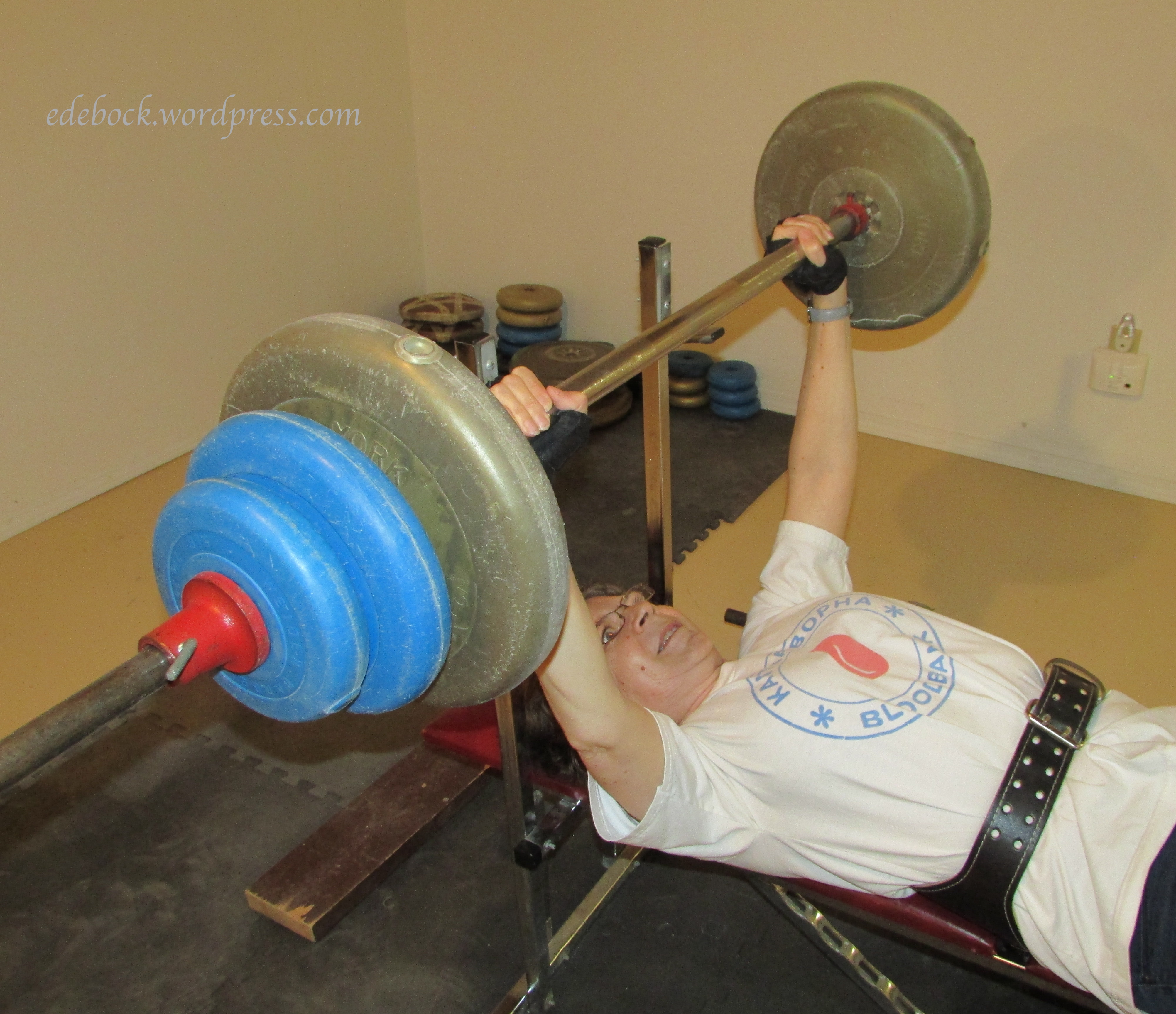
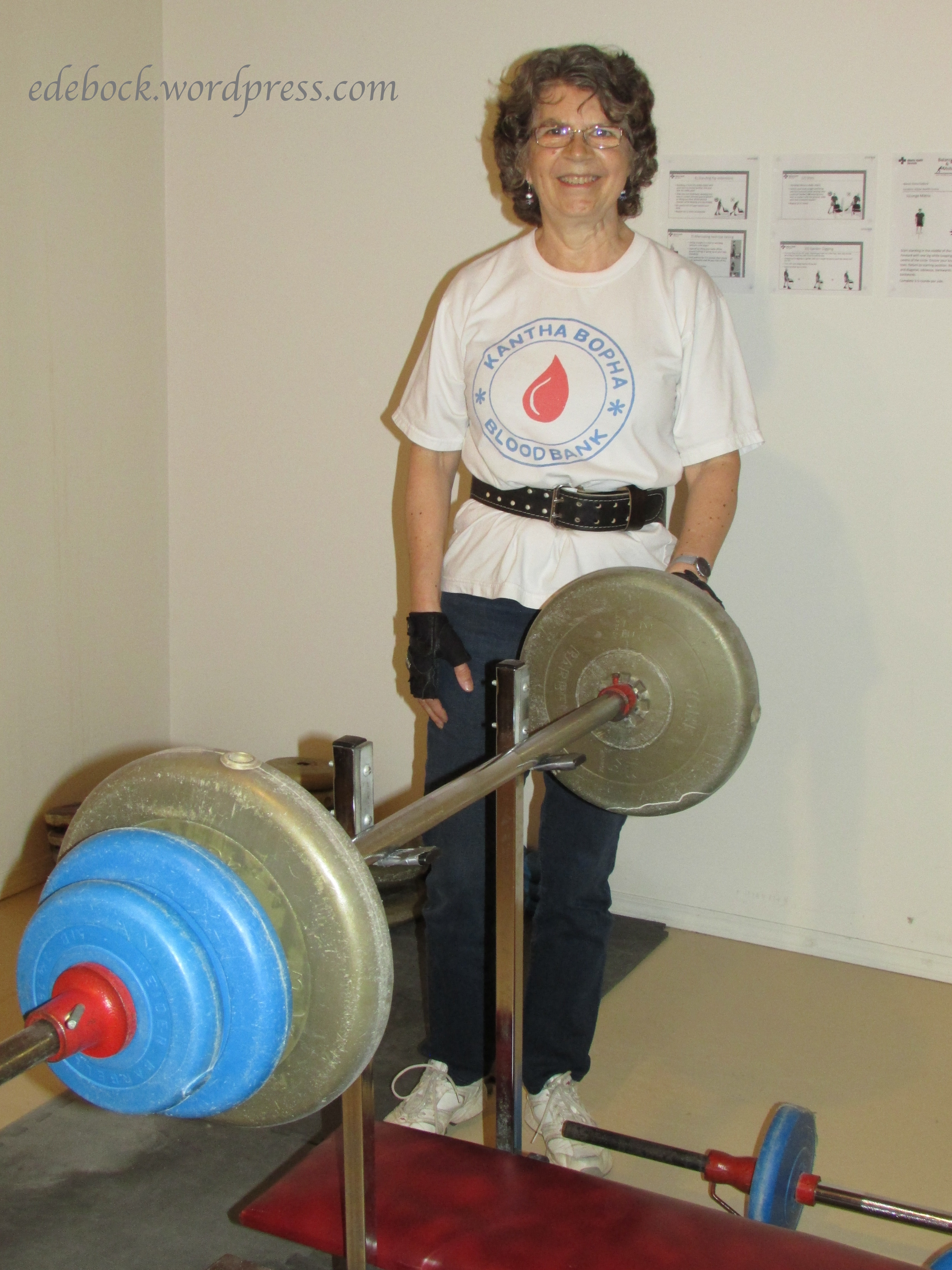
I started lifting weights in the early 1990s. It was never my intention to become a body builder, but I had recently entered my 40s and I thought that it might be a good idea to do something to try to keep in shape. We already had the equipment in the basement and hubby, who was a phys ed teacher at the time, had been lifting for several years, so I had him set up a routine for me and my lifting days began. I would never have foreseen that I’d still be lifting all these years later!

Unlike many serious lifters who work out year round, we only lift from mid October until the end of April each year; the months that the golf course is closed. We have a short summer season here in Alberta and we want to spend as much of it as possible engaging in outdoor pursuits, not working out in the basement! Over the almost three decades that I’ve been lifting, I’ve had good seasons, bad seasons, and  even one when I didn’t lift at all. We spent that year teaching English in Japan and rather than seeking out a gym to join, we spent as much time as we could seeing the country and soaking up the culture. There were also a couple of partial seasons including the winter that we headed off to China to spend a semester teaching there.

My best year to date was the winter of 2005-2006. I was 53 years old and many years pre cancer. At the end of that season, I was bench pressing 97.5 pounds. Why I never pushed myself to add just 2.5 more pounds and press 100, I’ll never know! I suspect that the golf course opened and I probably thought that I’d be able to push that little bit further the following year. In ensuing years, however, I never made it past 90 pounds again. That is until this year!

Each of the past few years, I had a midwinter PRRT treatment that set me back strength-wise, but I kept on pushing myself and refused to quit completely. Am I ever glad I did! I guess I didn’t realize how much those treatments were actually taking out of me, but I haven’t had one since last June and I cannot believe how strong I’ve felt this year. Today I did something that I gave up hope of ever doing a long time ago. I bench pressed 100 pounds! That might not seem like a lot to many more serious lifters, but to me, at 67 years old with two cancers, it was huge!

IMG_0998

It was back in February that I first caught a glimpse of potentially reaching a new personal best. It was definitely on a distant horizon, but barring injury or sickness, it might just be possible. It was very shortly after that thought crossed my mind, however, that we got the call telling us that my father was dying. We had to drop everything and head for Vancouver. With that interruption, I thought the possibility was gone, but when we got home, I picked up where I’d left off and soon realized that it might still happen. I’ve continued lifting later into the spring than I normally do partially because, with the Covid-19 shutdown, there wasn’t a lot else to do, but mostly because I was so close to reaching my goal and I simply couldn’t let it slip through my fingers this time.

IMG_1002

Definitely feeling pretty proud of myself!

IMG_1005

What’s my risk factor?

Before I even begin this post, especially for those who haven’t been here before, let me emphasize that I have absolutely no medical training. I am simply a neuroendocrine cancer (NETS) patient seeking answers and doing the best I can to weather the very unusual days that we all find ourselves in.

Screen Shot 2020-03-21 at 7.17.10 PM

Does my cancer and the PRRT treatments that I’ve received mean that I’m at higher risk of contracting COVID-19 than the general population? Not as far as I know. The reality, as I understand it, is that no one has immunity to this virus. It’s a brand new disease that our bodies have never encountered before; never had an opportunity to develop antibodies to. That’s why I’m doing what I think everyone should be doing. I’m not hiding out in fear, but I’m hunkering down at home and only going out for necessities such as food and medications.

When we hear about those people who are most vulnerable to COVID-19, this refers to those who may be at higher risk for more serious complications IF they contract the disease. That’s why it’s so important for all of us to do our part in helping prevent these populations from getting the COVID-19 virus in the first place. Am I one of the vulnerable ones? Certainly, my age puts me at higher risk than those who are younger, but I haven’t been able to find any information regarding NETS and COVID-19. In reality, such information probably doesn’t exist. At least, not yet.

So, what are those risk factors? 

  • An older adult  –  Recent figures show that more than 50% of the patients who have been admitted to an ICU with the disease and 80% of those who have died were over the age of 65. At 67, I’m at the low end of that population, but still within the high risk category.
  • People who have serious underlying medical conditions such as:
    • Heart disease  –  Not me!
    • Diabetes  –  I have been diagnosed as pre diabetic, but maintaining a careful, well disciplined diet has kept my blood sugar well regulated, so I doubt that this would put me at high risk.
    • High blood pressure  –  Experts indicate that if a person’s blood pressure is under control and they don’t have other risk factors, they probably aren’t at any greater peril than the general population. I’ve been on hypertension medication for several years and it’s been keeping my blood pressure under control but, of course, I do have other risk factors.
    • Chronic respiratory diseases  –  No again!
    • Cancer  –  This one raises lots of questions for me. Cancer is such a broad category. The word actually refers to any of the 200 different diseases, affecting many parts of the body, that are characterized by the uncontrolled growth of cells that invade and damage the body’s normal tissues. Do all of them put a person at higher risk for COVID-19 complications? I doubt it, but what about the 3 completely unrelated cancers that I’ve been diagnosed with since August 2013? That’s right, 3! As I mentioned above, I haven’t been able to find any information about NETS and COVID-19, but what about my untreated thyroid cancer? At present, there has been no indication that thyroid conditions place a person at jeopardy.
  • People who have a compromised immune system from a medical condition or treatment (e.g. chemotherapy)  –  In spite of having or having had 3 different cancers over the past 6 1/2 years, I’ve never had chemotherapy, but I haven’t been able to find any information on how PRRT affects the immune system, so once again, I’m left with questions.

The immune system is the body’s natural defence system. Unfortunately, there isn’t a simple questionnaire that will tell you how strong yours is. There are, however, several signs that you might have a weakened immune system:

  • Stress  –  Stress decreases the body’s lymphocytes, the white blood cells that help fight off infection. Thankfully, my life is relatively free of stress these days. For the most part, I think I can say with the apostle Paul, “I have learned to be content whatever the circumstances.”  Philippians 4:11b
  • Frequent colds or infections  –  I’ve had two colds this winter; one mild and one nasty. That’s more than I usually get, but I recovered from both in a reasonable length of time and I don’t remember the last time I’ve needed an antibiotic for an infection.
  • Frequent diarrhea or constipation  –  Diarrhea was one of the most obvious symptoms of my NETS cancer before it was diagnosed. Now medications tend to cause the opposite problem, but I can’t blame that on my immune system.
  • Wounds are slow to heal  –  I don’t think so. I haven’t had any serious wounds in recent years, but minor ones heal just fine.
  • Fatigue  –  When your immune system struggles, so does your energy level, but for the most part mine is good. My father passed away in the wee hours of March 1. I got almost no sleep that night and I definitely discovered that pulling an all-nighter in my 60s isn’t as easy as it was in my 20s! The week that followed was pretty exhausting too, but three weeks later, I’ve bounced back and feel completely rested. That seems to speak well of my immune system.

I do know, however, from regular blood tests, that my hemoglobin tends to be slightly on the low side which would make me somewhat vulnerable to infection and disease. On the other hand, I do all the right things to keep my immune system as healthy as I can. I don’t smoke, I eat a healthy diet, I maintain a healthy weight, I exercise regularly, I drink alcohol only in moderation, I get adequate sleep, I try to minimize stress, and I even wash my hands frequently!

So, what is my risk factor? I can only give a somewhat educated guess. Since I live in a sparsely populated area and I’m staying home most of the time, I’d say that my risk of getting COVID-19 is quite low. On the other hand, IF I do get it, my risk of suffering complications is probably moderately high.

Am I worried? No, but I’m definitely taking all the recommended precautions. I hope you are too!

Living in unusual times

We are definitely living in unusual times. We’ve watched as COVID-19 swept across the globe and now it’s reached our shores. I’m tempted to sit at my laptop hour after hour watching and reading updates. Things are happening so fast! Late Sunday, it was announced that schools across our province were closing. Yesterday, the province declared a state of emergency and non essential services began to shut down. Recreational facilities, museums, libraries, art galleries, community centres, children’s play centres, casinos… all closed until further notice. Gatherings of more than 50 people are prohibited. Even churches are closing their doors. I’m sure it’s much the same where you are.

So what do we do in such unprecedented and uncertain times? How do we cope when the calendar is suddenly blank? Self-isolate and social distancing are new additions to most people’s vocabulary, but I have a little more experience than most with these concepts. Over the past six and a half years, I’ve had 14 PRRT treatments and I was required to self-isolate for one to two weeks after each one. The present COVID-19 crisis will likely last significantly longer than that, but this too shall pass and when it does, I don’t want to look back on this as time wasted.

We’ve just been handed a lot of extra uninterrupted time, something most of us never seem to have enough of. What will you do with yours?

Here are a few suggestions:

  • Declutter. Clean out a closet, a drawer, the kitchen cupboards. Start your spring cleaning early.
  • Try some new recipes. This one might become a necessity. We visited five grocery stores today only to find the meat departments almost empty. I’m definitely going to have to be somewhat creative with meal planning over the next while!
  • Prepare and freeze some meals for when life gets busy again.
  • If you’re able, get outside. Self-isolating doesn’t mean you have to stay inside. Go for a walk or, depending on where you live, do some yard work, ride a bike, go snowshoeing, paddle a canoe. Fresh air and exercise are essential to maintaining a positive outlook in trying times.
  • Check out Duolingo and start learning a new language.
  • Keep up social connections via phone or video chat.
  • Play board games.
  • Do jigsaw or crossword puzzles.
  • Finish the craft that you started some time ago and never completed.
  • Start a journal or a blog.
  • Read all those books that you never had time for.
  • Enjoy virtual tours of 12 famous museums from around the world.
  • Attend the opera online.

Whatever you do, don’t panic and don’t just sit around waiting for this to pass. Take wise precautions, be safe, but also seize the moment. Choose to do something worthwhile in the midst of these difficult and uncertain times. Make it a time worth remembering!

And one final bit of advice… assuming that you don’t live alone and that no one in your household is sick, remember that hugs are healthy! The thing that I missed most during my periods of post treatment isolation was the comfort of physical touch.

Fine, thanks!

It’s been quite awhile since I posted an update about my health. That’s because there really hasn’t been anything new to report. For someone with two kinds of cancer, that’s actually a very good thing, but I know that there are those of you who want to know what’s going on, so here’s the latest.

It’s already been over six months since I had my final PRRT treatment. Other than monthly injections of Sandostatin that are mainly meant to control symptoms, I’m not presently receiving any treatment for my neuroendocrine tumours (NETs). That’s a bit disconcerting, especially when more than one fellow zebra that I’ve come to recognize through a Facebook support group has succumbed to the disease in recent months. It’s really hard when one of those announcements shows up in my news feed.

On the other hand, I’m feeling 100% healthy, so most days it’s easy to ignore the fact that there are things lurking inside me that shouldn’t be there and that could begin to grow or spread at any time. I’m blessed to be able to live a full and productive life. I’m lifting weights again this winter and I’ve recently dusted off the treadmill and started using it again. If anything, I’m feeling better and stronger than I did six months ago.

A week before Christmas, I was in Edmonton for CT scans and blood work to find out if I’m really as healthy as I feel and yesterday we met with the doctor to get the results. Sometimes I suffer from a few days of scanxiety before an appointment like this one, but this time I felt completely at ease. I just kept reminding myself that God promised to take care of me over six years ago when I was first diagnosed and He has been faithfully doing that ever since. There’s no better place for me to be than in His hands.

When we sat down with the doctor yesterday all I really needed to hear was one word. Stable! Nothing has changed. No growth, no spread! Nothing to worry about. So, unless I begin to experience symptoms (which I haven’t since treatment began), we go through the same routine six months from now and hopefully receive the same good news again… and again… and again.

The CT scans reveal very little about my thyroid cancer which is entirely different and unrelated to my NETs. For news about that one I’ll have to wait until early April when I see that doctor again and he uses ultrasound to take a closer look and measure whether or not there’s been any change.

In the meantime, when you see me and ask, “How are you?” if I answer, “Fine, thanks!” that’s because I really am!

174103009.1

Forgiveness and gratitude

I had my final PRRT treatment (also called radioisotope therapy) today. I’ve been injected with potent radioactive material at Edmonton’s Cross Cancer Institute fourteen times; MIBG twice and then Lutetium twelve times as part of a clinical trial. The clinic staff and other patients seemed to think that reaching this milestone was pretty exciting. In one sense, I guess it was, but it also feels a bit like stepping off a cliff! My neuroendocrine cancer (NETs) has been stable for almost six years, the entire time that I’ve been undergoing treatment. The tumours have not grown or spread. In fact, earlier on there was even some indication that they might be shrinking. I’m happy not to have to go through any more of these treatments and the week of radioactive seclusion that follows each one, but the stepping off a cliff sensation comes from the fact that I’ve now exhausted the best treatment option available. The human body can only withstand so much radioactivity. Even if the government agreed to fund more treatments, the doctors wouldn’t advise them for me. The plan from here on in is to simply monitor my cancer with blood work, CT scans, and clinic visits every six months. Considering the fact that NETs is incurable, that’s a bit unnerving. (I will continue to receive the monthly injections of Sandostatin that control symptoms and may have some effect on the tumours themselves.)

The Cross Cancer Institute is set up to administer PRRT treatments to three patients at a time. We sit together, each of us in a comfortable recliner, in a room set aside for this purpose. The process takes approximately four hours, so naturally we visit and share our cancer stories. I’ve never been with the same patient twice, so that’s quite a few stories over the past few years and each one is unique.

Today I shared the treatment room with a retired school teacher from Victoria, BC and a retired school administrator from a community much closer to my own. How unusual and how interesting that three retired educators ended up in that room together! Our conversation quickly came around to the fact that while we don’t choose many of the circumstances of our lives, including cancer, we do choose how we respond to them. Then the retired principal, an upbeat and cheerful man, made a comment that really resonated with me. He said that he believes that there are two keys to living a happy, successful life: forgiveness and gratitude.

That thought stuck with me throughout the remainder of the day. It’s definitely very true for me. I won’t go into detail, but I have had much to forgive, and in spite of that, I’m the first to admit that I also have much to be grateful for.

After pondering for awhile, I googled “forgiveness and gratitude” and was surprised to find many articles linking the two. Even more surprising to me was the fact that these weren’t Christian or religious writings. The fact that forgiveness and gratitude are positive psychological characteristics that are connected to well-being seemed to be a common theme. Both terms are complex and neither is easy to define.

Forgiveness is a conscious choice or decision to let go of anger, fear, self-pity, resentment, bitterness, hostility, and even hatred resulting from something someone has done to us or something that we’ve done ourselves and to replace those emotions with more positive ones such as peace, love, and joy. Forgiving a person doesn’t excuse what they did. It isn’t really about them at all; it’s about setting ourselves free. It releases us from the negative consequences of unforgiveness which may include anxiety, depression, and even physical symptoms of stress. It liberates us from a cycle of negativity and anger and allows us to open our hearts to gratitude, happiness, and love. I’ve heard it said that unforgiveness is like drinking poison and hoping it will kill the other person. 

Gratitude is a feeling of thankful appreciation for people, circumstances, and situations in life. Grateful individuals feel a sense of abundance, appreciate the simple pleasures of life, and recognize the contribution others make to their well-being.

Forgiveness is probably the more difficult of these two human virtues to put into action, but until we do, I think we’ll find it difficult to experience and express true gratitude. Professor Robert Emmons at the University of California, Davis, suggests that attitude change often follows behaviour change. By expressing gratitude that we may not necessarily feel through simple gestures like smiling and saying thank you, we may actually begin to feel it. The same is true of forgiveness. We may not feel like forgiving a person, but if we choose to act as if we have, we may eventually find that our resentment has faded away and we will, in fact, have forgiven them.

So, what does all this have to do with living with cancer? Obviously my cancers are no one’s fault. Not mine, not anyone else’s. However, if I was still living with unforgiveness, I doubt I’d have the emotional energy I need to deal with the ups and downs of this journey. And what about gratitude? Am I thankful for cancer? Absolutely not! That being said, however, I have so many things to be thankful for! In spite of having just been diagnosed with a third completely unrelated cancer, I feel healthy! I can eat almost anything I want, I can travel, hike, and even do a rope course with my grandchildren! I have an amazing circle of friends, family, and prayer warriors around the world loving me and supporting me and I have a faith that gives me “peace that passes understanding.” Philippians 4:7

Am I the courageous hero that people often tell me I am? No, I’m not, but as we concluded in our treatment room today, I can choose how I respond to my circumstances and I choose to be hopeful and positive. I choose to get on with life even if I feel a bit like I stepped off a cliff today.

Screen Shot 2019-06-18 at 10.10.23 PM

source: clipartfest.com

Give thanks to the Lord, for he is good. His love endures forever.  Psalm 136:1

Be kind and compassionate to one another, forgiving each other, just as in Christ God forgave you.  Ephesians 4:32