Sitting at His feet

I ended yesterday’s post with a question. How can we, like Mary of Bethany, sit at the feet of Jesus and learn from Him? (Luke 10:38-42) Today, I will try to answer that question by sharing a slightly edited version of the remainder of the first talk that I gave at a ladies retreat on Saturday. Again, although I was speaking to women, what I’m sharing applies to both men and women.
A.W. Tozer, a prominent 20th century pastor, author, and editor, said that “God can be known satisfactorily only as we devote time to Him” but how do we do that? I want to look at three answers to that question: Scripture, prayer, and community. There’s no one size fits all, perfect way to spend time with Jesus, but these three components are vital parts of a life with Him.

Let’s start with the Word of God. The Bible is so much more than just an ancient text. It’s filled with timeless truths and profoundly practical principles that are just as applicable today as they were when they were written thousands of years ago. The world in which we live has changed, but the principles are eternal.

There are many different ways to incorporate Scripture into our daily lives. Although there’s nothing inherently wrong with them, I’m not actually a big fan of read through the Bible in one year plans. You start off in Genesis with the stories of creation, Adam and Eve, Noah’s ark, Abraham, Isaac, Jacob, and Joseph. Exciting stories that keep you reading. Then you move into Exodus and read about God saving His people from slavery in Egypt, but after that comes Leviticus, a book about laws, rituals, sacrifices, and priestly duties. Perhaps you push through that only to find that Numbers is aptly named as the first few chapters detail a census counting the entire Israelite population by clan and family. By this point many people with great intentions get bogged down and give up. If that’s been you, you were probably left feeling frustrated and guilty, as if you’d failed at something important.

I really like something that our pastor said in his sermon several weeks ago. “The Bible isn’t a book to get through, it’s a book to get through to you.” 

If you do decide to read through the entire Bible from start to finish, doing it in one year might not be a manageable goal for you. That requires reading more than three chapters a day. Instead, if that’s more than you can realistically see yourself doing, try taking smaller, more manageable bites and really focusing on what you read. So what if it takes three or four years or even longer to finish? It’s not a race!

An option that I prefer for reading from Genesis through to Revelation is a chronological Bible that rearranges the text into the order that the events occurred historically, rather than the traditional order that we’re used to. It makes so much more sense to me that way. Many of the most commonly used versions are available in this format, but regardless of how you decide to incorporate Scripture into your daily life, make sure you choose a translation that you find easy to understand.

Instead of reading through the entire Bible, there are many other ways to incorporate Scripture into your busy days. There are, of course, print and online devotionals that provide short, daily readings and small portions of Scripture. Listening to an audio Bible is another great option that can be done almost anywhere.

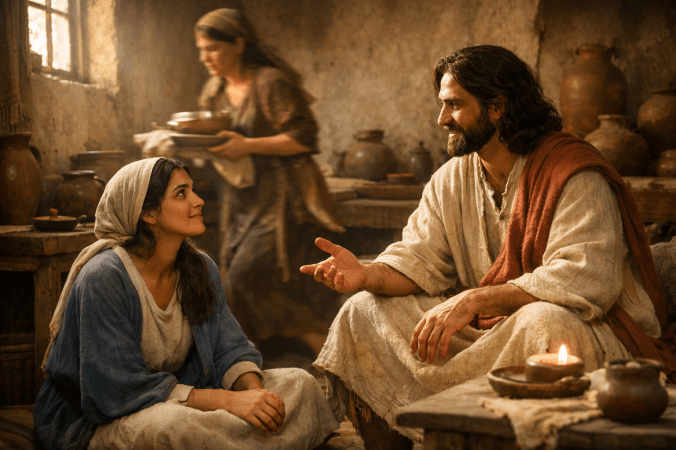
Psalm 119:11 says, I have stored up your word in my heart.” Regardless of how we do that, our goal must be more than surface knowledge. Instead, we need to allow the truth of God’s Word to sink deep into our hearts and shape our lives. We need to be like Mary sitting at Jesus’ feet. I suspect that she hung on every word He said. I don’t think she was daydreaming. Her mind wasn’t wandering and she wasn’t dwelling on the next thing on her to-do list.

God knows what season of life each one of us is in. He knows that the amount of time that we’re able to carve out for Him will vary at different times in our lives. We just need to make sure that we’re giving Him quality time. Whether you read three chapters a day or just a few verses, It’s very easy to fall into the trap of simply performing another duty, something else to check off on your to-do list. Don’t just skim over what you read, take time to really think about what it’s saying to you.

While Scripture is God speaking to us, prayer is us in conversation with Him. It’s how we stay close to Him. Jesus often withdrew to desolate, quiet places to pray. If He, the Son of God, needed solitude with the Father, how much more do we?

While a place of solitude sounds great, that might not be realistic for you in the season of life that you’re in right now. I go into my den and close the door for a time of prayer every morning, but I realize that being retired, I’m speaking from a position of privilege. That hasn’t always been the case. My den used to be a child’s bedroom and in those days, mornings certainly didn’t look like they do now. They were a hectic rush of making sure that everyone was dressed, fed, and ready to leave for school on time. During the 18 years that I taught in the next little town down the highway, my prayer time was in the vehicle on the way to school and back. I also remember praying in the bath when that was my only alone time. The point isn’t isolation though, it’s presence. It’s sitting at the feet of Jesus whenever and wherever works best for you at this point in your life.

In 1 Thessalonians 5:17-18, Paul gives us a clear and challenging command, Pray without ceasing, give thanks in all circumstances; for this is God’s will for you in Jesus Christ.” He doesn’t describe a prayer time, but a prayer life, an ongoing conversation with our Lord. Intentionally setting aside a specific time and place to pray each day is an important spiritual practice, but we can also pray anytime, anywhere. Praying isn’t just speaking though, it’s slowing down, listening, sitting with God, and letting Him speak into the never-ending noise. It’s a relationship, not a request line and it isn’t something to be squeezed into the edges of life.

Also, our love for God isn’t measured by how perfect our prayers sound. If Jesus is our friend, as Scripture tells us He is, and as He was to Mary and her sister, Martha, then we can talk to Him as we would to anyone else. We can tell Him anything. If it’s important to you, it’s important to God. Whether it’s praying for an open parking space or an end to the war in Ukraine, there’s nothing too big or too small to talk to Him about.

Although making Scripture and prayer part of our daily lives are usually solitary activities, God didn’t design us to live the Christian life alone. It’s a group project, not a solo event. We can’t be all that He designed us to be without community. We don’t have what it takes to thrive on our own. We need each other’s gifts and each other’s presence. When we walk with others whose lives are aligned with the Word of God, they challenge us, encourage us, and help us see what we can’t see on our own. We need people who will remind us of what’s true when we falter, who will pray when we can’t find the words, who will walk beside us when we feel like we can’t go on. That requires more than simply doing church together on Sunday mornings. It means getting to know one another on a deeper level. That’s one of the benefits of being part of a small group Bible study.

In John 15:4, Jesus said, Abide in me, as I also abide in you.” He didn’t say visit occasionally or check in when it’s convenient. He didn’t say, see you next Sunday! He said abide, remain, sit at my feet.

I’m going to conclude with a slightly altered version of an illustration from the book, Living by the Word, by Seth M. Jones:

Abiding is like tending a fire in winter. You don’t just light it once and walk away expecting the warmth to last. You return to it. You feed it. You guard it from going out. Your presence is required. Prayer, scripture, and community are three of the logs we lay on that fire. Without them, our love for God cools into embers, but with them it burns bright, steady, and strong.

In my next post, I plan to share from the second talk that I gave on Saturday on the theme, Present Over Perfect.
Lessons from Mary and Martha

I was the speaker at a ladies retreat at our church yesterday. Although a late spring snowstorm kept a few women away, those of us who were able to be there had a wonderful time. Our theme was Present Over Perfect and I was given two Scripture passages to speak from. A lot of work went into preparing what I was going to say, so I’d like to share some of it with a broader audience. I’ll do a bit of editing and I’ll break it down into several posts as I doubt you’d want to read it all in one go. Please keep in mind that I was speaking to women, but I think there are principles here that apply to both men and women.

Have you ever felt overwhelmed trying to prepare a special meal for a dozen or more guests? Perhaps it was Christmas or Easter and you wanted everything to be just right. That was likely the case with Martha of Bethany. The story is just five verses in Luke chapter 10.

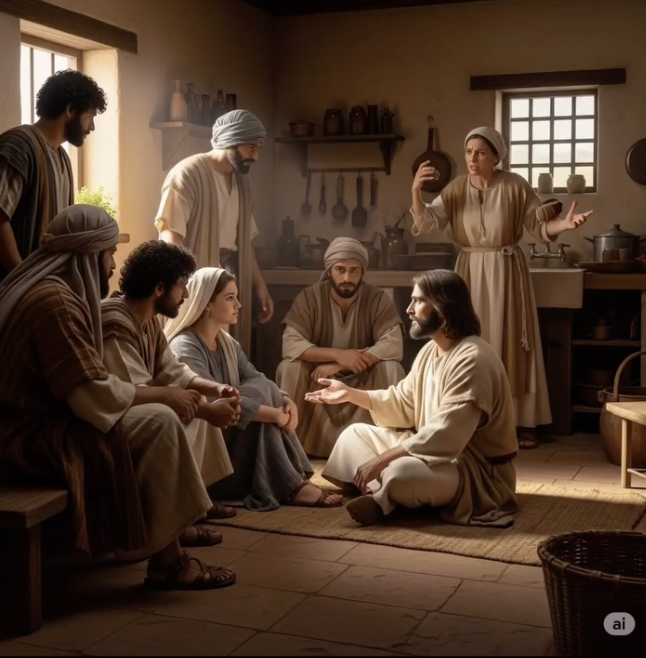
As Jesus and his disciples were on their way, he came to a village where a woman named Martha opened her home to him. She had a sister called Mary, who sat at the Lord’s feet listening to what he said. But Martha was distracted by all the preparations that had to be made. She came to him and asked, “Lord, don’t you care that my sister has left me to do the work by myself? Tell her to help me!”

“Martha, Martha,” the Lord answered, “you are worried and upset about many things, but few things are needed—or indeed only one. Mary has chosen what is better, and it will not be taken away from her.”

This wasn’t just any ordinary gathering. At the centre of the guests was Jesus himself. Martha knew Him as Messiah. She called Him Lord. No wonder she wanted everything to be perfect!

There’s a lot more going on here than meets the eye though, so let’s try to step into the story and look more closely at what’s happening. Luke doesn’t actually tell us that Martha was preparing a meal, although I think it’s safe to assume that she probably was. He simply says that she was “distracted by all the preparations that had to be made”. That could mean a lot of things. On occasion, Jesus was known to spend the night with Mary, Martha, and their brother Lazarus, so perhaps she was also preparing for overnight guests.

Keep in mind that this took place approximately 2000 years ago, in a time and place very different from our own. In order to correctly understand Scripture, it’s always important to be aware of the time, the place, and the culture that we’re reading about. In first-century Judea, there were no telephones. Martha likely had little or no warning that company was coming, no time to prepare in advance. In that time, cooking was a labor-intensive task. Meals were prepared from scratch using basic tools, locally sourced ingredients, and open-fire cooking. Martha didn’t have an instant pot, an air fryer, a microwave, or an electric oven. No wonder she was frazzled!

When this story is taught, I always feel bad for Martha. I think she often gets a bad rap. She was, in fact, doing exactly what would have been expected of her. In her culture, food preparation and serving in the home were exclusively the role the woman. Martha’s mistake was not in the work that she was doing, but in the fact that she allowed anxiety and frustration to steal her peace. Her mistake was in trying to be the perfect hostess instead of being present for her guests and especially in allowing her desire for perfection to rob her of time with Jesus.

I’m sure that most of us can identify with Martha. Like her, our lives are busy. We feel the weight of what needs to get done and there always seems to be more to do. In a culture that exalts multitasking and a “we-can-do-it-all” mentality, we too can become frustrated and overwhelmed. We get tangled up in our never ending to-do lists. Like Martha, it’s very easy for us to become “distracted” and “worried about many things”. Like her, we might find it hard to step away from the busyness of our lives to sit at the feet of Jesus.

So, what could Martha have done differently? What can we do differently? I don’t know what was on the menu at Martha’s house that day, but perhaps she was trying too hard. Perhaps she was going for perfection instead of good enough. Do we do that? Do you? Do we feel that our house has to look perfect before we can invite someone in? Do we plan an elaborate menu when our guests might be just as happy with a simple meal and a less stressed hostess?

We do know from both this story and other mentions of Martha in Scripture, that she was a close friend of Jesus. In fact, if she hadn’t been, I don’t think she would have spoken to Him the way she did. She was ticked off and she let Him know it! She was clearly angry with Mary for not helping her with the work that needed to be done, but I think she was also annoyed with Jesus for allowing it and she didn’t try to hide her feelings.

Perhaps in this way, Martha is a good example for us. Praying when we’re anxious, afraid, frustrated, or even angry with God is not only acceptable, it’s actually a good thing to do. Bringing our honest, raw emotions to Him is much healthier than bottling them up. Like Martha, it’s okay for us to say, “Lord, don’t you care?” God has all the time in the world to listen and He can handle our anger, our frustration, and our pain. Expressing those feelings is actually a sign that we truly trust Him with our full selves.

But what about Mary? Why wasn’t she helping her sister? It wasn’t unreasonable in that culture for Martha to expect Mary to be helping her serve their guests. In fact, that’s what everyone present would have expected of her; everyone except Jesus, that is.

Without understanding the cultural context, we might totally miss the significance of Mary sitting at the feet of Jesus. According to Jewish tradition, it was only men who would sit at the feet of a rabbi to learn from him. Sitting at his feet in this manner would identify a man as one of the rabbi’s disciples.

I don’t know about you, but I used to think of Martha as being the strong, dominant sister and Mary, the quiet, possibly subservient one, but that’s not actually the Mary we see here. She takes a bold and courageous stance when she chooses to join the men at Jesus’ feet. This would have been shocking to some and probably an embarrassment to her family. Mary, a woman in a male-dominated world, was breaking the social rules of her time. She was being totally counter-cultural.

In affirming her choice and telling Martha that Mary had chosen what was better, Jesus wasn’t just telling her to calm down or suggesting that she should come and sit at His feet with her sister. In a patriarchal society where men led and women followed, where men sat at the feet of a rabbi and women served, He was throwing a socially acceptable custom on its head. He was recognizing women as disciples and full-fledged members of the kingdom of God on equal footing with men.

Have you ever heard a message or read a devotional based on today’s story that asked, “Are you a Mary or a Martha?” Did it leave you feeling guilty because it seemed obvious that the answer should be that you’re a Mary, but in reality you know that you’re more like Martha, caught up in the busyness of serving others and finding it hard to make time for Jesus?

I’m here to tell you that that’s an unfair question! This isn’t an either-or situation. True disciples, male and female, are called to be both Mary and Martha, to sit and to serve, to have the heart of Mary and the hands of Martha. This story isn’t about “good vs. bad”. It’s about establishing right priorities. Mary wasn’t avoiding work, she was prioritizing presence.

So how do we do that? We can’t ignore the fact that Jesus told Martha that by sitting at His feet and listening to His teachings, Mary chose what was best, but how do we do that? That will be the topic of my next post, so I hope you’ll come back for more tomorrow!

Mostly good news

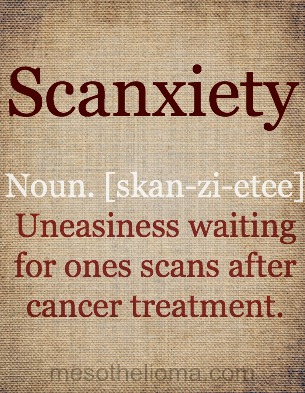
For the past couple of weeks, I’ve been riding a roller coaster that is known in the cancer world as scanxiety (scan + anxiety = scanxiety). 

scanxiety

Over the 9+ years since my stage 4 neuroendocrine cancer (NETS) was diagnosed, I’ve had more scans of various kinds than I want to count. The morning after each of my 12 radioactive PRRT treatments I had an octreotide scan to determine whether or not my tumours had grown or spread since the previous treatment. Any scanxiety that I experienced back then was short-lived because I met with the doctor immediately after the scan to review the results. Not so with the CT scans that I’ve had at 6 month, and more recently 9 month, intervals since completing my treatments in June of 2019. After each of those, I’ve had to wait about a week to find out the results. A week can feel like a very long time if you’re riding the scanxiety roller coaster, but because I’ve been doing so well for so long, that hasn’t usually been a big problem for me. 

This time was different. About three weeks prior to each scan, I have a whole battery of lab tests. The results of those are available to me online, so before I even had the CT scan, I knew that something might be amiss. Two markers that are of particular significance for NETS patients are chromogranin A in the blood and 5-HIAA (5-hydroxyindoleacetic acid) in the urine. Both had been gradually climbing and were now flagged as being higher than the normal range. That’s when the roller coaster ride began! 

360_F_141399140_3bi2tLZvTs4ek3a81nu6aSkeNc8pjsNd

In my lowest moments, I was sure that cancer was rapidly spreading throughout my body, but I did what I’ve done before in times like this. I called on a dozen godly women who share my belief in the power of prayer and asked them to pray. The ride was smoother after that. I still knew that something might be wrong, but I felt more at peace. I’d be a liar if I said that I wasn’t anxious at all, but I didn’t dwell in the low spots any longer. I also focused on one of my favourite passages from scripture, Philippians 4:6-7. 

Do not be anxious about anything, but in every situation, by prayer and petition, with thanksgiving, present your requests to God. And the peace of God, which transcends all understanding, will guard your hearts and your minds in Christ Jesus.

By the time the doctor phoned today for our follow-up appointment (saving us a 5 hour round trip to the city) I truly did feel at peace about whatever it was that she was about to tell me. She gave me the good news first. Nothing of concern appeared on the scans. In fact, a tumour in a lymph node that had been there since diagnosis in 2013 has completely disappeared! That’s amazing news, especially considering how long it’s been since I had my last treatment. I don’t think anyone expected that the PRRT would still be resulting in shrinkage of tumours three and a half years later. The good news was somewhat overshadowed though by the fact that those elevated levels in my blood and urine still indicated that something is happening. So what happens next? 

I’m going to be going for a Gallium-68 dotatate PET scan sometime in January. This newer imaging technique is similar to the octreotide scans that I’ve had in the past, but much more sensitive. It will be able to pick up even the tiniest growths that might have been overlooked on the conventional CT scan. The results of that will dictate what the next steps will be, but for now I’m not going to worry about it. I’m determined not to climb back on that roller coaster. Instead, I’m going to focus on having an enjoyable Christmas!

The scan did reveal something totally unrelated to my cancer. Apparently, I now have a 1.3 cm Thornwaldt cyst lurking in my head! This is a rare, benign growth that develops in the nasopharynx, above the soft palate and behind the nose. If it continues to grow or becomes infected, it has the potential to start causing things like headaches, postnasal drip, blockage of the eustachian tubes, and/or halitosis. If that occurs, it can be drained or removed surgically. I’ll cross that bridge if and when I get there. For now, it’s just one more thing to add to my long list of weird and not so weird diagnoses! 

Blogging woes and cancer news

My beloved MacBook Air is getting old; old enough that I’m not able to update to a newer browser. Recently, whenever I opened WordPress to check my stats or work on a post, I received a message telling me that I was using an unsupported browser. Until earlier this week, however, I was able to click through to the appropriate page and work as usual. Then came the fateful day when all that I could open was a blank page with the WordPress logo in the centre!

As I usually do when something goes wrong in my blogging world, I fired off a cry for help to WordPress support and hoped for the best. They’ve never let me down yet, but while I wait to find out what they can or can’t do for me, I’m typing this on my husband’s computer. Not easy! Mine is a Mac, but his is not. The keyboard is a different size and my fingers don’t know what to do. Things jump around when I’m not expecting them to and then there’s the issue of all my photos being on my computer and not knowing how to transfer them to his. With practice, I’m sure these things will get easier, but this is, at best, a very temporary solution! I’m hoping that I don’t have to invest in a new computer right now as mine still does everything else I want it to do, but I have to be able to blog!   

Now, for the other news… 

In mid August, I went through a series of tests and scans, as I do every six months, to determine whether or not there were any changes to my cancers. When the results became available online, I was concerned about a spike in one marker that is particularly significant to neuroendocrine cancer (NETS). Not only had the level increased dramatically, but it was now slightly above the normal range. Knowing that I had to wait several weeks to see the doctor for an explanation, my response was similar to when WordPress quit working. I called for support. I sent out a cry for help to eight godly women asking each of them to pray, not only that my cancer had not grown or spread, but also that I wouldn’t be anxious as I waited for answers. Almost immediately, an unnatural peace descended on me and I was able to go on without undue stress or anxiety. 

“Do not be anxious about anything, but in everything, by prayer and petition, with thanksgiving, present your requests to God. And the peace of God, which transcends all understanding, will guard your hearts and your minds in Christ Jesus.”  Philippians 4:6-7

And now for the really good news… my cancer continues to be stable and the doctor has no concerns! Though the spike in that one marker looked concerning to me, she assured me that it would have to be much higher before it was anything to worry about. Praise the Lord!

Pray for the persecuted church

As President of our local church’s Missions Council, one of the things that I do is present a short Missions Moment during the worship service every Sunday morning. These 3 or 4 minute messages are meant to give our congregation a global perspective and a feeling of connection to what’s happening on the mission field around the world. Though the response to these messages is always positive, one occasionally resonates particularly strongly with my listeners. This morning’s message was one of those and so I decided that perhaps I should share it more widely.

This seems especially timely considering the fact that as we joined Christians around the world in praying for the persecuted church this morning, 27 of our brothers and sisters lost their lives and more than two dozen others were injured in a horrific church shooting in Sutherland Springs, Texas.

……………………………………………………………………………………………………………….

November 5 and 12 have been set aside as International Days of Prayer for the Persecuted Church.

At least 200 million Christians worldwide are being persecuted for their faith. Christian persecution is any hostility experienced as a result of one’s identification as a Christian. From verbal harassment to hostile feelings, attitudes and actions, Christians in areas with severe religious restrictions pay a heavy price for their faith. Beatings, physical torture, confinement, isolation, rape, severe punishment, imprisonment, slavery, discrimination in education and employment, and even death are just a few examples of the persecution they experience on a daily basis.

Every month an average of 322 Christians are killed for their faith and 214 churches and Christian properties are destroyed.

The number one thing that persecuted Christians ask for is prayer.

The Bible calls us to be a voice for the voiceless. Psalm 82:3-4 says, “Defend the cause of the weak and fatherless; maintain the rights of the poor and oppressed. Rescue the weak and needy; deliver them from the hand of the wicked.”

As Christians, we are called to take a stand for our persecuted brothers and sisters in Christ. Hebrews 13:3 says, “Remember those in prison as if you were their fellow prisoners, and those who are mistreated as if you yourselves were suffering.”

Praying for Christians who are being persecuted for their faith may be the easy part of what I’m asking of you today. I also want to suggest that we pray for the perpetrators; the ones who are doing the persecuting. The Bible tells us to pray for our enemies. They need to experience the unconditional love of Jesus every bit as much as we do. Remember that the apostle Paul was once the greatest persecutor of Christians. He was on his way to bring violence against believers when Jesus showed up on the Damascus Road. God used this man, known for his hatred of Christians, in mighty ways to spread His gospel and plant His church. He can still do that today, so let’s pray and ask Him to radically show up in the lives and hearts of the persecutors. Pray against the evil but for those who commit it. Pray that they would come to know God and His forgiveness.

Throughout this week, let’s focus on praying for both those who are persecuted and those who persecute them. 

……………………………………………………………………………………………………………….

For more information and resources pertaining to the persecuted church, visit https://www.opendoorsusa.org/.


The Western Wall

One of the questions that I’ve been asked most often since we returned from Israel is “Did you go to the Wailing Wall?” Yes, we did and it was quite an adventure, but before I tell that story, there are some misconceptions to clear up. First of all, while in Israel, we never heard it referred to as the “Wailing” Wall. That term isn’t used by the Jews. It is the Western Wall. Where the term, Wailing Wall, came from is uncertain, but it probably referred to the weeping of the Jews over the destruction of their temple.

I had always understood that the so-called Wailing Wall was the only remaining piece of the ancient temple and for that reason it had been set aside as a holy place of prayer. Not so! It is actually a relatively small segment of a much longer retaining wall that was originally built as part of the expansion of the second Jewish temple by Herod the Great. Although other parts of the retaining walls remain, this particular segment is closest to the location of the Holy of Holies, the inner sanctuary of the temple where God promised that His presence would reside. For that reason, it is considered by the Jews to be the holiest place to pray. (Leviticus 16:2)

While the visible portion of the Western Wall is approximately 60 metres in length, the majority of it has spent centuries hidden underground. It is only in recent years that excavation of the Western Wall Tunnels has allowed access to a further 485 metres extending beneath the Old City of Jerusalem. Entrance to the tunnels is limited to tour groups and must be booked months in advance.

This is where our story begins. Our group had a 5:45 pm appointment on January 28th. We left our hotel with plenty of time to spare, but as we neared our destination we found ourselves caught in traffic that was completely backed up along a narrow, crowded street. It wasn’t going anywhere! As minutes ticked by, it was obvious that we would miss our appointment if we didn’t do something, but what do you do with a tour bus caught in such a jam? Our trusty guide, Shimon, jumped off the bus and gave directions while Jimmy, our amazing driver, turned the bus around in a space that I probably couldn’t have turned our SUV! When we finally arrived by an alternate route, we discovered why the traffic was so heavy. The entrance plaza was filled with hundreds of people there for an Israeli Defense Forces swearing in ceremony during which new recruits receive their weapon and a Jewish Bible.

During our exploration of the tunnels we saw the biggest stone in the Western Wall. With a length of 13.6 metres, a height of 3 metres and an estimated width of between 3.5 and 4.5 metres, it is estimated to weigh approximately 570 to 600 tons! How it was moved into place without the use of modern machinery is a mystery. We also walked a section of the Herodian road which ran alongside the Temple Mount, stepping on worn stones that our Saviour undoubtably walked upon.

IMG_0942 - Version 2

Our feet on the Herodian road

By the time we emerged from the tunnels, the swearing in ceremony was over and we wound our way through the jubilant crowd who were busy congratulating and taking pictures of their young soldiers. The segment of the wall designated for prayer is separated into a section for men and one for women. The seven women in our group formed a human chain as we made our way through the crowd so that we wouldn’t become separated from one another! We each spent a few minutes praying at the wall before rejoining the guys and heading back to our hotel.

IMG_0953

Women at the Western Wall

Some in our group said that they felt the presence of God in a special way at the wall. I don’t want to question anyone else’s experience, but personally, I didn’t feel any closer to Him there than I do in many other places. I am so thankful that we serve a God who is with us wherever we are and that we don’t need a temple to experience His presence!

Jesus said, “I tell you that one greater than the temple is here.”  Matthew 12:6

Is it good news?

We met with the doctor yesterday to discuss biopsy results. Apparently, I don’t have adenocarcinoma which is what he anticipated. Instead, I have been diagnosed with a “well differentiated neuroendocrine tumour” which is apparently less common. Is this good news?

Here’s what Dr. F wrote on a small slip of paper:

Adenocarcinoma            Prognosis: poor

Neuroendocrine             Prognosis:  ?

Question mark? My whole life, my future, is wrapped up in that one small question mark!

Dr. F, not one to give a person false hope, appeared to think that the diagnosis was good news, at least better than it might have been. For now, we’ll cling to that as a glimmer of hope.

So what comes next? We still don’t have a treatment plan. All of the information that has been gathered so far has been sent to the Cross Cancer Institute. Located in Edmonton, a two hour drive from here, the Cross is the comprehensive cancer centre for all of northern Alberta. As soon as I heard the dreaded C word, I knew that that’s where I’d likely end up.

The specialists at the Cross have requested a CT scan of my chest, presumably to ensure that the cancer hasn’t spread to my lungs. I fervently pray that it hasn’t and that it doesn’t. Once they have the results of the scan, my next appointment will be at the Cross where we should finally find out what treatment is going to look like.

So… for now, we wait some more! We wait for phone calls to tell me when to come in for these appointments. We wait to find out if the news is good or not.

Waiting is getting more difficult but we’re keeping busy which helps a lot and I know that the prayers of many people around the world are sustaining us while we wait.

Apron prayers

When we directed Vacation Bible School a couple of weeks ago, we taught the children to fold their hands and close their eyes when we prayed; not because there’s any magic in these things but because folded hands are less likely to get into trouble and closed eyes shut out distraction.

1 Thessalonians 5:17 tells us to “pray continually” but how do we do that? How can we make prayer an integral part of our busy everyday lives? Obviously, we can’t sit around all day with our hands folded and our eyes closed!

I have been humbled and quite overwhelmed by the response to my last post. Promises to pray for us as we walk this road called cancer have flowed in from around the world! I especially loved one friend’s practical approach. “I’ll put your name in my apron pockets,” she told me and went on to explain that she wears an apron at work and reaches into it’s deep pockets many times throughout the day. When she wants to remember a specific prayer request, she writes it on little pieces of paper and puts them in her apron pockets. As she finds them throughout the day, she stops what she’s doing for a  few moments and prays!

prayer asap

How do you remember to pray?

A new journey…

It looks like Richard and I are embarking on a new journey… not one that we would have chosen. It started with a phone call from my doctor on Tuesday morning.

If you’ve been reading my blog since we left for China at the end of February, you may recall that when we arrived we had to have complete medical check-ups including abdominal ultrasounds before our resident’s permits could be issued. That’s when we first learned that there was something on my liver but after having a CT scan, I was told that it was nothing to worry about. It was suggested that I follow up with my own doctor after returning to Canada.

Early in August, I went for my annual medical and took the ultrasound photos from China with me. Dr. H wisely ordered another ultrasound which I had early Monday morning. Immediately afterward, I was told that I should also have a CT scan and that was done before I left the hospital. I expected similar results to those I’d received in China but I couldn’t have been more wrong.

I was walking a nature trail in a provincial park several hours from home the next morning when my doctor called. He didn’t want to tell me the test results over the phone but since he was asking me to abort our planned trip to Vancouver and come home to meet with him, it was obvious that the news wasn’t good. I sat on the grass overlooking a beautiful lake while he told me that I have colon cancer which has already spread to my liver!

IMG_3103

Cancer… that dreaded C word!   Wow!   How do you respond to that?

With prayer!

I am a list maker so as soon as we got back to our campsite, I started writing a list of people I needed to call, not just to share our devastating news but also to ask for prayer. Prayer for healing, prayer for peace and prayer for the strength to walk this pathway with grace.

After dropping our daughter and grandchildren in Calgary the following morning as planned, we turned toward home and started this new journey. It all seems a bit surreal at this point as I feel perfectly fine! I saw an internist yesterday and I’m booked for a colonoscopy and biopsy on Wednesday. As long as the growth in my bowel isn’t threatening to cause a blockage anytime soon, it will not be removed at this point and I will likely start chemotherapy soon.

We believe in a mighty God who responds to the prayers of his people and we are asking for a miracle!  Whether he chooses to heal me with a touch of his hand or through the more usual medical means is immaterial to me but I am boldly asking for more time… there is much that I still want to accomplish in this life!

On the long drive home on Wednesday, as the doctor’s words rang in my head, I heard the still small voice of God’s Holy Spirit speak to my heart. I grabbed my notebook and wrote down his words so that I can recall them over and over again when things get rough and negative voices threaten to overcome me.

“I’ve got this in my hands. I know what’s going on. I’m going to take care of you.”

Where will this journey take us?

Where will this journey take us?

Tangled knots of tension

This has been an eventful week.

On Monday, I learned that my Dad had finally made the decision to seek permanent care for my Mom. She’s 90 years old and suffers from Alzheimer’s disease. In addition, she’s virtually blind, incontinent and confined to a wheelchair. Dad has been burning himself out trying to be her primary caregiver and most of the time she doesn’t even know who he is.

I was relieved! I would be able to leave the country knowing that Mom was being well cared for and that Dad could finally relax and possibly regain his flagging health and strength. Then came Wednesday and a phone call from my sister. Dad was suffering from chest pains and she was catching a plane that afternoon to fly out to Vancouver to be with them!

I was already feeling stressed over the delay in getting our visas. This news was almost more than I could handle! Questions and doubts flooded my mind. What was I thinking of? Was going to China at this point sheer insanity? We’d already signed our contracts! What choice did I have now?

I don’t handle stress well. Apparently, neither does my father! His chest pains were not an indication of an impending heart attack as we feared but, as far as we can tell, the result of stressing about the decision he’d made and all its implications. He had lain awake for long hours Tuesday night worrying about where Mom would end up, how he’d get her there, what he should pack for her, whether or not she’d adjust well to her new surroundings and so on and so on until the pain began.

We knew that initially, at least, Mom would go into the first appropriate long term care bed in their area. We prayed that it would be easily accessible by bus so that Dad, who no longer drives due to failing eyesight, could visit her regularly. God did even better than that! Tomorrow morning she’s moving into a care facility just down the street from the apartment building where my parents have lived for over 20 years! It’s literally about 500 metres away, close enough for Dad to walk over anytime he wants!

After more than 64 years of marriage, tonight will be the last night that my parents will spend together. It’s sad, but Alzheimer’s is sadder. In a sense, Mom has already been gone for quite a long time. I’m just glad that Dad will still be able to spend time with her each day and that my sister is there to help them with the transition.

Now, if only the results of our blood tests come back soon so that we can head to Calgary to apply for our visas. Then maybe the knots in my stomach will begin to untangle!