Lessons from Mary and Martha

I was the speaker at a ladies retreat at our church yesterday. Although a late spring snowstorm kept a few women away, those of us who were able to be there had a wonderful time. Our theme was Present Over Perfect and I was given two Scripture passages to speak from. A lot of work went into preparing what I was going to say, so I’d like to share some of it with a broader audience. I’ll do a bit of editing and I’ll break it down into several posts as I doubt you’d want to read it all in one go. Please keep in mind that I was speaking to women, but I think there are principles here that apply to both men and women.
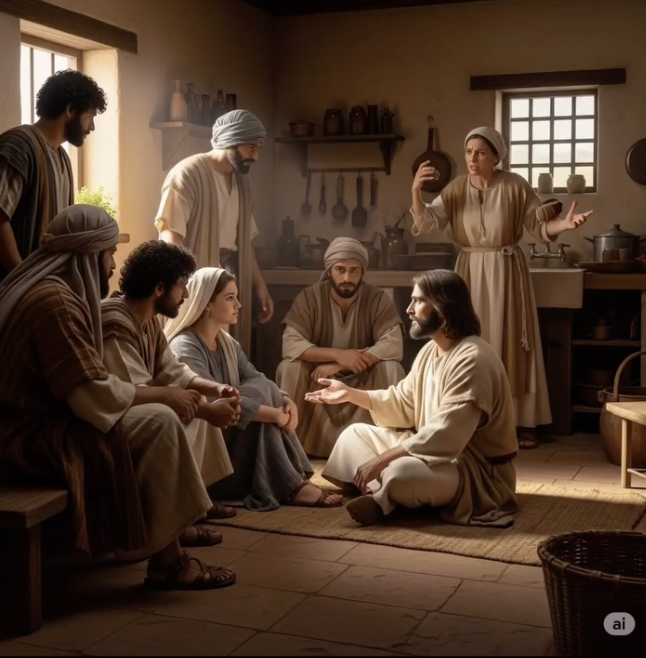
Have you ever felt overwhelmed trying to prepare a special meal for a dozen or more guests? Perhaps it was Christmas or Easter and you wanted everything to be just right. That was likely the case with Martha of Bethany. The story is just five verses in Luke chapter 10.

As Jesus and his disciples were on their way, he came to a village where a woman named Martha opened her home to him. She had a sister called Mary, who sat at the Lord’s feet listening to what he said. But Martha was distracted by all the preparations that had to be made. She came to him and asked, “Lord, don’t you care that my sister has left me to do the work by myself? Tell her to help me!”

“Martha, Martha,” the Lord answered, “you are worried and upset about many things, but few things are needed—or indeed only one. Mary has chosen what is better, and it will not be taken away from her.”

This wasn’t just any ordinary gathering. At the centre of the guests was Jesus himself. Martha knew Him as Messiah. She called Him Lord. No wonder she wanted everything to be perfect!

There’s a lot more going on here than meets the eye though, so let’s try to step into the story and look more closely at what’s happening. Luke doesn’t actually tell us that Martha was preparing a meal, although I think it’s safe to assume that she probably was. He simply says that she was “distracted by all the preparations that had to be made”. That could mean a lot of things. On occasion, Jesus was known to spend the night with Mary, Martha, and their brother Lazarus, so perhaps she was also preparing for overnight guests.

Keep in mind that this took place approximately 2000 years ago, in a time and place very different from our own. In order to correctly understand Scripture, it’s always important to be aware of the time, the place, and the culture that we’re reading about. In first-century Judea, there were no telephones. Martha likely had little or no warning that company was coming, no time to prepare in advance. In that time, cooking was a labor-intensive task. Meals were prepared from scratch using basic tools, locally sourced ingredients, and open-fire cooking. Martha didn’t have an instant pot, an air fryer, a microwave, or an electric oven. No wonder she was frazzled!

When this story is taught, I always feel bad for Martha. I think she often gets a bad rap. She was, in fact, doing exactly what would have been expected of her. In her culture, food preparation and serving in the home were exclusively the role the woman. Martha’s mistake was not in the work that she was doing, but in the fact that she allowed anxiety and frustration to steal her peace. Her mistake was in trying to be the perfect hostess instead of being present for her guests and especially in allowing her desire for perfection to rob her of time with Jesus.

I’m sure that most of us can identify with Martha. Like her, our lives are busy. We feel the weight of what needs to get done and there always seems to be more to do. In a culture that exalts multitasking and a “we-can-do-it-all” mentality, we too can become frustrated and overwhelmed. We get tangled up in our never ending to-do lists. Like Martha, it’s very easy for us to become “distracted” and “worried about many things”. Like her, we might find it hard to step away from the busyness of our lives to sit at the feet of Jesus.

So, what could Martha have done differently? What can we do differently? I don’t know what was on the menu at Martha’s house that day, but perhaps she was trying too hard. Perhaps she was going for perfection instead of good enough. Do we do that? Do you? Do we feel that our house has to look perfect before we can invite someone in? Do we plan an elaborate menu when our guests might be just as happy with a simple meal and a less stressed hostess?

We do know from both this story and other mentions of Martha in Scripture, that she was a close friend of Jesus. In fact, if she hadn’t been, I don’t think she would have spoken to Him the way she did. She was ticked off and she let Him know it! She was clearly angry with Mary for not helping her with the work that needed to be done, but I think she was also annoyed with Jesus for allowing it and she didn’t try to hide her feelings.

Perhaps in this way, Martha is a good example for us. Praying when we’re anxious, afraid, frustrated, or even angry with God is not only acceptable, it’s actually a good thing to do. Bringing our honest, raw emotions to Him is much healthier than bottling them up. Like Martha, it’s okay for us to say, “Lord, don’t you care?” God has all the time in the world to listen and He can handle our anger, our frustration, and our pain. Expressing those feelings is actually a sign that we truly trust Him with our full selves.

But what about Mary? Why wasn’t she helping her sister? It wasn’t unreasonable in that culture for Martha to expect Mary to be helping her serve their guests. In fact, that’s what everyone present would have expected of her; everyone except Jesus, that is.

Without understanding the cultural context, we might totally miss the significance of Mary sitting at the feet of Jesus. According to Jewish tradition, it was only men who would sit at the feet of a rabbi to learn from him. Sitting at his feet in this manner would identify a man as one of the rabbi’s disciples.

I don’t know about you, but I used to think of Martha as being the strong, dominant sister and Mary, the quiet, possibly subservient one, but that’s not actually the Mary we see here. She takes a bold and courageous stance when she chooses to join the men at Jesus’ feet. This would have been shocking to some and probably an embarrassment to her family. Mary, a woman in a male-dominated world, was breaking the social rules of her time. She was being totally counter-cultural.

In affirming her choice and telling Martha that Mary had chosen what was better, Jesus wasn’t just telling her to calm down or suggesting that she should come and sit at His feet with her sister. In a patriarchal society where men led and women followed, where men sat at the feet of a rabbi and women served, He was throwing a socially acceptable custom on its head. He was recognizing women as disciples and full-fledged members of the kingdom of God on equal footing with men.

Have you ever heard a message or read a devotional based on today’s story that asked, “Are you a Mary or a Martha?” Did it leave you feeling guilty because it seemed obvious that the answer should be that you’re a Mary, but in reality you know that you’re more like Martha, caught up in the busyness of serving others and finding it hard to make time for Jesus?

I’m here to tell you that that’s an unfair question! This isn’t an either-or situation. True disciples, male and female, are called to be both Mary and Martha, to sit and to serve, to have the heart of Mary and the hands of Martha. This story isn’t about “good vs. bad”. It’s about establishing right priorities. Mary wasn’t avoiding work, she was prioritizing presence.

So how do we do that? We can’t ignore the fact that Jesus told Martha that by sitting at His feet and listening to His teachings, Mary chose what was best, but how do we do that? That will be the topic of my next post, so I hope you’ll come back for more tomorrow!

I’m a Christian feminist

I’m a Christian feminist. Yes, there is such a thing and no, that f word isn’t an obscenity.

The label may not be a familiar one, but Christian feminism predates well known secular feminists and activists including Simone de Beauvoir, Betty Friedan, and Gloria Steinem. There is, in fact, a long history of Christian women devoting themselves to fighting for the status of women, and the right of women to vote, to own property, and to defend themselves in a court of law against rape and domestic abuse. Women like Nellie McClung who, based on her understanding of God’s intention for creation, together with Emily Murphy, Henrietta Muir Edwards, Irene Parlby and Louise McKinney, launched a legal challenge that would pave the way for women to be declared “persons” under law and to participate equally in all aspects of life in Canada. Thankfully, theirs is a rich tradition of pro-life feminism that continues today.

Within the Christian church, there are two schools of thought regarding the roles of men and women. Complementarians believe that men and women, though equal in worth, are meant to have distinctly different roles. Egalitarians, while agreeing that men and women are equal in worth, believe there should be no gender restrictions on what roles they can fulfill. Marriage and ministry are the primary points of disagreement between the two viewpoints.

When we first married, I was a baby Christian. I tried to be the submissive wife that my husband had been taught was his due simply because he was born with a Y chromosome and an extra appendage. It didn’t work. He wasn’t a good leader and, truth be told, I wasn’t a good follower. All the while, I wondered why God would want me to submit to a sinful man. Then I realized that He didn’t. We were meant to be partners, submitting to one another (Ephesians 5:21) with God as the head of our household.

But what about Ephesians 5:22-24 and Colossians 3:18, verses that exhort wives to submit to their husbands? We can’t simply ignore portions of scripture because they make us uncomfortable or dismiss the parts we don’t like. Sometimes we have to grapple with scripture. We have to understand the context and the time in which the words were written. We have to dig deep and seek to understand the principles being taught and then figure out how to apply them in our time and place.

“It’s dangerous to cherry-pick a few stand-alone verses, particularly when they are used as a weapon to silence and intimidate, effectively benching half the church… We can’t read letters written to specific people with specific situations in mind in a specific context and then apply them, broad-brush, to the whole of humanity or the church or even our own small selves.”  Sarah Bessey, Jesus Feminist

These select verses telling wives to submit to their husbands line up with the Greco-Roman household codes that were part of Pax Romana law at the time and in the place that the apostle Paul was writing his epistles. They were the law of the land at that time and, as in Romans 13:1-2, Paul is telling his readers that “everyone must submit himself to the governing authorities.”

Interestingly, just four verses after Colossians 3:18 instructs women to submit to their husbands, verse 22 tells slaves to obey their earthly masters. While wives must submit is a core teaching in most Christian churches today, no one takes that verse literally and suggests that slavery is actually a godly practice. I jokingly respond that if I have to submit to my husband, I also want my slave!

In addition to slavery, which is never actually prohibited in the Bible, the church has rightfully done away with many Biblical practices including polygamy, the buying and selling of daughters, stoning, the requirement that baby boys be circumcised, and many other ancient practices that were once culturally acceptable. Gender inequality is just one more example of an injustice that we need to let go of.

Nowhere in the Bible does it suggest that any of the gifts of the Spirt, which include teaching, pastoring, prophecy, evangelism and leadership (Romans 12, Ephesians 4, 1 Corinthians 12), are gender specific and yet many Christian churches today exclude women from these roles. Sadly, in spite of the fact that there are numerous examples of women leading, teaching, ministering, and prophesying in scripture, patriarchy is alive and well in many churches today. This is clearly contrary to Acts 2:18 which says “Even on my servants, both men and women, I will pour out my Spirit in those days, and they will prophesy.” Paul himself says in Galatians 3:28 “There is neither Jew nor Greek, slave nor free, male nor female, for you are all one in Christ Jesus.”

I served on the board of our previous church for seven years, but in our present church I would not be allowed to because I’m a woman. I’m okay with me not being on the board, but I’m not okay with half the church being denied full opportunity to use their God-given gifts simply by virtue of being female and I’m not okay with a church board not having the benefit of the female perspective. The very first chapter of the very first book of the Bible makes it abundantly clear that God created male and female in His image and gave THEM dominion over all that He had made.

According to Genesis, God did create Adam first, but He also said, “It is not good for the man to be alone. I will make a helper suitable for him.” The original word translated in English Bibles as helper or helpmeet is ezer, a word used twenty-one times in the Old Testament: twice in Genesis for the woman, three times for nations that Israel appealed to for military aid, and sixteen times for God Himself as Israel’s helper! God created His daughters to be ezers, strong and resourceful partners for His sons. He also makes it clear that in relationship, they are to become one. That’s partnership, not patriarchy! When a woman is held back, hushed up, minimized or lessened in any way, she is not free to walk in the fullness that God intended for her as His image bearer, His ezer.

“When half the church holds back – whether by choice or because we have no choice – everybody loses and our mission suffers setbacks.” Carolyn Custis James, Half the Church

So what do I make of 1 Corinthians 14:35 which says “If they want to inquire about something, they should ask their own husbands at home; for it is disgraceful for a woman to speak in the church.”? Again, if we were to delve into the historical context for this verse, we would find that it was written in direct response to disruptions that were occurring in the Corinthian church at that time. The underlying principle is not that women 2000 years later should be forbidden from speaking in church, but that a church service ought to be orderly, not chaotic, a topic that Paul actually begins to address at the beginning of chapter 11.

And what about 1 Timothy 2:12 “I do not permit a woman to teach or have authority over a man; she must be silent.”? Again, Paul’s restriction was given in the context of a personal letter to Timothy giving advice about a specific issue concerning false teaching that had arisen in the church at Ephesus. There is no suggestion that he was establishing church policy for all time. Neither is there any mention of this in the rest of Paul’s writings or elsewhere in the Bible. As has already been mentioned, there are clear examples elsewhere in scripture of women teaching, prophesying, and taking leadership roles.

So why do I, a Christian feminist, stay in a male-dominated church? First of all, there aren’t a lot of options in our small community. Fortunately, however, there are ways that I can use my spiritual gifts of teaching and faith within the confines of a patriarchal setting and I’ve always been comfortable worshipping with genuine believers who don’t see eye to eye with me on all matters. I also believe that God has placed me behind enemy lines, so to speak, for a reason. Though it likely won’t happen in my lifetime, I can pray for change and speak for justice for the women of the future. I may not be allowed to preach from the pulpit, which I don’t feel called to do anyway, but I can speak the truth, as I know it, when opportunity presents itself and I can certainly preach it from my keyboard!

For further reading on this topic, I highly recommend:

  1. Half the Church: Recapturing God’s Global Vision for Women, Carolyn Custis James
  2. Jesus Feminist: An Invitation to Revisit the Bible’s View of Women, Sarah Bessey
  3. The Making of Biblical Womanhood: How the Subjugation of Women Became Gospel Truth, Beth Allison Barr
  4. A Year of Biblical Womanhood, Rachel Held Evans

This is, of course, a controversial topic. I invite dialogue in the comment section, but I also insist that it remain a safe and respectful place for the expression of differing viewpoints and experiences.