Art to wear

LogoI grew up on the Pacific coast of Canada with a deep appreciation for the art of the Indigenous people of that area. Four years ago, I shared the story of the beautiful hummingbird ring made by Haisla artist, Hollie Bear Bartlett, that hubby gave me for Christmas.

This Christmas, I received some more wearable Pacific coast art!
IMG_3493

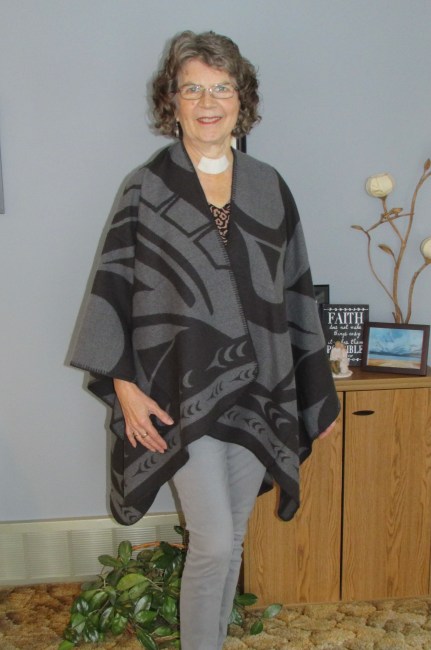
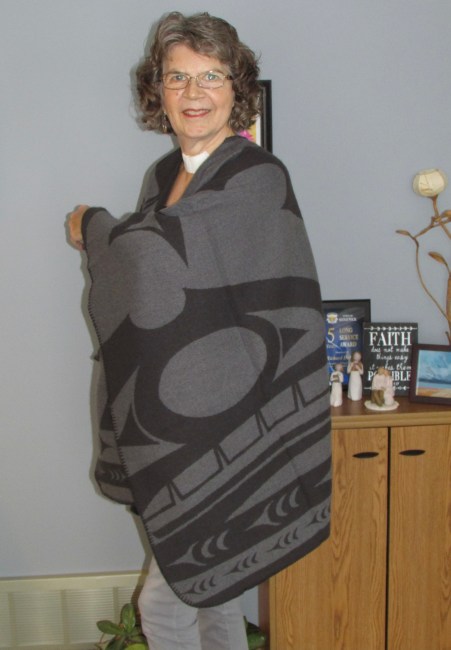
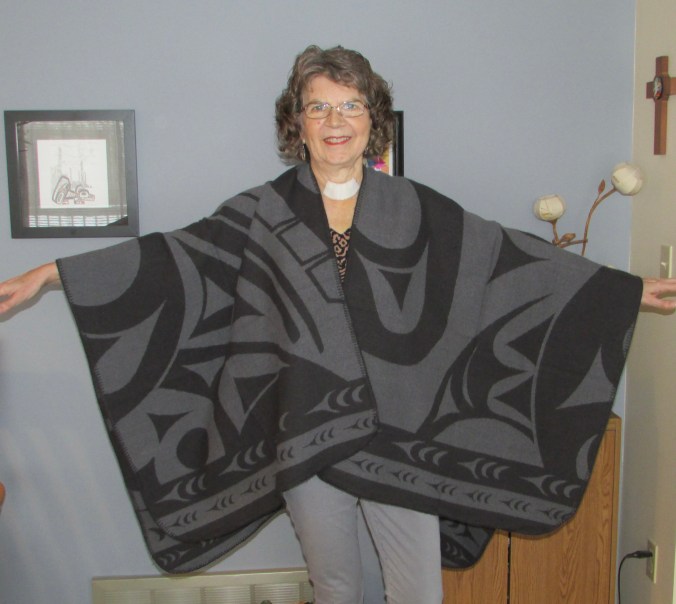
The cozy, reversible wrap, was a gift from the Vancouver branch of our family; our oldest son, his wife, and their two sons. A product of Native Northwest, it features the work of Coast Salish artist, Doug Horne. You can probably see the whale motif best in this photo. Look for the rounded head, the toothy mouth, and the blowhole on top.
IMG_3498

In the stories of the Northwest Coast, the killer whale, or orca, is associated with strength, dignity, prosperity, and longevity.

IMG_3503

100% of the art featured on Native Northwest products is designed by Indigenous artists and used with their consent. Artist names and cultural affiliations are acknowledged on all packaging and the artists are paid in fees and royalties.

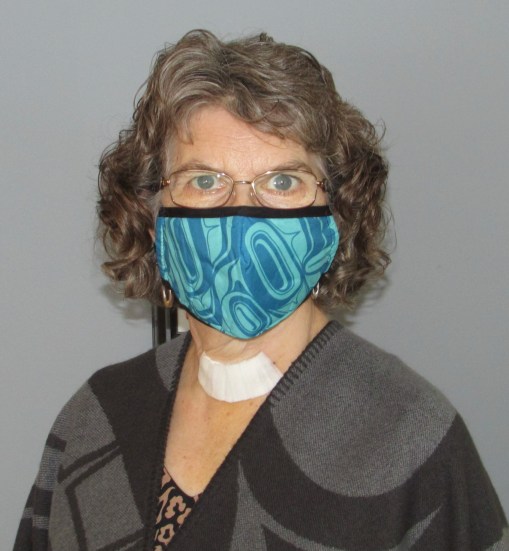
In addition to my beautiful wrap, hubby and I received two Native Northwest masks from another family member. Here, I’m wearing the eagle design by Haida artist, Roger Smith. Eagles are associated with guidance, hope, healing, and the pursuit of freedom.
IMG_3507

IMG_3509

You can easily see the tentacles on Ernest Swanson’s octopus on the mask on the right. Swanson comes from a long line of established Haida artists. The octopus is respected in the Northwest coast culture for its ability to adapt to change. The raven mask on the left, by well-known Tsimshian artist, Roy Henry Vickers, is one that I purchased when we were in Vancouver in October. It was produced by Oscardo, another company that partners with Canadian and Indigenous artists and pays royalties for each product sold. The raven is an important figure in Northwest coast art and mythology. Known as a trickster, he has the power to transform both himself and other beings. He can even change animate to inanimate, and vice versa. Hopefully, when I wear the mask, he transforms Covid into something harmless!
IMG_3495

Perhaps this is a good time to talk about the difference between cultural appropriation and cultural appreciation. Cultural appropriation involves adopting an element of another culture without respect for its meaning or significance or with the purpose of exploiting the culture for personal gain. Appreciation, on the other hand, involves a desire to learn about another culture in order to broaden one’s perspective and understanding. It also involves fair compensation and giving credit where credit is due. That’s why it’s so important to me to learn the meaning behind the symbols that appear on my wearable art and why I appreciate the fact that companies like Native Northwest and Oscardo credit the artists and pay royalties for their work.

If you’re interested in knowing more about the stories behind the symbols and creatures that appear in the art of the Pacific Northwest, the book Understanding Northwest Coast Art by Cheryl Shearar is an excellent resource.

Silver and gold!

LogoWhen I was young I wore only gold jewelry. I instinctively knew that it looked better on me than silver did. Sure enough, when I had my colours done in the 1980s, the analyst draped me in a gold metallic cloth and I glowed. Not so with silver. My skin had warm undertones and I was a Spring.

With the passage of time, however, I began to notice a change. As silver streaks began to appear in my hair, I realized that I could wear colours that I hadn’t been able to before, particularly black and white. I also began to add silver jewelry to my collection.

I particularly like pieces that combine both metals. I have several pairs of earrings and a favourite necklace that are part gold and part silver. I’ve always been especially thankful that the watch I received as a retirement gift from my employer is also both gold and silver as I wear it almost all the time.

IMG_5405

Until this Christmas, I wore three rings that I never take off (except when I’m undergoing medical scans that require me to remove all metal).  My engagement ring, my wedding ring, and my family ring are all gold. I’ve always thought that adding a silver ring would look odd, but my Christmas gift from my husband solved that problem! It’s both silver and gold!


IMG_5415

There’s a long story behind this beautiful and very unique ring. Last summer, we were wandering the shops in Jasper, Alberta with our oldest son and his family when I spotted a ring very similar to this one in Our Native Land, a gallery featuring authentic arts and crafts by Canada’s aboriginal artists. I fell in love with the concept; a wide band of sterling silver overlaid with a narrower band of 14kt yellow gold hand carved with a Northwest Coast motif. If you read my post about The Hazeltons last summer, you might remember how much I love the art and culture of the native peoples of the Pacific Northwest.

When our summer vacation was over, I couldn’t get that ring out of my mind. I began to do some research which soon led me to the website for Vancouver’s Douglas Reynolds Gallery. There I found a wide selection of wonderful rings including a couple of the style I had in mind. The website also referred to a book entitled Understanding Northwest Coast Art by Cheryl Shearar which is a detailed guide to the crests, beings and symbols used in Northwest Coast art. I had my local library bring it in and read it from cover to cover to help me decide what motif I wanted on my ring.

A Hummingbird Ring by Haisla artist, Hollie Bear Bartlett, was one of the ones that had caught my eye on the gallery website. The Haisla Nation are a subgroup of the Kwaguilth people, the group that I had focused on during my first anthropology course many years ago at the University of Calgary. According to Shearar’s book, the hummingbird isn’t traditionally a major motif in their art, but “it’s popularity today indicates that it has become a very important symbol of love and beauty.” Perfect!

I told Richard that this was what I wanted for Christmas, but the ring that was advertised wasn’t my size. He contacted the gallery to find out if it was available in other sizes and was told that they could have the artist make one in my size in time for Christmas. Even better! A ring made especially for me by the artist! Richard arranged to pick it up at the gallery on Dec. 23, the day after we planned to arrive in Vancouver for Christmas. By the time we arrived at the gallery, I was as excited as a little child waiting for Santa! After I tried it on, however, it went back in the box to be wrapped and placed under the tree at our son’s house until Christmas morn.

IMG_5410

The ring wasn’t the only piece of jewelry that I received for Christmas. Santa left this silver bangle in my stocking. I think he probably had some help from my daughter-in-law though! After all, she’s the wise young mom who tied a “courage bracelet” around her timid young son’s wrist to remind him that he could be brave and face whatever challenges come his way. My bracelet says “She believed she could, so she did” and I love it!

Please note: The individual ring photos are from the Douglas Reynolds Gallery website. The other photos are my own.


The Hazeltons

After six weeks in the trailer, we are home! Though it was our plan from the beginning to arrive home today, I really wasn’t ready to end our gypsy wandering and I would have happily extended our travels indefinitely. Real life issues beckoned, however, and so it seemed wise to follow through on our original plan. As much as I loved being away from home, I did miss having access to wifi and being able to update the blog on a regular basis. Now that I’m connected again, I’ll do my best to share the remainder of our travels with you over the next few days.

The Hazeltons, a collection of small communities, located around the confluence of the Skeena and Bulkley Rivers in northwestern British Columbia, have been home to the Gitxsan people for centuries. The Gitxsan are a matrilineal society made up of the Frog, Eagle, Wolf, and Fireweed clans. Though their territory is inland, their villages with intriguing names like Kispiox, Gitanmaax, and Hagwillget as well as Hazelton, New Hazelton, and South Hazelton, are a centre of Northwest Coast native culture and, as such, are a place that I’ve long dreamed of visiting. My love for the art and the culture of the native peoples of the Pacific Northwest began as a child growing up on the coast of British Columbia and grew as a student of anthropology during my university years.

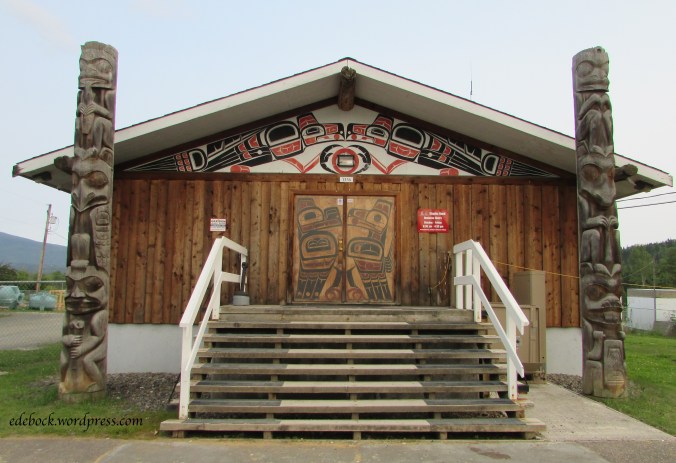
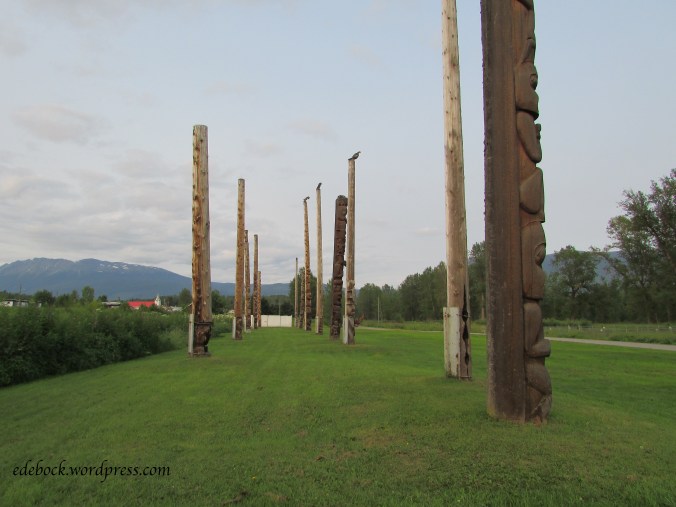
After settling into our campsite, we drove a few miles north to Kispiox, best known for the 15 totem poles, some dating back to 1880, that stand in the village alongside the Kispiox River. On the way into the village, we stopped to look at the art work decorating the band office.

IMG_4723

IMG_4732

IMG_4729

IMG_4733

IMG_4730

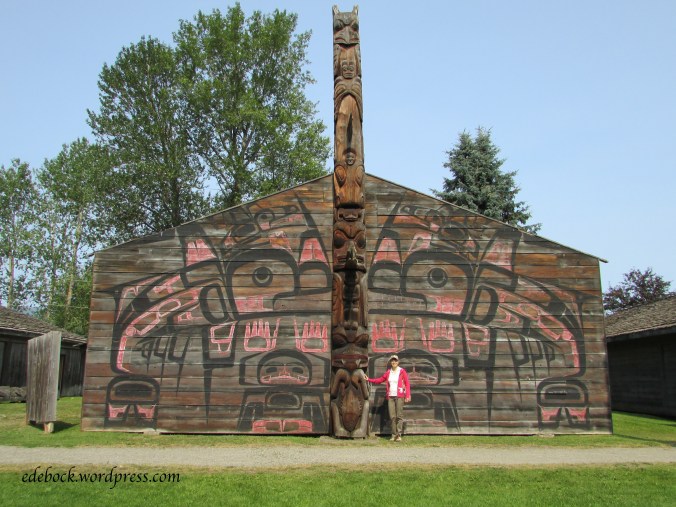
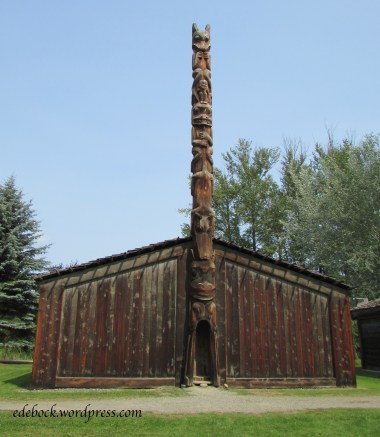
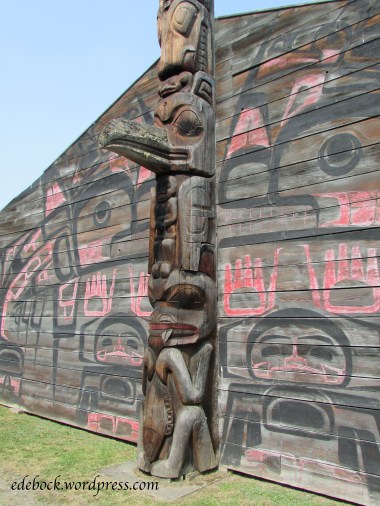
The following morning, we took a fascinating interpretive tour of the ‘Ksan Historical Village adjacent to our campground. It consists of seven replica cedar longhouses. One of the longhouses contains a small museum and a gift shop that are open to visitors who are also free to enjoy the grounds and photograph the buildings and totem poles. Only the guided tour, available in several languages, allows entrance into the three of the longhouses that contain an abundance of artifacts. The price is nominal and was well worth it! Aside from the Museum of Anthropology at the University of British Columbia in Vancouver, I have not seen such an extensive collection of Northwest Coast history anywhere! Unfortunately, photography was not allowed inside the longhouses, so I’m not able to share that part of the experience with you.

IMG_4774

IMG_4759

IMG_4763

IMG_4762

The small, narrow door in the last photo was designed to prevent enemies from entering in full armour.

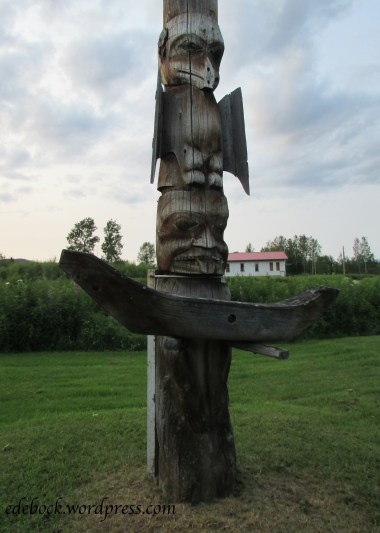
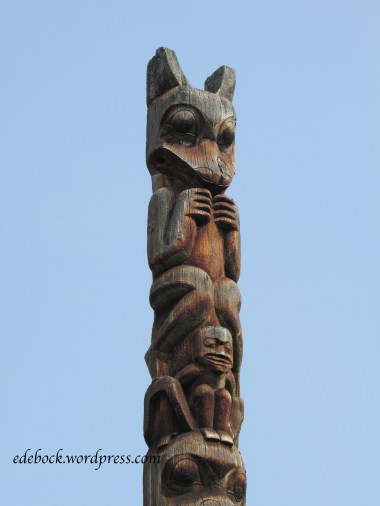
As always, the totem poles fascinated me. Here’s a closer look at a few of them.

IMG_4767

IMG_4776

IMG_4761

IMG_4760

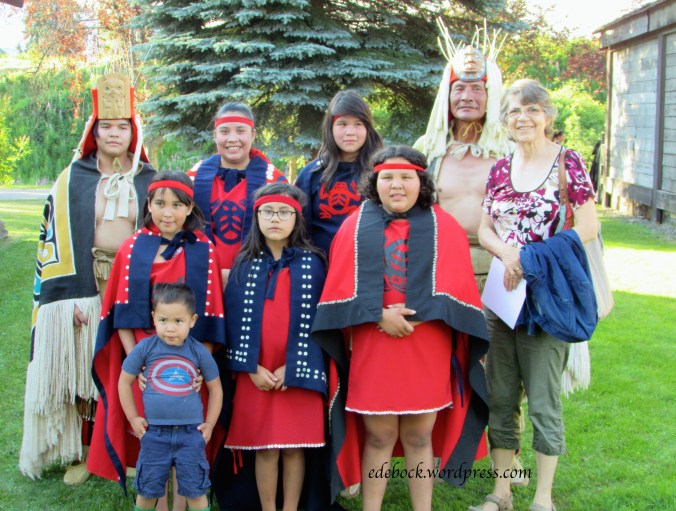
We were especially fortunate to be in the area on a Wednesday. Every Wednesday evening during the summer months, a local group offers a traditional song and dance presentation in the Wolf House, one of the historical village’s longhouses. Again, for a nominal fee, I was thrilled to have the unique opportunity to see and experience this aspect of the Northwest Coast culture. I was especially delighted to see that the group included all ages; that the traditional songs and dances are being passed on to the younger generations.

IMG_4799

As we explored the various villages that make up the Hazeltons, we were especially impressed with how welcoming the First Nations residents were. While we were strolling around the historical section of Old Hazelton a local woman stopped to chat and told us about an easy 10 minute hike from New Hazelton to a beautiful waterfall. Had she not been willing to share with us, we would never have known about it!

IMG_4792