and BACK!

109076967_4260609577313083_6399775725640299285_o

If you’ve been reading my blog recently, you already know that I’m participating in a fundraiser called HOOFING IT Across Canada. We, the Canadian neuroendocrine cancer (NETS) community, are working together in an effort to raise $100,000 for much needed neuroendocrine cancer research. Participants have been racking up as many kilometres as we can by walking, hiking, kayaking, swimming, cycling, roller-blading, or any other forward moving activity that we can think of and tracking our individual distances. Our original goal was to record 5,514 kilometres, the distance from Newfoundland and Labrador to the Yukon, but I am very proud to announce that in less than two weeks, we’ve already surpassed 4000 km! As a result, we have a brand new goal. We’re not just HOOFING IT Across Canada, we’re HOOFING IT Across Canada and BACK! That’s right! Our new goal is 11,028 km.

Personally, I’ve walked over 33 km since July 1st. While that’s a tiny fraction of the distance that’s been covered (it helps that we have some long distance cyclists and runners in the group), I’m one third of the way to reaching my personal goal of 100 km. At this rate, I may have to increase my goal too!

Of course, the main purpose of the HOOFING IT Across Canada campaign is to raise funds for research. Once rare, NETS is now the fastest growing class of cancers worldwide, accounting for approximately 2% of all cancers. We need to know why this is. We need safer and more effective methods to prevent, detect, diagnose, treat, and ultimately cure this disease. Research is the key to transforming and saving lives and research takes money.

HOOFING IT is the easy part. Asking people for money is more difficult, especially in today’s economy when many are facing financial hardship and don’t have extra to give. By last night, however, we had raised over $20,000 and were 20% of the way to meeting our goal. I’m extremely grateful to those who have made donations on my behalf. At $875, I’m almost 60% of the way to meeting my personal goal of $1500. If you would like to add to this amount, please click here to visit my fundraising page. No amount is too small. Every dollar brings us one step closer to finding the answers we’re looking for.

In the meantime, I’m off to the city tomorrow for CT scans to see if there’s been any change to my NETS tumours over the past six months. I won’t be meeting with the doctor and finding out the results until August 6, so I’ll try to provide an update after that.

106379562_10163650769870307_5736544973736533013_n

Walking in the rain

The past few days have been sunny and warm, just the way summer should be, but today has been mostly cool and cloudy again. I really didn’t feel like putting on my zebra stripes and going for a walk. Cancer’s a bit like that. I don’t only have it on days when I feel like it! I wake up with it every morning and I go to bed with it every night. These days, I’m not just walking because I want to. I’m walking to increase awareness of neuroendocrine cancer (NETS) and to raise funds for research.

As I walked, I thought about how fortunate I am to be able to do this. I don’t live where I’m able to attend support group meetings nor do I really feel that I need them, but I am part of several online groups for patients and caregivers. Every day I hear from people whose NETS stories are so much worse than mine. I walk for them as well as for myself. I walk in memory of those we’ve lost and I walk for those who will be diagnosed with this increasingly common type of cancer in the future. I walk in hope that money for research will eventually result in a cure.

I was walking in the exact opposite corner of our small town when it started to rain! (I think I need to find a zebra striped umbrella.) There was no way that I could suddenly transport myself back to the comfort of my warm, dry house. I had to keep walking. Cancer’s like that too. When you’re diagnosed, you suddenly find yourself a long way outside your comfort zone and there’s no going back. I treat my life with cancer a lot like a walk. I just keep putting one foot in front of the other and moving forward. I refuse to stand around in the rain feeling sorry for myself!

When I walk through the corridors of the cancer clinic as I’ll do again later this month, I can’t help feeling like I don’t really belong there. I look and feel so well compared to most of the people around me. It’s called “survivor’s guilt” and it’s common to those of us who have or are surviving cancer. We can’t help asking “why them?” and “why not me?” I only know that when all this started, God promised to take care of me and, while it hasn’t always been smooth sailing, He’s been doing a great job of it ever since. So here I am, feeling strong and able to HOOF IT Across Canada!

Since the campaign started on July 1, I’ve logged 12.96 kilometres. Reaching my goal of 100 km by September 7 should be no problem, but far more important is the money that I raise for NETS cancer research. As a Canada-wide community, we hope to raise $100,000. I set my personal goal at $1500 and at $550, I’m 36% of the way! Thank you so very much to those of you who have already donated. I’ll try not to bore you with too many updates! For those who haven’t donated yet and who would like to, you can find my personal fundraising page here.

287226b0-bda3-11ea-a9f0-2d2856e5b296

It’s Canada Day and Day 1 of HOOFING IT Across Canada!

a-canadian-zebra-mens-premium-t-shirt

Today is Canada Day, the 153rd anniversary of our country’s birth as a nation. It’s also Day 1 of the HOOFING IT Across Canada fundraising campaign for neuroendocrine cancer research. Today I begin counting the kilometres that I walk and/or hike between now and September 7th. Joining with participants from the neuroendocrine cancer (NETS) community across the country, we hope to record 5,514 kilometres, the distance from Newfoundland and Labrador to the Yukon! We also hope to raise $100,000!

I’m very grateful to those who made donations following Saturday’s post. Thanks to their generosity, I’ve already raised slightly more than 20% of my goal. There’s still a long way to go though!

If you haven’t already, I hope that you’ll consider going to my fundraising page and making a donation. No amount is too small! Every cent received will go toward neuroendocrine cancer research and hopefully bring us closer to understanding what causes this disease and to ultimately finding a cure.

I’ve been asked several questions regarding making a donation, so I’ll answer those here:

  1. What methods of payment are accepted?  You can make your donation using a credit card (VISA, MasterCard or American Express), PayPal, or a CanadaHelps gift card. 
  2. Can I donate from outside Canada?  Yes! Absolutely! Research conducted in Canada will benefit patients around the world. Many of my readers live in the US or elsewhere and some have already made donations. Your credit card statement will automatically show the value of your donation in your local currency.
  3. Will I receive a tax receipt?  Again, the answer is yes. When you make a donation, you’ll be asked for your email address and a tax receipt will be sent to that address immediately. Only Canadian tax receipts are issued however, so if you’re donating from elsewhere, you might want to check your country’s income tax policies to see whether or not you can use a Canadian tax receipt when you file your tax return.
  4. Can my business make a donation?  Yes. Simply select the “Corporate/Group” option under Donor Type when filling out the Donor and Tax Receipt Information section.

I hope that helps. If you have any other questions, please let me know and I’ll do my best to answer them. In the meantime, I’m off to watch a Canada Day parade later this morning and then it’s time to start walking!

HOOFING IT Across Canada!

Screen Shot 2020-06-26 at 8.57.55 AM

Today I’m super excited to share something that’s very close to my heart and to give you an opportunity to participate!

It’s almost 7 years since I was diagnosed with neuroendocrine cancer (NETS). Once the shock of learning that I had a cancer that I’d never heard of and that I’d be living with it for the rest of my life wore off, it became important to me to do what I could to help raise awareness of this little known disease and to support fundraising efforts for research, better treatments, and patient support. That’s why I’m going to be HOOFING IT Across Canada with CNETS Canada!

Between July 1st and September 7th, the Canadian neuroendocrine cancer community will be working together in an effort to raise $100,000 for neuroendocrine cancer research! Participants will rack up as many kilometres as they can by walking, hiking, kayaking, swimming, cycling, roller-blading, or any other forward moving activity that they can think of and tracking their individual distances. Together, we aim to record 5,514 kilometres, the distance from Newfoundland and Labrador to the Yukon! In the days of Covid-19, the beauty of this is that we can each participate in our own community while practicing appropriate social distancing.

My goal during this campaign is to walk and/or hike 100 kilometres and to raise a minimum of $1500. That’s where you come in! I’m hoping that I can persuade you to visit my fundraising page here and make a donation. No amount is too small! Every cent that is received by CNETS will be directed to neuroendocrine cancer research. We need to know what causes this disease and we need to find a cure!

If you’re in Sedgewick, you’ll probably see me walking around town or out on the walking path wearing my zebra stripes and from time to time I’ll post updates here on the blog.

IMG_0060 - Version 3

Please make a donation!

Celebrating survival!

2020-logo-color_New

Today, the first Sunday of June, is National Cancer Survivors Day, an annual, worldwide celebration of life set aside to honour the millions of people worldwide who are living with and beyond cancer and to raise awareness of the challenges that they face.

Major advances in cancer prevention, early detection, and treatment have resulted in longer survival, but a cancer diagnosis can leave a host of problems in its wake. Physical, financial, and emotional hardships often persist for years after diagnosis and treatment. Depending on where they live, survivors often contend with rapidly rising drug costs, inadequate insurance coverage, difficulty finding or keeping employment, and a lack of understanding from family and friends. Despite these difficulties, cancer survivors can live active, productive, inspiring lives.

So what is a survivor? To many, the term ‘cancer survivor’ suggests a person who has beaten their cancer; perhaps one who has been cancer free for several years, but I like the definition used by the National Cancer Survivors Day Foundation. “A ‘survivor’ is anyone living with a history of cancer – from the moment of diagnosis through the remainder of life.”

In other words, I am a survivor! In fact, I’m a three times survivor.

hello-im-a-survivor

I live with cancer every day. Unless a cure is found for neuroendocrine cancer (NETS) within my lifetime or God performs a miracle on my behalf, I will never be cancer free. People have a hard time grasping the idea of a chronic cancer. The usual assumption is that patients either die of their disease or they are cured, thereby becoming cancer survivors, but I look at my situation differently. I may eventually die of my cancer or I may die with it, but either way, I am a survivor! Fortunately my NETS is stable at this point and it doesn’t significantly impact my day to day life. I’ve had all the PRRT treatments that I can have, but a monthly injection given here in my home by a visiting nurse seems to be keeping things under control. I had my 87th of these “butt darts” just over a week ago.

I’m also a cancer survivor in the more tradition sense, as in one who had the disease, but is now free of it. As many of you know, seven months after my NETS diagnosis, I was diagnosed with a second, completely unrelated cancer that was removed surgically. Six weeks of radiation followed and, since that time, there has been no recurrence.

Cancer number three, most likely caused by the radiation that I received for the other two, was discovered in my thyroid almost exactly a year ago. Though it’s not a particularly aggressive form of cancer, it’s the one that concerns me the most right now. I was supposed to see my specialist two months ago and have an ultrasound to determine whether or not the cancer is growing. Thanks to Covid-19, that didn’t happen and it’s been eight months since my thyroid was last looked at. Though my specialist still isn’t seeing patients except in emergency situations, I decided to do a bit of self-advocating and his office is now in the process of trying to arrange for me to have an ultrasound done in a hospital closer to home in a small city that has only had one Covid-19 patient.

Yes, in spite of all this, I am a survivor! Survivors are people from all walks of life, of all ethnicities and income levels. They’re children, moms, dads, and grandparents. They may be your coworkers, friends, and loved ones. Traditionally, National Cancer Survivors Day celebrations have included parades, carnivals, health fairs, awareness walks, candle-lighting ceremonies, and other community events. This year, due to Covid-19 restrictions, the celebrations may be somewhat more subdued, but life with and after cancer goes on and it ought to be about more than just surviving. It ought to be about living well and that’s always something to celebrate!


What’s my risk factor?

Before I even begin this post, especially for those who haven’t been here before, let me emphasize that I have absolutely no medical training. I am simply a neuroendocrine cancer (NETS) patient seeking answers and doing the best I can to weather the very unusual days that we all find ourselves in.

Screen Shot 2020-03-21 at 7.17.10 PM

Does my cancer and the PRRT treatments that I’ve received mean that I’m at higher risk of contracting COVID-19 than the general population? Not as far as I know. The reality, as I understand it, is that no one has immunity to this virus. It’s a brand new disease that our bodies have never encountered before; never had an opportunity to develop antibodies to. That’s why I’m doing what I think everyone should be doing. I’m not hiding out in fear, but I’m hunkering down at home and only going out for necessities such as food and medications.

When we hear about those people who are most vulnerable to COVID-19, this refers to those who may be at higher risk for more serious complications IF they contract the disease. That’s why it’s so important for all of us to do our part in helping prevent these populations from getting the COVID-19 virus in the first place. Am I one of the vulnerable ones? Certainly, my age puts me at higher risk than those who are younger, but I haven’t been able to find any information regarding NETS and COVID-19. In reality, such information probably doesn’t exist. At least, not yet.

So, what are those risk factors? 

  • An older adult  –  Recent figures show that more than 50% of the patients who have been admitted to an ICU with the disease and 80% of those who have died were over the age of 65. At 67, I’m at the low end of that population, but still within the high risk category.
  • People who have serious underlying medical conditions such as:
    • Heart disease  –  Not me!
    • Diabetes  –  I have been diagnosed as pre diabetic, but maintaining a careful, well disciplined diet has kept my blood sugar well regulated, so I doubt that this would put me at high risk.
    • High blood pressure  –  Experts indicate that if a person’s blood pressure is under control and they don’t have other risk factors, they probably aren’t at any greater peril than the general population. I’ve been on hypertension medication for several years and it’s been keeping my blood pressure under control but, of course, I do have other risk factors.
    • Chronic respiratory diseases  –  No again!
    • Cancer  –  This one raises lots of questions for me. Cancer is such a broad category. The word actually refers to any of the 200 different diseases, affecting many parts of the body, that are characterized by the uncontrolled growth of cells that invade and damage the body’s normal tissues. Do all of them put a person at higher risk for COVID-19 complications? I doubt it, but what about the 3 completely unrelated cancers that I’ve been diagnosed with since August 2013? That’s right, 3! As I mentioned above, I haven’t been able to find any information about NETS and COVID-19, but what about my untreated thyroid cancer? At present, there has been no indication that thyroid conditions place a person at jeopardy.
  • People who have a compromised immune system from a medical condition or treatment (e.g. chemotherapy)  –  In spite of having or having had 3 different cancers over the past 6 1/2 years, I’ve never had chemotherapy, but I haven’t been able to find any information on how PRRT affects the immune system, so once again, I’m left with questions.

The immune system is the body’s natural defence system. Unfortunately, there isn’t a simple questionnaire that will tell you how strong yours is. There are, however, several signs that you might have a weakened immune system:

  • Stress  –  Stress decreases the body’s lymphocytes, the white blood cells that help fight off infection. Thankfully, my life is relatively free of stress these days. For the most part, I think I can say with the apostle Paul, “I have learned to be content whatever the circumstances.”  Philippians 4:11b
  • Frequent colds or infections  –  I’ve had two colds this winter; one mild and one nasty. That’s more than I usually get, but I recovered from both in a reasonable length of time and I don’t remember the last time I’ve needed an antibiotic for an infection.
  • Frequent diarrhea or constipation  –  Diarrhea was one of the most obvious symptoms of my NETS cancer before it was diagnosed. Now medications tend to cause the opposite problem, but I can’t blame that on my immune system.
  • Wounds are slow to heal  –  I don’t think so. I haven’t had any serious wounds in recent years, but minor ones heal just fine.
  • Fatigue  –  When your immune system struggles, so does your energy level, but for the most part mine is good. My father passed away in the wee hours of March 1. I got almost no sleep that night and I definitely discovered that pulling an all-nighter in my 60s isn’t as easy as it was in my 20s! The week that followed was pretty exhausting too, but three weeks later, I’ve bounced back and feel completely rested. That seems to speak well of my immune system.

I do know, however, from regular blood tests, that my hemoglobin tends to be slightly on the low side which would make me somewhat vulnerable to infection and disease. On the other hand, I do all the right things to keep my immune system as healthy as I can. I don’t smoke, I eat a healthy diet, I maintain a healthy weight, I exercise regularly, I drink alcohol only in moderation, I get adequate sleep, I try to minimize stress, and I even wash my hands frequently!

So, what is my risk factor? I can only give a somewhat educated guess. Since I live in a sparsely populated area and I’m staying home most of the time, I’d say that my risk of getting COVID-19 is quite low. On the other hand, IF I do get it, my risk of suffering complications is probably moderately high.

Am I worried? No, but I’m definitely taking all the recommended precautions. I hope you are too!

Fine, thanks!

It’s been quite awhile since I posted an update about my health. That’s because there really hasn’t been anything new to report. For someone with two kinds of cancer, that’s actually a very good thing, but I know that there are those of you who want to know what’s going on, so here’s the latest.

It’s already been over six months since I had my final PRRT treatment. Other than monthly injections of Sandostatin that are mainly meant to control symptoms, I’m not presently receiving any treatment for my neuroendocrine tumours (NETs). That’s a bit disconcerting, especially when more than one fellow zebra that I’ve come to recognize through a Facebook support group has succumbed to the disease in recent months. It’s really hard when one of those announcements shows up in my news feed.

On the other hand, I’m feeling 100% healthy, so most days it’s easy to ignore the fact that there are things lurking inside me that shouldn’t be there and that could begin to grow or spread at any time. I’m blessed to be able to live a full and productive life. I’m lifting weights again this winter and I’ve recently dusted off the treadmill and started using it again. If anything, I’m feeling better and stronger than I did six months ago.

A week before Christmas, I was in Edmonton for CT scans and blood work to find out if I’m really as healthy as I feel and yesterday we met with the doctor to get the results. Sometimes I suffer from a few days of scanxiety before an appointment like this one, but this time I felt completely at ease. I just kept reminding myself that God promised to take care of me over six years ago when I was first diagnosed and He has been faithfully doing that ever since. There’s no better place for me to be than in His hands.

When we sat down with the doctor yesterday all I really needed to hear was one word. Stable! Nothing has changed. No growth, no spread! Nothing to worry about. So, unless I begin to experience symptoms (which I haven’t since treatment began), we go through the same routine six months from now and hopefully receive the same good news again… and again… and again.

The CT scans reveal very little about my thyroid cancer which is entirely different and unrelated to my NETs. For news about that one I’ll have to wait until early April when I see that doctor again and he uses ultrasound to take a closer look and measure whether or not there’s been any change.

In the meantime, when you see me and ask, “How are you?” if I answer, “Fine, thanks!” that’s because I really am!

174103009.1

Canada’s going black and white for NET Cancer Day!

November 10 is World NET Cancer Day, a day set aside to raise awareness of neuroendocrine cancer, the uncommon disease that I’ve been fighting for the past six years. It’s our day to be heard by decision makers, health professionals and the general public. In addition to raising awareness, we want to encourage more funds for research, treatments, and patient support; and to advocate for equal access to care and treatment for NETS patients around the world.

ncd-logo-new

Zebra stripes symbolize how this rare cancer can go undetected for many years. Medical students are taught when hearing hoofbeats, to think of horses, not zebras. Neuroendocrine tumours are difficult to diagnose. Though they are the fastest growing class of cancers worldwide, their symptoms are usually vague and similar to more common health problems.  Many family doctors have never encountered a NETs patient. When presented with symptoms like stomach pain and diarrhea, they naturally think of things like Irritable Bowel Syndrome, Crohn’s Disease or lactose intolerance. They think of horses, not zebras. As a result, NETs is frequently misdiagnosed.

unnamed

It would appear, however, that through the tireless efforts of NETs patients and advocates, we’re beginning to be heard. This year on November 10, the following landmarks across Canada are lighting up in black and white for NET Cancer Day!

  • City Hall  –  Vancouver, British Columbia
  • High Level Bridge  –  Edmonton, Alberta
  • Calgary Tower  –  Calgary, Alberta
  • City Hall  –  Lethbridge, Alberta
  • CN Tower  –  Toronto, Ontario
  • City Hall Towers  –  Toronto, Ontario
  • Niagara Falls  –  Niagara Falls, Ontario
  • Hamilton Signature Sign  –  Hamilton, Ontario
  • Tower of Olympic Stadium (Parc Olympique)  –  Montreal, Quebec

If you’re near one of these locations on Sunday, I hope you’ll stop, take a photo, and post it on social media with the hashtag #LetsTalkAboutNETs @cnetscanada. Every bit of exposure helps raise awareness and may contribute to someone getting a quicker diagnosis.


Crazy (old) sock lady

LogoI’m a long-legged 5’8″ tall. For much of my life I worried about finding pants that were long enough to ensure that my socks didn’t show. Then along came ankle length cropped pants. Suddenly everyone’s ankles were showing. It took me awhile to warm up to the trend, but it really has made life easier for me.

I usually wear white sports socks with my jeans and other casual pants and black socks when I want a somewhat dressier look, but when I was cleaning out my drawers recently I realized that I’ve gradually accumulated a fairly sizeable collection of patterned socks. There are certainly much more colourful and fanciful pairs available, usually worn by gals who are several decades younger than me, but once in awhile it’s fun to look down and see something funkier than plain old black or white.

Some of my patterned socks, like these two weather themed pairs, are quite subtle. I’ve obviously worn the snowflake ones on the left a lot as they’re almost worn out. You can begin to see my gold toenail polish shining through!

These are definitely bolder! Both pairs were gifts from my daughter-in-law. There’s a story behind the zebra print pair on the left that make them very special to me. Robin is a long distance cyclist. She rides with a club that expects members to be able to ride at a minimum speed of 23 km/hr for at least 50 km and has taken part in many longer races and fundraising rides. If you’ve been reading my blog for very long, you know that I have neuroendocrine cancer (NETS) and that the zebra is our symbol. Robin wore the zebra socks for the first leg of a 2 day fundraising ride for cancer and then gave them to me (freshly washed, of course!)

IMG_0302

While zebra stripes hold special significance to me as a NETS patient, the giant panda is my favourite animal. Apparently Santa Claus knows that as this pair was in my Christmas stocking last year.

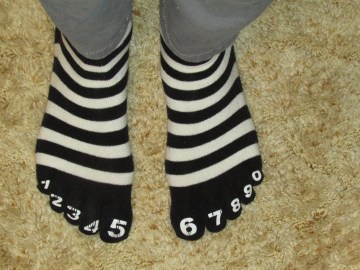
When we lived in Japan, I discovered that I love wearing toe socks which are very popular there. I brought several pairs home with me. I don’t wear them very often only because they’re a bit of a bother to put on, but once on they’re warm and comfortable. We were in Japan to teach English and I specifically bought this pair to wear to my Saturday morning preschool classes. Teachers and students alike take their shoes off before entering the classroom, so these were perfect for my little ones who were learning to count in English. They loved them!

IMG_0303

I didn’t realize until I started preparing for this post that almost all my patterned socks are in shades of black, white, and grey. Clearly, if I’m going to become a crazy (old) sock lady, I’ll have to invest in some coloured ones!

What about you? Do you wear patterned or brightly coloured socks? Would you?

Zebra stripes, more than just a fashion trend

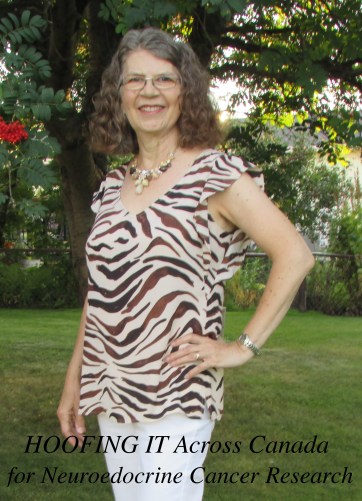
LogoIn August 2013, I was diagnosed with neuroendocrine cancer (NETS). In August of this year, I attended a cabi party and treated myself to a zebra print top from the Fall 2019 Uniquely Us Collection. Those might seem like two completely unrelated random facts, but they aren’t.

IMG_0060

The zebra is the symbol of neuroendocrine cancer. Neuroendocrine tumours are difficult to diagnose. The symptoms are usually vague and similar to more common health problems. Many family doctors have never encountered a NETS patient. When presented with symptoms like stomach pain and diarrhea, they naturally think of things like Irritable Bowel Syndrome, Crohn’s Disease or lactose intolerance. Flushing, especially in women of a certain age, makes them think menopause, not cancer. Medical students are taught “when hearing hoofbeats, think of horses, not zebras.” Neuroendocrine tumours are rare and therefore they are considered to be zebras.

Some NETS patients and advocates think the zebra symbol is foolish, that it trivializes the grave nature of our disease, and would like to see us stop using it. I disagree. I think we need to take advantage of every opportunity to draw attention to our cause and if that includes zebra stripes, I’m all for it!

Since my diagnosis, I’ve noticed zebra stripes everywhere! As I mentioned in last Friday’s post on trends for fall 2019, the zebra motif is particularly popular this season, but animal prints never go out of style and the zebra has been around for a long time. I’ve seen zebra t-shirts, zebra leggings, zebra jeans, zebra pjs, and zebra bras. I’ve also seen zebra handbags, zebra luggage, and even a zebra golf bag.

I remember trying on a darling zebra dress a couple of years ago, but I didn’t buy it. Like most zebra garments, its stark black and white pattern wasn’t flattering on me. With my pale Spring complexion, I look better in warmer tones. That’s why my new cabi top is so perfect. With its creamy vanilla background and chocolate ganache stripes (doesn’t that sound yummy?) it’s perfect for me.

With soft flutter sleeves, the top is a good stand alone piece for the occasional warm summery day that we enjoy at this time of year, but worn under sweaters and jackets, it will transition well into fall and winter. When worn alone, underarm insets provide good armhole coverage. While the neckline isn’t immodestly low, it leaves enough décolletage exposed to nicely frame a statement necklace. The top looks great tucked in, worn loose, or belted.

IMG_0086

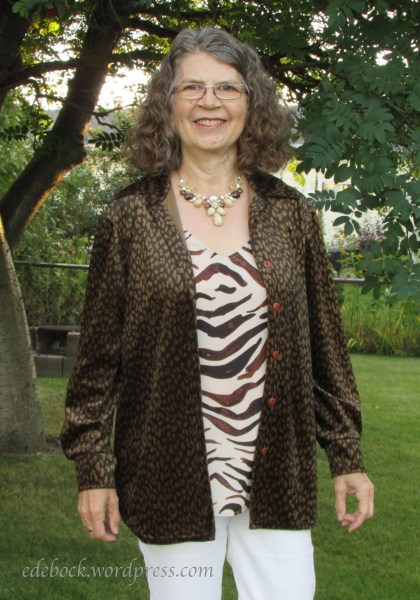
I even tried mixing animal prints. Because both prints are within the same colour family, I think it works!

IMG_0102

For today’s photo shoot, I wore my DIY frayed white jeans. Later in the season, I’ll pair the zebra top with darker pants or skirt, but obviously I don’t adhere to the antiquated don’t wear white after Labour Day rule!

And what am I wearing on my feet, you ask? A pair of flip flops that I bought for $5 at Walmart’s end of season clearance sale. They perfectly match my golden summertime toes!

IMG_0115