Fighting the third enemy

On February 7, shortly before our trip to Mexico, I had routine PET and CT scans to check on my neuroendocrine tumours (NETS). Diagnosed in September 2013, they are Enemy #1. NETS is a little known, slow growing cancer that’s usually considered incurable. Fortunately, in my case, treatment has been successful in shrinking the tumours and controlling the symptoms related to the hormones that they produce. For the most part, I feel 100% healthy and I’m able to lead a normal life.

Enemy #2 was a second completely unrelated cancer discovered in one of my salivary glands in March 2014. After seven hours of surgery and six weeks of radiation it was gone.

So what is Enemy #3?

Fear is not usually part of my vocabulary. I’ve placed my life in the hands of the creator of the universe and I trust Him completely. For the most part, I’ve held onto His promises to take care of me and I’ve experienced great peace, but there is an adversary who does his best to shake that confidence. He, or at least the anxiety that he instills, is Enemy #3.

Anxiety often begins as a little thing, but it feeds on itself. That’s what happened to me over the past couple of months and by this morning, when the phone finally rang to give me the results of last month’s scans, I was approaching a full-blown case of scanxiety.

When you have or have had cancer, it’s easy to start second guessing every ache or twinge and wondering if it’s related, if it’s a sign that something’s going wrong. That’s what happened this time. Back in January, I had a cold. It wasn’t even a particularly bad cold. It started in my sinuses, moved briefly into my ears and then settled in the lymph nodes in my neck. I knew that that’s a pretty normal scenario and that it can take awhile for the swelling and discomfort to dissipate, but I began to worry. When I’m stressed or anxious, I carry the tension in my jaw, neck and shoulders. I’m sure that that didn’t help. Add to that the fact that even almost three years after surgery, nerve damage to my face and neck is still gradually repairing itself. Sensations are constantly changing and feeling is returning where only numbness has been. I don’t even know what my neck is supposed to feel like anymore! Foolishly, I started wondering if maybe I was actually experiencing a recurrence of Enemy #2. Logically, I knew that that wasn’t the case, but Enemy #3 is insidious, sneaking doubts in where they don’t belong.

Then came Mexico. I relaxed, had a wonderful time and forgot all about my neck! On the way home, we spent a couple of days with grandchildren. The two year old, who attaches himself to me like velcro, had a nasty cold. Not surprisingly, I started to experience minor cold symptoms again and with them came a recurrence of the swelling in my neck. Enemy #3 started to poke and prod again.

Long story short, however, this morning’s phone call brought good news. Enemy #1 is still entirely stable. There’s been no growth or spread of my neuroendocrine tumours. Better yet, there’s absolutely no sign of Enemy #2; nothing unusual growing in my neck!

What a relief! Regardless of how weird my neck might feel, I can get on with living life. I will continue hanging on and not let Enemy #3 overcome me!


Not so rare after all!

November 10 was worldwide NET Cancer Day. In addition to writing my Let’s talk about NETS post, I read several other articles about neuroendocrine cancer that day and what I learned was quite astonishing.

When I was diagnosed with neuroendocrine cancer (NETS), I was told that it was rare and much of the literature about it seems to agree, but is it really? Is it actually rare, or is it just not very well-known?

You’ve heard of cystic fibrosis, right? And what about ALS (Amyotrophic lateral sclerosis), often called Lou Gehrig’s disease after a hall-of-fame baseball player for the New York Yankees who was diagnosed with ALS in the 1930s? If you hadn’t already heard of that one, I suspect that the famous Ice Bucket Challenge of July and August 2014 brought it to your attention. Unless you’re a fellow patient, however, I’m guessing that you’d never heard of NETS before you read about it here on my blog, but is that because it’s rare?

Let’s take a look at some statistics. I’m using numbers for the United States simply because they were the easiest ones to track down, but I’m assuming that the ratio would be similar elsewhere. In the US, there are

  • approximately 1000 new cases of cystic fibrosis each year
  • a little over 6000 new cases of ALS each year
  • an estimated 15 500 new cases of NETS each year

Do the math! That’s more than 15 times as many cases of neuroendocrine cancer as cystic fibrosis and more than twice as many cases as ALS! It’s also an average of more than 42 new cases a day or more than one every two hours!

So why is NETS not nearly as well-known as the other two diseases and why does that matter? It matters because doctors don’t detect what they don’t suspect and they don’t suspect NETS if they don’t know anything about it. Secondly, more research dollars go to higher profile diseases. According to the US Department of Health and Human Services, $49 million was spent on ALS research in the US in 2015 and $80 million on cystic fibrosis, but NETS wasn’t even on the report!

nets

I know you’d probably rather read about my travels or my Fashion Friday posts and they’re definitely more fun to write, but unfortunately, it falls upon patients like me to publicize and educate whenever and however we can. It might be easier if we had a Lou Gehrig, someone well-known to put a face to our disease, but that hasn’t happened yet. Our best hope so far was Steve Jobs, co-founder and former CEO of Apple Inc, but Jobs initially chose to reject his doctors’ recommendations and try alternative treatments, a decision that may have hastened his death in 2011. He was also very private about his condition which was, of course, his right, but he could have done so much good had he chosen to be a vocal spokesperson. The fact that the media, left in the dark by his silence, commonly reported that he died of pancreatic cancer rather than neuroendocrine cancer that originated in his pancreas, didn’t help our cause either.

Increasing awareness is a slow process, but I believe we’re making headway. In spite of the fact that it’s still not well-known, NETS is actually the fastest growing class of cancer worldwide! I believe that that’s because it’s being diagnosed more often and because improved treatments are allowing many of us to live longer. Our goal continues to be to raise awareness in both the medical field and the general public, so that research funds are made available that will lead to even earlier diagnosis and better treatment. It’s time for NETS to come out of the dark!

Let’s talk about NETS

letstalkaboutnetscartoon-1200x595

12,000 to 15,000 Canadians are estimated to have a rare cancer called neuroendocrine tumours (NETS). I am one of them. Today is the day for our voices to rise above those of all the more well known and prominent diagnoses and be heard.

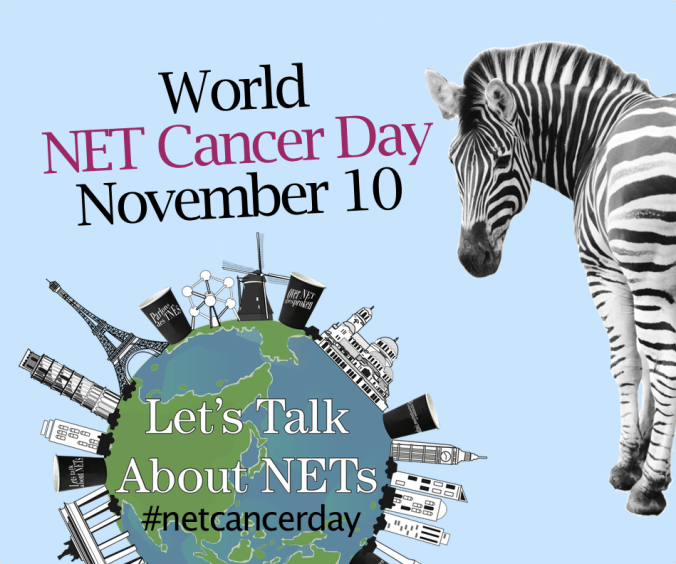
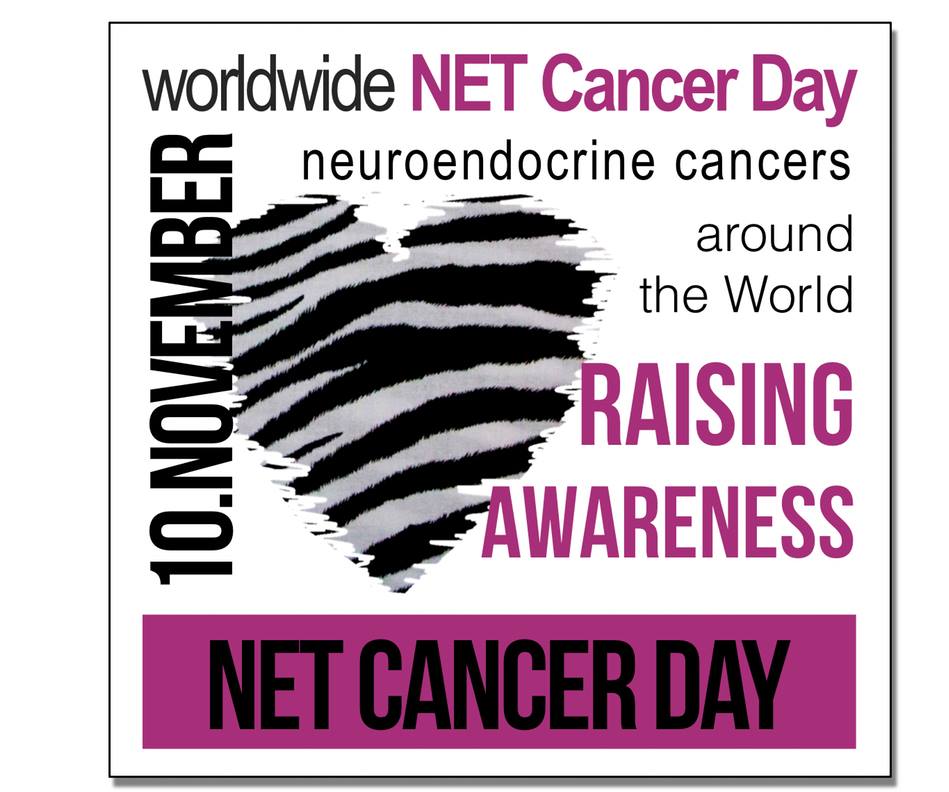
November 10 is World NET Cancer Day, a day set aside to raise awareness of this little known cancer among decision makers, health professionals and the general public; to encourage more funds for research, treatments, and patient support; and to ensure equal access to care and treatment for NETS patients around the world.

Today coffee shops around the world will be raising awareness about NETS by using special coffee cups bearing the slogan “Lets talk about NETS” and handing out promotional material to help educate their customers about the disease.


lets-cup10

Perhaps you drank your morning coffee from one of these. Black and white like the zebra that is used as the symbol of our disease, our hope is that they will draw attention to and begin conversations about this increasingly common, but poorly understood cancer.

There are several key messages that we would like to highlight today. First of all, as with other cancers, early diagnosis is important. Sadly, it doesn’t happen often. If the initial tumour is found before any secondary growths occur, it can often be removed surgically and the patient is considered cured. Once it has spread, however, the disease, though slow growing, is incurable. Treatments are improving, but it is still considered terminal.

Awareness of symptoms is key to early diagnosis. Unfortunately, however, misdiagnosis is extremely common. Typical symptoms, which often include abdominal pain and cramping, diarrhea, joint pain, wheezing, fatigue and flushing of the skin, are very similar to those of more common conditions such as Irritable Bowel Syndrome, Crohn’s disease, asthma, stomach ulcers, lactose intolerance, diabetes or even menopause. As a result, the average time to proper diagnosis for a NETS patient is 5 to 7 years.

NET cancer can arise in any organ that contains neuroendocrine cells including the stomach, intestines, lungs, liver, pancreas and appendix. While most commonly found in people over the age of 60, NETS can affect both men and women of any age.

So, while you sip your coffee today, whether it be from a black and white “Lets talk about NETS” cup or your favourite mug at home or at the office, why not initiate a conversation that could save someone’s life? Why not talk about NETS?

nets

Where’s that little black dot?

Now that my cancer treatments are six months apart and I feel so well in between, sometimes it’s almost possible to forget that I have that dread disease. Almost, but not quite.

Yesterday morning, we were back at the Cross Cancer Institute in Edmonton for Lutetium treatment #7 and this morning, I had the follow-up scans and met with my doctors to learn the results.

Once again, the news was good. The black marks on the screen that represent my tumours were not only significantly smaller than they were at diagnosis three years ago; they appeared to be noticeably smaller than they were six months ago. Three were still very obvious and the doctor pointed out the fourth one, but where was number 5? Gone? Was that possible?

Dr. Koumna, the newest member of my care team, explained that what we know for sure is that that tumour, one of the smallest in the first place, is no longer absorbing Lutetium, the radioactive substance that binds to my tumours and fights them on the spot. It may be gone or it may be dead or completely non-functioning. Either way, the news is definitely good!

On the other hand, the morning was also somewhat sobering as we were reminded once again that neuroendocrine cancer (NETS) is a deadly disease. We learned that a couple of things have changed in the treatment protocol since we last sat down with the doctors six months ago. First of all, I will now be having a CT scan three months after every treatment instead of after every second one. In other words, twice a year instead of only once. According to Dr. MacEwan, head of the team, they’ve discovered that leaving these tumours unchecked for six months, as they had been doing, was putting patients at too great a risk. Secondly, although I was told last year that after I’d had four treatments at six month intervals, if everything was still going well, we would try nine months between treatments, that is no longer an option. Again, leaving these tumours untreated for that long was proving to be too risky.

This type of therapy, known as Peptide Receptor Radionuclide Therapy or PRRT, is still very new. It is extending the lives of NETS patients beyond what was possible in the past and as that happens, even the specialists are still learning. I truly thank the Lord that I live so close to one of the centres where this treatment is available because there are not many of them in North America!

The most disconcerting thing that we learned this morning is that, at this point, only 12 Lutetium treatments are available per patient. For me, that means just 5 more. Two and a half years and then what? Dr. MacEwan was frank in explaining that the clinical trial that I’m part of and that is the only way to access this treatment in western Canada at this time, was set up with a maximum of 12 treatments because they didn’t actually expect to need more than that. Though they knew that in the early stages of use, Lutetium was proving to be successful in providing symptom relief, stopping or slowing tumour progression and improving overall survival, they really did not expect it to be as effective as it’s proving to be. Now that some patients are approaching the 12 treatment maximum and still doing well, Dr. MacEwan will be going back to the government to apply for further funding and permission to continue therapy beyond 12 treatments. He fully expects that to be in place before I need it.

In the meantime, I’m highly radioactive again meaning that I need to stay somewhat isolated from other people for the coming week and, as usual after a treatment, I’m feeling quite tired, but I’m home and very happy to report that one little black dot was missing from the screen today!

screen-shot-2016-11-03-at-5-05-05-pm

This is not my scan because I got so involved in discussing what I was seeing (and not seeing) on the screen that I forgot to ask if I could take a photo of it, but this gives you an idea what the scan I get after each treatment looks like. This patient has tumours that are larger than mine and located in different areas of the body.

Photo credit

When no news is good news

It’s been quite awhile since I wrote anything about my health as there really hasn’t been anything new to report. That in itself is good news!

As many of you are aware, I was diagnosed with two completely separate and unrelated cancers in late 2013 and early 2014. Yesterday, I finally received the results of CT and PET scans and other tests done three weeks ago. The first good news was that there has been no significant change in my incurable neuroendocrine cancer (NETS) over the last year. I have only had two radioisotope (Lutetium) treatments during that time, one last October and one in April, but that has been enough to keep things stable. The tumours have not grown or spread.

Screen Shot 2016-08-09 at 4.34.33 PMSource

Neuroendocrine tumours (NETS) produce serotonin which is sometimes referred to as a happiness hormone because a deficit can to lead to depression. An excess, however, can result in carcinoid syndrome which, as in my case, results in symptoms that include abdominal cramping and diarrhea, skin flushing, and periods of rapid heart rate. It can also lead to heart disease and other complications. A 24 hour urine test is used to measure the amount of serotonin in the body. Though I don’t know what units are used to measure serotonin, at the time of diagnosis, the level in my body was 150. Now, it’s down to 40. Though still above average, it is considered borderline and indicates that my tumours, if not completely dormant, are barely functioning. Monthly injections of Sandostatin, meant to suppress this serotonin production, are obviously working and I have had none of the above listed symptoms for the past couple of years.

More good news was the fact that there is absolutely no sign of recurrence of my second cancer which was an acinic cell tumour in one of my saliva glands. It was removed surgically followed by six weeks of radiation treatments, thirty in all. I have now been free of that cancer for over two years!

The best news, however, is the fact that I feel 100% healthy! My energy level is normal and except for the monthly injections, which are given by a nurse who comes to the house, and a treatment requiring an overnight stay in hospital in Edmonton once every six months, I’m able to lead a completely normal life. We haven’t gone on any long hikes yet this summer, but I’m quite certain that I could.

If things continue to go this well over the next year, treatments will then be reduced to one every nine months. I have no idea what the long term outlook is, but then, who really does know what their future holds? I know who holds my future and that is good enough for me!

“I know the plans I have for you, declares the Lord, plans to prosper you and not to harm you, plans to give you hope and a future.”                                      Jeremiah 29:11

I’m a survivor!

2016-NCSD-logo-166

Today is National Cancer Survivors Day, a day set aside to celebrate the more than 32 million people around the world who have battled the disease and to raise awareness of the challenges that many of them face.

So what is a survivor? To many, the term ‘cancer survivor’ suggests a person who has beaten their cancer; perhaps one who has been cancer free for several years, but I like the definition used by the National Cancer Survivors Day Foundation. “A ‘survivor’ is anyone living with a history of cancer – from the moment of diagnosis through the remainder of life.”

In other words, I am a survivor!

I live with cancer every day. Unless a cure is found for neuroendocrine cancer (NETS) within my lifetime or God performs a miracle on my behalf, I will never be cancer free. People have a hard time grasping the idea of a chronic cancer. The usual assumption is that patients either die of their disease or they are cured, thereby becoming cancer survivors, but I look at my situation differently. I may die of my cancer or I may die with it, but either way, I am a survivor! Fortunately my disease is stable at this point and it doesn’t significantly impact my day to day life. A schedule of monthly injections and biannual treatments restricts my previous worldwide wanderings a bit, but I recognize that every day is a gift.

I’m also a cancer survivor in the more tradition sense, as in one who had the disease, but is now free of it. As many of you know, seven months after my NETS diagnosis, I was diagnosed with a second, completely unrelated cancer that was removed surgically. Six weeks of radiation followed and, since that time, there has been no recurrence. That possibility still exists, of course, but in the meantime I will continue to live life to the fullest.

I am, after all, a survivor!

As good as my last scan

Fellow NET cancer patient and blogger, Ronny Allen, published a post awhile back entitled, “I’m only as good as my last scan.” That sentiment definitely resonated with me as I never know what to say when people ask me how I’m doing. For the past while, I’ve been feeling absolutely great, 100% even, but unless I’ve had a recent scan, I really have no idea how I’m doing on the inside. That’s why I was actually looking forward to this week’s treatment and it’s follow-up scans, the first look at my cancer in 6 months.

Today, let me walk you through what this two day process looks like. On Tuesday morning at 9:30 a.m. Richard and I sat down with Dr. Sandy McEwan, scientist and doctor extraordinaire and head of my cancer care team. I told him how great I’ve been feeling, he told me how great I look, and I signed consent for the treatment procedure. He also shared some of the recent findings of the clinical trial that I’m part of including the exciting news of one patient who has been surgically proven to be tumour free!

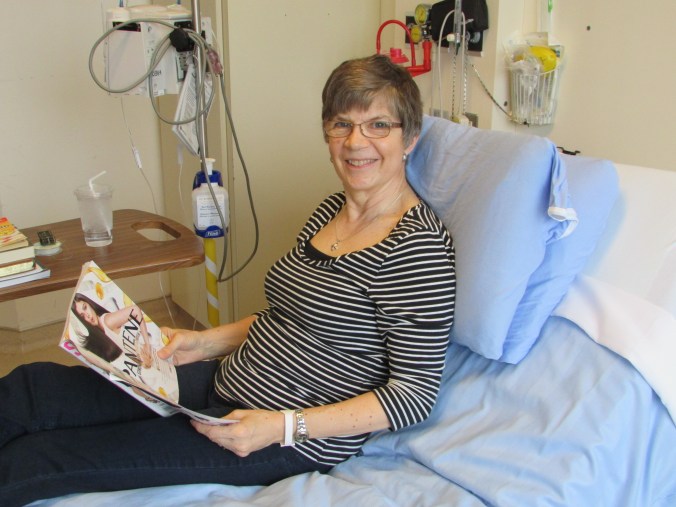
Next, we were off to the volunteer run Sunroom Cafe to kill time over a cup of tea while we waited for the next step which was having my IV inserted at 11:00. Shortly after that, we headed up to the third floor to check into my private room in the nuclear medicine corner of the inpatient ward. In preparation for the treatment itself, I was given an anti nausea pill and a saline drip was started. Then I sat back and relaxed until the arrival of the radioactive Lutetium-Octreotate, which had just been flown in from the Netherlands where it is produced. At that point, Richard had to leave and I continued to relax  while it flowed through my veins seeking out and attaching itself to my tumours. Because I’m part of a clinical trial, there is lots of monitoring to be done, so Michelle, who administers the treatment, was in and out of my room over the next hour or so constantly checking my vital signs. My blood pressure remained good and she was astonished by my slow, steady heart rate. Obviously, I wasn’t experiencing any stress. Why should I? After all, this was my sixth treatment and I’m an old hand at this now!

IMG_1543

Once the Lutetium was in and the lines were flushed, the IV was removed. If I lived in the city, I’d have been free to go home, but since I live a couple of hours away and had to be back for my scan by 8 o’clock the next morning, I stayed the night. Richard came back to visit bringing me a Subway sandwich as my one and only complaint about the Cross Cancer Institute is the food. It’s so bad that even the staff apologizes for it! Dr. McEwan dropped in to see how the treatment had gone and then I settled in for a quiet evening. I spent awhile visiting and exchanging stories with the patient in the room next to mine, a retired farmer from northern Saskatchewan. At the Cross, Lutetium is administered to three patients at a time.

I slept well and was up bright and early to head back downstairs for my scans. After spending the night at our son’s place, Richard met me there. For the full body scan, I had to lay perfectly still on my back with a pillow beneath my head and another under my knees. Covered by a warmed blanket, I was quite comfortable as my body slowly moved beneath the enormous camera just a few inches above me. Dr. McEwan had planned on having a second, 3D scan done as well, but that machine was down. The technicians were working on it and if he’d felt it was necessary, we’d have waited around until it was up and running again. He was certain, however, that the first scan showed all that we needed to know. My cancer is stable! The tumours haven’t grown and there aren’t any new ones. There’s also no sign of recurrence of my second, unrelated cancer. While it would have been nice to hear that the tumours were continuing to shrink or that, as in the case of the woman mentioned above, they had disappeared completely, that is most unusual and no change is also good news.

I hope Ronny doesn’t mind me borrowing his title, but he is right. I’m only as good as my last scan and right now, that’s very good!

Naming Lavita

Perhaps it’s just an extension of my love of words, but I find the meaning and origin of names fascinating. Long before we had our first child, Richard and I had two boys names picked out, Matthew and Nathan. Interestingly, they both mean “gift of God” and since God blessed us with two sons, we were able to use them both. We had a much harder time choosing names for our daughters. I’ve always been partial to girl’s names that end in A and, after much deliberation, we settled on Janina for our first daughter. A derivative of Jane, it too means “gift of God”! Though the spelling of our second daughter’s name is very similar to mine, Elaine means “light” and Melaina means “dark”! Like our other three, however, she is also a “gift of God” and that’s the meaning of her middle name, Jean!

In addition to naming our children, I’ve helped name a few pets along the way, but I never thought that I’d name a gastrostomy tube; a tube inserted through a patient’s abdomen to deliver nutrition directly to her stomach! Over the past few months, I’ve made contact with two other bloggers who are also neuroendocrine cancer patients and one of them, Lizbeth, recently wrote a post asking readers to help her choose a name for the tube that provides her with vital nutrition. She was tired of simply referring to it as “tube”.

I immediately began to search for girls names that meant “giver of life”, but I didn’t find one that I liked, so I changed my search slightly and began to look for names that simply meant “life”. I quickly came up with three of them and they even ended in A; Olivia, Livia and Lavita. I sent them off to Lizbeth and waited to see what would happen. Here’s what her next blog post said:

A fellow blogger, Elaine, has gave me a name that I’m rather struck on.  The name Elaine has suggested means life.  Rather apt.  For me the tube gives me a better quality of life…  It provides me with my essential nutrients and vitamins – my daily steak and chips or fresh fruit salad if you get my meaning.  For many people with a tube it is an essential lifeline and the only source of nourishment.  

The name I have chosen is Lavita.

image4

NET Cancer Day

ncd-logo-newNovember 10 is Worldwide NET Cancer Day, a day for raising awareness of neuroendocrine cancer.

It’s not surprising that this disease has escaped the attention of even the medical community at large until now. Many family practitioners will never see a case. My doctor has been practicing medicine for about 20 years and I’m his first NETS patient. A locum filling in at our local hospital last spring went so far as to debate with me whether I even have cancer! He was completely unaware that neuroendocrine tumours can be malignant as most are not.

Is NET cancer really that rare? Here in Canada, specific numbers are not even reported separately, but my estimate, based on US statistics, is that there are approximately 890 new cases per year across the country with only about 106 of those residing here in the province of Alberta. In comparison, 2100 Albertan women are diagnosed with breast cancer each year and 2500 men with prostate cancer. Is it any wonder that those cancers have a much higher profile?

Since it falls upon those of us with the disease to do what we can to raise awareness, there are several key messages that we would like to highlight today. First of all, as with other cancers, early diagnosis is important. Sadly, it doesn’t happen often. If the initial tumour is found before any secondary growths occur, it can often be removed surgically and the patient is considered cured. Once it has spread, however, the disease is incurable. I had 5 tumours at diagnosis and many patients have more. I have been told that I may have had this cancer for as long as 10 years before it was detected quite by accident! Fortunately, it’s usually very slow-growing.

Awareness of symptoms is key to early diagnosis. Unfortunately, however, misdiagnosis is extremely common. On average, patients see 6 healthcare professionals at more than 12 clinical visits before receiving a correct diagnosis because symptoms of NET cancer are often very similar to more common conditions including Irritable Bowel Syndrome, asthma, diabetes, stomach ulcers and lactose intolerance. Depending on where the tumours are located, typical symptoms include abdominal pain and cramping, diarrhea, joint pain, wheezing, fatigue, and flushing of the skin. In very severe cases, there can be heart damage causing shortness of breath.

I endured stomach pain and diarrhea off and on for at least 7 or 8 years before my tumours were finally detected. At one point, a medication used to treat acid-related stomach problems was prescribed, but it had little effect. Another time, I tried a dairy free diet for an entire month to see if that would help, but it didn’t.

NET cancer can arise in any organ that contains neuroendocrine cells including the stomach, intestines, lungs, liver, pancreas and appendix. My primary tumour is located in my colon, but I also have three growths on my liver and one in a lymph node. Though it can occur at any age, the usual age of diagnosis is somewhere between 40 and 60.

So what are some of the goals of NET Cancer Day?

  • to raise awareness among decision makers, health professionals and the general public
  • to promote research aimed at improving quality of life and prognosis for NET cancer patients
  • to advocate for equity in access to care and treatment for NET cancer patients around the world
  • to bring hope and information to people living with NET cancers, their caregivers and their families

What can you do to help? You can help us spread awareness by simply reposting this on your blog if you have one or posting a link to it on your Facebook page. Thank you!

NET Cancer Awareness

Walking the third pathway: living with chronic cancer

“Have you finished having treatments yet?”

“How many more treatments do you have to have?”

These are questions that I’m asked constantly. When someone has cancer, people usually expect one of two outcomes; either you’re cured or you die. Because two years have passed since my neuroendocrine cancer was diagnosed and I’m obviously still very much alive, people automatically assume that I must fall into the first category, those who beat the disease and move on. Few are even aware that there’s a third pathway. With proper treatment, however, some cancers are considered chronic. Though incurable, they can often be controlled with proper treatment and the patient can live what appears to be a relatively normal existence. That’s the road that I’m on.

“Have you finished having treatments yet?”

No. I’ll probably have to have them for the rest of my life.

“How many more treatments do you have to have?”

That depends entirely on how long I live.

People are usually startled by my responses, but this is the reality that I live with. It’s entirely possible that I’ll eventually die of my cancer, but I could also die with it. All I can say for sure is that, at present, things are going in the right direction. I had another treatment on Tuesday morning and the follow up scans showed that my primary tumour, which is located in my colon, has continued to shrink. In fact, it’s tiny compared to the size it was at diagnosis. That, in itself, was very good news, but we also learned that the largest of the three tumours on my liver has now started to diminish in size and there are no new growths. Obviously, the treatments are working! How long that will continue to be the case, no one has any idea, but we do know that there are new treatments on the horizon and when this one stops working, there will probably be something else that we can try.

So, what’s it like walking this third pathway?

There are plenty of things that I’d still like to accomplish in life and places I’d like to go. Some I’d like to return to and others I want to see for the first time. It may sound surprising, but there hasn’t been a huge sense of urgency to try to cram these things into whatever time I might have left. Perhaps that’s because our focus for the past two years has been largely on fighting, not one, but two cancers; the neuroendocrine tumours (NETS) that put me on the third pathway as well as the completely separate and unrelated cancer that was diagnosed seven months later. With that one out of the way and my NETS well under control now, maybe we can begin to focus more on crossing things off my unwritten bucket list, but the lack of urgency may also be due to the fact that I don’t really sense that my end is imminent. You see, I really hope to be one of the ones who dies with this disease, not of it.

I still plan for the future, but I’ve also been learning to inhabit one square on the calendar at a time. Walking this pathway has definitely given me a greater appreciation for the moment and for the small things in life. I’ve always loved hiking, but the delight that it gave me this summer was greater than ever before. I was simply so thankful to be able to do it! I don’t take things like that for granted anymore.

I’ve always been one who believed in living life to the fullest; now I just have to do that within the confines of my treatment. There are limitations, of course, especially during a week like this one when I’m highly radioactive, but overall, I am blessed to be able to continue living a fairly normal life.

NETS