Final day

Reflecting on and writing about our final day in Jerusalem seems like a perfect way to enter the Lenten season as we spent the day immersed in the final moments of Jesus’ life here on earth, visiting the sites surrounding his arrest, crucifixion, burial and resurrection!

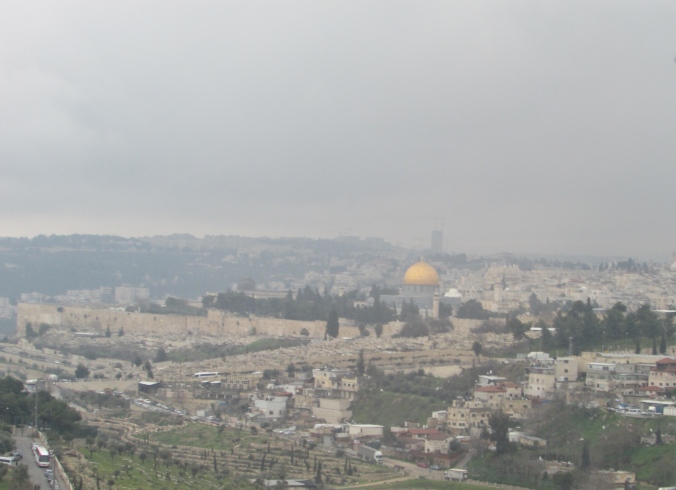
Our morning started on the Mount of Olives overlooking the Kidron Valley. The sun gleamed off the golden Dome of the Rock, the Muslim mosque that now stands atop Mount Moriah where the Jewish temple once stood. Before us lay the route that He took on His triumphal entry into Jerusalem on the day that has become known as Palm Sunday. (Matthew 21:1-11)

IMG_1107 - Version 2

As we stood atop the Mount, we were reminded that, according to prophecy, that is where He will return someday! (Zechariah 14:4) Come, Lord Jesus!

Walking down the Mount, we came to the Garden of Gethsemane where Jesus spent the final moments before His arrest. Even with the sound of traffic in the background, the garden was a place of great peace. In our devotional time there, we were reminded so clearly of the great burden that our Lord bore that night as He prayed alone, feeling the weight of the sin of the entire world on His shoulders. Kirk, our devotional leader, compared it to the deepest of depressions. For me, our time of reflection in the garden was spiritually profound. As I thought about the extreme anguish that I once felt when I was betrayed by someone I loved and then tried to multiply that by the sin and betrayal of every person who has ever lived, it was beyond my ability to comprehend. Is it any wonder that He sweat drops of blood and prayed, “Father, if you are willing, take take this cup from me.” How thankful I am that He followed this up with “yet not my will, but yours be done.” (Luke 22:39-45) Without that willingness to carry the weight of our sins to the cross, we would be forever lost with no hope of salvation and eternal life.

We stopped for a quick look at the Gethsemane Basilica of Agony with it’s beautiful mosaics above the portico.

IMG_1189

Continuing down the hill and up the other side of the valley, we entered the walled city through the Lions’ Gate, which is also known as St. Stephen’s Gate or the Sheep Gate.

IMG_1200

IMG_1203 - Version 2

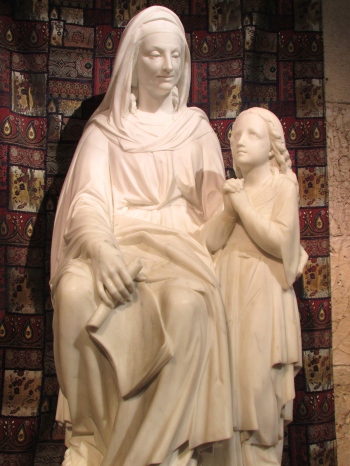
Inside the wall, we visited St. Anne’s Church where, when we sang Amazing Grace together, the acoustics were so amazing that each note hung in the air for a good four seconds! Though she isn’t mentioned in scripture, St. Anne was, according to tradition, the mother of Mary and the grandmother of Jesus. I was especially taken with the beautiful alabaster statue of a mother teaching her young daughter from scripture. The scroll in her hand has Deuteronomy 6:5 written on it in Hebrew. “Love the Lord your God with all your heart and with all your soul and with all your strength.” The delightful French Canadian priest told us that the church is often referred to as the “grandparents’ church” and reminded us of our Lord’s instruction to pass on His teachings to our children and grandchildren. (Deuteronomy 6:6-7)
IMG_1214

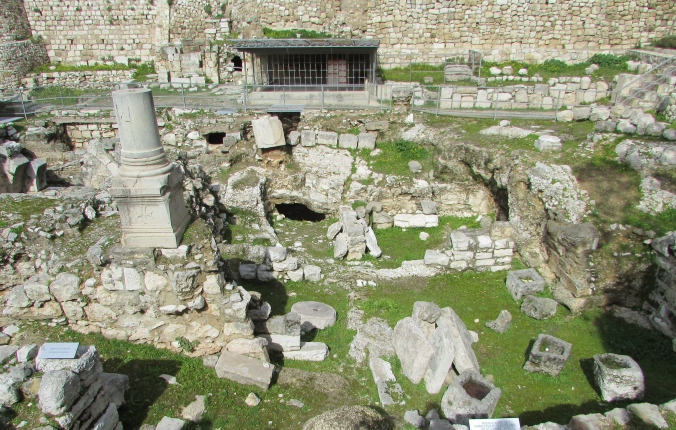
In the area, we also saw where the pools of Bethesda were once located. It was here that Jesus healed a man who had been crippled for 38 years. (John 5:1-15)
IMG_1218 - Version 2

A quick trip around the Temple Mount by bus took us to the Jaffa Gate where we entered Old Jerusalem and walked the narrow market streets to a tiny restaurant where we had lunch.

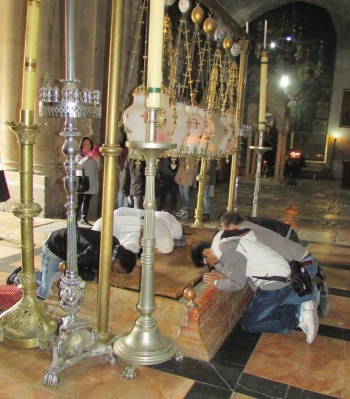
Our next stop was the Church of the Holy Sepulchre, a cavernous structure standing on the bedrock at a site said to encompass both Golgotha, or Calvary, the spot where Jesus was crucified, and the tomb (sepulchre) where His body lay. Filled with icons and incense, we could only think of what we saw as idolatry and, to me, it didn’t seem very different from what we’d seen in numerous Buddhist temples in Asia. Most disturbing to me was the Stone of Unction, or Stone of Anointing, a flat red stone some six metres in length and decorated with candlesticks and lamps that is located in the entrance of the church. It is purported to be the place where Jesus’ body was laid and prepared for burial after being taken down from the cross. It was surrounded by devoted pilgrims bowing before it, kissing it and rubbing their possessions on it in hope of receiving some sort of blessing. Personally, I was more than happy to leave. Apparently, people sometimes wait hours to enter the Edicule, an ornate cubicle that supposedly houses the empty tomb, but we had another tomb to visit!

IMG_1253 - Version 2

IMG_1255

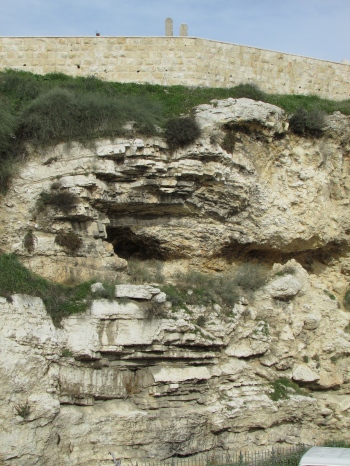
Some 2000 years after the fact, there is, of course, no way of knowing exactly where the cross of Christ stood or where the tomb that held his body was located, but the Garden Tomb seemed much more authentic to me. The guide who met us there, gave us many pieces of evidence pointing to the likelihood that this could be the place. If nothing else, there was a great sense of peace there that I didn’t feel in the Church. He first showed us the hillside that would appear to be Golgotha, meaning “the place of the skull”. Though the nose crumbled several years ago and a bus station has somewhat obliterated the lower portion, it’s easy to see a skull in the rocky hillside.
IMG_1272

Although I’ve always visualized the crosses standing at the top of a lonely barren hill, the guide explained that they were more likely positioned near the bottom beside a busy road and in the face of the throngs of passersby making their way into Jerusalem for Passover. That’s the way the Romans did things. He also pointed out the irony of thousands of lambs being brought into the city for the Passover sacrifices passing right by the true lamb of God hanging on the cross, but missed by the multitudes.

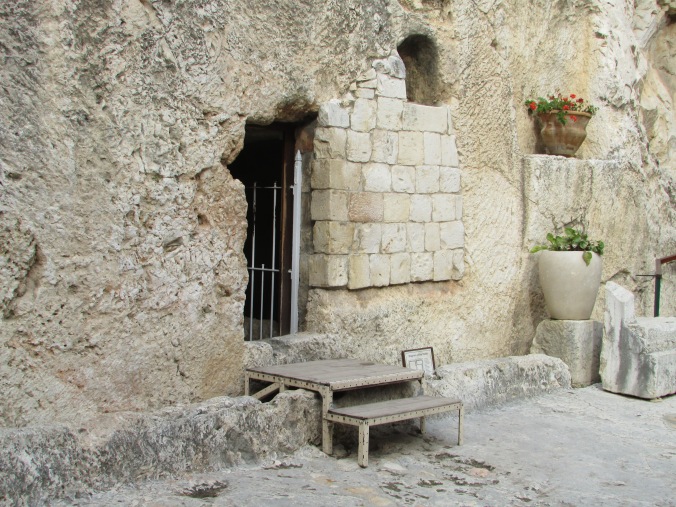
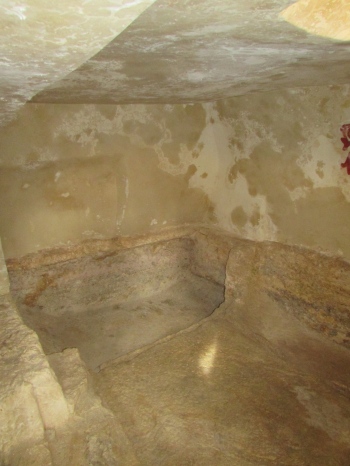
Next, he walked us through the garden to the empty tomb. Actually being able to enter and see the spot where Christ’s body may have lain was another very moving experience. The doorway has been enlarged and steps added to allow easier access.
IMG_1278

IMG_1284

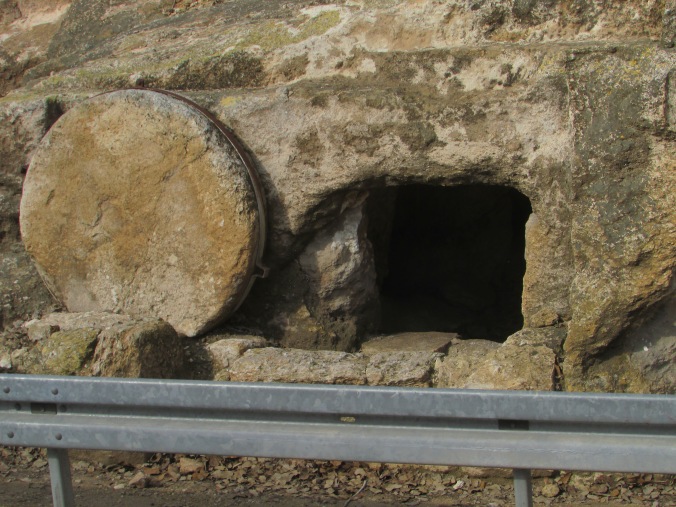
This is a similar tomb beside a road in Galilee that shows what the stone would have looked like.
IMG_0247

After we’d all had a chance to enter the tomb, we gathered in a tiny well-lit chapel in the garden for a service of communion. We drank our wine from tiny olive wood communion cups which we were then given to bring home with us. Celebrating our risen Lord with a group of people that we’d quickly grown close to and experienced so much with was very meaningful! Though that would have been a suitable finale to our pilgrimage, we made three more quick stops before our busy day was over!

On Mount Zion, we first visited the place that is traditionally held to be the location of the Upper Room where Jesus and His disciples shared their Last Supper. (Matthew 26:17-30) The building is actually a 12th century Crusader structure, but archaeological evidence of Roman construction on the lower level supports the possibility that this area was indeed the location where our Lord shared a final meal with his disciples. Like so many others, the building has changed hands many times throughout history.

On the lower level, we visited one of the most holy Jewish sites, the traditional location of the tomb of King David. The men were required to don yarmulke, the skullcap traditionally worn by Jewish males, and entered one room while we women went into a smaller adjoining room. In our room, a few women quietly read their Hebrew scriptures, but we could hear quite a din from the other side of the partition. Our men exited shaking their heads and describing a crowded room full of ultra-Orthodox men shouting, wailing and banging on a central table as they bowed and bobbed. There is obviously much that we don’t understand about their religious practices!

Our final stop was the house of Caiaphas, the high priest, where Jesus was taken after his arrest. There is clear evidence that this time we were, indeed, standing in an authentic spot. The stone stairs leading up to the house are the very ones that Jesus would have climbed on His way to trial.

IMG_1307

Inside the house, we went down into the dungeon where Jesus likely spent His final night on earth. It was nothing more a large hole dug into the rock beneath the house. Somewhat overcome by all that we had seen and experienced, we sang our final hymn together.

Yad Veshem

I think a person could easily spend a whole day in Jerusalem’s Yad Veshem Holocaust History Museum, Israel’s national memorial to the victims and the heroes of that horrible time in history, and not have time to take in every detail. We had an hour and a half! While some of us would probably have liked longer, I don’t know how much more we could have handled. After awhile, I think the horror would have been too much.

From beginning to end, the museum tells the story of those terrible years from a uniquely Jewish perspective. As visitors move from one gallery to the next, the displays, filled with artifacts, documents, survivor testimonies, diaries, letters, personal possessions and works of art, emphasize the experiences of individual victims. Beginning with Nazi Germany and its anti-Jewish policies prior to the outbreak of World War II and carrying through to post-war days when survivors sought to return to some sort of normal life again, it is a dramatic reminder of man’s inhumanity to man.

The circular Hall of Names at Yad Vashem is the Jewish people’s memorial to each and every Jew who perished in the Holocaust, a place where they may be commemorated for generations to come. Shelves around the outer edge of the cavernous hall hold the Pages of Testimony containing short biographies of each Holocaust victim. Over two million Pages are stored in the repository and there is room for six million in all, the number of men, women and children who were murdered by the Nazis and their accomplices.

Photo taking is not allowed inside the galleries, but I will seek to share a few of my strongest impressions:

  • Reading some of the details and quotations expressing anti-Jewish sentiment from the years prior to the Holocaust was especially disturbing because they sounded so familiar, so reminiscent of anti-Muslim and anti-refugee sentiments that we’ve been hearing in recent days. Is our world not ripe for something this evil to happen again?
  • Learning that at least one ship full of Jewish refugees headed to Cuba was turned away angered me. Refused refuge by both Canada and the US, it was forced to return to Europe. While some passengers were allowed to stay in Britain, others were forced to return to the mainland. I’ve seldom felt ashamed to be Canadian, but in the moment when I read that, I did.
  • Being reminded that in a situation like the Holocaust, everyone is involved either as victim, perpetrator, hero or part of the apathetic masses who fail to get involved or who follow corrupt leaders out of fear, I had to ask myself, which category I would fall into. Would I have the courage to stand by my convictions against such forces of evil?
  • Watching numerous video clips of survivors bravely telling their stories had a powerful impact on me. How thankful I am that these recordings were made. As the number of victims rapidly dwindles due to the passage of time, their stories will continue to be heard.

Our guide, Shimon, didn’t go into the museum with us. We assumed that he had probably been many times before, but he told us afterward that he has never been inside. He doesn’t need a museum to remind him of the effects of the Holocaust. Leaving their families behind, his parents came to Israel from eastern Europe as teenagers prior to World War II. It wasn’t until after the war that they learned that their entire families had perished. Shimon grew up with no extended family; no grandparents, aunts, uncles or cousins. Apparently this wasn’t uncommon for his generation in Israel. He also told us the story of his father-in-law who lost his first wife and their two children in the Holocaust, a secret that he told no one until moments before his death.

Outside the museum is the Garden of the Righteous. Trees, a symbol of the renewal of life, were planted here in honour of those non-Jews who risked their lives to save Jews during the war.

Exploring ancient Jerusalem

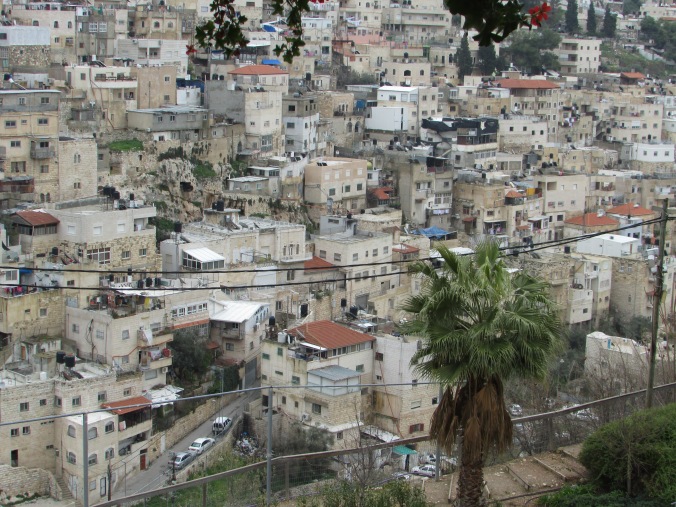
Are you tired of reading about archaeological ruins yet? Israel is truly an archeologist’s dream and Jerusalem is no exception. I must admit that by the second last day of our tour, I was beginning to experience information overload. That, combined with the fact that we were hurrying to stay ahead of a huge group of Taiwanese tourists when we visited the City of David, meant that I probably missed a few things, but there are some that stand out vividly in my memory. Located beneath the Arab neighbourhood of Wadi Hilweh and below the southern walls of Old Jerusalem, the City of David is the archaeological site of ancient Jerusalem of the pre-Babylonian exile era.

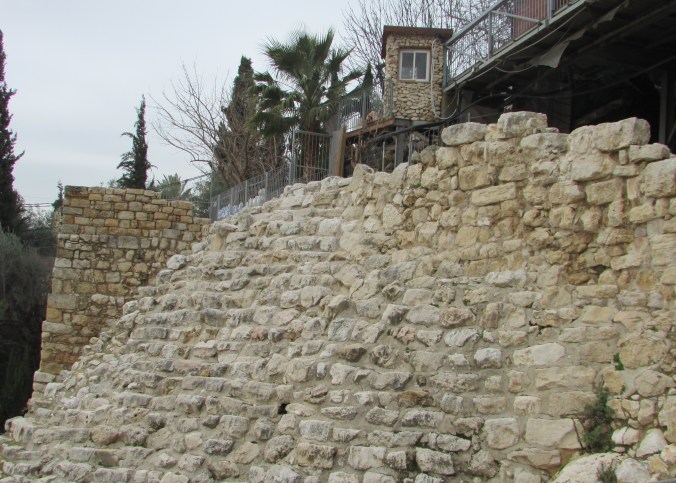
What stood out to me most was a section of wall from three different eras!

IMG_0989 - Version 2

Originally built by the Jebusites, a Canaanite tribe who built and inhabited Jerusalem prior to its conquest by King David, the tower to the left was added in David’s time. What interested me most was the upper right hand section of the wall where the stones are of slightly different size and colour. This is a section of the wall that was repaired under the direction of Nehemiah after the Jews returned from exile in Babylon. (Nehemiah 2-6)

Our local church here in Sedgewick is in the middle of a three year rebuilding project of our own. Over the years, we’d gradually let the church building and parsonage slip into disrepair. Our pastor used the story from Nehemiah to introduce the project and the accompanying need for extra funds to the congregation, so we chose to call it our Nehemiah Project. It gave me shivers to stand there and see with my own eyes a small portion of the original Nehemiah project!

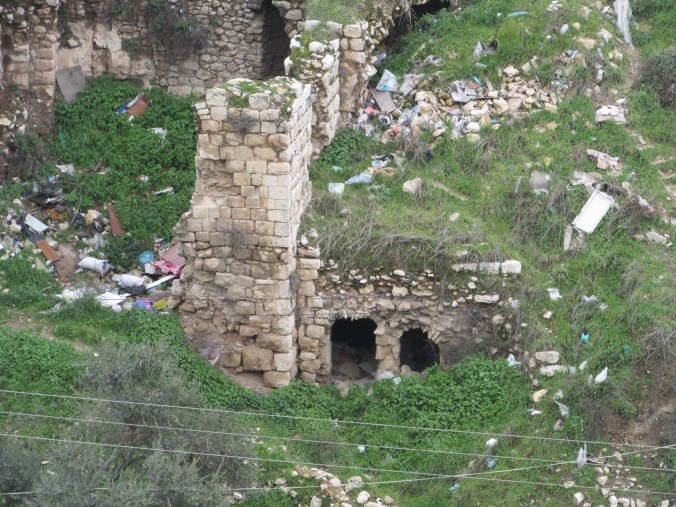
Looking across the valley to the bottom of the hill below the Arab village, we could see the entrances to ancient Jewish tombs with garbage scattered all around. It’s very easy to distinguish between Arab and Jewish communities in Israel. Jewish neighbourhoods and settlements are clean, orderly and prosperous looking while Arab ones are shabby and unkempt.

IMG_1000

Before leaving the City of David, we entered Warren’s Shaft which enabled the ancient Canaanite residents to draw fresh water from the Gihon Spring without leaving the city. Hezekiah’s Tunnel was later built under the direction of King Hezekiah to bring fresh water from the spring into Jerusalem. (2 Kings 20:20)

While we toured the City of David, we could hear the Arabs shouting at us, but since we couldn’t understand what they were saying, we paid them no mind. When we exited the water shaft, we had only a few hundred metres to go down a narrow street to what remains of the Pool of Siloam. Some tour groups were using shuttle vans for fear of being stoned, but we walked the distance briskly without any incident.

IMG_0986IMG_1024

It was at the Pool of Siloam that Jesus healed a blind man by putting mud on his eyes and telling him to wash in the pool. (John 9:1-12) Only a portion of it has been excavated. The remainder is under property owned by a Palestinian family who refuse to relinquish it.

IMG_1029

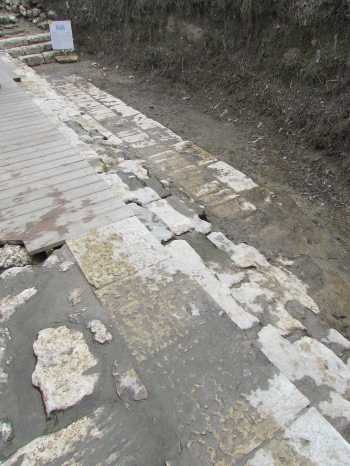
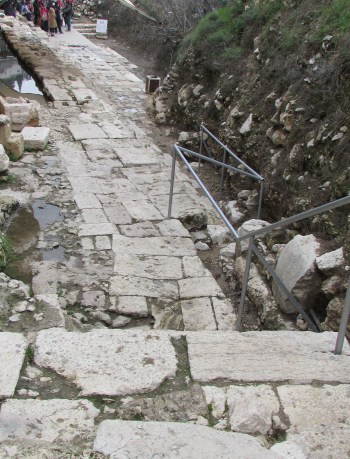
From the pool, we walked up another section of the Herodian road that we’d been on in the Western Wall tunnels the evening before, again walking on stones that our Lord undoubtably walked upon. This was the route used in His day to ascend from the Pool of Siloam to the Temple Mount.

IMG_1034 - Version 2

Next we made our way through the ancient city’s recently excavated central drainage tunnel which connects the west side of the Temple Mount to the Pool of Siloam area. Traversing the lengthy tunnel was definitely a “team building” experience as each of us called back to the ones behind us warning of slippery spots and low ceilings!

After further examining portions of the Western Wall, we had hoped to go to the southern steps, an enormous flight of stairs leading up to the Southern Wall, but the Muslim mosque above the area was in use and we couldn’t enter. Apparently, there have been incidents of people being stoned from above, so the area is closed when the mosque is in use!


Bethlehem, birthplace of our King

As the strains of John Starnes singing “Jerusalem: The Holy City” poured over the loudspeaker of our bus and the gleaming Dome of the Rock on the temple mount came into view, it was definitely a “Pinch me! Am I really in Jerusalem?” moment for most of us on our tour.

IMG_0719 - Version 2

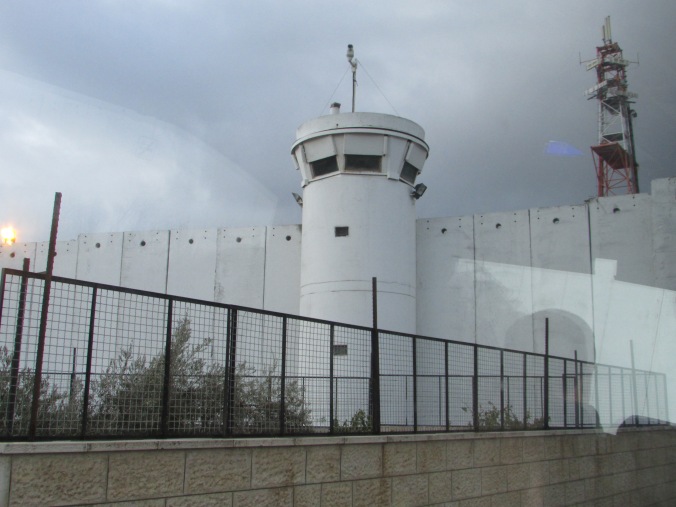
We didn’t stay long, however. At that point, we were actually just passing through the city on our way to Bethlehem, just 7 km away. Bethlehem is in Palestinian territory and Israelis are not usually allowed to pass through the checkpoint in the wall or “security barrier” that separates Jerusalem from the Palestinians. As a tour guide, however, Shimon has a special permit that allows him to take groups into Bethlehem. He accompanied us for lunch and then to a business run by a Christian family who make and sell beautiful olive wood carvings. There he stayed, however, passing us off to a delightful guide who resides in Bethlehem because he doesn’t feel comfortable or safe being out and about on the streets of that small city.

IMG_0794

The wall

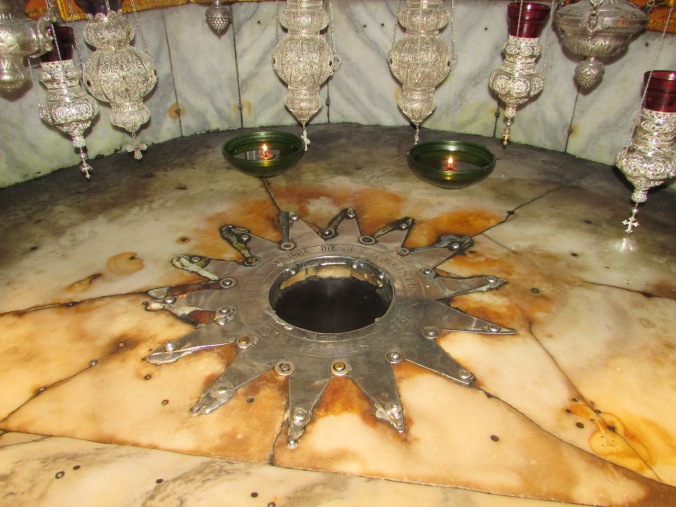
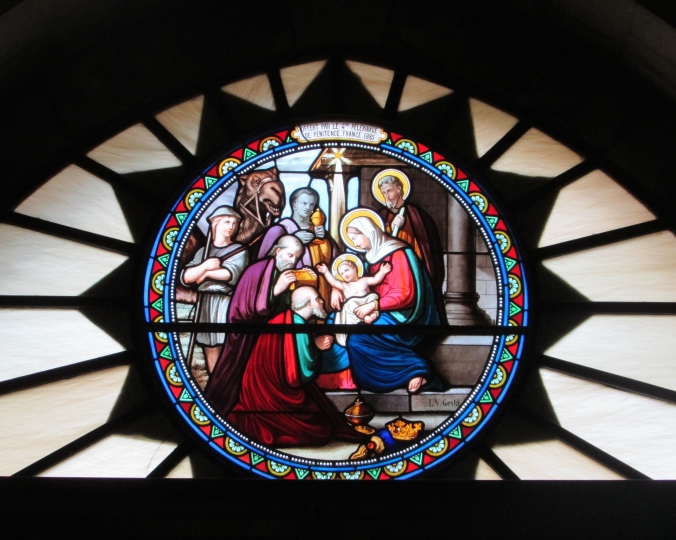
Our first stop was the Church of the Nativity, the supposed birthplace of Jesus. The church is administered jointly by the Greek Orthodox, Syriac Orthodox, Roman Catholic, and Armenian Apostolic churches. It consists of the main Basilica of the Nativity and the adjoining Church of St. Catharine. The Grotto of the Nativity, an underground cave located beneath the basilica, enshrines the site where Jesus is said to have been born. A large 14 pointed silver star set into the marble floor beneath an altar and surrounded by silver lamps and candles is said to mark the exact spot where Mary gave birth. A few feet away is the Grotto of the Manger, another shrine marking the spot where she apparently laid him in the manger.

IMG_0738

We went, we saw and we left. To be perfectly honest, it all seemed rather hokey to me and I found it somewhat disturbing to see other groups of pilgrims who appeared to be completely caught up in worshipping the place. I don’t mean to show disrespect for anyone else’s religious experience, but I do have to wonder how anyone can claim to know the “exact” spot where our Saviour was born in a humble animal shelter some 2000 years ago and, as I’ve said before, I don’t believe that there is any holy magic in the places where he was.

IMG_0758

From there, we descended to the Shepherd’s Fields, a park-like area commemorating the angel’s visit to the shepherds to announce the Messiah’s birth on that night so long ago as well as the fields of Boaz where Ruth the Moabitess gleaned. (Ruth 2:1-23) Notice that we descended to the shepherd’s fields. Again, the way I visualized things has been turned upside down! In my mind, I always pictured Bethlehem on lower ground and the shepherds tending their flocks on hillsides above town. In reality, communities throughout Israel are built on the tops of the hills. The shepherds and their sheep would actually have been on the hillsides below Bethlehem and they would have had to climb up to visit the newborn child. (Luke 2:8-17)

As we made our way back to Jerusalem to check into our hotel, I was reminded afresh how lucky we are to be Canadian. As we passed through the checkpoint, Shimon simply told the soldier on duty where we were from and we were sent on our way. Apparently, bus loads of Canadians and Americans pass through with ease while other nationalities are checked much more carefully. Vehicles driven by individuals are searched!