The Girl in the Red Coat: A Memoir
Roma Ligocka
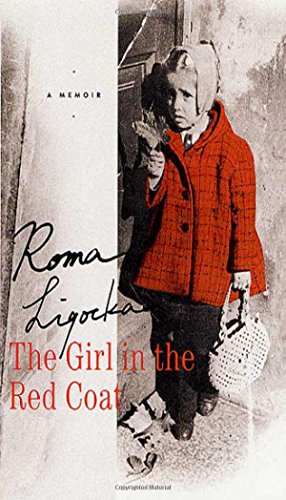 The book opens with an elderly Jewish woman sitting in the elegant dining room of a posh hotel on the French Riviera. Suddenly and quite seamlessly it transitions to the dark Ghetto of Kraków, Poland during World War II and I was hooked!
Roma Ligocka was born to Jewish parents in Poland in November 1938, less than a year before the beginning of World War II. Told through the eyes of a child, the story of her early years living in the Jewish Ghetto of Kraków is a harrowing account of uniformed men in shiny black boots with snarling dogs, people being shot indiscriminately, her mother’s tears, and from her hiding place under a table, seeing her own grandmother seized by SS officers. After her father is arrested and taken to Auschwitz, Roma and her mother, with their hair dyed blonde and carrying falsified documents, escape the Ghetto and are taken in by a non-Jewish family who pass them off as visiting cousins. Sometime later, when her father escapes the concentration camp and is reunited with his family, she fails to recognize the haggard spectre that he has become.
Roma is just short of her seventh birthday when the war comes to an end, but her life continues to be marked by severe hardship. Within two years her father dies and the communists take control of Poland.
As her adult life unfolds, we see the results of the trauma that she endured as a child. Although she studied art and costume design at the prestigious Academy of the Arts and became a successful costume and set designer, she continued to confront her frightful memories and her adult life is characterized by anxiety, eating disorders, substance abuse and the inability to maintain lasting relationships.
Finally, at the age of 55, on March 2, 1994, Roma reluctantly attended the première of Steven Spielberg’s epic movie “Schindler’s List” in Kraków. The Academy Award-winning movie was shot entirely in black and white except for the image of a little girl in a red coat. Seeing something of herself in that little girl, Roma, who had had a bright red coat of her own as a wee child, finally felt inspired and strong enough to tell the story of her own experiences.
Interestingly, although I suspected it early on, until late in the book, Ligocka doesn’t reveal the fact that her cousin, Roman, with whom she had a close relationship, was none other than the famous director, producer, writer and actor, Roman Polanski.
 In 2003, Morris, was introduced to Lale Sokolov, an elderly gentleman who “might just have a story worth telling”. As their friendship grew, Lale entrusted her with the innermost details of his life during the Holocaust. She originally wrote his story as a screenplay before reshaping it into her debut novel, The Tattooist of Auschwitz.
 In The Tattooist of Auschwitz, we are introduced to Cilka, a beautiful young prisoner who is forcibly separated from the other women by Johann Schwarzhuber, camp commandant, for his exclusive use. Quickly learning that her survival depends on it, she does what she has to do to stay alive. Although both books are historical novels, Cilka, like Lale, was a real person and at one point, he credits her with saving his life.


 Following Augustine