Tea, the universal drink

After water, do you know what the world’s most widely consumed beverage is? Would you say coffee? Beer? Wine? Coke? Wrong every time! It’s actually tea!

There was always tea available in our house when I was growing up in the 1950s and 1960s, but only plain black tea. We drank green tea on the rare occasions when we went to a Chinese restaurant. Now I drink two mugs of green tea every morning and the basket of other teas in my kitchen cabinet is overflowing.

In Canada, our increasingly multicultural society plays a large part in the growing popularity and availability of so many different teas. Over the years, the world has come to us and it has brought its teas with it.

Screen Shot 2019-02-25 at 9.03.21 PMDrinking tea is a tradition that is said to date back to 2737 BCE. According to legend, Chinese emperor Shen Nung was sitting under a tree while his servant boiled drinking water. When some dried leaves from the tree blew into the water, Shen Nung decided to try the infusion that was created and found it to his liking. Since then, tea drinking has spread around the world.

While black tea is more popular in Western countries, green tea is preferred in China and Japan where it is a common part of daily life. Green tea is unoxidized, giving it a lighter taste and aroma than black tea. The tea that is used in the traditional Japanese tea ceremony is matcha which is powdered and not infused. This means that the leaves themselves are consumed resulting in a much higher concentration of the antioxidants, minerals, and vitamins that make green tea healthy. For this reason, matcha has become quite trendy.

Taiwanese bubble tea is a modern innovation. This high calorie tea has as its base an iced tea (typically black, green, jasmine or oolong) with milk and a sugary syrup. The “bubbles” are actually tapioca pearls. As much as I like tea, this one has never appealed to me!

From Thailand comes the very popular Thai tea. Made from strong black tea, often spiced with ingredients such as star anise, crushed tamarind, and cardamom, it’s usually sweetened with sugar and condensed milk and served over ice.

India produces and consumes more tea that any other country in the world. It is best known for it’s chai blends that mix black tea leaves with spices like cinnamon, ginger, nutmeg, cloves, cardamom, and black pepper. Assam is another popular variety of black tea which is grown in the Assam region of India. It is used in many breakfast blends including English Breakfast and Irish Breakfast, but is also consumed on its own. It has a strong, malty flavour, a reddish colour, and is high in caffeine. Darjeeling is yet another tea that is grown in India, specifically the mountainous Darjeeling region in the northern part of the country.

In Morocco, drinking tea is more than simply a social custom, it’s also part of doing business. If you find yourself in a Moroccan market, you’ll likely be sat down and offered a glass of mint tea by a vendor wanting to sell you a beautiful carpet. This is touareg tea, a green tea prepared with spearmint leaves and sugar.

It was Portuguese and Dutch traders who first brought tea to Europe in the early 1600s. By the mid 18th century it had become Britain’s most popular beverage with the East India Company using fast ships called tea clippers to bring the leaves from India and China.

Then there are the herbal teas which aren’t considered “real” tea at all because, unlike black, white, and green teas, they aren’t made from the leaves of the tea bush (Camellia sinensis). Popular among the herbal teas is rooibos or bush tea from South Africa which is made from the leaves of the red bush, a broom-like member of the Fabaceae family.

One of my favourite teas is Earl Grey, a black tea flavoured with oil from the rind of the bergamot orange, a fruit grown mostly in Italy. It is thought to have been named for Charles Grey, 2nd Earl Grey, who was British Prime Minister from November 1830 to July 1834. In addition to regular Earl Grey, I have Vanilla Earl Grey, Lavender Earl Grey, and even Double Bergamot Earl Grey in my collection!

There are apparently all kinds of health benefits to drinking tea, especially green tea. The comparative lack of processing means that it has a higher level of antioxidants and polyphenols. Studies have shown that it may:

  1. lower cholesterol
  2. lower blood pressure
  3. reduce the risk of heart attack and stroke
  4. reduce the risk of neurological disorders like Alzheimer’s and Parkinson’s diseases
  5. lower blood sugar
  6. encourage weight loss
  7. aid digestion
  8. inhibit intestinal inflammation
  9. strengthen the immune system
  10. help fight infection
  11. help fight various cancers
  12. prevent bone loss
  13. reduce plaque buildup and tooth decay
  14. help cells regenerate and repair
  15. help slow down aging
  16. increase mental alertness
  17. lower stress hormone levels
  18. prevent arthritis

If nothing else, it’s a flavourful way to stay hydrated, it contains no calories, and it has less caffeine than coffee.

Tea, the healing beverage that knows no borders! 

IMG_7153

That’s 3 of my grandchildren on the cup!

Parents, please vaccinate your children!

When I learned that only slightly more than 80% of the children who attend the same school as two of my grandsons have been vaccinated, I was more than a little concerned! They live in Vancouver where there has been an outbreak of measles this month. Nine cases have been confirmed. The number grew from four to nine in less than 24 hours! At the centre of the outbreak is a family whose three children were not vaccinated due to concerns that the MMR (measles, mumps, rubella) vaccine might cause autism, a belief that has been scientifically debunked.

It may not be a popular opinion, but I don’t think that children should be allowed to attend public schools or any other kids’ programming if they haven’t been vaccinated (unless there’s a valid documented health reason why they shouldn’t be). Vaccines don’t just protect the people getting vaccinated; they protect everyone around them. The more people in a community who are vaccinated, the harder it is for a disease to spread. Having grown up with a dearly loved brother who was severely brain damaged by measles related encephalitis as an infant, I feel very strongly about this!

Some years ago, popular children’s author, Roald Dahl, who lost a daughter to measles encephalitis at the age of seven, had this to say:

Olivia, my eldest daughter, caught measles when she was seven years old. As the illness took its usual course I can remember reading to her often in bed and not feeling particularly alarmed about it. Then one morning, when she was well on the road to recovery, I was sitting on her bed showing her how to fashion little animals out of coloured pipe cleaners, and when it came to her turn to make one herself, I noticed that her fingers and her mind were not working together and she couldn’t do anything. 

“Are you feeling all right?” I asked her.

I feel all sleepy,” she said. 

In an hour, she was unconscious. In twelve hours she was dead.

The measles had turned into a terrible thing called measles encephalitis and there was nothing the doctors could do to save her. That was in 1962, but even now, if a child with measles happens to develop the same deadly reaction from measles as Olivia did, there would still be nothing the doctors could do to help her. 

On the other hand, there is today something that parents can do to make sure that this sort of tragedy does not happen to a child of theirs. They can insist that their child is immunized against measles. I was unable to do that for Olivia in 1962 because in those days a reliable measles vaccine had not been discovered. Today a good and safe vaccine is available to every family and all you have to do is ask your doctor to administer it. 

I couldn’t agree more! In my opinion, people who refuse to have their children vaccinated are putting their lives at risk. Roald Dahl went on to say:

So what about the risks that your children will run from being immunized? They are almost non-existent. In a district of around 300 000 people, there will be only one child every 250 years who will develop serious side effects from measles immunization! That is about a million to one chance. I would think there would be more chance of your child choking to death on a chocolate bar than of becoming seriously ill from a measles immunization. 

I can only assume that parents who have been blessed with perfectly healthy children and refuse to safeguard their health by immunizing them are completely oblivious to the risk they are running. As a parent who has lost a child and a grandparent who has watched a beloved grandchild fight for life; as a sister whose brother never had the opportunity to realize his potential and a daughter who saw her parents’ grief over that, that makes me livid!

Vaccines save lives! It’s as simple as that. There are no treatments or cures for diseases like measles, mumps and polio. The only proven way to protect your child is with vaccines. Parents, please just vaccinate your children!

36f282e21c56f3fe0a6e474cacb7de76

12 Days of WholyFit

Some of you who saw my recent fitness photos on Facebook have been asking what they were all about. WholyFit is a Christian alternative to yoga that offers fitness workouts for body, soul and spirit. Sessions are taught by well trained fitness professionals using exercise techniques that meet industry standards. Carrie is one such instructor. I’ve known her since she was a child and I took a series of classes from her a couple of years ago. When she introduced a 12 day fitness challenge on her Facebook page earlier this month, I decided to give it a try.

I know that there are some Christians who believe that we should never bend our body into yoga-like poses because in doing so we are bowing to false gods. What absolute poppycock! In very simple terms, yoga is a spiritual and ascetic discipline which includes breath control, meditation, and the adoption of specific bodily positions that are designed to be relaxing and to increase physical strength and stamina. While yoga has its roots in ancient eastern religious thought, it is not a religion and it definitely doesn’t own the poses!

As with anything else, it’s a matter of intentionality. The Bible tells us, whatever you do, do it all for the glory of God (1 Corinthians 10:31). As long as we don’t become obsessed with our own physique, when we take care of our bodies, we honour and glorify the God who made them and we equip ourselves to be better able to do the work He gives us to do. If we contemplate or meditate on His Word or His works while we stretch and pose, so much the better!

On December 5, Carrie posted the first challenge. Each day participants were to practice the pose at home, snap a selfie, and post it on their Facebook page. The idea was to try to hold each pose for 5 to 10 breath cycles (inhale and exhale). In some cases, I was able to do that quite easily. In others, not so much! The entire exercise took two weeks to complete because, in accordance with scripture, Sundays were a day of rest. For those of you who haven’t already seen my photos, I’m including all of them in this post. Since Richard is already well practiced at taking photos for the blog and it isn’t easy to take selfies while holding the poses, he acted as my willing photographer.

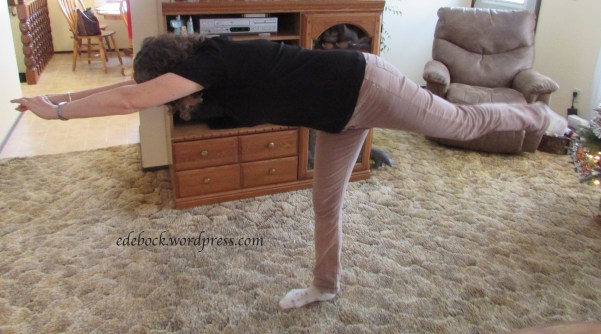
Day 1  –  Cross Balance

This pose was very similar to one that I’d been working on in a Balance and Mobility program that was recently offered by Alberta Health Services. Though I can hold it significantly longer than I could at first, I’d eventually like to be able to lift my back leg higher and keep it straighter.

Day 1 copy

Day 2  –  Side Shield

I honestly wasn’t sure I’d be able to do this pose and was delighted to find that I could!

Day 2 copy

Day 3  –  Bell

This one looked easier, but it wasn’t as simple as I thought it would be.

Day 3 copy

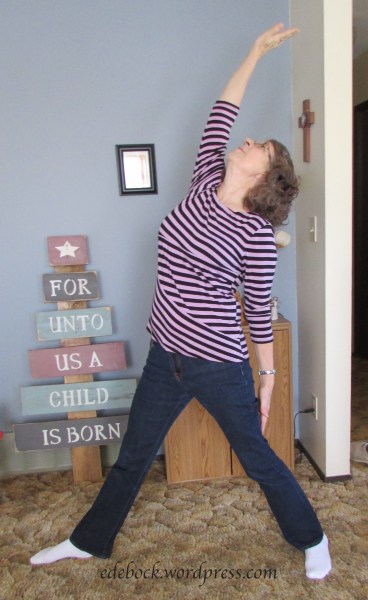
Day 4  –  Overcomer Side

I discovered after the fact that the palms of my hands should have been upward instead of down on this one which would have engaged different muscles. Oops!

Day 4 copy

Day 5  –  Candlestick

As opposed to being a static pose, this one involves slowing lowering yourself into this position and then reversing back up to a standing position keeping the heels lifted throughout.

IMG_6664 copy

Day 6  –  Sword

Carrie gave us two versions of this one and I opted for the simpler one. She advised that we not try the more advanced version unless we had first practiced this one sufficiently as it requires greater shoulder strength. Though lifting weights and paddling the kayak have given me fairly strong shoulders, I knew that I’d best leave the advanced version for the younger set and not take a chance on injuring myself. As on Day 1, I was surprised at how difficult it was to fully straighten my extended leg.

IMG_6668 copy

Day 7

Carrie designated Day 7 Blooper Wednesday. Her instructions were: Post your best blooper picture (if you’ve got one). Spend some time practicing 1 or 2 postures that you’ve worked on so far. Reflect on all the ways God is making you NEW and thank him for it 💕Since I’ve been weeding out photos and getting rid of ones I don’t want to keep, I didn’t have a blooper photo to post, but the latter part of her message resonated with me. Have you ever stopped to ponder how truly amazing our bodies are? Though my body is riddled with cancer and there are various parts that don’t work as well as they once did, I can walk, dance, kayak, hike, ride a bike, hug a loved one, lift weights, and bend into and balance in all sorts of poses! I can hear, see, taste, talk, think, and reason. I have so much to be thankful for! 

Day 8  –  Breastplate

Again, Carrie gave us two versions and this time I was able to do the more advanced one!

IMG_6679 copy

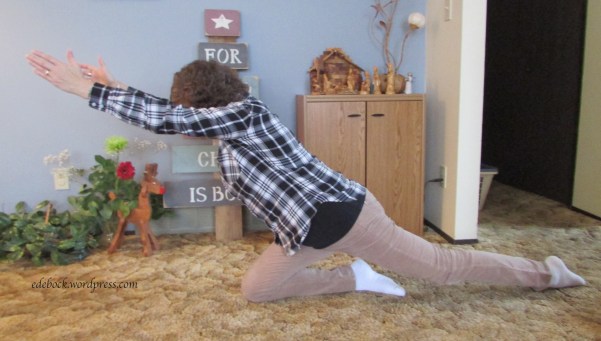
Day 9  –  Forward Dove

This one definitely needs work. Again, it was a challenge to get the extended leg as straight as it ought to be and I kept threatening to tip over before Richard could get a picture!

Day 9 copy

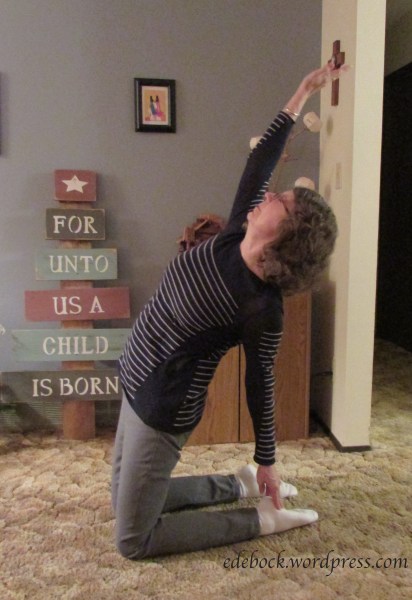
Day 10

By Day 10, the poses were getting more difficult and I wondered if I’d be able to do the final two! Carrie’s instructions for this one were to drop one hand or two to the heels. One hand I could do, but two was an impossibility! I simply can’t arch my back that much.

Day 10 copy

Day 11  –  Shield of Faith and Fire Extinguisher

Carrie gave us two poses to try on Day 11. The idea was to hold the first pose, Shield of Faith, and then drop one hip to the floor and move into the second pose, Fire Extinguisher. That one just felt like I was relaxing on the floor!

Day 11a copy

Day 11b copy

Day 12

As it turns out, I had nothing to worry about back on Day 10! The final two days weren’t too difficult after all. Overall, I’m pretty proud of what this 66 year old body was able to do.

Day 12 copy

If exercise, getting in shape, particularly increasing balance and flexibility, are on your list of New Year’s resolutions, I’d definitely suggest giving WholyFit a try. It’s more than just an exercise program as it offers faith centred health and wellness ministering to spirit and soul as well as body. If there isn’t a trained instructor in your area or you prefer to exercise at home rather than attending a group session, DVDs and video downloads are available on the website.

“Therefore we do not lose heart. Though outwardly we are wasting away, yet inwardly we are being renewed day by day.” 2 Corinthians 4:16

High heels? Yes or no?

LogoThere are very few topics that could be tagged Fashion, Health, and Politics, but today’s post will focus on one of them. I have very few positive things to say about our provincial government, but I do commend them for one recent decision. On January 1, 2019, changes to the Occupational Health and Safety Code will take effect banning mandatory footwear rules that pose health and safety risks to Alberta workers, particularly those in the hospitality industry.
“Mandatory high heel policies that can put workers at risks for slips, trips and falls and can become a workplace hazard are no longer acceptable,” Alberta Labour Minister Christina Gray announced recently. “We’re doing this after hearing from so many Albertans and workers who have had detrimental effects to having to work an eight-hour shift in high heels.” The new ruling isn’t about banning high heels; it’s about giving women the choice of whether to wear them or not.

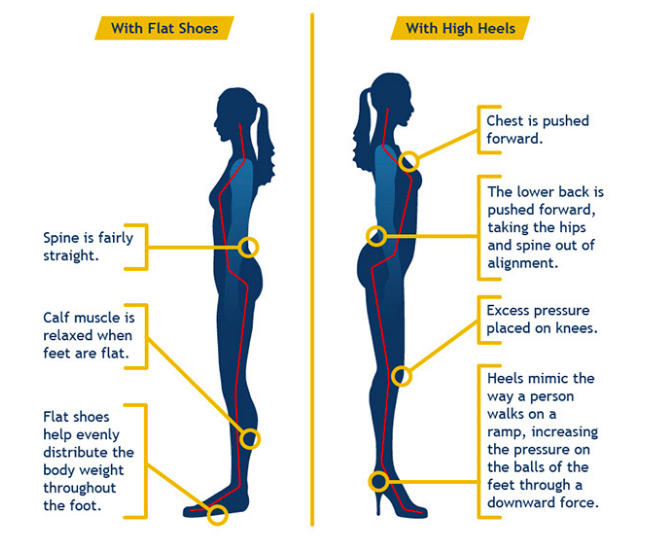
Since I’m significantly taller than my husband and I’ve always put comfort ahead of appearance, I seldom wear anything higher than a kitten heel. After reading about the toll that wearing high heels regularly can have on the spine, hips, knees, ankles and feet, I’m glad that I never got into the habit. Take a look at this graphic from the Florida Hospital Medical Group Spine Health Institute to see what I’m referring to.

Screen Shot 2018-12-05 at 9.15.41 PMLooking at the two profiles, it’s easy to see why men in particular tend to favour women in high heels, but is the increase in sex appeal worth the damage that they cause?

Studies have shown that by limiting the natural motion of the foot during walking, high heels can cause increased stress on the knees and may even contribute to osteoarthritis later in life. Similarly, if high heels are worn constantly, the spine’s ability to absorb shock can result in continued back pain. The vertebrae of the lower back may be compressed and back muscles over stressed. Wearing high heels too frequently can also cause the calf muscle to stiffen and the Achilles tendon to shorten which can actually make wearing flatter shoes uncomfortable. By putting a great deal of pressure on the ball of the foot and forcing the toes into a small toe box, high heels can cause or worsen many foot problems including corns, hammertoe, bunions, Morton’s neuroma and plantar fasciitis.

Does all this mean that women should never wear high heels? Not at all. Worn in moderation, for special occasions as opposed to every day, they are unlikely to cause any long-term physical health problems. So wear them to your upcoming Christmas parties if you like, just don’t wear them to work every day. On the other hand, there are so many cute flats available these days that you might not want to wear them at all!

corporate-heels-or-flats-for-womens


Radioactive again

10991307_10153055708750915_6654881605691342497_nI had my 11th PRRT treatment on Monday and once again I’m too radioactive to be in close contact with other people. For a week following each treatment I spend most of my time at home. I sleep in the guest room, have my own bathroom, and stay at least a few feet away from Richard at all times.

There’s nothing funny about cancer and high doses of radiation, but sometimes you just have to laugh. I pose a particularly high risk to pregnant women and children, but since there’s no chance of running into any of them at our weekly senior’s bowling league, I played yesterday but sat apart from the rest of the bowlers. There were some who knew exactly why, but others who were curious. One jovial fellow, noticing that I was sitting alone, commented, “I see you’re sitting back there with all your friends!” I hope he didn’t feel bad when he found out why I was keeping my distance. I thought his comment was funny! Then there are invariably questions about whether or not I glow in the dark! (I don’t) One friend laughed and said I must be a night light! I told him that that must be the reason that I’m not allowed to sleep with Richard! The glow would keep him awake.

In all seriousness though, I have scans the morning after each treatment to determine whether or not there has been any change to my tumours. In the past, I’ve been able to sit down with a doctor immediately afterward to discuss the results, but this time was different. Dr Sandy McEwan, head of the clinical trial that I’ve been part of since 2014 and the driving force behind bringing state of the art NET cancer treatment to Edmonton, has left the program. While I’m sad for myself and the rest of his patients, I’m happy for him that he has been able to relocate to Toronto where he will be closer to family. I knew a couple of years ago when he proudly told me that he’d become a grandpa that that day might come! His departure means that there isn’t time for the remaining doctor to meet with every patient both before their treatment and after their scans. That meant that this time I came home not knowing what they showed. While I was still able to laugh yesterday, the question was there in the back of my mind. Was this the time that the news would be bad?

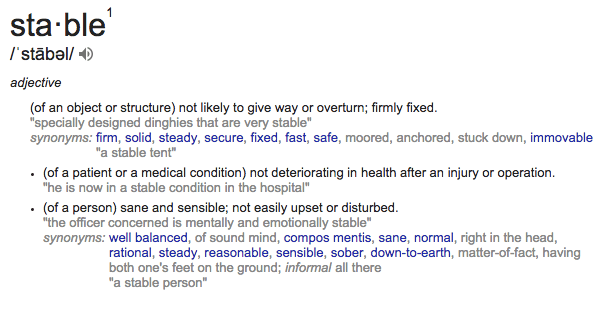
Thankfully, I wasn’t kept wondering very long. I chatted with one of the program nurses this morning and once again I heard that word that I’ve come to love; stable! There has been no change! Praise the Lord!

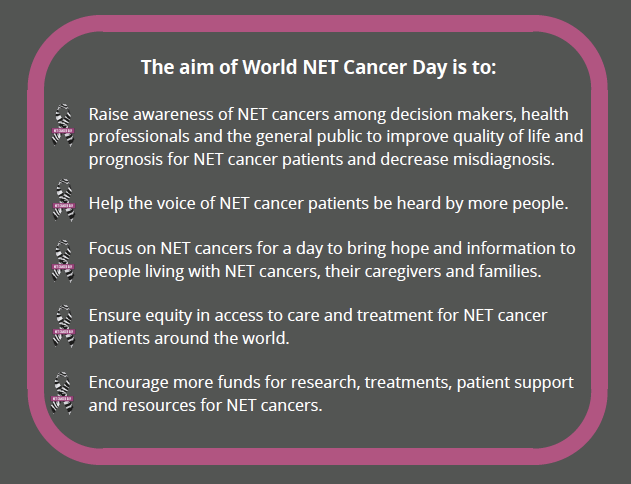
NET Cancer Day 2018

November 10 is World NET Cancer Day, a day set aside to raise awareness of neuroendocrine cancer, the disease that I’ve been fighting since 2013.

Screen Shot 2018-11-08 at 2.17.09 PM

Neuroendocrine (NET) tumours can arise in any organ that contains neuroendocrine cells including the stomach, intestines, lungs, liver, pancreas and appendix. While most commonly found in people over the age of 60, NET cancer can affect both men and women of any age. Though NETs is the fastest growing class of cancers worldwide, the symptoms are usually vague and similar to more common health conditions. As a result, NETs is frequently misdiagnosed as anxiety, menopause, Irritable Bowel Syndrome (IBS), asthma, or diabetes.

Screen Shot 2018-11-06 at 4.20.45 PM

Compared to most cancers, NETs is slow growing. It was estimated that I’d already had the disease for ten years when it was detected. I had been experiencing many of the common symptoms which include abdominal cramps, diarrhea, flushing of the skin, pounding of the heart, and wheezing or shortness of breath off and on for at least seven or eight years . Neither I nor my family doctor had any idea why. Like many general practitioners, he had never encountered a NETs patient before.

Almost 50% of patients visit a doctor 5 or more times before receiving a correct diagnosis! A recent study found that 58% of patients have advanced stage neuroendocrine cancer by the time they are correctly diagnosed. There is currently no cure for the majority of NET cancer patients, including me. Neuroendocrine cancers are complex and unpredictable. Once diagnosed, they require an expert and experienced multidisciplinary team of health care professionals to ensure the best possible outcome. Unfortunately, many patients, even in the world’s most developed countries, have difficulty accessing that kind of care.

ncd-logo-new

So what’s with the zebra? Everyone recognizes the ubiquitous pink ribbon as a symbol of breast cancer, but not all cancers are pink. Medical students are taught when hearing hoofbeats, to think of horses, not zebras, so the zebra was chosen as symbol of our lesser known disease. There are some patients and advocates who think it’s silly and would like to see us stop using it, but I think we need to take advantage of every opportunity to draw attention to our cause and if that includes zebra stripes, I’m all for it.

What can you do to help? You can help us spread awareness by simply reposting this on your blog if you have one or posting a link to it on your Facebook page. My fellow zebras and I thank you!


Having an Elijah moment

I don’t ever want to be one of those little old ladies in the nursing home who goes on and on endlessly complaining about her aches, pains, and infirmities to anyone who might be listening. On the other hand, while I’m determined to maintain a positive attitude, I’m not actually Wonder Woman and I do have my “Elijah moments”.

If you’re at all familiar with the Old Testament, you may remember the story of the prophet Elijah, who immediately after experiencing an amazing victory on Mount Carmel and defeating 450 prophets of the false god, Baal, flees into the desert when his life is threatened by the wicked queen, Jezebel. Exhausted and depressed, he sits down under a broom tree and prays to die. “I have had enough, Lord,” he said. “Take my life.” (1 Kings 19:4) Later, he goes on to say, “I have been very zealous for the Lord God Almighty. The Israelites have rejected your covenant, broken down your altars, and put your prophets to death with the sword. I am the only one left, and now they are trying to kill me too.” (1 Kings 19:10)

Poor Elijah! An emotional high followed by a crash. That’s what I call an “Elijah moment” and I can definitely identify!

As I shared in Wednesday’s post, I was elated to learn that afternoon that my cancer had not spread or grown. The very next day, however, I learned that my thyroid is no longer functioning as it should. I knew that this could happen as a result of my treatments, but it still seemed like one more in a long list of health related discouragements. In the past 5 years, since my first cancer diagnosis, there has been a second cancer, high blood pressure, prediabetes, osteopenia, and now hypothyroidism! Like Elijah, I felt like saying, “I have had enough, Lord!”

After all, I could argue that I have been very zealous about living a healthy lifestyle. I exercise regularly, I eat healthy, I don’t smoke, I drink in extreme moderation, I’ve never used illegal drugs. Heck, I don’t even drink coffee! Why me? Why another diagnosis? I was definitely having an “Elijah moment”!

But God didn’t leave Elijah under the broom tree wallowing in despondency. He sent an angel to give him food and water, then He let him rest. Later, He spoke to him in a gentle whisper, gave him someone to walk beside him and share in his work, and sent him out to continue. God wasn’t finished with Elijah yet and apparently He isn’t finished with me either! Within a few hours of learning about my failing thyroid, an email from a ministry that I’m involved with made that very clear. And so, like Elijah, I’ll keep on keeping on. I’m determined not to become that crabby little old lady who has nothing better to do than complain!

IMG_0243

Statue of Elijah on Mount Carmel – Israel trip 2016

Still stable!

Stable has become one of my favourite words! Not the kind you keep your horses in, but the word that my doctors use to tell me that my cancer has not grown or spread!

Screen Shot 2018-09-19 at 5.48.30 PM

I heard that word again today when I sat down with the doctor to discuss the results of the CT scans that I had back on August 21st. Waiting almost a month was difficult and I admit to having some episodes of scanxiety during that time. It was heaviest as I sat in the waiting room early this afternoon not knowing if the news would be bad or good. I had no reason to suspect that it would be bad; no symptoms to suggest that the tumours might be active or growing again, but the knowledge is always there that that day could come at any time.

When the doctor told us that everything continues to be stable, the load was lifted in an instant and I felt lighter than air! All the way home (a two hour drive) I felt as though, had my seatbelt not been fastened, I might have lifted right off my seat!

zebra with balloons

And so I keep on hanging on, living life to the fullest, and praising the Lord!


Five years and still very much alive!

Five years ago today I embarked on a new journey. That was the day that I sat on the grass beside a nature trail overlooking a beautiful lake while my doctor reluctantly told me that I had cancer! No, he wasn’t hiking with me. Richard and I were camping with our daughter and her children about three hours from home when Dr H phoned with the results of tests that I’d had done before leaving home the day before. We were planning to drop Melaina and the kids off in Calgary the following morning and continue on to Vancouver, but when I was told “this can’t wait” those plans suddenly changed. It would be another two weeks before I found out exactly what kind of cancer I had and even longer before I learned that it was incurable.

Five years is usually considered an important benchmark in cancer survival. Five years cancer-free or in complete remission has traditionally been seen as a milestone when a patient could say that their chances of having that cancer return was no longer likely. It’s a point at which they can, at the very least, be cautiously optimistic. But what of those of us who, barring a miracle, will never be cancer-free?

Sometime shortly after learning that I had cancer, we read that the average life expectancy for a neuroendocrine (NETS) cancer patient was five years following diagnosis. Well here I am five years later and still very much alive! Not only that, but as far as we know, the cancer has not grown or spread since that time. In fact, thanks to the PRRT treatments that I’ve been receiving, some of the tumours appear to have shrunk and one might even be gone altogether. I say “as far as we know” because I had CT scans last Tuesday and I won’t get the results until I meet with the doctor on September 19th.

As I reflect on those early days of uncertainty when I had no real expectation that I’d still be here today, I realize how very much I have to be thankful for. Immediately after diagnosis, I prayed for two very specific things: that I would live to see Melaina’s unborn baby (she was 10 or 11 weeks pregnant when I was diagnosed) and that I would see our youngest son married. I was definitely going out on a limb with that one as there was no young lady in his life at that time! Not only was I in the delivery room for Simon’s birth, but he’s now four and a half years old. I call him my “velcro” boy because whenever we’re together, he practically attaches himself to me. In addition, Nate has been married to our beautiful daughter-in-law, Colleen, for over three years.

So how does one celebrate five years of living with an incurable cancer? After all, it’s my cancerversary! I thought about planning a trip, something really momentous, but that didn’t happen. In fact, I’m not actually doing anything very special at all. The more I thought about it, the more I realized that whether you have cancer or not, every day is a gift. Every day is worth celebrating! The nurse was just here to give me my monthly injection. In awhile we’ll go out for lunch at The Wooden Spoon and then if the weather warms up a bit and the wind doesn’t blow too fiercely, we’ll take the kayak out on one of the lakes not too far from here.

Good news and then…

I’ve held off on writing this post for a little while because of the “and then” in the title, but here’s the latest update on my health. I had my tenth Lutetium treatment on Wednesday afternoon, spent the night in seclusion at the Cross Cancer Institute, and underwent follow-up scans early yesterday morning. After lying perfectly still under a warmed blanket (I love those warmed blankets!) while machines whirred around me taking detailed pictures of my insides, I sat down with Dr. Kounma to review the images.

These moments always stir up a bit of scanxiety. Rather than diminishing over time, I think that this has actually increased a bit in recent months. Shortly after I was diagnosed, we read that the average life expectancy for a NET cancer patient was five years following diagnosis. Better than a lot of cancers, I know, but I’m just a few months short of that now. Thankfully, the numbers have changed since that time. Last fall, Dr. MacEwan, head of my treatment team, presented at a NET cancer conference in Europe. By then, the time from diagnosis to disease progression (in other words, the cancer begins to grow and spread again) for patients who are part of the same clinical trial as I am, was 55 months. I passed that milestone a month ago.  This, too, is an ever changing number as more and more of us are meeting with success on this treatment plan.

Once again, the news was good! The post treatment images are not detailed enough to give exact measurements, but it was clear even to me that my cancer is not growing or spreading. In fact, if there has been any change at all in my tumours over the past few months, it appears to be for the better. We left the clinic rejoicing and praising the Lord!

AND THEN…

We were back home and it was four o’clock in the afternoon when the phone rang. It was Dr. Kounma. Apparently, when the radiologist reviewed the morning’s images, he saw something that appeared to be a partial obstruction of my small bowel. This was new since the CT scan that I had in February. Though I have exhibited absolutely no symptoms, Dr. Kounma’s instructions to me were “Go to ER for further evaluation today!”

YIkes!

That must have been one of the quickest ER visits in history! I left immediately for our small rural hospital, about ten minutes away and was back home again in little more than an hour. When I explained the situation to the intake nurse, she immediately picked up the phone and called my family doctor. He came over from his office, which happens to be housed in the same complex, and immediately reviewed the radiologist’s report online. His first comment to me when he saw me was, “Well you certainly look healthy for someone with a bowel obstruction!” He quickly determined that we were likely dealing with a red herring; that this was probably simply a false alarm. He was also quick to assure me that if there really was a blockage, it had absolutely nothing to do with my cancer. That was very reassuring. In fact, I wish that Dr. Kounma had thought to mention that.

Dr. Hanton decided that rather than jumping the gun and sending me back to the city for a CT scan, we would be best to take a wait and see approach. He told me the symptoms to watch for: vomiting, belching, abdominal pain, abdominal distention, lack of appetite, lack of bowel action, inability to pass gas. All of these would be pretty hard to miss if they began to happen. If need be, come back anytime, night or day, he told me and he even gave me his personal cell phone number in case I needed to get in touch with him!

18 hours have passed since the scans were completed and I’m still pooping and passing gas. (I bet you really wanted to know that, didn’t you?) It’s possible that there might be a partial blockage, but both doctors also assured me that these things sometimes resolve themselves. In the meantime, I’m thankful that my cancer is still stable and that, other than the usual post treatment tiredness, I’m feeling fine. Praise the Lord!