Reclaiming Christmas

The fact that the world has ‘stolen’ our Christian holy days and turned them into commercial extravaganzas has been one of my pet peeves for a very long time. Walk up and down the aisles full of Christmas decorations in any store and what do you see? Santas, reindeer, snowmen, and Disney characters galore. What do any of these have to do with the real meaning of Christmas? Look at the outdoor decorations in your neighbourhood. You might see a nativity scene, particularly in front of a church, but where is Christ in most of those decorations? What does an inflatable penguin or puppy have to do with Christmas? I don’t know either, but you can get one for just $19.98 CAD at Walmart!

Don’t even get me started on that stupid Elf on a Shelf! Whoever thought that one up did nothing but add more meaningless stress to an already over-stressed season for anyone who bought into it.

Don’t get me wrong. I’m not a total Grinch! I love Christmas lights. After all, it was Christ Himself who said, “I am the light of the world. Whoever follows me will never walk in darkness, but will have the light of life.” John 8:12 NIV

Though standing a tree in the house and decorating it with lights and ornaments often strikes me as a weird tradition, I also love the Christmas tree that stands in front of our living room window. Many of its decorations point to the true meaning of Christmas. That’s very intentional. It’s one small attempt at reclaiming Christmas.

IMG_0445

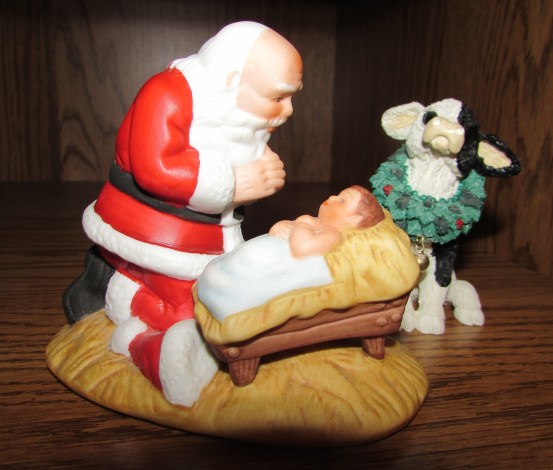
Although a beautiful nativity scene also has a place of prominence, our home isn’t completely devoid of the fun side of Christmas. Santa and one of his reindeer stand atop a cabinet in the living room. Surrounded by teddy bears and twinkly lights, he’s checking his list and preparing for his round the world gift giving flight, but it’s the little Santa bowing over the manger on another shelf that holds greater meaning for me.
IMG_0452

So what is the real meaning of Christmas? “I bring you good news of great joy that will be for all the people,” an angel told some shepherds keeping watch over their flocks outside Bethlehem that night so long ago; a night that would forever change the world. (Luke 2:8-10 NIV) That night the mighty Creator of the universe chose to come to earth in the form of a tiny babe, to live among us, and to show us who He really is. That night, He began His journey to the cross where He would pay the penalty for all our failures and give us the gift of eternal life with Him. There is no better gift than that! It costs nothing but the willingness to humble ourselves and surrender to His leading in our lives. That’s what Christmas is really all about! That’s true love and that’s why I want to reclaim Christmas. I can’t take it back from the masses who celebrate by overindulging and running up their credit card bills, but I can keep the love of Christ at the centre of my Christmas season.

When we were teaching in Japan, I asked one of my adult students why so many Japanese people celebrate the birth of a God they don’t believe in. “We love to decorate and we love to shop,” she told me. Perhaps that’s why most people celebrate a holy day that has no real meaning to them.

Why do you celebrate Christmas? What does it mean to you?


What is an Evangelical Christian anyway?

Christian terminology can be confusing even to Christians. We have a tendency to use words that aren’t part of the everyday vernacular of most people and sometimes we don’t even agree on what they mean!

When the word evangelical entered the conversation at our dinner table recently, a non-Christian guest asked what it meant. I was embarrassed to admit that I couldn’t readily come up with a clear and concise definition off the top of my head.

Then came the media reports of unprecedented flooding when Hurricane Harvey slammed into the coast of Texas forcing more than 30 000 people from their homes and leaving the area in a devastating state of emergency. When it came to light that Lakewood Church, one of the largest churches in the United States, pastored by televangelist Joel Osteen, allegedly refused to open their doors to hurricane victims seeking shelter, the media had a heyday. Mainstream and social media immediately began to paint all evangelical Christians with the same brush. Ignoring the fact that hundreds of them were, in fact, slogging through the mud and water striving to bring help and hope where it was so badly needed, evangelicals everywhere were suddenly uncaring hypocrites.

Please don’t get me wrong! If Lakewood Church did, in fact, turn a blind eye to those in dire need, they acted in a most unChristlike manner and deserve no one’s sympathy. Personally, due to conflicting news reports, I have no idea what really happened at Lakewood or why. I do know that I have problems with Joel Osteen’s theology as he preaches what is often referred to as the “prosperity gospel” or “health and wellness gospel” which teaches that that financial blessing and physical well-being will always come to those who have enough faith. This could not be further from the message of the Bible. Rather than guaranteeing them a life of ease, Christ told his followers that “In this life you will have trouble.” (John 16:33) If wealth was a legitimate goal for the Christian, Jesus would have pursued it himself. Instead, he was a poor itinerant teacher with “no place to lay his head.” (Matthew 8:20) In fact, the only disciple who concerned himself with financial wealth was Judas Iscariot.

I am not here, however, to defend or attack Lakewood Church or their pastor. I simply want to correct my own shortcoming and ensure that from now on when I use a term like evangelical, I know for sure what I’m talking about and can clearly communicate it to someone else!

So what exactly is an evangelical Christian?

Christian is the easy part. The term, first used in Acts 11:26, simply means a follower of Jesus Christ. But what makes us evangelicals?

That term comes from the Greek “euangelion” which means good news. An evangelical Christian, then, is simply a follower of Christ who believes that it is important to tell others the good news that through his death on the cross, Jesus Christ paid the penalty for our sins and that by his resurrection, he conquered death and provides everlasting life to all who follow him. It is a message of divine intervention; a message of hope for mankind who, no matter how hard we try, cannot save ourselves.

In the public arena, however, the phrase evangelical Christian is used in different ways, some of them derogatory. For some, it is simply a title used to differentiate between Christian denominations. Generally speaking, evangelical denominations are those that believe that the Bible is the inerrant word of God and that individual believers must accept Christ’s gift of salvation for themselves and enter into a personal relationship with God. For others, the term is equivalent to “wing nut”, “intolerant extremist”, or “right-wing, fundamentalist Republican”. There is no doubt that holding to the fundamentals of the Bible will result in a certain worldview, but being an evangelical Christian most definitely does not demand allegiance to a specific political party!

In reality, all Christians should be evangelical Christians; tellers of good news! The Bible very clearly instructs us “Therefore go and make disciples of all nations, baptizing them in the name of the Father and of the Son and of the Holy Spirit, and teaching them to obey everything I have commanded you.” (Matthew 28:19-20)