It’s so me!

IMG_7143

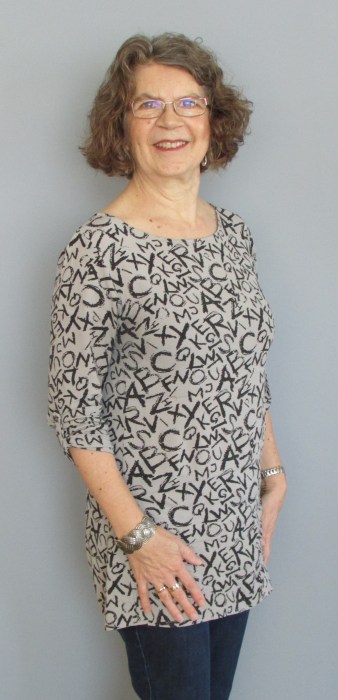
When I spotted this top in our local thrift store, I immediately remembered this post by Brenda Kinsel, one of my favourite fashion bloggers. Though the style of her coat isn’t something that I’d likely choose for myself, I loved the fabric.

BK-text-coat-from-Sonoma

Brenda Kinsel

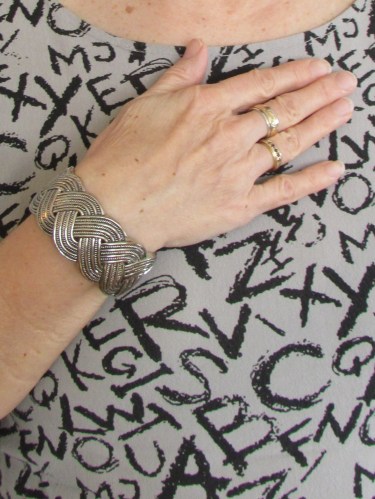
I love to read, I love to write, and I’m a self-professed word nerd. What could be more perfect than all those block letters on a comfy, eye catching top? It’s unique and it’s so me! My only regret is that I didn’t find it 15 years ago when I was still a language arts teacher! Wouldn’t the kids have loved it?

IMG_7142

Here, I’m wearing the top with a wide silver bracelet that was also thrifted.

IMG_7148

In my closet, this top is unique in another way. It was made in Italy!

Screen Shot 2019-02-16 at 4.27.29 PM

I’m always curious about any unfamiliar clothing lines that I find when I’m thrifting. A quick online search revealed that the Pistache designer is based in Toronto, Canada but all of the clothing is made in Italy. Sadly, while the “Made in Italy” label tends to suggest quality craftsmanship, I also learned that many of the garments that are made in Italy are stitched by illegal Chinese immigrants working in sweatshop-like factories in Tuscany.  Unfortunately, as is so often the case, I was unable to find out whether or not Pistache clothing is made in one of those. As much as I want to be an ethical shopper, it’s very difficult! In this case, however, I can comfort myself with the fact that my top was bought second-hand and was, therefore, at least a somewhat ethical purchase.

Logo


2018 fashion shopping review

LogoOn January 4 of this year one of my favourite bloggers, Sue Burpee, writer of High Heels in the Wilderness, published a post entitled Is It Possible To Be An Ethical Shopper? In it, she analysed the progress that she had made over the previous year in her quest to be a more ethical shopper and gave herself an overall mark of B-. By the time I was half way through reading her post, I had decided that I would keep a list of all the clothing purchases that I made this year and then analyse my own shopping habits. In addition to wanting to be a more ethical shopper, I was interested in finding out more about my spending habits and I wanted to be more intentional about wardrobe development.

Sue’s advice at the end of her post was

Plan carefully. Purchase wisely, not too much. Mostly quality.

And ethically… if possible. 

I divided my list into three categories: Clothing, Accessories, and Footwear. Within each category, I kept track of each item that I bought listing the date and place where it was purchased, where it was made, the regular price, and if it was bought on sale, the amount that I actually spent. I also indicated which items were thrifted.

So how did I do?

Alhough it’s difficult to find accurate information on women’s spending habits and it clearly varies from place to place, a survey of 1000 American women conducted by ING Direct and Capital One banks in 2012 found that most women, on average, spend somewhere between $150 and $400 on clothing per month, which equals approximately $1,800 to $4,800 per year. According to the research that Sue did for her post, the average American woman added 70 items to her wardrobe in 2013. Based on these statistics, I would give myself an excellent mark! In fact, I can’t even imagine spending or buying that much. All told, I purchased 35 wardrobe items in 2018. In addition to accessories and footwear, this included socks, underwear, and three badly needed bras. I paid full price for only 10 of the 35 items and I spent a total of approximately $1135 (CAD). Had I paid full price for everything, I would have paid somewhere around $2000. I can only give a rough estimate of that because I don’t know the original prices of the 5 thrifted pieces that I bought. For example, I spent $4.00 for a classic trench coat that would probably retail for $100 or more.
IMG_5731

Although I love thrift store shopping, I purchased fewer second hand items this year because I was determined not to continue filling my closet with impulse buys simply because the prices were fantastic. Instead, I spent more and focused on buying items that I needed and that could be worn at least three ways with things that I already owned.

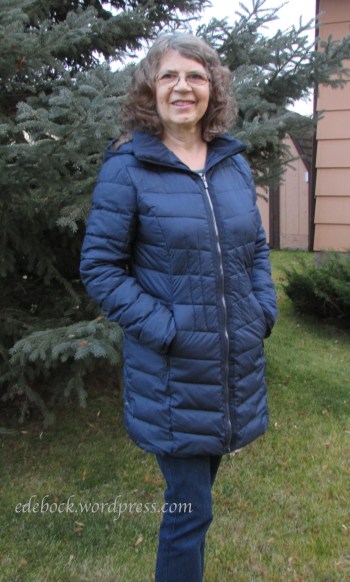
My most expensive purchase was my new winter coat. It was a planned purchase and I shopped around to find  exactly what I wanted. I paid the full price of $179.99, but considering cost per wear it will probably be one of my most economic purchases. By buying the coat when I did, I also received a $50 rebate on any item in the store which my husband was able to use for a new pair of jeans.
IMG_6504

I did purchase one item that I’ve never worn; a piece of costume jewelry that didn’t look as good as I thought it would with the items that I planned to wear it with. Thankfully, I bought it at half price and only paid $8.98.

Now, back to the topic of Sue’s post. She came to the conclusion that trying to shop ethically is complicated and discouraging and I completely concur. 22 of the items that I purchased this year were made in China and 5 in Vietnam, but were they made in sweatshops where workers are exploited and forced to work in unsafe conditions or are they manufactured in socially and environmentally responsible factories? It’s often impossible to find out. I’ve learned that retailers seldom respond to inquiries especially ones that touch on sensitive subjects like this one. I bought 8 cabi garments this year. I’ve been told by two different cabi stylists that their products are ethically produced, but I can’t find anything on their website to verify that. Likewise, I purchased 3 garments from another retailer who assured me that she carries only ethically produced clothing, but how do I know for sure and even if the garments are produced in safe and responsible factories, we have no way of finding out anything at all about the production of the fabric itself. As a result, though I very much want to be, I really don’t know if I’m an ethical shopper, so I won’t be as bold as Sue and attempt to give myself a letter grade for this year’s fashion shopping.

What are my goals for 2019?

  • I will continue tracking my purchases for the coming year so that I can review and evaluate my shopping habits again a year from now.
  • I would like to buy less and spend less.
  • I intend to buy basics that I need and items I love that work well with what I already have.
  • I will resist the pressure of friends to buy pieces that they like, but that aren’t right for me.
  • I will continue to buy quality pieces, not wasting money on fast fashion items that are poorly made and end up in the landfill after only a few wearings.
  • I will continue to write a weekly fashion post!

And finally, here are of a few of my favourite fashion purchases this year:


Can I wear it 3 ways?

LogoI frequently drop into our local thrift stores in search of used books, but invariably the clothing beckons and I have to take a look! I’ve been more disciplined in recent months, buying less and not filling my closet with impulse buys simply because the prices are irresistible. I’ve accomplished that by asking myself one simple question: Can I wear this at least 3 different ways with items that I already have in my closet? If so, it will probably be a good purchase. This doesn’t work for something like a special occasion dress, but it’s a good rule of thumb for most other wardrobe purchases, new or used.

On my most recent foray into a second hand store, this blouse caught my eye.

IMG_6600

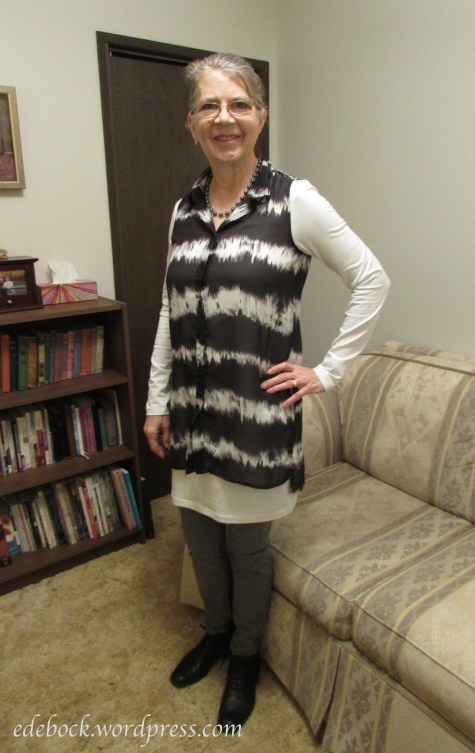
Could I style it 3 ways? Easily! It’s light and airy, so I could immediately visualize myself wearing it with capris next summer or perhaps sooner if we take a winter holiday to somewhere warm. It’s also long enough to wear over leggings or skinny jeans with some of my winter sweaters including the Prep Pullover that I showed you a couple of weeks ago. I decided to try it on.

On the way to the fitting room, I spotted this.

IMG_6599

A plain white cotton t-shirt dress. Could I style it 3 ways? I wasn’t sure, but I thought it would be a great layering piece and that it might actually look good under the black and white blouse.

What do you think?

IMG_6604

Even though I might have broken my 3 ways rule with the white top, both pieces came home with me and here I am wearing them with my light grey High Skinny jeans from cabi and a pair of black booties that were also purchased second hand.

Fashion math… thinking about cost per wear

LogoIf you’re like me, there have probably been times when you’ve stood in a dressing room trying to decide whether or not to buy an item because the price seems too high. It fits well, looks great on you, and you love it, but can you really justify spending that much?

That’s when you need to think about cost per wear (CPW). I was never very good at math, but this formula is so simple that even I can handle it!

Screen Shot 2018-08-23 at 11.56.29 AM

The simplest version involves dividing the price by how many times you estimate that you’ll wear the item. Of course, there are other factors to take into consideration. For example, does the item need to be dry cleaned. If so, it’s a good idea to factor that cost into the equation.

Screen Shot 2018-08-23 at 11.57.28 AM

Obviously, no one knows exactly how many times they’ll wear a particular item, but here are some questions that can help you estimate:

  • Where will I wear it?
  • Is it a single season item or something that I’ll wear year round?
  • Is it a trend that will likely disappear quickly or something that I’ll probably wear for several years?
  • Is it well made? Will it keep its shape and colour through multiple wears and washes or will it wear out quickly?
  • Will it play well with other items in my closet?
  • Will I get tired of it?

Let’s look at a couple of examples. I’m planning to buy a new winter coat this year. Imagine that I find the coat I want for $250. I live in a climate where winter lasts from late October until March. Unless I slip away to somewhere warm for a couple of weeks, I’ll likely wear that coat at least once a day all winter long, so let’s estimate that I wear it 150 times over the winter months. If I keep that coat for just one year, the cost per wear would be $1.67, but I’m likely to wear it for several winters so let’s multiply the number of wears by 3. Now I’m dividing $250 by 450 and the CPW is only 56 cents! On the other hand, if I spend $250 on a dress to wear to a wedding and I only wear it a couple of other times, the CPW is over $80! In my mind, the coat is a good buy, but the dress probably isn’t.

Here’s another way to look at it. Let’s imagine that you’re shopping for a basic black sweater and trying to choose between buying a high quality one for $120 or a cheaper, poorer quality version for $24. Which one is the better buy? As counterintuitive as it might sound, sometimes buying cheap is actually more expensive. If you would wear the more expensive sweater 200 times over the next few years, the CPW would be 60 cents, but you might only get 20 wears out of that cheaper sweater before it starts to pill, stretch out of shape, or even unravel. In that case, the CPW would be 83 cents. Clearly, the more expensive sweater is actually the better buy.

For CPW to work to your advantage, you have to love and enjoy wearing your clothes to such an extent that you’re willing to continue wearing them long term instead of constantly buying new ones; you have to be willing to make fewer and more intentional purchases. That’s the whole idea! Rather than forking over more and more of your hard earned dollars for cheap quality pieces that won’t last, you’ll spend more for clothes that will last longer.

Cost per wear isn’t a hard and fast rule. Splurging on something trendy that you won’t wear long term isn’t all bad. Getting dressed ought to be fun, so achieving a low cost per wear isn’t always the desired end, but it’s a handy tool to use, especially when you’re considering a major purchase or when sales racks tempt you to buy on impulse.

So next time you go shopping for clothes, shoes, or accessories, why not do the fashion math?

Summer sales!

LogoIt seems like summer has hardly arrived in our part of the world and already retailers are selling off their summer stock and preparing for the next season. It’s a great time to perk up your summer wardrobe at discount prices.

Those of you who have been reading my Fashion Friday posts for the past couple of years are aware of the fact that I’m a cabi girl. Cabi clothes, sold through direct sales, are fun, fashionable, and good quality, but they’re a bit pricey for this frugal fashionista. That’s why I love it when my cabi consultant holds her end of season sales!

On my recent visit to her beautiful in-home boutique, I came away with a couple of delightful buys. Today I’m wearing the Poet Blouse. I love the uneven hemline and the feminine flair of this ruffled bohemian top. The lightweight sheer poly drapes beautifully and gives the blouse an airy feel on hot summer days. Its muted colour palette of beige, soft pink, green, yellow and black adds versatility allowing it to be worn with many different bottoms.

Perhaps the most surprising and delightful aspect of the Poet Blouse is that it’s really two garments in one. Snap the tank top liner off at the shoulders and it can be worn on its own or mixed and matched with other garments. The overtop could also be worn over a different tank or camisole to add a solid colour at the neckline. The versatility is endless!

The tank isn’t limited only to summer. Under a cardigan or jacket, it will move right into fall with me.

Have you checked out any summer sales? Did you find any bargains?

Should I keep it?

LogoTwo of my favourite fashion bloggers, Pamela Lutrell who writes Over50Feeling40 and Jennifer Connolly of A Well Styled Life, write a weekly Would You Wear It feature in which they each post photos of a mannequin they’ve found and ask if their readers would wear what its wearing. Today I’m going to do something similar only instead of a mannequin, you’re seeing me and I’m asking Should I Keep It?

One of my fashion goals this season is to cull my summer closet removing older, worn, or unused items that are simply taking up space. This dress, purchased at one of our local thrift stores a few years ago, didn’t come out of my closet last summer and I’m debating whether to keep it or let it go.

IMG_5918

I don’t wear dresses very often but this one seems casual, bold, and a bit quirky, all things that I’d like my summer wardrobe to say. The bodice is a bit snug, but it’s just  loose enough around the midriff to hide the bulges that lurk there and I love the double slits front and back that make it cool, comfortable, and easy to walk in. Many women in my age range don’t like to bare their arms, but I love to go sleeveless in the summer.

IMG_5915

I’m wearing it with a favourite bracelet, a piece of wearable art that picks up the colours in the dress, and a pair of dark brown American Eagle gladiator sandals that were also second-hand.

So, what do you think? Should I keep the dress or pass it on? Please give reasons for your answer.

The classic trench coat

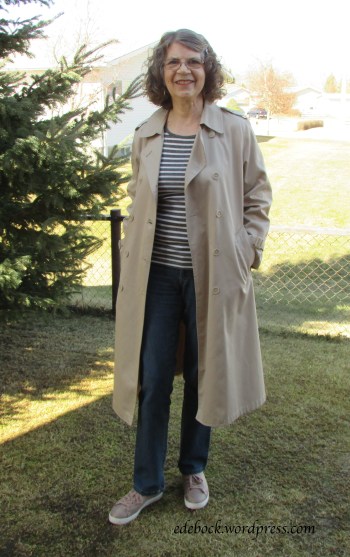
LogoSpring has finally arrived and with it comes the opportunity to put away my winter coats and start wearing the classic beige trench coat that I picked up for $4.00 at one of our local thrift stores a while back.

IMG_5759

The trench coat first appeared in the 1850s and by the turn of the 20th century, it had become an enduring fashion trend. During WWI, the coat shielded military officers from the unrelenting weather and the mud of the trenches; hence its name. Loved by the officers for its weatherproof qualities and its functional design which included large pockets that kept maps dry and strategically placed flaps that offered ventilation, the coat became popular with both male and female civilians after the war came to an end. Brigitte Bardot wore one, as did Marilyn Monroe, Jackie Onassis and Audrey Hepburn.

In Hollywood, the trench coat became associated with detectives. Humphrey Bogart wore one as detective, Sam Spade, in The Maltese Falcon in 1941 and later as private eye, Philip Marlowe, in The Big Sleep in 1946. Peter Sellers wore one as Inspector Clouseau in The Pink Panther in 1963, as did Gene Hackman as a private investigator in The Conversation in 1974. Even Inspector Gadget, a 1980s cartoon detective wore a trench coat!

A perfect go to for spring and fall, the trench coat is amazingly versatile. It can be styled with almost anything from blue jeans and sneakers to a dress and heels. Here I’m wearing a lightweight pair of dark wash jeans that have been part of my warm weather wardrobe for the past few years, my favourite Breton tee, and my new Sam Edelman sneakers that I’ve also been saving for spring. Though the photos make them look like they’re the same colour as the coat, they’re actually a lovely taupe rose.

There’s an unspoken fashion rule that says that even when the belt of a trench coat has a buckle, it should be tied, not buckled. In fact, the “buckle” on mine doesn’t actually  buckle at all. Google “how to tie a trench coat” and you’ll find numerous videos and tutorials showing a myriad ways to knot a trench coat belt. If you really want to use the buckle or you think it looks silly hanging there at the end of a tied belt, it is acceptable to buckle and tie as I’ve shown in the second photo above.

IMG_5755

How many is too many?

LogoI’m a little later than usual posting my weekly fashion piece today as I spent yesterday afternoon driving an hour each way to see my dentist instead of working on it. Thankfully, the tenderness and lump on my gum didn’t turn out to be an abscess as I feared it might and I won’t require extensive dental work! I’m also thankful that I don’t have to drive anywhere today. After listening to the wind howl all night we woke up to another dump of fresh snow. If you’re wondering why I’ve been complaining so much about this never ending winter, here’s a visual…

IMG_3981

March 20, 2017

IMG_5615

This morning… March 23, 2018

We’ve been golfing as early as April 8th, but this year I think we’ll still be snowshoeing! Hoping that spring will eventually come, I dug into the back of our entryway closet this week and took a look at my collection of warm weather jackets. I knew there were quite a few back there, but even I was surprised to find 23 of them! 23! Who needs 23 spring and summer jackets? Some are dressy, some are casual, and some are worn only for camping, but still, 23? At the very most, I can wear them for about 6 months of the year and I would hope that at least half that time I won’t need a jacket at all, so 23? That’s ridiculous! Obviously, this is the year to pare down that collection.

So, let’s take a closer look. What was in that closet?

  • 3 blue jean jackets
  • 1 grey denim with ruffles
  • 3 other cotton twill jackets (1 dark brown, 1 white, 1 patterned)
  • 4 leather jackets (1 black, 1 dark brown, 1 red, 1 white)
  • 1 faux leather 
  • 2 windbreakers
  • 1 fleece lined windbreaker
  • 2 quilted jackets (1 pale yellow, 1 olive green)
  • 1 anorak (so old that it’s back in style again!)
  • 3 hoodies (1 pink, 1 blue, 1 black)
  • 1 navy polar fleece
  • 1 trench coat

Just so you know that I’m not as big a spender as this makes me sound, all but 4 of these were either thrifted or gifted.

My question for today is how, when faced with a collection like this, will I decide what to keep and what to get rid of? Let’s begin by looking at trends. What do I have that fits with this season’s top looks? Three trends that I didn’t mention in last week’s post are anoraks, trench coats, and ruffles. Though I’ve had my light beige anorak for many years and I’ve worn it a lot, it’s still in very good condition and I still like it, so it will definitely stay. Though there are many versions of the classic trench coat available this season, they tend to be knee length or longer and quite roomy. Mine is shorter, almost a long jacket, and close fitting. It’s a bit snug on me and its one of those things that I actually think looks better on the hanger than it does on me. Trend or not, it will probably go. I had been thinking about getting rid of the grey denim jacket, but when I realized how trendy ruffles are this season, I decided to hang onto it for at least one more year.

Another important consideration is fit. When I featured my blue jean jackets a couple of weeks ago, I realized that one of them doesn’t fit as well as the other two. Since no woman really needs 3 blue jean jackets, that one will go.

Perhaps the best question to ask myself is which of these jackets do I love? Which ones will I actually wear often enough to make it worth keeping them? Brown used to be a staple in my wardrobe, but over the past few years, my love affair with brown has waned. Now I gravitate toward other neutrals instead. That means that the 2 dark brown jackets can probably go. One of the windbreakers hasn’t been worn for ages, so it should go too.

So far, that eliminates 5 jackets from the list, but 18 remain. In my mind, 18 is still way too many! What do you think? How many is too many and how do you suggest I choose a few more to get rid of?


The always stylish denim jacket

LogoIn the world of fashion there are trends like the bell sleeves that I wrote about last week, that are often short-lived, and then there are timeless fashions that never go out of style. I’ve been thinking a lot about one of those lately. Perhaps it’s the fact that winter seems to be going on forever this year, but I’m getting very tired of my winter wardrobe and I’ve been dreaming of the day when I can begin wearing my denim jackets again.

The jean jacket is a classic fashion staple that’s comfortable, casual, and easy to wear. Created in the United States in about 1880 by Levi Strauss, it was originally designed as a durable, heavy-duty jacket to be worn by cowboys, miners, and railroad workers. Over time, however, it has become a wardrobe staple for men and women alike.

I don’t suppose any woman really needs three blue jean jackets, but all of mine are thrifted (I spent a total of less than $10 on them) and each one is different. For the purpose of these photos, I’m wearing each of them with my grey striped Breton tee and dark wash jeans. Yes, you can wear denim-on-denim! Just make sure the washes are different.

My favourite is a traditional jean jacket from Gap.

The second one, from Jones New York, is made of very lightweight denim. It has snaps instead of buttons and the pockets give it a slightly dressier look. It also has a bit of elastic at the sides for a closer fit.

The third, from Fylo, is a fitted blazer style. Its brass buttons set it apart from the others, but the faded denim keeps it looking casual.

Not all denim jackets are blue, of course. Here’s one that comes in a wide variety of colours and it’s on sale right now. I love the Monticello Peach! This cute one in a floral print is also on sale.

My black denim jacket (also thrifted) from Bianca Nygard has appeared on the blog a couple of times in the past. With its silver sparkle and big blingy buttons it is super easy to dress up, but it can still be worn casually as shown here.

What’s not to love about a denim jacket? It’s stylish and amazingly versatile. You can wear it with almost anything, so don’t save yours only for casual wear. Here, the second jacket shown above adds an effortless, casual vibe to a much dressier outfit. I’m wearing it with the Treasure Dress from cabi’s Fall 2017 collection. I seldom wear heels, but I thought these ones, passed down to me by my very generous sister-in-law, added to the dressy summer look that I was going for here.

IMG_5538

Now, if spring would only get here!

Trying a trend

LogoThough I like to be aware of what the latest fashion trends are, I’m not one who jumps onto every new boat that passes by. For the most part, I want my wardrobe to be made up of timeless pieces that I can wear for many seasons. When I do decide to try something trendy, I’m often a bit late to the party.

Bell sleeves have been on trend for about a year now and I’ve been studiously avoiding them for a couple of reasons. First of all, I wore them back in the early 1970s. I distinctly remember sewing myself a bubble gum pink mini dress with voluminous bell sleeves. Somehow I couldn’t quite picture my 65-year-old self in a style that I wore when I was 20!

My second reason for avoiding them was practicality. I have nothing against the look, but unless the sleeves are short or three-quarter length, those bells get in the way. I simply don’t want my sleeves dragging in my dinner!

Bell sleeves aren’t going anywhere in a hurry though. They’re definitely sticking around for spring and summer 2018, so when I found this top on a Northern Reflections sales rack for 75% off its regular price, I couldn’t resist.

I love the colour, the fit is perfect, and at less than $20, what did I have to lose? The bells are smaller than many and if I get tired of them or the trend passes quickly, I can simply cut them off. I think this top would look equally good with three-quarter length sleeves.