Eating Kosher

I knew that I would be asked what the food was like in Israel, so this time I was prepared and even took pictures! We ate all of our breakfasts and suppers at our hotels while lunches were enjoyed in restaurants wherever we happened to be at the time. I can say without hesitation that the food was delicious, nutritious and kosher!

So what does it mean to eat kosher? Essentially, it means eating according to the dietary laws given in the Old Testament, or Torah. I was already aware that this meant only eating meat from animals that both have cloven hooves and chew their cud, avoiding all seafood except fish with fins and scales, and avoiding eating meat and dairy together. I’ve learned, however, that eating kosher is much more complicated than that and that even amongst Jews, there are many different ways of interpreting and following the dietary rules.

For example, when it comes to meat, it isn’t only a matter of which animals are eaten, but also how the animal is slaughtered and how the carcass is prepared for butchering. Some birds are kosher, while others are not. The eggs of kosher birds may be eaten, but only if they contain no blood which means that each egg should be examined individually. All dairy products must be derived from the milk of kosher animals. Hard cheeses pose a problem because an essential ingredient in their production is an enzyme called rennet, which is normally derived from the stomach of an animal. Some rabbinic authorities maintain that the enzyme is so separated from its original source, that it should not even be considered a meat product. Therefore, these authorities believe that it is permissible to eat cheese that was made with rennet. Others, however, believe that rennet still constitutes a part of an animal, and thus cannot be mixed with milk. Eating processed food is particularly troublesome because one must be sure that every ingredient, no matter how much or how little the product contains, is kosher.

Generally, all fruits and vegetables are kosher, but again, we learned, in Israel, that it isn’t quite that simple. There, these products are only considered kosher if 10% of the crop is left on the plants, bushes or trees around the perimeter of the field or orchard at harvest time for the use of the poor in the community and if the land is left to rest every 7th year. Fruits and vegetables must also be very carefully checked for insects as they are not kosher. Drinking wine or grape juice that has been produced by non-Jews is also forbidden.

There are those who claim that God established the dietary laws to protect the health of His people and that, for this reason, we would be wise to follow them. I don’t believe this to be true. Though there may have been some health advantages to some of the laws in the days before refrigeration, there is nothing less healthy about eating camel or rabbit than eating beef or chicken. I believe that it was simply God’s intent to distinguish His people from those around them and to teach them obedience. I am, therefore, in agreement with those Jews who say that they eat kosher simply because God told them to and for no other reason. How thankful I am that as New Testament believers, we are not subject to the Old Testament dietary laws. God made that very clear to the apostle Peter in a vision while he was staying at the house of Simon the Tanner in Joppa. (Acts 10:9-16)

All meals served in the hotels where we stayed were kosher. Each hotel is under the supervision of its local rabbinical council and should they ever be caught serving anything non-kosher, the penalty would be severe.

So, what did we eat? The meals were similar at all four of our hotels. Breakfasts and dinners were sumptuous buffets with a myriad of wonderful choices. It’s only in the west that breakfast is an entirely different meal from lunch and supper. For example, when we lived in Japan, if we asked our students what they ate for breakfast, the answer would most often be fish and rice. If we asked what they ate for dinner, the answer would usually be the same. This appeared to be true in Israel as well. Though cereal and toast were available at breakfast time and our last hotel had a station where yummy looking omelettes were made to order, breakfast also included a complete salad bar! Cottage cheese, yogurt, various cheeses, buns and breads were also part of the breakfast menu, but so were fish, olives and a variety of hot dishes. Coffee and a variety of teas were also available.

I think I could have lived off the salad bars alone. I started each day with a plate filled with salad, a dollop of cottage cheese, a few slices of cheese and a bun or a slice of hearty bread. When that was done, I finished off with a taste of a one or two of the hot dishes.

We were thankful for the hearty breakfasts as our days were full and we did lots of walking and climbing. Lunch was most often a pita filled with either falafel (spiced mashed chickpeas formed into balls and deep-fried) or schawarma (roasted, shaved meat) and vegetables. Simple, but tasty and filling.

Dinner was usually fairly late. After a busy day, we were ready to load up our plates again!

Again, I filled a plate at the salad bar and then went back for a smaller serving from the many hot food choices. Meats most often included fish, chicken and beef. The dessert selections looked absolutely amazing, but I didn’t take any pictures as I didn’t want to linger over them too long! I managed to stick to my low sugar diet most of the trip. Three of our four hotels offered sugar free dessert options which was nice. When I didn’t see any on offer at our last hotel, I asked, and after a long wait, I was brought a piece of very dry, plain cake that was still slightly frozen in the centre. After that, I didn’t ask! I did break my diet twice, once when we celebrated our youngest group member’s 16th birthday with a lovely cake and once when I tried a teeny, tiny chocolate eclair because everyone else was raving about them. It was well worth it!

Though the reason for my diet is the fact that I’m pre-diabetic, I was pleased to discover that in spite of eating so well, I didn’t gain any weight while we were away!
 

Cultural surprises

Sheila has been with us for over two weeks already but she continues to be amazed by something new almost every day. In her eyes, my kitchen is a magical place. Most of the small appliances and gadgets that we take for granted are brand new to her. Like most Chinese kitchens, the one in her parents’ home doesn’t have an oven let alone a toaster, a bread maker or a food processor. Her eyes nearly popped out of her head the first time she saw me using my electric knife!

It’s not only the appliances that surprise her, however. Most of our food is also new to her. Though she’s familiar with a lot of the ingredients, we cook them entirely differently and even I’ve been surprised at how many convenience foods I use. We tend to eat a healthy diet avoiding a lot of processed foods but I do depend on things like pancake mix that are completely foreign to her. Breakfast cereal is also something she’s never eaten before. So far, Harvest Crunch, a sweetened granola with coconut and almonds, is her favourite. She’s accustomed to a spicier diet than ours and the ketchup bottle has become her best friend. In fact, she’s dubbed herself a “ketchupholic”!

The rest of the house contained many surprises for her too. Not unexpectedly, even though I’d explained the bathroom to her the evening she arrived, it took a flooded floor to remind her that the shower curtain must be inside the tub when you take a shower! That’s a common blunder for Asians when they first arrive on our shores as an Asian bathroom is basically an oversized shower stall and bathtubs are not common in China.

Laundry brought more surprises. Though we had a fitted sheet on our bed in China, Sheila had never seen one until we stripped the beds to wash the sheets! She thought I must have sewn the elastic corners myself. (In case you were wondering, fitted sheets were actually invented by an African American lady named Bertha Berman in the 1950s.) The clothes dryer also fascinates her as clothing is hung to dry in China.

That brings me to a topic that has been a big surprise to Richard and I. When we lived in China, we were amazed to see people in the street wearing their pyjamas. What we didn’t realize until Sheila came to stay is that Chinese people wear their pyjamas whenever they’re at home! Sheila only dresses to go out and immediately changes back into pyjamas when she gets home. Of course, if you’re just stepping out to run a quick errand, why bother changing at all? Sheila has been out with me more than once now in her pjs and I finally understand why we saw people walking down Little Street dressed that way!

While we continue to learn much about Chinese life from Sheila, it’s definitely been fun looking at our own lives through the eyes of someone for whom almost everything is brand new!

Little Street

According to the signs,the street below our apartment is called Lanqing Jie but to English speakers in the area, it’s known as Little Street. How can I possibly put it into words that will bring it to life for you? Pictures will help but without the sounds and smells, something is missing. Little Street really must be experienced to be fully appreciated but since you can’t all come to visit, I’ll try my best to describe it.

Close your eyes and imagine the sound of a crowd such as you might hear at a sporting event. Now add intermittent horns honking, the occasional rumble of an old truck or the sound of a motorcycle passing by, and if you can hear it, the sizzle of food hitting a hot grill. As darkness falls, add music pouring from the open doors of a nearby restaurant and the sounds of bottles clinking and voices rising as some of the patrons enjoy the open air seating across the street. Little Street is usually quiet for a few hours in the middle of the night!

Then there are the smells, most of them emanating from the various food stands along the street. Barbequing skewers of meat over hot coals is very popular and usually smells pretty tasty but sometimes billows of smoke fill the air. Occasionally the smell of overheated cooking oil forces us to close our windows.

You can buy almost anything on Little Street. In addition to the restaurants and food stalls, there are several fruit and vegetable stands and lots of permanent businesses as well as the vendors who simply set out their wares along the curbs to sell. There’s a pharmacy that’s clean, bright and well organized but most of the shops selling clothing, hardware and other household items are tiny and crowded. The scene is a constantly changing one. Where fast food was being sold a few days ago, a new beverage shop called Miss Milk is now celebrating its grand opening.

Though Little Street seems pretty unique to us, there are thousands of streets just like it in hundreds of cities across this country! It’s just one of the many faces of China.

Gambei!

Who knew that I would have my very first taste of Canadian ice wine while living in China? Life is full of the unexpected!

I didn’t expect to meet Richard Guo, founder and president of EIE (Education in English), the company that employs us to teach English at Liaoning Normal University while I was here in Dalian either. After all, he makes his home in Mississauga, Ontario.

The day before yesterday, however, while we were relaxing at home the phone rang and we were informed that Mr. Guo was at the school and wanted to meet us. We were asked if we could come right away and, of course, we did. He started by telling us that he wished we weren’t leaving at the end of this term and that we are welcome to return to China and to EIE at any time in the future. We’d been told that already but we didn’t expect to hear it directly from the top dog! He went on to explain that the company is expanding and that he was actually in China to sign an agreement to begin offering English instruction to nurses in training at Dalian Medical University. If plans proceed as expected, nursing students who study English with EIE will be able to take their first three years of training here and then transfer to an affiliated college in Ontario to complete their degree. After explaining all of this, Mr. Guo invited me to join him at the official signing ceremony which was to be held this morning! That was certainly unexpected!

At 8:30 this morning, Mr. Guo (pictured on the left below), our supervising teacher Cliff, and I met at our school gate where we were picked up by a very comfortable van from the medical university and taken to the new campus overlooking the ocean at Lushun which is about an hour from here at the tip of Liaoning Peninsula. It was a bright sunny morning and the drive reminded me of travelling through parts of British Columbia.

When we arrived at our destination, we were greeted by an English speaking staff member who took us on a short tour of the campus before accompanying us to the very formal boardroom where the ceremony would take place. Cliff and I didn’t really know what to expect but we felt a bit like visiting dignitaries as we were ushered about with great decorum. In reality, I think I was only there as the token Canadian and because I had no classes scheduled until late this afternoon!

Cliff and I had no active role in the actual signing ceremony but we were each provided with a translator to explain the key points of the speeches and discussion that took place before the documents were signed and sealed. Our delegation sat across the long boardroom table from the president of the medical university, the director its school of nursing, the head of its foreign languages department, the director of teaching, the president of a separate but affiliated school of nursing and one or two other important individuals. As soon as the ceremony was over, most of them rushed away to other meetings related to the fact that it’s graduation week at the university. We relaxed over tea until most of us reconvened for lunch in a private dining room with an ocean view.

Lunch was a most interesting affair. It was by far the fanciest and most beautifully presented meal that I’ve enjoyed in China. Though there were a wide variety of dishes, seafood was featured prominently. I’m not overly fond of jellyfish but I took a bit to be polite and it was better than any I’ve had before. The abalone soup, scallops on the half shell and sweet and sour prawns were heavenly. Lunch really wasn’t about the food though. Between delicious morsels, we toasted everyone and everything that had anything at all to do with the new agreement! That’s where the ice wine came in. Richard Guo brought it all the way from Canada for the toast that he proposed! We used a lovely red wine for all the others. We were constantly out of our chairs clinking glasses and declaring Gambei! (cheers!) Even Cliff and I got into the action. When my turn came, I congratulated both sides of today’s agreement telling them that in addition to benefiting them, it will also help alleviate Canada’s nursing shortage which is expected to worsen in the next few years as more and more nurses reach retirement age. I told them that, as part of Canada’s aging population, I appreciate the fact that they plan to send well trained young nurses to help take care of me in my old age!

Gambei!

Dragon Boat Festival

Today was the first day of China’s three day Duanwu or Dragon Boat Festival holiday. The festival itself which falls on Wednesday, commemorates ancient China’s patriotic poet, Qu Yuan, who lived from 340 to 278 BC. Though stories vary somewhat, according to legend, Qu was accused of treason and banished from the ancient state of Chu for failing to support the king’s proposed alliance with the increasingly powerful state of Qin. During his years of exile, he wrote many enduring patriotic poems. When the state of Qin later captured the capital of Chu, Qu committed suicide by drowning himself in the Milou River. HIs death occurred on the 5th day of the 5th month of the Chinese lunar calendar which this year falls on June 12. Apparently the festival takes its name from the idea that people rowed their boats out into the river in an unsuccessful attempt to either save their beloved poet or retrieve his body.

At the beginning of the semester, when I saw the Dragon Boat Festival on our school calendar, I had visions of watching colourful boats filled with rowers racing on a local waterway. Sadly, that doesn’t happen in Dalian.

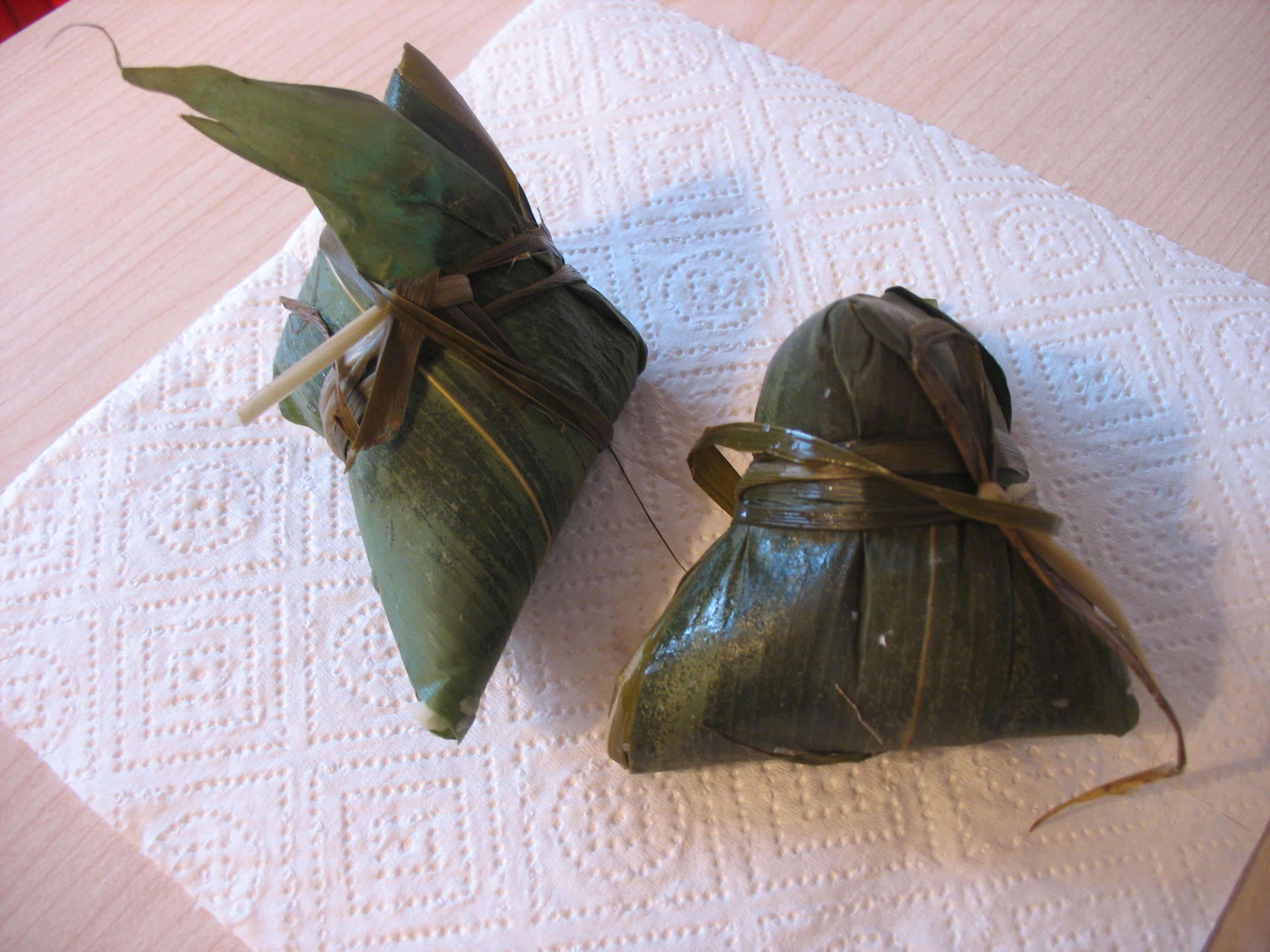
It would seem that the primary way that people here celebrate the festival is by eating zongzi, triangular packets of glutinous rice wrapped in bamboo leaves. The stores and markets have been filled with them for the past few days. It is said that this tradition originated when local people dropped sticky rice packets into the river to feed the fish and keep them from consuming Qu’s body!

We were given several homemade zongzi yesterday. Though the rice tasted okay, having taken on a mild grassy flavour from the bamboo leaves, we weren’t very impressed by its texture. For me, the word glutinous even sounds gluey and that’s exactly what it was!

A second tradition is the wearing of five-coloured silk cords around the wrists. These are being sold everywhere right now by women who have obviously been busy making them by hand. I bought mine for 1 yuan (about 17 cents) each and will wear them on Wednesday. Apparently, when the festival is over, they’re supposed to be cut off and thrown away to get rid of bad luck.

When we went down to the street market to pick up vegetables and meat this morning, we noticed lots of bundles of leaves being sold. We guessed that they too must have something to do with the festival. They didn’t look very edible and we had no idea what their purpose was until I read up on the celebration online and learned that they were mugwort leaves and calamus. Apparently, people put bundles of them over their doors to protect themselves against disease. I wonder if they have any effect on shingles? Perhaps I should have bought some! Actually, the stems and leaves of these plants are said to dispel an aroma that is thought to purify the air and discourage flies and mosquitoes so perhaps there’s something to the tradition.

Although this festival has long been part of Chinese culture, the government of the People’s Republic of China, established in 1949, refused to officially recognize it as a public holiday. It was only reinstated as a national holiday in 2008. Since it falls on a Wednesday this year, many people, including us, worked on Saturday and Sunday so that they could have today and tomorrow off and make it a three day vacation.

Since our tour of China is coming up soon, we decided not to go anywhere this holiday. Instead, we’re staying here in Dalian and being tourists in our own town but I’ll share more about that in future posts.

Duck soup and purple bread

A couple of Sundays ago, we went out for lunch with a colleague of ours, a self-professed foodie, and his wife. In addition to eating at a restaurant that they’d found the week before, we also visited a little takeaway kiosk across the street where we were able to buy a whole roasted duck for under $10. This wasn’t just any old duck though. It was Peking duck and came complete with the paper thin wraps and the soy based hoisin sauce that are part of this most famous of Chinese meals.
After choosing our duck, we watched in fascination as the proprietor used her razor sharp cleaver to cut it up and slice the meat into tiny thin slices. In a matter of minutes, she was done and there was hardly any meat left on the bones. We ate well that night and the next and had enough left over to freeze for a third meal at a later date! It was delicious!

The bones also came home with us and went into the freezer. I boiled them this morning and made broth that left the apartment smelling absolutely wonderful. Some of it went back into the freezer to flavour a future rice dish and I used the rest to make soup for tonight’s supper. I love making home made soups. Every one is a little bit different, depending on what ingredients I have on hand. This time, I didn’t even have to worry about adding any seasonings. There was enough of the skin in this morning’s pot to carry the delicious flavour of the seasoned glaze that the duck was coated with before it was roasted through to the soup pot.

At home in Canada, I would probably have made biscuits or corn bread to go with the soup but here I have neither the ingredients or an oven to cook it in. Bread would have to do but tonight’s wasn’t just any bread. The first time we went to the supermarket here, we were fortunate to find a whole grain bread that’s baked on site. We’ve been enjoying it ever since but when we went shopping yesterday, the store was out of it. The time had come to try something new, something that I’d been eying with curiosity for quite some time, purple bread! At first glance, I thought it had bits of nut in it but on closer inspection I realized that it was sweet red bean which would also explain the bread’s unusual colour. Though we’ll continue to buy the whole grain product most of the time, its slightly sweet flavour was a nice change and went surprisingly well with the duck soup.

My love/hate relationship with Chinese food

Simply said, Chinese food is delicious! Absolutely delicious! In the past three months, I can only recall one dish that we didn’t enjoy. It looked tasty and there was nothing wrong with the flavour but it consisted mainly of gristle on bone. We didn’t know for sure what it was but we called it knuckles because that’s what it most resembled!

There are a myriad of tiny restaurants within a few blocks of our apartment where we can easily buy a meal for the two of us for significantly less than $10. If we weren’t as health conscious as we are, it would be easy to eat out even more often than we do, especially considering the limited cooking facilities we have here at home.

China is a huge country, of course, and cuisine varies from one region to another but in general, a Chinese diet is heavy on rice and noodles. We do our best to balance the carbs with healthy amounts of meat and vegetables but there’s not a lot we can do about the fact that almost everything seems to be cooked in oil.

I know that there are healthy and not so healthy cooking oils but then there’s Chinese cooking oil! The following is a direct quote from our trusty Lonely Planet guidebook. Be forewarned! If you have a delicate stomach, you may not want to read it!

"In 2010, diners in China were appalled to discover that one in 10 meals cooked in Chinese restaurants was prepared with cooking oil dredged up from sewers and drains. Oil is lavishly employed in Chinese cooking and generates considerable waste.

This waste oil is harvested by night soil collectors who scoop out the solidified oil from drains near restaurants and sell it. The oil is then processed, sold to restaurant owners and it re-enters the food chain…

Once used again, there is nothing to stop the waste oil from being harvested afresh for further recycling. At present, no regulations preventing the recycling of waste oil exist in China."

Yum!

Food scandals abound in China. A couple of them have made headlines in China Daily, the English language newspaper that we read regularly. Several food stores in Shanghai have been temporarily or permanently shut down for selling fake mutton made from fox, mink and rat meat! We’re a long way from Shanghai and I don’t care much for mutton so we’re not likely to be affected by that one.

We watched with great interest when a restaurant below our window underwent a complete makeover recently and we looked forward to stopping in for a meal when it opened for business. Even after one of our students told us that the sign indicated that it served "everything from a sheep" we thought we’d give it a try but they lost me with the severed goat’s head! It was on display on a table out front one morning when I visited the street market and it remained there all day! Though I was tempted to take a picture, I didn’t, so you’re spared that gruesome sight! It seems to have been effective advertising though. The restaurant has been doing such a booming business that they’ve erected some temporary shelters on the sidewalk across the street and serve their overflow customers there. When we go to bed at night, there are still patrons enjoying whatever it is that they serve!

Then there’s the tainted rice scandal that hit Guangdong province recently. An inspection campaign found that the cadmium levels in six batches of rice and two batches of rice noodles produced in two different factories exceeded national standards. Cadmium is a carcinogenic substance often used in fertilizer. Fortunately, no cadmium poisonings have been reported.

Armed with this kind of information, how can we stand to eat at all? It’s easy… as I said, the food is absolutely delicious and miraculously, my somewhat finicky stomach hasn’t bothered me a bit since we arrived in China! If we are what we eat, I guess we’re a little bit gross right now but I keep telling myself that we’re only here short term and that our bodies will clean themselves out when we get home.

Yes, I definitely have a love/hate relationship with Chinese food!

Field trip!

Spring… the time of year when teachers often take classes on field trips.

Imagine a field trip where the pupil teacher ratio is 1:1. Now imagine that there are only 4 students, all girls and that they’re in their late teens! I’m sure my Canadian colleagues who are busy herding groups of 20 or more children through museums, historic sites and other educational venues would have seriously envied us today!

This afternoon’s Class A field trip was a "western picnic" partially planned by the girls themselves. We rode the bus to beautiful Children’s Park. I’m not sure why it’s called that. It was occupied mainly by seniors including some in wheelchairs who appeared to be on outings from a nearby care centre, and other than a small playground/amusement park area in one corner, there wasn’t anything specific to appeal to children. It was, however, a lovely spot for a picnic.

In addition to teaching them English, we’re also trying to introduce our students who plan to study abroad to western culture so our menu didn’t include any Chinese food. Instead, we ate sandwiches, potato chips, cookies and miniature chocolate bars. If we could have, we would have introduced them to s’mores but even Carrefour, the French department store that carries some import foods, didn’t have the ingredients nor did we have anywhere to roast the marshmallows.

After lunch, we had a photo scavenger hunt. Each student/teacher partnership had eleven items to find and photograph. The list was, of course, in English. Finding "something fuzzy" is a challenge if you don’t know what the word fuzzy means! I explained to my partner that it meant soft, like an animal’s fur and we set off to see if we could find the cute little puppy that had passed by while we were eating. It was nowhere to be found and I was very proud of Sheila when she spotted the poplar fuzz gathered along the edge of the sidewalk and asked, "Is that fuzzy?" We were the last to return to the starting point with our list completed but we were declared the winners because our pictures were the best! Yay!

Next came a word game. Each of us was shown a word but one person’s was different from everyone else’s. Without giving away it away, we had to take turns saying simple sentences about the word until we could guess whose was different. With word pairs like shampoo and conditioner, bread and cake, and orange and tangerine, it was tricky and the girls had to think hard to come up with good sentences. There was lots of laughter and good-natured bantering and though the senior ladies sitting near us had no idea what we were saying, they clearly enjoyed watching the girls’ enthusiasm.

Yes, this was definitely the most relaxing field trip I’ve ever been on!

The pattern of snack

Have you ever noticed how often we use the word usually? I hadn’t until I came to China to teach English and immediately noticed that the Chinese always say urally! I have no idea how the r sound crept in but apparently that’s the way all Chinese English teachers teach it. Wrong habits are hard to break and our students still need to be reminded once in a while but after lots of practice they do know how to pronounce it correctly now.

Though urally was one of the most common mistakes made by our students, who have never been taught by native English speakers before, we have encountered many other mispronunciations. Vowel sounds are particularly difficult. It isn’t any wonder considering the fact that one little letter like an a or an o can represent so many different sounds. Sometimes these mispronunciations lead to a complete lack of understanding but we also have a lot of fun with them.

Early in the term, one of my students told me that he liked eating snakes! I clearly remember being somewhat startled but this is China, after all! We’ve eaten bullfrog and catfish, restaurants serve silkworms and there’s one not far from here that specializes in donkey meat, so why not snakes? When I attempted to clarify, however, I discovered that he actually meant that he liked eating snacks! As it turns out, the snake/snack confusion is a common one and has led to lots of laughter in our classes!

Is it any wonder then that the headline "Snacks Dominate the Fashion World of This Early Spring" caught my eye when I picked up the April issue of Sichuan Airline’s in-flight magazine on our recent trip to Jinan. The magazine is published in Mandarin but some of the articles are translated into English. Clearly, they could use a more qualified translator but this particular article was hilarious! Here’s just one tidbit:

"It is the year of the snack, patterns of reptile animals have crawled back to the fashion world of women’s wear in spring and summer, among which the pattern of snack turns out to be the most popular. It seems like designers have already foreseen that the pattern of snack would be a fashion trend, this eye-catching animal pattern is now seen in all fashion fields."

The article was accompanied by photos of clothing with a snakeskin motif as well as snakeskin purses and shoes!

I haven’t been following most of my favourite fashion blogs lately because both WordPress and Blogspot are blocked in China. It’s also been several months since I’ve seen a fashion magazine so I don’t know whether or not snakeskin has caught on as a new fashion trend in North America. I haven’t actually seen it being worn here yet but for those who want to know, apparently the pattern of snack is the newest trend!

Entertaining angels

Do not forget to entertain strangers, for by so doing some people have entertained angels without knowing it. Hebrews 13:2

We’re back in Dalian and though we’ve only been living here since late February, it really did feel like we came home today. As we settle in and get back into routine, I find myself reminiscing about the many "angels" we encountered as we travelled. They may not actually have been heavenly beings but I can’t help thinking that God brought them across our path to make our way easier and more enjoyable. I’ve mentioned some of them in previous posts.

First there was Michael who helped us find our hotel when we arrived in Jinan and later led us to a restaurant and helped us order a delicious dinner. Though he wanted to spend more time being our guide, circumstances didn’t allow it but Michael kept in touch by texting for the remainder of our trip making sure that we were fine and offering to translate or advise if we needed him to.

Then there was the gentleman who volunteered to drive us from the village of Zhujianyu to the bus station in nearby Mingshui so that we could get back to Jinan after exploring the historical site. We didn’t get his name and though we offered, he wouldn’t accept any payment for his trouble. Definitely an "angel"!

Many of the long distance buses here have someone who rides along, collecting tickets or cash from passengers as they board at various pick up stops. She often disembarks somewhere near the outskirts of the city once everyone is on board but when we rode from Jinan to Qufu, the "stewardess" stayed on board all the way. When we pulled into the Qufu bus station, 6 km outside town, she left the bus with us, found us a taxi and made sure he knew where to take us before she boarded the bus again and it continued on to its next destination. We could have managed on our own but it was much easier having an "angel" who knew the language taking care of us.

That evening, when we went out to find some supper, we encountered another one of our "angels". We were thinking about eating at the local night market where food is cooked and sold on the street. We had just started walking through the market area checking out the various things that were being prepared when Daphne, a local college student, walked up to us and asked in excellent English if she could be of any help. She advised us not to eat at the market because it might not be very healthy (exactly the same advice that our own students give us). After asking us what we enjoy eating, she suggested a restaurant, took us there, helped us order and visited with us while we ate.

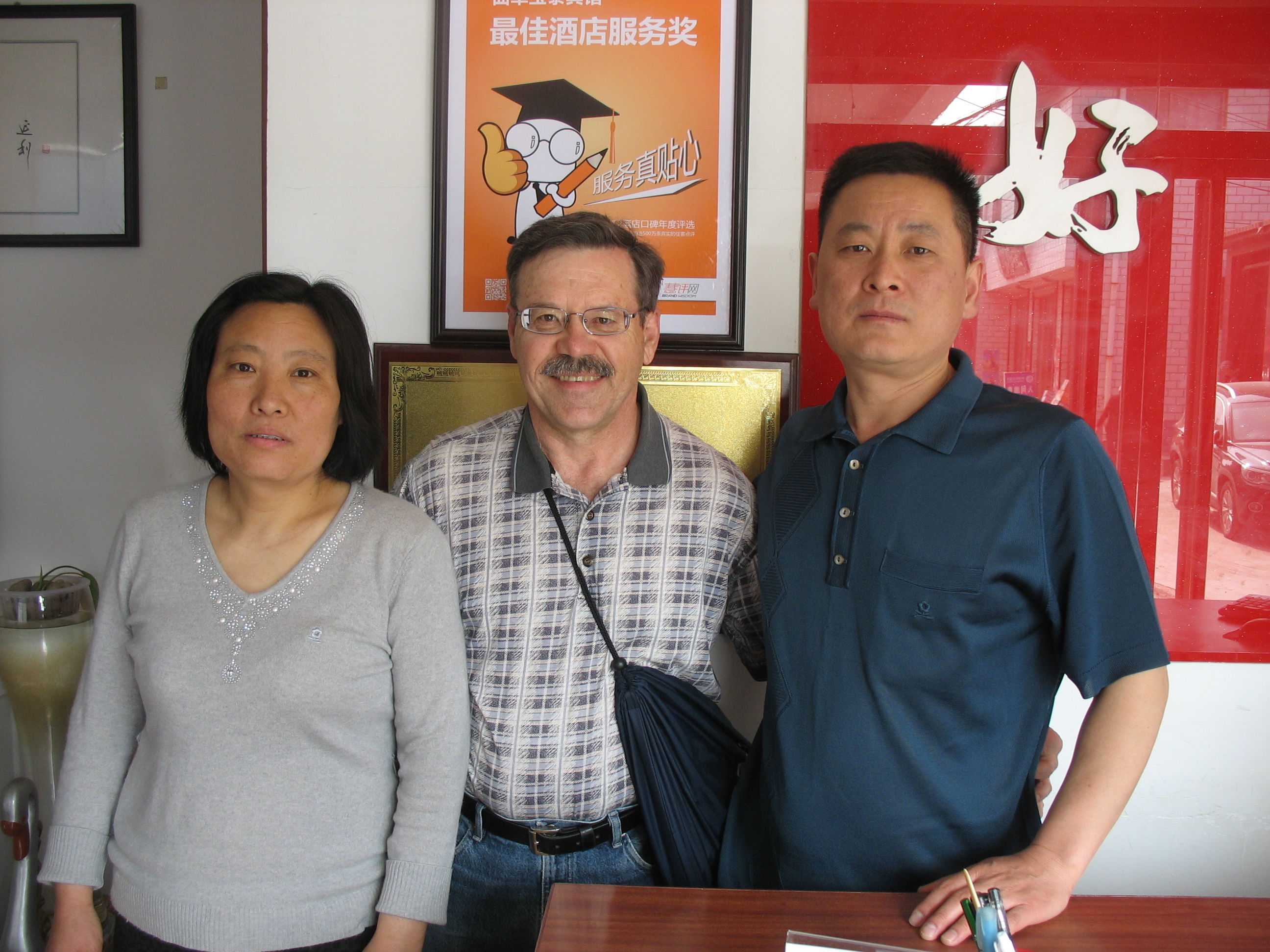
The next day Aku appeared out of nowhere to act as our guide to the Confucius Temple and Mansions but I mustn’t forget to also give credit to one more Qufu "angel", our host at the tiny Bao Tai Hotel. Our room was basic; the mattress was thin, the towels tiny and at $13 a night, we couldn’t complain about the room not being made up each day. What made our stay heavenly was our host. He didn’t speak a word of English but when we arrived, he asked us through gestures if we were hungry and when we said yes, he walked us around the corner to a little restaurant. While we ordered, he headed off on his bicycle to find a map of Qufu and brought it back to the restaurant for us. Later, he was able to communicate through the translator on his computer, that we were the first Canadian guests to ever stay in his establishment and he treated us like royalty. When we came downstairs to check out yesterday morning, he insisted on driving us to the bus station himself instead of allowing us to take a taxi! Though he isn’t smiling in the photo, I think that’s the only time I saw him without one. Yes, that’s definitely the face of an "angel"!