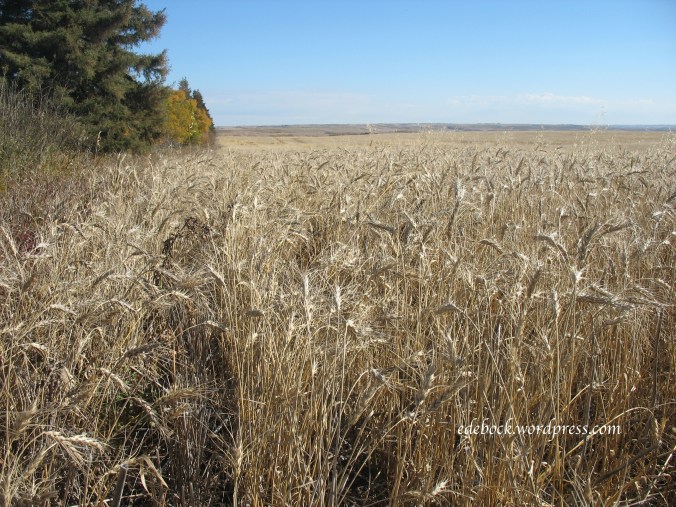
I hate to be one to whine about the weather, but when you live in farming country and a prolonged wet spell like we’ve been experiencing lately occurs in the middle of harvest, it adversely affects the mood of the entire community. Early snow blanketed much of the province last week bringing harvest to a halt. Extended exposure to heavy, wet snow or rain will adversely affect the quality of the grain. We desperately need warm, windy weather to dry the crops and the muddy ground so that the heavy harvest equipment can get back into the fields. Livelihoods depend on it. We need what has long been known in this part of the world as Indian summer!
The question I’ve heard asked several times lately is “Can we even use that term anymore?” Is it politically correct to use the title Indian summer? After all, it’s no longer acceptable to refer to the aboriginal people of North America as Indians. In the US, they are Native Americans and in Canada, First Nations.
Clearly, there are terms, such as Indian giver for a person who gives something away and then takes it back, or Indian time which implies that aboriginal people are always late, that are culturally offensive, but what about Indian summer? Is it derogatory to call that beautiful period of warm, dry weather that often occurs in late autumn Indian summer? And if not Indian summer, what should we call it?
The origin of the term is somewhat hazy. Its first recorded use appears to have been in Letters From an American Farmer, a 1778 work by French-American soldier turned farmer, J.H. St. John de Crèvecoeur. There are many references to the term in American literature in the following hundred years or so. There have been many guesses made as to why the phenomenon was referred to as Indian summer, but no one knows for sure. There is, however, no evidence to show that it was ever intended or used in a negative or insulting manner. There are those who claim that because the term refers to a short period of summer-like weather that comes after that season appears to have ended, it like Indian time, implies that native people are always late. I would argue that that appears to be a recent interpretation, probably dreamt up by those who want to prove that the phrase is politically incorrect.
I recognize that many injustices have been committed against our indigenous people. I am as horrified as anyone else by the unspeakable horrors that today’s elders endured growing up during the residential school era. I am not, however, a slave to political correctness. Changing words doesn’t right old wrongs or heal old wounds. Yes, we need to be sensitive and aware of those occasions when what we say is truly hurtful. There are words and phrases that we should no longer use, but Indian summer? Personally, I think that anyone who claims to find that one offensive is simply looking for something to be contentious about.
So, politically correct or not, I’m going to say it. We need Indian summer!





 Following Augustine