A life transformed

Back in August when I wrote this post about several 50 year milestones in my life in 2025, I mentioned that In October it would be 50 years since I made the life-changing decision to follow Christ. A couple of readers mentioned that they would be interested in hearing more about how I reached that decision. I had already been thinking about sharing that story on the blog, so I decided I would do it today, the 50th anniversary of the day that my life was transformed.

As far back as I can remember, my family went to church every Sunday morning. I attended Sunday School and youth group and for several years, church camp was the highlight of my summers. In my early teens, I attended confirmation classes to learn more about the church and the Christian faith. The purpose of these classes was to prepare us for church membership, but when the classes ended and the minister asked me if I was ready to join the church, I said no. I felt that something was missing, but I didn’t know what it was. I knew that Jesus loved me and that He had died for me, but I felt that there must be more to it than that. When I discovered that all the other students in the class were going to join, however, I didn’t want to be the only one who was left out, so I changed my mind. After all, I was a good kid, a quiet kid who didn’t like to stand out from the crowd.

The summer before my final year of high school, my father took a job in the Northwest Territories and we moved from Vancouver to Yellowknife; from the third largest city in Canada to a small, isolated  community in the middle of nowhere. I had to leave my home, my friends, my school, my church, and everything else that mattered to a teenage girl. I wouldn’t get to graduate with my class. I was angry and I made a very conscious decision to rebel. I decided that I was going to find out how the other half lived. I quit going to church and started drinking and partying. I abandoned the morals that I had been taught and less than two years after leaving Vancouver, I entered into a teenage marriage that never should have happened.

We had only been married for a year and a half when my husband, a very charismatic narcissist, told me that he had fallen in love with someone else. He didn’t want our marriage to end though. Instead, he wanted to invite her to move in with us! I absolutely refused to allow that to happen and tried for another year to make our relationship work, but midway through my third year of university, it was over and we went our separate ways. I was broken. My dreams were shattered and I felt like unwanted, unloved garbage. That led to more unhealthy relationships.

In spite of all that was going on in my personal life, I managed to graduate from university with my teaching degree and I accepted a job in the very small town where we still live today. I realized that as a teacher in such a small community, my life would be on display for everyone to see. It was the mid 1970s and I was sure that if I continued to live the way I had been, parents wouldn’t want me teaching their kids.

Once again, I made a conscious decision to turn my life around. I thought I could do it on my own, but God had a much better plan. Richard was also a new teacher at the school that year. One evening early in the fall, he shared with me what it meant to be a Christian in a way that I had never heard before. He told me that if I acknowledged my sins, asked for God’s forgiveness, and surrendered my life to Christ, I could have a personal relationship with Him and my life would be transformed. I quickly realized that this was the missing piece that I hadn’t heard about growing up. I didn’t know that I had to make an actual decision to follow Christ or that I could have a personal relationship with Him.

At the same time, I also realized that making that decision would mean giving up control of my own life. Considering what a mess I’d been making of it up to that point, you would think that this would be an easy or obvious decision, but I wrestled with it. Eventually though, I couldn’t deny that God was calling me and I finally surrendered my stubborn will to His. When that happened my life changed completely. There were no flashes of lightning or tongues of fire, just an incredible peace that I had not known before. I felt like a brand new person, free of any guilt or shame over my past. I no longer had any desire to live the way I had been.

I quickly learned that God didn’t want to be a distant deity who cared about me, but who wasn’t personally involved in my life. Like a Japanese kintsugi artist, He began to fill the broken places in my life with gold and turn me into a vessel that He could use for His good purposes.

I wish that I could tell you that life was always easy after that, but of course, it wasn’t. In John 16:33, Jesus tells us, “In this world, you will have trouble. But take heart! I have overcome the world.” Over the past 50 years, I have suffered great loss and betrayal. I have spent the last 12 of those years fighting cancer, but I have never been alone in any of these dark times. One of my favourite Bible verses is Isaiah 41:10 which says, “Do not fear, for I am with you; do not be dismayed, for I am your God. I will strengthen you and help you; I will uphold you with my righteous right hand.” I can testify to the truth of that!

Whatever you take away from this post, please note that this is not about church or even about religion, it’s about an intimate, personal relationship with the Creator of the universe; a relationship that is available to everyone regardless of who you are and what you’ve done. If you have any questions or would like to chat about this, please feel free to comment below or send me an email at debock2@gmail.com.

Image: ChatGPT

Where was God?

Sitting down to write a blog post seems almost frivolous in light of the horrific events that have unfolded in Texas and New Mexico over the past week and a bit. We’ve seen whole buildings washed downstream like bits of flotsam. We can’t look at the news or scroll through social media (something I admit to doing way too much of) without seeing the faces of adults and children who were swept away by a raging torrent. We read agonizing reports from those who sift through the debris searching first for survivors and now for bodies to bring some sense of closure to grieving families.

How can I, who loved going to summer camp year after year when I was growing up, wrap my head around Camp Mystic? As an adult, I’ve slept in dusty old camp cabins with groups of little girls under my care. Some of those same cabins were later swept away by a flood, but thankfully no one was in them at the time. As a parent, I’ve packed up my own children and sent them off to camp trusting that they’d come home with happy stories of their time away.

I can easily imagine the whispers and giggles of little girls settling into their bunks for the night, but then came the nightmare; the rushing waters that weren’t just a bad dream. How can we even begin to process that?

Where was God in this? Couldn’t He have stopped the flood? Couldn’t He have saved every one of those lives? Why did He let this happen? Those are hard questions. Questions that might shake a person’s faith. Questions that don’t have easy answers.

I’m not here to give pat answers, to try to explain the unexplainable. I will simply tell you what I know and that is that God is still present and He is still good. This tragedy is not a sign of His anger or His judgement. He was there in the chaos and He is there for those who were left behind to grieve. Yes, He could have stopped it from happening, but for reasons that are far beyond my understanding, He chose not to.

This is not a time for speculation as to causes or for blame. It is a time for grieving, for lament, for prayer, and for reflection. It is also a time when we are reminded of the brevity and the fragility of life. Perhaps it should be a time for reevaluation. A time to ask, what am I doing with the time I’ve been given? Will my life make a difference? Am I ready for eternity?

The most important things

I had a different idea in mind for this week’s post, but then I read something that caused me to pause and think about the important things in life. The truly important things.

If I were to ask many people what’s most important in life, their answers would probably include things like family, good health, happiness, financial or job security, and a safe place to live. Depending on their circumstances, they might even say enough to eat or clean drinking water. These are, after all, very important. In fact, it was some of these things that first came to mind when I started asking myself what’s most important in life, but then I thought of something else.

When Jesus was asked which commandment was most important, He replied, “‘Love the Lord your God with all your heart and with all your soul and with all your mind.’ This is the first and greatest commandment. And the second is like it: ‘Love your neighbour as yourself.'” 

My faith, my personal relationship with God, is the most important thing in my life because it’s the only thing of eternal value, but it was actually Christ’s second statement that I was thinking about when I sat down to write this post. “Love your neighbour as yourself.” The Bible actually has a lot to say about how we treat one another. In fact, the “golden rule” that we were taught as children actually comes directly out of Scripture. Luke 6:31 says, “Do to others as you would have them do to you.”

So why have I been thinking about the importance of how we treat one another? In Canada and the US, at least, and perhaps other parts of the world as well, we have become very polarized people. We are sharply divided along political lines. No sooner had Canadians drawn together in response to threats from our southern neighbour than our own federal election tore us apart again. As I feared would happen, we went from “elbows up” unity to attacking one another for our political views. Nowhere was worse than on social media where people tend to say things they wouldn’t say in person.

Politics is important, but is it the most important thing? Is it worth losing friendships over? Surely each of us is entitled to have our own opinion and to express it without condemnation. Can’t we disagree, but still treat one another with respect or must we vilify those who don’t see eye to eye with us?  After all, while we might not agree on which party is the right one to govern or which leader is the most competent, we all want the same things. We all want what’s best for our country, our families, and ourselves.

Perhaps the most important things in life aren’t things at all. Perhaps our character, who we are and how we treat others, is much more important.

Resurrection Sunday!

If you are one who usually reads my blog on Fridays, you will have noticed that there wasn’t a new post this week. We spent Good Friday with family and it was indeed a good day. In the morning, we attended a solemn service commemorating the final 24 hours leading up to our Lord’s crucifixion. I don’t think there’s any better way to explain the significance of Good Friday than by sharing the B.C. comic. It says it all. Jesus took my place. He took your place. And He did it willingly. Thankfully though, that wasn’t the end of the story.
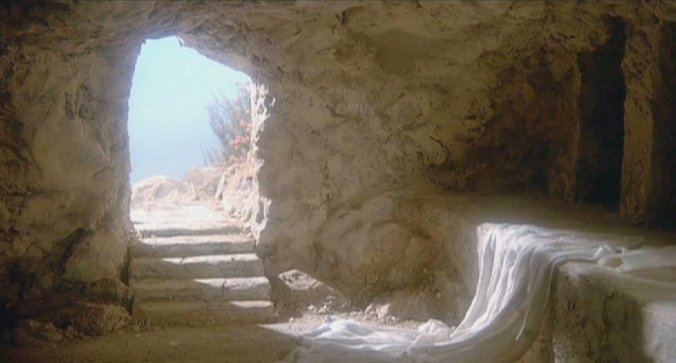

Today is Easter, the day that we celebrate the fact (yes, it is a fact) that the broken, battered body that was laid in a borrowed tomb overcame death and rose again! A more fitting name for the day would actually be Resurrection Sunday.

It is thought that the word, Easter, which doesn’t appear in the Bible, was probably derived from the name of Eostre, a pre-Christian goddess in England who was celebrated at beginning of spring. Given the symbolism of new life and rebirth, it seems fitting to celebrate the resurrection of Jesus at this time of year, but the real reason that this time of year was chosen is the close proximity to the Jewish Passover. It was during the Passover festival that Jesus was executed.

Regardless of what we call it though, Easter is the most important day on the Christian calendar. It is the day that we celebrate victory over sin and death.

“Jesus said to her, “I am the resurrection and the life. The one who believes in me will live, even though they die.”  John 11:25

If you haven’t accepted Jesus as your Lord and Saviour, this verse might seem like nonsense to you. How can we live if we die? Look back at the comic. Death is the punishment for our sins, our wrongdoings. The Bible tells us that there is no one without sin, not even one, except for Jesus Christ, and He chose to take our punishment. Yes, our bodies will eventually die, but the essence of who we are is not this physical body. It is the spirit that lives within. On Resurrection Sunday, we celebrate the fact that if we accept His payment for our sin, the spirit that is the real me, the real you, will spend eternity with Him. We will not die!

This is not religion. It’s not a set of rules and regulations. It’s a relationship; a relationship with the one who made us and who willingly died for us.

How do I know that this is true? I know because almost fifty years ago He changed my life completely. He took a messed-up life that would surely have ended in despair and transformed it into one that experiences deep inner peace and joy even in the most trying of times. I know because He speaks to me. Like a child with a parent, I don’t always like what He says, but I’ve learned that He always wants what is best for me. I know because He is always with me. I am never alone.

If you don’t know this kind of peace, why not make this Resurrection Sunday the day you decide to accept His free gift of life? It’s as simple as ABC. Admit that you are a sinner (we all are!) Believe that Jesus willingly took your place, died for your sins, and rose again in victory over sin and death. Confess Him as Lord of your life and choose to live in obedience to Him. If you choose to do that today, please let me know, or if you have any questions, feel free to email me at elainedebock@gmail.com.

The tomb is empty. Happy Easter!

One word for 2025

Happy New Year!

For each of the past eight years I’ve chosen one word to inspire or guide me in the new year as well as a scripture verse to go along with it, but this year will be different. Instead of choosing a new word for 2025, I’m going to keep my one word for 2024 for another year.

Hope!

Hope has been such a significant and meaningful word for me for the past year that I’m not ready to let it go and focus on another.

The New Oxford American Dictionary defines hope as “a feeling of expectation and desire for a certain thing to happen”. That meaning is definitely part of the reason that I originally chose it as my one word. There are many things that I hope for in 2025. I hope that my family is healthy and happy. I hope that my own health remains stable and that hubby and I can make the trips that we are planning. I hope that the renos on our house that will begin in a couple of weeks turn out well. Yes, I hope for many things, but there is a hope that is so much greater than any of these.

The Biblical word hope is much more than just wishful thinking. From the Hebrew word tikvah, it’s an expectation, a certainty, a strong expression of faith. It’s confidence that God is who He says He is and can do what He says He will do. That’s the hope that I hold fast to; a hope that doesn’t depend on my circumstances.

Last year, I had a difficult time choosing a Bible verse to go along with my one word because there were so many possibilities. I finally settled on two of them. Romans 5:13 says May the God of hope fill you with all joy and peace as you trust in him, so that you may overflow with hope by the power of the Holy Spirit.” and the first part of Hebrews 6:19 reads “We have this hope as an anchor for the soul, firm and secure.”  This year, even though I’m keeping my one word for another year, I decided to choose a different verse to go with it. Again, I pondered several possibilities and finally chose Romans 12:12. 

romans-12-12-bible-verse

What do you hope for in 2025?

Have you chosen a word for the new year? 

When the church disappoints

building-simple-flat-black-white-icon-logo-vector-castle-church_653669-14312

This topic has been weighing heavily on my heart for the past couple of days. I don’t know whether I’ll be able to do it justice or not, but since writing is the best way I know to process heavy things and I need to get this off my chest, I’ll give it my best.

I know I’m not the only one feeling completely disheartened by the results of this week’s election in the US. There is no question that we are living in difficult times. What disturbs me most and what has prompted me to write this post is the fact that the election was won with the support of so many so-called evangelical Christians.

There was a time when I might have used that term to describe myself, but I no longer do. Don’t get me wrong. I’m not abandoning my faith. I’m still a Christian although the term that I prefer is Christ-follower. I will not, however, call myself an evangelical Christian. There is no way that I can possibly identify with the overwhelming number of evangelicals who bow down in adoration to a convicted felon, a racist, a misogynist, a liar. How is it that they can possibly believe that God is pleased with their choice? How can they have been so deceived?

Scripture tells us that, as Christians, we are to be “the pleasing aroma of Christ” (2 Corinthians 2:15-16), but frankly, something smells really bad right now!

The Christian church has a long history of going wrong. From the slaughter of Jews and the destruction of their communities during the Crusades to the devastating effect of church-run residential schools on our Indigenous population in the past century, the church has missed the mark in big ways and small.

There’s a common saying amongst believers that the reason there are no perfect churches is that there are no perfect people. That’s true, of course. The church is a collection of sinners, of failures, of flawed human beings, but I think that sometimes we like to use that truth to excuse the inexcusable.

I know that I’m painting the church with a broad brush here. Certainly there are individual congregations or individuals within congregations that are as disappointed as I am with the outcome of the recent election. So how do we respond? What do we do when the church disappoints?

Do we bail out? Do we turn our backs on the church and walk away? Hebrews 10:24-25 advises us to “consider how we may spur one another on toward love and good deeds, not giving up meeting together, as some are in the habit of doing, but encouraging one another“. If there’s ever a time when we need encouragement, it’s now!  So no, I don’t advise abandoning the church altogether. We’re living in a post Christian era. Clearly the recent election outcome is just one more sign that society is moving farther and farther away from the teachings of Jesus. Whether it’s in a formal church setting or some other kind of gathering, we need one another.

Personally, I will pray and I will continue to nurture my own relationship with Christ, the all-sufficient one. After all, the church is not the saviour of the world and whether or not he would agree, the president-elect isn’t either. That is solely Jesus’ role.

Colossians 3:15 tells us to “let the peace of Christ rule in your hearts, since as members of one body you were called to peace. And be thankful.” (italics are mine) We can fight our disappointment with gratitude remembering that even in the midst of a world that seems so wrong, we have much to be thankful for.

And finally, let’s not give in to fear. One of my favourite verses, Isaiah 41:10, says, “So do not fear, for I am with you; do not be dismayed, for I am your God. I will strengthen you and help you; I will uphold you with my righteous right hand.”

As the Jim Bailey song says, “I don’t know what the future holds, but I know who holds the future”. In days that seem dark, that gives me a glimmer of hope.

Cancer metaphors and an update

Patients, caregivers, fundraisers, and even medical professionals use a variety of different metaphors to describe life with cancer.

From day one, I’ve referred to my cancer experience as a journey. As a seasoned traveller, when I was diagnosed I felt as if I was embarking on a trip into the unknown. It’s been a long and tumultuous trip, but the metaphor is one that still works for me. Some patients, however, are bothered by it believing that a journey should always be fun and something that you have control over.

An even more controversial metaphor is the one that refers to life with cancer as a battle. Although it’s very common, many people take exception to using the vocabulary of violence at a time when patients are at their most vulnerable. Within the language of winning and losing, there’s also the uncomfortable implication that those who’ve died of cancer are losers and that maybe if we just fight hard enough we can win. While I realize that there are limitations to any metaphor, I think that the battle metaphor can be empowering. I am in a fight for my life and cancer is the enemy.

Thankfully, no one fights cancer alone and that’s also where the battle metaphor works well. My closest ally is my husband who accompanies me to every appointment and is involved in every decision regarding my care. An army of skilled medical professionals with a vast array of formidable weaponry (chemical, biological, and nuclear) at their disposal direct my care and they are backed up by a battalion of prayer warriors around the world. Ultimately, the commander in chief, the only one who knows the final outcome, is the Lord Himself. As we sang in church yesterday,

So when I fight, I’ll fight on my kneesWith my hands lifted highOh God, the battle belongs to YouAnd every fear I lay at Your feetI’ll sing through the nightOh God, the battle belongs to You

360_f_141399140_3bi2tlzvts4ek3a81nu6askenc8pjsnd

While my life with cancer is both a journey and a battle, at times it’s also a roller coaster and that brings me to the latest news that I want to share with you. After several years of stability, things began to change about 18 months ago. The first sign that my cancer was becoming active again were some changes in lab results. Two markers that are of particular significance for neuroendocrine cancer (NETS) patients had been gradually climbing and were now flagged as being higher than the normal range. Suddenly, the roller coaster went over the top and I felt like I was falling! More frequent surveillance eventually showed significant growth to the largest tumour on my liver. That led to the Therasphere treatment that I had in March of this year. The roller coaster dropped again when a post treatment CT scan showed what appeared to be a new growth in my lower abdomen raising concerns that my cancer was spreading. In mid April I met with a new oncologist. After reviewing my case, he requested a Gallium scan (the most detailed scan for NETS) and another CT scan. Last week, I met with him again to discuss the results and the news was fantastic! First of all, the Therasphere treatment was successful in destroying the large tumour on my liver. Equally exciting was the news that what had looked like a new tumour in my abdomen was nothing more than a harmless diverticulum, a bulge in the lining of my colon! There are other tiny growths that we will need to continue to keep an eye on with regular surveillance, but those don’t appear to have changed significantly. Since my cancer is incurable, this news is about as good as it gets and I’m hoping for a smooth ride for some time to come!

So, what metaphors should you use when talking to or about a cancer patient? It is, of course, valid for a person to speak about their own illness in any way they choose and their loved ones ought to adopt the same language as a way of reflecting those experiences. Simply take your cues from the patient and you won’t go wrong.

Lyrics: Battle Belongs, Phil Wickham

What not to say to someone with cancer

freepik dot com

Image: freepik.com

While most people mean well, knowing what to say to a cancer patient can be challenging and as a result, many people say things that are are far from helpful. As you know, I have chosen to be very transparent about my experience and how I’m doing. For the most part, people have been supportive and I appreciate that greatly, but I’ve also been taken aback by some of the things that have been said. So, from the perspective of someone who has been dealing with the disease for over a decade, here are 12 things not to say to someone with cancer. 

I know how you feel. 

No you don’t! Even if you have or have had cancer yourself, everyone experiences the journey uniquely. As similar as your story might be, how you felt might be completely different from how the person you’re speaking with feels. 

My aunt / grandmother / next door neighbour’s cousin had cancer and they… 

There are more than 200 different kinds of cancer and even two people with the same kind may experience it and its treatment entirely differently. 

My friend / family member died of cancer. 

It is never a good idea to remind someone who is battling cancer that people die of the disease. We already know that! We all know someone who died of cancer. We don’t need to be reminded of our mortality. 

Do they know what caused it?

Saying this seems to imply that the person might have an underlying genetic flaw or worse, that unhealthy lifestyle choices might have led to their diagnosis. Many of us have no known risk factors or family history that would explain our cancers and introducing feelings of doubt or guilt are not helpful! 

You should try [insert an alternative therapy here]. 

This is one of my pet peeves! It is never okay to suggest that a patient might not be getting the best care possible or that you, an armchair expert, know better than the professionals in the field of cancer care. The rule of thumb here should be, don’t give any advice unless you’re asked for it. 

You should eat more / stop eating …

This is another one that really irks me. I’ve been given so much, and sometimes even conflicting, dietary advice by well-meaning people that I could probably write an entire blog post about it, but I won’t. Good nutrition is important during cancer treatment, but there is absolutely no scientific evidence that certain foods or specific diets can cure cancer. 

Big pharma is blocking or withholding new cancer treatments.

This is one of many common myths or misconceptions about cancer treatment that should be stopped in its tracks. Unfortunately, scientific studies and clinical trials to determine the safety and effectiveness of new cancer treatments take time. That may create the appearance or lead to reports that effective new treatments are being blocked, but that simply isn’t the case. No one is hiding the cure to cancer or withholding help from those who need it. 

A positive attitude is all you need to beat cancer.

There is absolutely no scientific proof that a positive attitude gives you an advantage in cancer treatment or improves your chance of survival. It does, however, improve your quality of life during cancer treatment and beyond. I can definitely attest to that, but it’s also a reality that no one can stay positive all the time. Everyone will have down days.  

You don’t look sick. It must not be that bad.  or  You don’t look like you have cancer.  

Outward appearance isn’t always indicative of how serious a person’s cancer is. I may look good on the outside, but you can’t see the mess that my insides are in! 

You’re so brave.

No, I’m not! Courage is choosing to willingly confront agony, pain, danger, uncertainty, or intimidation. Those of us with cancer didn’t have any choice in this. We are simply dealing with what was dealt us and trying to make the best of a bad situation. 

God won’t give you more than you can handle.

Oh, yes he will! Nowhere in scripture does it say that God won’t give us more than we can handle. In fact, it says that there will always be suffering, trials, temptations, pain, and situations that we won’t be able to handle on our own. It also promises that He will be with us through those times. We aren’t meant to handle them on our own; we’re meant to depend on Him. 

Let me know if there’s anything I can do. 

While this sounds great, it’s too vague. Instead, offer something more specific. Ask if they need a ride to appointments or if some freezer meals would be helpful after a treatment or surgery. If they have children, offer to provide childcare while they receive medical care or just take a much needed break. When you make a specific offer, the person can say yes or no, and they are also more likely to ask for help when they actually need it. 

Several of these tips would also apply to other serious illnesses as well as to loss. Sometimes it’s better not to say anything at all than it is to say the wrong thing. In fact, your presence is often what’s needed most. Simply be there; be willing to listen if the person wants to talk, but understand if they don’t. Even those of us who are very open about what we’re going through want to be seen as more than just a person with cancer, so talk to us about the same things you’d talk to anyone else about. 

Clothe me in peace, hope, and inner strength

This will not be a fashion post in the traditional sense. I won’t be showing you an outfit today or giving any style advice. I’ve held off on writing an update about my health since undergoing the TheraSphere treatment on my liver on March 11 because I needed time to wrestle with what’s been happening. Time to figure out how to “wear” the latest news.

The treatment itself went very well. I was in and out of the hospital in approximately eight hours and walked away feeling pretty good. A CT scan following the treatment showed that the vast majority of the radioactive microspheres that were injected during the treatment had been deposited on target at the site of the largest tumour on my liver while a minimal amount had reached a second smaller tumour and surrounding tissue. This was exactly what was hoped for. 

Had that been all that the scan showed, I would have weathered the post treatment fatigue and mild nausea with ease, but unfortunately, it also showed a nodule elsewhere in my abdomen that has grown significantly since a previous scan five months ago. That raises concerns that the cancer has spread. Knowing the importance of being proactive and advocating for myself, I contacted my specialist’s office as soon as I read the scan report and was able to have a phone consult with her earlier this week. She is going to refer my case to the medical oncology team asking them to review my file and make recommendations. 

So how do I deal with all of this? 

I feel a bit like I did at the beginning of this journey over 10 years ago. Once again, I’m facing a huge unknown. At that time, I prayed for strength to walk this pathway with grace and I continue to ask for that. In my morning prayer time this week, I’ve been meditating on a snippet of scripture from 2 Peter 2:19. “… a man is slave to whatever has mastered him.” Whatever happens, I do not want to become a slave to fear! 

428687383_10168379011675307_73446089108254976_n

You may remember that my one word for 2024 is hope. This beautiful graphic, which I found on Rare Disease Day, perfectly combines my word with the zebra ribbon representing rare diseases and more specifically, neuroendocrine cancer (NETS) which, though no longer considered rare, is definitely not well-known. Though the pathway may become rough, I am not giving up hope!  

Clothe me in peace, hope, and inner strength.

Let that be my style! 

A World Cancer Day update

World-Cancer-Day-2024-1-1

When I posted a World Cancer Day graphic on Facebook this morning and mentioned that I’m currently waiting for a treatment to destroy a tumour on my liver, the outpouring of support from people near and far was immediate and heartwarming. I was also asked recently whether this was related to my original cancer or something new. In response, I decided that today would be a good day to share an update on what’s been happening in my ongoing battle with cancer.

For those of you who may be new to the blog, I was diagnosed with neuroendocrine cancer (NETS) in 2013. The primary tumour was in my cecum (a pouch at the beginning of the large intestine that the appendix is connected to) and, as is very common with NETS, it had already spread to lymph nodes and my liver. A series of radioactive treatments (PRRT) resulted in some shrinkage and stability that lasted until about 17 months ago when we started to notice gradual changes in my regular lab results and scans. As neuroendocrine cancer is usually a slow-growing disease, we took a cautious approach. We started monitoring more often and eventually changed the medication that I receive by injection every 28 days. Unfortunately, that didn’t have the desired result.

The last time I wrote an update on the blog was back on November 10, NET Cancer Day. At that time, it was clear that the tumours that had been basically dormant for several years, or at least the largest one which is on my liver, were growing and producing an excess of hormones again. I was waiting for the tumour board at the Cross Cancer Institute to discuss my case and make their recommendations.

Shortly after that, I was referred to the Interventional Radiology department at the University Hospital and my NET specialist told me that I would undergo a radiofrequency ablation, a fairly non-invasive procedure that would destroy the cancer cells without damaging much of the surrounding tissue. I was all for that. Let’s zap that tumour, I thought! As it turns out, however, at 5 cm (2 inches) my tumour is too large for that procedure to be successful. Instead, I’ll be undergoing a transarterial radioembolization, also known as a TheraSphere treatment. (I love words, but as a cancer patient, I’ve learned a lot of big ones that I wish I’d never had to hear!)

The treatment is a minimally invasive procedure that deposits millions of glass microspheres, each about one-third the width of a human hair, containing a radioactive isotope (Y-90) inside the blood vessels that supply a tumour. This blocks the blood supply to the cancer cells and delivers a high dose of radiation to the tumour. The treatment will destroy a significant portion of my liver, but thankfully, it has the amazing capacity to regenerate itself after damage.

Three weeks ago, I had a work-up which was basically a trial run. As will happen in the actual treatment, a catheter was inserted through the femoral artery in my groin and guided via x-ray to the hepatic artery supplying my liver. Mapping and measurements of the blood vessels feeding the tumour were done and then a contrast was injected and various images taken to ensure that the Y-90 would stay in my liver and not travel anywhere else in my body. During this entire time, which took several hours, and for four hours afterward, I had to lie on my back without raising my head or moving my right leg. It was a long and somewhat grueling day and after almost eleven hours, I was very happy to walk out of the hospital with no ill effects. I may not be quite as fortunate after the real deal. I’ve been told that common side effects include abdominal discomfort, nausea, and fatigue for a week or two afterward, but it will be worth it if it successfully destroys the tumour!

I was initially told that the treatment would take place two to five weeks after the work-up, but three weeks later, I haven’t been given a treatment date yet. Wheels often move very slowly in the medical world and waiting is something that patients have to get used to. It never seems to get any easier though!

To those of you who suggested in your very kind responses on Facebook this morning that you would be praying for me, I very much appreciate it. While I am enormously thankful to live in a part of the world where I have access to state of the art medical care at no personal expense, and I have a body of amazing doctors taking care of me, I know that God is ultimately my healer and it is He who holds my future. I continue to put my hope in Him!

Screenshot 2024-02-04 at 2.54.31 PM

Image: TheraSphere Patient Info – Boston Scientific