A Christmas shopping suggestion

LogoIt’s December 1st and the Christmas season is upon us! I like to get my Christmas shopping done early before the mad rush begins, but if you’re still trying to figure out what to buy for some of the people on your list, perhaps I can help.

Kiva is an international nonprofit with a mission to alleviate poverty through micro loans. By lending as little as $25, anyone can help a Kiva borrower start or grow a business, attend school, or improve their living conditions. I’ve written several posts about Kiva in the past, but what I haven’t written about is the Kiva Store, a partnership between Kiva and its partner NOVICA, a mission-driven company that works with artisans around the world. By purchasing some of your Christmas gifts at the Kiva online store, where you’ll find unique and high-quality products (jewelry, fashion, and home decor) at very reasonable prices, you can help support the efforts of artisan producers and strengthen the fair trade movement.

Here are just a few of the over 1400 fashion items currently available through the Kiva Store.

The Kiva Store isn’t only for women though. There are many suitable gifts for men as well. Here’s one of my favourites.

If jewelry would suit someone on your Christmas list, the Kiva store has a vast array of necklaces, bracelets, rings, earrings, pins, and even anklets. Personally, I think this sterling silver cuff with amethysts and pearls is exquisite

and I could certainly see myself wearing these earrings! That’s the only problem with doing your Christmas shopping at the Kiva Store. You might end up ordering for yourself too!

Kiva ships to over 100 countries worldwide making it a truly global marketplace for both artisans and customers, but don’t wait too long to order. Christmas is just around the corner and you want your gifts to arrive on time.
Café Finca La Cañada

My Richard is a coffeeholic. Coatepec is known as the coffee capital of Mexico. Visiting a coffee growing operation seemed like a no-brainer.

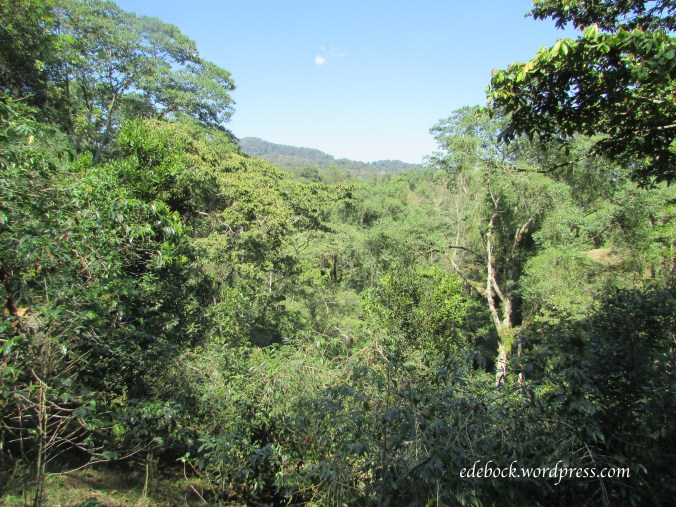
Through another expat friend, Richard M was able to arrange for us to tour Café Finca La Cañada yesterday. Located just outside of Coatepec, up one of the roughest roads we’ve ever traveled, is the beautiful canyon estate owned by retired University of New Hampshire professor, Clifford J. Wirth, where he has now been producing organic, fair trade coffee for several years.

At first glance, the lush valley appears to be wild jungle, but on closer inspection one can see not only coffee trees but macadamia, banana, lemon, orange and tangerine trees growing on the steep hillside.

img_3852

img_3838

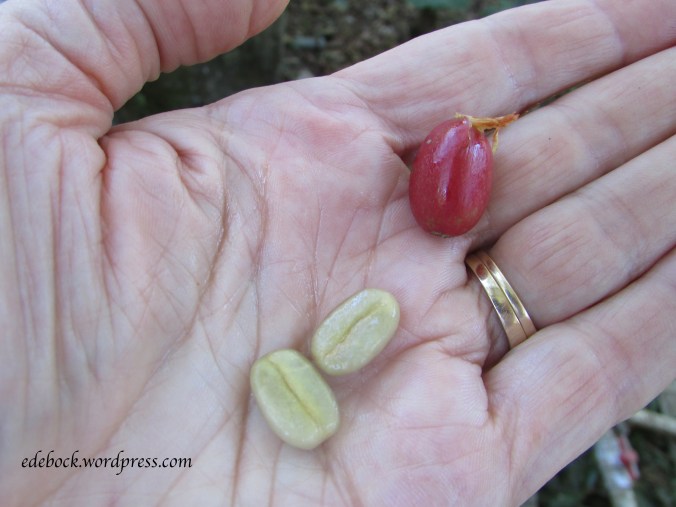
Coffee “cherries” ripening

Cliff started our very enjoyable and informative tour by walking us through the coffee harvesting process. The “cherries” are all hand picked by the Mexican family that works for him and lives on the estate. He explained the two processing methods that can be used, a wet method and a dry method. He uses the wet method. First, the freshly harvested cherries pass through a pulping machine to separate the skin and pulp from the bean.

img_3832

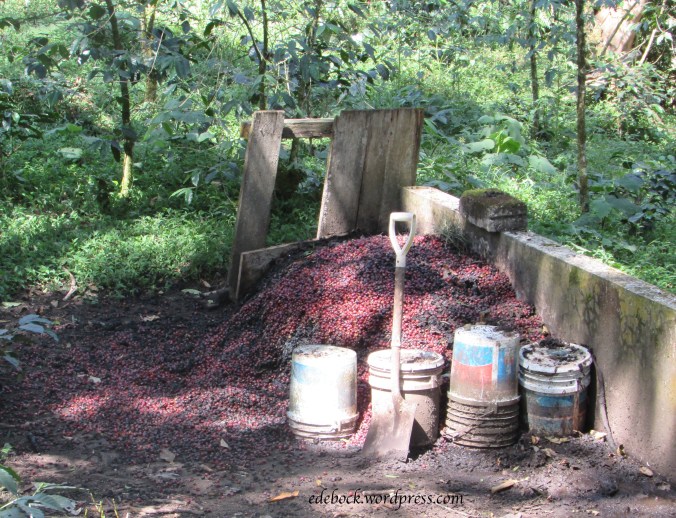
Then the beans are placed in a cement tank of water. The lighter unripe beans float to the top, while the heavier ripe ones sink to the bottom. The husks and unripe beans are  composted.

img_3829

Ripe coffee beans

img_3831

Composting the husks

After separation, the tank is again filled with water and the beans remain there for 3 or 4 days to remove the sweet gluey layer of mucilage that is still attached to the beans. While resting in the tanks, naturally occurring enzymes cause this layer to dissolve. When this process is complete, the beans feel rough to the touch.

img_3840

Drying beans

img_3843

At this point, the beans are placed on outdoor drying racks where they are turned regularly until most of the moisture has been removed. The racks are tented with plastic to protect the drying beans from rain.

Once the beans are ready, they are sent off-site for roasting and packaging. In addition to selling his coffee in a number of local shops, Cliff supplies several hotels and shops in the Cancun area. According to his Facebook page, his coffee is “Cultivated naturally below the tall trees of the Veracruz cloud forest without using agrochemicals, thus protecting the delicate ecosystem of the Suchiapa River, its flora and fauna–particularly the birds that migrate between Mexico, the United States, and Central America. The cultivation and processing methods protect the environment and workers’ welfare.”

Sadly, a fungus called coffee rust, or roya, has swept across Central America in recent years, withering trees and slashing production everywhere. Cliff told us that his trees are slowly dying and the estate now produces only 40% of the coffee that it did before the roya hit. When he took us hiking down into the beautiful canyon, he showed us examples of leaves that have been affected. He is now in the process of planting a new hybrid variety that is resistant to the blight.

I don’t drink coffee anymore because the acid bothers my stomach, but we bought a kilogram to take home and I’ll definitely be tasting it. I’ll just have to be careful to leave most of it for my coffeeholic husband!