One Word for 2021

For the past few years I’ve chosen one word to inspire or guide me in the coming year as well as a scripture verse to go along with it. There’s actually a whole #OneWord365 movement on the internet urging members to choose a word to focus on every day, all year long; a word that sums up who they want to be or how they want to live.

My one word for 2020 was Bold. I wanted the boldness of the early disciples who shared their faith in spite of great opposition. I wanted the courage to confront injustice and stand up for the downtrodden. I wanted to boldly speak up for what I believed in or knew to be true. That led me to my one word for 2021.

Truth

The dictionary defines truth as that which is in accordance with fact or reality.

There seems to be very little of that going around these days! In fact, fake news, propaganda, and false information seem to spread faster than Covid-19! I have an insatiable desire to grow in wisdom, knowledge, and understanding; to know the truth about anything that affects my life. Perhaps it’s simply a reaction to having been the victim of lies and deception in the past, but I abhor falsehood of any kind.   

When I see something online that I’m unsure about or that doesn’t sound right to me, I check the facts and, in accordance with my desire to speak the truth with boldness, I often post my findings in the form of a comment or a link. This hasn’t always been popular. In fact, one acquaintance called me the “resident fact checker” in an online discussion. She clearly didn’t mean it as a compliment, but I fail to see how seeking and speaking the truth could be anything but good! Thankfully, others have expressed appreciation either online or in person and I’ve even been approached a couple of times by people looking for help in checking the validity of something they’ve read or been told. 

We live in a day of relativism; the idea that you can have your truth and I can have mine. That isn’t actually truth at all; that’s belief or opinion. Unfortunately, belief doesn’t create fact. Truth is independent of belief. Being able to discern between fact and opinion, between news and editorial, between truth and belief, is a very important skill.  American politician, sociologist, and diplomat, Daniel Patrick Moynihan, was quoted as saying, “Everyone is entitled to his own opinion, but not his own facts.” 

Accepting that absolute truth exists is an essential foundation of Christianity. God was very clear in the Bible that what He revealed was truth. In John 14:6, Jesus declared, “I am the way and the truth and the life. No one comes to the Father except through me.” That’s either true or it isn’t. It can’t be true for some and not for others. 

There are many other Bible verses about truth, so choosing one to accompany my one word for 2021 was challenging. I finally settled on 2 Timothy 2:15, “Do your best to present yourself to God as one approved, a worker who does not need to be ashamed and who correctly handles the word of truth.”

That’s what I want to focus on in 2021, correctly handling the truth. Not just Biblical truth, but all truth. 

Have you ever chosen a word to inspire or guide you in a new year? What would your word for 2021 be?
truth

So much anger!

We’re living in a very angry world, or so it seems to me. Everywhere we look, whether in person or on social media, people seem to be protesting or venting their anger. First it was the shutdowns, then masks, and now the prospect of a vaccine that isn’t even available yet.

Calgary-COVID-protest-Nov-28-20204

Calgary, November 28, 2020 – Global

What is really behind all this anger? It’s clearly a response to what’s going on in the world around us, but why so much anger? Why are so many people lashing out at one another and at those in positions of authority? I think it’s much more than being asked to wear a little piece of fabric over their mouth and nose or the thought of having to have an injection.

There are many different emotions that might result in anger, but anxiety, sadness, fear, frustration, disappointment, and worry are some of the most common triggers and who amongst us hasn’t experienced some of those feelings in recent months? Add to that the fact that we feel like we’ve lost control of our lives. Things that we’ve always taken for granted, like spending time with family, have been taken away. For many, the things that they’ve trusted in, things that have given them a sense of security, have also been swept away. Some have lost jobs, others have had to close businesses. Some are still working, but feeling isolated at home. In addition to all of this, with the incredible amount of false information and fear mongering being spread by irresponsible “news” sources and keyboard warriors, it should be no surprise that undiscerning people are being sucked into the swirling maelstrom of fear and anger that surrounds us. The virus is everywhere. There isn’t even anywhere we can go to escape!

Unfortunately, anger is one of the most divisive and destructive forces on the planet. It’s a poison that spreads with astonishing speed; faster perhaps than Covid itself. It turns crowds into mobs, inflicts deep wounds, and crushes the human spirit. Plus, it does absolutely nothing to alleviate the crisis that we all find ourselves in.

Anger itself isn’t the problem; it’s what you do with it. First of all, let’s look at what NOT to do.

Don’t be a spreader! Don’t spread the virus, don’t spread misinformation, and don’t spread anger.

Don’t spread the virus. Whether or not you fully agree with the measures that have been recommended or mandated in your area, suck it up and cooperate. Wear the mask, stay 6 feet (2 metres) from other people, and whenever possible, stay home. We’re all in this together. The sooner we really start working together to limit its spread, the sooner we’ll have any hope of reclaiming some of the things that we’ve lost. 

Don’t spread false information. The internet is awash with misinformation, much of it deliberately intended to mislead and to stir up fear and anger. Don’t add to the noise! Check your facts before passing something on. Chances are that your neighbour down the street or your friend from high school doesn’t know as much about epidemiology as the experts do. The lack of respect and support for doctors, scientists, and other health professionals during this pandemic is nothing short of astonishing. There is plenty of evidence to show that masks do make a difference and no, they aren’t harmful to your health. There are very, very few people who have legitimate reasons for not being able to wear one and those people should be staying home because they clearly have other issues that put them at high risk. Yes, the vaccines have been fast tracked, but that doesn’t necessarily mean that they’re dangerous. They’ve been through the same rigorous testing as any other vaccines, but because of the urgency of the present situation, they weren’t allowed to bog down in bureaucratic red tape the way things usually do.  

Don’t spread your anger. Denying that you’re angry or keeping it bottled up inside isn’t healthy, but taking it out on an unsuspecting cashier who’s simply attempting to do her job in trying circumstances doesn’t make the situation better. Neither does waving a protest sign or ranting on social media. 

So what CAN we do with our anger? What SHOULD we do? 

  • Think before you speak, post or repost.
  • Find constructive ways to express your concerns clearly and directly to the right people without trying to hurt or control anyone. This might include asking questions in an attempt to seek out the truth and understand the reasons behind measures that are being recommended or mandated.
  • Take a break. That might mean taking a self-imposed time out from social media or getting outside for some fresh air and exercise.  
  • Practice relaxation. Listen to music, write in a journal, do a few yoga poses or some deep breathing exercises… whatever works for you.
  • Pray. Pray for wisdom, understanding, and grace. Pray for those in positions of authority who are daily faced with making incredibly difficult decisions. 
  • Do something positive for someone else. Instead of writing that Facebook rant, why not write a note of encouragement to someone? Instead of attending a protest rally, look for an opportunity to volunteer in your community. 
  • Know when to seek help. If your anger feels out of control, reach out to a mental health professional. 

I’m as eager as the next person to see this pandemic come to an end, but I’m equally anxious to see us pull together and rise above the overwhelming flood of anger that threatens to crush us all. 

Facebook, not Factbook!

facebook-thumbs-guardian-express

In my opinion, Facebook is a perfect example of a good thing gone very wrong. Facebook was launched on February 4, 2004 by Mark Zukerberg and his three college roommates as a social media platform meant to connect Harvard University students with one another. By the next day, over 1000 students had registered and by the end of that year, membership was open to nearly every university in the US and Canada. In September 2006, Facebook became available to anyone over the age of 13 with an email address and it rapidly ballooned into one of the most significant social media companies in history. By July 2015 half the world’s internet users were using Facebook.

On the surface, a social networking service open to everyone sounds like a wonderful idea, but people being people, it quickly morphed into something much uglier. ‘Everyone’ includes a lot of awful people who like nothing more than using the internet to be awful to as large an audience as possible. Online abuse and hate speech quickly became major issues that Facebook was ill-equipped to deal with. In no time, what was meant as a way for people to share their lives and photos with friends and family became flooded with fake news, propaganda, and false information on any and all subjects. This is particularly concerning considering the mind boggling fact that a study from the Pew Research Centre, also conducted in July 2015, found that 63% of Americans on the site were getting their news from Facebook!

Screen Shot 2020-08-10 at 11.41.42 AM

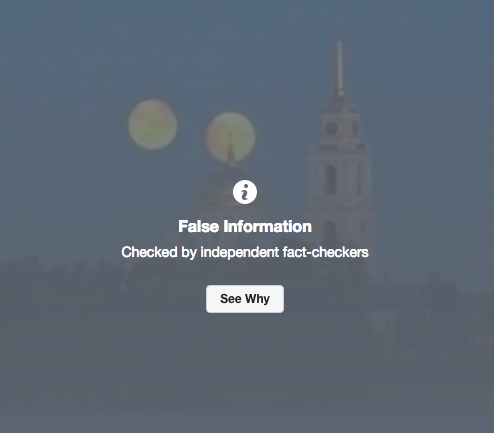
Facebook now works with third-party fact-checkers to try to identify and limit false news and I’m beginning to see more of these notifications, but so far, they’re only managing to catch the tip of the iceberg. It would help a great deal if people would do their own fact checking, but it’s a lot easier to just hit the share button than it is to do the work involved in making sure that something is accurate. The teacher in me always wants to point people toward the truth, but sadly, this sometimes gets me in trouble with those who don’t actually care if what they’re sharing is true as long as it fits their particular bias.

While there are many who are simply naive or gullible and who unintentionally share false information, there are others who are very purposeful about it. They are deliberate, sophisticated in their methods, and very devious. Take this recent post, for example.

117086856_10158958329000016_7096568034737799281_o It looks legit, but it’s not. Notice that it gives sources below the graphs. They’re blurry which makes them difficult to read and they don’t actually link to the sources given, but more grievous is the fact that if a person actually checks those sites, they discover that the numbers on the graphs don’t line up with the figures that they give! Someone has gone to a great deal of effort to create a false graphic that serves their agenda, but doesn’t provide facts.
So, in light of all this, why do I still use Facebook? I use it for the purpose that it was originally created. As frustrating as it can be, it’s still a useful communication tool. The chat feature was absolutely invaluable during the many years that we dealt with the needs and care of my very elderly parents from a distance. It allowed family members scattered across North America to participate in an ongoing discussion about life and death issues and to come to some very important decisions. It also allows me to participate in the day to day lives of my grown children and grandchildren who all live some distance away. I’ve used Facebook to reconnect with some important people from my past and to keep in touch with friends in faraway places like Japan, Mexico, China, and Saipan. As a neuroendocrine cancer patient living in a rural location where I don’t have access to an in-person support group, the Facebook patient groups that I belong to have been excellent sources of information and encouragement. Linking my blog to Facebook also allows it to reach a wider audience than it would otherwise.

So what can we, who still want to use Facebook, but who care about truth, do to ensure that we don’t contribute to the spread of false information? The American Friends Service Committee (AFSC) came up with a simple four step acronym that I think is worth sharing. SCEP: Source, Confirm, Evidence, Pause.

  1. Consider the Source. Is it from an independent news source that is likely to use fact-checkers and editors to verify a writer’s claims or is it from a website with a stated political aim?
  2. Google to Confirm. Is the story being reported by more than one site or author? If you can find it in other credible sources, it has a better chance of being legit.
  3. Assess the Evidence. A solid news story will be supported by strong evidence: verified documents, peer-reviewed research and sound studies, and direct quotes from named, not anonymous, sources.
  4. Pause. Instead of instantly liking or sharing a post that hits home, pause and consider. Is the article likely real? What do I hope will happen if I share it?

Be SCEPtical! It’s Facebook, not Factbook.


Check your facts please!

One of my pet peeves is the amount of false or misleading information that people post or repost on social media. How is it that seemingly intelligent and honest people can be so gullible, so naive, as to believe everything they read? Just because you see something on Facebook, on somebody’s blog, or in an email doesn’t mean that it’s true!

As a teacher, it was part of my job to insist that students learn to check their sources and back up their statements with fact. Perhaps that’s why it bothers me so much when I see people spreading false information like dandelion seeds on the wind. It’s more important than ever to be critical online. The amount of misinformation that is spread on the web is absolutely staggering!

mujer-soplando-una-flor

image

Some of the false information that is spread on the internet consists of ridiculous hoaxes that play on people’s fears, like the ones that are continually circulating warning us that Facebook is about to make everything we’ve ever posted public. Others are more damaging. Here’s a little video that explains this more clearly than I ever could.

In addition to scams and hoaxes, politics and religion are particularly hot topics for false information, but it goes far beyond those topics. I don’t know how many times I’ve seen people repost missing person reports only to discover when I check that the person has already been found safe and sound, sometimes many months or even years before! I can only assume that people repost these things because they simply don’t know how to distinguish fact from fiction or they don’t know how to fact check.

How to spot bogus stories

  1.  The author is anonymous. If it were true, why wouldn’t the author put their name on it?
  2. On a similar note, beware of quotes from famous people. The internet is rife with false quotes attributed to everyone from Albert Einstein to Abraham Lincoln to Adolph Hitler.
  3. The message is riddled with spelling mistakes. This is pretty much a sure sign that it’s false. Why would you trust someone who doesn’t even bother to use spellcheck?
  4. The message itself argues that it isn’t false. “THIS IS NOT A HOAX!’ likely means that it is and “THIS IS A TRUE STORY” is probably a sure sign that it isn’t.
  5. And then there’s the old adage, if something sounds too good to be true, it probably is.
  6. Perhaps above all else, be skeptical!

How to fact check

  1.  Ask the person who has posted the story if it can be verified. If they can’t offer any evidence for the claims that are being made, perhaps they aren’t true.
  2. Check the date and time that the original post was published.
  3. Consider the source. Is it reputable? For example, the internet is rife with wacky health advice. Use the search feature on the Mayo Clinic website to check for accurate information.
  4. If it’s a news item that seems questionable, check to see if other news sources are reporting it.
  5. If a news source is unfamiliar, go to their About tab. It may acknowledge the site’s bias or say that it’s satirical.
  6. Do a Google search. If you don’t find what you’re looking for right away, try other search terms. Whenever I see a missing person report on Facebook, I google the person’s name (eg. John Doe missing) and I can almost always find out immediately whether or not the person has already been located.
  7. Use one of the following fact checking sites. Again, you may have to try different search terms to find what you’re looking for. Be as specific as you can.
    • Snopes.com  Snopes is an excellent go-to for checking out hoaxes, rumours, urban legends, false quotes, etc. The number of topics that they cover is astounding and the site is constantly updated.
    • TruthorFiction.com  TruthorFiction is another excellent site that provides the truth about a wide variety of rumours, inspirational stories, virus warnings, hoaxes, scams, humorous tales, pleas for help, urban legends, prayer requests, and calls to action.
    • Hoax-Slayer.com  Hoax-Slayer is yet another recommended site that is dedicated to debunking email hoaxes, thwarting internet scammers, combating spam, and educating web users about email and internet security issues.
    • FactCheck.org  FactCheck.org is a nonpartisan, nonprofit site that aims to reduce the level of deception and confusion in American politics.

null-4

So how should you respond to someone who reposts false information? Keep it light. The goal isn’t to make anyone feel foolish. Assume that they weren’t intentionally trying to mislead anyone. Perhaps suggest a site where they can get accurate information about the topic or provide a link to the Snopes article that debunks the myth or rumour that they’ve reposted. Most people will respond well to gentle correction. The ones who boggle my mind are those who respond with something like “I know, but I thought it was interesting anyway” when I point out that they’ve posted something false. So far, I’ve managed to bite my tongue, metaphorically speaking, but in cases like that I’m sorely tempted to be less than polite!

And lastly, what do you do if you share something online and subsequently discover that it’s not true? It isn’t easy to put the genie back in the bottle, but by all means, try! Admit your mistake and do your best to correct it.